

Pick unscented candles for meals, small bedrooms, and fragrance-sensitive guests. Pick scented candles for cozy living areas or bathrooms when ventilation is decent and the scent matches the mood.
Both candle types can feel luxurious, but they solve different problems. Unscented candles create atmosphere without competing with food, perfume, or someone’s breathing space. Scented candles add fragrance that can make a room feel warmer, or overwhelm it fast. The best choice usually comes down to airflow, seating distance, and whether anyone in the room reacts to fragrance.
Use this quick comparison table to decide before you light anything.
| Context | Choose Unscented | Choose Scented | Watch-outs |
|---|---|---|---|
| Meals, wine, or food service | Best default | Only after dining, away from the table | Fragrance can compete with taste and aroma |
| Small bedrooms, offices, or closed rooms | Best default | Only if the room can vent and the scent stays light | Scent feels stronger up close and lingers longer |
| Living rooms and bathrooms | Works well when fragrance is not the goal | Good fit when mood is part of the goal | Overly strong throw can take over the room fast |
| Guests with fragrance sensitivity | Best default | Usually avoid | Headaches, nausea, or breathing discomfort can start quickly |
| Unknown preferences or gifts | Safest choice | Only when you know the recipient likes fragrance | What feels cozy to one person can be unusable to another |
Compare Scented vs. Unscented for Dining and Food Environments
Use unscented candles during meals. Use lightly scented candles only after dining, or away from the table in a well-ventilated space.
If you want to choose candles by use case, start with the broader guide to candle types, then match the candle to the moment. Dining usually needs neutrality, while lounging can handle aroma. Even light scents travel, so it helps to understand how scent throw behaves before lighting anything near a table. For tastings and pairings, keep the table scent-free during pours.
Unscented candles are the safer default for meals because fragrance can interfere with how food and drinks taste. Scented candles usually work better after eating, or in a separate room with airflow.
For wine tastings and fine dining, keep tables unscented. Place any candles off to the side, and light scented candles only after tasting ends.
Wine is judged partly through retronasal aroma, which is the smell perceived while tasting as aromas travel from mouth to nose. Added fragrance can blur those cues. Even a clean scent can register like flavor when glasses are close to faces.
Quick rules of thumb
- Best choice during meals: unscented, or no candle if the table is crowded
- Best choice after dinner: a mild scented candle across the room with decent airflow
- Hosts with mixed preferences: unscented at the table, fragrance only in another room
- If you can smell it while eating: it is already competing, so extinguish it or move it
Steps to Choose Scented or Unscented by Room and Occasion
Choose unscented for small rooms, close seating, sleep, and work. Choose scented only when the goal is mood and the space can vent.
Start with the room’s purpose so you can pick candles by room and occasion without guessing. Small rooms and closed doors amplify fragrance, so assume scent will feel stronger up close and linger longer than expected. In tighter layouts, a small-space ventilation plan for candles matters more than the label. Also check the rules. Offices, venues, and shared buildings may restrict fragrance entirely.
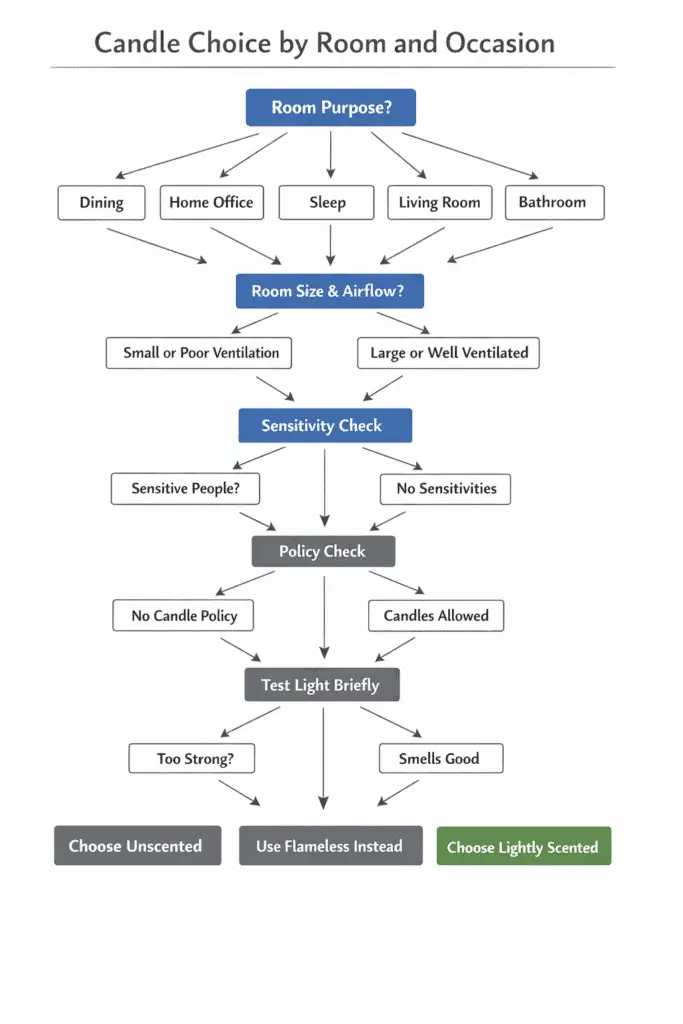
Use this decision sequence
- Start with the room’s purpose. Dining, work, and sleep usually favor unscented. Living rooms and bathrooms can handle gentle scent more easily.
- Check the room size and airflow. Small rooms and poor ventilation intensify fragrance quickly.
- Check the people in the room. If anyone is sensitive, default to unscented and let the atmosphere come from light rather than aroma. For recurring concerns, start with candle options for asthma, allergies, or sensitive pets.
- Check the policy. Offices, venues, and shared buildings may limit or ban fragrance.
- Test lightly. Burn for a short period first. If the candle distracts or overwhelms, extinguish it and switch to unscented.
How to Get a Cleaner Burn: Soot, Smoke, and Ventilation
Trim the wick, avoid drafts, and ventilate the room so the flame stays steady and the air stays clearer.
Start by fixing wick length and placement first. Most smoke and soot complaints come from an unstable flame, poor airflow, or a wick that is too long. Shared spaces add another layer, because policy and comfort expectations may matter more than personal preference.
Three habits solve most smoke and soot problems: keep the wick short, keep the melt pool even, and keep air moving gently rather than creating a direct draft. A candle is more likely to smoke when the flame flickers, the wick mushrooms, or the jar sits near a vent, fan, or open window.
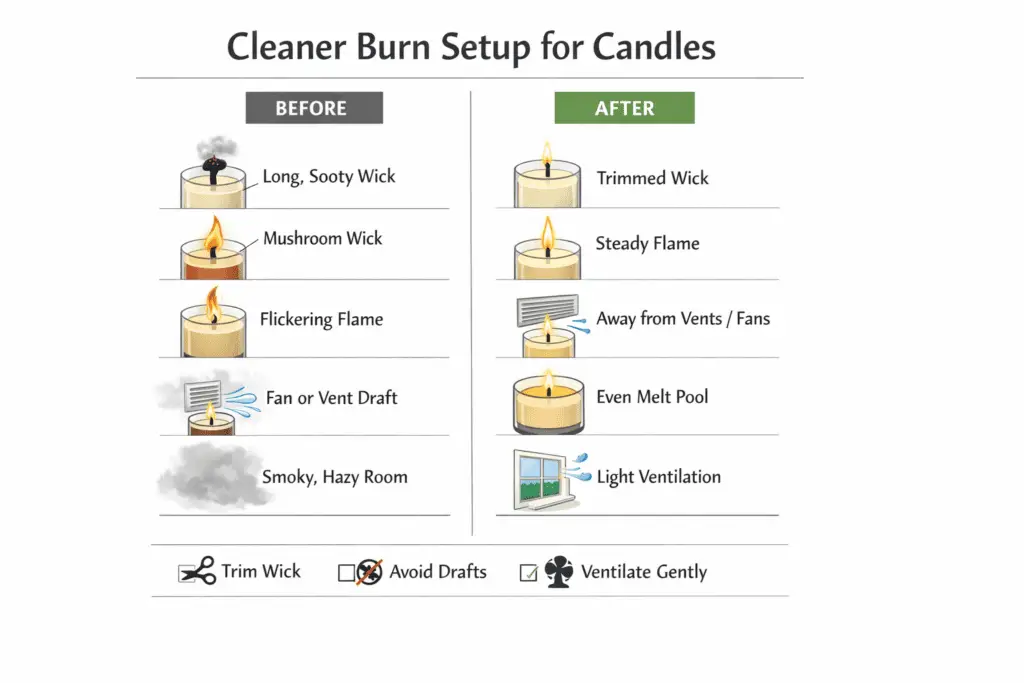
Clean-burn setup checklist
- Trim the wick before lighting, especially if you see a mushroomed tip
- Keep the candle away from vents, open windows, and direct fan paths
- If the room looks hazy, crack a window or run an exhaust fan and shorten the burn session
How Wax Type and Fragrance Load Affect Scent Throw
Scent throw depends on wax, fragrance load, wick heat, container size, and cure time. A candle can feel strong in one setup and weak in another.
To get predictable results, choose by scent-throw needs first. Use subtle scent for small rooms and close seating, and stronger scent only for open-plan spaces with decent airflow. In many shared spaces, whether fragrance is allowed matters more than how well the candle performs.
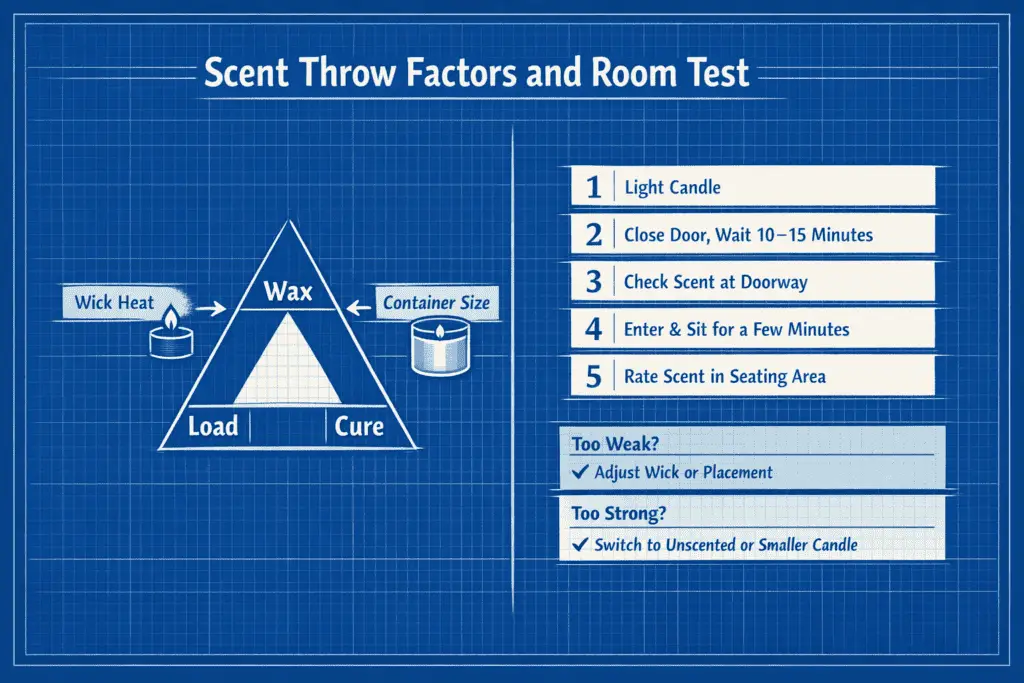
A simple throw triangle explains most scent issues:
- Wax: different wax blends hold and release fragrance differently
- Load: more fragrance can help, but too much can destabilize the burn
- Cure: cure time lets wax and fragrance bind more evenly
That is why the same scented candle can feel pleasant in a large living room and overwhelming in a small bedroom, while unscented removes the throw question entirely.
Quick in-room test protocol
- Close interior doors and return ventilation to normal, with no direct fan on the candle
- Burn until the melt pool reaches the container edges
- Step out for 2 minutes, then re-enter and rate scent strength at the doorway and seating area
- If the doorway is strong but seating is weak, adjust wick or placement
- If both are overwhelming, switch to unscented or a smaller candle
Etiquette and Venue Policies: When Unscented Is Required
When rules or guest preferences are unknown, use unscented and confirm fragrance and open-flame policies in writing before the event.
To avoid problems, ask the coordinator about fragrance, open flame, and container restrictions, then save the approval in your event notes or contract. Even if the venue seems relaxed, check rules for food service areas, exits, décor materials, and rentals so nothing gets removed mid-setup.
Policies exist because scent travels quickly in crowded spaces, and one complaint can turn into a last-minute change. When you cannot control airflow or seating distance, unscented keeps the atmosphere without taking over the room.
Venue compliance checklist
- Confirm whether the venue is fragrance-free, scent-limited, or unrestricted
- Confirm whether open flames are allowed, limited to enclosed holders, or banned entirely
- Confirm placement rules, especially near drapes, florals, aisles, and high-traffic corners
- Assign one person to light, monitor, and extinguish
- Bring a swap plan, such as unscented only or flameless, in case the answer changes on site
Workplace and Clinic Fragrance Policies
In workplaces and clinics, treat fragrance as opt-in. Default to unscented or flameless, and get explicit approval before lighting anything.
In hospitals, clinics, and care homes, assume fragrance-free and use LED unless staff approve a supervised, enclosed unscented candle in the specific room. When the rule is unclear, stop there and switch to flameless rather than improvising.
Religious and Ceremonial Settings
In religious or ceremonial settings, choose unscented unless leaders explicitly approve fragrance. Prioritize stable holders, low smoke, and simple supervision.
Your first step is choosing candles that burn steadily, stay stable in holders, and are easy to supervise in a crowded setting. Before bringing anything, confirm fragrance and flame rules with the officiant or venue contact, especially in enclosed chapels or historic buildings.
Scent can distract, clash with incense-free rites, or trigger sensitivities, and you usually cannot control who sits nearby. Choose the candle form that stays stable for the ritual and burn time, but keep the fragrance profile simple so the room stays calm for everyone nearby.
Ceremony-ready checklist
- Confirm whether fragrance is permitted, and default to unscented if the answer is unclear
- Trim wicks before lighting to reduce smoke and keep flames calm
- Use drip guards or catch plates under tapers, and keep spare matches and a snuffer nearby
- Place candles where robes, veils, florals, and fabric runners cannot brush the flame
- Assign one person to light, monitor, and extinguish
- If the ceremony transitions into food or wine, keep candles unscented so aromas stay clean
Photography and Film Sets
On photo or film sets, use unscented candles and control drafts, then move any set-specific continuity planning into a dedicated candle photography and styling guide.
Headache Triggers and Migraine Management
If fragrance causes headaches or nausea, choose unscented, burn briefly with airflow, and stop immediately at the first sign of discomfort.
Look for patterns such as the scent itself, the room size, and how quickly symptoms begin after lighting. To reduce risk, prioritize soft light, short burn sessions, and distance over aroma.
Some people experience osmophobia, which means heightened sensitivity to smell and can trigger or worsen migraine attacks. This section is not medical advice. It is a comfort-first approach for fragrance-sensitive homes.
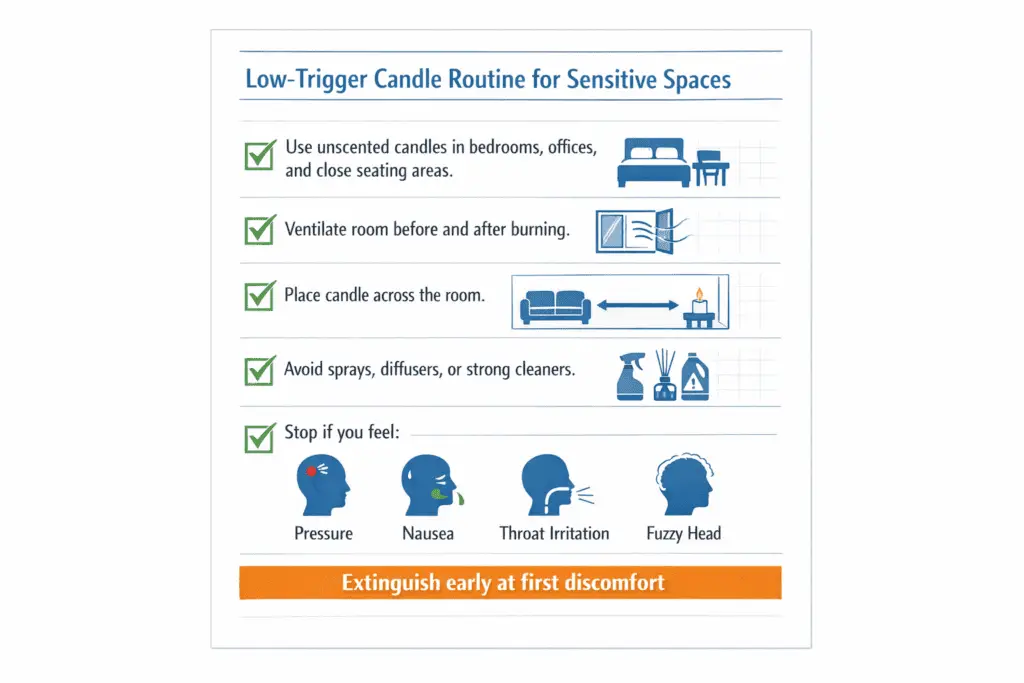
Low-trigger routine
- Choose unscented in bedrooms, offices, and anywhere people sit close together
- Ventilate lightly before and after burning
- Keep the candle across the room, not on the same table
- Avoid combining scented candles with sprays, diffusers, or strong cleaning products
- Extinguish early if you notice pressure, nausea, throat irritation, or fuzzy concentration
For recurring fragrance reactions, start with a step-by-step plan to reduce soot, smoke, and fragrance irritation before testing another candle.
Gifting Guide: How to Pick Scented vs. Unscented by Recipient Profile
When you do not know someone’s fragrance tolerance, gift an unscented candle or include an easy-to-swap option so the gift stays usable.
For a full present-focused breakdown, use the gift candle guide and keep this page focused on when fragrance helps or hurts in the room.
Final Takeaway
Scented candles work best when fragrance is part of the goal and the space can handle it. Unscented candles work best when comfort, food, policy, or sensitivity matter more than aroma.
When in doubt, choose unscented. It is the lower-risk option for shared spaces, close seating, and unknown preferences, and it still gives you warmth, light, and atmosphere without creating problems you then have to manage.