

The best candle gifts match the recipient, room, and occasion: choose tins and sets for low-risk gifting, personalized or seasonal jars for impact, and unscented tapers when food or sensitivity matters.
Use this guide if you want a candle gift that feels thoughtful without guessing on scent or format. It helps you narrow the choice by recipient, budget, room size, and holiday setting. The main trade-offs are scent strength, presentation, portability, and how easy the candle is to use well. The sections below move from fast gift picks into special cases like travel sets, seasonal scents, and sensitive households.
Here’s a quick gift-type chooser before you get into the details:
| Gift situation | Best candle type | Why it works | Watch out for |
| Host gift or dinner invite | Unscented tapers or a subtle mini jar | Low scent risk and easy to use | Strong fragrance near food |
| You do not know their scent taste | Travel set or sampler | Variety lowers the risk of a miss | Too many similar scents |
| Holiday gift with visual impact | Seasonal jar candle | Feels festive and display-ready | Overpowering spice or gourmand blends |
| Personal, sentimental gift | Photo or message candle | High emotional impact | Proofing and delivery timing |
| Scent-sensitive home | Unscented candle or mild beeswax | Lower fragrance load | Vague “lightly scented” labels |
| Budget gift under €25 | Lidded tin or mini jar | Looks intentional without overspending | Flimsy lids and weak burn quality |
If you want the broader format overview first, start with candle types before narrowing the gift fit.
Premium candles usually pay off when the gift needs better presentation, steadier multi-wick burn, or a more layered scent profile. For casual gifting, sturdy tins, sampler sets, and simpler jars are often enough.
Travel Candle Sets & Discovery Kits
Travel sets and discovery kits make great gifts when you want variety, portability, and a low-risk way for someone to test scents before committing to a full-size candle.
For packing and safe use away from home, choose rigid tins, secure lids, and scents that suit smaller rooms. Discovery kits are best for exploration (multiple scent families, quick feedback), while one full-size candle is best for impact (a single statement scent, fewer variables). Tins work well because they cool faster and are easy to close, but they need a lid that fits well and a vessel that won’t deform in a bag.
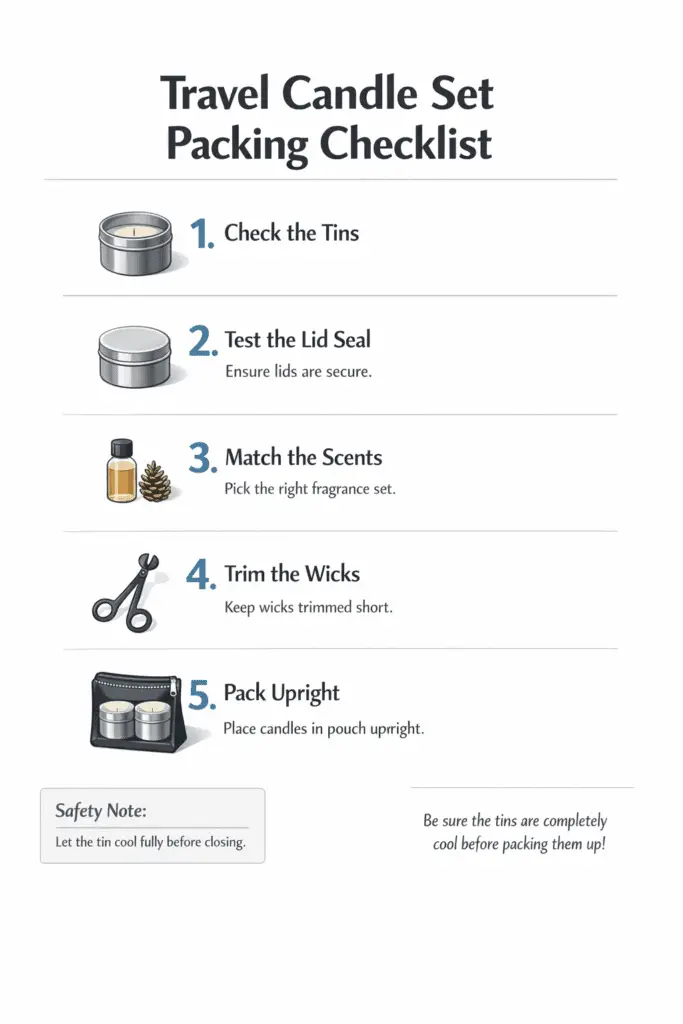
A 5-step pick-and-pack flow (fast but surprisingly effective):
- Choose dent-resistant minis: pick tins that feel rigid, with a snug base and no flex at the rim.
- Do a lid seal check: press and twist lightly—if it pops loose easily, it may open in transit.
- Match scents to small spaces: lighter profiles usually feel better in hotel rooms and guest rooms than heavy smoke, resin, or ultra-sweet gourmands.
- Add a wick-trim reminder: include a tiny note to trim before each burn and to keep burns short in unfamiliar spaces.
- Pack a simple pouch: keep tins upright together so lids don’t scrape off and the wax surface stays clean.
If you want the kit to burn well, use candle containers and jars as a quick checklist even for minis: diameter and headspace still affect whether a candle tunnels or melts evenly. For transit, the same logic from package candles for shipping applies—padding and upright packing matter more than decorative wrap.
For travel use, stick to the usual candle-safety basics: never leave a flame unattended, keep the tin away from drafts, and let it cool fully before closing and packing.
Eco-Friendly Candles (Soy, Coconut, Beeswax)
Soy, coconut, and beeswax can all be eco-friendly gifts, but the best pick depends on scent strength, burn cleanliness, and how sensitive the recipient is.
For gifting, soy is usually the easiest “safe bet” on price and availability, coconut often feels smoother and can perform well at lower burn temperatures, and beeswax is long-burning with a naturally honeyed aroma but tends to cost more. For the bigger picture before choosing, candle wax types is the best quick comparison point. The most useful gift filter is how strong the scent feels, how cleanly the candle tends to burn, and whether the recipient wants a naturally mild profile.
Here’s the fast 3×3 trade-off grid most people need for gifting:
| Wax | Scent throw (typical) | Cleanliness / residue (typical) | Best gifting fit |
| Soy | Medium | Clean when wicked well; can frost cosmetically | Most budgets, everyday gifting |
| Coconut (or coconut blends) | Medium–strong, often “smooth” | Clean when tuned; softer wax can feel creamy | Scent lovers, open-plan rooms |
| Beeswax | Low added-scent throw; has its own aroma | Very low soot when burning well | Scent-sensitive recipients, premium gifts |
Use the table as a shopping shortcut, not a lab comparison: wick choice, vessel size, and room conditions can still change how a candle behaves.
To compare blends like a pro without overthinking it, read the wax line first, then scan for what “wins” in your recipient’s home:
- Small bedrooms / offices: gentler throw can feel nicer than powerhouse projection.
- Large living rooms: wider vessels or multi-wick candles usually perform more evenly.
- Sensitive households: choose naturally mild profiles and prioritize clean-burning behavior over loud fragrance.
If a natural-wax candle smells faint, fix weak scent throw in natural candles is the quickest next step before writing it off as a bad gift.
For the “eco” label itself, look for clear disclosure of wax family and blends, avoid vague “natural” claims without specifics, and treat “non-toxic” wording cautiously when the label gives no clear support.
Aromatherapy & Essential-Oil Candles (Wellness Focus)
Aromatherapy candle gifts are best for people who prefer gentle, natural-leaning scents and a calmer burn experience, while strong fragrance-led candles are better for bold room-filling scent.
An essential-oil (EO) candle is scented primarily with essential oils, while many “aromatherapy-style” candles use a mix of EO and fragrance oil (FO) to improve consistency and projection. Because essential oils contain volatile top notes, the first burn and wick trimming matter more: too much heat can flatten brighter notes, while a steady, moderate flame preserves the intended profile.
A quick starter table that pairs EO families with room size and gifting fit:
| EO family | Common notes | Best room size | Gifting tip |
| Floral / calming | Lavender, chamomile-style blends | Small–medium | Choose “soft” labels and lighter vessels |
| Citrus / bright | Orange, lemon, grapefruit | Medium | Great for daytime spaces; keep burns shorter |
| Herbal / evergreen | Rosemary, eucalyptus-style, fir blends | Medium–large | Feels cozy; avoid placing near drafts |
If you’re deciding between “pure EO” marketing and a more reliable blend, essential oils vs fragrance oils is the cleanest way to set expectations: EO-led candles usually read gentler, while FO blends often project more consistently.
Practical gifting rules that keep EO candles enjoyable (and not headache-inducing):
- Pick “gentle first”: aim for softer profiles if you don’t know someone’s tolerance.
- Keep the first burn moderate: long, hot burns can overwhelm a small room and dull bright notes.
- Trim before every burn: a shorter wick often means a steadier flame and less soot.
- Place with airflow in mind: drafts can tilt the flame and distort the melt pool, changing how scent releases.
- Treat “better” as “different”: EO candles shine as a ritual and ambiance gift, not as the loudest option.
Allergy-Friendly & Fragrance-Free Options
For scent-sensitive gifting, the safest play is an unscented candle with clear warning labels, a stable wick, and a “short-burn + fresh-air” routine that keeps smoke and residue low.
If you need a deeper filter for scent-sensitive homes, see best candle options for people with asthma, allergies, or sensitive pets. For this page, the quick screen is simple: choose unscented first, keep burns moderate, trim the wick, and avoid drafty burn spots that create visible smoke.
To choose a candle that’s more likely to burn calmly, check wick types and sizing for centered placement and sensible wick strength before you buy.
A quick “low-trigger” shopping checklist:
- Choose unscented first; if scented, pick lighter profiles and smaller sizes.
- Favor cotton-style wicks and consistent, centered placement in the vessel.
- Avoid very wide jars with a single weak wick (tunneling can create sootier relights).
- Look for straightforward warning labels and burn instructions.
- Gift with a simple care note: trim, keep away from drafts, and don’t “power burn” for hours in a closed room.
Personalized, Photo & Message Candles
Personalized candles become great gifts when the customization is readable on a curved jar, the proof is approved quickly, and the ship-by date accounts for production time so it arrives before the occasion.
Even a beautiful design can look blurry or misaligned once it wraps around glass, so the safest move is to prepare a sharp image and insist on a proof. The two big trade-offs are impact versus durability: photo wraps look dramatic, while engraved lids tend to last longer but offer less design space.
Proofing flow (text diagram)
Pick candle + vessel → Upload photo/text → Receive digital proof → Approve or revise → Production → Ship → Deliver
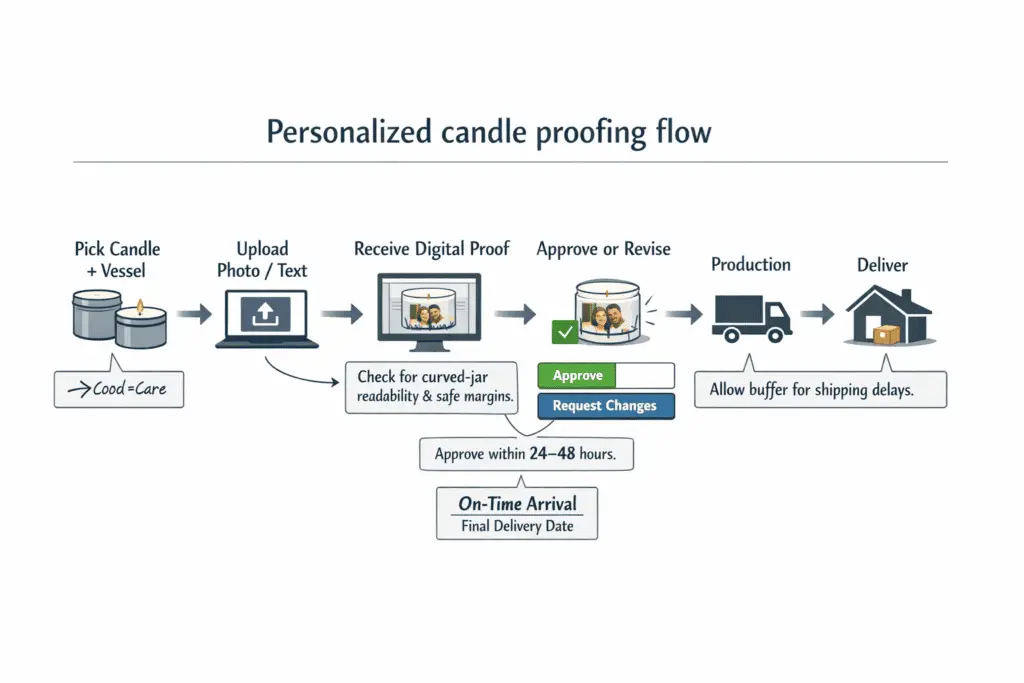
A simple 5-step order process (that prevents most disappointments):
- Pick the vessel finish and size that suits the design: wider labels need more room, and very tall jars can hide text when viewed from above.
- Prep a high-resolution image with safe margins so key faces or text don’t land on the seam.
- Approve the digital proof fast (often within 24–48 hours) so the production clock actually starts.
- Match scent choice to the recipient: if you’re uncertain, choose unscented or a gentle profile rather than an intense seasonal blend.
- Lock your ship-by date with a buffer for cold snaps and carrier delays, especially in November–December.
When you’re unsure how curvature affects seams and alignment, thinking like someone who would choose the best candle container helps: smaller diameters need simpler designs, and busy patterns make seams more noticeable. For winter or long-distance delivery, ask the seller how they pad glass and protect labels before you order.
Wrap vs engraved lid (quick comparison)
- Photo wrap: biggest “wow,” best for faces/graphics, but needs careful seam placement and a sharp source image.
- Message label: easiest to read, great for short notes, and typically the fastest proof cycle.
- Engraved lid: most durable, feels premium, but limited space and lower contrast for fine detail.
Holiday-Themed Scents & Seasonal Collections
Choose holiday candles by note family (spice, pine, gourmand), then match intensity to room size and the recipient’s scent sensitivity so the scent feels festive, not overwhelming.
A quick way to decode seasonal candles is to match scent family to where the candle will actually burn. Spices (cinnamon/clove-style profiles) read instantly seasonal but can dominate small spaces; pine and balsam feel fresher in entryways; gourmand notes (vanilla/cookie) feel cozy in living rooms but can clash with cooking smells. Limited editions add novelty and gift excitement, but they often cost more per burn hour than a brand’s core line—so they’re best when the recipient loves trying new seasonal drops.
| note_family | room_size_m2 | audience | intensity |
| Spice | 6–10 | scent-lovers | High |
| Spice | 10–18 | mixed crowd | Medium–High |
| Spice | 18–30 | open-plan | Medium |
| Pine | 6–10 | scent-sensitive | Medium |
| Pine | 10–18 | mixed crowd | Medium |
| Pine | 18–30 | hosts/entryways | Medium–High |
| Gourmand | 6–10 | cozy-home | Medium–High |
| Gourmand | 10–18 | mixed crowd | Medium |
| Gourmand | 18–30 | living areas | Medium |
Treat the grid as a quick matching tool, not a fixed rule: drafts, wick strength, and vessel width can shift how strong a scent feels in the room.
If you’re buying for an office, dinner host, or anyone sensitive to fragrance, scented vs unscented candles is the cleanest way to set expectations: go lighter (or unscented) at the table, and stronger in an entryway or living room where people can step away.
A simple 3-step selection routine:
- Pick the note family that fits the recipient (spice = bold, pine = fresh, gourmand = cozy).
- Match intensity to the smallest room they’ll likely use it in.
- Decide “core vs seasonal”: core for predictable comfort; limited edition for novelty.
Common gifting mistakes (and quick fixes):
- Out of stock after mid-November → shop earlier or choose a core scent in holiday packaging.
- Overpowering scent → size down, move it to a larger room, or switch to pine/unscented.
- “Not festive enough” → choose a set with one spice plus one pine for balance.
Seasonal note: collections and price bands change year to year, so it’s smart to reassess options each Q4 and avoid assuming a specific limited edition will still be available.
Advent Calendars & Multi-Candle Gift Sets
Use a 5-step plan: confirm day count and mini sizes, check total burn hours vs budget, plan a scent arc to avoid fatigue, verify inserts for transit, and ship early for cold routes.
Before you buy, apply the same small-format logic you would use for any mini candle: tiny vessels heat up fast, and small shifts in wick or airflow can change how they burn. Calendars are great for daily surprise and variety; curated gift sets often win on value per burn hour and let you pick a clearer theme (cozy, fresh, gourmand) without forcing 24 different scents.
Pack-integrity checklist (fast scan before checkout):
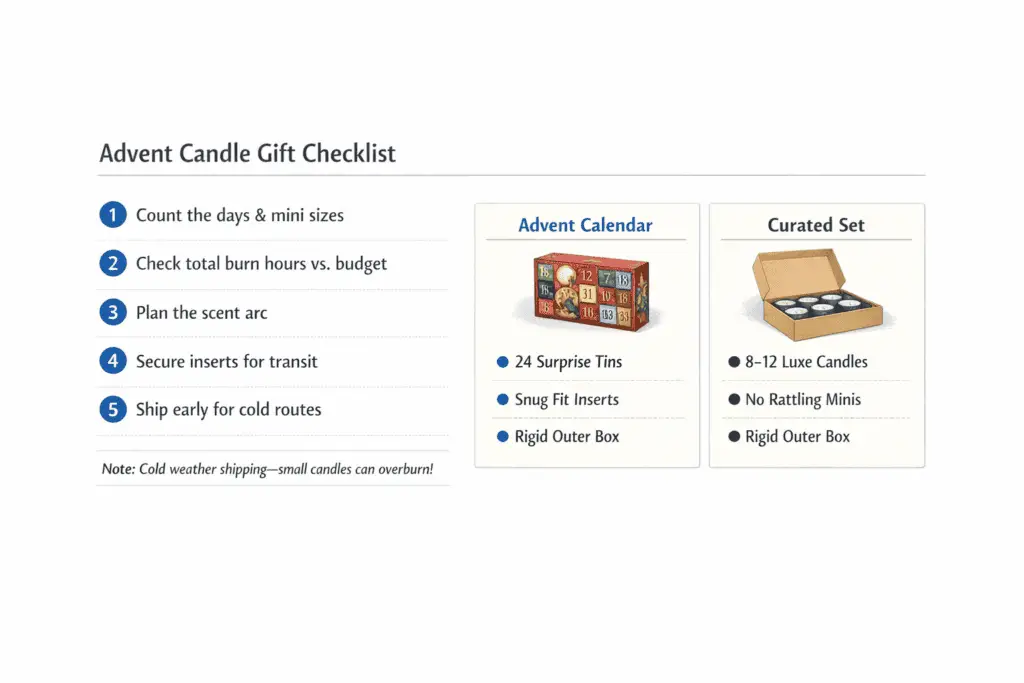
- Compartments keep each mini from touching the next
- A rigid outer box resists corner crush
- Each tin or mini jar is snug (no rattling)
- The lid/cap can’t pop off when shaken
- Any glass minis sit away from the box edge
To make “worth it” comparisons without guessing, use total wax volume and stated burn hours as rough shopping clues, not guarantees. A 24-day calendar with 24 × 1 oz minis can feel generous, but a smaller curated trio of larger candles may still deliver more total use for the same budget.
How to choose between a calendar and a set:
- Choose an advent calendar when the recipient loves variety and the daily ritual.
- Choose a curated set when they prefer fewer, bigger favorites and steadier performance.
Scent pacing (to prevent “everything smells the same” by day 10):
- Start with fresh or citrus-like profiles early.
- Put spice-heavy and smoky profiles later (or reserve for weekends).
- Alternate gourmand and evergreen so nothing dominates for too many days in a row.
When you’re evaluating minis and inserts, focus on padding, compartmentalization, and snug fit so lids stay on and glass stays protected during winter delivery.
Safety note: don’t skip the burn instructions that come with minis, because small candles can heat up quickly and are easier to overburn.
Stocking Stuffers & Gifts Under €25
Under €25, the best candle gifts are sturdy lidded tins, mini jars, taper pairs, and small sampler sets that look intentional, burn reliably, and don’t require knowing someone’s exact scent preferences.
The trick at this price is avoiding “cheap-smelling” overwhelm and choosing formats that are forgiving: smaller candles are easier to place, easier to finish, and less likely to disappoint if the scent isn’t a perfect match. When you’re gifting minis, the same fundamentals still apply—diameter and wick strength decide whether a tiny candle burns cleanly—so the safest buys are the ones with stable lids, sensible jar widths, and straightforward burn instructions.
A practical under-€25 menu (fast choices that usually land well):
- 4–6 oz tins: best all-around stocking stuffer; portable and gift-ready with a lid.
- Mini jar candles: slightly more premium feel than tins; great for desks and nightstands.
- Taper pairs (unscented): ideal for hosts and holiday tables when paired with holders.
- Mini sampler sets (2–4 scents): safest when you don’t know their taste.
- Seasonal minis: fun, but choose lighter profiles if the recipient is scent-sensitive.
Use this quick matrix to choose the “right kind of small”:
| Under-€25 gift type | Best for | Why it works | Watch out for |
| Lidded tin (single) | coworkers, teachers, neighbors | easy to store and travel | lids that pop off easily |
| Mini jar (single) | close friends, small rooms | feels more “keepsake” | very wide minis that tunnel |
| Taper pair (unscented) | hosts, dinner invites | décor + low scent risk | wobbly fit in holders |
| Small sampler set | “not sure what they like” | variety reduces risk | too many similar scents |
| Votive-style minis | add-on gifts | compact, easy bundle | needs a proper holder |
If you’re shipping these, keep it simple: choose lidded formats, avoid rattling, and pack them snugly so tins don’t dent and lids don’t scuff labels.
Safety, Burn Time & Gifting Etiquette
The best candle gift is the one that burns safely and predictably, so include simple care rules (trim, avoid drafts, don’t overburn) and pick a size and scent strength that fits the recipient’s space.
Most candle issues that feel like “bad quality” are actually use issues: wick left too long, candle burned in a draft, or the first burn ended before the top melted evenly. A short safety refresher helps keep the gift enjoyable, and trim candle wicks is the single easiest habit to reduce smoke, soot, and uneven burning.
A simple burn-time reality check: burn hours are estimates, not promises. They help most when you use them to compare candles in the same size range, not when you treat them as exact timing for every room and every burn style.
A minimal care card that fits in a gift bag:
- Trim the wick to ~5–6 mm (¼ in) before each burn.
- Burn long enough to melt most of the top on the first use.
- Keep away from drafts (vents, open windows) to prevent uneven melting and soot.
- Use a stable, heat-safe surface and keep the flame attended.
- Stop using if the container is cracked or the flame smokes persistently.
Gifting etiquette that avoids awkward moments:
- If you don’t know their tolerance, choose lighter scents or unscented.
- For dinner hosts, avoid strong fragrances at the table; tapers or unscented pillars are safer.
- For offices, pick subtle, fresh profiles and smaller sizes.
- If you’re gifting a very “holiday-specific” scent, pair it with a neutral option (fresh or unscented).
- Include a note about pets and kids if you know the home has them—placement matters more than brand.
If the recipient reports a candle that tunnels or smells weak, it’s usually fixable with small changes. The fastest troubleshooting mindset is: check wick length, check drafts, and match burn length to vessel diameter before assuming the candle itself is defective.
A quick holder-fit check in four moves:
- Check the cup: the taper should slide in with firm resistance, not wobble.
- Level the base: nudge the candle until it stands straight when viewed from the side.
- Test the “gentle push”: a light tap should not make it sway or scrape the holder rim.
- Add drip control: use a plate, tray, or drip bobeche under the holder when the setting allows.
Pick taper length by dinner duration, not by guessing exact burn hours:
| Dinner duration | Best taper plan | Why it works |
| 2–3 hours | 10 in (25 cm) tapers | Plenty of height without committing to a long burn |
| 3–4 hours | 12 in (30 cm) tapers | More wax mass for a longer session |
| 4–5 hours | 12 in tapers + a spare pair | Swap cleanly if one burns unevenly |
| 5–6 hours | Pillars on plates | More stable for extended, low-fuss burning |
Etiquette note for meals: unscented tapers are often the safest choice, since fragrance can compete with food. If you want scent at the same gathering, place a jar candle in an entryway or living room instead of the dining table.