
The best candle types for sensitive noses are usually unscented, fragrance-free, additive-minimal, simple-wick, or flameless options.
This guide compares candle types and candle-type features for scent-sensitive spaces. It does not diagnose allergies or guarantee that any candle is hypoallergenic. Best means best tolerated for the room and person, with the lowest practical scent burden and the clearest product information.
Start with the scent claim, then check additives, wick, wax, room fit, and whether a flameless option is better. No candle type works for every sensitive person, so the lowest-doubt buying path is to choose simply and test briefly before regular use.
What Candle Types Are Best for Allergies, Sensitive Noses, and Unscented Spaces?
For allergies, sensitive noses, and unscented spaces, the best starting choices are fragrance-free, no-added-fragrance, additive-minimal, simple-wick, or flameless candles.
This page compares candle types and candle-type features for scent-sensitive spaces; it does not diagnose allergies or guarantee any candle is hypoallergenic.
The American Lung Association advises avoiding scented candles when they trigger asthma or COPD symptoms and suggests unscented or battery-operated flameless candles when candle ambience is wanted.
The best candle types for sensitive noses are usually unscented, fragrance-free, additive-minimal, simple-wick, or flameless options, depending on room conditions and personal tolerance. The goal is not to find the strongest, longest-burning, cheapest, or most decorative candle. The goal is to reduce scent exposure, avoid unnecessary product variables, and choose a candle type that fits the room.
| Candle type or feature | Why it may fit | Main caveat | Best room fit |
|---|---|---|---|
| Fragrance-free candle | Gives the clearest “no added fragrance” buying signal when the product page supports it | Wax or wick materials may still have a mild odor | Bedrooms, offices, shared unscented rooms |
| Unscented candle | Avoids a deliberate scent goal and is easier to tolerate than scented candles for many users | Unscented does not always mean odorless | Living rooms, guest rooms, light-use spaces |
| Additive-minimal candle | Reduces variables such as dyes, glitter, botanicals, and vague “infused” claims | Simple construction is not a medical safety guarantee | Sensitive bedrooms, small rooms, shared spaces |
| Simple-wick candle | Clear wick construction can make burn behavior easier to judge | Wick choice does not replace safe use or troubleshooting | Enclosed rooms where smoke or soot would be noticed quickly |
| Flameless candle | Removes flame, combustion, fragrance release, and wax burn from the decision | It is a candle alternative, not a traditional burning candle | Strict no-scent spaces, rentals, dorms, offices |
An unscented candle is a candle sold without an added fragrance goal. It may still have a detectable smell from wax, wick, packaging, storage, or natural material odor. That difference matters because a sensitive buyer may react to the presence of scent, not just to whether the product was marketed as scented.
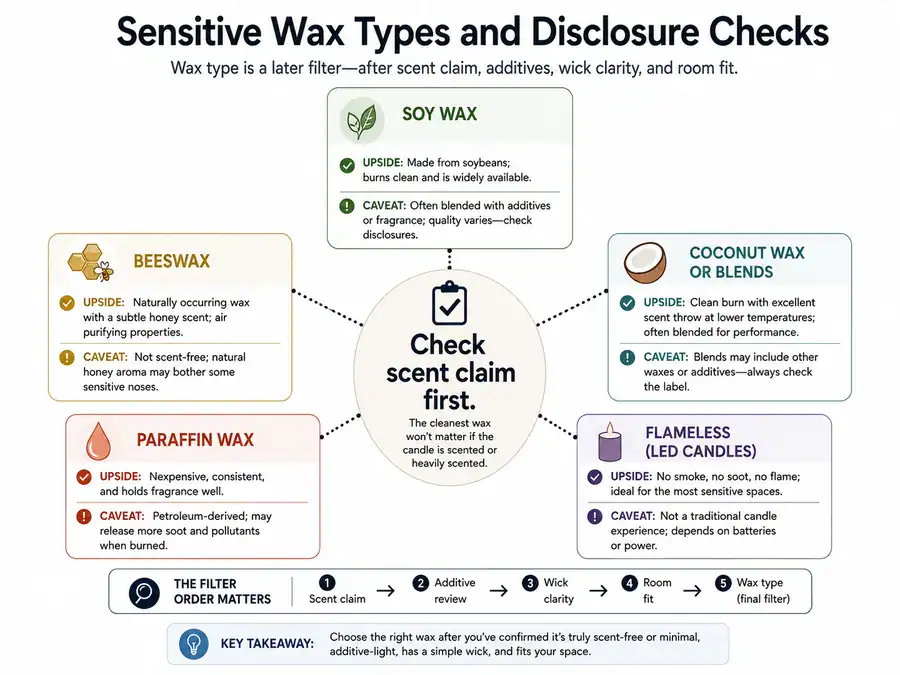
A practical buying order works better than picking by wax type alone. Check the scent claim first, then look for extra additives, wick clarity, wax type, room size, and shared-space tolerance. If the room needs to stay as neutral as possible, choose flameless instead of trying to make a burning candle behave like a no-output product.
For broader material comparisons, use the candle wax types guide. For medical symptoms or allergy diagnosis, consult a qualified health professional rather than relying on candle selection.
Unscented vs Fragrance-Free vs Low-Fragrance Candles
Fragrance-free, unscented, and low-fragrance are candle-buying claims, not interchangeable guarantees of zero odor or medical allergy safety.
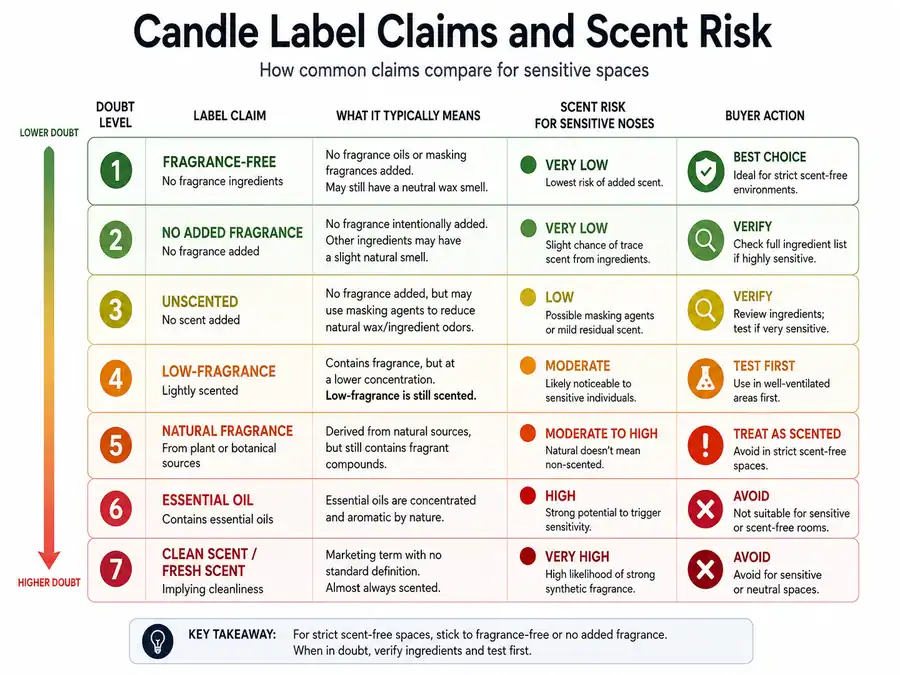
Fragrance-free is usually the clearest label to check first because it signals that no fragrance was intentionally added. Unscented means the candle is not made to smell like a named scent, but material odor can remain. Low-fragrance still means scented, so sensitive buyers should treat it as a test-first option rather than a safe default.
The FDA notes that some products labeled “unscented” may still contain fragrance ingredients. For candles, treat the label as a starting filter and verify the scent, wax, wick, and additive details.
| Label claim | Buyer interpretation | Sensitive-space risk | Best action |
|---|---|---|---|
| Fragrance-free | No added fragrance should be the intended claim | Product pages may still be vague or incomplete | Verify the description and ingredients before buying |
| No added fragrance | Strong buyer-facing signal for scent avoidance | Natural wax or wick odor may remain | Good first filter for unscented spaces |
| Unscented | Not made with a fragrance goal | May still smell like wax, wick, or storage materials | Test briefly before regular use |
| Low-fragrance | Still scented, but marketed as lighter | Can still bother sensitive noses in small rooms | Avoid for strict scent-free needs; test only for mild sensitivity |
| Natural fragrance | Scent source is still present | “Natural” does not mean fragrance-free | Treat as scented |
| Essential-oil candle | Scented with essential oils | Essential oils can still be strong or irritating for some users | Treat as scented and test first |
| Clean scent | Marketing language, not a scent-free claim | Meaning varies by brand | Do not use as a safety or tolerance signal |
The best label is the one that lowers doubt about added scent and scent strength. For strict scent avoidance, look for “fragrance-free” or “no added fragrance,” then confirm the product details. For mild sensitivity, a low-fragrance candle may work only after a short test in the actual room. For shared unscented spaces, fragrance-free, no-added-fragrance, or flameless options are lower-doubt starting points.
Essential-oil candles are not fragrance-free just because the scent source is plant-derived. “Natural,” “clean,” “botanical,” and “aromatherapy” claims still point to scent sources, so they do not solve the problem for someone trying to keep a room neutral.
For fragrance-ingredient standards or oil-blend details, use the fragrance oil guide; this section is for interpreting candle product claims.
Which Wax Types Are Better for Sensitive Spaces?
Wax type is one candle-type attribute for sensitive spaces; it does not by itself prove a candle is scent-free, clean, or allergy-safe.
Wax matters, but it should come after the scent claim, additives, wick clarity, and room fit. A fragrance-free candle in a simple wax is usually easier to judge than a “natural” wax candle with scent, dye, botanicals, and vague blend claims.
| Wax type or option | Sensitive-space upside | Main caveat | Best next check |
|---|---|---|---|
| Soy wax | Common, easy to find, and often sold in unscented versions | Soy wax alone does not make a candle allergy-safe | Confirm no added fragrance, simple additives, and clear wick details |
| Beeswax | Can be sold without added fragrance and may appeal to natural-wax buyers | Beeswax can still have a natural honey-like smell | Test first in the actual room |
| Coconut wax or blends | Often used in softer, premium-style candles | Blend wording can hide what the candle is mostly made from | Look for clear wax and fragrance disclosure |
| Paraffin wax | Widely available and predictable in many standard candles | Some sensitive buyers avoid it for comfort or confidence reasons | Keep claims cautious and compare product details |
| Flameless candle | No wax burn, no flame, and no fragrance release from combustion | It is a candle alternative, not a burning candle type | Use when zero scent output matters most |
The lowest-doubt decision order is simple: choose no added fragrance first, avoid unnecessary additives second, check wick clarity third, then compare wax type. Wax preference can matter, but it should not override a strong scent claim or unclear ingredient wording.
For a full material breakdown, use the candle wax types guide; wax remains one decision factor for sensitive spaces here.
Beeswax Candles: Good Candidate, But Not Scentless
Beeswax can be unscented by added-fragrance status but still naturally aromatic.
That distinction matters for people who want an unscented room. A beeswax candle may have no added fragrance and still smell faintly sweet, warm, or honey-like. For some users, that natural odor is pleasant and tolerable. For strict unscented spaces, it can still be too noticeable.
| Beeswax claim | What it means for sensitive spaces |
|---|---|
| Unscented beeswax | No added scent goal, but natural wax odor may remain |
| Fragrance-free beeswax | Better label signal if product details support it |
| Natural beeswax scent | Still a scent, even without fragrance oil |
| Best use case | Mild sensitivity, natural-wax preference, and test-first use |
Beeswax is not the best choice when the user needs the room to smell like nothing. In that case, fragrance-free wax or flameless candles are better first checks. For full beeswax candle coverage, use the beeswax candles page; here, beeswax remains a sensitive-space fit check.
Soy Candles: Useful Only When Fragrance and Additives Are Controlled
Soy candles are useful for sensitive noses only when fragrance, additives, wick, and blend disclosure are controlled.
Soy is a candidate, not a guarantee. A heavily scented soy candle can be a poor fit for a sensitive room, while a fragrance-free soy candle with a plain wick and minimal additives may be easier to tolerate. The wax name matters less than the full product setup.
Soy is a better fit when:
- The candle is fragrance-free, no-added-fragrance, or clearly unscented.
- The product does not rely on essential oils or “natural scent” language.
- The wick construction is clear and simple.
- Dyes, glitter, botanicals, and decorative inclusions are absent.
- Blend details are not hidden behind vague premium wording.
Soy is not enough when the candle is strongly scented, heavily dyed, or described with broad claims such as “clean,” “spa-like,” or “aromatherapy” without clear disclosure. For a full soy candle material page, use the soy candles guide.
Coconut Wax and Blends Need Clear Disclosure
Coconut wax and blended wax candles should be judged by disclosure quality, not premium wording.
Coconut wax does not mean coconut fragrance. It describes the wax base or part of the wax blend, while scent comes from added fragrance, essential oils, or natural material odor. For sensitive buyers, the useful question is not whether the candle sounds premium. It is whether the wax, scent claim, wick, and additives are clear.
| Product wording | Better interpretation | Buyer action |
|---|---|---|
| Coconut wax candle | May be coconut wax or a coconut-heavy blend | Check whether it is scented or fragrance-free |
| Coconut wax blend | Mixed wax base | Look for blend details if sensitivity is high |
| Coconut scented candle | Scented candle, regardless of wax type | Treat as scented |
| Natural coconut candle | Marketing phrase unless details are listed | Do not treat as fragrance-free |
| Premium wax blend | Broad quality claim | Check actual scent and additive details |
Blends are not automatically bad for sensitive spaces. They only become harder to judge when the brand does not explain what is blended, whether fragrance is added, or which wick and additives are used. For deeper blend composition, use the wax blend comparison; this page checks disclosure quality only.
Paraffin Candles: When Sensitive Buyers May Prefer Alternatives
Some sensitive buyers prefer to avoid paraffin, but paraffin should not be described as always toxic, always unsafe, or always the cause of sensitivity.
Paraffin can be a buyer-confidence issue for people who already associate it with odor, smoke, or discomfort. That does not mean every paraffin candle is medically unsafe, and this page should not turn a candle-type decision into a toxicology debate.
A cautious way to phrase the choice:
| Say | Do not say | Better route |
|---|---|---|
| Some sensitive buyers prefer alternatives to paraffin for comfort or confidence. | Paraffin candles are always toxic. | Use a safety or paraffin comparison page for deeper claims. |
| Wax type is one factor after scent, additives, wick, and room fit. | Wax type alone determines sensitivity. | Return to the full candle-selection checklist. |
| If paraffin worries you, choose fragrance-free soy, beeswax with a test, or flameless. | Natural wax is always safer for allergies. | Compare actual product details. |
If the buyer already feels unsure about paraffin, there is no need to force that choice. A fragrance-free soy candle, a carefully tested beeswax candle, or a flameless candle may be a better fit. For deeper paraffin or emissions discussion, use the safety or paraffin comparison guide.
Choose Simple Wick Construction to Reduce Burn Uncertainty
Simple, clearly described wick construction helps sensitive buyers reduce burn uncertainty, especially in small rooms where smoke, soot, odor, or flame behavior is noticed quickly.
The best wick choice for sensitive spaces is simple, clearly described, and suitable for the candle. Decorative, oversized, crackling, or unclear wick claims can add doubt in small or shared rooms.
Use this quick inspection order:
- Check whether the wick material is stated clearly.
- Confirm the candle is fragrance-free, no-added-fragrance, or low-fragrance by intent.
- Avoid candles with heavy dyes, glitter, botanicals, or decorative inclusions.
- Match the candle to the room size and shared-space tolerance.
- Burn briefly at first, then stop using it if smoke, soot, or odor becomes noticeable.
A simple wick does not make a candle scent-free or medically allergy-safe. It only reduces one part of the buying doubt. If the product page gives no wick information and the candle is meant for a small bedroom, office, or other enclosed space, choose a more transparent product or a flameless option.
Wood wicks are not automatically wrong, but they are not the lowest-doubt default for a sensitive shared room if the user dislikes crackling, visible flame variation, or stronger burn character. For sensitive spaces, predictable and clearly stated construction matters more than novelty.
For soot, smoke, tunneling, or flame behavior, use a wick or soot troubleshooting guide; this page uses wick details only for purchase selection.
Avoid Extra Additives When You Need a Simpler Candle
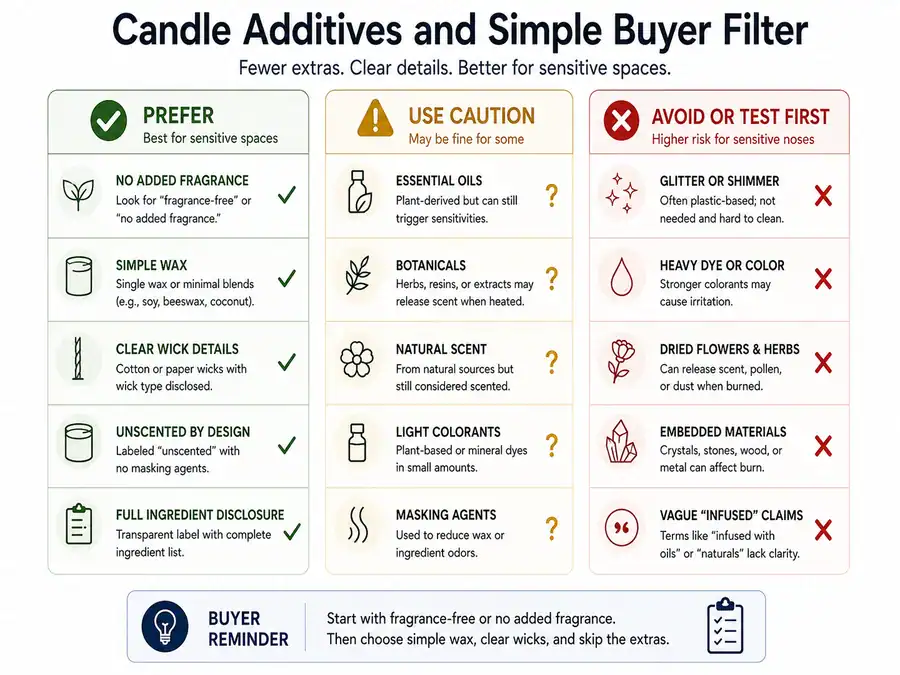
Additive-minimal candles are candle types or product variants that avoid nonessential dyes, glitter, embedded botanicals, and decorative materials that can add uncertainty for sensitive spaces.
Additive-minimal candles reduce unnecessary variables, but simple does not automatically mean medically allergy-safe. For a sensitive room, fewer extras usually make the candle easier to judge before buying and easier to stop using if it bothers the room.
Use this buyer filter:
- Prefer: no added fragrance, simple wax, clear wick details, and no decorative inclusions.
- Use caution: essential oils, botanicals, “natural scent,” “infused,” or vague clean-scent claims.
- Avoid or test first: glitter, heavy dye, dried flowers, embedded materials, or unclear additive language.
Dye-free does not mean fragrance-free. A candle can have no visible color and still contain fragrance oil, essential oil, or a strong natural scent. The reverse can happen too: a candle may be colored but unscented. For sensitive buyers, the scent claim matters before the color claim.
Botanical candles need extra caution in small rooms. Dried flowers, herbs, petals, and decorative inclusions may look natural, but they add another material to a product that will be warmed or burned. That does not make every botanical candle unsafe, but it makes the product harder to judge for a sensitive bedroom, office, or shared room.
Common buying mistakes include:
| Mistake | Better interpretation |
|---|---|
| Buying a “natural” candle and assuming it is scent-free | Natural can still mean scented, aromatic, or essential-oil-based |
| Treating dye-free as fragrance-free | Color and scent are separate product features |
| Choosing botanical candles for a sensitive bedroom | Decorative inclusions can add odor, smoke, or burn uncertainty |
| Trusting “clean candle” without details | Clear scent, wax, wick, and additive information matters more than broad marketing language |
A simpler candle is best when it removes nonessential sensory, burn, and label variables. It is not a medical guarantee, a toxicology verdict, or proof that every sensitive person will tolerate it.
For legal ingredient rules or chemical safety claims, use a dedicated safety or ingredient resource. This section gives practical buyer filters only.
When Flameless Candles Are the Best Scent-Free Option
Flameless candles may be the best option when the user wants ambience without fragrance, smoke, flame, or combustion.
A flameless candle is a candle alternative, not a traditional burning candle type. It fits this guide because strict scent avoidance sometimes cannot be solved by choosing a better wax, wick, or label claim. If the real need is zero scent output, no flame, or no shared-room odor, flameless is often the clearest choice.
| Option | What it gives | Main limit | Best fit |
|---|---|---|---|
| Unscented wax candle | Traditional candle feel without an intended scent | May still have wax, wick, or burn odor | Mild sensitivity and rooms where a short test is acceptable |
| Fragrance-free wax candle | Stronger no-added-fragrance signal when product details support it | Still burns wax and uses a wick | Bedrooms, offices, or shared spaces needing low scent |
| Additive-minimal candle | Fewer decorative and sensory variables | Still needs flame and burn testing | Buyers who want a real candle but fewer extras |
| Flameless candle | Ambience without burning wax, wick, or fragrance | Not a real flame or traditional candle feel | Strict no-scent rooms, rentals, dorms, offices, and no-flame areas |
Flameless candles are the better answer when the buyer keeps trying to make a burning candle act like it produces nothing. A burning candle may be fragrance-free and still create heat, flame, wax odor, wick odor, or room presence. A flameless option removes those variables instead of trying to minimize them.
Choose flameless first when:
- The room must stay neutral for multiple people.
- Flame is not allowed in the space.
- The user notices odor even from unscented candles.
- The candle is for a dorm, rental, office, nursery-adjacent area, or small bedroom.
- The goal is visual comfort rather than a true burn experience.
Flameless candles should not turn this page into a décor or product-roundup guide. Battery life, realism, remote controls, timers, and holiday styling belong in a flameless candle guide. Here, the role is narrower: flameless is the fallback when low-scent candle selection is still too uncertain.
For styling, realism, battery life, or décor choices, use the flameless candles guide. This page only treats flameless candles as a scent-free and no-flame alternative.
Match Candle Type to Room Size, Shared Spaces, and Ventilation
Room size and shared-space conditions can change which candle type is best, even when the candle is unscented or low-fragrance.
A candle that feels mild in a large room can feel noticeable in a small bedroom, office, bathroom, or dorm. Sensitive buyers should match the candle type to the room before deciding that the candle itself is the problem.
| Room or space | Better candle type | Why it fits | Test-first rule |
|---|---|---|---|
| Small bedroom | Fragrance-free, no-added-fragrance, additive-minimal, or flameless | Small rooms make mild odors easier to notice | Test for a short period before using near bedtime |
| Shared office | Flameless or fragrance-free | Shared spaces need lower scent impact and fewer complaints | Avoid low-fragrance candles unless everyone agrees |
| Bathroom | Unscented or flameless | Small enclosed rooms can hold odor quickly | Avoid strong scent claims and decorative inclusions |
| Dorm or rental | Flameless | Flame rules and shared air make burning candles harder to justify | Check building rules before using any flame |
| Large living room | Unscented, fragrance-free, or carefully tested low-fragrance | More air volume may make mild scent less noticeable | Start with short use, then judge comfort |
| Guest room | Fragrance-free or flameless | Guests may have unknown sensitivities | Choose the least noticeable option |
Ventilation matters only as a room-fit clue in this guide. This section is not an air-quality, heating, cooling, purifier, or medical respiratory guide. The buyer-facing question is simpler: will this candle make the room feel noticeable, smoky, perfumed, or uncomfortable for the people using it?
A practical test-first sequence works like this:
- Choose the lowest-scent candle type that still fits the room.
- Avoid extra additives, botanicals, glitter, or strong scent language.
- Use the candle briefly in the actual room.
- Stop if the room develops a noticeable odor, smoke, soot, or discomfort.
- Choose flameless if the space needs to stay neutral.
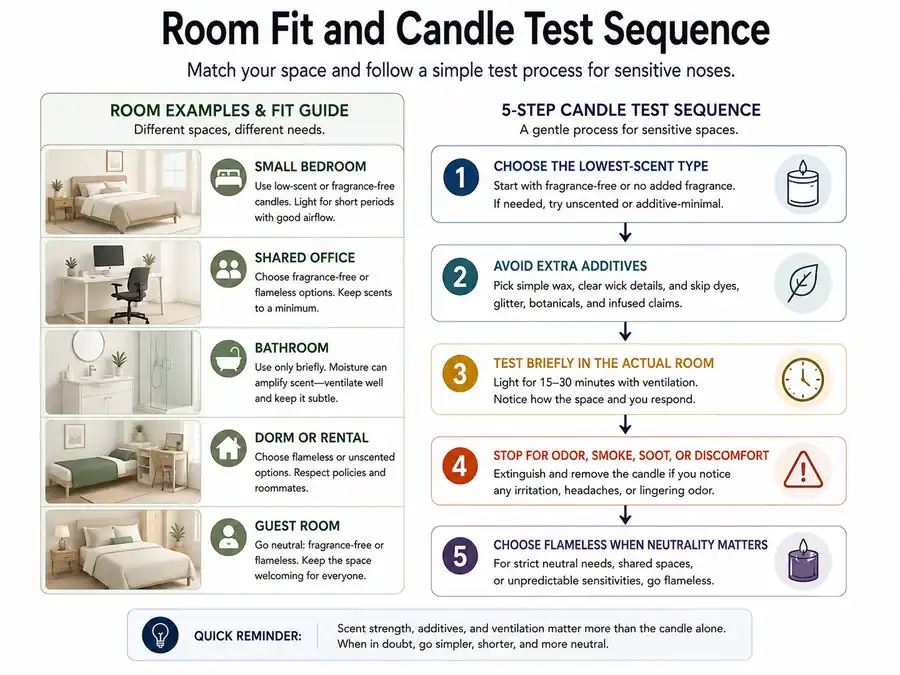
Room fit is especially important for shared spaces. A candle can be tolerable for one person and still be a poor choice for an office, guest room, dorm, or small bedroom. In those spaces, the best candle type is often the one that creates the least room-level presence, not the one with the nicest product description.
For air quality, ventilation, or purifier guidance, use a dedicated indoor-use or expert resource. This section only uses room conditions to support candle selection.
Sensitive-Buyer Candle Label Checklist
The label checklist turns candle type, scent claim, wax, wick, additives, and room fit into a buy, test-first, avoid, or flameless decision.
Use this checklist after comparing the main candle types. It keeps the decision focused on practical tolerance signals instead of broad claims such as “clean,” “natural,” “premium,” or “hypoallergenic.”
| Check | Buy | Test first | Avoid | Choose flameless |
|---|---|---|---|---|
| Scent claim | Fragrance-free or no added fragrance with clear details | Unscented with possible material odor | Strong scent, vague scent, or perfume-forward wording | Needed when any scent is too much |
| Fragrance source | No fragrance oil or essential oil listed | Very light scent with clear disclosure | Essential oil, aromatherapy, natural fragrance, or clean scent when strict neutrality is needed | Needed for zero scent output |
| Additives | No glitter, botanicals, heavy dye, or embedded materials | Minor color with clear product details | Decorative inclusions or vague “infused” claims | Needed when burn variables are unwanted |
| Wick clarity | Simple, stated wick construction | Wick not central to the product claim but still acceptable | Oversized, novelty, or unclear wick claims in small rooms | Needed when flame or smoke is not acceptable |
| Wax type | Wax matches the user’s preference after scent and additives are checked | Beeswax, soy, coconut blend, or paraffin based on comfort and disclosure | Wax marketing used to hide scent or additive details | Needed when wax burn itself is unwanted |
| Room fit | Large or private space with short initial use | Small room, bedroom, or shared space | Shared unscented space with uncertain tolerance | Best for offices, dorms, rentals, and strict no-scent rooms |
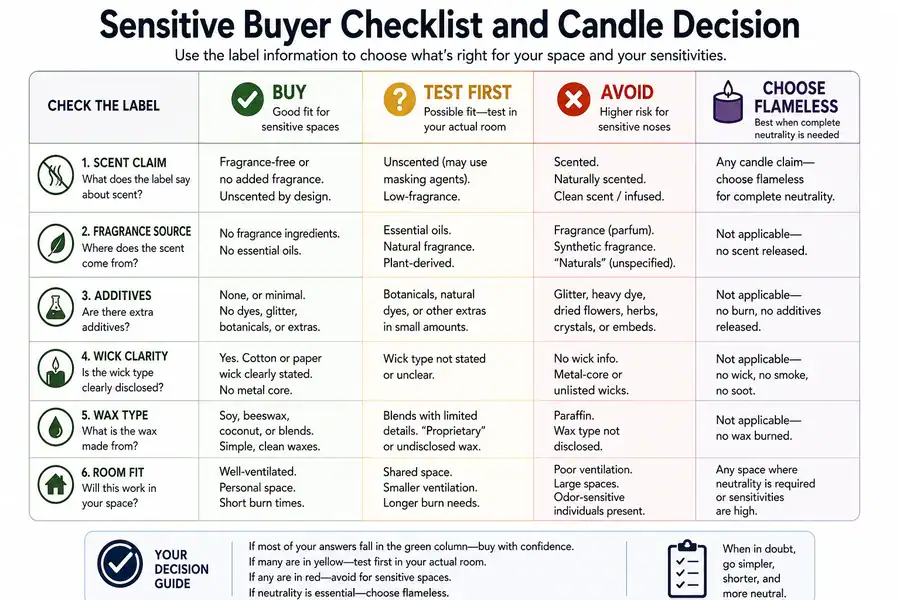
A good label usually answers four questions without making the buyer guess: Is fragrance added? What wax is used? What wick is used? Are there extra decorative or sensory additives? If the label skips those points, the lowest-doubt action is to test first or choose a clearer product.
Use this final decision path:
- Choose buy when the candle is fragrance-free or no-added-fragrance, additive-minimal, clearly described, and matched to the room.
- Choose test first when the candle is unscented, low-fragrance, beeswax, blended, or lightly described but not clearly risky.
- Choose avoid when the candle relies on strong scent, vague natural claims, heavy additives, botanicals, glitter, or unclear construction.
- Choose flameless when the room needs ambience without fragrance, flame, smoke, wax burn, or shared-space doubt.
The biggest label mistakes are assuming unscented means odorless, natural means gentle, dye-free means fragrance-free, and soy means allergy-safe. None of those shortcuts is reliable enough for sensitive spaces. The better path is to read the label in order: scent claim, fragrance source, additives, wick, wax, and room fit.
For fragrance standards, wax details, or ingredient questions, use the relevant candle wax types, fragrance oil, flameless candles, or candle ingredients guide. This checklist is the final buyer filter for this page.
Final Recommendation
The best choice is the candle or candle alternative with the lowest scent burden, clearest disclosure, simplest construction, and best room fit for the user’s tolerance.
For strict scent avoidance, start with fragrance-free, no-added-fragrance, or flameless options. For mild sensitivity, an unscented or carefully tested low-fragrance candle may work if the wax, wick, and additives are clearly described. For natural-wax preference, soy or beeswax can be reasonable only when scent and additive claims are controlled.
Use this final match:
| Need | Best starting choice | Why |
|---|---|---|
| No scent output | Flameless candle | Removes fragrance, wax burn, wick, smoke, and flame from the room |
| Lowest added-scent risk | Fragrance-free or no-added-fragrance candle | Gives the clearest buyer signal when the product details support it |
| Mild sensitivity | Unscented, additive-minimal candle | Keeps the traditional candle feel while reducing scent variables |
| Natural-wax preference | Soy or beeswax with clear scent disclosure | Can fit sensitive spaces when not treated as automatically allergy-safe |
| Shared office, dorm, or rental | Flameless or fragrance-free | Reduces room-level impact and avoids many shared-space concerns |
| Small bedroom | Fragrance-free, additive-minimal, or flameless | Small rooms make even mild odor easier to notice |
Do not choose by wax type alone. A soy candle with essential oils, heavy dye, and vague scent claims may be a worse fit than a simpler candle with clearer disclosure. A beeswax candle may have no added fragrance and still smell naturally sweet. A low-fragrance candle is still scented. An unscented candle is not automatically odorless.
The lowest-doubt buying order is:
- Check whether fragrance is added.
- Avoid vague scent claims if the room needs to stay neutral.
- Prefer fewer additives and decorative inclusions.
- Check wick clarity and room size.
- Treat wax type as a later filter, not the whole answer.
- Choose flameless when even a simple burning candle adds too much doubt.
This guide supports comfort-oriented candle selection only. It cannot diagnose allergies, identify medical triggers, or certify that any candle is hypoallergenic for every person. If symptoms are persistent, severe, or hard to explain, candle selection should not replace advice from a qualified health professional.