

Container, pillar, and taper candles cost different amounts to make because each type uses a different mix of wax, fragrance, wick, vessel or mold, labor, waste, and testing. Candle types in this article means container candles, freestanding pillar candles, and slender taper candles.
Cost means make-cost or production cost under stated assumptions. It does not mean retail price, profit margin, startup investment, shipping, or universal supplier pricing.
Use this article to compare the three candle types before moving into exact COGS math, pricing formulas, wax calculators, burn-testing plans, or packaging decisions.
Quick Answer: Which Candle Type Usually Costs the Most to Make?
Container candles usually have the highest repeat make-cost because every finished candle needs a jar or vessel. Pillar candles can cost more in the first batch because of molds, while taper candles often shift cost into labor and setup time.
| Candle type | Usual cost position | Main reason | Hidden cost to watch |
|---|---|---|---|
| Container candle | Often highest repeat cost | A vessel, lid, wick system, wax, and fragrance are tied to each finished unit. | Broken jars, unusable lids, multi-wick testing, and label mistakes. |
| Pillar candle | Medium repeat cost, higher first-batch cost | The mold can be reused, but the candle needs enough structure, finish work, and testing. | Cracks, poor release, surface defects, and mold cleanup. |
| Taper candle | Often lower material cost, higher labor sensitivity | The candle is narrow, but dipping, straightening, paired production, and handling add time. | Uneven tapers, rejects, trimming loss, and slow batch flow. |
There is no universal cheapest candle type because the answer changes when the estimate switches from material-only cost to repeat-production make-cost or sale-ready make-cost.
A simple material-only estimate can make tapers look cheapest and containers look expensive, but that is not the full production picture. Container candles carry recurring vessel cost. Pillar candles carry mold and defect risk. Taper candles carry process time, handling, and yield risk.
The practical ranking usually looks like this:
- Lowest material cost: taper candles, when unscented or lightly scented.
- Most predictable beginner format: container candles, because the vessel supports the wax.
- Highest first-batch uncertainty: pillar candles, because mold release, wax hardness, and finish quality can change the usable yield.
- Highest repeat unit cost: container candles, when jars, lids, labels, fragrance oil, and wick testing are included.
This is why the best answer is not “one candle type is always cheapest.” The correct answer is that each type has a different cost profile.
A candle COGS calculator is better for exact worksheet math. This comparison is better for choosing which candle type makes the most sense before you price or scale production.
Method Used for This Comparison
This article compares candle types by finished-unit production cost. The comparison includes wax, fragrance when used, wick, vessel or mold effect, active labor, waste, testing, and sale-ready protection.
It excludes retail price, profit margin, wholesale markup, business startup cost, shipping rates, and full accounting overhead.
Beginner Assumptions Used in This Cost Comparison
A beginner estimate should use one clear cost basis before comparing candle types. This article assumes small-batch production, finished candles, ordinary supplier pricing, and a separate allowance for waste, testing, and active labor.
Beginners often get misleading numbers when they compare a jar candle with fragrance against an unscented taper, or a repeat pillar batch against a first mold purchase. The comparison is fair only when the same assumptions are used across all three candle types.
| Assumption | Used here | Why it matters |
|---|---|---|
| Candle formats | Container, pillar, and taper only. | “Each candle type” is bounded to these three formats, not every candle shape. |
| Cost meaning | Make-cost or production cost. | It keeps the article separate from candle pricing formulas and profit-margin planning. |
| Production stage | Repeatable small-batch estimate, with prototype cost called out separately. | First attempts cost more because failed tests and rejects distort the true unit cost. |
| Scent assumption | Scented cost is discussed separately from unscented cost. | Fragrance oil can change the comparison, especially in larger candles. |
| Labor assumption | Active hands-on time only. | Cooling, curing, and waiting time should not be counted as paid labor unless the maker’s own accounting method requires it. |
| Waste assumption | Waste and rejects are included as a real cost layer. | Finished-unit cost rises when some poured candles cannot be sold, gifted, or used. |
| Packaging assumption | Basic sale-ready protection is discussed, but shipping is not. | Packaging can change cost by type, but ecommerce fulfillment is a separate topic. |
For a beginner, the safest estimate is not the cheapest ideal batch. It is the cost of a finished candle after ordinary waste and testing are allowed.
That is why this article keeps container, pillar, and taper costs side by side instead of giving a single universal candle cost.
A wax-only estimate belongs in a wax-per-candle article. A full pricing formula belongs in a candle pricing article. A detailed spreadsheet belongs in a COGS calculation page. This article stays focused on which candle type costs more to make and why.
Prototype Cost vs Repeat-Production Cost
Prototype cost is the cost of making test candles before a formula is reliable. Repeat-production cost is the cost of making the same candle again after the wax, wick, fragrance, vessel or mold, and process are set.
This difference matters because a first pillar candle, first container candle, or first taper batch may cost much more than the same candle made later. Failed wick tests, cracked pillars, uneven tapers, and rejected jars belong to development cost first. Repeat batches should use the proven formula.
| Cost basis | What it includes | Best use |
|---|---|---|
| Prototype cost | Test wax, test wicks, trial fragrance loads, failed burns, rejects, notes, and rework. | Comparing how expensive a candle type is to develop. |
| Repeat-production cost | Proven materials, normal waste, active labor, and finished yield. | Estimating the cost of each finished candle in a stable batch. |
| Sale-ready make-cost | Repeat-production cost plus basic labels, boxes, inserts, or protection. | Comparing finished candles prepared for gifting, markets, or sale. |
Container candles often have a lower learning curve because the jar supports the wax. The cost risk comes from recurring jars, lids, labels, fragrance oil, and wick testing. A failed container test can waste a vessel, wax, wick, and fragrance together.
Pillar candles can have a higher prototype cost because mold choice, wax hardness, release quality, surface finish, and burn behavior must work together. Once the mold and formula are reliable, the mold cost can be spread across repeated batches.
Taper candles may use less wax per candle, but the prototype stage can still become costly. Uneven dipping, crooked shapes, pair matching, wick tension, and handling damage can reduce the number of usable finished tapers.
A fair comparison should label the stage before the number. “This container candle costs less than this pillar candle” is weak unless both numbers are either prototype estimates, repeat-production estimates, or sale-ready make-cost estimates.
Cost-Stage Checklist
A cost-stage check keeps prototype, repeat-production, and sale-ready estimates from being compared as if they were the same number.
- State whether the estimate is prototype, repeat-production, or sale-ready make-cost.
- Use the same wax and fragrance assumption across container, pillar, and taper candles.
- Keep failed tests out of the repeat cost unless that failure rate still happens in normal batches.
- Spread reusable mold or tool cost across realistic repeated use.
- Count only finished units in the final yield.
How Batch Size and Finished Yield Change Candle Cost
Batch size changes candle cost because setup time, cleanup time, testing losses, and reusable tools are spread across more finished candles. Finished yield is the number of usable candles left after pouring, trimming, rejecting, and reworking.
A one-candle estimate is often too high for labor and too low for waste. A batch estimate is more realistic because candle making usually involves melting wax, preparing wicks, pouring or forming multiple units, and finishing the candles together.
| Batch factor | Container candle | Pillar candle | Taper candle |
|---|---|---|---|
| Setup time | Spreads well across many jars. | Spreads well if enough molds are available. | Spreads well only when the dipping or forming setup can handle enough pairs. |
| Finished yield | Reduced by jar defects, wick issues, sinkholes, or label errors. | Reduced by cracks, poor release, frosting, dents, or uneven bases. | Reduced by bends, uneven pairs, drips, surface flaws, or breakage. |
| Reusable cost | Low, because the vessel is consumed per candle. | Important, because molds are reused. | Important, because racks, dipping setup, and forming tools are reused. |
| Labor per candle | Drops as more jars are wicked, poured, and finished together. | Drops when multiple molds can be filled in the same melt cycle. | Drops when several tapers are dipped or formed in a smooth sequence. |
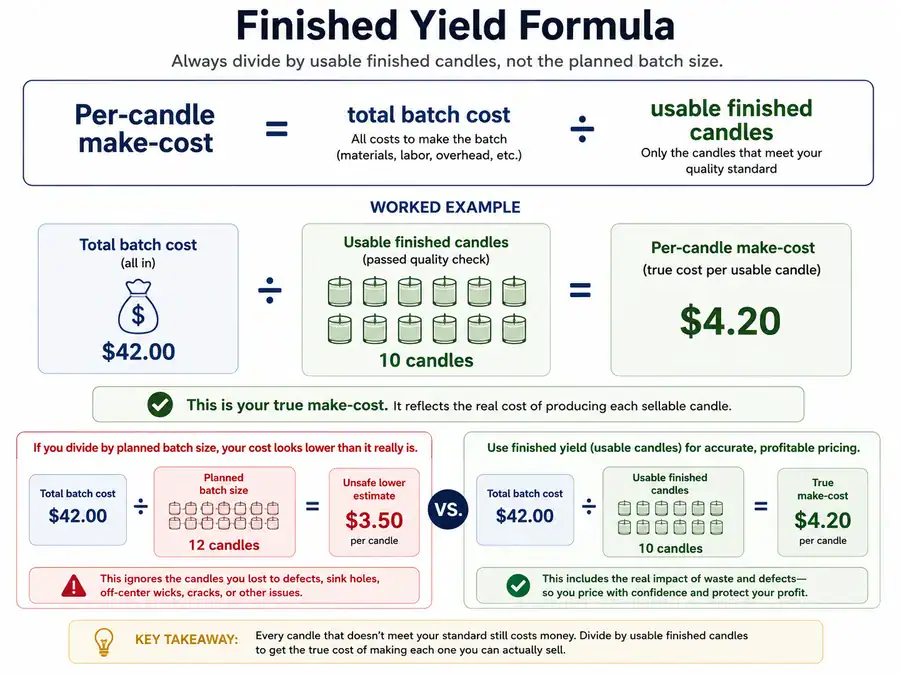
The basic logic is:
Per-candle make-cost = total batch cost ÷ usable finished candles.
That means a batch that starts with 24 candles but finishes with 21 usable candles should be divided by 21, not 24. This is where beginner estimates often go wrong. They count planned output instead of finished yield.
Container candles can scale cleanly when the maker has matching jars and a repeatable wick choice. Pillar candles scale once the mold set is large enough to avoid repeated waiting. Taper candles scale only when the forming process stays consistent, because a larger batch can create more handling defects if the workflow is rushed.
Batch size should not hide real material cost. More candles may reduce active labor per candle, but wax, fragrance oil, wicks, jars, labels, and packaging still rise with production. The main savings come from spread setup time, fewer one-off mistakes, and better reuse of molds or tools.
Simple Yield Example
A maker spends $42 on materials and active labor for a small container candle batch. The batch was planned for 12 candles, but 2 candles fail burn testing or finish checks.
The true repeat-production estimate is:
$42 ÷ 10 usable candles = $4.20 per finished candle.
Using the planned 12 candles would show $3.50 per candle, but that number ignores the failed units. Finished yield gives the safer comparison.
How Material Costs Change by Candle Type
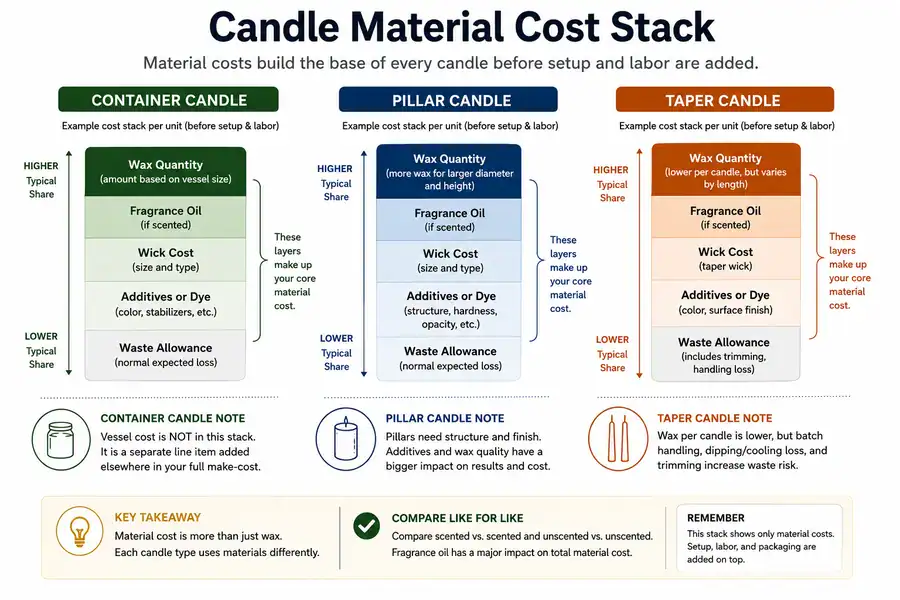
Material cost changes by candle type because each format uses a different wax mass, fragrance amount, wick setup, and optional additive need. Container candles usually add vessel cost elsewhere, while pillar and taper candles put more pressure on structure and finishing.
For this comparison, material cost means ingredients and small consumables that are used in the candle itself. It does not include full equipment buying, supplier reviews, shipping, retail markup, or business overhead.
| Material driver | Container candles | Pillar candles | Taper candles |
|---|---|---|---|
| Wax quantity | Based on vessel fill weight. | Based on mold size and finished freestanding shape. | Lower per candle, but usually made in pairs or sets. |
| Wax unit price | Multiplied by fill weight and waste. | Multiplied by mold capacity and scrap risk. | Multiplied by dipped or formed wax used across the batch. |
| Fragrance oil | Often a major cost in scented jars. | May be used, but structure and burn quality limit assumptions. | Often lower or omitted, depending on the product style. |
| Wick cost | Can rise with larger jars or multi-wick designs. | Usually one wick, but sizing tests matter. | Usually one long wick per taper. |
| Additives and dye | Often optional for color or appearance. | More likely when structure, hardness, or opacity matters. | More likely when hardness, color consistency, or drip behavior matters. |
Wax Quantity by Candle Type
Wax quantity is the base material amount needed to make a finished candle. Container candles use fill weight, pillar candles use mold capacity, and taper candles use the wax retained through dipping or forming.
The key distinction is net finished wax versus poured or melted wax. A container candle estimate often starts with the wax fill weight of the jar. A pillar estimate starts with the mold’s finished candle size. A taper estimate depends on the batch method because some wax stays in the dipping vat or is lost through trimming and uneven buildup.
| Candle type | Best wax quantity basis | Cost risk |
|---|---|---|
| Container candle | Net wax fill weight in the vessel. | Overfilling, sinkholes, or failed wick tests can waste the full jar. |
| Pillar candle | Mold capacity and finished pillar weight. | Cracking, poor release, or trimming can reduce usable yield. |
| Taper candle | Wax used across the dipped or formed batch. | Uneven tapers, drips, and rejects can hide true wax use. |
A wax-per-candle calculator is the better place for exact fill-weight math. Here, the useful rule is to compare finished candle formats on the same basis: wax used, waste allowed, and usable finished yield.
Wax Cost per Unit
Wax unit cost is the wax price converted into the same weight unit before candle types are compared. A fair estimate should use one currency and one weight basis, such as cost per pound or cost per kilogram.
This step matters because a cheap wax used in a large container candle can cost more per finished unit than a higher-priced wax used in a small taper. The wax type alone does not decide the candle’s cost. The format, wax mass, waste allowance, and batch yield decide how much of that wax price lands in each finished candle.
Use this sequence for a clean estimate:
- Convert wax price to one unit, such as price per pound.
- Estimate wax used per finished candle type.
- Add a waste allowance before dividing by usable finished yield.
- Keep scented and unscented versions separate.
Fragrance Load and Fragrance Oil Cost
Fragrance oil cost is the oil cost added to a scented candle based on fragrance percentage, wax mass, and oil unit price. It should be excluded when comparing unscented candles.
This is one of the biggest places where candle type comparisons become unfair. A scented container candle should not be compared against an unscented taper as though both use the same recipe. A larger candle also holds more wax, so the same fragrance percentage can add more oil cost to one format than another.
| Comparison question | Safer assumption |
|---|---|
| Are all three candle types scented? | Compare scented with scented, or separate unscented from scented. |
| Is the same fragrance oil used? | Use the same oil unit price across all types. |
| Is the same fragrance percentage used? | State the percentage as an assumption, not a universal rule. |
| Is fragrance part of the main product? | Include it for scented product cost, exclude it for unscented baseline cost. |
Fragrance load belongs in this article only as a cost driver. Choosing the best fragrance percentage for soy wax, coconut wax, paraffin wax, or beeswax belongs in a fragrance-load article.
Wick Cost and Wick Count
Wick cost changes by candle type because wick size, wick length, wick tab, and wick count vary by format. The unit price may be small, but failed wick tests can make the true cost higher.
Container candles can need thicker wicks or multiple wicks when the vessel is wide. Pillar candles often use one wick, but the wick must support a freestanding burn pattern. Taper candles usually use one long wick per candle, but straightness and tension can affect rejects.
| Wick factor | Why it affects cost |
|---|---|
| Wick count | Multi-wick containers use more wick assemblies per finished candle. |
| Wick length | Tapers may use longer wick lengths than small jars. |
| Wick size testing | Wrong sizing can create failed prototypes and wasted materials. |
| Wick accessories | Tabs, stickers, sustainers, or centering tools may apply to some formats. |
The wick itself is rarely the largest line item. The larger cost risk is testing. A failed wick test can consume wax, fragrance, dye, vessel use, labor, and time before a reliable formula is set.
Additives, Dye, and Hardening Agents
Additives, dye, and hardening agents add cost when they are used for function, color, structure, or appearance. They should not be treated as required costs unless the candle format or recipe needs them.
Container candles may use dye mainly for appearance. Pillar candles may need structure-related formulation choices because the candle must stand without a vessel. Taper candles may need hardness or color consistency depending on the wax and making method.
This category should stay secondary in a cost comparison. Wax, fragrance, vessel or mold effect, labor, waste, and testing usually matter more. Additives become important when they prevent rejects, improve release, support color goals, or help a freestanding candle hold shape.
Material-Cost Method
Material-cost method adds candle ingredients and small consumables before the estimate accounts for waste and finished yield.
Material cost per finished candle = wax + fragrance + wick + additive or dye + format-specific consumables + waste allowance.
This formula still needs the correct candle type. Container candles usually add recurring vessel cost in the next section. Pillar candles need reusable mold cost handled separately. Taper candles need process setup and yield handled separately.
Container, Mold, or Taper Setup Cost
Setup cost differs because container candles consume a vessel, pillar candles reuse molds, and taper candles depend on dipping or forming tools. This is the main reason the cheapest first batch may not be the cheapest repeat batch.
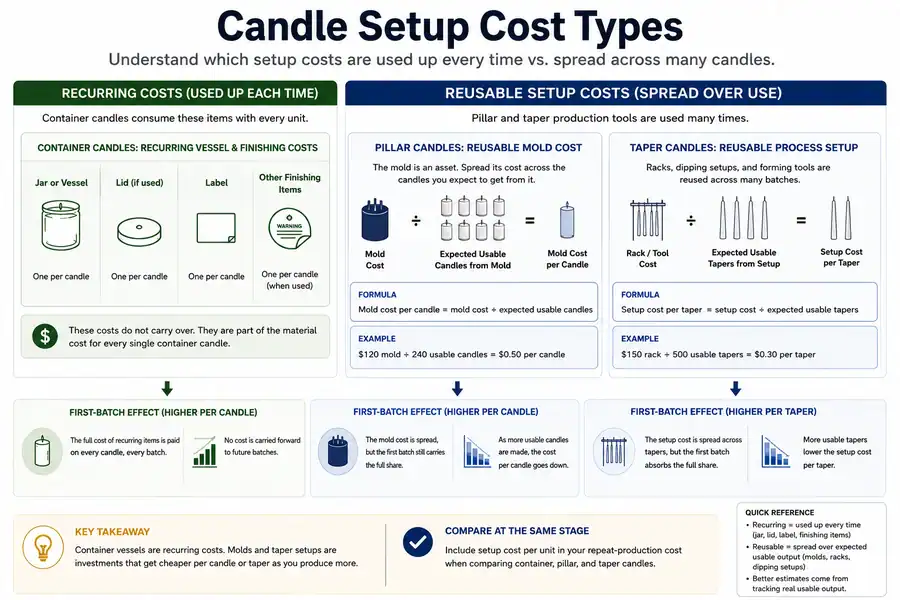
For candle types, setup cost should be split into recurring cost and reusable cost. A jar is usually a recurring unit cost because each container candle needs one. A pillar mold is usually reusable, so its cost should be spread across many finished candles. Taper tools can be reusable, but the process may add more labor.
| Cost type | Container candle | Pillar candle | Taper candle |
|---|---|---|---|
| Recurring form cost | Jar, tin, lid, or vessel per finished candle. | Usually low, unless liners or release products are used. | Usually low per candle, depending on method. |
| Reusable form cost | Limited, because the vessel leaves with the candle. | Mold cost spread across repeated batches. | Dipping rack, mold, frame, or forming setup spread across use. |
| First-batch effect | High if jars, lids, and testing units are bought upfront. | High if molds are new and the formula fails. | High if setup tools are bought before the process is stable. |
| Repeat-batch effect | Vessel cost remains tied to every candle. | Mold cost drops per candle as it is reused. | Tool cost drops, but labor may stay higher. |
A container candle often feels beginner-friendly, but the vessel cost repeats forever. A pillar candle can feel expensive at the start, but the mold can become cheaper per candle over repeated batches. A taper candle can use less material, but its setup only pays off when the maker can produce straight, usable tapers in a reliable batch.
Mold Amortization for Pillar Candles
Mold amortization means spreading the cost of a reusable mold across the number of usable candles it helps make. It is not the same as a full accounting depreciation schedule.
The practical estimate is:
Mold cost per candle = mold cost ÷ expected usable candles from that mold.
For example, a $20 mold spread across 100 usable pillar candles adds $0.20 per candle before wax, wick, labor, waste, and testing. The first batch should not carry the whole mold cost if the maker plans to use the mold many times. It should carry a reasonable portion.
This is why pillar candles can look expensive in the first batch but more cost-effective later. The mold is a reusable production form, not a consumable vessel.
Container Defect and Breakage Allowance
Container candles need a defect allowance because jars, tins, lids, and labels are tied to each finished unit. A chipped jar, poor lid fit, crooked label, or failed wick test can make the vessel cost part of the loss.
This allowance is not about ecommerce shipping damage. It is about production-stage loss before the finished candle is ready. A container candle cost estimate should leave room for unusable vessels and finished candles that cannot pass a basic quality check.
Common container cost losses include:
- chipped or scratched jars;
- lids that do not fit cleanly;
- labels applied incorrectly;
- wick stickers that fail;
- jars lost during failed burn tests;
- finished candles rejected for cosmetic or performance reasons.
A container candle may still be the best beginner format because the vessel supports the wax and simplifies the shape. It just should not be priced as wax plus fragrance only.
Setup-Cost Method
Setup-cost method separates recurring vessel costs from reusable mold or taper-tool costs before comparing formats.
- Put jars, lids, and single-use inserts into recurring cost.
- Put pillar molds, taper racks, and reusable forming tools into spread cost.
- Keep full equipment buying lists outside this article.
- Add first-batch uncertainty when the process is not proven.
- Compare repeat-production cost only after the reusable setup is assigned fairly.
The equipment article is the better place for a complete buying list. This cost article only includes setup items when they change the per-candle estimate.
How Labor Time Changes by Candle Type
Labor cost depends on active hands-on time, not cooling, curing, or waiting time. Container candles are usually faster to repeat, pillar candles add mold and finishing work, and taper candles often take the most process attention.
Labor belongs in the make-cost estimate when the candle is made for a market, shop, wholesale account, or any production setting where time has a value. Hobby makers can leave labor as a note, but the comparison still helps because some candle types take more hands-on work than others.
| Labor task | Container candles | Pillar candles | Taper candles |
|---|---|---|---|
| Setup | Wick jars, prepare vessels, melt wax, stage fragrance. | Prepare mold, wick mold, seal if needed, melt wax. | Prepare wick, rack, dipping vat, mold, or forming setup. |
| Making process | Pour into vessels and center wicks. | Pour into mold and manage release. | Dip, build layers, form, or straighten in repeated steps. |
| Finishing | Trim wick, clean rim, smooth top if needed, label. | Trim base, smooth surface, clean seam, fix release marks. | Trim ends, pair tapers, straighten, inspect surface. |
| Repeat-batch labor | Often drops quickly once jars are staged. | Drops when several molds can be filled in one cycle. | Drops only when the dipping or forming rhythm is steady. |
Container candles often have the simplest active workflow. The jar holds the wax, the shape is fixed by the vessel, and batches can be staged in rows. That makes container candles easier to repeat once the wick choice and pour method are reliable.
Pillar candles add more active handling because the finished candle must stand on its own. The maker may need to prepare the mold, release the candle, trim the base, inspect the surface, and fix minor finish issues.
Taper candles often use less material per candle, but labor can rise because the candle shape depends on repeated handling. Dipping, straightening, matching pairs, trimming, and rejecting uneven tapers can make a low-material candle less cheap in real production.
Finishing and Cleanup Labor
Finishing labor is the hands-on work needed after the candle is formed. It includes trimming, smoothing, cleaning, inspecting, pairing, labeling, and preparing the candle for use or sale.
| Candle type | Common finishing work | Cost effect |
|---|---|---|
| Container candle | Trim wick, clean vessel rim, apply label, inspect top. | Usually predictable, but label errors and surface fixes add time. |
| Pillar candle | Remove from mold, trim base, smooth seams, correct surface flaws. | Can add time when mold release or surface quality is inconsistent. |
| Taper candle | Trim ends, straighten, match pairs, remove drips, inspect shape. | Can add time when tapers bend, vary in thickness, or need pairing. |
Cleanup also differs by type. Container batches leave pouring pots, thermometers, and spills to clean. Pillar batches add mold cleaning and release residue. Taper batches can leave dipping equipment, racks, and wax buildup that must be reset before the next batch.
Equipment Energy and Heat-Hold Time
Equipment energy is usually a smaller cost than wax, fragrance, labor, waste, and testing. It matters most when a process requires longer melting, remelting, or heat-holding time.
Container candles may have a simple melt-and-pour workflow. Pillar candles may need remelting when molds are reused in rounds or when failed pieces are reworked. Taper candles may need a longer heat-hold window if the maker keeps a dipping vat at working temperature.
This cost should stay small in the comparison unless the maker tracks utilities closely. For most beginners, it is enough to note that longer process time can raise marginal cost, while exact utility accounting belongs outside this article.
Labor-Cost Method
Labor-cost method counts active hands-on minutes and divides that time across usable finished candles.
- Count active hands-on minutes only.
- Keep cooling and curing time separate unless someone is actively managing the batch.
- Divide batch labor by usable finished candles.
- Note extra finishing work by candle type.
- Compare hobby estimates both with and without labor so the difference is clear.
A candle batch workflow article is the better place for a full production sequence. This article only counts labor when it changes the container, pillar, and taper cost comparison.
Waste, Scrap, and Rework Rate by Candle Type
Waste raises true candle cost because planned materials do not always become usable finished candles. Container candles lose cost through failed vessels, pillar candles through cracks and release issues, and taper candles through uneven or damaged pieces.
A realistic estimate should include a waste allowance. Without it, the cost looks like an ideal recipe instead of a finished-unit production estimate.
| Waste type | Container candles | Pillar candles | Taper candles |
|---|---|---|---|
| Material waste | Spills, overfills, sinkholes, failed fragrance or dye tests. | Cracks, poor release, trimming loss, remelted wax. | Drips, uneven buildup, trimming loss, wax left in the dipping setup. |
| Unit rejects | Failed burn tests, poor tops, damaged jars, crooked labels. | Cracked bodies, unstable bases, poor finish, unsafe burn behavior. | Bent tapers, mismatched pairs, broken candles, uneven thickness. |
| Rework chance | Some wax may be saved, but the jar or label may be lost. | Wax can sometimes be remelted, but labor still rises. | Some wax can return to the pot, but shape and handling losses remain. |
| Main cost risk | A failed unit can waste wax, wick, fragrance, jar, lid, and label. | A failed unit can waste time and reduce usable mold output. | A failed unit can reduce pair yield and slow the whole batch. |
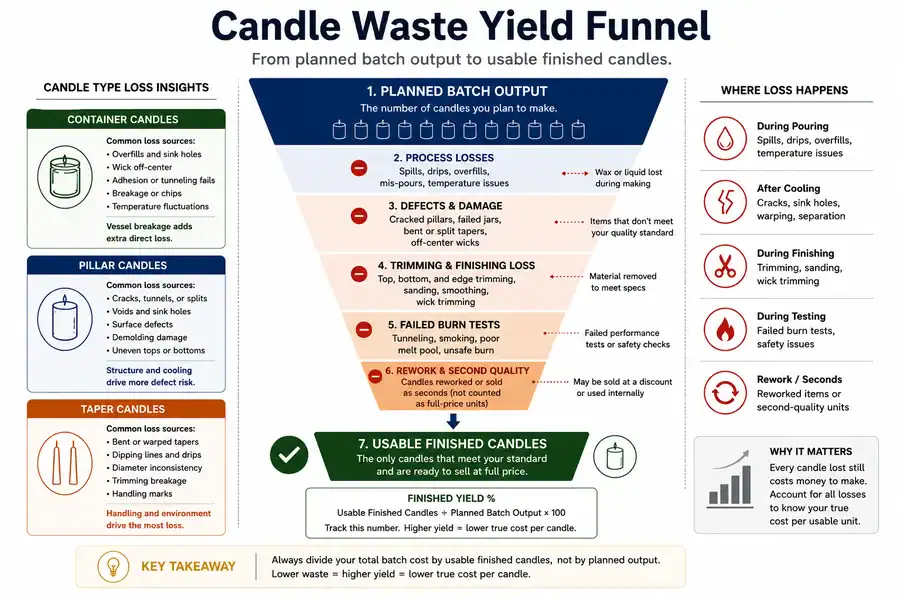
Waste is not only spilled wax. It includes any input that does not become a usable finished candle. That may include wax, wick, fragrance oil, vessel, label, packaging, time, or testing material.
Failure Log: Common Cost Errors
Common candle-cost errors come from dividing by planned output, ignoring rejects, or mixing prototype and repeat-production numbers.
| Error | Root cause | Cost-safe fix |
|---|---|---|
| Counting planned candles instead of usable candles. | The estimate uses batch size, not finished yield. | Divide by usable finished candles after rejects. |
| Treating all wax as saleable output. | Trimming, spills, failed pours, and remelts are ignored. | Add a small waste allowance before comparing types. |
| Comparing first attempts with proven batches. | Prototype cost and repeat-production cost are mixed. | Label the estimate as prototype or repeat production. |
| Ignoring container losses. | The jar is treated as separate from failed tests. | Count unusable vessels, lids, and labels in finished-unit cost. |
| Assuming pillars are cheap because molds are reusable. | Mold reuse is counted, but cracks and finish failures are ignored. | Spread mold cost and include expected rejects. |
| Assuming tapers are cheap because they use less wax. | Labor, pair matching, bends, and breakage are ignored. | Count usable pairs or usable individual tapers after inspection. |
Container candles can have high waste cost when a failed test consumes a full vessel. Pillar candles can have high rework cost when a batch releases poorly or cracks. Taper candles can have hidden waste when many pieces must be paired, straightened, trimmed, or rejected.
Remelting can lower material loss, but it does not erase the full cost. The maker still spent time, used heat, delayed the batch, and may not recover fragrance quality, color consistency, vessel cost, or wick cost.
Waste-Cost Method
Waste-cost method adjusts planned batch output to usable finished yield before dividing total batch cost.
- Start with planned batch size.
- Remove failed, rejected, or unusable candles.
- Count recovered wax only when it can be reused safely in the same production plan.
- Keep unsafe burn failures separate from cosmetic defects.
- Divide total batch cost by usable finished candles.
- Use a troubleshooting page for defect diagnosis instead of turning this article into a defect manual.
This waste layer is why a candle that looks cheapest on materials can become less cheap in practice. The true comparison is not only what went into the pot. It is what came out as usable finished candles.
Testing Cost and Burn-Test Burden
Testing cost is development cost, not normal repeat-production cost, until a candle formula has passed burn checks. A burn test is a controlled burn check used to evaluate wick behavior, melt pool, flame, heat, and finish performance.
Testing affects container, pillar, and taper candles differently because each format fails in different ways. A failed test candle should usually be counted in prototype cost. It should not be treated as a normal repeat-production unit once the same formula is proven and repeatable.
| Testing question | Container candle | Pillar candle | Taper candle |
|---|---|---|---|
| What can fail? | Wick size, vessel heat, melt pool, soot, scent load, jar safety checks. | Wick size, wax hardness, stability, sidewall behavior, cracking, melt pattern. | Wick tension, straightness, drip behavior, pairing, burn rate, breakage. |
| What cost is lost in a failed test? | Wax, wick, fragrance, jar, lid, label, and labor. | Wax, wick, fragrance if used, mold time, finish labor, and possible rework. | Wax, wick, dipping time, trimming, pair matching, and handling time. |
| What makes testing heavier? | Wider vessels, multi-wick jars, heavy fragrance, new jar shapes. | New molds, freestanding shapes, structural wax changes, surface defects. | New dipping methods, wick tension, and fragile shapes. |
| Where should details go? | Burn testing candles article. | Burn testing candles article. | Burn testing candles article. |
Container candles can look simple, but testing may be costly when each failed test uses a jar. Multi-wick container candles raise the risk because one wrong wick choice can waste a finished vessel and all scented materials inside it.
Pillar candles often need more development work because the candle must burn well and stand on its own. A pillar that cracks, tunnels, leans, or releases poorly from the mold may be usable for notes but not for a reliable cost estimate.
Taper candles may have a low material cost per candle, but testing can expose labor and yield problems. A batch may burn acceptably yet still lose value if the tapers bend, drip too much, break, or cannot be matched into clean pairs.
Failure Log: Testing-Cost Mistakes
Testing-cost mistakes happen when failed prototypes are counted like normal repeat-production units.
| Mistake | Why it misleads the estimate | Better cost treatment |
|---|---|---|
| Counting a failed test as a normal unit. | It hides development cost inside repeat production. | Put failed tests under prototype cost. |
| Testing only the cheapest version. | It may ignore fragrance, dye, or wick changes used in the final candle. | Test the actual finished formula. |
| Comparing tested containers with untested pillars or tapers. | One format carries development cost while another does not. | Compare all three at the same production stage. |
| Treating burn testing as legal compliance. | It pulls the article into safety or jurisdiction-specific rules. | Use a burn testing article for full test planning. |
| Ignoring batch records. | The maker cannot tell whether a later batch matches the tested one. | Keep a batch record for wax, wick, fragrance, vessel or mold, and date. |
A safe cost comparison should say whether testing is included. Prototype estimates include test candles, failed burns, and formula changes. Repeat-production estimates include normal waste and quality checks after the formula is stable.
Use a burn testing candles article when the question becomes a full burn-test plan. Use a batch record template when the question becomes recordkeeping. This section only explains how testing changes the cost comparison between container, pillar, and taper candles.
Testing-Cost Method
Testing-cost method keeps failed candles in development cost until the formula is stable enough for repeat production.
- Label the estimate as prototype or repeat production.
- Count failed test candles as development cost.
- Do not compare a tested candle type with an untested candle type.
- Keep safety, standards, and full test protocol details outside this cost article.
- Move the proven formula into repeat-production cost only after the result is stable enough to repeat.
Packaging and Protection Differences
Packaging belongs in candle make-cost only when the estimate is for a sale-ready candle. Sale-ready make-cost is production cost plus basic label, box, insert, or protective materials before shipping.
Packaging can blur the line between making a candle and selling a candle. This article includes basic protection only when the candle is being prepared as a finished item for gifting, markets, or sale. Shipping, fulfillment, carrier damage, and ecommerce packing belong outside this comparison.
| Packaging need | Container candle | Pillar candle | Taper candle |
|---|---|---|---|
| Basic label or warning label | Often placed on the jar or lid. | Often placed on wrap, box, base label, or insert. | Often placed on sleeve, wrap, pair band, or box. |
| Protection need | Protect jar, lid, glass, surface, and label. | Protect edges, surface finish, base, and scent transfer. | Protect straightness, pairs, tips, and breakage-prone shapes. |
| Cost risk | Glass, lids, and labels can add recurring cost. | Boxes, wraps, and inserts may be needed to prevent scuffs or dents. | Sleeves, trays, or rigid boxes may be needed to stop bending or snapping. |
| Boundary | Production-stage packaging only. | Production-stage packaging only. | Production-stage packaging only. |
Container candle packaging can be simple when the jar is the presentation. The extra cost usually comes from labels, warning labels, lids, dust covers, inserts, and protection against scratches or breakage before sale.
Pillar candles often need surface protection because the candle itself is exposed. A wrap, box, or insert can prevent dents, dust, fragrance transfer, and scuffing. This can make a freestanding candle cost more than the wax and wick suggest.
Taper candles can need more protective packaging than beginners expect. Long, narrow candles can bend, snap, dent, or lose paired presentation. A low material-cost taper may need sleeves, pair bands, trays, or boxes to stay sale-ready.
Include-or-Exclude Packaging Table
Packaging belongs in the estimate only when each finished candle normally receives that label, wrap, box, insert, or protective material.
| Estimate type | Include packaging? | Reason |
|---|---|---|
| Material-only comparison | No. | The goal is ingredient cost, not finished presentation. |
| Prototype cost | Usually no, unless packaging is being tested too. | The goal is formula and process reliability. |
| Repeat-production cost | Sometimes. | Include it only if every finished unit normally receives packaging. |
| Sale-ready make-cost | Yes. | The candle is being prepared as a finished item. |
| Retail price or shipping estimate | Not here. | Pricing and fulfillment belong on separate pages. |
The candle packaging article is the better place to compare candle packaging costs in detail. Shipping candles is a separate fulfillment cost because shipping includes carrier rates, destination, packing method, weather risk, and delivery damage.
Packaging should not change the main answer unless the estimate is sale-ready. If the comparison is material-only, containers may still be expensive because of the vessel, but boxes and wraps should stay out. If the comparison is sale-ready, tapers and pillars may rise because they need more protection after production.
Packaging-Cost Method
Packaging-cost method includes only unit-level labels, wraps, boxes, inserts, or protection that belongs to the finished candle.
- State whether the estimate is material-only, repeat-production, or sale-ready.
- Add labels, lids, sleeves, wraps, boxes, or inserts only when they are part of the finished unit.
- Keep shipping cartons, postage, carrier fees, and fulfillment labor outside this page.
- Compare packaging by candle type, not as one flat cost for every format.
- Use the packaging article when the decision becomes label type, box type, or shipping protection.
Hidden Cost Table by Candle Type
Hidden costs are production costs that do not show up in a simple wax-plus-wick estimate. They include failed tests, wasted vessels, mold cleanup, taper handling loss, packaging, and extra finishing time.
These costs matter because container, pillar, and taper candles fail in different ways. A format that looks cheap on materials can become more expensive once rejects, rework, and testing are counted.
| Hidden cost | Container candles | Pillar candles | Taper candles |
|---|---|---|---|
| Failed wick tests | Can waste wax, fragrance, wick, jar, lid, and labor. | Can waste wax, wick, mold time, and finish labor. | Can waste wax, wick, dipping time, and paired output. |
| Form cost loss | Broken jar, bad lid, crooked label, or unusable vessel. | Mold cost is reusable, but poor release reduces yield. | Tool cost is reusable, but poor setup can slow the whole batch. |
| Finish work | Top repair, rim cleanup, label correction, wick centering fixes. | Seam smoothing, base trimming, surface correction, mold cleanup. | Straightening, trimming, pairing, drip removal, breakage checks. |
| Waste allowance | High when a full jar candle fails late. | High when cracks or release defects affect a batch. | High when many units are uneven, bent, or unmatched. |
| Testing burden | Higher with new vessels, fragrance loads, or multi-wick jars. | Higher with new molds, structural wax changes, or large freestanding forms. | Higher with new dipping methods, wick tension, and fragile shapes. |
| Sale-ready protection | Labels, lids, dust covers, wraps, or boxes. | Wraps, boxes, base labels, or surface protection. | Sleeves, pair bands, trays, or rigid boxes. |
The biggest hidden cost for container candles is that the vessel is tied to each finished unit. If the test fails or the jar is damaged, the loss is not just wax.
The biggest hidden cost for pillar candles is process reliability. A reusable mold can lower repeat cost, but cracks, release problems, and finish defects can raise the cost per usable candle.
The biggest hidden cost for taper candles is handling. Less wax does not always mean lower cost when straightness, pair matching, trimming, and breakage reduce the usable yield.
Hidden-Cost Check Before Choosing a Type
Use this check before deciding which candle type is cheapest for your situation:
- Count only usable finished candles.
- Add a waste allowance for the format you are making.
- Keep prototype tests separate from repeat batches.
- Spread reusable mold or tool cost across expected use.
- Include packaging only when the estimate is sale-ready.
When One Candle Type Becomes More Cost-Effective
A candle type becomes more cost-effective when its repeatable make-cost drops below the other formats under the same assumptions. That usually happens through batch size, reusable tools, lower waste, faster labor, or simpler testing.
Cost-effective does not mean most profitable. Profit depends on pricing, market demand, wholesale terms, retail margin, and brand position, which belong in a pricing article. Here, cost-effective means lower repeat production cost for usable finished candles.
| Situation | Type that may become more cost-effective | Reason |
|---|---|---|
| You need a predictable beginner batch. | Container candle | The vessel supports the wax and makes the shape easier to repeat. |
| You can reuse molds many times. | Pillar candle | Mold cost drops per candle when the same mold produces many usable units. |
| You can make straight tapers in reliable batches. | Taper candle | Lower wax use can win when labor and rejects stay controlled. |
| You use expensive jars or lids. | Pillar or taper candle | The recurring container cost can make jars the higher repeat-cost format. |
| You sell or gift sale-ready sets. | Depends on packaging | Tapers may need more protection, while containers may already have a presentable vessel. |
| You are still testing formulas. | No type is automatically cheapest. | Prototype failures can distort every format. |
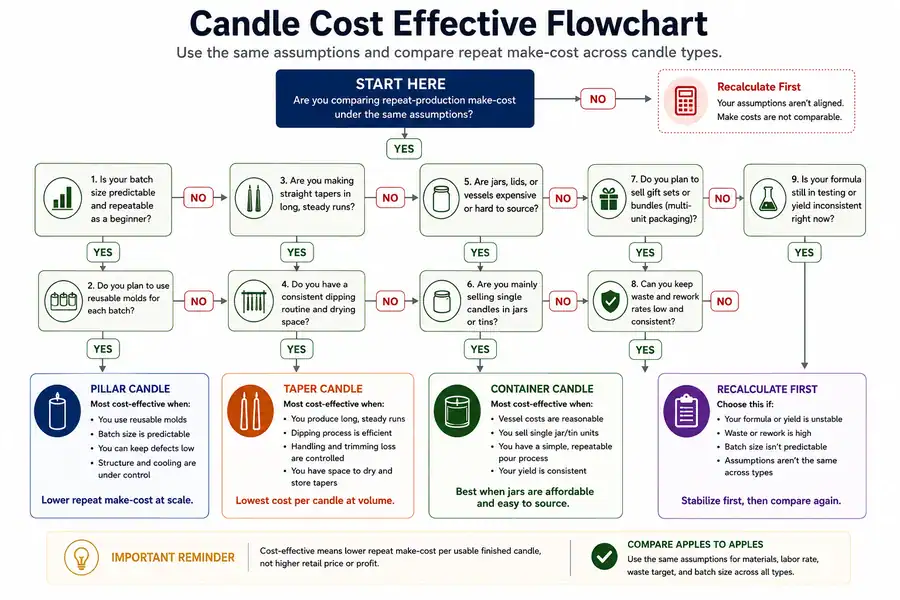
Container candles become more cost-effective when the maker can buy vessels consistently, reduce wick testing failures, pour in batches, and keep labels or lids simple. They become less cost-effective when jar cost, breakage, and multi-wick testing rise.
Pillar candles become more cost-effective when molds are reused across many finished candles and the formula releases cleanly. They become less cost-effective when cracks, surface flaws, poor bases, or failed burn tests reduce usable yield.
Taper candles become more cost-effective when the maker can produce straight, matching pieces with low breakage and steady process time. They become less cost-effective when labor, dipping setup, crooked pieces, or packaging protection add too much cost.
Decision Threshold Checklist
Use these thresholds as practical decision points:
- Choose container candles when predictable shape and beginner repeatability matter more than the recurring vessel cost.
- Choose pillar candles when you can reuse molds enough times to lower the per-candle setup cost.
- Choose taper candles when you can control labor, straightness, breakage, and pair yield.
- Recalculate when changing wax type, fragrance load, vessel size, mold size, or batch size.
- Move to a pricing formula only after make-cost is stable.
The main comparison should stay tied to finished-unit production cost. Once the question becomes “what should I charge?” the next step is a candle pricing formula, not a deeper version of this cost comparison.
What to Calculate Next
After comparing candle types, calculate exact COGS only when you know the candle format, recipe, batch size, finished yield, and whether packaging is included. COGS means cost of goods sold, or the direct cost assigned to each finished unit.
This article helps choose between container, pillar, and taper candles. It should not replace a full worksheet because exact numbers depend on supplier prices, recipe size, fragrance choice, waste rate, testing stage, and finished yield.
| Next question | Use this next page or tool | Why |
|---|---|---|
| How do I calculate the exact cost per finished candle? | How to calculate COGS per candle | It handles worksheet math and batch totals. |
| What should I charge for the candle? | Candle pricing formula | It adds margin, retail price, wholesale terms, and sales goals. |
| How much wax do I need? | How much wax per candle | It handles fill weight, mold capacity, and wax conversion. |
| What does a container candle cost by itself? | Cost to make container candles | It covers jars, lids, labels, vessel defects, and container-specific testing. |
| What does a pillar candle cost by itself? | Cost to make pillar candles | It covers molds, release, structure, finish work, and pillar-specific waste. |
| What does a taper candle cost by itself? | Cost to make taper candles | It covers dipping or forming, straightness, pair yield, and taper packaging. |
| How should I record batches? | Candle batch record sheet template | It tracks recipe, yield, test results, and repeatability. |
For a fast decision, compare the three candle types this way:
- Start with the same cost meaning: repeat-production make-cost.
- Compare material cost by format.
- Add recurring vessel or spread reusable mold cost.
- Add active labor.
- Add waste and testing allowance.
- Add packaging only for sale-ready cost.
- Move exact numbers into a COGS worksheet.
Container candles often cost more per repeat unit because the vessel is consumed. Pillar candles may cost more at first but can improve with mold reuse. Taper candles may use less material but can lose the advantage when labor, straightness, breakage, or packaging rise.