

Candle packaging cost is the packaging-only expense for labels, boxes, inserts, and physical shipping protection, not wax, jars, labor, postage, tax, or full candle cost of goods.
A practical candle packaging cost answer is the landed usable cost of each packaging layer divided by each sellable candle; simple label-only packaging stays lowest, while boxes, inserts, custom printing, and ecommerce protection raise the number.
Use candle packaging cost to budget the materials that present and protect each candle before it reaches a customer. It covers visible items such as labels, retail boxes, inserts, sleeves, and wraps, plus transit materials such as dividers, cushioning, and void fill. The number changes with print method, order quantity, customization, supplier shipping, setup or proof fees, waste, and sales channel. Keep it separate from full candle cost of goods because wax, fragrance, wicks, vessels, labor, fees, postage, tax, and profit margin belong in a broader pricing calculation.
How Much Does Candle Packaging Cost Per Candle?
Candle packaging cost per candle is the per-candle cost of presentation and protection materials, not the full cost to make or sell a candle.
It includes labels, boxes, inserts, wraps, cushioning, dividers, supplier shipping, setup fees, proof fees, and waste when those items apply. It excludes wax, fragrance, wicks, vessels, labor, marketplace fees, postage, tax, and profit margin.
Use this packaging-only formula before setting price:
Packaging cost per candle = (visible packaging component costs + supplier shipping + setup or proof fees + waste allowance) ÷ usable units
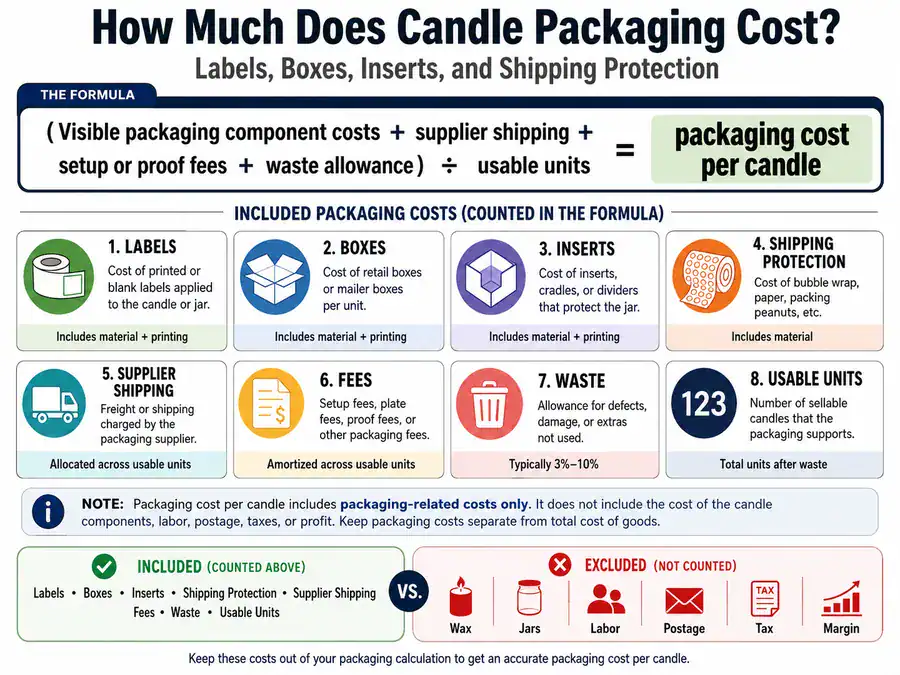
| Calculator input | What to enter | Why it matters |
|---|---|---|
| Label cost | Cost of vessel, lid, box, or safety-panel labels | Labels are often the first visible packaging cost. |
| Box cost | Retail box, gift box, sleeve, or mailer cost | Boxes can raise unit cost fast when custom printed. |
| Insert or card cost | Care card, thank-you card, scent card, coupon, or printed insert | Inserts are useful, but many are optional. |
| Shipping protection cost | Wrap, dividers, cushioning, sleeves, void fill, or carton protection | Protection helps prevent breakage without changing the candle formula. |
| Supplier shipping | Shipping charged by packaging suppliers | Landed packaging cost should spread this across usable units. |
| Setup or proof fees | Print setup, proof, die, or plate fees | Small custom runs can look cheap until fees are divided by units. |
| Usable packaging units | Units left after damage, misprints, or extras | Usable units are the real denominator. |
| Waste percentage | Expected waste from misprints, damage, or unusable stock | Waste raises the true per-candle packaging cost. |
A simple example: if visible packaging is $1.10 per candle, supplier shipping adds $0.15 per usable unit, setup fees add $0.10 per usable unit, and waste adds $0.08, the landed packaging cost is $1.43 per candle. Treat that as a packaging-only number, then use a full candle cost of goods calculation for wax, fragrance, vessels, labor, fees, and margin.
The table uses modeled packaging categories rather than live supplier prices because packaging costs change by supplier, quantity, print finish, and shipping distance. Check current quotes before ordering, especially for custom boxes, specialty labels, or short-run print jobs.
The largest packaging-cost driver is usually the layer that changes structure or fulfillment: custom boxes, rigid gift packaging, fitted inserts, and ecommerce protection usually change the total faster than a basic label or single card.
| Packaging component | Low-build version | Higher-build version | Include in packaging-only cost? | Watch for |
|---|---|---|---|---|
| Labels | Stock or home-printed labels | Professional printed labels with finish | Yes | Ink, misprints, test sheets, proof fees |
| Boxes | Stock kraft or plain box | Custom printed folding carton or gift box | Yes | Minimum order quantity and setup fees |
| Inserts | One care card | Multiple cards, coupons, scent cards, or booklets | Yes | Overbuilding the unboxing experience |
| Wraps and sleeves | Tissue, belly band, or paper wrap | Custom sleeve or printed wrap | Yes | Waste from sizing errors |
| Shipping protection | Paper fill, dividers, wrap, or cushioning | Custom inserts, fitted dividers, stronger cartons | Yes, for ecommerce orders | Breakage risk versus overpacking |
| Supplier shipping | Packaging supplier freight or delivery charge | Freight on bulky box orders | Yes, for landed cost | Dividing freight across usable units |
| Candle materials | Wax, fragrance, wick, jar, dye, additives | Any candle formula input | No | Belongs outside packaging |
| Selling costs | Postage, platform fees, tax, margin, ads | Any sales or business expense | No | Use calculate your full candle price after packaging is known |
Packaging cost is one part of candle pricing, not the whole price. Use calculate your full candle cost of goods when you need the full product cost stack, use estimate your final candle price when margin and fees enter the decision, and use where to source candle packaging when supplier quotes or minimum order quantities become the main question.
How Much Do Candle Labels Cost?
Candle label cost is the packaging expense for printed or blank adhesive labels used on the vessel, lid, box, or safety panel.
This cost covers label material, printing, finish, shape, quantity, supplier shipping, and wasted sheets. It does not decide whether the label is legally complete, which belongs with candle label requirements and warning label rules for candles.
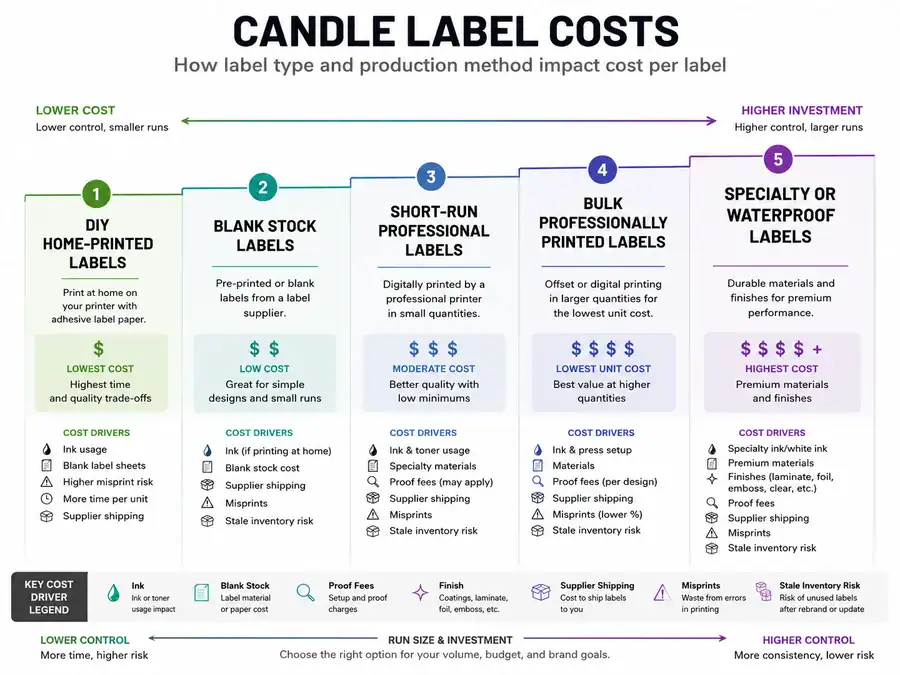
| Label type | Print method | Best for | Cost driver | Hidden cost to watch | When another topic applies |
|---|---|---|---|---|---|
| DIY home-printed labels | Inkjet or laser printer | Test batches, markets, scent trials, small runs | Ink, blank label stock, printer quality, sheet waste | Misalignment, test sheets, smudging, reprints | Use simple DIY candle packaging for hands-on package ideas. |
| Blank stock labels | Purchased blank sheets or rolls | Makers who want low custom cost with flexible designs | Material, adhesive, size, sheet layout | Unused shapes, printer mismatch, label waste | Keep the cost here; design ideas belong elsewhere. |
| Short-run professional labels | Online or local printer | Small launches that need cleaner output | Run size, proof fee, finish, shipping | Setup fees and higher unit price at low quantity | Compare supplier quotes before scaling. |
| Bulk professionally printed labels | Label supplier or packaging printer | Repeat scents, larger batches, wholesale-ready packaging | Quantity tier, roll format, material, finish | Minimum order quantity and stale inventory risk | Use where to source candle packaging when buying options become the main task. |
| Specialty or waterproof labels | Professional or specialty stock | Bath-adjacent products, glossy finishes, textured branding, high-touch presentation | Waterproof stock, laminate, foil, texture, die cut | Finish surcharge, proof delay, longer lead time | Keep logo systems and brand identity outside this cost section. |
DIY labels can be cheaper for very small runs, but they are not free if ink, wasted sheets, test prints, and hand-application time are ignored. Professional labels can cost more upfront, yet they often give cleaner output, steadier color, and lower waste once the same label is reordered in a larger quantity.
Label material affects cost because paper, clear film, waterproof stock, textured stock, foil, and laminate do not behave the same during printing or application. Shape also matters: a standard rectangle is usually easier to source than a custom die-cut label, and roll labels can price differently from sheet labels.
Label costs are best estimated by cost drivers instead of fixed prices because suppliers change print tiers, finish charges, proofs, and freight. Before ordering, compare the unit label cost after supplier shipping, setup fees, expected misprints, and unusable stock.
Keep label production cost separate from label law. If the question is what the label must legally say, treat that as a compliance question, not a packaging-cost question.
How Much Do Candle Boxes Cost?
Candle box cost can mean retail boxes, gift boxes, rigid presentation boxes, mailers, or shipping cartons, and each type has different cost drivers.
A retail or gift box is presentation packaging. A shipping carton is transit packaging. A mailer can serve both roles, but only if it protects the candle well enough during delivery.
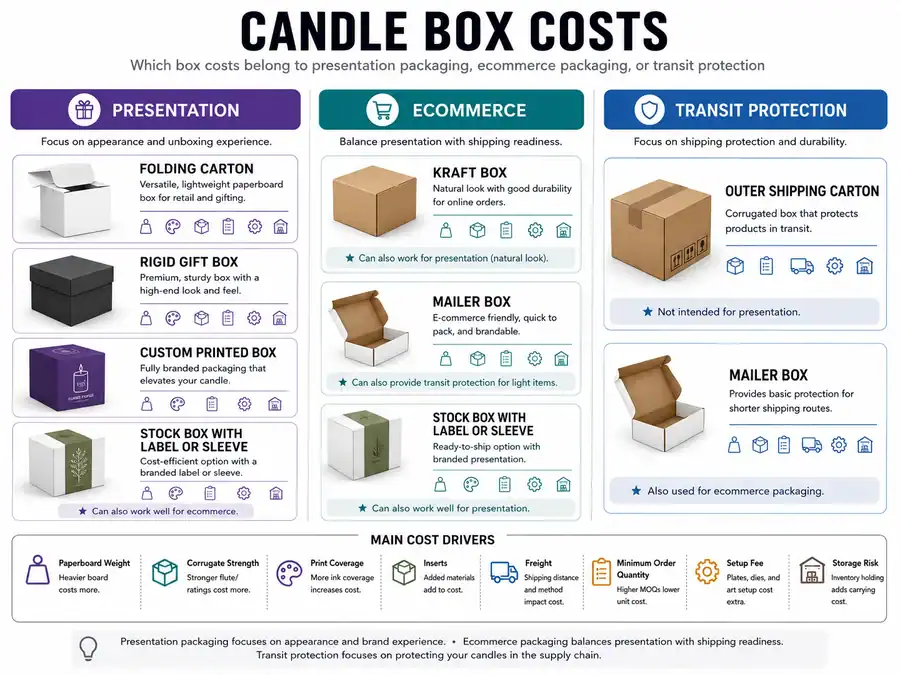
| Box type | Primary use | Cost driver | When it is worth it | When to delay | When another topic applies |
|---|---|---|---|---|---|
| Folding carton | Retail or gift presentation | Paperboard weight, print coverage, finish, size | You need a cleaner shelf or giftable look without rigid-box cost | You are still testing scents, jars, or label sizes | Use choose the right candle box type when box structure becomes the main decision. |
| Kraft box | Simple retail or market packaging | Stock size, paper weight, label or sleeve use | You want low-friction packaging that still looks finished | Your candle size changes often | Keep the decision cost-based before adding custom design. |
| Rigid gift box | Premium gifting or luxury-style presentation | Thick board, assembly, inserts, finish, freight | Your margin and audience support a higher presentation cost | You sell mainly test batches or price-sensitive candles | Treat luxury presentation as a separate design decision. |
| Mailer box | Ecommerce presentation and light protection | Corrugate grade, print coverage, size, insert fit | You ship direct-to-customer and want one box to present and protect | The candle still needs a separate outer carton or cushioning | Use shipping protection for candles when transit damage is the main concern. |
| Outer shipping carton | Physical transit protection | Corrugate strength, size, void fill, dividers | You sell online or ship multi-candle orders | You only sell in person and hand over the product | Do not treat carrier postage as box cost. |
| Custom printed box | Branded retail, wholesale, or premium packaging | Minimum order quantity, setup fee, proof, print area, supplier shipping | Your candle line is stable and repeat orders are likely | You may change jar size, brand marks, or scent lineup soon | Use source candle packaging suppliers when quotes, order minimums, and vendor comparison become the main task. |
| Stock box with label or sleeve | Budget-friendly branded presentation | Stock box price, label, sleeve, application time | You need a branded look without custom-box risk | You need exact retail shelf specs or special inserts | Move structural fit questions to box design rather than supplier rankings. |
Custom boxes often need a minimum order quantity because the supplier must set up print, cutting, proofing, and production before the first usable box is made. That setup cost spreads better across larger orders, but it can punish a small launch if the candle size or scent line changes before the boxes are used.
Rigid boxes usually cost more because they use thicker material, more assembly, more storage space, and higher inbound freight than flat folding cartons. A simple stock box is enough when the candle is sold locally, the vessel already looks good, or a label, sleeve, or belly band can give the package a finished look without locking you into custom inventory.
Box costs should be compared by usable unit, setup fee, minimum order quantity, supplier shipping, and expected waste. Detailed dielines, luxury box strategy, supplier rankings, retail shelf rules, and packaging photography sit outside the packaging-cost decision.
How Much Do Inserts, Care Cards, and Thank-You Cards Cost?
Inserts and cards are printed packaging materials placed in or around the package, such as care cards, thank-you cards, coupon cards, scent notes, and safety inserts.
Not every insert is required. The cost question is whether each printed piece improves customer use, safety communication, gifting, or repeat buying enough to justify paper, print, finish, quantity, and waste.
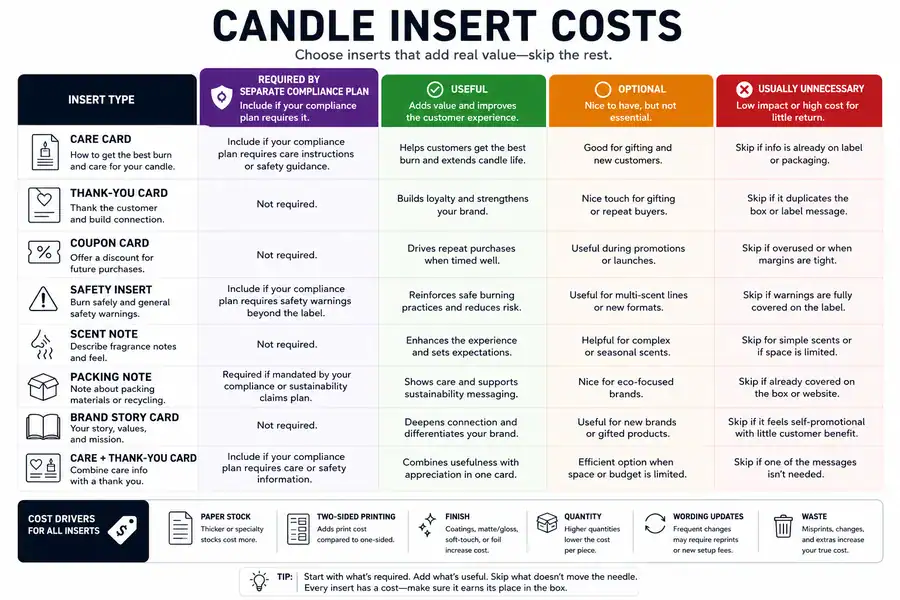
| Insert type | Required, useful, optional, or unnecessary | Purpose | Cost driver | When to use | When to skip |
|---|---|---|---|---|---|
| Care card | Useful | Explains safe candle use, trimming, burn time habits, and storage basics | Paper stock, size, color, finish, print quantity | Use one when customers need clear burn and care reminders | Skip duplicates if the same instructions are already on the label or package. |
| Thank-you card | Optional | Adds a personal note and giftable feel | Card stock, print side count, handwriting time, batch size | Use one for handmade positioning, gift orders, or local market follow-up | Skip when it adds cost without changing the customer experience. |
| Coupon card | Optional | Encourages a repeat order | Code setup, card printing, offer clarity, expiration changes | Use when the offer is simple and profitable after discount | Skip when the discount trains customers to wait or the code changes often. |
| Safety insert | Useful or required by your separate compliance plan | Adds safety details when label space is limited | Space, wording updates, legal review needs, print changes | Use when safety details cannot fit clearly on the main label | Do not use it as a substitute for checking label requirements. |
| Scent note | Optional | Describes fragrance notes or collection story | Print quality, paper choice, scent-line changes | Use for discovery sets, gift boxes, or premium collections | Skip when scent names are clear and customers do not need extra explanation. |
| Packing note | Usually unnecessary | Confirms order contents or handling note | Software output, paper, ink, packing time | Use when it solves order confusion or wholesale packing issues | Skip when it duplicates the packing slip or order confirmation. |
| Brand story card | Optional | Explains maker story, materials, or collection theme | Design changes, paper quality, print run size | Use when the story supports gifting or premium price | Skip when it repeats the website or makes a small order feel overbuilt. |
| Care-plus-thank-you card | Useful | Combines instructions and appreciation in one print piece | Layout, two-sided printing, card size | Use one combined card to cut extra inserts | Skip separate cards when one card can do both jobs. |
A care card is often worth it because it can reduce confusion about trimming, first burns, and safe use. Thank-you cards are worth it when they make a handmade order feel more personal, but they can become wasteful if every order already has strong packaging and clear communication.
Coupon inserts are most wasteful when the offer is unclear, too small to motivate a reorder, or too expensive after discount and shipping. Safety information may belong on a label, an insert, or both depending on the separate compliance context, so route wording and required-warning questions to the candle warning label topic rather than treating them as a print-cost choice.
Insert cost should be treated as paper, print, finish, quantity, and usefulness. Legal review, loyalty programs, email sequences, and packing-slip software belong outside this packaging-cost estimate.
Use a candle care-card template when the main need is wording or layout for care instructions. Use post-purchase customer education when the question shifts from printed packaging to follow-up messages after the order arrives.
How Much Should You Budget for Shipping Protection?
Shipping protection cost means protective packaging materials that prevent physical transit damage, including breakage, scratches, shifting, crushing, dents, and impact damage.
Here, protection means physical damage prevention only. It does not mean postage, carrier insurance, carrier choice, heat protection, claims, fulfillment software, customs paperwork, or melted-wax prevention.
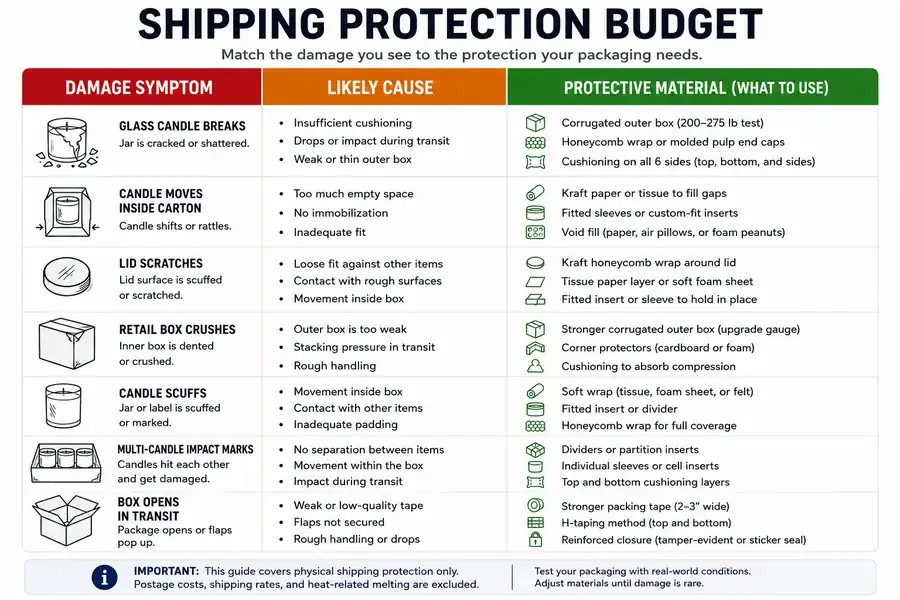
| Damage symptom | Likely cause | Protective material to add | Cost impact | When another topic applies |
|---|---|---|---|---|
| Glass candle breaks in transit | Not enough cushioning or void fill | Corrugated outer box, honeycomb wrap, kraft paper, or cushioning | Medium to high, depending on fragility and order weight | Use how to ship candles safely when the full packing sequence is the problem. |
| Candle moves inside carton | Missing divider, restraint, or snug fit | Dividers, fitted sleeves, paper fill, or internal restraints | Low to medium if corrected with stock inserts or paper | Use prevent candle breakage in transit when damage repeats after basic packing. |
| Lid arrives scratched or dented | No top protection or surface separation | Sleeve, paper wrap, lid pad, or corner protection | Low to medium | Keep this as physical protection, not presentation redesign. |
| Retail box arrives crushed | Weak outer carton or poor carton fit | Stronger corrugated box, better carton size, extra corner support | Medium | Do not turn this into carrier-rate calculation. |
| Candle surface scuffs during shipping | Jar rubs against box, insert, or another product | Paper wrap, sleeve, divider, or soft cushioning | Low | Keep cosmetic scuff prevention separate from brand-design changes. |
| Multi-candle order arrives with jar impact marks | Products touch during transit | Dividers, honeycomb wrap, kraft paper, or separate internal cells | Medium | Use a packing workflow only when order configuration becomes the main issue. |
| Box opens or weakens in transit | Poor tape choice or poor closure pattern | Stronger tape, better sealing pattern, or reinforced edges | Low | Tape cost belongs in protection, but postage does not. |
| Candle melts or sweats in delivery | Heat exposure, not impact damage | Not solved by ordinary cushioning | Not part of this protection budget | Route melting questions to hot-weather candle shipping. |
Retail packaging may not be enough for ecommerce shipping because a shelf box is usually built for presentation, not carrier handling. A candle that looks finished in a gift box may still need an outer corrugated carton, void fill, a sleeve, dividers, or cushioning once it enters transit.
Void fill counts as packaging cost when it prevents movement or impact inside the carton. Carrier postage does not count as shipping protection cost because postage pays for delivery, while protection materials reduce damage during delivery.
Use common damage patterns and practical cost-impact labels before buying in bulk. Check current material prices before ordering, especially for corrugated boxes, honeycomb wrap, dividers, and larger ecommerce cartons.
How Order Quantity Changes Packaging Cost
Order quantity affects candle packaging cost because supplier pricing, setup fees, print runs, shipping, and waste change the usable unit cost.
Larger packaging orders often lower unit cost, but they can increase cash outlay, storage needs, waste risk, and the chance of buying packaging before sales are proven. MOQ means minimum order quantity, and landed unit cost means the real cost per usable packaging unit after supplier shipping, fees, and waste are included.
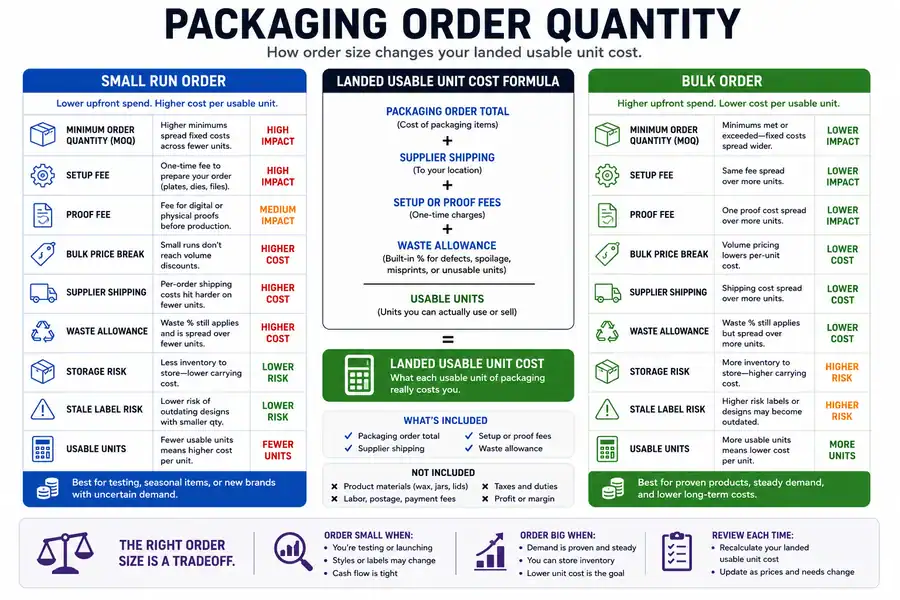
| Packaging component | Small-run option | Bulk option | Cost advantage | Hidden risk | Best stage |
|---|---|---|---|---|---|
| Labels | Home-printed sheets or short-run online labels | Roll labels or larger professional print runs | Bulk can lower the label cost per usable unit | Misprints, stale scent labels, proof fees, or design changes | Small run for testing; bulk for repeat scents |
| Boxes | Stock kraft boxes or plain folding cartons | Custom printed boxes or larger stock-box cases | Bulk can reduce box cost and improve consistency | High cash outlay, storage space, wrong size after jar changes | Stock for early sales; bulk after jar size is stable |
| Inserts | Small batch of care cards or thank-you cards | Larger print run of cards | Bulk can reduce print cost per card | Outdated coupon codes, scent names, or care wording | Small run until messaging is stable |
| Shipping protection | Small packs of wrap, paper, tape, or cushioning | Cases of corrugate, dividers, void fill, or honeycomb wrap | Bulk can reduce material cost per order | Bulky storage and wasted sizes if package dimensions change | Ecommerce once orders repeat |
| Sleeves or belly bands | Hand-cut or small-batch printed sleeves | Printed sleeve run | Bulk can improve consistency and reduce assembly waste | Setup fees and size lock-in | Market or ecommerce stage with stable vessels |
| Custom packaging | Stock packaging with label or stamp | Custom printed packaging with MOQ | Bulk spreads setup and proof fees across more units | Expensive mistakes at small volume | Only after sales, size, and branding are stable |
A setup fee is a one-time production charge for preparing a print or packaging job. A proof fee covers a sample or approval version before full production, and a bulk price break is the lower unit price offered at a higher order quantity.
Bulk means packaging purchase quantity, not candle inventory volume or wholesale sales volume. A beginner can own 500 candles and still need a small packaging order if the scent line, jar size, label design, or sales channel is not stable.
Use this formula before deciding whether bulk is cheaper:
Landed usable unit cost = (packaging order total + supplier shipping + setup or proof fees + waste allowance) ÷ usable units
A bulk order is only cheaper when the lower unit price beats the extra fees, supplier shipping, storage burden, and waste risk. Use source candle packaging suppliers when quotes, minimums, and vendor comparison become the main task, use calculate your candle price when packaging changes affect the final retail price, and use prepare for wholesale candle orders when packaging consistency becomes a sales-channel requirement.
Quantity breaks, fees, and freight change by supplier and material. Use current quotes and divide every fee across usable units, not ordered units, before treating a bulk price as cheaper.
DIY vs Professional Candle Packaging: Which Costs Less?
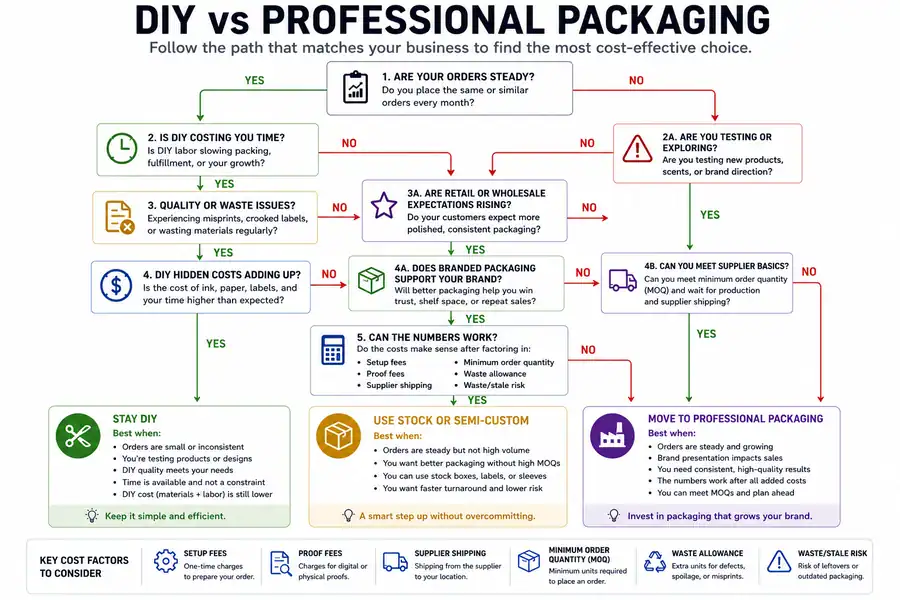
DIY candle packaging often costs less at tiny volumes, but professional packaging can cost less per usable unit when labor, waste, setup fees, and minimum orders are justified.
DIY means in-house printing, cutting, stamping, labeling, wrapping, or assembly. Professional packaging means outsourced printing or production for labels, boxes, inserts, sleeves, or branded packaging materials. Professional does not mean hiring a branding agency, building a luxury strategy, or paying for premium presentation before sales support it.
| Method | Best for | Visible cost | Hidden cost | Quality risk | Switch trigger |
|---|---|---|---|---|---|
| DIY packaging | Test batches, markets, new scents, changing jar sizes | Blank labels, ink, tissue, stock boxes, stamps, sleeves | Labor, test prints, misalignment, wasted stock, slow packing | Uneven cuts, smudged ink, crooked labels, inconsistent presentation | Move on when orders repeat and rework raises the real cost. |
| Stock packaging | Early sales with stable candle sizes | Stock boxes, blank labels, basic inserts, off-the-shelf mailers | Supplier shipping, unusable sizes, manual assembly | Cleaner than DIY, but less distinct | Move on when the same packaging repeats across batches. |
| Semi-custom packaging | Growing brands that need a branded look without full custom risk | Stock box plus custom label, sleeve, stamp, or card | More pieces, more hand assembly, design changes | Good balance if sizing stays stable | Move on when assembly time or presentation limits sales channels. |
| Professional labels | Repeat scents, larger batches, cleaner finish | Print run, material, finish, proof, shipping | Setup fees, proof fees, minimum quantity, stale label stock | More consistent, but mistakes can be expensive | Move on when DIY labels create misprints or slow packing. |
| Professional boxes or sleeves | Ecommerce, wholesale-ready packaging, giftable lines | Custom print, paperboard, die, finish, freight | Minimum order quantity, storage, setup, wrong-size risk | Strong consistency if specs are stable | Move on only when volume and channel expectations justify the order. |
The cheapest method is the one with the lowest landed usable unit cost, not the lowest visible supply price. A home-printed label may look cheaper than a professional label, but wasted sheets, ink, cutting time, and rejected labels can erase the gap.
Use this switch-trigger checklist before outsourcing packaging:
- Orders are steady enough to justify a minimum order quantity.
- DIY labor is slowing packing or market prep.
- Misprints, crooked labels, or wasted materials are raising real cost.
- Retail or wholesale buyers expect a steadier presentation.
- Branded packaging supports the current sales channel.
- The lower unit cost offsets setup fees, proof fees, supplier shipping, and waste risk.
Use make simple DIY candle packaging when the need is a hands-on packaging idea or low-volume assembly method. Use source candle packaging suppliers when quotes, minimums, and vendor comparison become the main job. Use plan candle branding basics when the question shifts from packaging cost to visual identity, logo use, or positioning.
Compare DIY and professional options by cost drivers, labor pressure, waste risk, minimum orders, and consistency triggers. Check current quotes and divide setup fees, proof fees, freight, and waste across usable packaging units before treating professional packaging as cheaper.
Hidden Candle Packaging Costs Beginners Miss
Hidden candle packaging costs are packaging-related expenses that are often missing from a supplier’s simple unit price.
Hidden does not mean fraudulent charges, tax deductions, bookkeeping categories, or general overhead. It means common packaging expenses such as supplier shipping, setup fees, proof fees, die fees, misprints, damaged materials, storage, overage, waste, unused seasonal packaging, and rush ordering.
| Underbudgeting mistake | Root cause | Packaging cost affected | Fix | When another topic applies |
|---|---|---|---|---|
| Counting only the listed unit price | Supplier page shows item cost before freight and fees | Labels, boxes, inserts, protection materials | Calculate landed usable unit cost before ordering | Use full candle cost of goods calculation when wax, fragrance, jars, labor, or fees enter the cost stack. |
| Ignoring supplier shipping | Boxes, mailers, and protective materials can be bulky | Landed packaging cost | Spread supplier shipping across usable units | Do not mix supplier shipping with customer postage. |
| Forgetting setup or proof fees | Custom print jobs may need setup, artwork checks, samples, or proofs | Custom labels, boxes, sleeves, inserts | Divide each fee across usable units | Use calculate your full candle price only after packaging cost is complete. |
| Treating ordered units as usable units | Misprints, damaged stock, wrong sizes, and test pieces reduce usable inventory | All printed and protective packaging | Estimate usable units after waste, not ordered units | Keep bookkeeping and tax handling outside this packaging-cost estimate. |
| Buying seasonal packaging too early | Holiday designs, scent names, or promotions expire | Boxes, labels, inserts, sleeves | Order closer to proven demand or use neutral packaging | This is packaging waste, not a full sales forecast. |
| Overordering custom packaging | Minimum order quantity looks cheap per unit but locks cash into one design | Custom boxes, labels, sleeves | Use smaller runs until jar size, scents, and artwork are stable | Use where to source candle packaging when supplier quotes and ordering terms become the main task. |
| Paying rush charges | Packaging was ordered after candles were ready to sell | Labels, inserts, boxes, protection materials | Set reorder points before stock runs out | Do not turn this into full inventory financing. |
| Storing bulky packaging badly | Boxes and mailers take space and can bend, scuff, or absorb odors | Retail boxes, mailers, inserts | Store flat, dry, and protected from crushing | Warehouse planning is outside this packaging-cost page. |
Listed unit price is not the same as landed usable unit cost. The better calculation is:
Landed usable unit cost = (listed packaging price + supplier shipping + setup fees + proof fees + die fees + waste allowance + damaged packaging) ÷ usable units
Setup fees can make small custom runs more expensive than expected because the fee is spread across fewer usable pieces. A $40 setup fee spread across 50 boxes adds more per box than the same fee spread across 500 boxes, even before supplier shipping and waste.
Use this hidden-cost checklist before placing a packaging order:
- Supplier shipping is included.
- Setup fees are included.
- Proof fees are included.
- Die fees are included.
- Minimum order quantity is realistic.
- Misprints are expected.
- Damaged materials are allowed for.
- Overage is not mistaken for usable stock.
- Storage space is available.
- Waste is included.
- Unused seasonal packaging is considered.
- Rush ordering is avoided where possible.
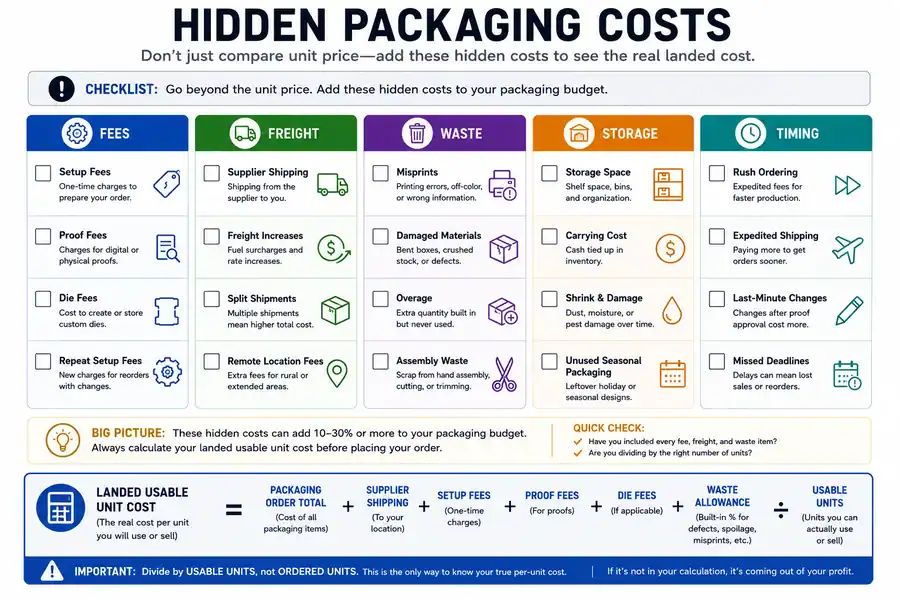
This checklist corrects the gap between visible packaging prices and real usable packaging cost. Tax accounting, bookkeeping workflows, overhead allocation, business insurance, inventory financing, and full margin planning belong outside packaging-only budgeting.
Packaging Budget by Stage: Hobby, Market, Ecommerce, Wholesale, and Premium
A candle packaging budget should change by business stage because hobby makers, local market sellers, ecommerce sellers, wholesale-ready brands, and premium gifting brands do not need the same packaging spend.
Budget means packaging-specific allocation for labels, boxes, inserts, and protection. It does not mean total startup cost, formal forecasting, full business budgeting, or profit planning.
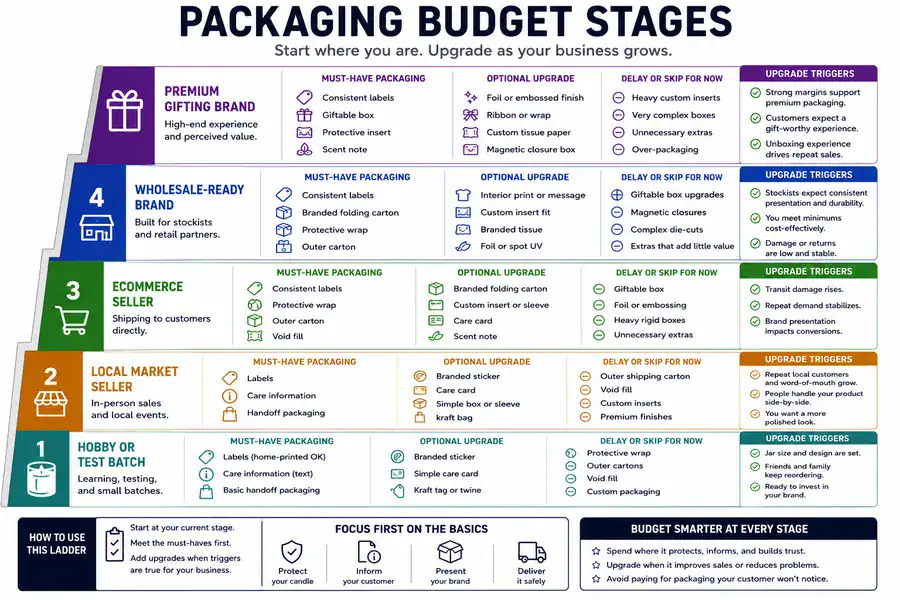
| Business stage | Primary channel | Must-have packaging | Optional upgrade | Upgrade to delay | Upgrade trigger |
|---|---|---|---|---|---|
| Hobby or test batch | Gifts, samples, early scent testing | Basic label, simple safety or care information, clean storage or handoff packaging | Stock label stock, simple wrap, small care card | Custom printed boxes, premium inserts, large label runs | Upgrade only when the jar size, scent name, and repeat demand are stable. |
| Local market seller | Farmers markets, craft fairs, pop-ups | Clean label, sturdy lid protection, simple bag or box for transport, basic care card | Stock kraft box, belly band, small-batch insert | Rigid gift boxes, high minimum custom packaging | Upgrade when customers handle products in person and presentation affects buying. |
| Ecommerce seller | Direct online orders | Label, protective wrap, outer carton, void fill, tape, dividers when needed | Branded mailer, combined care and thank-you card, fitted sleeve | Fancy retail box that still needs separate shipping protection | Upgrade when repeated orders show breakage, scuffing, or weak unboxing. |
| Wholesale-ready brand | Boutique inquiries, repeat stockists, larger batch sales | Consistent labels, consistent box or sleeve, clear care information, repeatable packing format | Branded folding carton, cleaner insert system, case-ready packing notes | Contract-specific packaging, retailer negotiation materials, full merchandising plans | Upgrade when buyers expect repeatable presentation across scents and batches. |
| Premium gifting brand | Gift boxes, curated sets, higher presentation expectations | Polished label, giftable box or sleeve, protective insert, clean card or scent note | Rigid box, upgraded paper stock, coordinated insert set | Luxury brand strategy, complex structural packaging, expensive seasonal runs | Upgrade when the selling price, audience, and reorder history support the higher presentation cost. |
Premium means elevated presentation expectations, not a full luxury-brand strategy. Wholesale means packaging-readiness for consistent presentation, not wholesale contracts, retailer negotiation, or legal terms.
A beginner should usually pay for clear labels, clean handoff packaging, and only the protection needed for the current channel. Ecommerce needs more shipping protection than local selling because the package must survive transit, not just look finished at the point of sale.
Branded boxes become worth considering when the candle size is stable, orders repeat, and the package supports the channel. Use calculate your candle price before allowing packaging upgrades to raise the retail price, use prepare for wholesale candle orders when packaging consistency becomes part of buyer readiness, use make simple DIY candle packaging for low-volume presentation ideas, and use plan candle branding basics when packaging decisions turn into brand positioning.
Match packaging spend to current channel, order volume, customer expectations, and margin risk. Premium packaging should not arrive before the business can use it.
Final Packaging Cost Checklist
The final packaging estimate should include packaging-only materials, supplier shipping, setup and proof fees, waste, damaged packaging, and hidden packaging costs.
It should exclude wax, fragrance, wicks, jars, labor, marketplace fees, customer postage, tax, margin, legal compliance work, supplier rankings, and full business planning. Use this checklist before placing the packaging number into a pricing calculation.
- Define packaging-only cost before pricing candles.
- Add label costs for vessel labels, lid labels, box labels, or safety-panel labels.
- Add box costs for retail boxes, gift boxes, sleeves, mailers, or outer cartons when relevant.
- Add insert costs for care cards, thank-you cards, scent notes, coupon cards, or safety inserts.
- Add shipping-protection costs for cushioning, wrap, dividers, void fill, sleeves, tape, and corrugated cartons.
- Include supplier shipping when calculating landed packaging cost.
- Include setup fees, proof fees, die fees, and print-run fees when they apply.
- Include waste from misprints, damaged stock, wrong sizes, test pieces, and unused seasonal packaging.
- Divide the total by usable packaging units, not ordered units.
- Separate packaging cost from wax, fragrance, wick, jar, labor, platform fees, tax, postage, and margin.
- Decide whether DIY, stock, semi-custom, or professional packaging matches current volume.
- Choose packaging upgrades by stage and channel instead of copying premium brands too early.
- Use calculate full candle COGS before treating packaging cost as the full product cost.
- Use estimate your final candle price before changing retail price, margin, or discount decisions.
The least misleading final number is the landed usable packaging cost per candle. It is narrow enough to keep packaging separate from full cost of goods, but complete enough to stop labels, boxes, inserts, protection, fees, and waste from being ignored.
Do not turn the final checklist into a legal, accounting, supplier-ranking, or business-plan step. Those topics need separate decisions because they include rules, costs, and risks beyond packaging-only budgeting.
FAQ
Does candle packaging cost include the jar?
No. The jar or vessel belongs in cost of goods, not packaging-only cost, unless the outer decorative container is separate presentation packaging. Use calculate your full candle cost of goods when the jar, wax, fragrance, wick, labor, and selling fees need to be counted together.
Should supplier shipping be included in packaging cost?
Yes. Supplier shipping should be spread across usable packaging units when you calculate landed packaging cost. This keeps labels, boxes, inserts, and protection materials from looking cheaper than they are after delivery and waste.
Do candle label costs include legal label requirements?
No. Candle label cost covers label production, such as blank stock, printing, finish, supplier shipping, setup fees, and waste. Use candle label requirements when the question is what the label must say.
Is shipping protection the same as shipping cost?
No. Shipping protection means physical materials that prevent damage, such as cushioning, dividers, wrap, tape, and corrugated cartons. Shipping cost usually means postage, carrier delivery charges, or rate calculation, and heat-related delivery problems belong with hot-weather candle shipping.
Is DIY candle packaging always cheaper?
No. DIY packaging can cost less for small runs, but labor, misprints, wasted stock, uneven finish, and slow assembly can raise the real cost. Professional packaging can make more sense when orders repeat and the lower usable unit cost offsets setup fees and minimum order quantities.
When should a candle business upgrade packaging?
Upgrade packaging when the sales channel, repeat order volume, customer expectations, and margin can support the added cost. Use prepare for wholesale candle orders when the reason for upgrading is buyer readiness or consistent stockist presentation.
What hidden packaging costs should beginners include?
Beginners should include supplier shipping, setup fees, proof fees, die fees, waste, misprints, damaged materials, overage, storage, rush ordering, and unused seasonal packaging. Use estimate your final candle price only after the packaging-only number is complete.