

Candle additives on this page are wax-performance modifiers such as stearic acid, Vybar, UV stabilizers, and related structure or finish aids, and the right choice means the best fit for your goal, wax system, and retesting burden rather than a universal “best” additive, a popularity pick, a brand preference, a legal-safety claim, or a decorative choice.
Candle makers usually reach for additives when the next step is not obvious: add a modifier, keep the formula simple, or leave a pre-blended wax alone. Here, performance means changes in firmness, opacity, scent-throw support, release, and nearby burn behavior, while compatibility means fit with wax type, fragrance load, wick behavior, pre-blended wax choices, and additive overlap. This page covers wax-performance modifiers, not fragrance oils, dyes, decorative additives, legal topics, or full recipe-building tools, so exact ratio charts, full troubleshooting trees, and full fragrance design belong elsewhere. For additive types and selection basics, start with candle additives and enhancers before you choose a performance path. Start with the result you want, then narrow the choice by hardness, finish, scent throw, wax fit, and stacking.
| Goal | Likely path | Better alternative when it fits | Retest burden | Go deeper |
|---|---|---|---|---|
| More firmness without pushing too far | Hardening additive path | Change to a firmer wax or blend first if the base wax is too soft from the start | Medium to high | Hardness, opacity, and mold-release guidance |
| More opacity or a creamier finish | Finish-support additive path | Change wax if the base wax already misses the look you want | Medium | Finish-focused additive guidance |
| Better scent support inside a known system | Additive support only after checking wax, wick, and load fit | Fix the wax-load-wick match first if throw or burn already looks unstable | Medium to high | Weak throw and poor-burn diagnosis |
| One broad performance gap with low test tolerance | Leave the formula simple or use a pre-blended wax | Do not add a modifier yet if the real issue is the wax path | Low to medium | Pre-blended wax decision page |
| The real question is exact use level | Move to dosage guidance | Do not solve an amount question by stacking more modifiers | High | Additive dosage guidance |
Choose the Right Candle Additive for the Result You Actually Want
Choose candle additives by the result you want, the wax system you use, and the retesting burden you can accept; sometimes the better path is changing wax or using a pre-blended system instead.
Candle additives are wax modifiers used to change firmness, finish, scent-throw support, release, or nearby burn behavior inside a wax system. On this page, performance means the candle result you want to change, and compatibility means whether that change still fits your wax, fragrance load, wick, and format. That matters because a good additive choice is not the same as a popular additive, and the right path can still be “do not add anything yet.”
Use choose an additive by candle goal as the first filter, not brand name or a generic “best additive” claim. Start with one main result, because a harder candle, a creamier look, and better scent support do not always point to the same path. If your wax already sits close to the result you want, changing wax can beat adding another modifier. If you cannot say what the additive is supposed to change, the formula is not ready for another variable.
Use this order before you add anything:
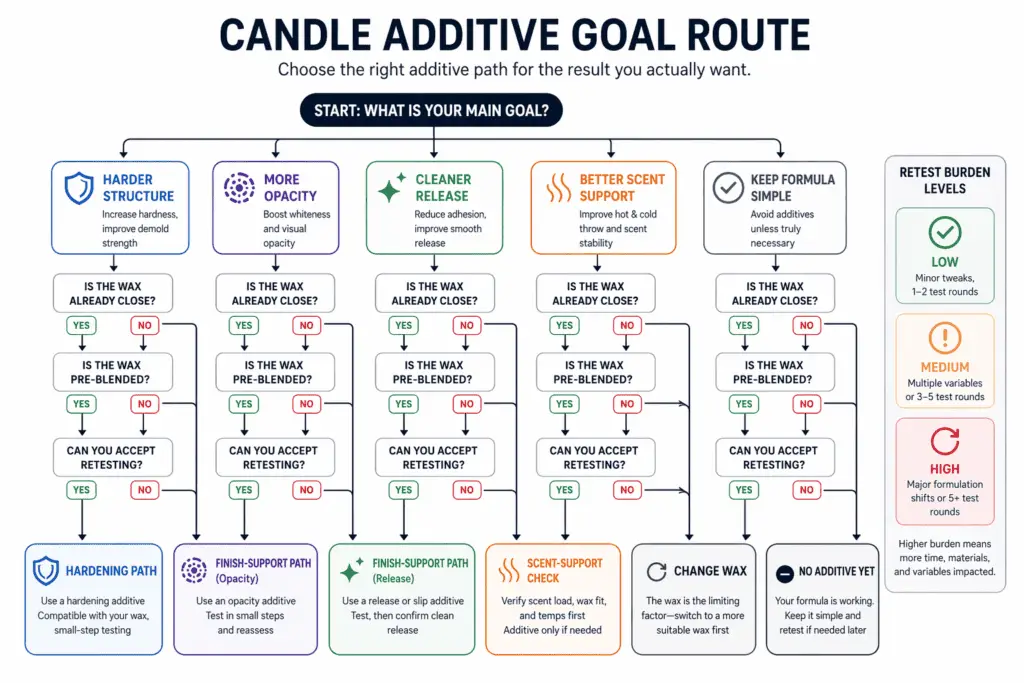
- Pick one main goal: harder structure, more opacity, cleaner release, or better scent support.
- Check whether your wax family already leans that way before you change the formula.
- Ask whether the change is large enough to retest the wick after additive changes.
- Decide whether the problem is broad or narrow. Broad problems often point to a wax-path change, while narrow gaps can justify a modifier.
- If the goal is broad and you want fewer moving parts, compare pre-blended wax with DIY additives before buying a modifier.
A narrow additive choice makes sense when the wax is known, the goal is clear, and you can still test after the change. A wax change makes more sense when the wax fights the goal from the start. A pre-blended path makes more sense when you want fewer variables and a more predictable result. The wrong move is adding a modifier before you know whether the base wax was the real limit.
A few quick examples make the decision easier to read:
- If the candle is close to right but still too soft, a hardening path may fit.
- If the candle is too translucent and the look matters more than a slight formula change, a finish-focused additive path may fit.
- If the wax already misses several targets at once, changing the wax is often cleaner than stacking fixes.
- If the wax is already sold as a balanced, pre-blended system, your first question should be whether intervention is needed at all.
That last point gets missed often. Many makers treat every performance gap as an additive problem when the better answer is a different wax path or a simpler system. On this page, “best” always means best for the goal, wax family, and testing tolerance you actually have.
When More Additive Stops Helping
More additive does not always give more benefit; after a point, it can flatten the gain or create a new problem.
The limit usually shows up as a tradeoff, not as a neat stop sign. You may get more firmness but lose balance, or you may get a visual gain and then lose clean burn behavior. That is why it helps to know when more additive stops helping instead of assuming every extra bit pushes the candle in the right direction. The useful range is not just about whether the additive “works.” It is about whether the candle still works as a whole.
Three signs the formula has moved past the useful point:
- The first change helped, but the next change barely moved the result.
- The candle gained one benefit and lost another, such as smoother structure but weaker scent throw.
- Burn behavior turned worse after the additive change, which means it may be time to retest the wick after additive-driven tradeoffs.
It helps to separate three different cases:
- Useful increase: the change improves the target result and the candle still behaves well.
- Diminishing return: the change keeps adding complexity but gives only a small visible gain.
- Wrong path: the change creates fresh problems and points back to wax choice, wick fit, or load balance.
That difference matters because “use less” and “use something else” are not the same answer. If the candle only needs a small nudge, another additive push may not be the right move. If the whole system is resisting the goal, the issue may be the route, not the amount.
Questions that usually signal over-addition include these:
- Did the candle get firmer but start throwing less?
- Did the finish improve while the burn got less steady?
- Did the formula become harder to judge because too many things changed at once?
- Did the extra additive solve one small issue but open a larger one?
When the real question becomes exact use level instead of route choice, move from over-addition to dosage guidance rather than treating the issue as a broad additive decision.
Pre-Blended Wax vs DIY Additives
Pre-blended wax is often the cleaner path when you want one broad result with less testing, while DIY additives fit narrower gaps inside a known wax system.
A pre-blended wax already carries a built-in direction, so it can reduce extra variables. A DIY additive path gives you more control, but it asks for clearer goals and more testing discipline. That is why many makers should compare pre-blended wax with DIY additives before they chase a second or third modifier. On an additive page, “do nothing and switch the wax path” is still a valid decision.
Use the comparison this way:
| Route | Best fit | Main tradeoff |
|---|---|---|
| Pre-blended wax | One broad goal, lower test tolerance, simpler setup | Less room for narrow tweaks |
| DIY additives | One clear gap inside a known wax system | More retesting and more chances to stack tradeoffs |
A pre-blended wax often fits when the maker wants a simpler path, is still early in testing, or needs several traits to improve at once. A DIY path often fits when the wax is mostly right and one outcome still needs work. The mistake is treating those paths as interchangeable. They are not. One removes variables. The other adds them.
A few route checks help:
- If your goal is “make this wax behave more like a different wax,” the cleaner answer may be a wax change.
- If your goal is “fix one narrow weakness in a wax I already know well,” a DIY additive can make sense.
- If the wax is pre-blended and already sold for the job you want, first ask what real gap remains.
- If the candle needs several fixes at once, adding separate modifiers can turn a simple choice into a harder one.
If your goal is broad and your test tolerance is low, choose a simpler wax path instead of modifying the formula. If the wax already works and only one result is missing, a DIY modifier can be the cleaner move. When one additive becomes the clear answer, move from route choice to additive-specific guidance instead of treating every additive as interchangeable.
Once the goal is clear, firmness becomes easier to judge because added structure only helps when it does not turn into brittleness.
Which Additive Path Improves Hardness Without Brittleness?
A hardening additive can increase firmness, but the better path depends on wax type and format because more hardness can raise brittleness and retesting needs.
Candle additives change structure, not every candle result at once. Here, hardness means firmer structure and easier handling, while brittleness is the warning sign that the gain has gone too far or the wax path was wrong. Harder does not automatically mean better, and a firmer candle that burns worse is not a clear win.
Use this section to improve candle firmness without brittleness by matching the path to the wax and the candle format, not by chasing the hardest result possible.
| Path | Firmness gain | Brittleness risk | When it fits best | Main caution |
|---|---|---|---|---|
| Firmer wax or firmer blend | Medium to high | Low to medium | Base wax is too soft from the start | May remove the need for an additive at all |
| Stearic-led hardening | Medium to high | Medium to high | Need more structure and a firmer feel | Can push the candle too far and change burn fit |
| Vybar-related structural support | Low to medium | Low to medium | Need extra structure without chasing the hardest result | Still changes the system and may need retesting |
| Pre-blended hard-wax path | Medium to high | Low to medium | Want a firmer result with fewer moving parts | Less room for narrow adjustment |
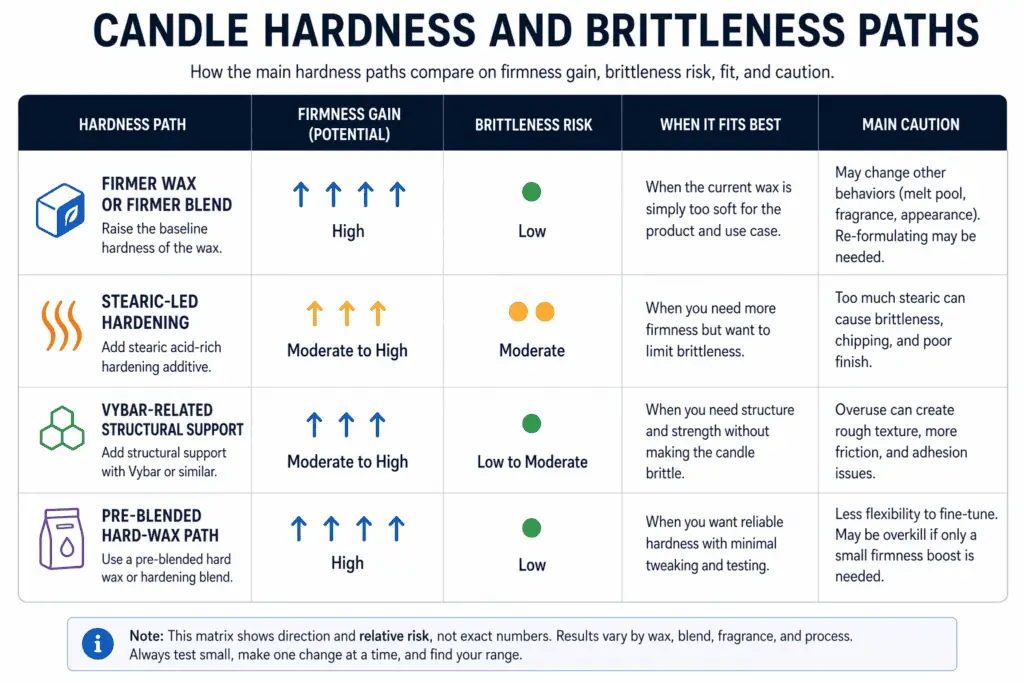
How to read the comparison: these are direction markers, not supplier-specific numbers. Low, medium, and high only show the likely pattern, so the final call still depends on wax family, candle format, fragrance load, and wick fit. The useful question is not “Which option is strongest?” but “Which option moves structure in the right direction without forcing a worse tradeoff somewhere else?” If the real question is one structural path against another, compare stearic acid vs. Vybar separately.
Container candles and pillar or mold candles should not be treated as the same job. A container candle often needs enough structure to hold shape and burn well, while a pillar or mold candle may need much more firmness before the candle even handles well. That does not mean every hardening discussion should become a pillar tutorial. It only means format changes how much firmness is actually helpful. When format becomes the main issue, pillar-specific additive guidance is the next step.
Softness can come from different causes:
- The wax itself may be naturally softer than the format needs.
- The fragrance load may be making the system feel less stable.
- The additive path may be helping structure but hurting another part of the system.
- The candle may be in the wrong wax family for the result being chased.
A harder candle does not automatically burn better. If a hardening change leaves you with weak scent throw, soot, or poor burn behavior, the formula has moved out of a pure hardness question and into wick and system fit. In that case, the next move is usually retesting, not adding more hardener. The better answer may be “back up and change the route” rather than “push harder.”
If softness is really a wax-choice problem, change the wax path before you keep adding structure modifiers. If the real question is exact use level, how dosage changes hardness tradeoffs becomes the next question, because a small shift can move a firm candle into a brittle one.
Which Additives Change Opacity and Visual Finish?
Additives can make wax look more opaque, creamy, or less translucent, but this section covers additive-led finish support rather than full defect diagnosis or color design.
Additives change visible finish only inside the wax system, so appearance gains should be judged against wax choice, defect causes, and tradeoffs elsewhere. Candle additives are wax modifiers here, and performance means visible wax outcome, not color design or a full defect-repair path. Opacity means how solid or creamy the wax looks, while visual finish covers surface character such as a smoother, more even, or less translucent look.
Use change candle opacity with additives when the goal is a different wax look, not when the real goal is stronger dye color or a full defect diagnosis. A finish change can come from the additive, the wax base, or both, so a more opaque result does not prove that the additive was the main lever. If the wax family already gives the look you want, changing wax can be cleaner than adding another modifier.
A simple way to separate the main causes:
- Additive-led change: the wax looks creamier, less translucent, or more solid after the modifier change.
- Wax-led change: the base wax itself already pushes the finish in that direction.
- Defect-led problem: the surface issue points to cooling, pouring, or formula trouble rather than a finish-support decision.
- Color-led choice: the real need is tint, shade, or color depth rather than opacity support.
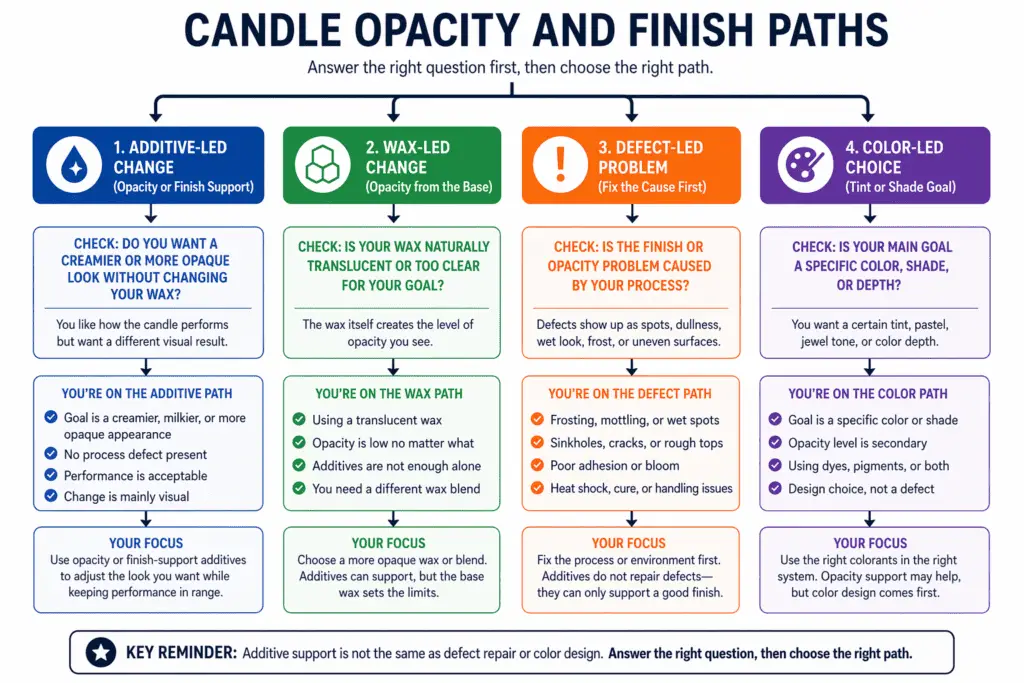
Opacity questions often get mixed up with other finish questions. A candle can look too clear, too mottled, too uneven, or too pale, and those are not all the same issue. This page only covers additive-led finish support. It does not turn every surface problem into an additive answer.
That is why opacity is not the same as defect repair. If the question is really how to troubleshoot frosting and surface defects, the better path is a troubleshooting page, because frosting, mottling, and sinkholes can come from more than additive choice alone. If the real question is color or tint, choose dye or additive based on the finish goal instead of treating both tools as the same fix.
A few comparison checks help keep the decision clean:
- If the wax is naturally translucent and you want a creamier look, an opacity-support path can make sense.
- If the surface issue showed up after a process change, the additive may not be the main cause.
- If the candle looks good but burns worse after the formula change, the finish gain may not be worth it.
- If the base wax already gives the right look, adding another modifier may only add test burden.
Common finish patterns are easier to read when you compare the goal with the tradeoff. A creamier or more opaque look can help when the wax seems too translucent, but the gain may not justify an extra variable if the same candle already burns and smells the way you want. When the look change brings a new burn or throw problem, the formula has moved out of a finish-only decision.
Once the look is clear, scent throw becomes the next filter because the same additive that changes finish can still change how fragrance performs.
Do Candle Additives Actually Help Scent Throw?
Candle additives can affect scent throw, but they are not universal throw boosters.
Additives may help scent throw with the right additive only when wax, fragrance load, and wick fit still work together. In this part of the article, performance means hot-throw and cold-throw limits inside the candle system, not a promise that any additive will make the candle smell stronger on its own. Hot throw is the scent you get while the candle burns, and cold throw is the scent you notice before lighting.
A useful rule is to ask what the additive may change and what it cannot control alone. An additive can shift how the wax holds or releases fragrance, but it does not replace base-wax fit, fragrance-load balance, or wick behavior. That is why one maker may see a gain while another sees weaker hot throw from what sounds like the same change. “Helps” here means conditional support, not direct magic.
Three distinctions keep the topic clear:
- Cold throw vs hot throw: a candle can smell fine at rest and still underperform when lit.
- Support vs cure: an additive can support a system, but it cannot cure a poor wax-load-wick match by itself.
- Additive effect vs system effect: the same additive may look helpful until the wick or load shifts the result the other way.
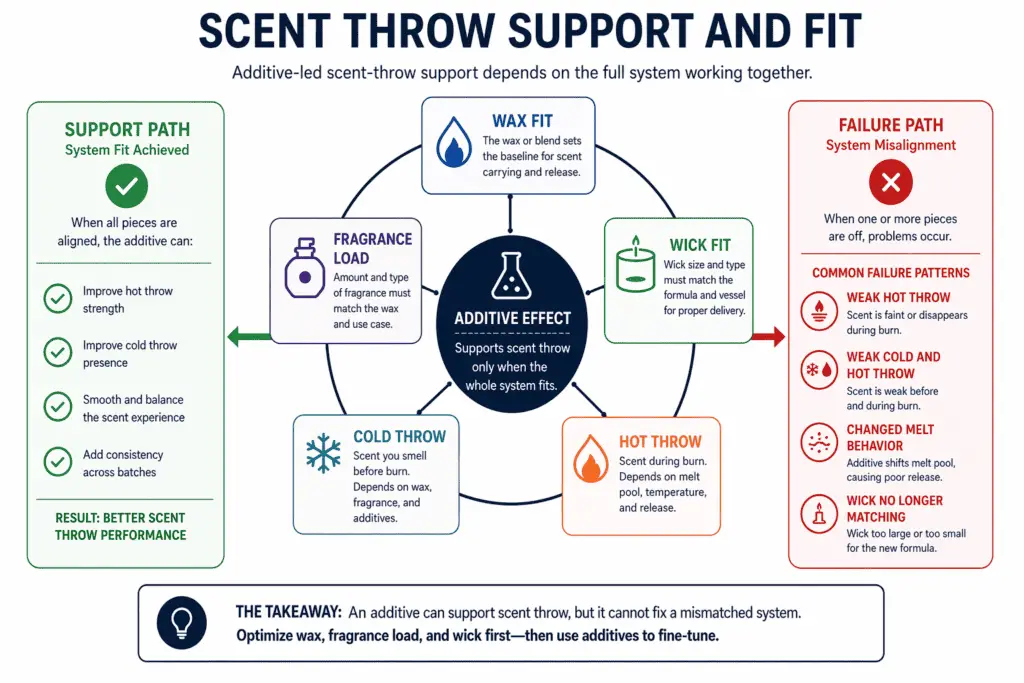
When an additive seems to make throw worse, the usual patterns are narrow and practical:
- The wax and additive no longer work well together.
- The fragrance load is already too high for the new system.
- The wick no longer matches the changed melt behavior.
- The formula was chasing throw when the real problem sat elsewhere.
A simple way to read the result is to keep the comparison tight. If cold throw stayed fine but hot throw dropped, the wick or melt behavior may matter more than the additive label. If both hot and cold throw weakened after the change, the wax-additive-fragrance fit may have moved in the wrong direction. If the main complaint is unstable burning, use fix weak scent throw by checking wick and load before adding more support.
A few common contradictions deserve a plain answer:
- Can a structural additive still help throw in some systems? Yes, sometimes, but only when the full system supports that result.
- Can a hardening path lower throw in some setups? Yes, because more structure can come with a release tradeoff.
- Does weak throw always mean the additive failed? No. It can mean the wick or load stopped matching the new formula.
That last point matters because throw complaints often sit one layer away from the additive itself. A formula change that seems minor can still shift melt pool behavior, release, and burn balance enough to change what you smell in the room.
The wick often needs review first, because throw complaints can belong to wick fit or fragrance-load compatibility after additive changes rather than to the additive alone. If the main need is full weak-throw diagnosis, cure-time questions, or oil-specific troubleshooting, that belongs on a narrower page.
The next choice is wax-system fit, because the same additive can behave one way in soy and another in paraffin or a blend.
Which Additives Fit Different Wax Systems?
Additive compatibility depends on the wax family or blend, not on whether the additive is popular or widely used.
Candle additive compatibility means whether a wax modifier behaves in a predictable way in a specific wax family or blend, not whether it works everywhere. Candle additives are conditional modifiers, so soy, paraffin, coconut, beeswax, and blends can react to the same additive in different ways. That is why it helps to choose additives by wax type before you judge hardness, finish, throw, or burn changes.
A simple wax-first comparison keeps the choice narrow:
| Wax system | Common reason people add a modifier | Usual decision path | Main caution | Retest burden |
|---|---|---|---|---|
| Soy | More firmness, better finish, or cleaner release | Start with a narrow modifier only if the wax is not already pre-blended | Natural wax systems can swing faster after small formula changes | Medium to high |
| Paraffin | Fine-tune firmness, finish, or fragrance support | Targeted additive changes are often easier to read | A good result in paraffin does not mean the same result in soy or a blend | Medium |
| Coconut or soft blends | Add structure or support a harder surface | Treat it as a blend question first, not a coconut-only question | Soft blends can expose new burn or throw issues after a formula change | Medium to high |
| Beeswax | Correct one clear issue without changing the character too much | Keep changes narrow and question whether an additive is needed at all | Extra modifiers can pull the candle away from the reason beeswax was chosen | Medium |
| Mixed wax blends | Balance more than one trait at once | Judge the dominant wax first, then the target result | Blend behavior can hide overlap and make results harder to read | High |
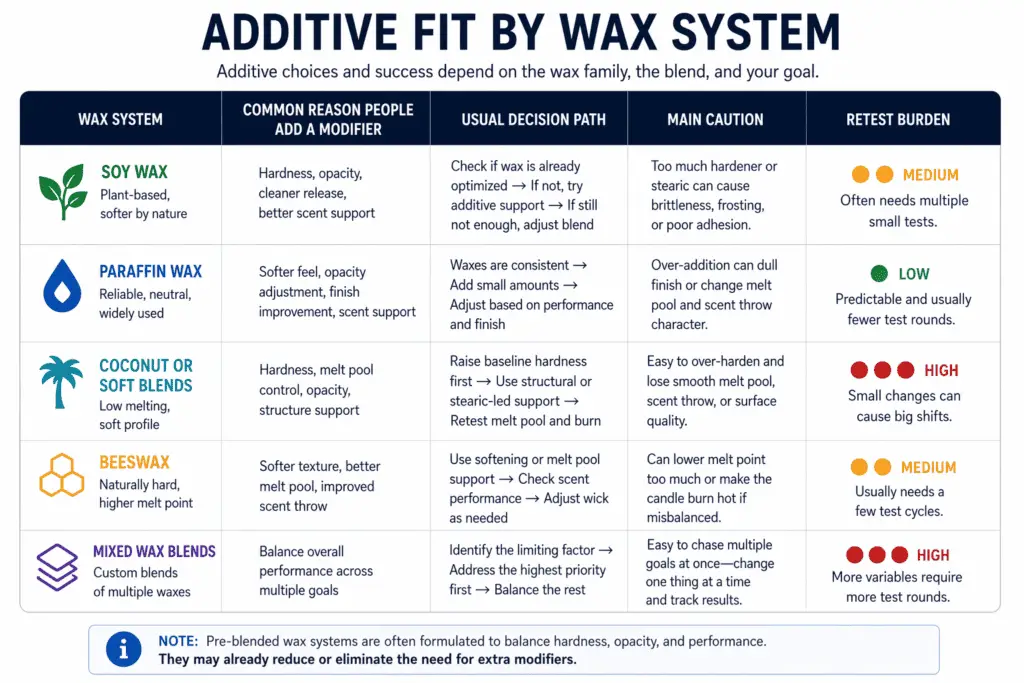
The table gives direction, not brand-level rules. A wax family changes what “compatible” means, how much retesting you should expect, and whether the better move is no additive change at all. Pre-blended systems often shrink the need for extra modifiers, so a formula that is already balanced should not be treated like raw wax that still needs major correction.
Wax-first thinking helps because it prevents the most common wrong assumption: that an additive which worked in one wax will work the same way in another. It may not. Natural blends, especially softer ones, can react differently from paraffin-led systems. A pre-blended wax can change the decision again because the modifier package may already be doing part of the work.
A few practical checks help:
- If the wax is raw and still not close to the goal, an additive may be part of the answer.
- If the wax is pre-blended and already built for the job, the first question is whether you need extra intervention at all.
- If the wax is a soft natural blend, expect more retesting burden after even a modest formula change.
- If the result looks good in one wax but fails in another, do not assume the additive is inconsistent before checking the wax family first.
Two route checks matter before you change anything. First, use fragrance-load compatibility after wax selection when the real pressure comes from how much oil the system is carrying. Second, retest the wick when the wax system changes if the additive materially shifts melt behavior, firmness, or pool shape.
How Additives Change Fragrance-Load Compatibility
Additives can support fragrance-load stability in some wax systems, but they do not give unlimited room for more oil.
Here, the question is not how to push fragrance as high as possible. The question is whether a modifier still keeps the wax, oil load, and burn system stable enough to work well. That is the reason to stabilize fragrance load with the right additive path, not to treat any additive as permission to keep raising the load.
Load compatibility sits under wax compatibility on this page. It is still an additive question, but only in relation to whether the modified system stays stable. It is not a full fragrance tutorial, a compliance topic, or a page for exact oil limits.
A useful split is simple. If the candle stays stable and the load goal is modest, additive support may help. If sweating, separation, or erratic burn behavior appears, it may be smarter to lower fragrance load instead of adding more support. In many cases, the wrong target is the problem, not the absence of another modifier.
A few signs help separate support from overload:
- The candle holds together well after the change and still burns in a stable way.
- Oil beads or sweating show up after fragrance and additive changes.
- The surface looks less settled after the formula shift.
- Hot throw goals keep rising while the system looks less stable.
- The wick starts behaving differently after a change that was supposed to support load.
Watch for three signs that the system is under too much stress:
- Oil beads or sweating show up after the formula change.
- The candle burns less evenly after fragrance and additive changes.
- Throw goals keep rising while the wax system looks less stable.
When those signs appear, troubleshoot the changed formula before you assume the candle needs more support. If the question becomes exact oil limits, oil-specific behavior, or rule-based fragrance limits, that belongs on a fragrance-load page rather than inside this additive decision page.
When an Additive Change Means You Must Retest the Wick
If an additive materially changes the wax system, the wick may need retesting because burn fit can shift with the formula.
A wick does not stay locked just because the wax name stayed the same. Structure changes, pool changes, and fragrance-load shifts can all alter how the wick behaves after an additive change. That is why you should retest the wick after additive changes when the formula change is large enough to affect melt behavior or burn balance.
On this page, wick interaction is a system consequence of additive-led formula change. It is not a full wick chart, and it is not a broad troubleshooting page. The point is simpler: if the additive changed the burn conditions, the wick may no longer be a clean fit.
Use this quick check after a formula change:
- What changed: hardness, finish, fragrance load, or more than one variable.
- What showed up: tunneling, drowning, soot, weak throw, or an odd melt pool.
- What follows: keep the wick, retest the wick, or stop and rethink the additive path.
A few common triggers make retesting more likely:
- The wax became firmer or softer in a way that changes melt behavior.
- The fragrance load shifted enough to affect the burn.
- The pool shape or pool speed no longer looks familiar.
- A finish-driven change ended up altering burn behavior too.
- More than one formula variable changed at once.
Not every burn problem comes only from the additive. A new symptom can still have more than one cause, which is why it helps to stop guessing and narrow the sequence: what changed first, what symptom appeared second, and whether the symptom fits a wick problem, a load problem, or a route problem.
If a new tunnel shows up after the change, diagnose the new burn pattern before you assume the wick line was wrong from the start. If the candle now burns hotter, soots more, or throws less, check weak throw, soot, or poor burn after additive changes before resizing the wick so you do not solve the wrong problem. When the need becomes exact wick sizing or a full burn diagnosis, that belongs on a wick or troubleshooting page.
Can You Combine Candle Additives or Should You Keep the Formula Simple?
Yes, you can combine candle additives, but the real question is whether stacking is justified or whether one cleaner path is better.
On this page, additive stacking means combining wax modifiers for overlapping or separate goals inside one candle system, not building an open-ended custom formula. Two additives can work together, yet they can just as easily duplicate the same job, raise retest burden, and make the result harder to read. That is why the safer starting point is to combine candle additives without adding unnecessary complexity only when each additive has a clear, separate job.
A simple decision split keeps stacking from turning into guesswork:
| Decision path | When it fits | Main risk |
|---|---|---|
| One dominant additive | One clear goal, such as more firmness or a different finish | Adding a second modifier may only duplicate the first job |
| Two additives with different jobs | Two distinct targets that do not pull in the same direction | More variables can blur the cause of a bad result |
| No extra additive change | Wax choice or a pre-blended system solves the problem more cleanly | Chasing a second modifier can turn a simple fix into a messy one |
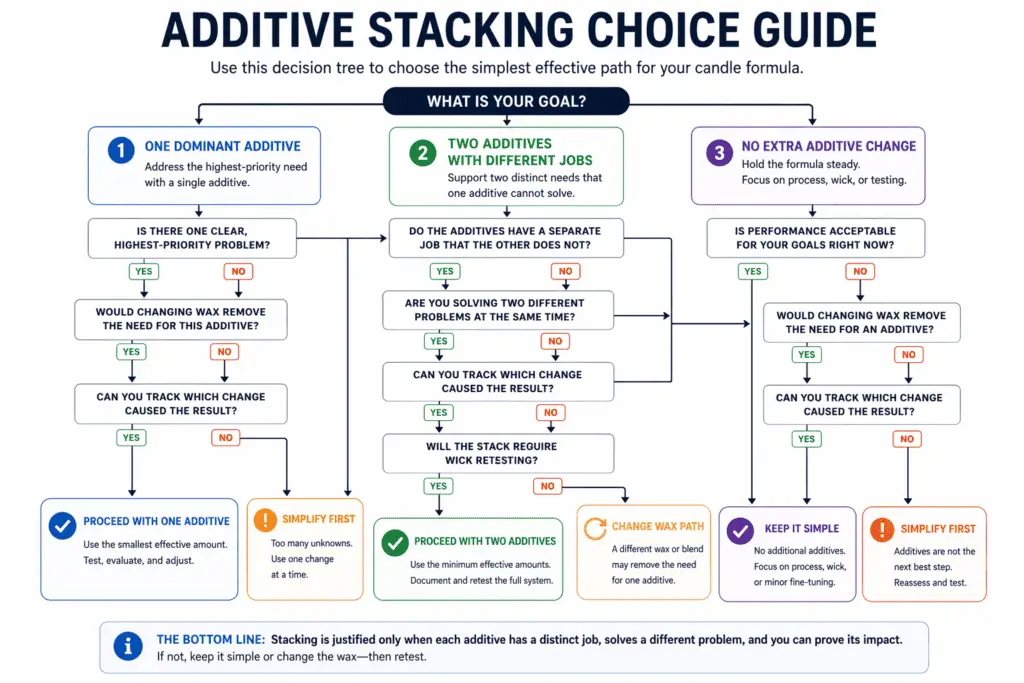
The key test is role separation. If one additive is there for structure and the other is there for a different finish or release result, the stack may be easier to justify. If both additives aim at the same outcome, the second one may only add overlap. A stack is weaker when you cannot explain what each part is supposed to do.
Use these checks before stacking:
- Can you state the separate job of each additive in one sentence?
- Are the two additives solving different problems rather than the same one twice?
- Would changing wax remove the need for one of them?
- Can you still tell which change caused the result if the candle gets worse?
- Are you ready to retest the wick if the stack changes burn conditions?
The warning signs are easy to spot. “I combined two additives and the candle got worse.” “I changed too many variables at once.” “I cannot tell which change caused the problem.” Those are not signs that the formula needs even more support. They usually mean overlap, poor goal separation, or a wax choice that should have been handled first.
The simpler path often wins for a reason. A cleaner formula is easier to test, easier to read, and easier to correct when something goes wrong. That does not mean stacking is always wrong. It means stacking should earn its place by solving two clear needs that one route cannot solve cleanly.
One practical rule helps. If both additives target the same outcome, start with one path and test it before adding another. If the new mix changes burn behavior, retest the wick after stacking additives instead of assuming the stack is working. If the question turns into exact ratios, sequencing, or clone-style combo recipes, move from additive stacking to advanced formulation guidance because the page has moved past a simple additive choice.