
Choose a booster wood wick when the candle needs more heat or melt-pool support; choose single-ply when it already burns cleanly, then test both in the same candle system.
A wood wick is the wooden strip that carries the flame and shapes how the candle burns. A booster wood wick adds a support layer to change heat delivery, while a single-ply wick uses one flat wood strip. Stronger throw means stronger hot throw from a stable flame, full melt pool, and steady fragrance release, not more fragrance oil or unsafe heat. The right choice depends on wax type, vessel diameter, fragrance load, crackle preference, and burn quality.
What Is a Booster Wood Wick?
A booster wood wick is a wood wick configuration with an added booster strip or layer attached to the main wood strip. The booster strip changes burn behavior; it is not a fragrance booster, scent additive, or separate second wick. Candle makers usually test booster construction when single-ply wood wicks do not create enough heat support, melt-pool development, or flame stability.
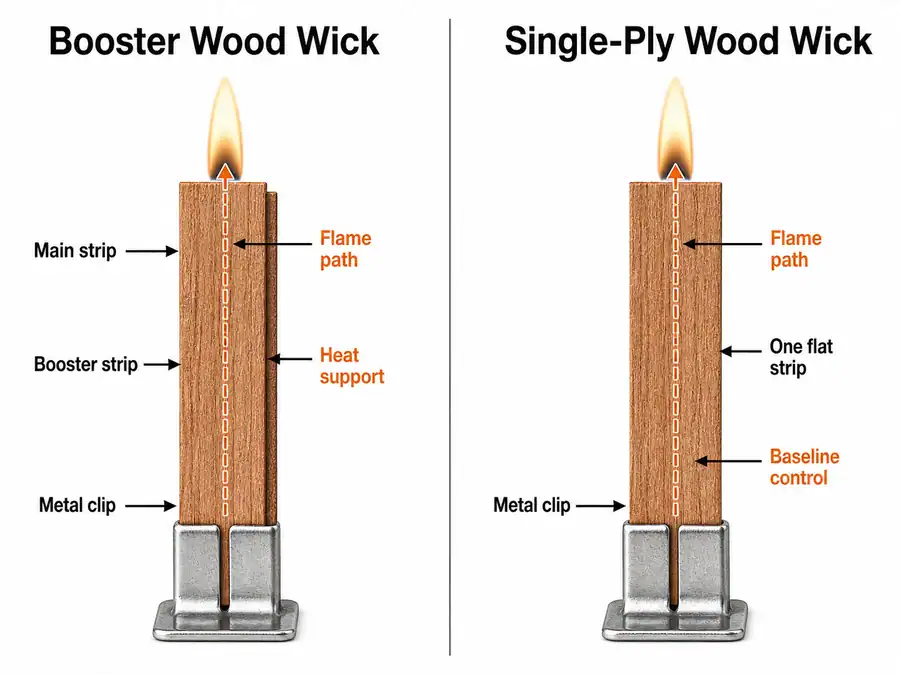
| Part | What it is | Why it matters |
|---|---|---|
| Main strip | The primary flat wood wick | Carries the flame path |
| Booster strip | An added support strip or layer | Can add heat support and crackle potential |
| Clip | The metal base that holds the wick upright | Keeps the wick centered during the burn |
| Flame path | The burning edge of the wood | Affects wax draw, melt pool, and flame behavior |
A booster wick can help when the candle system needs more heat, but it can be too much wick in small vessels or easy-burning waxes. If the question becomes exact diameter matching, use wood wick sizing by vessel diameter as the next decision layer instead of guessing from construction alone.
Booster does not mean fragrance booster. It names the physical wick construction, so it should not be confused with additives, oils, or scent chemicals.
A booster wick is not the same as using two separate wicks. It is one wood wick setup with a main strip and an attached support strip, held in one clip.
What Is a Single-Ply Wood Wick?
A single-ply wood wick is one flat strip or layer of wood used as the wick body, without an added booster strip. Single-ply is the baseline wood wick option compared with booster construction. It describes construction, not wick width, wood quality, weak crackle, or poor hot throw by itself.
| Construction | Layer setup | Best understood as | Common wrong assumption |
|---|---|---|---|
| Booster wood wick | Main strip plus booster strip | More heat-support potential | Always stronger scent |
| Single-ply wood wick | One flat wood strip | Cleaner baseline control | Always weaker throw |
Single-ply can still give strong hot throw when the candle forms a full melt pool, keeps a stable flame, and burns cleanly. If the decision moves into ply count beyond this comparison, single-ply and multi-ply wood wick construction is the cleaner next topic. If the candle lights poorly, drowns, tunnels, or soots, wood wick burn troubleshooting belongs outside this definition section.
How Wick Construction Can Affect Stronger Hot Throw
A wood wick can affect hot throw by changing heat delivery, melt pool formation, flame stability, and fragrance evaporation. Hot throw means scent released while the candle is burning, not cold jar scent or added fragrance oil. Wick construction is one variable inside the candle system, so a booster can help only when heat delivery is the limiting factor.
Stronger throw means stronger hot throw with acceptable burn quality. It does not mean a larger flame, more fragrance oil, unsafe heat, or guaranteed scent strength in every wax and vessel.
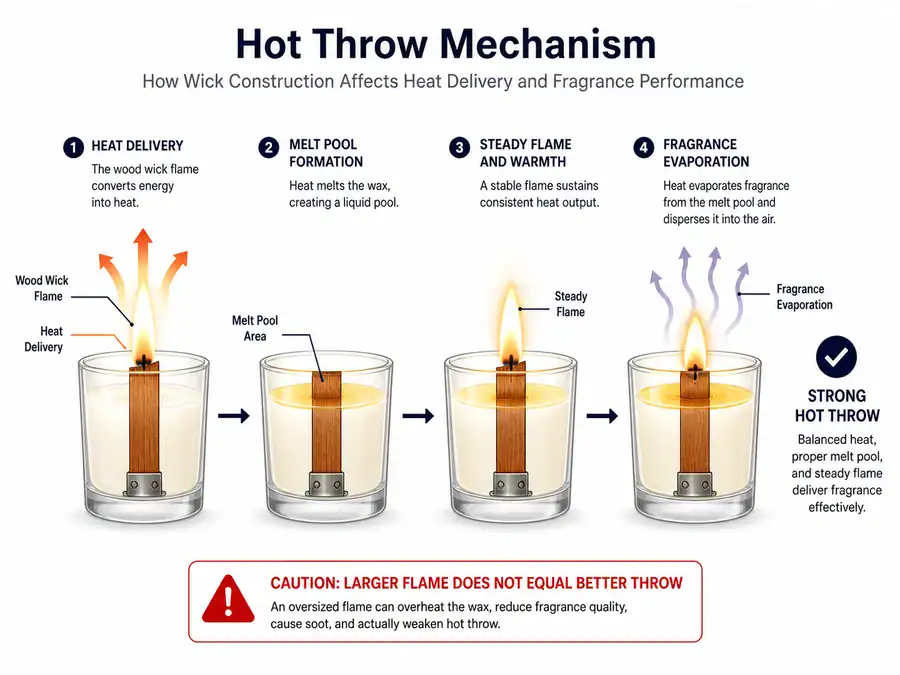
| Factor | Booster effect | Single-ply effect | Throw impact | Risk |
|---|---|---|---|---|
| Heat delivery | May add heat support | Usually gives lower heat control | Can help a weak melt pool release more fragrance | Too much heat can overwick the candle |
| Melt pool | May help widen or deepen the melted wax area | Works well when wax already melts evenly | A full melt pool can support steadier fragrance release | Fast melt can raise container heat |
| Flame stability | May strengthen a struggling flame | Can stay cleaner in easy-burning systems | A steady flame supports steady evaporation | Oversized flame can soot |
| Fragrance evaporation | Can improve release when heat was too low | Can still release fragrance well with proper fit | The better wick is the one that releases scent cleanly | Wick change will not fix poor fragrance or cure issues |
A booster wick does not always give stronger scent. It can improve hot throw when the candle needs more heat, but it can make a small or easy-burning candle run too hot.
Single-ply can still throw strongly. It can be the better choice when it creates a full melt pool, holds a steady flame, and avoids soot or fast burn.
If formula variables become the main issue, weak hot throw troubleshooting is the better path than continuing to change wick construction. For wax, cure, and fragrance limits, fragrance load for stronger hot throw and wax cure time and hot throw should stay separate from this wick comparison.
Booster vs Single-Ply by Wax, Vessel, Diameter, and Fragrance Load
The better wood wick choice depends on the candle system, especially wax type, vessel diameter, fragrance load, and melt pool behavior. Booster is not automatically stronger, and single-ply is not automatically weaker. Stronger throw means better hot throw inside a stable burn, not the hottest possible flame.
Use this matrix as a first-test filter, not a full wick size chart.
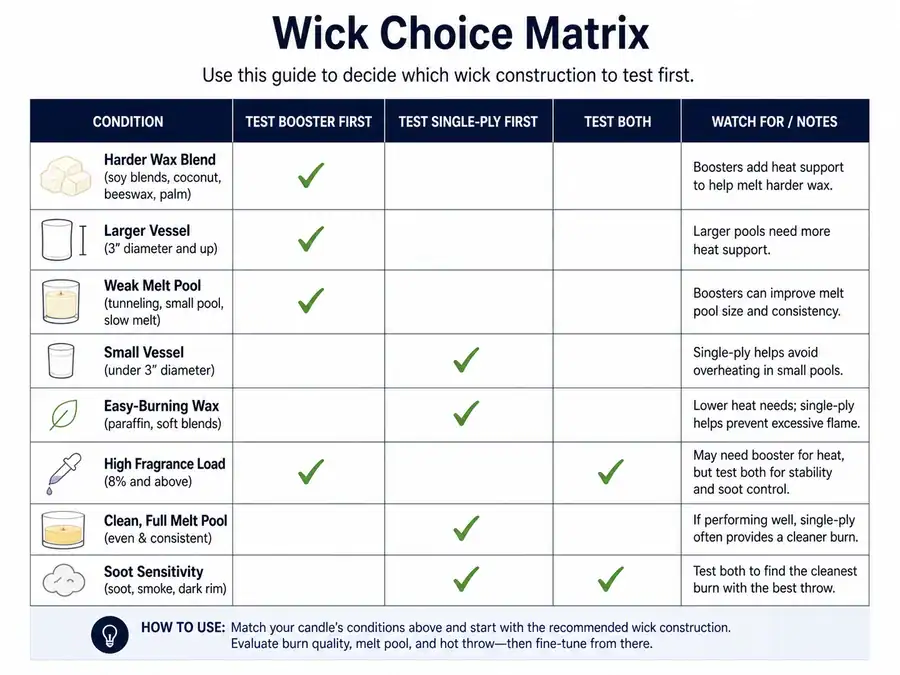
Use it to decide which construction to test first; use a separate wood-wick size chart when the question is exact width, thickness, or jar-diameter matching.
| Candle condition | First wick to test | Why it may fit | Watch for |
|---|---|---|---|
| Harder wax blend | Booster | More heat support may help the melt pool form | High flame or fast wax use |
| Larger vessel | Booster | Wider wax surface may need more heat spread | Container heat and soot |
| Weak melt pool | Booster | Added heat may help release fragrance during burn | Overwicking if the flame grows too large |
| Small vessel | Single-ply | Lower heat is often easier to control | Weak melt pool if underwicked |
| Easy-burning wax | Single-ply | Extra booster heat may be unnecessary | Drowning only if the wick lacks draw |
| High fragrance load | Test both | Fragrance can change burn behavior | Do not assume high load always needs booster |
| Clean full melt pool | Single-ply | The system already has enough heat | Do not change wick just for more flame |
| Soot sensitivity | Single-ply first | Lower heat can reduce dirty-burn risk | Weak throw if the wick is too small |
Jar diameter matters because wider containers often need more heat distribution, but exact matching belongs in wood wick sizing by vessel diameter rather than a broad comparison. Fragrance load matters because oil percentage can affect wax behavior, but percentage choices belong in fragrance load for stronger hot throw instead of this wick-first decision.
For deeper wax behavior, keep wax selection/cure guidance separate from the booster-versus-single-ply choice. If the candle shows high flame, soot, tunneling, drowning, or relighting issues, move that symptom into wood wick burn troubleshooting before blaming scent throw alone.
Choose the wick that gives the candle enough heat for scent release without pushing the burn into soot, rapid melt, or excess container heat.
Booster vs Single-Ply Performance Tradeoffs
A booster wood wick can add heat and melt-pool support, while a single-ply wood wick can offer cleaner burn control when extra heat is not needed. Stronger hot throw only counts as a win when flame size, soot, burn rate, relighting, and container heat stay acceptable.
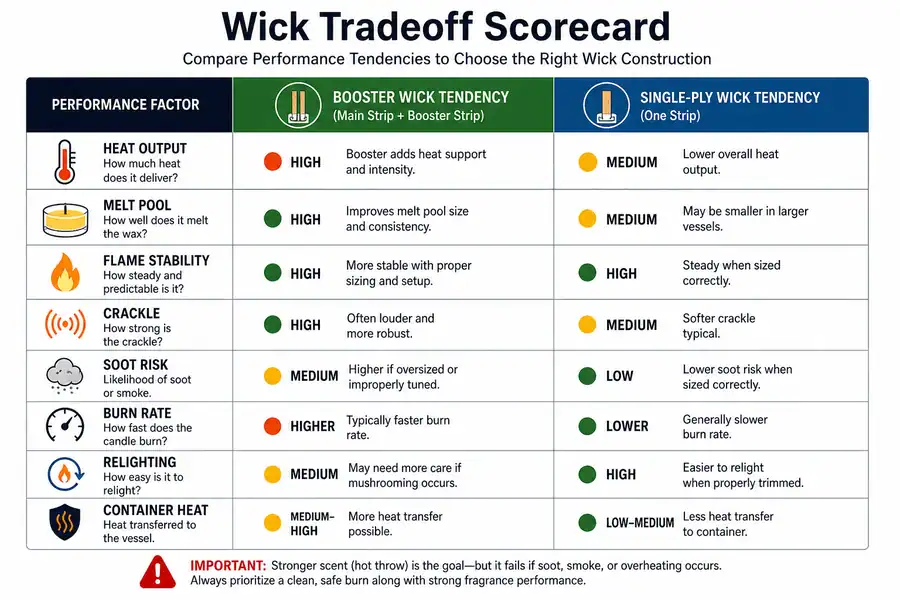
| Performance factor | Booster tendency | Single-ply tendency | What to check |
|---|---|---|---|
| Heat output | Often higher | Often lower | Does the wax melt evenly without overheating? |
| Melt pool | May build faster or wider | May build slower but cleaner | Is the melt pool complete without flooding? |
| Flame stability | Can support a weak flame | Can stay calmer in easy systems | Does the flame stay steady after trimming? |
| Crackle | May be more noticeable | May be softer | Do not treat crackle as scent strength |
| Soot risk | Higher if overwicked | Lower when properly matched | Is there smoke, black residue, or flicker? |
| Burn rate | Can burn faster | Can burn slower | Is wax disappearing too quickly? |
| Relighting | May relight better in some blends | May struggle if underpowered | Does the wick relight after a normal trim? |
| Container heat | Can run hotter | Often easier to manage | Does the vessel become too hot during use? |
Signs the booster is too much wick include a high flame, visible soot, rapid burn, and excessive container heat. Those symptoms mean the extra heat is creating a new burn-quality problem, even if the candle smells stronger at first.
Use wood wick burn troubleshooting when the main issue is soot, mushrooming, drowning, tunneling, flame height, or relighting. Use wood wick sizing by vessel diameter when the tradeoff points back to exact width, jar size, or adjacent wick testing.
Safety still matters in a throw comparison. Wood wick safety guidance should stay separate from buyer preference because a stronger-smelling burn is not better if the vessel overheats or the flame becomes unstable.
Only compare booster/single-ply product pages after the burn tradeoffs are clear, because construction choice should follow the candle’s heat need rather than a universal product label.
The next step is to test both wick types under the same candle conditions so scent strength and burn quality are judged together.
Steps to Burn-Test Booster vs Single-Ply Wood Wicks
To compare booster and single-ply wood wicks fairly, test them in the same wax, vessel, fragrance load, cure time, and burn conditions. The winning wick is the one that improves hot throw while keeping the flame, soot, burn rate, melt pool, and container heat acceptable.
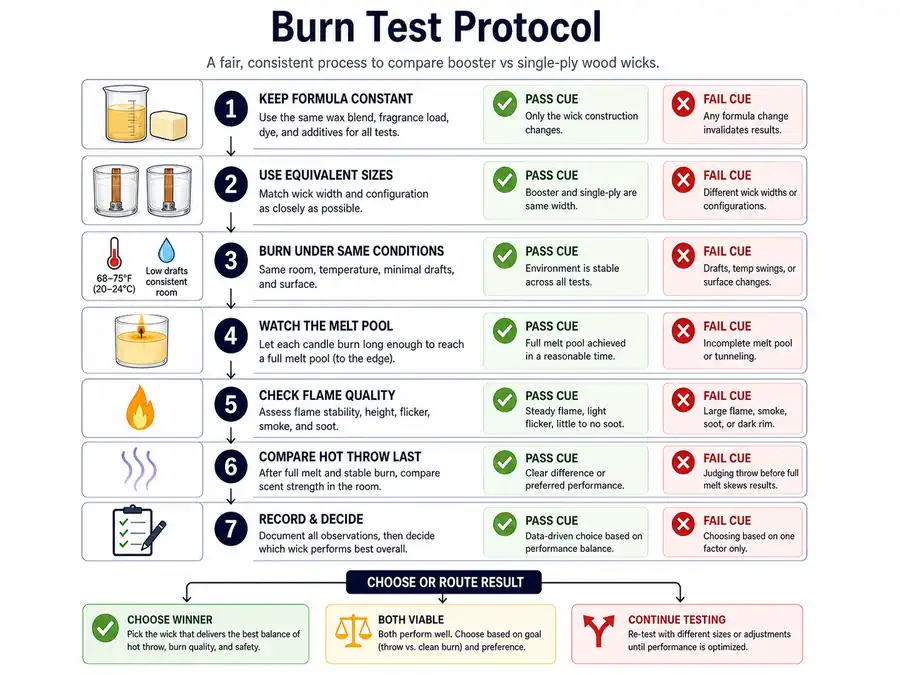
| Step | Test action | What to record | Pass cue | Fail cue |
|---|---|---|---|---|
| 1 | Keep the candle formula constant | Wax, fragrance load, cure time, vessel, and wick type | Only the wick construction changes | Wax, fragrance, vessel, or cure time changes too |
| 2 | Use equivalent or closest practical sizes | Booster size and single-ply size | Sizes are close enough for a fair comparison | One wick is much larger or smaller |
| 3 | Burn under the same conditions | Burn time, room drafts, trim, and relight timing | Both tests follow the same routine | One candle gets easier or harsher conditions |
| 4 | Watch melt pool development | Melt pool width, depth, and edge behavior | Melt pool develops without flooding or overheating | Tunneling, drowning, or fast melt appears |
| 5 | Check flame quality | Flame height, flicker, soot, and smoke | Flame stays stable and clean | Flame is high, dirty, smoky, or unstable |
| 6 | Compare hot throw last | Scent strength during the burn | Stronger scent appears with a clean burn | Scent improves only because the candle burns too hot |
| 7 | Choose or route the result | Final burn notes and repeat issues | One wick gives better throw and cleaner burn | Both wick types fail in similar ways |
A stronger-smelling wick does not win if it creates excessive flame, soot, fast wax use, or unsafe container heat. That result usually means the test found an overwicking problem, not a better wick.
Failure Log
A failed booster-versus-single-ply test is any result where wick construction cannot be isolated or stronger scent appears with unsafe or dirty burn behavior.
| Invalid test result | Why it fails | Better next action |
|---|---|---|
| Changed wax and wick at the same time | The wick result cannot be separated from the wax change | Retest with the same formula |
| Judged hot throw too early | The melt pool may not have fully developed | Compare after the burn has had time to stabilize |
| Kept the booster despite soot | Stronger scent came with dirty burn behavior | Move to wood wick burn troubleshooting |
| Rejected single-ply before adjacent width testing | Construction was blamed before size was checked | Use wood wick sizing by vessel diameter |
| Both wicks burned cleanly but smelled weak | Wick heat may not be the limiting factor | Move to weak hot throw troubleshooting |
A complete testing workflow can track repeated burns, container temperature, adjacent wick sizes, wax behavior, cure time, and longer burn cycles, but this comparison only needs a controlled booster-versus-single-ply test. Use a full burn-test protocol when the result must be repeated across a full candle line.
Keep the test narrow: change the wick construction first, then move to sizing or scent diagnosis only after the burn notes show what failed.
Choose Booster or Single-Ply? Best-Choice Scenarios
Choose a booster wood wick when your candle system needs more heat or melt-pool support, and choose a single-ply wood wick when the system already burns cleanly without extra heat. The best choice is conditional, not universal. Stronger throw means better hot throw with acceptable burn quality, not the largest flame or the loudest crackle.
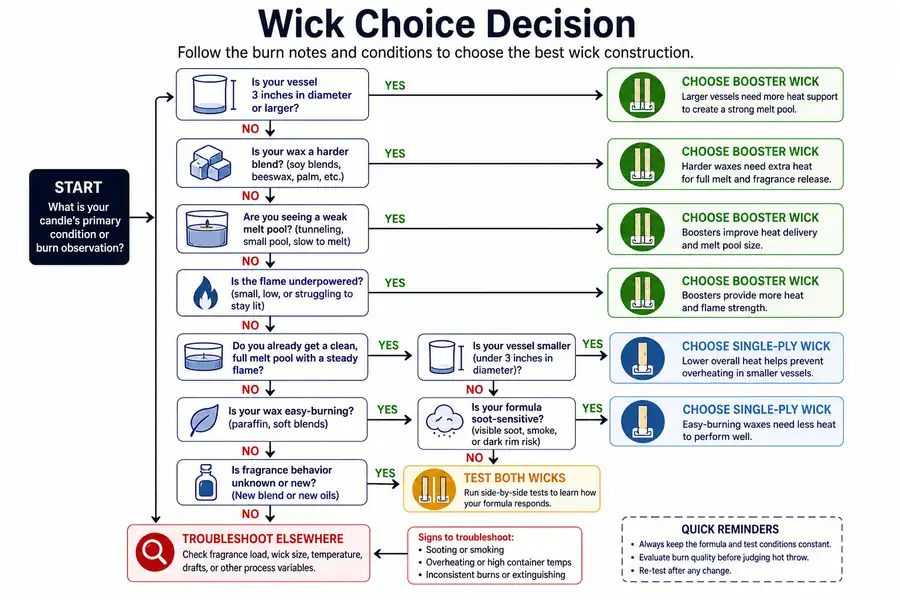
| Candle condition | Choose booster if | Choose single-ply if | Test both if | Route elsewhere if |
|---|---|---|---|---|
| Larger vessel | The melt pool is weak or slow | The burn already reaches the edges cleanly | The vessel is new to your formula | Exact width is unclear |
| Harder wax blend | The flame looks underpowered | The melt pool forms without struggle | Wax behavior is unknown | Multiple wick sizes need testing |
| Weak melt pool | The test is otherwise controlled | Single-ply still reaches a full melt pool | The result sits near the edge | Tunneling or drowning dominates |
| Underpowered flame | The flame cannot support wax draw | The flame is already steady | Flame behavior changes by trim | Relighting problems repeat |
| Weak hot throw tied to low heat | Burn notes show incomplete melt or low heat | Clean burn and full melt already exist | Scent change is hard to read | Scent remains weak after a good burn |
| Smaller vessel | Extra heat is still needed after testing | Heat is easy to control | The jar shape behaves oddly | Container heat rises too much |
| Easy-burning wax | Single-ply cannot keep the melt pool stable | The candle burns cleanly and evenly | Fragrance load changes burn behavior | Soot appears with booster |
| Soot-sensitive formula | Single-ply underperforms without soot | Booster causes smoke or residue | Both burn cleanly in small samples | Flame defects need diagnosis |
| First-time formula | Early tests show too little heat | Lower-heat testing is safer | You lack burn notes | Formula variables are changing |
| Unknown fragrance behavior | Heat is clearly the weak point | Full melt pool and clean flame exist | Oil behavior may affect both | Fragrance, cure, or oil quality is suspected |
For exact wick width, move to wood wick sizing by vessel diameter before treating construction as the whole answer. If the candle is ready for small-batch comparison, use booster wood wick sample options and single-ply wood wick sample options as plain test categories, not as a brand ranking.
A wick sample pack guide can make sense when the wax, vessel, or fragrance load is still uncertain. The safer buying decision is usually a small test set, not a full commitment to one wick type based on the word “booster.”
Single-ply is often the lower-risk first test for small vessels, easy-burning waxes, and candles that already form a full melt pool. Booster is the better first test when burn notes show the candle needs more heat and still stays clean when heat increases.
If both choices burn correctly but the candle still smells weak, move the decision to weak hot throw troubleshooting instead of buying another wick configuration.
Fixing the Wrong Question: When Wick Choice Is Not the Throw Problem
Changing from single-ply to booster will not fix weak hot throw when fragrance load, oil compatibility, wax behavior, or cure time is the real limit. A wood wick can change heat and melt-pool behavior, but it cannot rescue every formula problem. The key is to separate wick-related burn signs from non-wick scent limits.
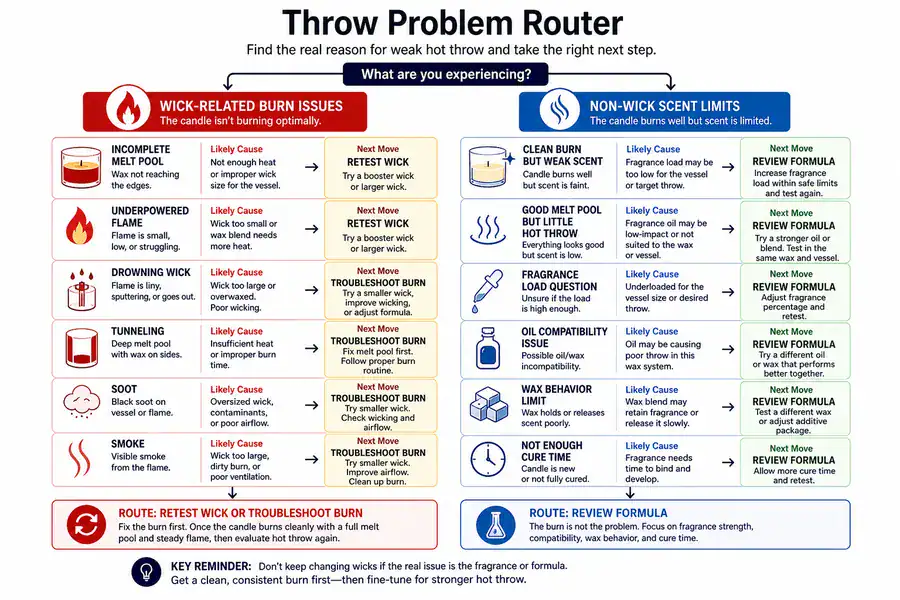
| What you see | Likely category | What it means | Better next move |
|---|---|---|---|
| Incomplete melt pool | Wick-related | The wick may not be giving enough heat or wax draw | Retest size or construction |
| Underpowered flame | Wick-related | Single-ply may be too low-heat for the wax or vessel | Compare booster under the same conditions |
| Drowning wick | Wick-related burn issue | The wick cannot keep up with melted wax | Use wood wick burn troubleshooting |
| Tunneling | Wick-related or size-related | The candle is not melting across the vessel well | Recheck wick fit before changing fragrance |
| Soot or smoke | Wick-related burn issue | The wick may be too large, too hot, or unstable | Reduce heat before judging throw |
| Clean burn with weak scent | Non-wick scent limit | The wick may be working, but fragrance release is still poor | Use weak hot throw troubleshooting |
| Good melt pool but little hot throw | Non-wick scent limit | Heat may not be the main problem | Check oil compatibility and wax behavior |
| Both wick types fail the same way | System-level issue | Construction alone is probably not the limiting variable | Review wax, fragrance, cure, and burn conditions |
| Scent improves only after formula changes | Non-wick formula issue | The wick was not the main cause | Use fragrance load for stronger hot throw |
| Scent changes after more cure time | Non-wick cure issue | The wax and fragrance may need more time to settle | Use wax cure time and hot throw |
This boundary matters because a booster wick can make the candle smell stronger only when low heat or poor melt-pool formation is holding fragrance back. If the candle already has a clean flame and complete melt pool, more wick heat may add soot or container heat without solving the scent problem.
Use the table as a routing log: fix burn defects as wick problems, but route clean-burn weak scent into formula, fragrance, wax, or cure review. That keeps the booster-versus-single-ply decision focused on wick construction instead of turning it into a full scent diagnosis.
FAQs About Booster vs Single-Ply Wood Wicks
Does a booster wood wick always give stronger hot throw?
No. A booster wood wick can help when the candle needs more heat or melt-pool support, but it can overwick small vessels, easy-burning waxes, or formulas that already burn cleanly.
Can a single-ply wood wick still have strong throw?
Yes. A single-ply wood wick can have strong hot throw when it forms a full melt pool, keeps a stable flame, and releases fragrance without soot, flooding, or fast burn.
Should beginners start with booster or single-ply wood wicks?
Beginners should usually start with the lower-risk option for the wax and vessel. Single-ply is often a cleaner first test for small or easy-burning candles, while booster is useful when early burn notes show low heat or a weak melt pool.
Is weak hot throw always a wick problem?
No. Weak hot throw can come from fragrance load, oil compatibility, wax behavior, cure time, burn conditions, or wick fit. A wick change is only the right fix when burn notes point to heat, flame, or melt-pool problems.
What should I test first if I am unsure?
Test booster and single-ply wood wicks in small batches while keeping wax, vessel, fragrance load, cure time, trim, and burn conditions the same. Change only the wick construction first so the result is readable.
Next Step: Test the Right Wick Configuration
Choose the wick setup that improves hot throw while keeping flame, soot, melt pool, burn rate, and container heat acceptable. Start with single-ply if the candle already burns cleanly, choose booster if burn notes show low heat, or test both when the result is borderline.
| Your burn notes show | Best next test | Why |
|---|---|---|
| Weak melt pool, low flame, or slow wax release | Booster wood wick | The candle may need more heat support |
| Full melt pool, clean flame, and steady burn | Single-ply wood wick | Extra heat may add soot or container heat |
| New wax, new vessel, or uncertain fragrance behavior | Small side-by-side test | The system is not predictable yet |
| Both wick types smell weak with a clean burn | Scent diagnosis, not more wick changes | The limit may be wax, fragrance, cure, or oil fit |
| Booster smells stronger but soots or overheats | Step back from booster | Stronger scent is not a win if burn quality fails |
Use booster wood wick sample options, single-ply wood wick sample options, or a wick sample pack guide only after burn notes show whether the candle needs more heat support, cleaner control, or a small test range. The right wood wick is the one that gives stronger hot throw without turning the candle into an overwicked, smoky, fast-burning, or overheated system.