

Rapeseed wax for candles is a candle-grade plant-based wax or blend that can suit containers, melts, and selected formats when supplier guidance and burn tests support the design.
On this page, good, best, and clean describe candle-making fit, burn behavior, finish, scent testing, and repeatability; they do not prove medical safety, legal sale-readiness, or a universal sustainability advantage.
Rapeseed wax for candles is candle-grade wax made for container candles, wax melts, and selected blended candle formats. It is worth testing when you want a plant-based wax with possible smooth finish, scent performance, and regional sourcing benefits, but the main decision is whether its pros, cons, wick behavior, and temperatures fit your candle design. Supplier instructions and burn tests should overrule generic advice because blends, jars, fragrance oils, and wicks change the result.
What Is Rapeseed Wax for Candles?
Rapeseed wax for candles is a candle-grade plant-derived wax or wax blend made for candle making.
It is used in container candles, wax melts, and selected candle formats. Here, rapeseed wax means candle wax, not food-grade rapeseed oil, canola cooking oil, biodiesel feedstock, cosmetic wax, or general agricultural rapeseed.
In candle-making searches, canola wax may be used as a related naming path, but this page still means candle-grade rapeseed wax, not cooking oil.
A clear definition matters because wick choice, pouring temperature, fragrance load, finish, and burn behavior can change by supplier and formulation. Plant-based means the wax comes from plant feedstock for candle wax use; it does not automatically mean safer, cleaner, smoke-free, or better than every other wax.
| Term | Means Here | Does Not Mean Here | Why It Matters |
|---|---|---|---|
| Rapeseed wax for candles | Candle-grade wax or wax blend used for candle making | Cooking oil, canola oil, or agricultural rapeseed | Candle wax must be judged by burn, finish, scent, and supplier instructions |
| Candle-grade | Sold or specified for candle use | Any hardened oil or raw plant material | The intended use affects temperatures, fragrance limits, and wick testing |
| Plant-based | Derived from plant feedstock | Automatically non-toxic, soot-free, or superior | Performance still depends on the actual candle setup |
| Rapeseed blend | Wax containing rapeseed with other waxes or additives | A fragrance blend or homemade recipe guess | Blends can change wick size, pour behavior, and scent results |
For a broader comparison of wax families, use Candle Wax Types; this page stays focused on how rapeseed wax behaves in candle making.
What Are the Main Pros of Rapeseed Wax for Candles?
Rapeseed wax can be a good candle wax when its benefits match the candle format and testing plan.
Its main advantages can include plant-based origin, regional sourcing appeal, smooth finish potential, container-candle suitability, blend flexibility, and scent performance potential. These are practical candle-making benefits only when the wax, wick, fragrance, jar, and supplier guidance work together.
The strongest benefit is decision fit: rapeseed wax gives makers another plant-derived option to test when soy, paraffin, coconut, or blended waxes do not match their sourcing goals or finish preferences. It should still be judged by the finished candle, not by the word natural, clean, eco, or sustainable on its own.
| Benefit | Candle Outcome | Condition | Caveat |
|---|---|---|---|
| Plant-based origin | Supports makers who prefer plant-derived waxes | The product is candle-grade rapeseed wax | Plant-based does not prove safer or universally better |
| Regional sourcing angle | May fit some EU/UK sourcing preferences | Supplier documents the sourcing claim | Strong sustainability wording needs supplier proof |
| Smooth finish potential | Can support neat-looking container candles | Pouring and cooling are controlled | Finish problems can still happen with poor temperatures |
| Container suitability | May work well in jars and tins | The wax or blend is intended for containers | Wick and jar diameter still need testing |
| Blend flexibility | Can be adjusted by supplier formulation | The blend is designed for the candle format | Blend changes can reset wick and temperature assumptions |
| Scent potential | May carry fragrance well in a tested setup | Fragrance load, cure, wick, and burn are matched | Strong scent is not guaranteed by wax choice alone |
Rapeseed wax may support a plant-based or regional sourcing preference, especially in some EU/UK supplier contexts, but only supplier documentation can support stronger sustainability wording. For broader wax-family selection, use Candle Wax Types; for a deeper plant-wax comparison, use Rapeseed Wax vs Soy Wax rather than turning this section into a full soy comparison.
What Are the Cons and Trade-Offs of Rapeseed Wax?
Rapeseed wax is not automatically easier or better than other candle waxes.
It can require careful wick testing, supplier-specific temperatures, and controlled process notes. These cons are candle-performance trade-offs, not proof that rapeseed wax is bad, unsafe, or unsuitable for every maker.
The main drawback is that small changes can change the result. A different jar, wick series, fragrance oil, dye, supplier batch, or blend can affect melt pool, flame size, scent throw, surface finish, and adhesion. For broad or non-rapeseed-specific defects, Candle Troubleshooting is the better place to solve the full problem pattern instead of blaming the wax too quickly.
| Trade-Off | What You May Notice | Likely Variable | Next Step |
|---|---|---|---|
| Wick sensitivity | Tunneling, drowning, mushrooming, or a flame that runs too hot | Wick size, wick series, jar diameter, fragrance load | Test one wick variable at a time |
| Supplier variation | One rapeseed wax behaves differently from another | Pure wax, blend status, additives, intended candle type | Follow the supplier sheet before copying another maker’s process |
| Temperature sensitivity | Rough tops, sink marks, wet spots, or weak adhesion | Pour temperature, cooling speed, jar temperature, room conditions | Adjust temperatures in small controlled batches |
| Scent inconsistency | Cold throw works but hot throw feels weak, or the reverse | Fragrance oil, load, cure time, wick heat, wax blend | Test scent after cure and during a proper burn test |
| Availability issues | Fewer local options than soy or paraffin in some markets | Supplier network, region, product demand | Check supply reliability before building a product line |
| Learning curve | A first test candle burns once but cannot be repeated | Too many variables changed at once | Keep written batch notes before scaling |
Choose another wax, or delay bulk buying, if you need a wax with easier local supply, published process data for your exact format, or fewer wick and temperature variables. Rapeseed wax can still be a strong fit, but only after the same candle design burns, smells, cools, and finishes consistently.
The next variable to check is whether the wax is pure rapeseed or a rapeseed-containing blend, because that can change nearly every test result.
Pure Rapeseed Wax vs Rapeseed Wax Blends
Blend status is a candle-making variable that can change rapeseed wax test results.
A rapeseed wax blend is not the same as pure rapeseed wax. Blend status can change wick choice, pour temperature, scent throw, finish, hardness, melt behavior, and which candle format the wax suits.
Pure rapeseed wax means the wax is sold as rapeseed wax without another main wax blended in, based on the supplier’s description. A rapeseed wax blend means a candle wax blend containing rapeseed wax; it does not mean a fragrance blend, dye blend, or a disclosed proprietary recipe. For broader wax-family terms, use Candle Wax Types, and for wick effects after a formulation change, use Wick Types and Sizing.
Blends exist because suppliers may adjust hardness, container performance, surface finish, scent behavior, melt point, burn profile, or format suitability. That can be helpful, but it also means you should retest when the blend, supplier, or formulation changes.
| Blend Status | Likely Behavior Change | Wick Retest Needed | Temperature Retest Needed | Supplier Note |
|---|---|---|---|---|
| Pure rapeseed wax | More dependent on the base wax’s natural hardness and melt behavior | Yes | Yes | Check intended use before choosing container, melt, or specialty format |
| Rapeseed container blend | May improve jar adhesion, finish, or container burn behavior | Yes | Yes | Use the supplier’s container-candle guidance first |
| Rapeseed-soy blend | May behave differently from either wax alone | Yes | Yes | Do not copy pure soy or pure rapeseed settings without testing |
| Rapeseed-coconut blend | May change softness, melt pool behavior, and scent perception | Yes | Yes | Watch for wick drowning or excessive heat in small containers |
| Rapeseed-pillar or melt blend | May be harder or more format-specific | Yes, if wicked | Yes | Confirm whether the product is intended for pillars, melts, or containers |
| Unknown supplier blend | Results are hard to predict from the word rapeseed alone | Yes | Yes | Ask for the product sheet before scaling |
The safe assumption is simple: a new blend behaves like a new wax until your own wick, temperature, fragrance, and burn notes prove otherwise.
Which Candle Types Suit Rapeseed Wax Best?
Rapeseed wax is often most practical when matched to the right candle format and tested under that format’s requirements.
It may suit containers, wax melts, selected blends, and some specialty candles. “Best” here means best fit by candle format, hardness, wick needs, scent goals, temperature handling, and repeatable test results, not universal wax superiority.
Pure rapeseed wax and rapeseed wax blends should not be treated as the same format decision. A container blend may behave well in jars, while a harder melt or pillar blend may be designed for a different use.
| Candle Type | Fit Level | Condition | Watch For | Related Topic |
|---|---|---|---|---|
| Container candles | Often a strong test candidate | Wax or blend is intended for jars or tins | Wick drowning, tunneling, adhesion, scent throw | Wick and burn testing |
| Wax melts | Possible when the wax is suited to melts | Hardness and fragrance load match supplier guidance | Soft melts, sweating, weak scent, poor release | Wax Melts |
| Pillar candles | Possible with the right blend | Wax is firm enough or blended for freestanding candles | Slumping, cracking, poor release, weak structure | Pillar Candle Wax |
| Rapeseed blends | Often practical for format-specific use | Supplier states the intended candle type | Retesting after any blend or supplier change | Supplier product sheet |
| Specialty candles | Possible with caution | Shape, color, fragrance, and burn goals are tested | Unstable burn, cosmetic defects, poor repeatability | Format-specific testing |
| First-time projects | Good only with a simple test setup | One jar, one wax, one fragrance, controlled notes | Too many variables changed at once | Beginner test workflow |
Rapeseed wax is usually easiest to judge in a simple container candle because wick behavior, scent, and finish can be observed in one controlled test. Wax melts and pillars need their own format logic, so this page keeps them as suitability decisions instead of turning them into full recipes.
Rapeseed Wax vs Soy Wax: Short Decision Boundary
Rapeseed wax and soy wax can both work for candles, but the better choice depends on the tested candle goal.
“Better” means better for a stated candle format, sourcing preference, wick-testing path, scent goal, supplier guidance, and retesting tolerance. It does not mean one plant wax wins every container, melt, pillar, fragrance, or maker preference.
Use Rapeseed Wax vs Soy Wax for the full comparison before changing wax families. Do not copy soy-wax temperatures, wick sizes, or scent assumptions into rapeseed wax without retesting the actual candle setup.
What Wicks Work Best With Rapeseed Wax Candles?
The best wick for rapeseed wax is a tested starting wick family or series, not a guaranteed size.
Wick choice depends on container diameter, rapeseed wax formulation, fragrance load, dye, cure time, and the burn cycle. A wick that works in one rapeseed blend may drown, tunnel, mushroom, or burn too hot in another.
Rapeseed wax for candles is the wax being matched to wick families in a real candle design. “Best wick” means the best tested fit for that design, not a universal wick size for every jar, fragrance, or blend.
Some rapeseed waxes or rapeseed blends may need a stronger or thicker wick starting point than another wax in the same jar, but the final size must come from burn testing.
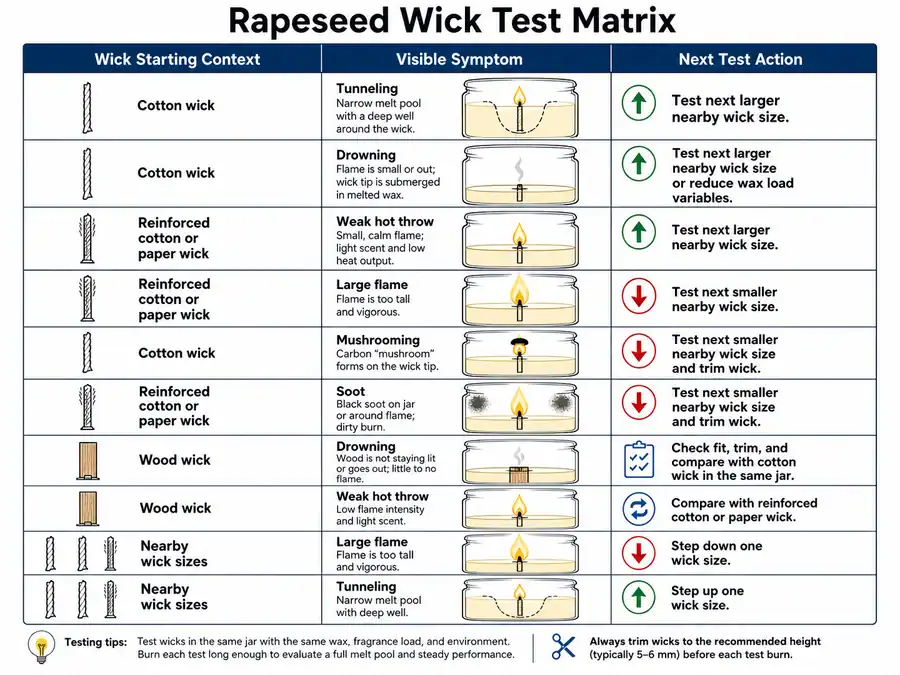
| Wick Family | Good Starting Context | Watch For | Go Deeper With |
|---|---|---|---|
| Cotton wick | Standard container-candle tests where the supplier allows cotton wicks | Tunneling if too small, excess flame if too large | Wick Types and Sizing |
| Paper or reinforced cotton variants | Containers that need a steadier structure or different heat profile | Mushrooming, soot, or uneven melt pool | Wick-series testing |
| Wood wick | Test only when the wax, jar, and supplier guidance support it | Weak flame, drowning, crackle inconsistency, overheating | Wick-specific testing |
| Pre-waxed wick samples | Early testing across nearby sizes or series | Mistaking one short burn for a final result | Controlled burn notes |
| Unknown wick type | Avoid for final candles until identified | Unclear burn behavior and poor repeatability | Supplier confirmation |
Use sample wicks and controlled burn tests before choosing a final wick. For exact wick-series sizing and jar-diameter testing, use Wick Types and Sizing; this section gives rapeseed-wax-specific starting logic.
How to Test Wick Size in Rapeseed Wax
Wick size in rapeseed wax must be validated by burn testing, not selected from a chart alone.
Test the wick in the actual rapeseed wax formulation, container, fragrance load, dye condition, cure period, and burn schedule. Change one variable at a time, or the result will not show whether the wick, wax, fragrance, or temperature process caused the problem.
A useful first test compares nearby wick sizes or series in the same container and wax setup. Record what happens during each burn cycle, then adjust the next test based on the visible burn pattern.
| Symptom | Likely Wick Issue | Other Variable to Check | Next Test |
|---|---|---|---|
| Tunneling | Wick may be too small or too cool | Jar diameter, wax blend, cure time | Test the next larger wick or warmer series |
| Wick drowning | Wick may be too small for the melt pool | Fragrance load, soft blend, container heat | Test a stronger wick or reduce competing variables |
| Large flame | Wick may be too large or too hot | Container size, draft, fragrance behavior | Test the next smaller wick |
| Heavy mushrooming | Wick may be too large or poorly matched | Fragrance, dye, wick construction | Test a smaller or different wick family |
| Soot on container | Wick may be too hot or unstable | Draft, trim length, fragrance load | Test a smaller wick and confirm burn conditions |
| Weak hot throw | Wick may not create enough heat for the setup | Cure time, fragrance oil, load, wax blend | Retest after cure or test a nearby wick size |
| Excessive container heat | Wick may be too large for the candle | Jar size, burn duration, wax pool depth | Stop that test and move smaller |
For broad burn defects that are not specific to rapeseed wax wick selection, use Candle Troubleshooting instead of turning every symptom into a wick-size problem.
What Temperatures Should You Use for Rapeseed Wax Candles?
Rapeseed wax temperature guidance is supplier-specific and stage-specific.
“Temps” means candle-making working temperatures for melting, fragrance addition, pouring, and cooling conditions. Rapeseed wax for candles is the wax being heated, fragranced, and poured, so its working temperatures should follow the supplier’s range and be tested in your setup.
Use supplier-recommended temperature ranges for the exact rapeseed wax product, then test melt, fragrance-add, pour, and cooling conditions separately. A single universal number is unreliable because pure rapeseed wax, rapeseed blends, jar size, fragrance oil, room temperature, and cooling speed can all change finish, adhesion, scent throw, sink marks, and burn consistency.
Supplier example: HansaWax lists about 75°C for melting, 60–65°C for casting, up to 10% fragrance absorption, and at least 48 hours after pouring for one container rapeseed wax. Treat those figures as product-specific example data, not a universal rapeseed wax rule.
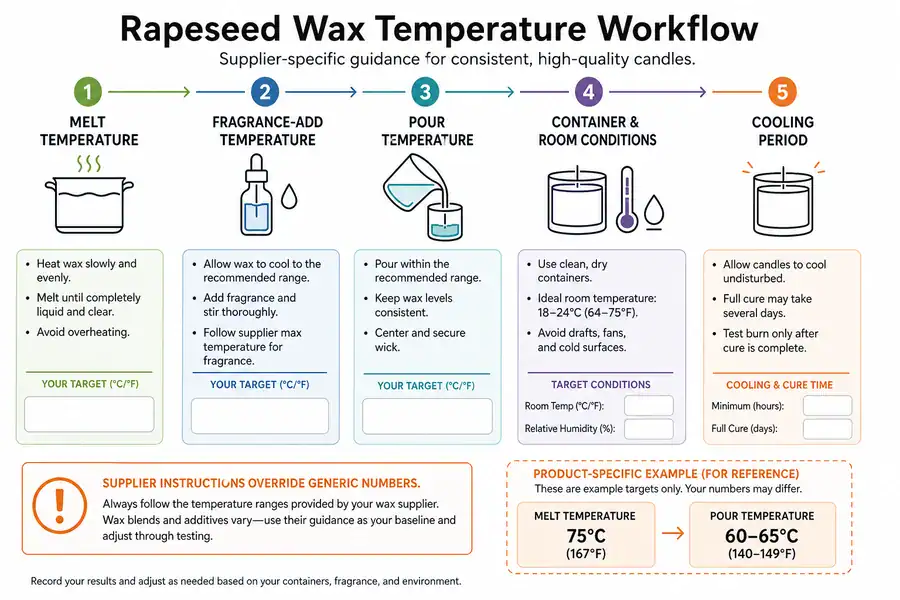
For the full candle-making process, use the Beginner Candle Making Guide; this section only explains temperature decisions specific to rapeseed wax.
| Stage | Supplier Range | Actual Batch Temp | Why It Matters | Notes |
|---|---|---|---|---|
| Melt temperature | Copy the wax supplier’s range in °C/°F | Record the thermometer reading before fragrance | Fully melts the wax without guessing from another wax type | Do not use a universal wax chart as the final rule |
| Fragrance-add temperature | Copy the supplier’s fragrance-add range in °C/°F | Record the temperature when fragrance oil goes in | Affects fragrance binding, scent results, and batch repeatability | Do not treat flash point as the same as the correct add temperature |
| Pour temperature | Copy the supplier’s pour range in °C/°F | Record the temperature at the pour | Affects surface finish, adhesion, sink marks, and cooling behavior | Test small changes before scaling |
| Container and room conditions | Record room and container conditions where possible | Note cold glass, warm glass, draft, or room swings | Cooling speed can change tops, wet spots, and shrinkage | Keep the same room setup during comparison tests |
| Cooling period | Follow supplier handling notes if given | Record where and how the candle cooled | Affects surface appearance and repeatability | Avoid moving, chilling, or disturbing tests unless that is the variable |
A good temperature test does not ask, “What is the one correct rapeseed wax temperature?” It asks whether your melt, fragrance-add, pour, and cooling process can be repeated with the same wax, jar, fragrance load, wick, and cure time.
If a rough top, poor adhesion, or sinking appears after a temperature change, check temperature records before changing the wick. If the same defect continues across controlled batches, use Candle Troubleshooting to separate wax, container, cooling, wick, and fragrance causes.
Why Supplier Instructions Matter for Rapeseed Wax
Supplier instructions matter because rapeseed wax products vary by formulation, intended candle type, fragrance capacity, and working temperature range.
Generic advice is only a starting point. The recommended temperature means the supplier’s working range for that exact product, not a universal rapeseed wax temperature.
A Supplier Datasheet reference should guide your first test notes before you copy another maker’s numbers. Supplier instructions can show whether the wax is made for containers, melts, pillars, or blends; they can also give temperature guidance, fragrance limits, and handling notes that affect retesting.
| Datasheet Field | What to Copy Into Test Notes | Why It Matters |
|---|---|---|
| Product name and batch | Exact wax name, supplier, and batch if available | Prevents mixing results from different products |
| Intended candle type | Container, melt, pillar, or blend use | Stops a format mismatch before testing |
| Melt range | Supplier melt temperature in °C/°F | Keeps the wax process tied to the product |
| Fragrance-add range | Supplier add temperature in °C/°F | Helps separate fragrance problems from temperature mistakes |
| Pour range | Supplier pour temperature in °C/°F | Helps diagnose finish, adhesion, and sink marks |
| Maximum fragrance load | Supplier maximum percentage | Prevents treating fragrance load as a guess |
| Handling notes | Safety and storage notes from the supplier | Keeps the test aligned with product instructions |
Retest when you change supplier, blend, batch, fragrance oil, jar size, wick series, dye, or temperature process. Those changes can make yesterday’s successful rapeseed wax candle a new test, not a finished formula.
Does Rapeseed Wax Have Good Scent Throw?
Scent throw depends on the full candle system, not the wax alone.
Rapeseed wax can produce good scent throw, but it must be tested with the chosen fragrance oil, load percentage, wick, cure time, container, and burn setup. Rapeseed wax for candles is the wax being evaluated for fragrance performance, so scent results should be judged under defined test conditions.
Cold throw means how the candle smells when unlit. Hot throw means how the candle smells while burning or warming in use. Strong scent throw means evaluated cold throw and hot throw under a defined wax, fragrance load, wick, cure, and jar setup; it does not mean maximum fragrance percentage or guaranteed room-filling scent.
Higher fragrance load does not automatically create stronger scent. Too much fragrance can weaken burn stability, create fuel-like notes, disturb the wick, or perform worse than a lower tested percentage. Use a supplier maximum as the upper boundary, then test inside that limit.
| Variable | Test Condition | Cold Throw Impact | Hot Throw Impact | Retest Note |
|---|---|---|---|---|
| Fragrance oil | Same fragrance across test candles | Shows how the oil smells in the wax before burning | Shows whether the oil performs under flame heat | Change oil only after the wax and wick test is readable |
| Fragrance load | Keep percentage fixed when testing other variables | Higher load may smell stronger cold, but not always better | Higher load can help, weaken, or destabilize hot throw | Confirm the supplier maximum before increasing |
| Add temperature | Record °C/°F when fragrance is added | Poor mixing can reduce cold scent quality | Poor mixing can reduce hot scent or cause inconsistency | Retest one nearby add temperature at a time |
| Wick series | Keep wax, fragrance, load, and jar fixed | Usually affects cold throw less directly | Strongly affects heat, melt pool, and hot throw | Use Wick Types and Sizing for deeper wick-series logic |
| Cure time | Hold cure period steady between tests | Scent may settle or become clearer after resting | Hot throw may change after the wax and fragrance stabilize | Compare candles cured for the same length |
| Container size | Keep jar diameter and fill level fixed | Changes headspace and scent perception | Changes heat, melt pool, and scent release | Do not compare different jars as one scent test |
For fragrance-oil safety or IFRA details, use a dedicated fragrance guide; this section only covers scent throw as a rapeseed wax testing factor. For fragrance percentage planning, use a Fragrance Load guide when you need fragrance math or safety limits beyond this wax-specific testing decision.
How Long Should Rapeseed Wax Candles Cure Before Testing?
Rapeseed wax cure time should be treated as a test condition that can affect scent and burn results.
Cure time is the resting period after pouring and before judging the candle. It is not one universal wait time for every rapeseed wax blend, and it is not the same as legal sale-readiness or business compliance.
A useful scent test compares candles cured under the same conditions. If one rapeseed wax candle is burned after a short rest and another after a longer rest, the result may reflect cure time instead of wax quality, wick fit, or fragrance choice.
| Cure Test Point | What It Can Show | What It Cannot Prove | Test Note |
|---|---|---|---|
| Early test | Whether the candle has obvious wick, finish, or fragrance problems | Final scent performance for every blend | Record it as an early check, not the final verdict |
| Supplier-recommended cure point | How the candle performs under the supplier’s suggested timing | Universal cure time for all rapeseed wax products | Use this as the main comparison point when available |
| Longer rest comparison | Whether scent throw or burn behavior changes with time | That longer is always better | Keep fragrance load, wick, jar, and temperature process fixed |
| Repeat batch | Whether the same cure schedule gives the same result | Sale-readiness by itself | Pair cure notes with burn notes and scent scores |
Treat Cure Time support as part of the scent test, not as a separate reason to approve or reject rapeseed wax. A candle that smells weak after one early burn may need a controlled retest before you change fragrance load, wick size, or wax choice.
What Does a Good Rapeseed Wax Burn Test Look Like?
A good rapeseed wax burn test shows stable flame behavior, controlled melt-pool growth, limited soot, no severe mushrooming, no tunneling, no drowning, and safe container heat.
Rapeseed wax for candles is being judged by visible burn performance in the actual candle setup. A “clean burn” here means stable observed candle performance; it does not mean toxin-free, zero-emission, medically safe, or indoor-air-quality proven.
A useful burn test checks more than whether the candle stayed lit. It shows whether the wick, wax formulation, fragrance load, cure time, container, and temperature process are working together.
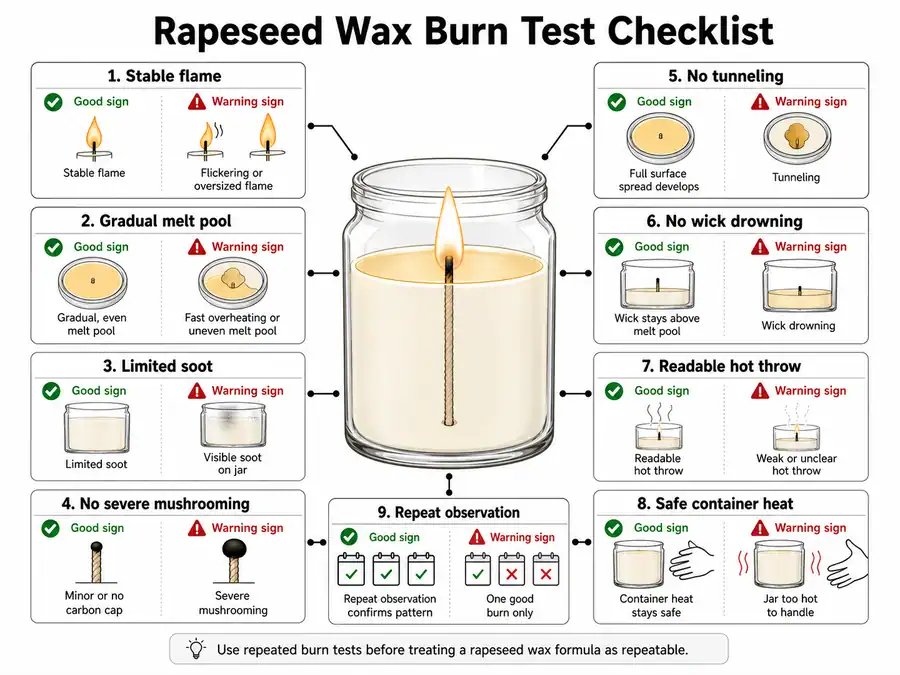
| Indicator | Good Sign | Warning Sign | Likely Next Action |
|---|---|---|---|
| Flame behavior | Flame stays steady without racing, shrinking, or flickering heavily | Flame is too large, too weak, erratic, or repeatedly self-extinguishes | Retest a nearby wick size or wick family |
| Melt pool | Melt pool develops gradually and reaches an appropriate width for the container over the burn cycle | Melt pool stays narrow, floods the wick, or reaches the edge too aggressively | Check wick size, jar diameter, wax blend, and burn duration |
| Soot | Little to no visible soot appears under normal trimmed-wick use | Soot marks appear on the jar or flame looks smoky | Test a smaller or cooler wick and check fragrance load |
| Mushrooming | Wick tip has little buildup after a normal burn cycle | Heavy carbon buildup appears quickly | Test a smaller wick, different wick series, or lower fragrance variable |
| Tunneling | Wax melts outward enough to avoid a deep central hole | Wax burns down the middle and leaves thick sidewalls | Test a stronger wick or review container diameter |
| Wick drowning | Wick remains exposed enough to burn steadily | Wick sinks into melted wax and struggles to stay lit | Test a stronger wick or review wax softness and fragrance load |
| Scent release | Hot throw is readable during the burn test under the same cure and fragrance conditions | Scent is weak, harsh, or inconsistent across similar tests | Hold wick and cure constant before changing fragrance load |
| Container heat | Container feels appropriate for the design and burn duration | Container becomes concerningly hot or unevenly heated | Stop that test and move to a smaller or cooler wick setup |
| Repeat observation | Similar setup gives similar burn behavior | One candle passes but the next one behaves differently | Record variables before treating the result as final |
For exact wick-series selection, use Wick Types and Sizing rather than turning this burn check into a full wick chart. If the same symptom appears across waxes or cannot be traced to the rapeseed wax setup, use Candle Troubleshooting instead of assuming the wax alone caused it.
One burn observation is not enough for final confidence because a first burn can hide later tunneling, container heat, soot, weak hot throw, or drowning. A good test becomes more useful when the result is repeated with the same wax, wick, jar, fragrance load, cure time, and burn schedule.
Use the Measurement Variables section to keep burn notes comparable before deciding whether the wick, wax, temperature, or fragrance needs the next adjustment.
Beginner Testing Workflow for Rapeseed Wax Candles
A rapeseed wax test is controlled candle testing with fixed variables, written notes, burn observations, and one changed variable at a time.
Beginners should test rapeseed wax candles in small batches before buying in bulk, selling, or judging the wax from one attempt. Rapeseed wax for candles is being tested as a complete candle system: wax, jar, wick, fragrance, temperature process, cure time, and burn behavior.
A casual first candle can show whether the wax is interesting, but it cannot prove the formula is repeatable. A real test keeps enough variables fixed that the next result tells you what changed.
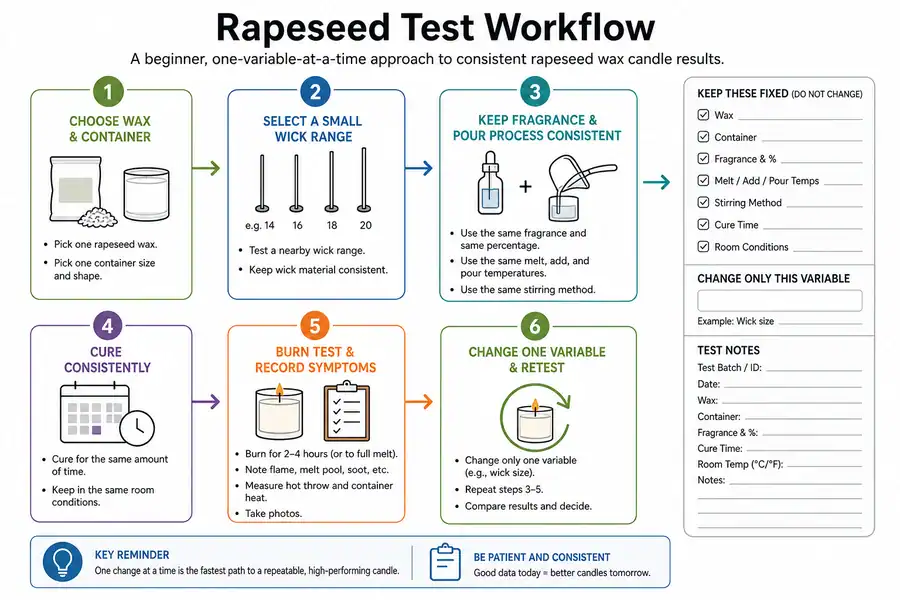
| Step | Fixed Variable | Changed Variable | What to Record | Decision Trigger |
|---|---|---|---|---|
| 1. Choose one wax and one container | Wax product, supplier, jar shape, jar diameter in mm | None yet | Wax name, blend status, jar diameter, fill weight | Start only when the wax and container stay the same |
| 2. Select a small wick sample range | Wax, jar, fragrance plan, temperature plan | Wick size or nearby wick series | Wick family, series, size, tab type | Move up or down only after burn symptoms are visible |
| 3. Keep fragrance and pour process consistent | Fragrance oil, fragrance load in %, melt/add/pour temperatures in °C/°F | Wick only, if wick is the test variable | Fragrance oil, load, temperature readings, dye status | Change fragrance only after wick behavior is readable |
| 4. Cure consistently | Wax, jar, wick, fragrance, temperature process | Cure duration only if cure is being tested | Cure days, storage conditions, test date | Compare candles only after the same cure period |
| 5. Burn test and record symptoms | Burn schedule, trim habit, room conditions as much as practical | None during the burn cycle | Flame, melt pool, soot, mushrooming, tunneling, drowning, scent, container heat | Change the next test based on the strongest failure sign |
| 6. Change one variable and retest | All other variables | One wick, temperature, cure, or fragrance variable | New result against the old result | Treat the change as useful only if the result improves repeatably |
Use Beginner Candle Making Guide for the full first-candle process; this workflow only covers rapeseed wax testing decisions. Use Wick Types and Sizing when the next question is exact wick-series selection, not whether rapeseed wax itself is working in the setup.
Testing note: The useful inputs are wax supplier, jar diameter in mm, wick sample set, fragrance load in %, pour temperature in °C/°F, and cure time in days. The useful outputs are a controlled test plan and the next variable to adjust. Change one variable at a time and repeat key tests before treating a result as final.
What to Record in a Rapeseed Wax Test Batch
Record wax formulation, wick series and size, container diameter, fragrance load, dye, melt temperature, pour temperature, cure time, burn schedule, and observed results.
A rapeseed wax test record turns a burn result into comparable information. Without the minimum variables, a good candle becomes hard to repeat and a failed candle becomes hard to diagnose.
| Test Field | Unit or Format | Why It Matters | Missing-Variable Risk |
|---|---|---|---|
| Wax product | Supplier name and exact product name | Separates pure rapeseed wax from rapeseed blends | Results from two waxes may be mixed |
| Batch or purchase lot | Supplier batch if available | Helps explain changes between batches | A supplier change may look like a wick problem |
| Container diameter | mm | Affects heat, melt pool, and wick demand | Wick results cannot be compared fairly |
| Wick series and size | Supplier wick code | Connects flame behavior to wick choice | A passed test may not be repeatable |
| Fragrance oil | Oil name and supplier | Affects scent, burn, and wick behavior | Weak scent may be blamed on wax too quickly |
| Fragrance load | % | Shows how much fragrance was used | Scent and burn results cannot be interpreted |
| Dye | yes/no and amount if used | Dye can change burn behavior | Wick symptoms may be misread |
| Melt temperature | °C/°F | Shows how the wax was prepared | Finish or scent issues may be hard to trace |
| Pour temperature | °C/°F | Affects finish, adhesion, and cooling | Rough tops or sink marks may be unexplained |
| Cure time | days | Affects scent and test timing | Early and later tests may be compared unfairly |
| Burn hour | hours | Shows when the symptom appeared | A late problem may be missed |
| Result note | pass/fail/note | Converts observations into next steps | The next test may repeat the same mistake |
Use the Measurement Variables section as the test-note standard for rapeseed wax, not as a full calculator. If the problem becomes broad, unresolved, or no longer tied to rapeseed wax variables, use Candle Troubleshooting.
When Is a Rapeseed Wax Candle Repeatable Enough?
A rapeseed wax candle is repeatable enough when the same controlled setup gives the same acceptable result across repeated test batches.
Repeatable means practical process control, not certification, legal clearance, insurance approval, or permission to sell. It means the maker can reproduce the candle’s burn, scent, finish, and temperature process without relying on one lucky pour.
| Repeatability Check | Pass Sign | Not Enough Yet | What to Do Next |
|---|---|---|---|
| Same wax and jar | The same wax product and container give similar burn behavior | One candle worked once | Repeat the same setup before scaling |
| Same wick result | The chosen wick burns similarly across repeated tests | A nearby wick has not been compared | Run a small wick range before locking the wick |
| Same temperature process | Melt, add, and pour notes stay consistent | Temperatures were guessed or missed | Record °C/°F readings in the next test |
| Same scent result | Cold and hot throw are acceptable after the same cure period | Scent was judged at different cure times | Retest with the same cure days |
| Same finish | Tops, adhesion, and surface appearance are acceptable across batches | One smooth top happened once | Repeat with the same cooling conditions |
| Same burn outcome | No severe soot, tunneling, drowning, or unsafe heat repeats | Symptoms change without clear cause | Go back to one-variable testing |
If you plan to sell candles, separate repeatable candle performance from business, labeling, insurance, and compliance questions. Use Candle Business/Compliance for those selling decisions instead of treating a good test burn as legal sale-readiness.
How to Diagnose Rapeseed Wax Candle Problems
Diagnose rapeseed wax candle problems by classifying the visible symptom before changing the wax, wick, temperature, fragrance load, or container.
Rapeseed wax for candles is the wax context for the test, so a problem should be sorted by likely cause before you replace the wax or blame the wick. A “problem” here means a classified candle test failure with a next retest action, not every candle defect in every wax type.
| Symptom | Likely Cause Category | First Check | Next Retest | If Unresolved |
|---|---|---|---|---|
| Tunneling | Wick, jar, wax blend, or burn schedule | Wick size, jar diameter, first burn length | Test a stronger wick or nearby hotter series | Use Wick Types and Sizing |
| Wick drowning | Wick, soft wax blend, fragrance load, or container heat | Melt pool depth and wick strength | Test a stronger wick or reduce the competing variable | Use Candle Troubleshooting |
| Heavy mushrooming | Wick, fragrance, or fuel balance | Wick size, fragrance load, dye, trim length | Test a smaller or different wick family | Use Wick Types and Sizing |
| Weak hot throw | Fragrance, cure, wick heat, or wax blend | Cure days, fragrance load, wick heat, add temperature | Retest after equal cure or test a nearby wick | Review scent and cure notes |
| Rough top | Temperature, cooling, or wax formulation | Pour temperature, room condition, cooling speed | Adjust pour temperature in a small controlled test | Check supplier guidance |
| Poor adhesion | Temperature, container, cooling, or formulation | Glass temperature, pour temperature, room draft | Retest with controlled jar and room conditions | Use Candle Troubleshooting |
| Sink marks | Cooling, pour temperature, or wax contraction | Pour temp and cooling conditions | Retest one temperature change at a time | Check supplier guidance |
| Unstable flame | Wick, draft, fragrance, or container mismatch | Wick trim, draft, fragrance load, jar diameter | Retest with a controlled burn setup | Use Wick Types and Sizing |
| Inconsistent repeat tests | Untracked process change | Wax batch, wick code, fragrance %, temperatures, cure | Repeat with written variables fixed | Return to the test-batch notes |
Do not change three variables at once after a failed rapeseed wax candle. If you change wax supplier, wick series, fragrance load, and pour temperature together, the next burn will not show which correction worked.
A useful order is: identify the visible symptom, choose the most likely cause category, check the recorded variable, retest one change, then compare the next burn to the previous one. Broad problems that are not tied to rapeseed wax, wicks, temperatures, fragrance, container fit, or cure time belong in Candle Troubleshooting rather than this wax-specific diagnosis.
How to Fix Rough Tops, Sink Marks, or Poor Adhesion
Rough tops, sink marks, and poor adhesion in rapeseed wax candles should be treated as finish clues first, not proof that the wax is unusable.
Check pour temperature, jar temperature, room drafts, cooling speed, and supplier notes before changing wax or wick. If the same finish issue repeats across controlled batches, route the broader pattern to Candle Troubleshooting.
Should You Use Rapeseed Wax for Candles?
Use rapeseed wax if its candle-format fit, sourcing preference, supplier guidance, wick-testing path, scent goals, temperature process, and repeatability needs match your project.
The right wax is the wax that fits your candle type, testing tolerance, wick path, and performance requirements. Rapeseed wax should be bought, tested, or avoided based on the finished candle system, not on plant-based wording alone.
| Decision | Choose This If | Evidence You Need | Do Not Choose This If | Related Topic |
|---|---|---|---|---|
| Buy a small test amount | You want to test a plant-based wax for containers, melts, or a stated supplier format | Supplier sheet, intended use, starting temperature range, wick plan | You need a finished formula without testing | Candle Wax Types |
| Test before switching | You already use another wax and want to compare burn, scent, finish, and sourcing fit | Same jar, same fragrance, controlled wick and temperature notes | You plan to copy another wax’s settings directly | Rapeseed Wax vs Soy Wax |
| Keep testing | Early results are mixed but the failure category is clear | Burn notes, fragrance %, temperatures, cure time, wick series | The same failure repeats with no clear improvement | Candle Troubleshooting |
| Use it for a product line | Repeated batches show stable burn, scent, finish, and process control | More than one controlled batch with matching results | One candle worked once and no variables were recorded | Wick Types and Sizing |
| Avoid or delay | Supplier guidance is unclear, supply is unreliable, or the candle format does not match | Product sheet, format notes, test outcomes | You need predictable scaling immediately | Candle Wax Types |
| Do more planning | Batch size, wax amount, or cost planning is the next problem | Candle size, fill weight, wax amount, and batch target | The wick and burn test are not solved yet | Candle Wax Calculator |
Rapeseed wax is a good candidate when you are willing to test it like a new candle system. It may be a poor fit when you need universal wick sizes, one fixed pouring temperature, guaranteed scent throw, supplier rankings, live price comparisons, or legal sale-readiness advice.
A sensible final decision is to start small, use the supplier sheet, test nearby wicks, record temperatures, compare scent after the same cure time, and repeat the best result before scaling. If that sounds like too much testing for your project, another candle wax may be a better match.