

A candle wick curls when it bends or hooks over; it mushrooms when carbon buildup forms a cap, so trim first and retest if it returns.
Candle wick behavior means the visible way the wick tip, flame, carbon residue, smoke, and soot act during burning. Curling is wick bending or hook-over, while mushrooming is a black carbon bulb on the wick tip. Start by trimming the cooled wick and removing loose carbon before relighting. If the same cap, smoke, soot, or unstable flame returns, check wick heat, formula load, wax, container, airflow, and burn habits.
Fast diagnosis flow:
- Identify whether the wick is curled, mushroomed, only darkened, or dropping loose carbon.
- Extinguish the candle and let the wick and wax cool before touching the wick.
- Remove loose carbon, trim the cooled wick, and clear the wax surface before relighting.
- Retest in similar still-air conditions so drafts, long burns, or quick relights do not distort the result.
- If the symptom returns, route the next check to wick heat, formula load, wax, container heat, airflow, or burn testing without changing several variables at once.
What’s the Difference Between a Curling Wick and a Mushrooming Wick?
A curling wick bends or hooks during burning, while a mushrooming wick develops a carbon cap at the tip.
Candle wick behavior is the visible way the wick tip, flame, and carbon residue act during or after burning. Curling and mushrooming can appear together, but they are not the same problem.
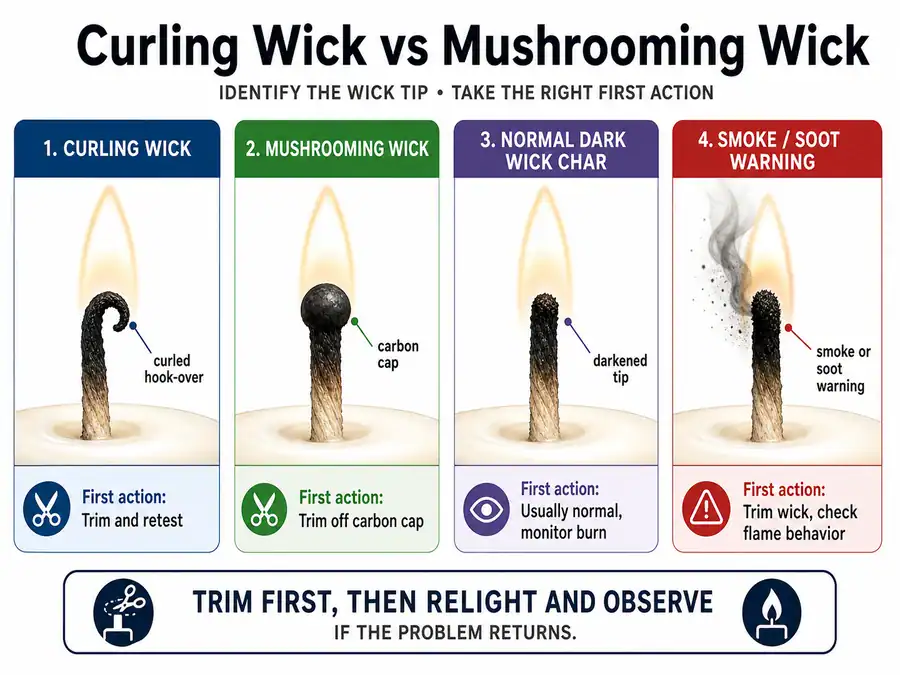
| What you see | What it usually means | First action |
| Wick bends to one side | Curling or hook-over | Watch flame posture and trim after cooling if needed |
| Black bulb on wick tip | Mushrooming from carbon buildup | Extinguish, cool, remove loose carbon, then trim |
| Dark wick tip only | Normal char may be present | Do not treat it as a mushroom unless it forms a cap |
| Smoke, soot, or tall flame | Wick, fuel, or burn condition may be off | Trim first, then retest under similar conditions |
Use candle wick troubleshooting to name the symptom before changing the candle. A curled wick is only a problem when it causes smoke, soot, flame instability, contact with the wax pool, or repeated poor burning. A mushroomed wick is a carbon-cap problem, so the first fix is removal and trimming before the next burn.
Some slight curl can be part of self-trimming wick behavior, especially when the flame stays steady and there is no soot. If the wick keeps forming a cap after correct trimming, save how to choose the right candle wick size for the sizing step instead of turning this section into a full wick chart.
Candle Wick Curling and Mushrooming Diagnostic Matrix
Use this diagnostic matrix to match the visible wick symptom to a likely cause, first fix, maker-level fix, and next test.
“Diagnostic” means likely next action based on visible wick behavior plus burn conditions. It does not mean a photo alone proves the root cause without trimming, cooling, and retesting.
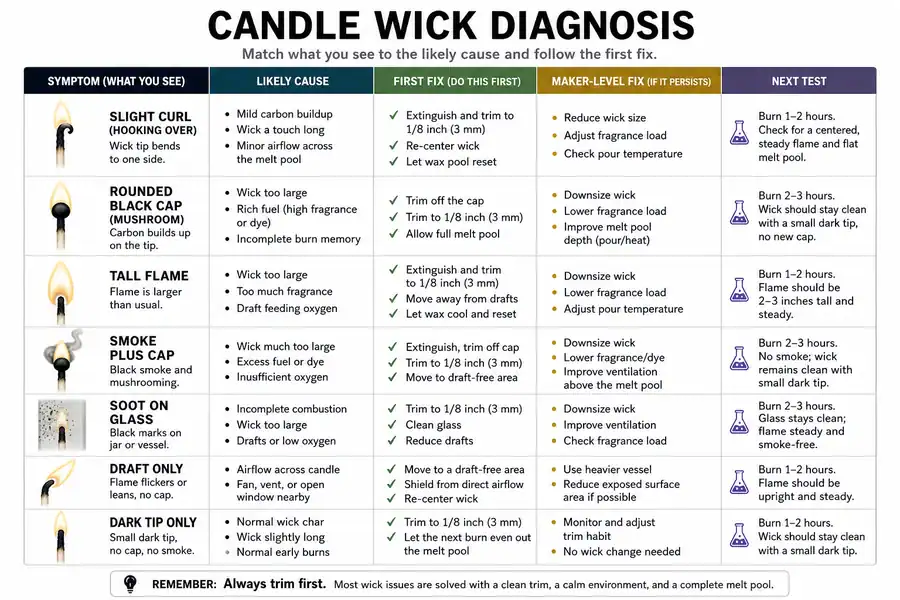
| Visible wick symptom | Likely cause | First fix | Maker-level fix | Next test or route |
| Wick bends slightly with a steady flame | Normal self-trimming behavior | Leave it alone unless residue appears | Compare against the same wick in the same formula | Monitor after cooling |
| Rounded black cap on wick tip | Carbon buildup or overfeeding | Extinguish, cool, remove cap, and trim | Check wick heat, wax, fragrance, and burn conditions | Retest one variable |
| Carbon cap returns after trimming | Wick, formula, container, or burn-condition mismatch | Repeat the trim-first retest | Wick down or isolate formula and container variables | Use how to choose the right candle wick size |
| Tall flame with mushrooming | Wick may be too hot or too long | Extinguish, cool, and trim | Test a smaller or cooler wick option | Compare under the same burn conditions |
| Smoke plus carbon cap | Cap, airflow, fuel load, or wick heat may be involved | Remove carbon and retest in still air | Check formula load and wick match | Use candle burn test protocol |
| Soot on glass with mushrooming | Burn is leaving residue | Trim and reduce uncontrolled burn factors | Review wick heat, dye, fragrance, and airflow | Use how to prevent candle soot |
| Mushrooming after fragrance increase | Formula load may be too heavy for the system | Retest a lower or unchanged load | Isolate fragrance from dye and additive changes | Use candle fragrance load calculator |
| Wick curls into wax and weakens | Wick posture may be crossing into drowning | Stop, cool, trim, and inspect | Test wick posture and melt-pool behavior separately | Route to wick drowning if the wick loses flame contact |
| Wick curls toward glass | Heat may be directed toward the container wall | Stop burning if flame or wick nears glass | Retest only after trimming and centering checks | Use candle safety basics if heat or glass contact is a concern |
| Wick sits off-center while burning | Placement may be the main issue | Stop and inspect after cooling | Correct centering in the next pour | Route to off-center wick placement |
| Symptom appears only in drafts | Airflow is likely distorting the burn | Retest in still air | Keep test conditions stable before changing wick or formula | Do not resize from a drafty result |
| Photo shows a dark tip only | Normal char may be mistaken for mushrooming | Look for a raised cap, smoke, or soot | Compare before and after trimming | Stay within candle wick troubleshooting before changing parts |
What does wick mushrooming look like? It looks like a rounded black carbon cap, not just a darkened wick tip. What does the symptom probably mean? The table gives a likely next action, not a final proof. Should you trim, wick down, change formula, or retest? Trim first for cap buildup, wick down when heat repeats after trimming, change formula when the symptom follows a formula change, and retest when the cause is still uncertain.
If the matrix points to wick size, formula load, burn testing, soot, safety, drowning, or off-center wick placement, follow the matching plain-language route instead of solving every workflow inside this page.
Why Candle Wicks Mushroom: Carbon Buildup and Carbon Caps
Candle wick mushrooming is carbon buildup that forms a bulb or cap on the wick tip.
Mushrooming happens when carbon collects at the wick tip faster than the flame burns it away. That cap can change flame size, shed debris, create smoke, or leave soot because the wick is no longer burning cleanly at the tip.
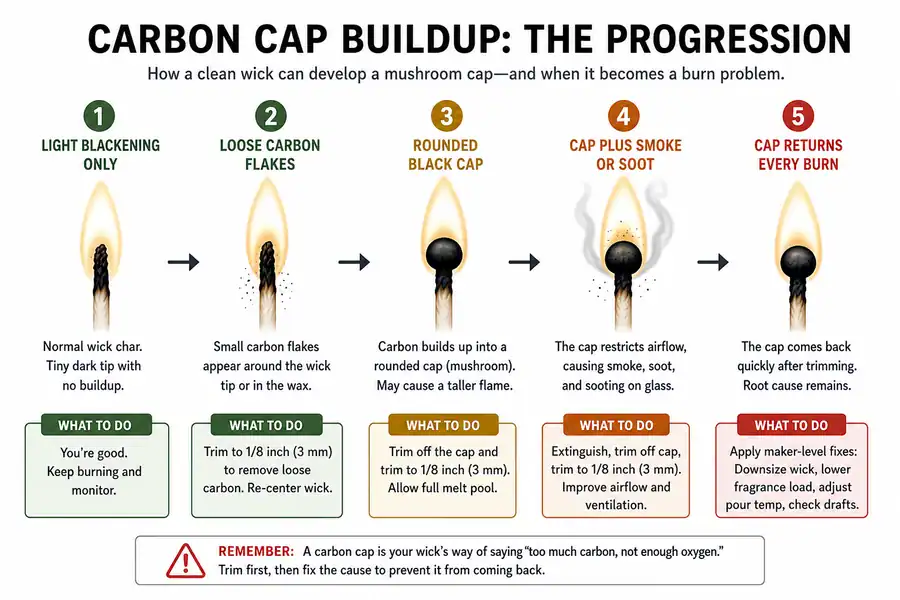
| Wick-tip sign | Meaning | What to do next |
| Light blackening only | Normal char after burning | Monitor after the candle cools |
| Small loose carbon flakes | Early buildup | Remove loose pieces before relighting |
| Rounded black cap | Mushrooming | Cool, remove cap, trim, and relight |
| Cap plus smoke or soot | Wick or formula may be overfeeding the flame | Trim, retest, then check wick heat or fuel load |
| Cap returns every burn | Repeated mushrooming | Escalate beyond trimming |
In candle wick troubleshooting, carbon buildup is a symptom, not a final diagnosis. A long wick, too much heat, heavy fuel draw, dye, additives, fragrance load, or unstable burn conditions can all help the cap form. The point is not to study flame chemistry; the useful question is whether the cap disappears after trimming or keeps coming back.
Smoke is visible airborne residue, while soot is the dark deposit it can leave nearby. For a full cleaning and prevention path, how to prevent candle soot belongs with soot care; here, soot only helps confirm that mushrooming is affecting the burn. If the cap returns after a proper trim, why mushrooming returns after trimming becomes the next diagnostic step.
How to Trim a Mushroomed or Curling Wick Before Relighting
Trim a mushroomed wick only after the candle is extinguished and the wick and wax have cooled. For ordinary candle care, trim the cooled wick to about ¼ inch / 6 mm before relighting unless the candle maker gives a different instruction.
Pre-burn trimming means shortening the wick before lighting. Post-burn carbon-cap removal means removing the black mushroomed buildup after the candle has been put out, cooled, and inspected. Never cut a live flame or hot wick, because the wick, melt pool, and loose carbon can shift suddenly.
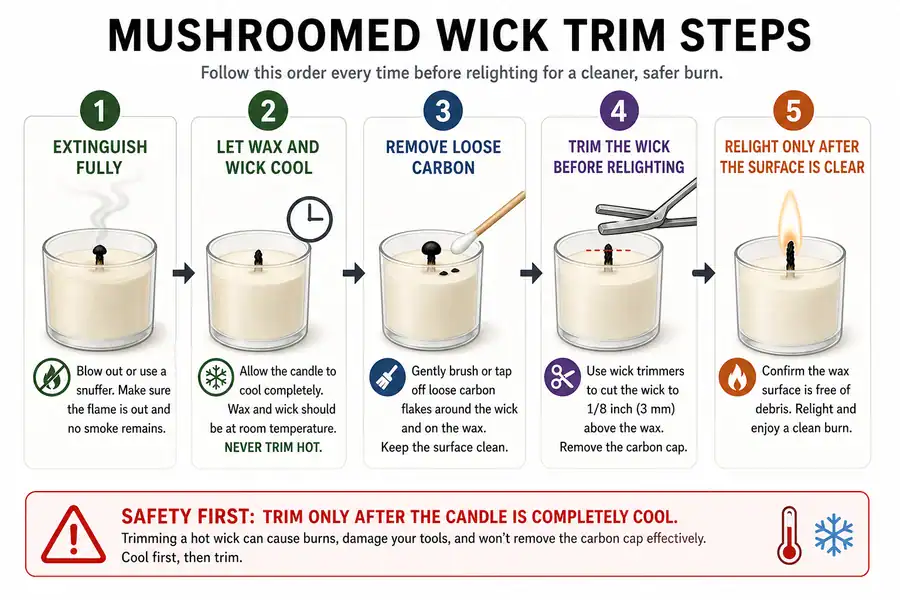
| Step | What to do | Why it matters |
| 1 | Extinguish the candle fully | Stops heat and flame movement before handling |
| 2 | Let the wax pool and wick cool | Keeps the wick stable and reduces hot-wax risk |
| 3 | Remove loose carbon from the tip | Prevents debris from falling into the wax |
| 4 | Trim the wick before relighting | Reduces tall flame, smoke, and repeated carbon buildup |
| 5 | Relight only after the surface is clear | Gives the next burn a cleaner starting point |
When the symptom is unclear, start with trimming when the wick is long, curled, or capped. A long wick can feed a larger flame, and a larger flame can leave more carbon at the tip. The goal is not to reshape the wick for appearance; the goal is to restart the burn with a shorter, cleaner wick tip.
A simple candle care routine can include wick trimming, but this fix stays focused on curling and mushrooming. If a properly trimmed wick mushrooms again under similar conditions, move to why mushrooming returns after trimming and wick-size checks.
When the Carbon Cap Is Big Enough to Remove
Remove a carbon cap before relighting when it causes smoke, soot, tall flame, unstable burn, falling debris, or repeated buildup.
A carbon cap is worth removing when it changes how the candle burns, not just because the wick tip looks dark. Ordinary char can appear after burning, but a rounded bulb, loose black clump, or recurring cap is a stronger sign that the wick needs attention.
| Wick-tip condition | Action | Reason |
| Darkened tip only | Monitor | Normal char may not affect the flame |
| Small loose flakes | Remove before relighting | Loose carbon can fall into the wax |
| Rounded black cap | Remove and trim | The cap can enlarge the flame or smoke |
| Cap plus smoke or soot | Remove, trim, and retest | The burn is showing residue problems |
| Cap returns after trimming | Escalate diagnosis | The wick, formula, container, or burn conditions may be mismatched |
Avoid exact universal cap-size rules. A cap is too much when it affects flame behavior, drops debris, creates smoke or soot, or keeps returning after the same trim-first correction.
When Mushrooming Means the Wick Is Too Hot or Too Large
A wick is “too large” when its heat output and fuel draw are too strong for the candle’s wax, fragrance load, container, and burn conditions.
A mushroomed wick does not automatically prove the wick is oversized. Trim first, cool the candle, and compare the next burn under similar conditions before changing wick size. Repeated mushrooming after proper trimming can mean the wick is drawing too much fuel or creating too much heat for the candle.
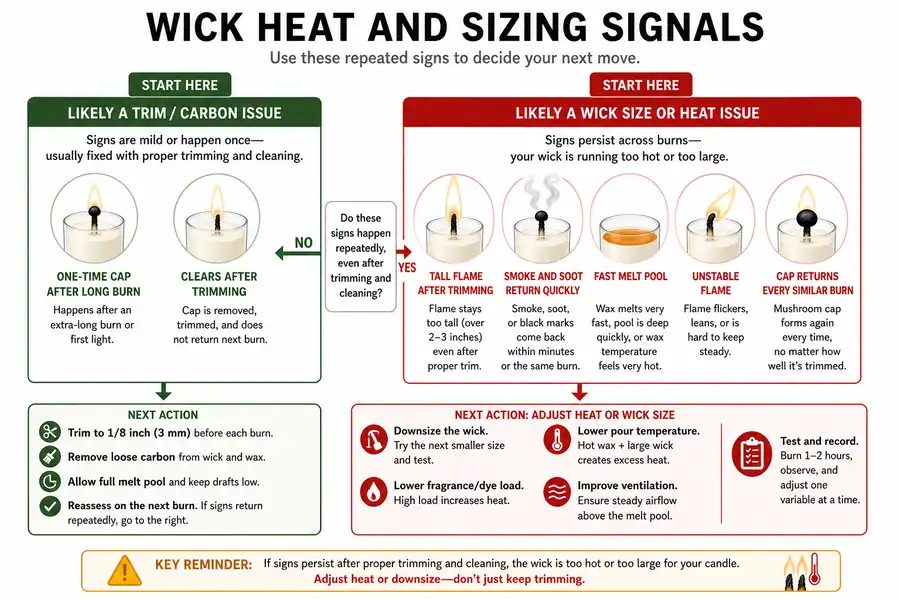
| Sign after proper trimming | More likely trim issue | More likely wick-size or heat issue |
| One-time cap after a long burn | Yes | Not enough evidence |
| Cap returns every similar burn | Less likely | More likely |
| Tall flame after trimming | Less likely | More likely |
| Smoke and soot return quickly | Less likely | More likely |
| Melt pool grows unusually fast | Less likely | More likely |
| Cap appears with unstable flame | Possible | More likely |
In candle wick troubleshooting, “too hot” means the wick is making more heat than the wax, container, and formula can handle cleanly. The warning signs are a tall flame, smoke, soot, fast melt pool, unstable flame, and recurring carbon cap. That pattern points beyond a simple trimming mistake.
Use this section to decide whether wick size is suspect; use how to choose the right candle wick size to choose the next exact size. If you test a smaller wick or a different wick series, keep the wax, fragrance load, container, and room conditions as similar as possible so the result is not confused by a new variable. Save the full candle burn test protocol for the structured test stage, because this section only decides whether wick heat is the likely next cause.
If It Keeps Mushrooming After Trimming, Escalate the Test
If a properly trimmed wick mushrooms again under similar burn conditions, suspect a system mismatch.
Recurring mushrooming means the same symptom comes back after the wick was trimmed, the candle was cooled, and the next burn was compared fairly. That does not prove the wick alone is wrong, but it does justify moving past quick maintenance.
| Repeated symptom | Likely next check | What to avoid |
| Cap returns with tall flame | Wick heat or size | Jumping to fragrance blame first |
| Cap returns with smoke and soot | Wick, formula, or airflow | Treating soot as a separate-only issue |
| Cap returns only in one jar | Container heat feedback | Changing wax and wick together |
| Cap returns after formula change | Fragrance, dye, or additive load | Assuming trim length caused everything |
| Cap returns in drafty conditions | Airflow and burn environment | Downsizing before still-air retest |
Change one variable at a time. A wick-down test is useful only when the next burn can be compared against the same wax, container, fragrance load, and burn conditions.
Can Wax Type Make a Candle Wick Curl or Mushroom?
Wax type can change melt-pool behavior and fuel delivery, which can make the same wick burn cleaner or mushroom more.
Wax is part of the candle’s fuel system, so it affects how much melted fuel reaches the wick during burning. In candle wick troubleshooting, wax should be checked only as a wick-behavior variable, not as a full wax ranking.
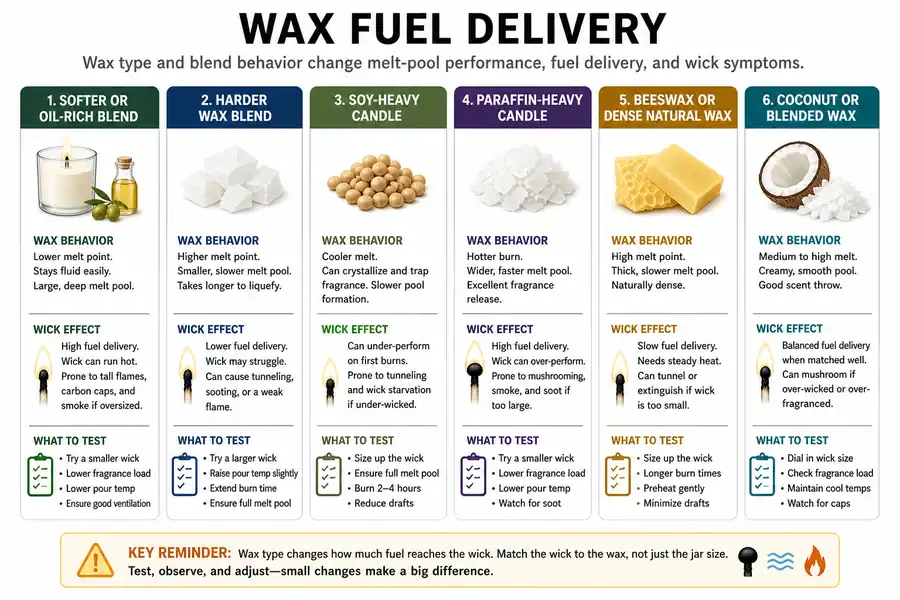
| Wax or blend behavior | How it can affect the wick | What to test |
| Softer or oil-rich blend | May feed the wick more readily | Compare mushrooming after trimming |
| Harder wax blend | May change melt-pool size and fuel flow | Check whether the wick struggles or overheats |
| Soy-heavy candle | May behave differently from the same wick in paraffin or blends | Retest the wick in the exact wax blend |
| Paraffin-heavy candle | May create a different flame and melt-pool response | Compare flame height and carbon cap recurrence |
| Beeswax or dense natural wax | May need a different wick match | Watch for curl, weak burn, or carbon buildup |
| Coconut or blended wax | Can vary widely by supplier blend | Treat the blend as its own test condition |
The useful comparison is not whether one wax is always cleaner than another. A better question is whether the same wick curls, mushrooms, smokes, or burns steadily in the exact wax blend you are using. That is why soy vs paraffin vs beeswax for candle making belongs in a wax comparison path, while this section stays focused on wick symptoms.
For full wax comparison and pairing charts, use wax and wick pairing; this section only explains how wax can affect the wick symptom.
Can Fragrance Oil, Dye, or Additives Cause Wick Mushrooming?
Fragrance oil, dye, and additives can contribute to wick mushrooming, but they should be isolated as formula variables before they are blamed.
“Too much fragrance” means above the tested tolerance of the wax-wick-container system, not simply a candle that smells strong. Additive load means the total formula burden from fragrance oil, dye, botanicals, stabilizers, or other extras that may affect residue, fuel flow, or burn consistency.
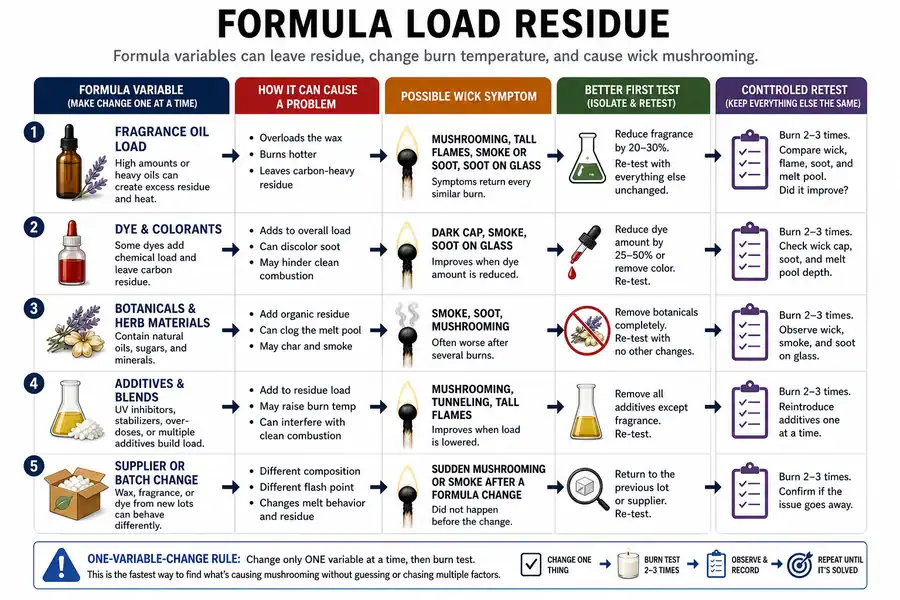
| Formula variable | Possible wick symptom | Better first test |
| Fragrance oil load | Mushrooming, smoke, unstable flame, or faster carbon buildup | Retest with the same wick and a controlled fragrance adjustment |
| Dye load | Smoke, darker residue, or wick-tip buildup | Compare dyed vs undyed version if possible |
| Botanicals or decorative additives | Debris, flare risk, or uneven burning near the wick | Keep loose material away from the burn path |
| Mixed additives | Harder-to-read mushrooming pattern | Remove or reduce one variable at a time |
| New supplier oil or dye | Different burn behavior with the same wick | Retest before changing several parts of the formula |
Do not blame fragrance before the pattern supports it. If the candle mushrooms only after a formula change, the formula deserves testing; if it mushrooms across several formulas, wick size, wax pairing, container heat, or burn conditions may be more likely. The decision is not “reduce fragrance or wick down first” every time; it is “change one variable and compare the next burn.”
Use the candle fragrance load calculator for exact percentages; this section only tells you when formula load should be tested as a cause. Keep candle-safe additives separate from wick diagnosis when the question becomes additive safety, botanical use, or full formula design.
What Flame, Smoke, and Soot Signs Mean With a Curled or Mushroomed Wick
Smoke, soot, tall flames, and unstable flicker are wick-related warning signals when they appear with curling or mushrooming.
Visible flame behavior helps separate a simple trim issue from a wick, formula, or burn-condition problem. In candle wick troubleshooting, look at the wick tip, flame height, smoke, soot, and carbon cap together instead of judging one sign alone.
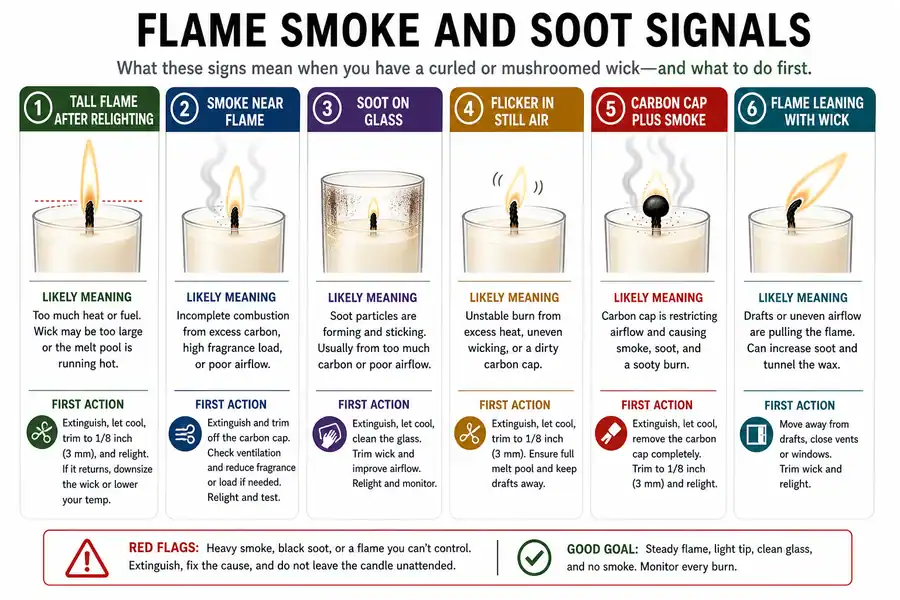
| Signal you see | Likely meaning | First action |
| Tall flame after relighting | Wick may be too long or too hot | Extinguish, cool, trim, and retest |
| Smoke near the flame | Wick, carbon cap, draft, or fuel load may be off | Check for mushrooming and airflow |
| Soot on glass or nearby surface | Burn is leaving residue | Trim first, then review wick and formula |
| Flicker in still air | Wick or fuel flow may be unstable | Retest under the same conditions |
| Carbon cap plus smoke | Mushrooming is affecting the burn | Remove cap, trim, and compare the next burn |
| Flame leaning with the wick | Curl, draft, or melt-pool flow may be involved | Check wick posture before changing size |
Smoke is the visible residue in the air; soot is the dark deposit it can leave behind. Mushrooming can contribute to soot, but soot can come from wick heat, fragrance load, dye, airflow, or burn habits. For a complete soot-prevention workflow, use how to prevent candle soot; here, soot and smoke only act as wick-performance signals.
When to Stop Burning a Candle With a Curled or Mushroomed Wick
Stop burning if the flame is too tall, smoky, unstable, touching glass, dropping debris, or producing heavy soot.
A curled or mushroomed wick is not just a cosmetic issue when it changes flame behavior or sends heat in the wrong direction. Let the candle cool before trimming, removing carbon, or inspecting the wick.
Stop burning when:
- The flame stays tall after a proper trim.
- Smoke continues after the candle is out of a draft.
- Soot builds on the jar or nearby surface.
- The wick drops black debris into the melt pool.
- The flame leans toward the glass.
- The wick curls into the wax pool and struggles to burn cleanly.
Use candle safety basics for broader burn limits and placement rules. For this wick problem, the boundary is simple: stop the burn when the wick symptom creates heat, smoke, soot, debris, or unstable flame that trimming does not correct. Keep unattended-burning, remaining-wax, and label rules in the broader candle safety path instead of expanding them here.
Burn Duration, Relighting Habits, and Room Conditions
Long burns, short relights, drafts, and inconsistent burn conditions can make wick symptoms worse or harder to diagnose.
Burn duration, relighting habits, and room conditions can make wick curling or mushrooming look worse than it would under a controlled burn. A normal burn here means stable air, a suitable burn length, and wick inspection after the candle cools. If the room, timing, or relighting pattern keeps changing, the same wick can look like it has a different problem each time.
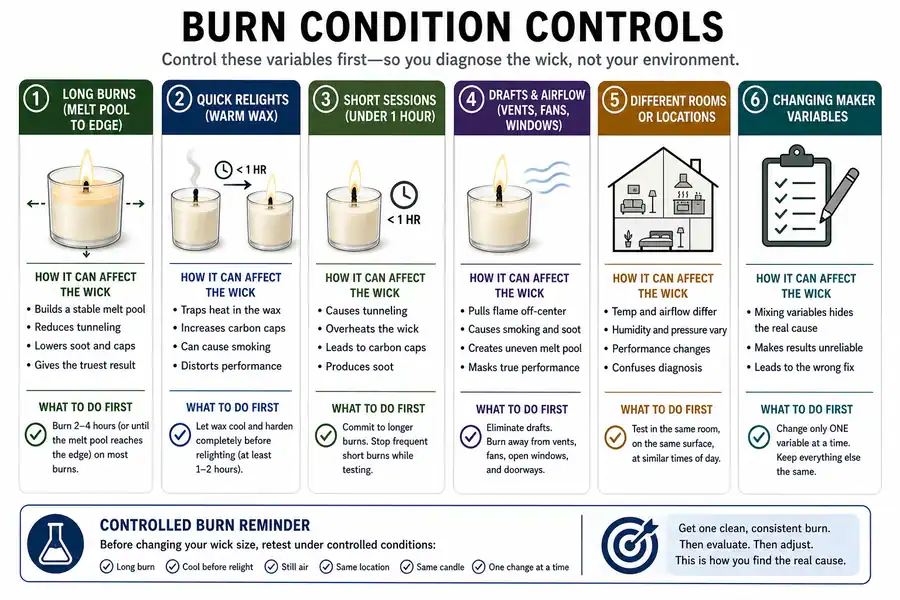
| Burn condition | How it can affect the wick | What to do first |
| Very long burn | Can enlarge melt pool, heat, and carbon buildup | Let the candle cool and inspect the wick |
| Quick relight after a smoky burn | Can restart with leftover carbon | Remove loose carbon before relighting |
| Short, uneven sessions | Can make symptoms harder to compare | Keep the next test more consistent |
| Drafty room | Can bend the flame and unevenly carbonize the wick | Retest in still air |
| Different room each burn | Can change flame behavior | Compare only similar conditions |
| Maker test with changing variables | Can hide the real cause | Change one variable at a time |
Use candle wick troubleshooting when burn habits blur the cause. A candle that mushrooms after an unusually long burn may not need the same correction as one that mushrooms after every trimmed, stable burn. If the issue appears only under uncontrolled burn conditions, fix the condition first; use candle burn test protocol only when maker-level validation is needed.
For everyday use, how long should you burn a candle belongs with burn-time habits. Here, burn duration matters only because it can exaggerate wick curling, carbon caps, smoke, and soot.
How Drafts and Airflow Can Make Wick Problems Look Worse
Drafts can bend the flame, change oxygen exposure, increase flicker, and make the wick carbonize unevenly.
A draft means moving air from a window, fan, vent, door, or frequent movement near the candle. Drafts can make a normal wick look unstable because the flame no longer sits evenly around the wick.
Still-air retest checklist:
- Move the candle away from fans, vents, windows, and walkways.
- Let the candle cool before the next burn.
- Trim the wick and remove loose carbon before relighting.
- Burn in the same container, wax, and formula condition.
- Watch whether the flame steadies and whether the cap returns.
- Change wick size only if the symptom repeats in still air.
Do not treat a drafty test as proof that the wick is wrong. First prove the symptom repeats when the flame is steady, the wick is trimmed, and the candle is inspected after cooling.
Is Wick Curling Ever Normal?
Some candle wicks are designed to curl slightly as they burn, and that curl can be part of normal self-trimming behavior.
Self-trimming means a designed bend that helps the wick tip burn cleaner; it does not mean every curled wick is acceptable. In candle wick troubleshooting, the question is whether the curl keeps the flame steady or creates smoke, soot, contact, or repeated carbon buildup.
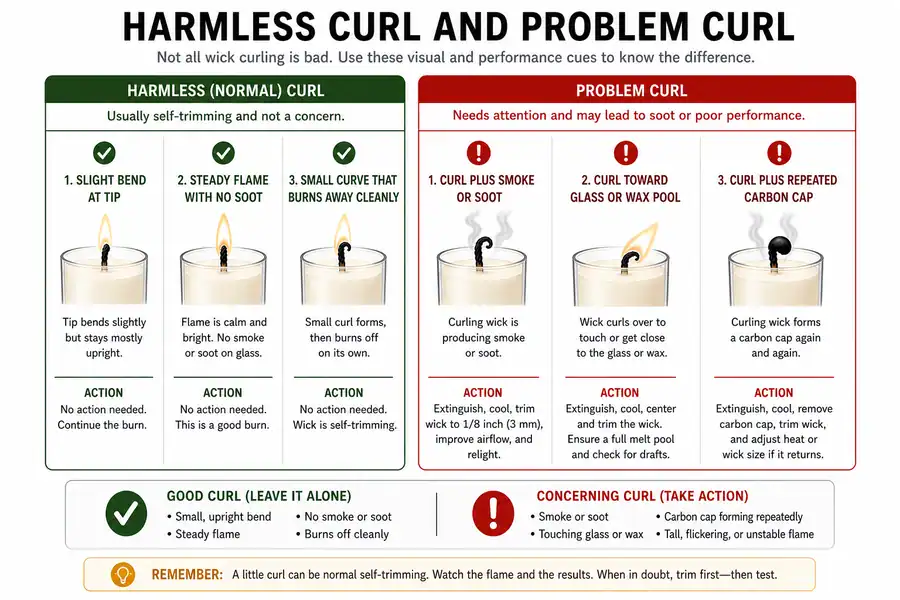
| Wick curl sign | Usually normal | Needs attention |
| Slight bend at the tip | Yes | No |
| Steady flame with no soot | Yes | No |
| Small curve that burns away cleanly | Yes | No |
| Curl plus smoke or soot | No | Yes |
| Curl toward glass or wax pool | No | Yes |
| Curl plus repeated carbon cap | No | Yes |
If the candle burns cleanly, do not rush to change wick size, wax, or fragrance. For wick-series and construction differences, use the wick types guide; this section only explains whether the curl itself is normal or problematic. Use candle wick types when the next question becomes wick family selection rather than symptom diagnosis.
Harmless Curl vs Problem Curl
A curled wick is a problem when it causes smoke, soot, instability, contact, drowning, or repeated carbon buildup.
A harmless curl stays small, keeps the flame stable, and does not leave residue beyond normal wick char. A problem curl changes how the candle burns, especially when the flame leans, the wick dips into wax, or the same cap returns after trimming.
| Curl type | What it means | What to do |
| Slight curl with steady flame | Normal self-trimming behavior | Leave it alone and inspect after cooling |
| Curl with small char only | Usually normal burn residue | Trim before the next burn if needed |
| Curl with smoke | Burn is not clean | Extinguish, cool, trim, and retest |
| Curl with soot | Residue problem is present | Check wick heat, formula, and airflow |
| Curl into wax pool | Wick may drown or burn unevenly | Stop, cool, trim, and diagnose |
| Curl plus carbon cap | Curling and mushrooming overlap | Remove cap, trim, and retest |
Use harmless curl vs problem curl as the decision point: leave a clean self-trimming curl alone, but fix a curl that changes the flame, residue, or melt-pool behavior.
Wick Material, Braid, and Core Differences
Wick material, braid, and core type can change how a wick bends, feeds wax, and forms carbon during a burn.
A “bad wick” means unsuitable wick behavior in this exact candle system, not a universally defective material. In candle wick troubleshooting, wick construction matters only when it explains curling, mushrooming, fuel draw, flame posture, or repeated carbon buildup after proper trimming.
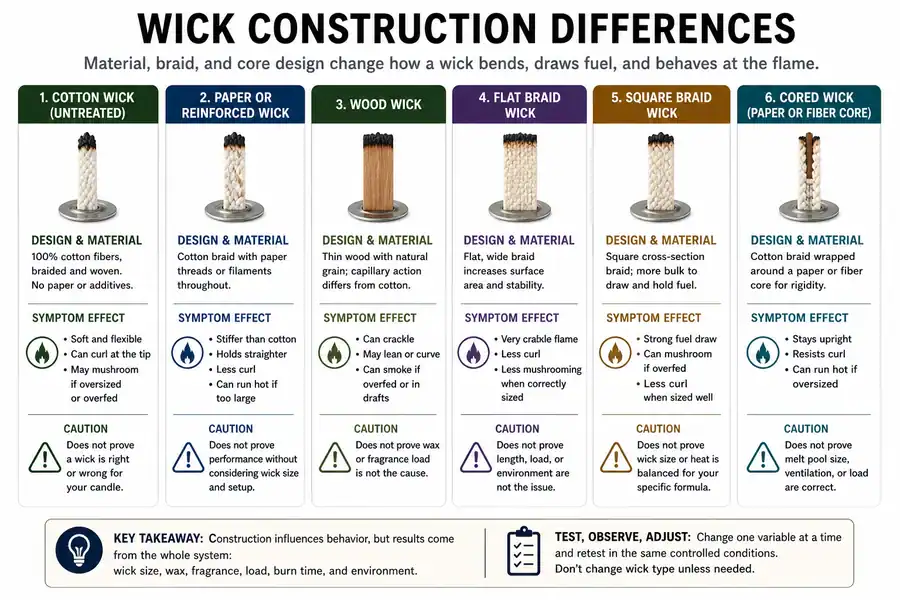
| Wick construction factor | How it can affect symptoms | What it does not prove |
| Cotton wick | May bend, curl, or self-trim depending on braid | Cotton is not automatically the cause |
| Paper or reinforced wick | May change stiffness and fuel draw | Reinforcement is not always too hot |
| Wood wick | May lean or burn differently because of clip and grain behavior | Wood is not the same issue as cotton curl |
| Flat braid | May curl as part of its burn posture | Curling is not always a defect |
| Square braid | May behave differently in denser waxes | It is not always better for every candle |
| Cored wick | May stay more upright but still mushroom if mismatched | Upright does not mean clean-burning |
Use this section to understand construction as a cause; use the wick types guide to choose between wick families. Use candle wick types for material and construction choices, and use how to choose the right candle wick size when the symptom points to heat output or fuel draw.
Test a different wick type only after trimming, still-air burning, and formula checks do not solve the symptom. Changing wick material too early can hide the real cause, especially when wax type, fragrance load, container heat, or burn duration changed at the same time.
Container Diameter and Heat Feedback
Container diameter and heat feedback can change flame temperature, melt-pool behavior, and fuel delivery.
The same wick can mushroom in one jar but burn cleanly in another because the container changes how heat returns to the wax and wick. In candle wick troubleshooting, “right container” means the container’s diameter and heat behavior match the wick and wax system, not that the jar only looks correct.
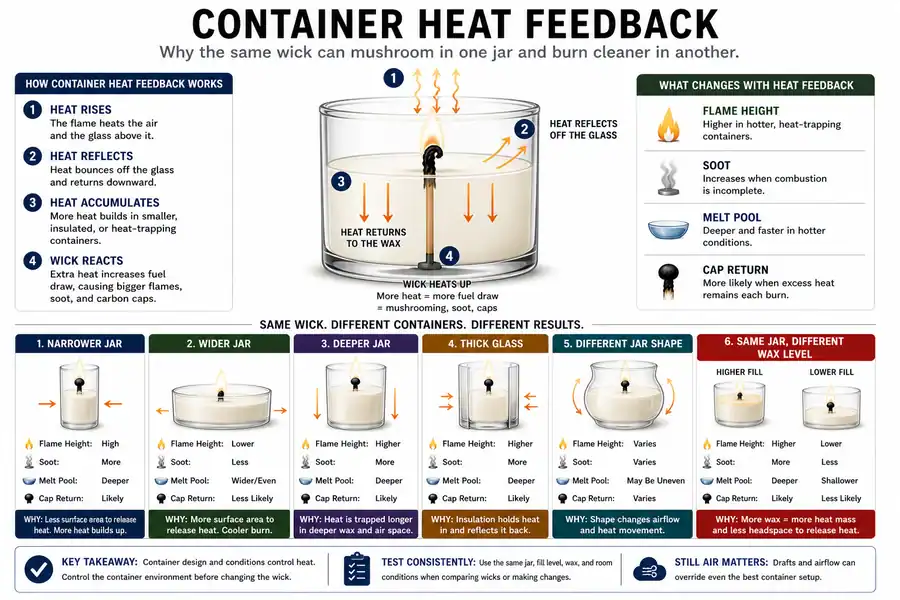
| Same wick, different jar condition | How it can affect mushrooming | What to compare |
| Narrower jar | May hold more heat around the flame | Flame height, soot, and cap return |
| Wider jar | May spread heat differently across the melt pool | Full melt behavior and wick stability |
| Deeper jar | May trap heat as the candle burns lower | Mushrooming later in the burn |
| Thick glass | May retain heat differently | Flame size after the jar warms |
| Different jar shape | May change airflow and heat concentration | Whether the same wick behaves differently |
| Same jar, different wax level | May change heat feedback over time | Early burn vs later burn behavior |
Do not turn one jar result into a universal wick verdict. If the wick mushrooms only in one vessel, the problem may be the wick-container match, not the wick by itself. Use the container diameter wick-size guide when the next step is choosing a size for a specific vessel.
Curl Direction and Wick Posture in the Melt Pool
Where the wick curls matters: a wick curling into wax, toward glass, or away from the flame can point to different causes and safety routes.
Curl direction means where the wick bends relative to the flame, melt pool, and container wall. Wick posture is the position and direction of the wick tip during or after burning, including whether it curls, leans, collapses, or contacts wax or glass.
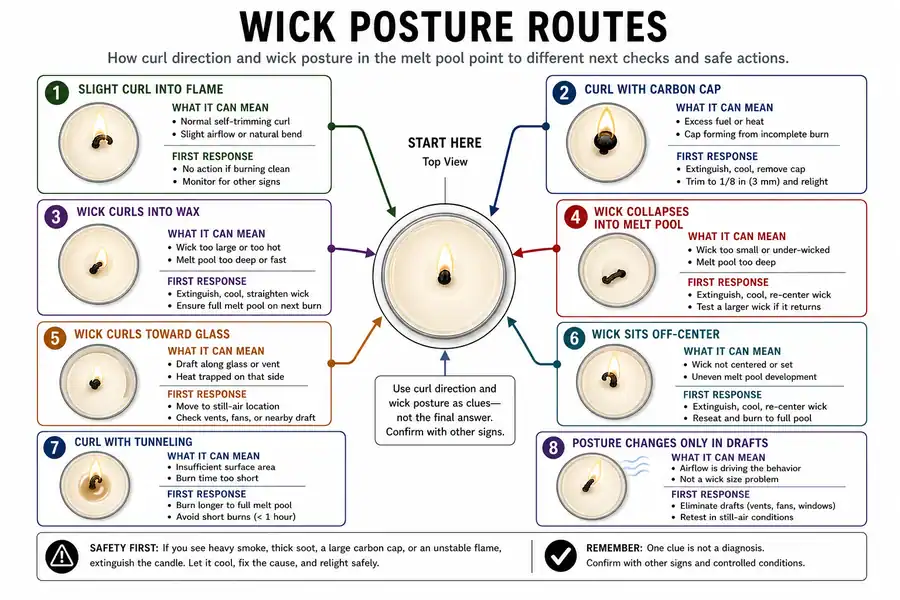
| Wick posture pattern | What it may mean | First response |
| Slight curl into the flame | Normal self-trimming may be happening | Watch for smoke, soot, or cap growth |
| Curl with carbon cap | Curling and mushrooming overlap | Extinguish, cool, remove cap, and trim |
| Wick curls into the wax | Wick may be losing clean flame contact | Cool, trim, and check whether it repeats |
| Wick collapses into the melt pool | The issue may be closer to wick drowning | Stop treating it as simple curling |
| Wick curls toward the glass | Heat may be directed toward the container wall | Stop burning if flame or wick contacts glass |
| Wick sits visibly off-center | The issue may be off-center wick placement | Route the fix to placement, not mushrooming |
| Wick curl appears with tunneling | Melt-pool shape may be part of the symptom | Do not diagnose it from curl alone |
| Wick posture changes only in drafts | Airflow may be distorting the flame | Retest in still air before resizing |
What if the wick curls into the wax? Treat it as a posture warning when the flame weakens, the wick struggles, or the tip sits in the melt pool. What if the wick curls toward the glass? Stop the burn if the flame, wick, or heat is directed at the glass. Is this wick drowning or just curling? If the wick is submerged, collapsing, or losing flame contact in the melt pool, it is no longer only a curl problem.
Use candle wick troubleshooting to keep the symptom connected to wick behavior, but do not diagnose the root cause from a photo alone. Route the issue to wick bridging or wick drowning when the wick loses flame contact, crosses the melt pool, or stays submerged. Curl direction helps route the next step; it does not replace trimming, still-air retesting, formula checks, or wick-size testing.
How to Retest After Fixing Wick Curling or Mushrooming
After trimming, wicking down, or changing the formula, retest with only one variable changed so you can tell what actually fixed the wick behavior.
Retest with similar burn conditions, a cooled wick inspection, and one changed variable at a time. “Fixed” means repeatable improvement under similar conditions, not one clean-looking relight.
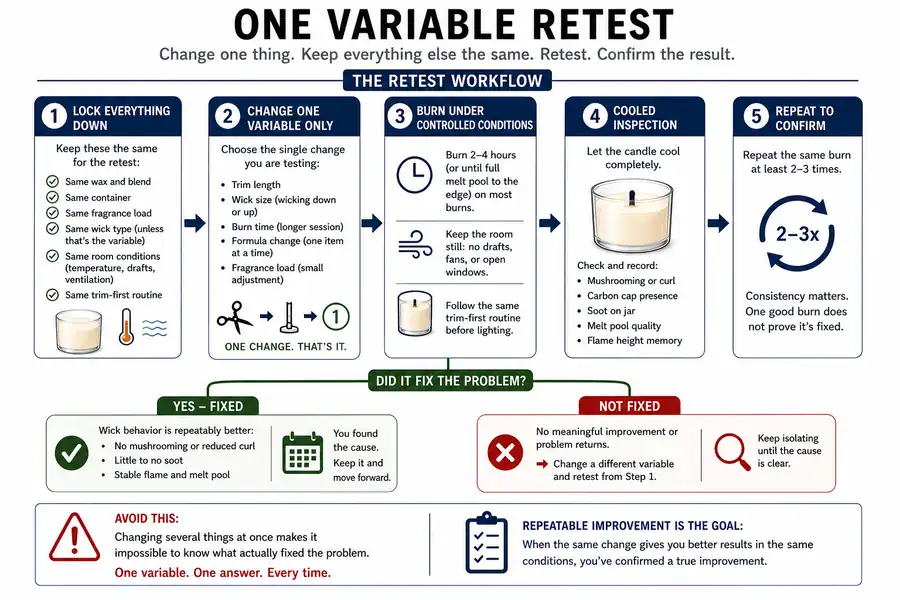
| Retest step | What to keep the same | What to watch |
| 1 | Same wax, container, and fragrance load | Whether the cap returns |
| 2 | Same room conditions if possible | Whether drafts distort the flame |
| 3 | Same trim-first routine | Whether mushrooming improves after maintenance |
| 4 | One changed variable only | Whether the change actually helped |
| 5 | Cooled inspection after the burn | Wick posture, soot, smoke, and carbon buildup |
Cure Time and Formula Stability
An unstable or under-cured candle can make wick symptoms inconsistent and harder to diagnose reliably.
“Not cured” here means the candle is not stable enough for a fair wick diagnosis, not that cure time is always the cause of mushrooming. A wick test is easier to read when the wax, fragrance, dye, and additives have settled into a repeatable burn pattern.
| Test condition | Why it can mislead you | Better action |
| Testing too soon after pouring | Burn behavior may not repeat later | Wait and compare another burn |
| Testing after a formula change | Wick symptoms may reflect the new formula | Keep notes on what changed |
| Changing wick and cure timing together | You cannot tell which variable helped | Change one variable at a time |
| Reading one cleaner burn as a fix | One burn may be a false improvement | Repeat under similar conditions |
| Comparing different cure states | Results may not be equal | Compare candles at similar stability |
Use a cure-time guide when you need wax-specific timing. For this wick problem, cure time is only a test-confidence variable: it helps decide whether the mushrooming pattern is reliable enough to act on.
If the symptom changes during the retest, return to the visible wick behavior before changing another variable. A wick that stops mushrooming after trimming may only need better maintenance, while a wick that keeps mushrooming after the same trim may need how to choose the right candle wick size. If a formula change caused the symptom, reverse or isolate that formula change before blaming the wick.
A quick retest is enough when the candle is for personal use and the symptom clearly improves. A maker-level retest is needed when you sell the candle, change wick size, change fragrance load, change wax, or need repeatable proof across more than one burn. Use candle burn test protocol for the full validation path; keep this step focused on one-variable confirmation.