

The best candle wick for beginners is a forgiving, format-safe wick that is easy to test in the candle type being made, not one universal wick for every candle.
A candle wick is the fuel-delivery strand that draws melted wax to the flame. For beginners, best means forgiving, format-safe, and easy to test, not cheapest, strongest, or final without a burn test. Container candles and pillar candles need different start points because a jar holds the wax while a pillar must hold its own shape. The lowest-risk first move is to choose the candle format, then use wick family, wax type, and adjacent sizes to narrow the first test.
This guide covers beginner start points for container and pillar candles; exact wick-size charts, wax-specific sizing, brand rankings, and burn-failure diagnosis belong in separate supporting guides.
What Makes a Candle Wick Beginner-Friendly?
The best candle wick for beginners is the easiest wick to choose, test, and adjust for the candle format, not one perfect wick for every candle.
A beginner-friendly wick is a forgiving starting option that gives readable test results. A candle wick is the strand that draws melted wax to the flame and controls how the candle burns.
Use a candle wick guide for the full wick part breakdown, but judge beginner wicks by format fit, supplier sizing help, and easy retesting. Wick family is the wick type or series. Wick size is the specific size inside that family. The final tested wick is the one that works in your actual wax, fragrance load, vessel or mold, and candle format.
| Criterion | Why it helps beginners | Container relevance | Pillar relevance | Selection risk |
| Matches the candle format | Prevents jar logic from being used on freestanding candles | High | High | Low |
| Has supplier sizing help | Gives a starting range instead of a guess | High | High | Low |
| Comes in adjacent sizes | Lets you test up or down without changing the whole setup | High | High | Low |
| Works with common beginner waxes | Reduces mismatch risk during early tests | Medium | Medium | Medium |
| Produces readable burn results | Makes tunneling, weak flame, or large flame easier to interpret | High | High | Medium |
| Avoids brand-only claims | Keeps the choice based on fit, not marketing | High | High | Low |
This table uses practical selection criteria for first tests, not lab data, retailer rankings, or professional production scoring.
A beginner-friendly wick is not testing-free. It simply gives you a cleaner first path than buying one random size and hoping it works. A cotton, paper-core, flat-braid, or square-braid wick may be beginner-friendly only when it fits the candle format and has a size range you can test. A candle making for beginners path should treat the wick as one starting variable, not the whole candle recipe.
Once you know that “best” means a testable starting point, the next decision is whether you are making a container candle or a pillar candle, because those formats need different wick behavior.
Container vs Pillar Wicks: The First Choice Beginners Must Make
Container and pillar candle wicks are not interchangeable beginner start points because candle structure changes how the wick must behave.
A container candle burns inside a jar, so the vessel contains the melted wax. A pillar candle is freestanding, so the wick must help control the melt pool while the outer wax wall stays intact.
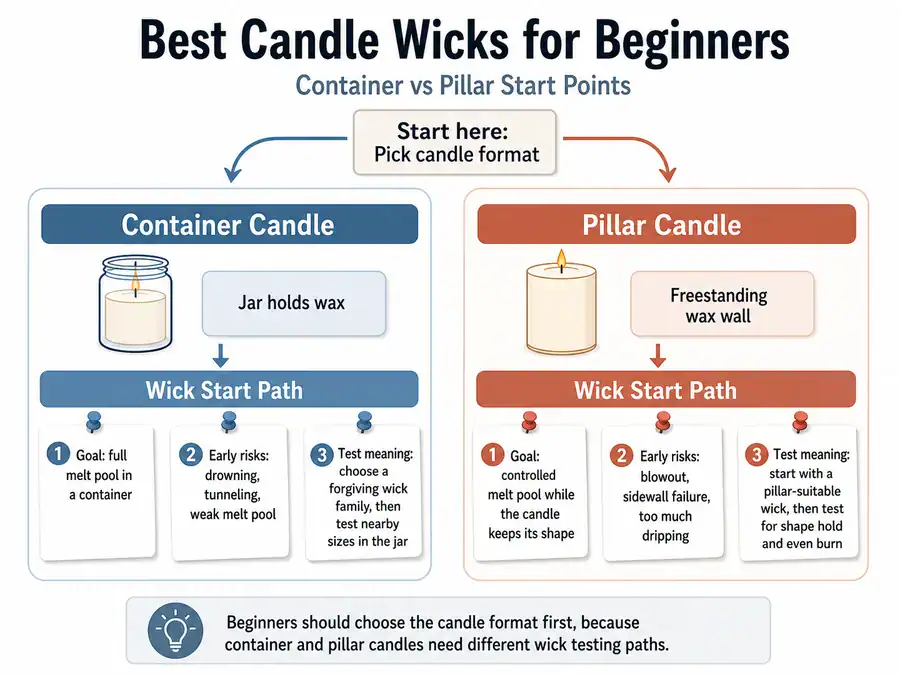
| Decision point | Container candle | Pillar candle | Beginner meaning |
| Wax support | Jar holds the wax | Candle body holds itself | Start with the candle structure |
| Melt pool goal | Reach a clean pool across the jar over testing | Avoid breaking the outer wall | Same flame size can behave differently |
| Main early risk | Tunneling, drowning, or soot | Leaking, wall collapse, or narrow core burn | Do not copy one format’s result into the other |
| Wick choice path | Jar diameter, wax, supplier range, adjacent sizes | Pillar diameter, wax hardness, wick family, conservative testing | Format comes before size |
| Chart use | A container candle wick size chart helps after the jar path is clear | A pillar candle wick sizing guide helps after the freestanding path is clear | Use the right chart type |
| Test meaning | Jar heat and wax pool show whether the start point is close | Wall stability and melt control show whether the start point is close | Test results are format-specific |
Some wick families can appear in both container and pillar candles, but that does not make the same wick size right for both. The best wick for a jar may be too aggressive, too weak, or simply the wrong starting path for a freestanding candle.
Tea lights, votives, tapers, and decorative specialty candles use different wick decisions, so they sit outside this container-versus-pillar choice. For jar candles, use the container start-point path before checking a full container candle wick size chart. For freestanding candles, use the pillar start-point path before moving to a pillar candle wick sizing guide.
A candle wick testing checklist becomes useful after the format path is chosen, because the test should confirm the wick in one candle structure rather than mix container and pillar rules.
Best Beginner Wick Start Points for Container Candles
Container candle wick selection starts with the jar’s inner diameter and wax system, but the recommended wick is still only a test starting point.
For beginners, the best container wick means the easiest wick to size and test for one jar and wax setup. Jar volume matters less than the inside width of the container, because the flame must create a controlled melt pool across that space.
A pre-tabbed wick is a wick already attached to a small metal base, which makes centering easier in many beginner jar candles. Start with the jar’s inner diameter, identify the wax or wax blend, check the supplier’s starting range, then test the suggested size plus nearby sizes. Use the container candle wick size chart for diameter-by-diameter options after you know the jar and wax path.
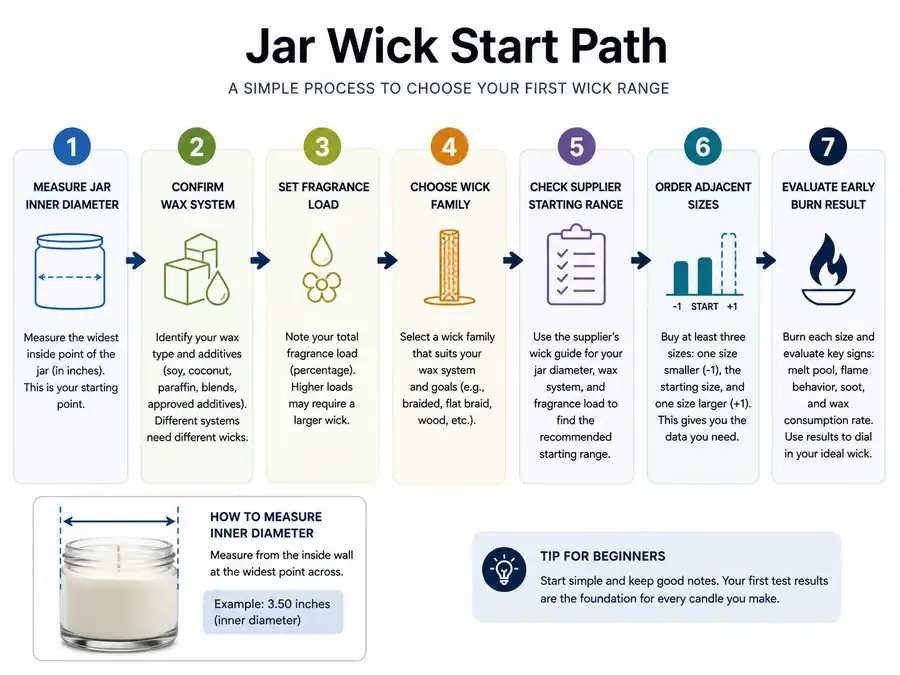
| Container starting factor | Beginner start point | Why it matters | What not to do |
| Jar inner diameter | Measure the inside width of the jar opening | The flame must fit the container’s burn area | Do not choose by jar volume alone |
| Wax system | Note whether the candle uses soy, paraffin, coconut, beeswax, or a blend | Wax hardness and melt behavior can shift wick choice | Do not assume one wax uses the same wick as another |
| Fragrance load | Keep the first test simple and repeatable | Heavy fragrance can change burn behavior | Do not test many variables at once |
| Wick family | Pick a family with supplier sizing help | Starting ranges reduce random guessing | Do not buy a single unsupported wick size |
| Adjacent sizes | Test the suggested size plus one smaller and one larger when available | Nearby sizes show whether the first pick is close | Do not scale a batch from one untested candle |
| Early burn result | Watch for tunneling, drowning, soot, or a large flame | The result shows the next adjustment direction | Do not treat symptoms as a full diagnosis here |
A soy container candle may need a different start path than a paraffin or coconut blend, so use a soy candle wick guide only when wax-specific detail becomes the main question. Supplier charts are starting references, not guarantees, because jar shape, wax blend, fragrance, dye, and wick treatment can all change the result.
Tunneling can mean the wick is too small, but it can also come from burn time or wax behavior. Soot or a large flame can suggest over-wicking, while drowning can suggest weak heat generation or a mismatch between wick and wax. Use the candle wick troubleshooting guide when the problem needs diagnosis rather than a first selection path.
Use this starting path to choose a first test range. Then use the candle wick testing checklist before making a batch or selling the candle.
Best Beginner Wick Start Points for Pillar Candles
Pillar candles need wick start points that protect freestanding wax structure, not just wicks that melt wax quickly.
For beginners, the best pillar wick is stable, conservative, and testable in a candle that must hold its own shape. A pillar candle has no jar to contain melted wax, so wick choice must balance flame size, melt-pool control, and the outer wax wall.
A burn wall is the outer shell of wax that remains around the melt pool as a pillar candle burns. Start by confirming the candle is a pillar, then identify pillar diameter, wax hardness, mold shape, wick centering, and test-burn stability. Use the pillar candle wick sizing guide for diameter-specific wick choices after choosing the pillar path.
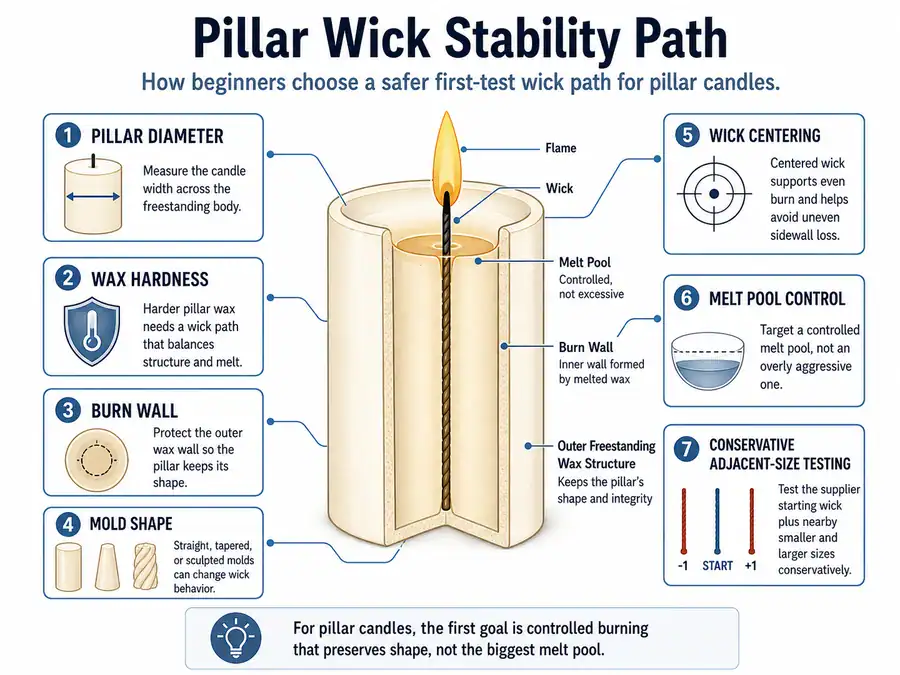
| Pillar starting factor | Beginner start point | Main risk if wrong | Safer beginner direction |
| Pillar diameter | Measure the freestanding candle width | Wrong flame size for the candle body | Start with the supplier’s pillar range |
| Wax hardness | Note whether the wax is firm enough for pillars | Soft wax can lose shape or leak | Match the wick to pillar-suitable wax |
| Wick family | Consider flat braid or square braid when supplier guidance supports it | Wrong family can burn too hot or too weak | Choose a family sold for pillars |
| Mold shape | Keep the first pillar shape simple | Complex shapes can distort burn results | Test a plain mold before decorative forms |
| Wick centering | Keep the wick straight and centered | Off-center burns weaken one side | Use centering tools during setup |
| Test stability | Watch the wall, flame, and melt pool together | A larger flame can cause leaking or collapse | Test conservative adjacent sizes |
Pillar logic differs from container logic because the wick must support the candle’s structure while it burns. A jar candle can tolerate a wider melt pool inside the vessel, but a pillar needs controlled wax retention. This is why a container wick result should not be copied into a pillar candle.
Flat braid and square braid wicks can both appear in pillar guidance, depending on wax and supplier range. No wick family is universally best, because pillar diameter, wax hardness, and burn-wall control decide whether the start point is close. A pillar candle making for beginners path should keep the first pillar simple before testing wider molds or more decorative shapes.
If the pillar leaks, collapses, or burns a narrow core, move to the candle wick troubleshooting guide instead of guessing a larger wick. Use a candle burn test guide when the next step is controlled testing rather than choosing the first pillar wick family.
Use this pillar starting path to choose the format-safe wick direction. Use the pillar candle wick sizing guide for diameter-specific wick choices.
How to Pick a Starting Wick Size Without Guessing
Wick size is a starting estimate until a candle is test burned, not a guaranteed answer from a chart.
A candle wick size is a series-specific label that points to a test candidate inside one wick family. The best size means the best first test candidate for your candle format, diameter, wax type, and supplier range.
Start with the wick testing checklist only after you choose the first size range. The checklist confirms the final wick; it does not replace the first selection logic.
| Input | Why it matters | Beginner action | Route if uncertain |
| Candle format | Container and pillar candles burn under different structure rules | Choose container or pillar first | Review the format comparison before sizing |
| Diameter | Width affects how much wax the flame must handle | Measure the inner jar width or pillar width | Use a format-specific chart |
| Wax type | Soy, paraffin, beeswax, coconut, and blends can burn differently | Match the chart to the wax direction when possible | Move to wax-specific guidance later |
| Wick family | Size labels only make sense inside the same family | Pick the family before the size | Do not compare labels across suppliers |
| Supplier chart | A chart gives a starting range, not a final result | Choose the suggested size and nearby options | Use adjacent sizes instead of one exact wick |
| Test result | The candle confirms whether the size is close | Test, observe, and adjust one variable at a time | Use troubleshooting guidance for symptoms |
Use the container candle wick size chart for jar candles after you know the jar diameter and wax direction. Use the pillar candle wick sizing guide for freestanding candles after you know the pillar diameter and wax hardness. Diameter alone is not enough because wax blend, fragrance load, wick family, and candle structure can all change the burn.
A safe beginner sequence is:
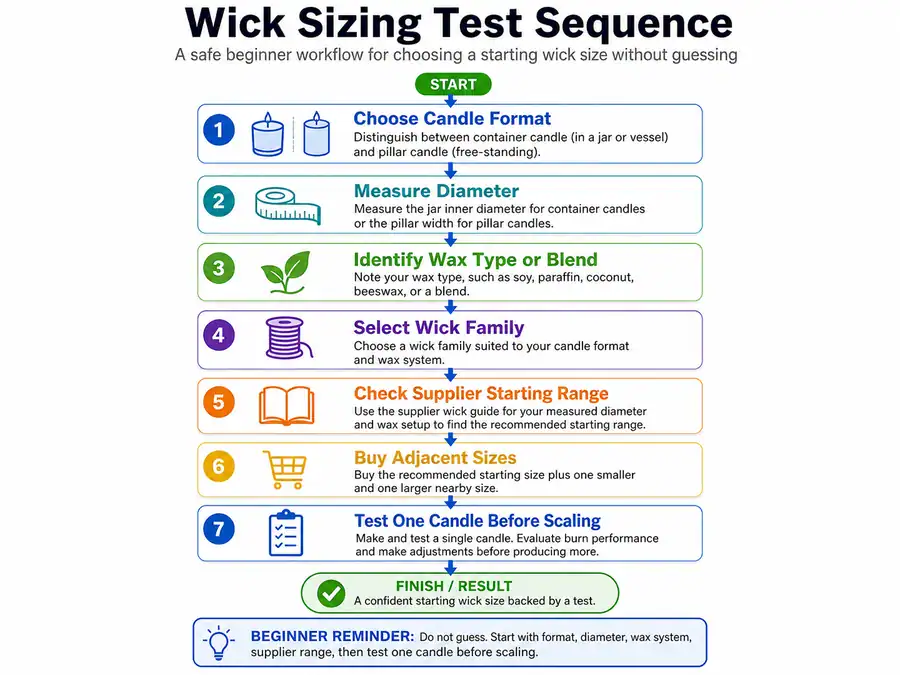
- Choose the candle format.
- Measure the candle diameter.
- Identify the wax type or blend.
- Select a wick family that fits the format.
- Check the supplier’s starting range.
- Buy adjacent sizes or a small sampler range.
- Test one candle before scaling the batch.
Wick up means testing a larger wick size when the first test is too weak for the candle. Wick down means testing a smaller wick size when the flame is too large or dirty for the candle. These are adjustment directions, not automatic fixes.
Warning: over-wicking can create an oversized flame, extra soot, or heat that is too aggressive for the candle. Under-wicking can create tunneling, drowning, or a weak flame. If a test burn shows tunneling, drowning, soot, or mushrooming, use the candle wick troubleshooting guide rather than changing size blindly.
Use this starting-size path to choose a range; use the candle wick testing checklist to confirm the final wick. If the size problem is unclear, the over-wicked vs under-wicked candle guide is the next decision point before retesting.
This table uses conservative supplier-chart logic as a start-point method, not a replacement chart. It avoids exact wick promises because supplier labels and candle conditions differ.
Which Wick Families Are Easiest for Beginners to Test?
Wick family is not the same as wick size; it is the type or series chosen before selecting sizes to test.
The easiest wick family for beginners is format-matched, supported by supplier guidance, and available in adjacent sizes. A candle wick family can describe construction, such as cotton core, paper core, flat braid, or square braid, or a supplier series such as CD-style or ECO-style.
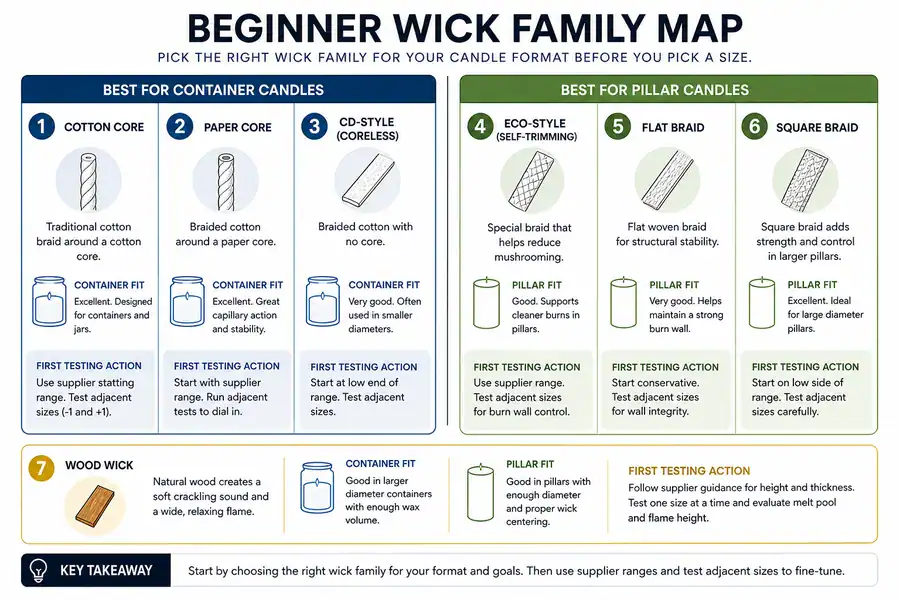
Use the container candle wick size chart after choosing a container-suitable family. Use the pillar candle wick sizing guide after choosing a pillar-suitable family. The chart only helps when the wick family fits the candle format.
| Wick family | Beginner benefit | Container fit | Pillar fit | Main risk | Best first action |
| Cotton core | Easy to find and often chart-supported | Often suitable | Sometimes suitable if sold for pillars | Can still be wrong for the wax or format | Match it to the supplier’s format notes |
| Paper core | Common in many container paths | Often suitable | Usually not the first pillar assumption | Can burn differently across wax blends | Check wax and jar guidance first |
| CD-style series | Often used for container candles with size ranges | Strong container path | Not a default pillar path | Beginners may copy sizes across waxes | Test adjacent sizes in one jar setup |
| ECO-style series | Often used in soy-container starting paths | Strong container path | Not a default pillar path | Wax assumptions can become too broad | Confirm wax compatibility before sizing |
| Flat braid | Often appears in freestanding candle guidance | Less common as a first jar path | Often suitable when chart-supported | Can be misused like a container wick | Start with pillar supplier guidance |
| Square braid | Often used where pillar or beeswax guidance supports it | Not a general jar shortcut | Often suitable when chart-supported | Can be chosen too large for the candle | Keep the first pillar test conservative |
| Wood wick | Visually popular but less forgiving for many beginners | Container-focused when used | Usually outside beginner pillar start points | Adds extra variables beyond basic sizing | Treat as a separate learning path |
This comparison is a practical beginner table, not a full wick taxonomy or brand ranking. Supplier wick charts are the basis for the decision pattern because family names and size labels are not universal.
For a first container candle, a chart-supported cotton, paper-core, CD-style, or ECO-style path is usually easier to test than an unsupported specialty wick. For a first pillar candle, flat braid or square braid becomes more relevant when the wax and supplier guidance point that way. The right family is the one that gives you a starting range and nearby sizes, not the one with the most dramatic flame.
Wax can change the family choice, so a soy candle wick guide is useful when soy wax becomes the main variable. A beeswax candle wick guide is useful when wax hardness and beeswax behavior drive the choice. Keep those wax-specific decisions separate from the first container-versus-pillar decision.
How Wax Type Changes the Starting Point
Wax type changes the starting wick point, but it does not replace the first decision: container candle or pillar candle.
A candle wick can behave differently in soy, beeswax, paraffin, coconut, or blended wax because each wax melts, hardens, and feeds the flame differently. The best wick is still the most forgiving format-safe test candidate, not a universal wax-only answer.
Use wax type as a qualifier after choosing container or pillar format. A soy container candle and a soy pillar candle do not automatically need the same wick path because the jar and the freestanding wax structure change the burn conditions. Supplier guidance matters more than generic wax claims, especially when the wax is a blend.
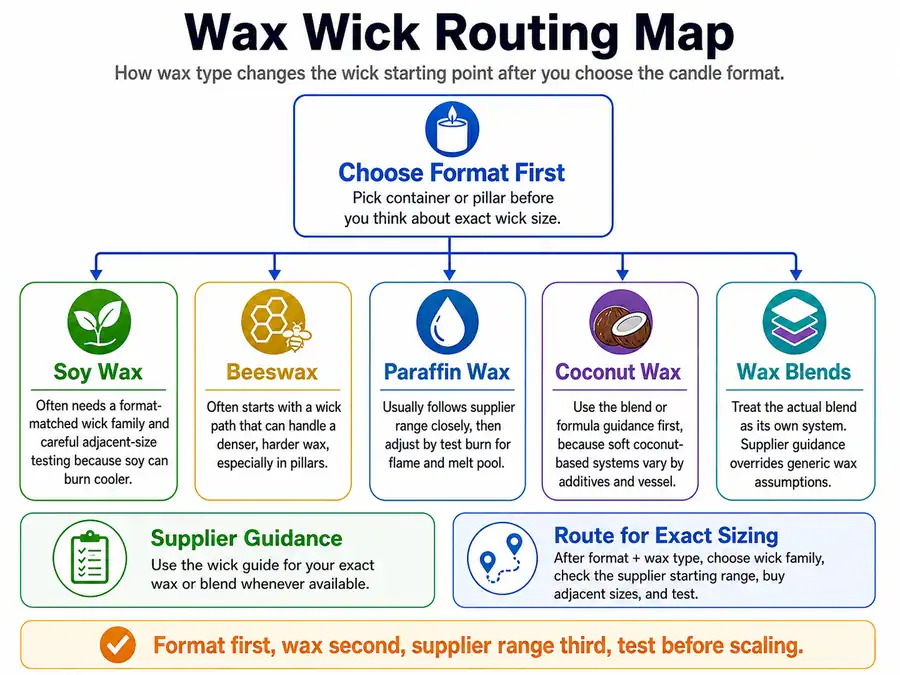
| Wax type | Beginner implication | Typical wick-family direction | Format reminder | Route for exact sizing |
| Soy wax | Often needs careful melt-pool testing | Commonly paired with chart-supported cotton, paper-core, CD-style, or ECO-style options | Choose jar or pillar path first | soy candle wick guide |
| Beeswax | Firmer wax can need stronger wax-suitable guidance | Often points beginners toward supplier-supported braid options | Do not copy container logic into pillars | beeswax candle wick guide |
| Paraffin wax | Behavior changes by blend and candle type | Many wick families can work when chart-matched | Match the wick to the candle format | paraffin candle wick guide |
| Coconut wax | Often appears in blends rather than as a simple single-wax choice | Follow supplier notes for the exact blend | Treat the blend as its own test condition | Wax-blend guidance |
| Wax blends | Labels can hide real burn differences | Use the supplier’s chart before choosing size | Retest if the blend changes | Wax-specific supplier chart |
This table gives beginner routing, not a full wax-by-wax wick chart. Wax-specific wick charts belong in separate guides because exact size depends on candle diameter, wick family, fragrance load, dye, supplier series, and test results.
If fragrance load, tunneling, drowning, soot, or a weak flame becomes the main issue, route to troubleshooting or the candle wick testing checklist instead of expanding wax-specific diagnosis here. For exact wax-specific sizing, use the soy, beeswax, paraffin, or blended-wax wick guide after the format-safe starting point is chosen.
Should Beginners Buy a Wick Sampler Pack?
A wick sampler pack is useful because it lets beginners test a starting range instead of gambling on one exact wick.
A wick sampler pack is a small set of related wick options, usually adjacent sizes in the same family or compatible family group. Beginners usually benefit from a format-matched sampler pack because adjacent sizes make testing possible.
A sampler pack is optional; it is useful when it matches the candle format, wax direction, and supplier chart, but it is not required before every beginner wick test.
The best kit is the one that gives the most testable path for your candle format, not the cheapest or biggest bundle. More variety is not automatically better. A random mixed pack can create more confusion than a smaller set that matches your container or pillar path.
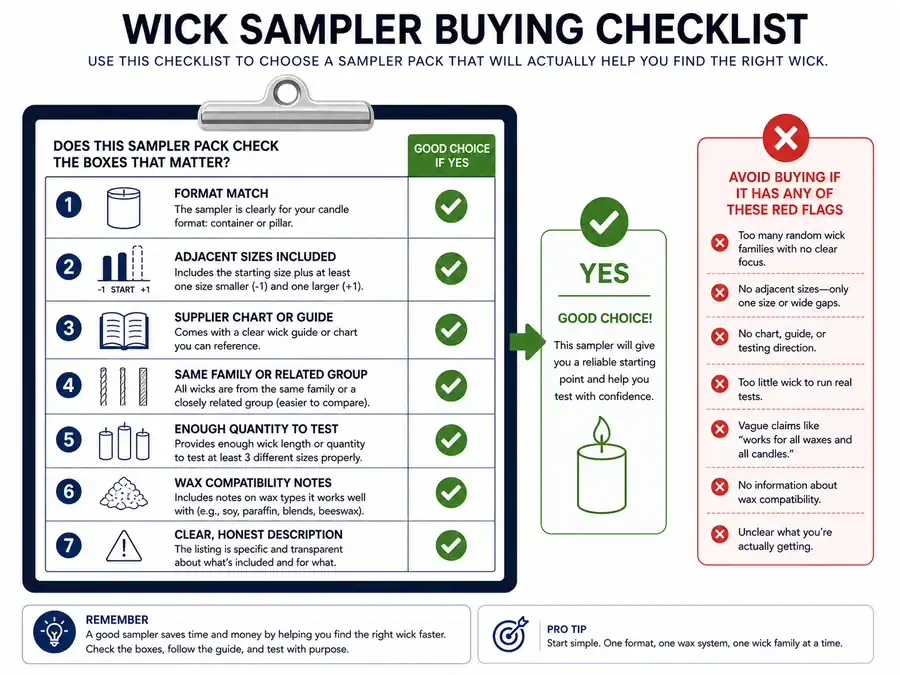
| Sampler-pack criterion | Why it matters | Container beginner | Pillar beginner | Avoid buying |
| Format match | Keeps the pack tied to the candle being made | Pre-tabbed jar wicks are often easier to place | Longer or non-tabbed options may fit some pillar setups | A pack that does not say container or pillar suitability |
| Adjacent sizes | Lets you test up or down from a starting point | Helps compare nearby jar-wick sizes | Helps test conservative pillar changes | One exact wick size with no nearby options |
| Supplier chart | Gives a reason for the starting range | Match jar diameter and wax direction | Match pillar diameter and wax hardness | Packs with no sizing guidance |
| Same family or related group | Keeps the test controlled | Reduces random changes between tests | Reduces confusion between construction types | Too many unrelated wick families |
| Enough repeat quantity | Lets you repeat a promising result | Useful for retesting the same jar | Useful for checking pillar stability | Single pieces that cannot be retested |
| Wax compatibility notes | Reduces mismatch risk | Helps with soy, paraffin, coconut, or blends | Helps with harder waxes such as beeswax | Vague “works for all waxes” claims |
Buy the sampler to create test options; use the candle wick testing checklist to choose the final wick. If you already know your candle format and wax, use the matching container candle wick size chart or pillar candle wick sizing guide before choosing the sampler range.
Avoid these beginner sampler-pack mistakes:
- Buying the biggest mixed bundle before choosing container or pillar candles.
- Treating the first wick in the pack as the final wick without testing.
- Mixing wax type, fragrance load, wick family, and container size in the same test.
- Choosing a sampler with no supplier chart or size logic.
- Buying a full candle-making starter kit guide style bundle when the real question is only wick range.
A sampler pack reduces single-size purchase risk, but it does not remove the need for test burns. Use the pack to compare nearby options in one candle setup, then keep the wax, diameter, fragrance load, and candle format stable while you decide.
Beginner Wick Mistakes That Cause Bad Test Burns
Beginner wick mistakes usually come from treating the candle wick as universal instead of format-, wax-, diameter-, and test-dependent.
Most bad beginner test burns start before the flame is lit. The wick is often chosen without checking candle format, candle diameter, wax type, supplier guidance, or a test adjustment path.
Use this table to identify selection mistakes; use the candle wick troubleshooting guide for full symptom diagnosis.
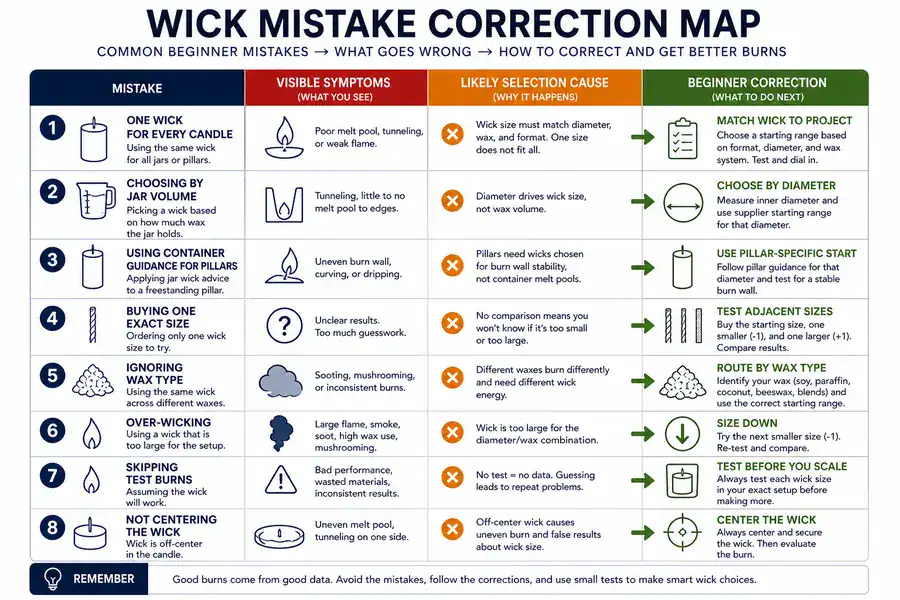
| Mistake | Visible symptom | Likely selection cause | Beginner correction | Route for deeper diagnosis |
| Using one wick for every candle | Mixed results across jars and pillars | The wick was treated as universal | Choose by container or pillar format first | candle wick troubleshooting guide |
| Choosing by jar volume | Tunneling or a weak melt pool | The jar width was ignored | Measure inner jar diameter before sizing | fix candle tunneling guide |
| Using container guidance for pillars | Leaking, wall failure, or unstable burn | Jar logic was copied into a freestanding candle | Start from pillar diameter and wax hardness | candle wick troubleshooting guide |
| Buying one exact size | No adjustment path after failure | There were no adjacent sizes to compare | Test a small range in the same wick family | over-wicked vs under-wicked candle guide |
| Ignoring wax type | Weak flame, soot, or uneven burning | The wax changed how the wick fed the flame | Match the wick family to the wax direction | candle wick troubleshooting guide |
| Over-wicking to force a full melt pool | Large flame, soot, or excess heat | The wick was made too aggressive | Retest with a smaller adjacent size | over-wicked vs under-wicked candle guide |
| Skipping test burns | Failed batch or inconsistent candles | The starting wick was never confirmed | Test one candle before scaling | candle wick troubleshooting guide |
Tunneling is not always solved by a larger wick. Soot is not always solved by trimming alone. Pillar leaking and container tunneling have different causes because one candle sits inside a jar and the other must hold its shape.
A failed test does not automatically mean the wick family is bad. It may mean the size, wax match, diameter choice, or format path was wrong. If you are unsure whether the candle is over-wicked or under-wicked, move to the over-wicked vs under-wicked candle guide before retesting.
If the issue is tunneling, soot, drowning, mushrooming, or pillar leaking, treat this as a routing step, not a complete fix. Use the fix candle tunneling guide only when tunneling is the main problem, not as a catch-all answer for every failed burn.
What Should Beginners Do After Choosing a Wick Start Point?
The best beginner candle wick path is format first, then wick family, wax qualifier, size range, and test burn.
Choose the candle structure before choosing a wick. Container candles need jar-based start points, while pillar candles need freestanding burn control. A beginner-friendly wick is the most forgiving test candidate for that setup, not a universal answer.
For jar candles, move from diameter and wax direction to the container candle wick size chart. For freestanding candles, move from pillar width and wax hardness to the pillar candle wick sizing guide. When the first choice looks close, use the candle wick testing checklist to confirm the final wick before making a larger batch.
A good candle making for beginners decision path keeps the first test simple. Pick the format, choose a chart-supported wick family, buy adjacent sizes when possible, and change one variable at a time.