

A clean-burning wax-and-wick setup reduces visible smoke and soot by matching the full candle setup, not by choosing wax alone.
A candle wax-and-wick setup is the combined pairing of wax type, wick material and size, fragrance load, dye or additives, container diameter, trim height, and burn environment. Clean-burning means lower visible smoke and soot under matched conditions, not zero emissions, medical safety, or a soot-free guarantee. The cleaner choice is the setup that keeps a stable flame and leaves minimal residue during controlled test burns. Wax, wick, scent, jar shape, airflow, and trimming all need comparison before a setup is repeated or scaled.
What “Clean-Burning” Means for a Wax-and-Wick Setup
Clean-burning means lower visible smoke and soot under matched wax, wick, fragrance, container, trim, and airflow conditions.
A candle wax-and-wick setup includes the wax type, wick material and size, fragrance load, dye or additives, container diameter, trim height, and burn environment. Clean-burning means the finished candle burns with a steadier flame and less visible residue during test burns; it does not mean zero emissions, medically safe, universally non-toxic, or guaranteed soot-free.
Use clean burning wax and wick setups as a setup-level comparison, not as a label for one wax or one wick. A soy candle can smoke if the wick pulls too much fuel, and a well-wicked paraffin or blend can burn more steadily than a poorly matched “natural” candle.
| Clean-burn signal | What to look for | Soot-risk warning |
| Flame stability | Flame stays steady instead of jumping or leaning hard | Tall, flickering, or draft-pulled flame |
| Visible smoke | No steady smoke trail during normal burn | Smoke appears after lighting, trimming, or fragrance change |
| Jar soot ring | Little to no dark ring after a test burn | Black residue builds near the rim |
| Wick mushrooming | Small carbon cap or none after burn | Heavy mushrooming that feeds a smoky flame |
| Residue after burn | Container stays mostly clear after cooling | Dark film appears on glass or nearby surfaces |
Read this checklist as an observation screen for candle testing, not as a medical, emissions, or safety guarantee. Candle safety references can help frame safe use, but the setup still needs its own burn record.
Does clean-burning mean soot-free? No. It means the wax-and-wick setup reduces visible smoke and soot under controlled test conditions.
Does clean-burning mean non-toxic? No. A cleaner-looking burn does not prove a candle is medically safe, allergen-free, or suitable for every room.
For health, fire-safety, or indoor-air-quality questions, use the candle safety guide; this page only compares setup variables that affect visible smoke and soot.
Which Candle Wax Types Tend to Burn Cleaner When the Wick Is Matched?
Soy, beeswax, and coconut-blend waxes are common lower-soot starting points when the wick, fragrance load, jar size, trim height, and airflow are matched.
Some waxes may support lower-soot setups, but wax alone does not determine whether a candle burns cleanly. The wick, fragrance load, dye, container diameter, trim height, and burn test decide whether the wax behaves well in the finished candle.
Use the wax family as the first filter, then use the burn test as the decision point.
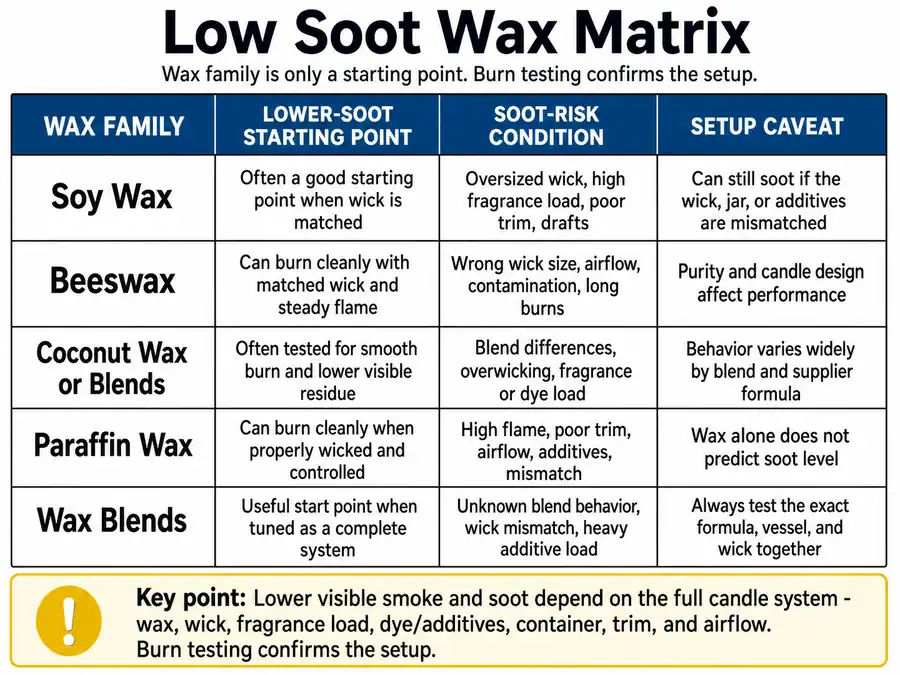
A useful low-soot wax guide should treat wax as a starting point, not a guarantee. Soy, beeswax, coconut wax, paraffin, and blends can all smoke when the wick is oversized, the fragrance load is too heavy, or the container changes the melt pool.
| Wax type | Lower-soot advantage | Soot-risk condition | Setup caveat |
| Soy wax | Often used for lower-soot container candles | Can smoke with an oversized wick or heavy fragrance | Test wick size after fragrance is added |
| Beeswax | Often has a clean-burn reputation | Can still smoke if the wick is too large or a draft is present | Validate flame height and residue |
| Coconut wax / blends | Often burns smoothly in containers | Blend composition and fragrance load vary | Treat supplier guidance as a starting point |
| Paraffin wax | Performs predictably when properly wicked | Often carries stronger soot perception | Judge the finished setup, not the wax label alone |
| Wax blends | Can balance burn behavior and scent throw | Additives may change fuel draw | Retest when the blend or additive changes |
This comparison assumes each wax is judged under matched conditions: suitable wick size, stable container diameter, tested fragrance load, trimmed wick, and similar airflow. Supplier technical sheets can help flag material limits, but they do not replace a burn test.
The phrase “cleanest wax” needs a narrow meaning. It should mean a wax family that gives a better starting point for lower visible smoke and soot when paired correctly, not a wax that is always clean, toxin-free, or soot-proof.
For full wax properties, sourcing, melt points, and formulation tradeoffs, use the candle wax types guide. For a narrower comparison between two common wax families, use the soy vs paraffin guide; this section only compares wax behavior as it affects smoke and soot inside the setup.
Why Wick Size Controls Smoke, Mushrooming, and Soot
Wick size controls how much fuel reaches the flame, so a wick that is too large or poorly matched can create smoke, mushrooming, and soot.
The right wick is a tested match for the wax, container diameter, fragrance load, trim height, and burn result. Within a candle wax-and-wick setup, wick size means the wick series, diameter, material, and fuel-draw behavior working inside one specific candle.
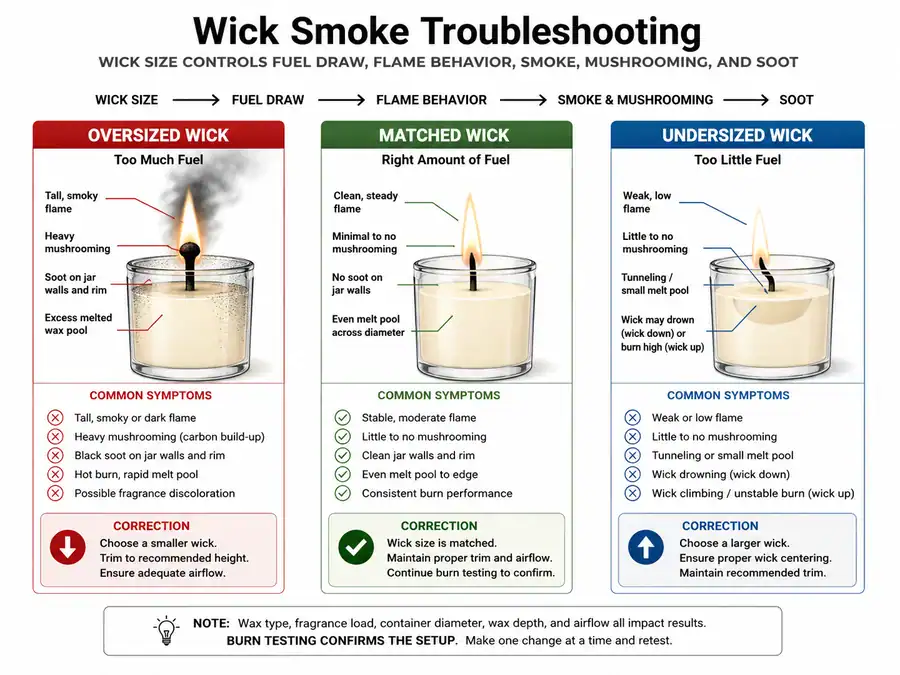
| Symptom | Likely wick issue | First test correction | When to use another resource |
| Tall flame and black smoke | Wick is too large or too aggressive | Wick down within the same series | Need exact diameter chart |
| Heavy mushrooming | Excess fuel draw or poor wick match | Test a smaller wick or different series | Need wick type comparison |
| Jar gets very hot | Over-wicked setup | Wick down and retest the burn interval | Need candle safety guidance |
| Tunneling with weak flame | Wick may be too small | Wick up one test size | Need tunneling guidance |
| Smoke after fragrance is added | Wick no longer matches the formula | Retest with fragrance included | Need fragrance load guidance |
Is smoke caused by wax or wick? It can be either, but wick mismatch is a common cause because the wick controls fuel draw and flame heat. An oversized wick often looks tall, smoky, hot, or heavily mushroomed; an undersized wick may tunnel, relight poorly, or create an unstable melt pool.
A wick mushrooms when carbon and unburned fuel collect at the tip faster than the flame can consume them. If the flame is tall and smoky, test down first; if the flame is weak and tunneling, test up carefully. For exact wick sizes by jar diameter, wax type, and wick series, use the wick sizing guide; this section explains how wick mismatch affects smoke and soot.
Use the wick types guide when the question shifts from sizing symptoms to wick material, braid, core, or series behavior. Use candle wick mushrooming troubleshooting when mushrooming is the main failure and the candle needs a symptom-first diagnosis.
Best Starter Wax-and-Wick Pairings for Lower Smoke and Soot
Good starter setups usually begin with supplier-recommended cotton wicks for soy, blend-specific wick guidance for coconut or soy blends, and tighter wick testing for paraffin or high-fragrance formulas.
The best starter pairing means a practical test direction for a specific wax, wick, fragrance load, container, trim, and burn environment. It is not a universal recipe, a final production formula, or a guarantee that the candle will be soot-free.
| Wax family | Starter wick direction | Soot sensitivity | Fragrance caveat | Test-burn priority |
| Soy container wax | Begin with the supplier-recommended cotton wick range | Medium | Heavy fragrance can require retesting | High |
| Beeswax | Test wick choice carefully because viscosity and vessel shape vary | Medium | Less scent is common, but additives still need testing | Medium |
| Coconut blend | Use supplier wax or blend guidance first | Medium | Blend and fragrance behavior vary widely | High |
| Paraffin container wax | Match wick tightly to jar and fragrance load | Medium-High | Scented paraffin can smoke if over-wicked | High |
| Soy/paraffin blend | Use blend-specific wick guidance | Medium | Blend changes melt pool and fuel draw | High |
Use this matrix to shortlist a wax-and-wick setup, then confirm it with a controlled burn test. A setup that looks clean unscented may smoke after fragrance, dye, or container changes because the fuel behavior has changed.
Use wick sizing guide for exact wick series and diameter decisions. Use low-soot wax guide when the wax-family choice needs more detail than this setup matrix can provide. Use fragrance load guide when scent percentage or oil compatibility changes the burn result, and use candle test-burn log to record flame stability, visible smoke, jar residue, and wick behavior across repeated tests.
Why Fragrance Load, Dye, and Additives Can Change a Clean-Burn Result
Fragrance load, dye, and additives can change a candle’s fuel behavior, so a clean base wax-and-wick pairing may need retesting after formula changes.
A clean-burning scented candle means low visible smoke and low residue after the fragrance, dye, and additives are tested inside the finished wax-and-wick setup. It does not mean allergen-free, non-toxic, or compliant with every fragrance standard by default.
| Additive variable | Visible symptom | Likely setup cause | First retest action |
| Higher fragrance load | Smoke or mushrooming after scent is added | Fuel behavior changed | Retest wick size with fragrance included |
| Dye added | Flame instability or residue change | Additive changed burn behavior | Test dyed and undyed versions separately |
| Multiple additives changed | Unclear smoke cause | Too many variables changed at once | Change one variable per test |
| New fragrance oil | Setup no longer behaves like the previous scent | Formula compatibility changed | Retest before scaling |
Does fragrance oil make candles smoke? It can, but the cause is usually the finished setup, not scent alone. A wax-and-wick pairing that burns clean unscented may smoke after fragrance is added because the wick now pulls and burns a changed fuel mixture.
Can candle dye cause soot? It can contribute to residue or flame instability when the dye does not behave well with the wax, wick, and fragrance. Test dyed and undyed versions separately before blaming the wax family or changing the whole setup.
Use the fragrance load guide for scent percentage and formula math, the fragrance compliance guide for SDS or IFRA questions, and a wick retesting guide when smoke appears only after scent, dye, or additives change.
How Jar Size and Drafts Can Distort Smoke and Soot Testing
Container diameter and airflow can change flame behavior, so smoke and soot signals should be judged under controlled test-burn conditions.
Jar size, jar depth, wick centering, trim height, and draft exposure are part of the tested candle wax-and-wick setup. Low-soot indoor burn conditions mean controlled jar, wick, trim, fragrance, and minimal-draft testing, not a guarantee that the candle will burn the same in every room.
| Test condition | What to control | Why it matters |
| Container diameter | Match the wick test to the actual jar | Melt pool and fuel draw change with width |
| Wick centering | Keep the wick centered during pour and burn | An off-center flame can overheat one side |
| Draft exposure | Test away from fans, windows, and vents | Drafts can create flicker and smoke |
| Trim height | Keep trim consistent between burns | A long wick can mimic over-wicking |
| Burn interval | Use comparable burn periods | Short tests can miss later soot behavior |
A wide jar can need a different wick response than a narrow jar because the melt pool and oxygen exposure change. A deep container can trap heat differently, while an off-center wick can make one side of the jar show residue before the whole setup is at fault.
Drafts can make a good setup look smoky by pushing the flame, stretching it, or pulling it toward the container wall. Judge wax and wick results only after the candle is tested away from fans, windows, vents, and heavy foot traffic.
Use the candle care guide for trimming and burn habits, tunneling troubleshooting for weak melt-pool failures, the wick sizing guide for jar-diameter mismatch, and the candle safety overview for broader fire-safety or indoor-use questions.
Test-Burn Checklist: How to Validate a Cleaner Wax-and-Wick Setup
A cleaner wax-and-wick setup is not validated until the finished candle shows stable flame behavior, low visible smoke, and minimal residue across controlled test burns.
A test burn validates the complete candle wax-and-wick setup, not wax or wick in isolation. That setup includes wax, wick, fragrance load, dye or additives, container, trim height, burn interval, airflow, flame behavior, smoke, and residue.
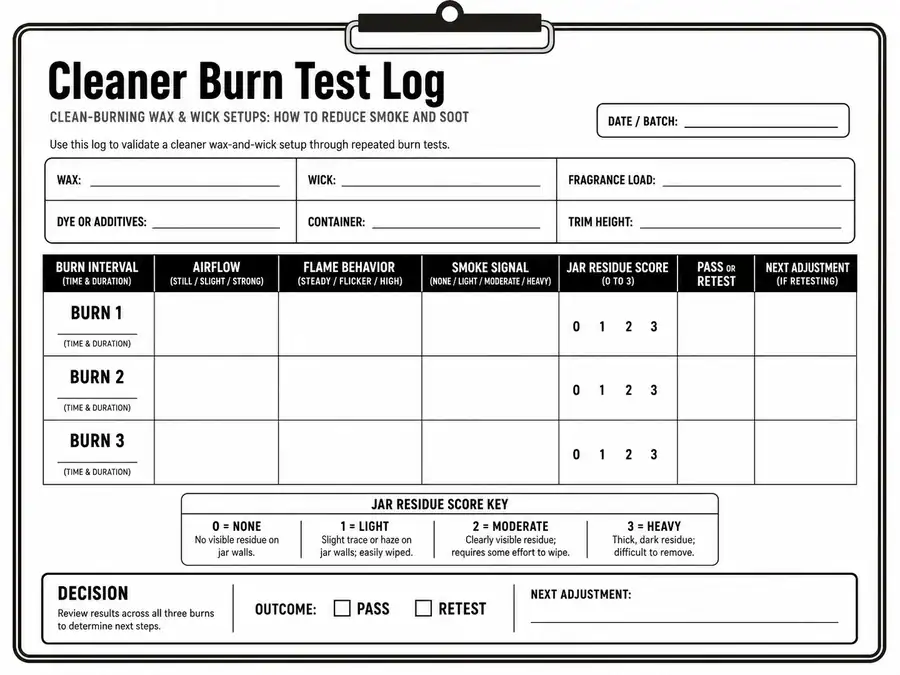
| Burn interval | Trim height | Flame behavior | Smoke signal | Jar residue score | Pass / retest decision | Next adjustment |
| Burn 1 | Record trim | Stable / tall / weak | None / brief / steady | 0–3 | Pass or retest | Keep, wick up, wick down, adjust formula |
| Burn 2 | Record trim | Stable / tall / weak | None / brief / steady | 0–3 | Pass or retest | Confirm or adjust |
| Burn 3 | Record trim | Stable / tall / weak | None / brief / steady | 0–3 | Pass or retest | Validate before scaling |
A practical candle test-burn log should show whether the setup stays stable across repeated burns. One good burn is useful, but it does not prove that the candle will stay low-smoke after the melt pool deepens, the fragrance behaves differently, or the wick develops a carbon cap.
Use this sequence before repeating or scaling a recipe:
- Prepare one controlled setup with the same wax, wick, fragrance load, dye, container, and trim target.
- Burn the candle for the planned interval and keep airflow steady.
- Record flame height, flicker, smoke, mushrooming, melt-pool behavior, and jar residue.
- Let the candle cool fully before judging the residue pattern.
- Repeat the burn before changing variables.
- Change only one variable at a time, such as wick size, fragrance load, or container diameter.
- Retest until the setup shows low visible smoke, stable flame behavior, and minimal residue.
Can you trust a wax-and-wick chart without testing? Use charts as starting points, not final proof. The chart cannot see your exact fragrance, dye, container diameter, wick trim, airflow, or burn interval.
Testing note: The 0–3 residue score is a maker-friendly observation scale. Use 0 for no visible residue, 1 for light residue, 2 for clear soot marks, and 3 for heavy soot that requires correction before scaling.
For exact wick selection, use the wick sizing guide before treating a smoky result as a wax problem. For larger batch controls, use the candle production testing guide rather than turning this small-batch checklist into a commercial testing system. For fire-safety or compliance questions, use the candle safety overview; this checklist only validates whether this wax-and-wick setup reduces visible smoke and soot in a controlled test burn. If the wax family itself is still the question, return to the low-soot wax guide before changing multiple setup variables at once.
Common Setup Mistakes That Cause Smoke or Soot
Setup mistakes cause smoke or soot when one part of the wax-and-wick setup disrupts stable combustion or makes the test result misleading.
A setup mistake means the wick size, wick centering, wax-and-wick match, fragrance load, dye or additives, jar diameter, trim height, burn interval, or airflow is wrong for the finished candle. This section is a diagnostic layer, not the main comparison itself; it prevents false conclusions before you blame the wax, replace the wick series, or clean residue without fixing the cause.
| Mistake | Visible symptom | Setup cause | First fix | Offload if |
| Wick too large | Tall smoky flame | Too much fuel draw | Wick down and retest | Need exact wick chart |
| Fragrance load too high | Smoke after scent is added | Formula changed burn behavior | Lower load or retest wick | Need fragrance calculator |
| Drafty test area | Flicker and smoke | Airflow disturbance | Retest in controlled location | Need candle-care guidance |
| Multiple changes at once | Unknown cause | Variables not isolated | Change one variable per test | Need test-burn log |
| Soot residue cleaned only | Soot returns | Cause not fixed | Diagnose setup first | Need soot cleanup page |
| Alarm triggered | Smoke detector responds | Different troubleshooting intent | Stop and route topic | Need smoke detector guide |
Why is a homemade candle smoking? In this setup-focused scope, common causes include an oversized wick, excess fragrance load, poor wick centering, a drafty test area, skipped trimming, or a container that does not match the wick test.
Is soot caused by wax or wick? It can be either, but the finished setup decides the result. A weak wax-and-wick match can smoke even when each material looks reasonable on its own.
Did you use too much fragrance oil? Treat that as a testable possibility when smoke appears only after scent is added. Use the fragrance load guide when the next decision is scent percentage, calculator work, or oil compatibility rather than wick behavior.
Should you wick up or wick down? Wick down when the flame is tall, smoky, hot, or heavily mushroomed. Wick up only when the flame is weak, the melt pool stalls, and the candle tunnels without smoky over-fueling signs.
Cleaning the jar does not fix soot if the setup still burns poorly. Use candle soot troubleshooting when you need a symptom-first diagnosis, and use candle soot cleanup only after the burn cause is corrected.
For exact wick adjustments, use the wick sizing guide rather than guessing from soot alone. For broader fire-safety questions, use the candle safety overview. For alarms triggered by candle smoke, use smoke detector candle troubleshooting; this section only covers setup mistakes that create smoke or soot during burn testing.
Final Takeaway
The cleanest setup is the one that stays stable during controlled test burns.
Judge the setup by visible smoke, jar residue, flame stability, and repeatable burn records, not by wax label alone.
Use wax and wick recommendations as starting points, not final proof. Retest after changing fragrance load, dye, additives, jar size, wick series, trim height, or burn location. Fix setup-driven soot causes before cleaning residue or switching materials. Route safety, cleanup, alarm, and compliance questions to their dedicated pages instead of treating every smoke or soot problem as a wax-and-wick issue.