

A gel candle turns cloudy when its clear gel structure is disrupted by fragrance oil, overheating, contamination, additives, trapped air, cooling conditions, or wax-grade mismatch.
A gel candle is a transparent candle made with gel wax, so clarity defects show more easily than they do in opaque wax. Here, “cloudy” means haze, milkiness, fogging, suspended specks, opaque patches, or dense microbubbles inside the gel.
It does not mean soot, smoke, weak scent throw, soy frosting, tunneling, or black marks on the container unless those problems directly affect the gel’s visible clarity.
The fastest way to fix the problem is to match the timing and appearance of the cloudiness to the most likely cause before reheating, remaking, filtering, or discarding the candle.
Quick Diagnosis: Match the Symptom to the Cause
The cause of a cloudy gel candle is usually shown by when the haze appears and what the defect looks like.
Use the timing first, then check the visual sign. A gel candle that turns milky right after fragrance behaves differently from one that looks foggy after cooling or full of tiny bubbles after fast stirring.
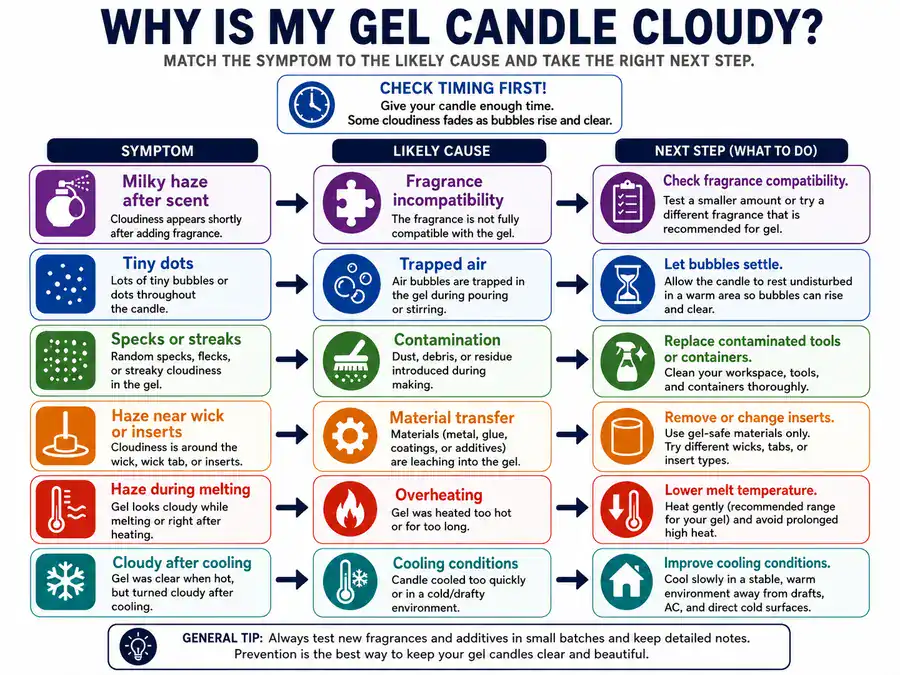
| What you see in the gel candle | Most likely cause | Confirmation sign | Best next step |
|---|---|---|---|
| Milky haze right after adding scent | Fragrance oil incompatibility or overload | The gel was clearer before scent was added | Check the fragrance oil and load before remaking |
| Tiny dots or a champagne-like haze | Trapped air bubbles | Dots look round under side light | Rest, warm gently if still unpoured, and pour slower next time |
| Specks, streaks, or cloudy trails | Moisture, dust, dirty tools, or embed residue | Defect starts near the jar, tool path, or object | Recheck container and tool prep before another pour |
| Cloudiness near the wick or wax insert | Pre-wick coating or wax insert melting into the gel | Haze starts near the wick base, insert, or wax decoration | Use gel-appropriate wick assemblies and avoid wax inserts that can bleed into gel |
| Cloudiness after dye or mica | Colorant or additive incompatibility | The gel looks more opaque than tinted | Use only gel-safe soluble dye for clear designs |
| Haze that appears during melting | Overheating or uneven heat exposure | Gel clouds before fragrance or dye is added | Stop heating and compare against supplier heat guidance |
| Clear when poured, cloudy after cooling | Cooling speed, drafts, humidity, or delayed incompatibility | Timing starts after pour or overnight | Separate surface fog from internal haze before fixing |
| Repeated cloudiness with the same recipe | Wax grade mismatch or overload | The same fragrance or embed fails in multiple batches | Compare wax grade to the project’s scent and embed needs |
For the wider wax-selection context, this diagnosis belongs under candle wax types, but the fix on this page stays limited to gel candle clarity. Do not assume the wax type is wrong until fragrance, additive, contamination, heat, and bubble signs have been checked.
A useful order is: first inspect for bubbles, then review fragrance oil, then check heat, container prep, dye or additives, cooling conditions, and wax grade. That order prevents the common mistake of reheating a candle when the real issue is an incompatible oil or a contaminated jar.
Is It Actually Cloudiness or Tiny Air Bubbles?
A gel candle can look cloudy when many tiny trapped air bubbles scatter light, even if the gel itself is still clear.
This is not the same as chemical haze. Bubble haze usually looks like many small dots or a fine mist inside the gel, while true cloudiness looks milky, streaky, oily, or uniformly fogged.
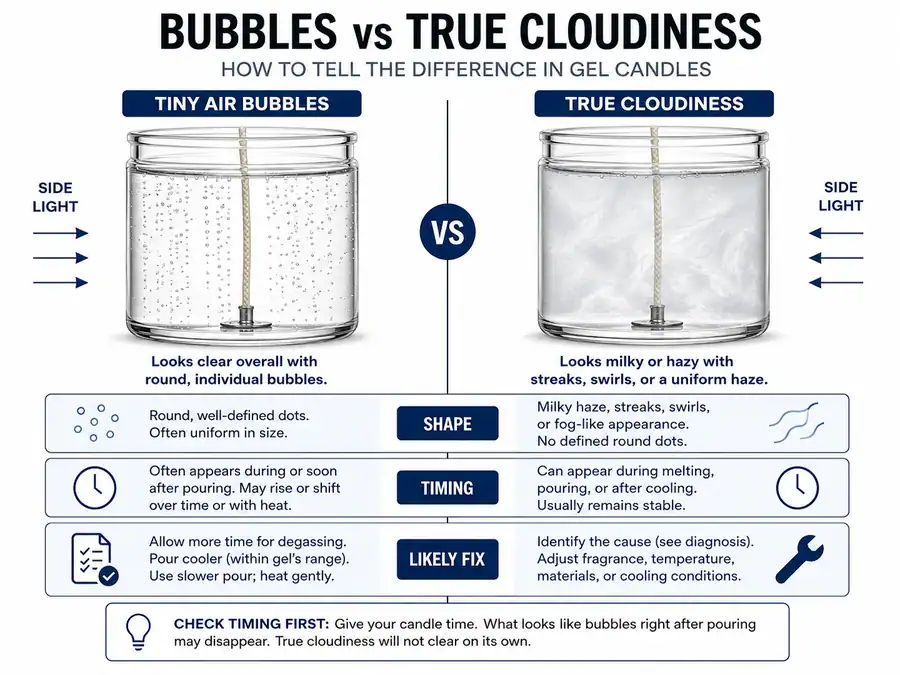
| Check | Tiny air bubbles | True cloudiness |
|---|---|---|
| Shape | Round dots or small pockets | Milky haze, fog, streaks, or opacity |
| Timing | Often after stirring, fast pouring, or moving the container | Often after scent, dye, heat, contamination, or cooling |
| Side-light test | Dots become easier to see from the side | Haze stays cloudy rather than dot-like |
| Surface pattern | May rise slowly before the gel firms | Usually stays suspended or spread through the gel |
| Likely fix | Rest the gel, reduce stirring, pour slower | Find the material or process cause before reheating |
Tiny bubbles form when gel wax is stirred too hard, poured too quickly, or cooled before air has time to rise. Clear gel makes those bubbles more visible than opaque wax, so a candle can look cloudy even when the batch is not chemically ruined.
Common bubble mistakes:
| Mistake | Why it makes gel look cloudy | Correction |
|---|---|---|
| Stirring too aggressively | It folds air into the clear gel | Stir slowly and only as much as needed |
| Pouring too fast | It traps air pockets and streaks | Pour in a slow, steady stream |
| Moving the candle while cooling | It disturbs rising bubbles | Let the container stay level and still |
| Cooling before bubbles escape | It locks microbubbles in place | Give the gel time to settle before it firms |
If the gel is still unpoured and the only issue is bubbles, gentle settling and careful warming may improve the appearance. If the candle is already finished, do not keep reheating it just to chase every bubble, especially when fragrance, dye, embeds, or unknown additives are inside.
Bubble troubleshooting is a narrow visual check. If the haze is milky, oily, separated, or appears right after fragrance oil, move to the fragrance oil section instead of treating it as an air problem.
Fragrance Oil Problems That Make Gel Candles Cloudy
Fragrance oil can make a gel candle cloudy when the oil is incompatible with gel wax or used above the gel’s holding capacity.
This is a clarity failure, not the same as weak scent throw. A candle can smell weak without being cloudy, and a cloudy candle can smell strong while still having fragrance-related haze, milkiness, oily streaks, or separation.
For broader ingredient selection, use a fragrance oil compatibility guide, but diagnose the visible gel problem first. The key clue is timing: if the gel was clear before scenting and cloudy after fragrance oil was added, the oil or fragrance load becomes the first material to check.
Here, “safest” means the action that avoids burning, reheating, or masking a gel candle when oil separation, water, unknown additives, or unsafe embedded materials may be present. It does not mean regulatory compliance, general toxicology advice, broad candle fire-safety guidance, product-quality preference, or cosmetic clarity preference alone.
| Mistake | Visible symptom | Likely cause | Safest next action |
|---|---|---|---|
| Using fragrance oil not labeled for gel candles | Milky haze or cloudy trails after scenting | Oil does not mix cleanly with gel wax | Do not add more oil; remake with gel-safe fragrance oil |
| Adding too much fragrance oil | Oily layer, slick surface, or suspended haze | Load is above what the gel can hold | Do not burn if oil separates; remake with supplier load guidance |
| Adding fragrance at the wrong stage | Clear gel turns streaky during mixing | Oil and gel did not combine evenly | Test a small batch with supplier heat and mixing guidance |
| Mixing too hard after fragrance | Cloudy look with tiny bubbles and streaks | Air plus uneven scent mixing | Separate bubble haze from oil haze before reheating |
| Repeating the same cloudy result | Same haze with the same oil and recipe | Oil, load, or wax grade mismatch | Change one variable in a small test batch |
To confirm fragrance oil as the cause, ask: was the gel clear before fragrance was added, did haze appear right after scenting, is there an oily slick, and did the supplier label the oil as gel-compatible?
If the answer points to oil separation or unknown compatibility, treat the candle as a safety concern, not a cosmetic flaw. Use a gel candle safety guide before reheating or burning a candle with visible oil separation.
Record the fragrance oil name, amount used, add stage, mixing style, and final appearance. That makes the next test cleaner because you can change one variable instead of the whole recipe.
When Wax Grade Is the Real Issue
Gel wax grade can affect clarity when the wax cannot support the fragrance load, embeds, or additives in the candle.
Wax grade is a conditional cause, not the default answer for every cloudy gel candle. Suspect it when gel-safe fragrance, careful mixing, clean tools, and compatible dye still produce repeated haze, instability, or separation.
| Situation | Why wax grade may matter | What to check | Where to go next |
|---|---|---|---|
| Cloudiness repeats with the same fragrance load | The gel may not hold that amount of oil cleanly | Supplier load guidance for that wax grade | Gel wax types guide |
| Gel turns unstable after embeds | The project may need stronger embed support | Embed weight, material, and residue | Gel candle embeds guide |
| Additives make the gel hazy even when used carefully | The wax may not support that formula | Additive type and amount | Candle dye guide or embed guide |
| Low-density gel clouds in scented projects | The grade may be mismatched to fragrance load | Wax grade, scent amount, and separation signs | Candle wax types page |
| Technique is correct but haze persists | The formula may exceed the wax’s support limit | Test one wax grade change in a small batch | Gel wax types guide |
For a full comparison of low-, medium-, and high-density gel wax, use the gel wax types guide. This page only uses wax grade as a troubleshooting clue for cloudiness, haze, separation, or instability in a gel candle.
Do not switch wax grade before checking fragrance oil, dye, contamination, overheating, and bubbles. Wax grade becomes more likely when the same cloudy result repeats after the obvious process and material mistakes have been removed.
Can Overheating Gel Wax Cause Cloudiness?
Overheating gel wax can make a gel candle cloudy when excessive or uneven heat disrupts clarity before or after pouring.
Heat-related cloudiness means visual haze or clarity loss in the gel. It does not mean smoke from a flame, soot on the jar, wick heat, container scorching, or soy and paraffin melting behavior.
Use supplier heat guidance for exact limits because gel wax formulas vary. For a full melting process, use a beginner gel candle tutorial or candle-making temperature guide, but keep this diagnosis focused on the cloudy appearance.
| Heating stage | What can go wrong | Visual clue | Better next step |
|---|---|---|---|
| Melting starts | Direct or uneven heat creates hot spots | Gel clouds in the pot before scent or dye | Use gentler heat and monitor the batch |
| Wax is held hot too long | Long heat exposure stresses clarity | Gel looks dull before pouring | Reduce hold time and work in smaller batches |
| No thermometer is used | Peak heat is unknown | Cloudiness appears without a clear cause | Track heat next time with a candle thermometer |
| Gel is reheated again and again | Repeated heat adds more stress | Haze increases with each correction attempt | Stop reheating and diagnose the original cause |
| Gel clouds after pouring | Heat may have combined with mixing or cooling stress | Haze appears after the jar is filled | Compare heat, bubble, fragrance, and cooling signs |
| Gel was clear before scenting, then cloudy after scenting | Heat may not be the primary cause | Timing points to the fragrance step | Check fragrance oil compatibility before blaming heat |
Before reheating a finished gel candle, check a gel candle safety guide. Reheating can be the wrong move when the candle contains fragrance oil, dye, unknown additives, embeds, or visible separation.
To diagnose heat, focus on when the cloudiness first appeared: in the pot, after holding hot, after pouring, or after cooling. That timing separates overheating from fragrance incompatibility, bubbles, contamination, and cooling-related haze.
Moisture, Dust, or Dirty Tools Can Leave Gel Candles Hazy
Moisture, dust, or residue can make a gel candle cloudy because clear gel makes tiny contaminants visible.
Moisture often looks like fogging or cloudy patches. Dust often appears as small specks. Residue can create trails, streaks, or haze near the jar wall, bottom, tool path, or decorative object.
For detailed jar preparation, use a candle container preparation guide. This section only covers contamination when it changes gel candle clarity.
| Source of contamination | Visible clue in the gel | Confirmation check | Prevention |
|---|---|---|---|
| Damp container | Foggy patch near the glass | Jar was washed or stored where moisture remained | Use dry containers before pouring |
| Dusty jar | Specks near the wall or bottom | Particles appear where the gel touched the jar first | Inspect the jar under light before filling |
| Dirty tool | Suspended particles or cloudy trails | Streaks follow the stirring or pouring path | Keep tools clean and dry |
| Water on embeds | Haze around the decorative object | Cloudiness starts near the embed | Test embeds separately before use |
| Oily residue | Cloudy trail or slick-looking area | Jar, tool, or embed had residue | Avoid reused or unverified materials |
| Unsealed decorative object | Local haze, particles, or color bleed | The defect forms around that object | Use a gel candle embeds guide before adding decor |
Wick coating and wax inserts can also create localized clouding. If haze starts near the wick assembly or around a wax decoration, treat it as a material-transfer problem before blaming humidity, bubbles, or the gel wax grade.
Location matters. Cloudiness near the glass points to the container, haze around an embed points to the object, and streaks through the pour path point to the tool or handling step.
Stop treating the problem as contamination when the whole candle turns uniformly milky after fragrance oil. Stop treating it as moisture when the cloudiness appears during melting before the gel touches a jar. Stop treating it as dust when the haze has a suspended shimmer, because mica or pigment may be the better explanation.
If a finished candle contains unknown residue, damp decorative material, or untested embedded objects, check a gel candle safety guide before burning it. Clear gel is visual, but contamination can be more than a cosmetic flaw.
Dyes, Mica, Pigments, and Additives That Make Gel Wax Look Opaque
Dyes and additives make gel wax cloudy when they suspend particles, separate, bleed residue, or block light instead of dissolving cleanly.
Clear gel candles need additives that preserve transparency. A gel-safe soluble dye can tint gel without making it opaque, while mica, pigments, botanicals, and many decorative additives can scatter light and turn the candle cloudy, shimmery, speckled, or milky.
For a full colorant guide, use a candle dye guide. For decorative objects, use a gel candle embeds guide before placing materials inside the candle.
| Additive type | How it behaves in clear gel | Cloudiness risk | Better choice |
|---|---|---|---|
| Gel-safe soluble dye | Dissolves into the gel and tints it | Lower when used as directed | Use for transparent color |
| Mica powder | Suspends reflective particles | High for cloudy or shimmery haze | Avoid when clear gel is the goal |
| Pigment powder | Suspends solid color particles | High for opacity and specks | Use only when opacity is intentional |
| Non-gel-safe liquid dye | May separate, streak, or haze | Medium to high | Check supplier gel compatibility |
| Botanicals | Can release moisture, dust, or residue | High for haze and safety uncertainty | Avoid inside gel candles unless verified safe |
| Glitter or craft additives | May sink, bleed, or suspend particles | High unless designed for candle use | Use only verified candle-safe materials |
| Unknown embeds | Can carry moisture, coating, or residue | High near the object | Test before adding to a finished candle |
A common maker failure pattern is: “I added mica, and the gel looked cloudy instead of clear.” That result is expected when the additive stays as tiny suspended particles rather than dissolving. The candle may look decorative, but it is no longer a clear gel design.
Judge additive cloudiness by comparing the gel before and after the additive, then record additive type, amount, mixing stage, visible symptom, and recommended action. The useful split is dissolved versus suspended, because suspended materials scatter light while dissolved dyes tint the gel more cleanly.
If the candle turns cloudy right after colorant, do not fix it by adding more dye. More color can hide the defect, but it does not solve the gel clarity problem or the safety uncertainty from incompatible materials.
Cloudiness After Cooling, Drafts, or Humidity
A gel candle can turn cloudy after cooling when room conditions create haze, fogging, condensation, or delayed material problems.
Timing matters. If the candle was clear in the pot and clear at pour, then became cloudy after cooling or overnight, check the cooling environment before changing the whole recipe.
| Timing clue | Likely explanation | What to check | Next action |
|---|---|---|---|
| Fog on the surface after cooling | Condensation or room humidity | Is the haze on the surface only? | Let the surface dry and review room conditions |
| Haze near the glass | Cold or damp container | Was the jar cold, washed, or stored damp? | Use dry, room-temperature containers next time |
| Internal haze after a drafty pour | Uneven cooling | Did the candle cool near a window, fan, or vent? | Cool in a stable, still area |
| Cloudiness appears overnight | Delayed fragrance, dye, or additive incompatibility | Did oil, dye, or embed material separate later? | Return to the material cause before reheating |
| Specks or trails appear after cooling | Contamination became visible as gel settled | Are defects near tools, embeds, or jar walls? | Recheck prep and embedded materials |
| Tiny dots remain throughout | Trapped bubbles locked in place | Are the dots round under side light? | Treat it as bubble haze, not cooling failure |
Do not blame humidity when the gel turned milky right after fragrance oil. Do not blame cooling when mica, pigment, or botanicals were added and particles are visible. Cooling is most likely when the timing changed after pour and the defect matches surface fog, uneven haze, or cold-container contact.
For a wider curing and cooling process, use a candle curing or cooling guide. For this gel candle problem, the practical rule is simple: pour into dry, room-temperature containers and let the candle cool in a still, stable room.
Can You Fix a Cloudy Gel Candle?
A cloudy gel candle can sometimes be fixed, but the safe action depends on the cause of the cloudiness.
Do not reheat every cloudy candle. Reheating can help with simple trapped bubbles in unscented or controlled gel, but it can make fragrance separation, unknown additives, moisture, and contamination more risky.
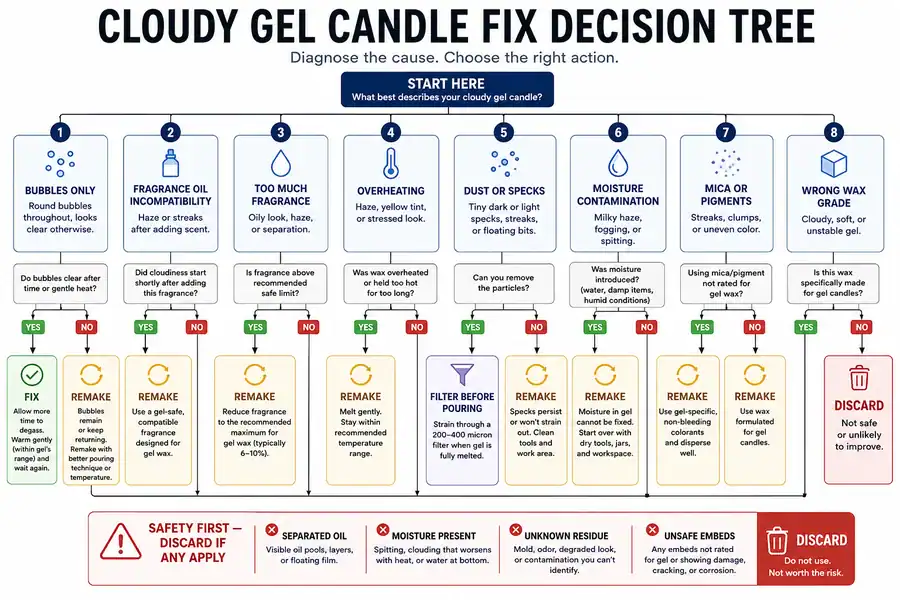
| Cloudiness cause | Can it usually be fixed? | Best action | Do not do this |
|---|---|---|---|
| Tiny air bubbles only | Sometimes | Let the gel rest, warm gently if still workable, and pour slower next time | Keep reheating a finished scented candle |
| Fragrance oil incompatibility | Usually no | Remake with gel-safe fragrance oil and correct load | Burn a candle with oily separation |
| Too much fragrance oil | Usually no | Discard or remake with supplier load guidance | Add wax or dye to hide the problem |
| Overheating | Sometimes, if mild and unscented | Start a new controlled test batch | Reheat repeatedly without finding the cause |
| Dust or specks | Sometimes before pouring | Filter only if the gel is still in a safe, workable stage | Burn a candle with unknown debris |
| Moisture contamination | Usually no | Discard the batch and dry containers next time | Trap water inside a finished candle |
| Mica, pigment, or botanicals | Usually no for clear gel | Treat it as a design or remake without the additive | Add more dye to mask the haze |
| Wrong wax grade | No for that finished batch | Change wax grade or load in the next test | Assume all gel wax grades hold the same formula |
Use a gel candle safety guide before burning or reheating any candle with oily separation, water exposure, unknown embeds, residue, or repeated heating. A clear-looking repair is not enough if the original problem came from an unsafe material or formula.
A practical rule is: fix bubbles, remake incompatible formulas, filter clean particles only before pouring, and discard candles with separated oil, moisture, unknown residue, or unsafe embedded materials. For a full beginner process, use a beginner gel candle tutorial, but keep repair decisions tied to the visible clarity defect.
Prevention Checklist for Clear Gel Candles
The best way to prevent cloudy gel candles is to control fragrance, heat, containers, additives, bubbles, cooling, and wax grade before pouring.
Prevention works better than repair because many clarity defects come from materials that cannot be fixed after the gel sets.
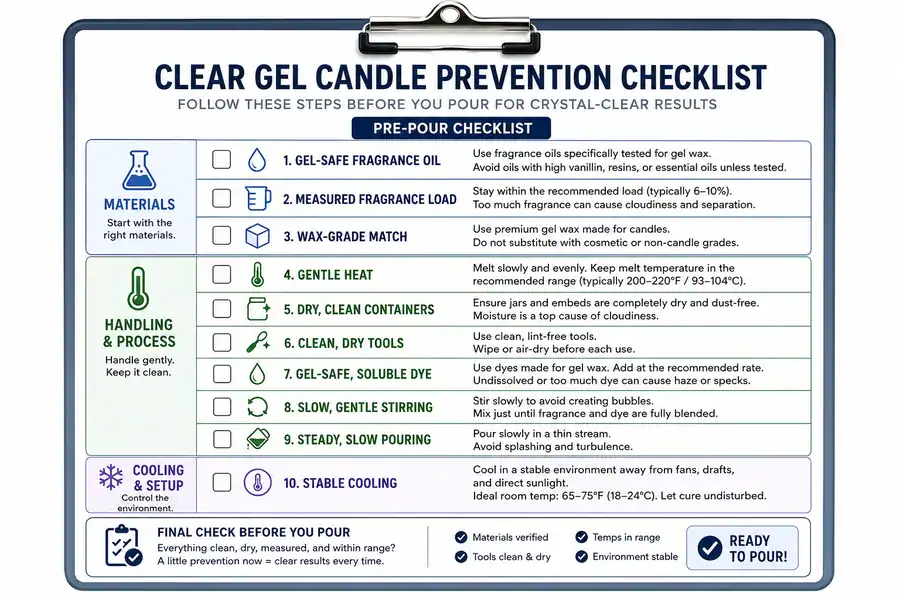
| Prevention step | What it prevents | Check before pouring |
|---|---|---|
| Use fragrance oil labeled for gel candles | Milky haze, oil separation, and scent-related streaks | Supplier compatibility and load guidance |
| Measure fragrance load carefully | Overloaded gel and oily cloudiness | Amount used per batch |
| Heat gently and track temperature | Heat haze and repeated correction attempts | Supplier heat guidance and thermometer reading |
| Use dry, clean containers | Fogging, specks, and moisture haze | Jar is dry, clean, and room-temperature |
| Keep tools clean and dry | Streaks, particles, and residue trails | Pitcher, stirrer, and workspace are ready |
| Use gel-safe soluble dye | Opaque color, suspended particles, and shimmer haze | Dye is meant for gel wax |
| Avoid mica, pigments, botanicals, and unknown craft additives | Suspended opacity, residue, and safety uncertainty | Additive is verified for gel candles |
| Stir slowly | Microbubble haze | No aggressive whipping or fast mixing |
| Pour in a slow, steady stream | Air pockets and cloudy-looking bubbles | Pour path is controlled |
| Cool in a still, stable room | Surface fogging and uneven haze | No fan, draft, cold jar, or damp area |
| Match wax grade to the project | Repeated instability with scent or embeds | Wax grade fits fragrance and embed needs |
Run one small test batch when changing fragrance oil, dye, embed material, wax grade, or heating method. A test batch makes the cause visible before you scale the mistake into several cloudy candles.
The cleanest prevention sequence is: choose compatible materials, measure the formula, heat with control, prep dry containers, mix slowly, pour steadily, and cool the candle without drafts. If cloudiness still appears, the timing and symptom pattern from the diagnosis table will point back to the most likely cause.
FAQs About Cloudy Gel Candles
Cloudy gel candle problems usually come from material compatibility, handling, or cooling, so the fix depends on the visible symptom.
Why did my gel candle turn cloudy after adding fragrance oil?
A gel candle turns cloudy after fragrance oil when the oil is not gel-compatible, the fragrance load is too high, or the oil did not mix cleanly with the gel wax.
If the gel was clear before scenting and milky after scenting, check the fragrance oil label, supplier guidance, and amount used. Do not add more fragrance to “fix” the haze.
Can I reheat a cloudy gel candle to make it clear again?
A cloudy gel candle should be reheated only in limited cases, such as simple bubbles in a controlled, still-workable batch.
Do not reheat a finished candle with oily separation, unknown additives, moisture, botanicals, or untested embeds. In those cases, remaking or discarding is safer than trying to hide the cloudy defect.
Why did my gel candle get cloudy after cooling?
A gel candle can get cloudy after cooling because of drafts, a cold or damp container, surface condensation, trapped bubbles, or delayed fragrance and additive problems.
If the haze is on the surface, check humidity and condensation. If the haze is internal, review fragrance oil, dye, embed materials, cooling speed, and jar temperature.
Is a cloudy gel candle safe to burn?
A cloudy gel candle is not automatically unsafe, but it should not be burned if the cloudiness comes with oily separation, water contamination, unknown residue, unsafe embeds, or repeated overheating.
Bubble haze is usually a visual problem. Separated oil, moisture, and unverified materials are different because they may change how the candle behaves when heated.
Does mica make gel candles cloudy?
Mica can make gel candles look cloudy because it suspends reflective particles in the clear gel.
That shimmer may be intentional in some designs, but it will reduce transparency. Use gel-safe soluble dye when the goal is a clear tinted candle.
Can the wrong gel wax cause cloudiness?
The wrong gel wax grade can contribute to cloudiness when the wax cannot support the chosen fragrance load, embeds, or additives.
Do not blame wax grade first. Check fragrance oil, dye, heat, bubbles, contamination, and cooling before changing gel wax grade.
Why does my gel candle look cloudy but still have tiny dots?
Tiny dots usually mean trapped air bubbles, not true chemical cloudiness.
Look at the candle under side light. If the “cloud” is made of round dots, reduce stirring, pour slower, and let the gel settle longer next time.
Can I hide cloudy gel wax with more color?
Adding more color to cloudy gel wax can hide the haze, but it does not fix the cause.
If the haze comes from incompatible fragrance, moisture, residue, or unsafe additives, darker color only masks the warning sign. Remake the batch when the cause is material-related.
What is the fastest way to prevent cloudy gel candles?
The fastest prevention method is to use gel-safe fragrance oil, measure the fragrance load, avoid mica and pigments for clear designs, keep containers dry, stir slowly, pour steadily, and cool the candle in a still room.
Change one variable at a time in small test batches. That makes the cause easier to see when a candle turns cloudy again.