

Wick curl is a candle-wick burn behavior where the lit wick bends toward one side as it burns. A small curl can be normal self-trimming, but it becomes problematic on this page when it leans the flame, builds a carbon cap, leaves soot, or hooks into the melt pool.
Use this page if you need to tell a harmless wick bend from a setup problem. For the main guide, see candle making. It shows what normal curl looks like, why excessive curl happens, and what to change first. The main variables are wick family, wick size, fuel load, and airflow during repeat burns. Those variables lead into the normal-versus-problematic signs below.
This page classifies wick curl and the first changes to test, while full wick sizing, mushrooming, and deeper troubleshooting belong on dedicated pages.
What Is Wick Curl? (Normal vs Problematic)
Wick curl is the way a burning wick bends toward one side, and it is helpful in moderation but becomes a problem when it distorts the flame or dirties the jar.
For wick-family and sizing background, see Wick Types and Sizing.
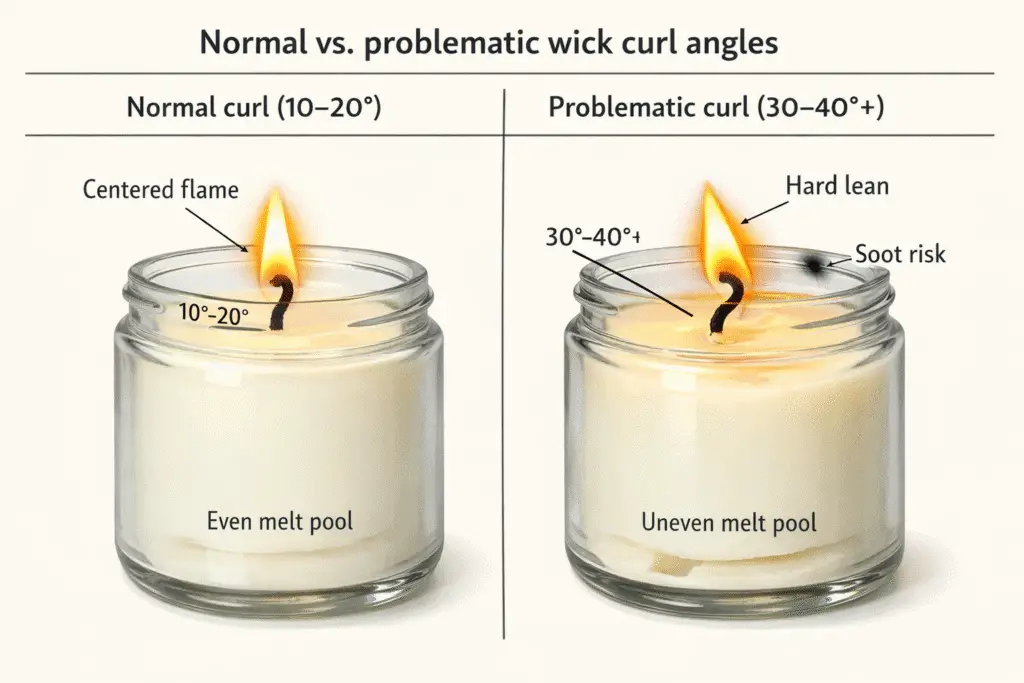
A wick is braided so it can draw liquid wax upward like a tiny fuel straw, and that structure naturally makes one side burn down faster than the other, creating curl. A gentle J-shaped curve helps the wick self-trim, keeping the tip in the hottest part of the flame so carbon burns off instead of building up. Many candle safety guidelines, including those from the National Candle Association, recommend trimming wicks to about 6 mm (around 1/4 inch) before lighting so that curl stays controlled and the flame does not get too tall. You are aiming for a flame that is upright, lively, and roughly centered, without heavy smoke or streaks of soot above the jar.
Not every wick style behaves the same way. Flat-braided and square-braided cotton wicks are often designed to curl into the hotter edge of the flame and self-trim, while many cored wicks are meant to stay more upright in container candles and wooden wicks follow a different burn pattern again. That is why wick curl should be judged against the wick family you are using, not treated as a universal defect. Compare families before retesting so you do not treat normal self-trimming behavior as a fault.
Wick bridging happens when a curling wick stops self-trimming cleanly and leaves part of the carbonized tip stretched across the melt pool instead of burning away. Mushrooming is different: it is carbon buildup that forms a bulb at the wick tip. Bridging describes failed self-trimming across the melt pool, while mushrooming describes a carbon cap at the tip.
| Curl behavior | What it usually means | What to do next |
| Slight bend, centered flame, clean jar | Normal self-trimming | Keep the same trim length and continue the burn test |
| Stronger lean, light soot, tip getting heavier | Borderline mismatch between wick, wax, fragrance load, or airflow | Trim to 1/4 inch, retest in still air, and compare one wick size up or down |
| Hooking into the melt pool, carbon cap, tall or unstable flame, or a one-sided hot spot | Problematic curl or bridging behavior | Stop that setup, change wick size or series, and retest before using it in production |
Use repeated behavior across comparable burns as the pass/fail signal. A universal angle cutoff sounds exact, but centered flame, soot level, cap formation, and repeatable burn-test results are more useful decision markers.
Do a quick curl check each time you test-burn a candle. During the first part of the burn, look at the wick from the side and from above: is it roughly upright with a modest bend, or is it forming a tight crook that drags the flame sideways? Note any soot on the jar, tunneling, or pronounced lean and record those observations in your testing notes. If you see a strong hook, streaks of soot, or a leaning flame on comparable burns, treat that combination as “do not ship” and change something before you pour more. Start with trimming and recentring between burns; if the same pattern returns, move next to wick size and series before you blame the wax blend.
What to Change First When Wick Curl Is Excessive
These five changes show the first retest order when wick curl moves past normal self-trimming.
- Trim the wick to 6 mm (around 1/4 inch) and remove any carbon cap before the next burn.
- Retest in a draft-free room so airflow does not fake a wick problem.
- If the wick still hooks over or soots, change wick size by one step and retest in the same vessel and wax.
- If the same size still misbehaves, switch wick series before changing multiple variables at once.
- Only after wick size and series checks should you adjust fragrance load, dye, or wax blend.
Why Wick Curl Happens (Normal Self-Trimming vs Excessive Curl)
Wick curl happens because one side of a burning wick shortens faster than the other, and it turns problematic when extra fuel or airflow pushes that bend too far.
Normal self-trimming keeps the tip in the hotter part of the flame so carbon burns off. Excessive curl starts when the wick family, wick size, fuel load, or room conditions stop that balance from holding.
| Likely cause | What it usually looks like | What to change first |
| Self-trimming wick design | Slight bend, centered flame, clean jar | Keep the same trim length and keep testing |
| Wick family or size mismatch | Deeper curl with a weak melt pool or repeated lean | Retest one wick size up or compare a different series |
| Excess fuel load | Sharper hook, taller flame, heavier tip, or carbon cap | Trim, retest, then step down or switch series if the pattern repeats |
| Airflow | Curl shifts more near vents, windows, or fans | Burn in still air before you reject the setup |
Judge the cause by repeated comparable burns, not one dramatic flame. When the same pattern returns after trimming and recentring, use the first-change column before you move on to wax-specific factors.
How Wax Type Affects Wick Curl (Soy, Coconut, Paraffin, Beeswax)
Wax type affects wick curl because melt speed and fuel flow change whether a small bend stays normal or becomes excessive.
Treat wax as a diagnostic signal, not the main owner topic here. If curl deepens with a weak melt pool, use the wick size chart by jar diameter and wax type as the next route; if curl comes with a taller, dirtier flame, route the setup into how to fix common candle wick problems before changing multiple variables at once.
Choosing Wick Size/Series to Minimize Curl
To minimize wick curl, choose the smallest wick size and series that still give a full, even melt pool in a controlled burn test.
Use that as a routing rule, not a full chooser guide. For full selection work, move to wick size chart by jar diameter and wax type, wick size and series, and CD vs ECO wicks instead of using curl alone to pick a wick.
Is Wick Curl an Early Sign of Mushrooming? (How to Tell)
Growing wick curl can be an early sign of mushrooming, but it matters whether curl increases over time and comes with a heavy, unstable flame.
Keep the distinction short on this page: curl is the bend in the burning wick, while mushrooming is a carbon bulb at the tip. If the same setup repeats caps, soot, or hook-over behavior across comparable burns, move to why your candle wick is curling and mushrooming or how to fix common candle wick problems instead of diagnosing the full pattern here.
Wick Curl FAQ
Wick curl is usually normal when it stays small and the flame stays centered, but it signals a mismatch when the hook grows, smokes, or drops into the melt pool.
Is wick curl normal?
A small curl can be normal in self-trimming cotton wicks if the flame stays centered, the jar stays clean, and the wick tip does not drop into the melt pool.
Why does a candle wick curl into a hook?
A hook usually means the wick is not self-trimming cleanly anymore. Common causes are the wrong wick size or series, excess fuel from wax or fragrance, carbon buildup, or airflow that keeps pushing the flame sideways.
Does wick curl mean the wick is too big?
Not always. Some curl is intentional. It becomes a sign of over-wicking when the curl grows sharper, the flame gets taller or dirtier, and a carbon cap or soot starts showing up.
Can trimming fix wick curl?
Trimming helps control carbon buildup and flame size, but it will not rescue a poor wick-and-wax match on its own. If trimming only fixes one burn, the sizing or series still needs work.
Do wooden wicks curl like cotton wicks?
Usually not in the same way. Wooden wicks can lean, split, or extinguish, but they do not use the same self-trimming curl behavior common to many braided cotton wicks.
What is wick bridging, and how is it different from mushrooming?
Wick bridging is when the carbonized tip does not burn away cleanly and stretches across the melt pool, while mushrooming is a carbon bulb at the tip. For recurring bridging or cap problems, route the setup into how to fix common candle wick problems rather than treating this FAQ as the full troubleshooting page.