
A container candle is a candle poured and burned inside a heat-safe vessel, such as a jar, tin, or ceramic container, rather than being made to stand on its own.
Container candles are popular because the vessel makes the candle easier to use, easier to present, common for fragrance, and approachable for beginners. A jar candle is one type of container candle, but container candles also include tins, ceramics, and other heat-safe vessels.
This article explains what container candles are, why people use them, and where their benefits have limits. It does not replace a full candle-making tutorial, wick-sizing guide, or vessel-safety test.
What Is a Container Candle?
A container candle is poured and burned inside a heat-safe vessel instead of standing on its own.
The vessel stays with the candle during burning, so it is part of the candle format rather than removable packaging. In the candle types overview, container candles sit apart from freestanding candles because the vessel holds the wax, shapes the melt pool, affects heat behavior, supports scent use, and creates the finished presentation.
| Term | Means | Does Not Mean |
|---|---|---|
| Container candle | Candle made and burned inside a heat-safe vessel. | Any candle placed near a container. |
| Jar candle | Container candle made in a jar. | The entire container candle category. |
| Tin candle | Container candle made in a metal tin. | A candle without vessel-safety requirements. |
| Pillar candle | Freestanding candle that holds its own shape. | A container candle. |
| Votive / tealight | Small candle formats often used with holders or cups. | Full synonym for container candle. |
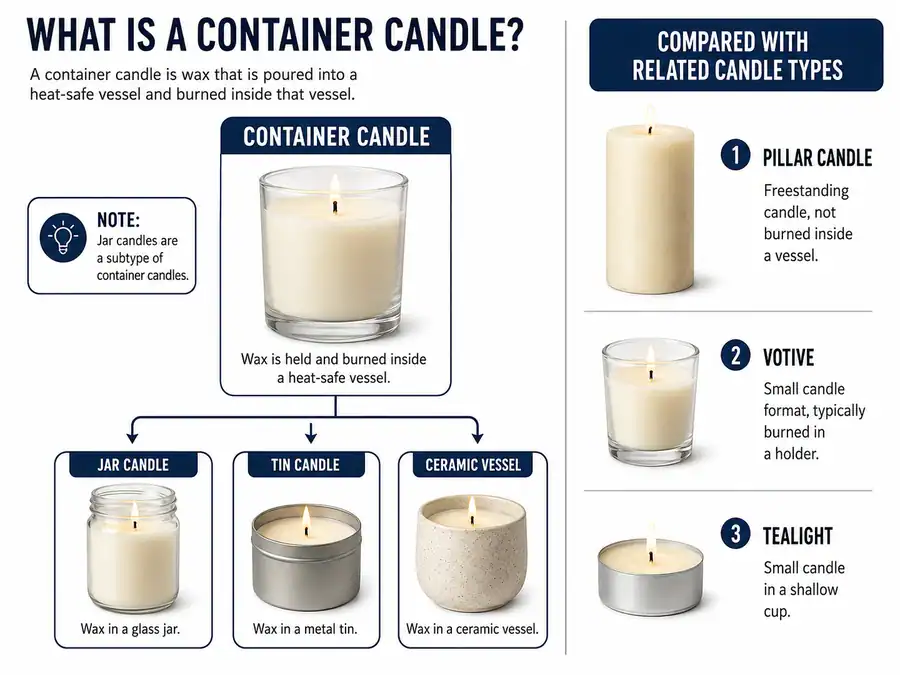
This terminology table is modeled from category distinctions, not from a private lab test. Its purpose is to keep the definition clear before deeper making, safety, or comparison topics begin.
A container candle can be made in a jar, tin, ceramic vessel, or another heat-safe candle container. The key condition is not the style of the vessel; the key condition is that the wax is designed to be poured, held, melted, and burned inside that vessel.
A jar candle guide is the better next page when the reader needs jar-specific details. A how to make container candles guide is the better next page when the reader needs pouring steps, wick placement, cure time, or testing instructions.
Are Jar Candles the Same as Container Candles?
A jar candle is a type of container candle, but not every container candle is a jar candle.
“Jar candle” names one common subtype. “Container candle” is the broader category because it includes candles poured into jars, tins, ceramic vessels, and other heat-safe candle containers.
Quick clarification: A jar candle is usually the right term when the vessel is specifically a jar. Container candle is the clearer term when the point is the candle format: wax designed to be poured, held, melted, and burned inside a vessel.
People often use “jar candle” casually because glass jars are familiar and easy to recognize. That wording can hide the larger category, especially when a maker is comparing jars with tins, ceramics, or other vessel formats.
For jar-specific making or buying details, use a jar candle guide. For the full process, use the container candle making guide.
Why the Container Is Part of the Candle
The container is part of the candle because the wax is designed to be held, melted, and burned inside that vessel.
In a container candle, the vessel affects structure, melt-pool shape, heat behavior, handling, placement, and presentation. “Functional” means the vessel changes how the candle works; it does not mean any container automatically qualifies as safe.
| Vessel Role | Why It Matters | What Not to Assume |
|---|---|---|
| Holds wax | Keeps softened and melted wax contained during use. | Containment removes heat or flame risk. |
| Supports shape | Lets the wax rely on the vessel instead of standing alone. | Wax choice no longer matters. |
| Fixes burn area | Vessel width helps determine the melt-pool area. | Any wick will work. |
| Handles heat | The vessel must tolerate candle-use conditions. | Any glass jar is safe. |
| Presents product | The vessel creates the finished look for display or gifting. | Decoration replaces safe use. |
A pillar candle must hold its own shape after it leaves a mold. A container candle does not have that same structural job because the vessel stays in place during use. That is why container candles can use wax blends and designs made for contained burning rather than freestanding strength.
The vessel still has limits. It should not be treated as ordinary packaging, a removable holder, or a decorative afterthought. It should not be treated as automatically safe just because it looks sturdy.
This section explains why the vessel matters; the candle container safety guide explains how to evaluate whether a vessel is suitable for candle use.
Common Container Materials: Glass, Tin, and Ceramic
Glass, tin, and ceramic are common container candle materials, but material alone does not prove that a vessel is safe for candle use.
A material overview helps readers picture the category before they move into the candle container safety guide. The safer question is not “Is this glass, metal, or ceramic?” but “Was this vessel made or verified for candle use?”
| Material | Why Makers Use It | What Not to Assume |
|---|---|---|
| Glass | Shows wax color, accepts labels well, and is familiar for jar candles. | All glass can handle candle heat. |
| Tin | Feels light, portable, opaque, and giftable. | Metal cannot overheat. |
| Ceramic | Looks decorative, sturdy, and more finished. | Every ceramic vessel is candle-safe. |
This material table is a high-level recognition guide, not a vessel test. A glass jar, metal tin, or ceramic cup can still fail if the vessel is not suited to heat, flame, wax expansion, or real candle use.
Tins can count as container candles when the wax is poured and burned inside the tin. Ceramic vessels can count the same way. The format depends on the vessel remaining part of the candle during burning, not on the vessel being glass.
For deciding whether a specific jar, tin, or ceramic vessel is safe to use, move to the candle container safety guide. For jar-specific sizing and shopping questions, use a best jars for candle making guide instead of treating this section as a container buying list.
Why Are Container Candles So Popular?
Container candles are popular because the vessel makes them easy to use, easy to display, useful for home fragrance, approachable for beginners, and suitable for gifts or small-batch selling.
“Popular” means commonly chosen for practical reasons. It does not mean container candles are always safest, cheapest, strongest-scented, highest quality, or better than every other candle type in the candle-type comparison.
| Popularity Reason | Why It Matters | Caveat |
|---|---|---|
| Easy to understand | The candle stays in a vessel. | It still needs suitable materials and safe use. |
| Beginner-friendly | No mold release or freestanding shape is needed. | It still requires testing. |
| Home fragrance | Scented wax sits in a finished vessel. | Scent depends on wax, wick, fragrance load, and burn conditions. |
| Giftable | Vessel, lid, label, and scent feel finished. | Decorative does not mean safe anywhere. |
| Stable-looking | Wax is contained inside the vessel. | It is not risk-free. |
| Brandable | The vessel gives space for a label, lid, scent name, and design. | Branding is not compliance. |
| Less drippy | The melt pool is usually contained. | It is not mess-free. |
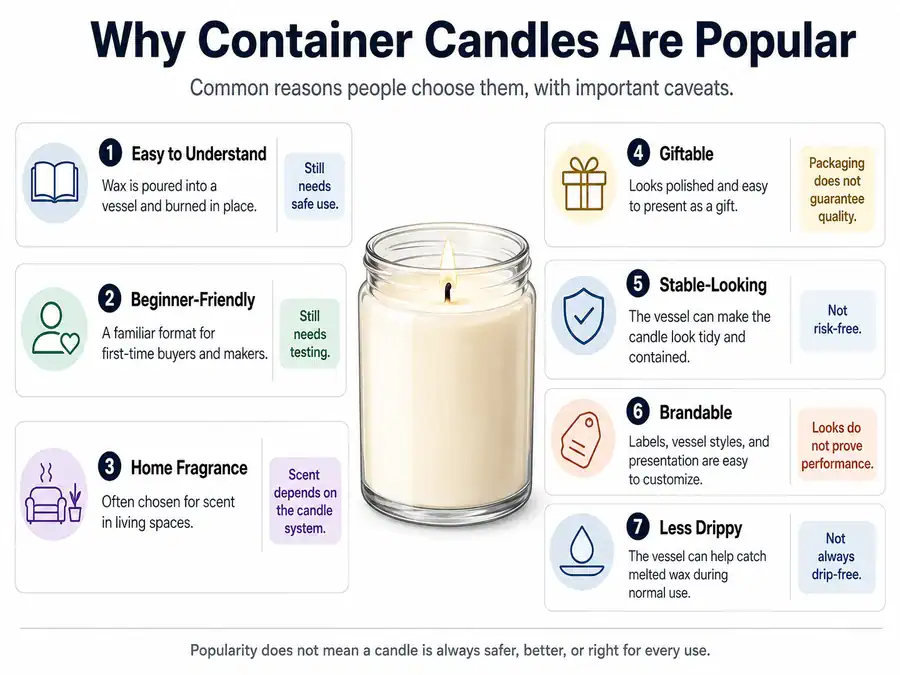
This popularity matrix separates real user appeal from overclaims that can mislead beginners.
Container candles often feel less intimidating than pillar, taper, or molded candles because the vessel handles structure. The wax does not need to stand on its own, and the finished candle can look complete with a lid, label, or simple jar.
Their popularity comes from home use too. A container candle can sit on a table, shelf, or gift box more easily than a freestanding candle, but placement still has to follow heat and flame safety.
The main mistake is treating popularity as proof. A popular container candle can still have the wrong wick, weak scent throw, unsafe vessel, overheating risk, or poor burn behavior.
When the real question is “Which candle type should I choose?”, move to the container vs pillar candle comparison or a broader candle types guide. This section explains why container candles are often chosen, not why every reader should choose them.
Why Beginners Often Start With Container Candles
Container candles are beginner-friendly because the candle remains inside the vessel, which removes the need for mold release or freestanding candle structure.
“Beginner-friendly” means fewer structural steps, not no wick testing, no safety checks, or automatic success.
| Format | Beginner Friction | Why Container Candles Feel Easier |
|---|---|---|
| Container candle | Lower structural friction. | Wax stays in the vessel during cooling and burning. |
| Pillar candle | Must stand alone. | Wax structure and clean release matter more. |
| Molded candle | Must release cleanly. | Shape, mold material, and release issues add variables. |
| Taper candle | Shape and formation matter. | The format is less forgiving for a first project. |
A beginner does not need a mold for a container candle because the vessel holds the wax from pour to burn. That removes one common process problem: getting the candle out of a mold without dents, cracks, sticking, or shape damage.
The tradeoff is that the vessel introduces its own decisions. A beginner still needs a heat-safe container, suitable wax, matched wick, fragrance-safe handling, and burn testing before treating the candle as finished.
Starter kits can reduce setup friction, but they do not solve every candle variable. The candle making supplies for beginners guide is the better next step when the reader needs a supply list, and the full container candle tutorial is the better next step when the reader needs the making sequence.
Why Container Candles Are Giftable and Easy to Present
Container candles are giftable and easy to present because the vessel is both functional and visible.
The container gives the candle a finished shape, display surface, and presentation before the candle is wrapped or boxed. That presentation comes from the jar, tin, ceramic vessel, lid, label, wax color, scent name, and seasonal styling.
| Surface | What It Helps Communicate | What It Should Not Be Confused With |
|---|---|---|
| Front label | Scent, maker, style, and collection. | Full legal compliance. |
| Lid | Finished product feel and gift readiness. | Safety guarantee. |
| Vessel color | Mood, season, or collection identity. | Proof of quality. |
| Glass finish | Clear, frosted, amber, or opaque presentation. | Proof that the vessel is heat-safe. |
| Scent name | Fragrance identity and gift appeal. | Performance guarantee. |
| Warning label area | Safety information placement. | Optional decoration. |
| Gift packaging | Presentation for gifting or selling. | Business strategy. |
The built-in surface is one reason container candles work well for gifts and small batches. A plain pillar candle may need a separate wrap, holder, or display plan, while a container candle already has a visible vessel that can hold a label, lid, and scent identity.
For selling, warning labels, or legal label requirements, use the candle labeling guide. For presentation ideas, use the candle packaging guide.
Are Container Candles Reusable or Sustainable?
Container candles can look reusable because a vessel remains after burning, but reusable-looking does not mean sustainable, refill-safe, or zero-waste.
The leftover jar, tin, or ceramic vessel can make container candles feel less wasteful than candles with no reusable-looking part. That perception depends on what the vessel is made from, how it is cleaned, how it was heated, whether it is safe to refill, how it was packaged, and what the user does with it.
| Claim | Safer Wording |
|---|---|
| Reusable | Some vessels may be reusable for non-burning purposes after proper cleaning. |
| Refillable | Refill safety depends on vessel condition, heat history, and candle design. |
| Sustainable | Sustainability depends on material, packaging, disposal, and actual reuse. |
| Zero-waste | Do not claim zero-waste without proof. |
A used candle jar may be fine for storage after cleaning, but that is different from pouring a new candle into it. Refill safety needs its own checks because the vessel may have heat stress, cracks, residue, or a design that was not meant for repeated candle burns.
For cleaning, reuse, or refill safety, use the candle jar reuse or refill-safety guide.
Why Container Candles Are Common for Home Fragrance
Container candles are common for home fragrance because they hold scented wax in a stable, finished vessel, but scent performance depends on wax, wick, fragrance load, vessel size, and burn conditions.
The container format supports home scent use because the candle can sit in a finished vessel while the wax melts around the wick. It does not mean container candles automatically smell stronger than pillar, tealight, or wax-melt formats.
Cold throw means the scent a candle gives off when unlit. Hot throw means the scent noticed while the candle is burning.
| Factor | How It Affects Scent | Caveat |
|---|---|---|
| Wax | Holds and releases fragrance differently. | No wax guarantees strong scent alone. |
| Wick | Controls flame and melt pool. | Wrong wick can weaken or overheat the candle. |
| Fragrance load | Affects scent concentration. | More is not always better or safer. |
| Vessel diameter | Affects melt-pool area. | Diameter links to wick selection. |
| Cure and burn conditions | Affect perceived scent. | Troubleshooting belongs elsewhere. |
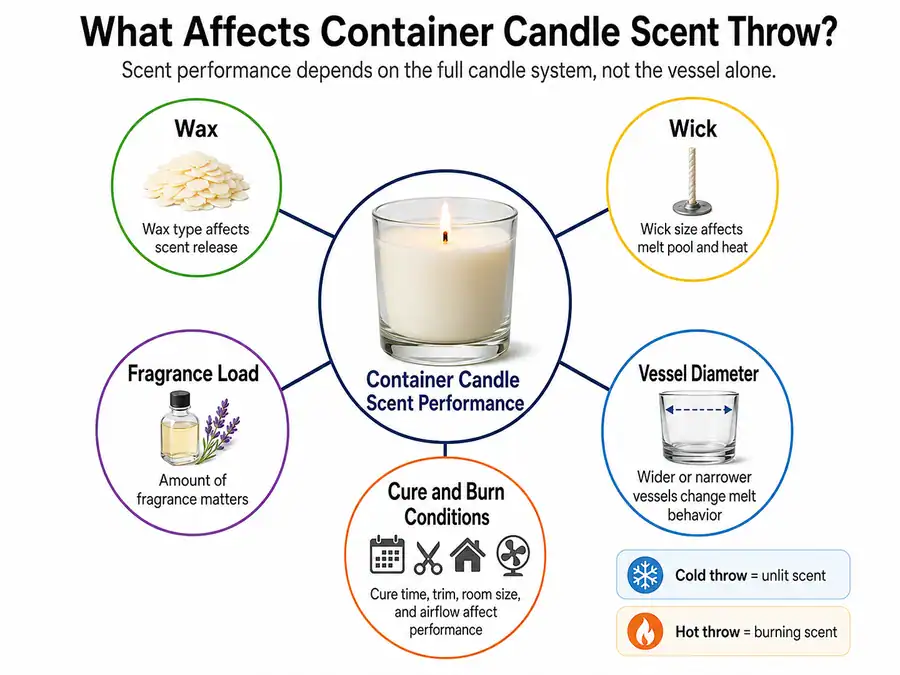
This scent table is a dependency guide, not a scent test or fragrance formula. It shows why container format helps organize a scented candle, while the actual scent result still depends on the full candle system.
Container candles are commonly used for home fragrance, gifts, ambiance, seasonal scents, small displays, and small-batch selling because the vessel makes them contained, portable, and presentable. Relaxation here means ambiance only, not therapy, wellness treatment, or a health benefit.
If the candle smells weak, burns too hot, or leaves wax around the edges, move to the candle scent throw basics guide or the fragrance oil load guide instead of treating this explainer as a troubleshooting page.
Are Container Candles Safer or More Stable?
Container candles can feel more stable because the wax is held inside a vessel, but they are not automatically safe or risk-free.
“Safe” means conditional use under the right vessel, wick, flame, and burn conditions. It does not mean child-safe, pet-safe, compliant, suitable for any jar, or free from fire and heat risk.
| Container Candles Can Reduce | Container Candles Cannot Eliminate |
|---|---|
| Exposed wax drips in normal use. | Fire risk. |
| Need for freestanding wax structure. | Heat risk. |
| Some handling mess. | Unsafe vessel risk. |
| Some tipping or balance issues. | Wick, flame, soot, or overheating problems. |
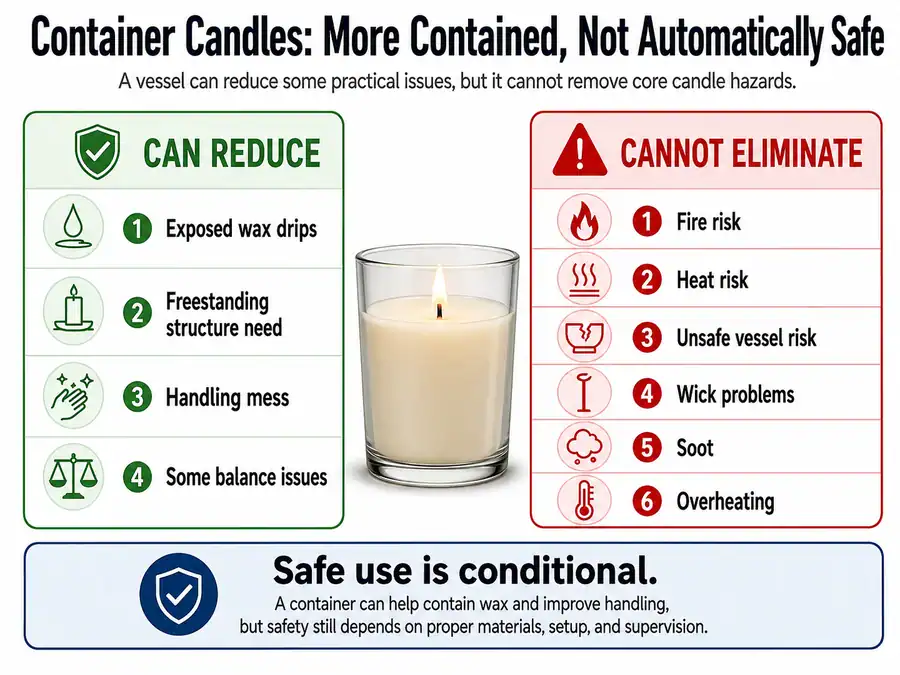
This safety caveat is a failure-pattern summary, not a vessel test, legal compliance guide, or fire-safety standard.
The container can make the candle feel steadier than a freestanding candle because the wax stays inside the vessel. That perceived stability depends on the vessel being heat-safe, the wick being matched, and the candle being burned on a suitable surface.
The main mistake is treating containment as protection from every hazard. A container candle can still overheat, crack a poor vessel, produce a poor flame, soot, tunnel, or become unsafe through user handling.
For vessel suitability, use the candle container safety guide. For flame behavior, burn duration, and test observations, use the candle burn testing guide. For required warning language, use the candle warning labels guide.
How Container Candles Compare With Other Candle Types
Container candles differ from pillar, taper, votive, tealight, and molded candles because the vessel remains part of the candle during burning.
The main difference is support. A container candle relies on the vessel to hold the wax, while freestanding candle types rely more on wax structure, shape, or a separate holder.
| Candle Type | Support Method | Typical Use | Beginner Friction | Caveat |
|---|---|---|---|---|
| Container candle | Vessel supports the wax. | Home fragrance, gifts, décor. | Often lower. | Vessel, wick, and burn safety still matter. |
| Pillar candle | Wax stands alone. | Freestanding display. | Higher. | Wax structure and burn control matter. |
| Taper candle | Long freestanding form. | Dining, ceremony, décor. | Higher. | Needs a holder and stable placement. |
| Votive candle | Small candle often used with a holder. | Accent or devotional use. | Medium. | Holder and size affect use. |
| Tealight | Small cup-based candle. | Warmers and accents. | Low to medium. | Small format has different limits. |
| Molded candle | Mold gives the wax its shape. | Decorative shapes. | Higher. | Release and shape quality matter. |
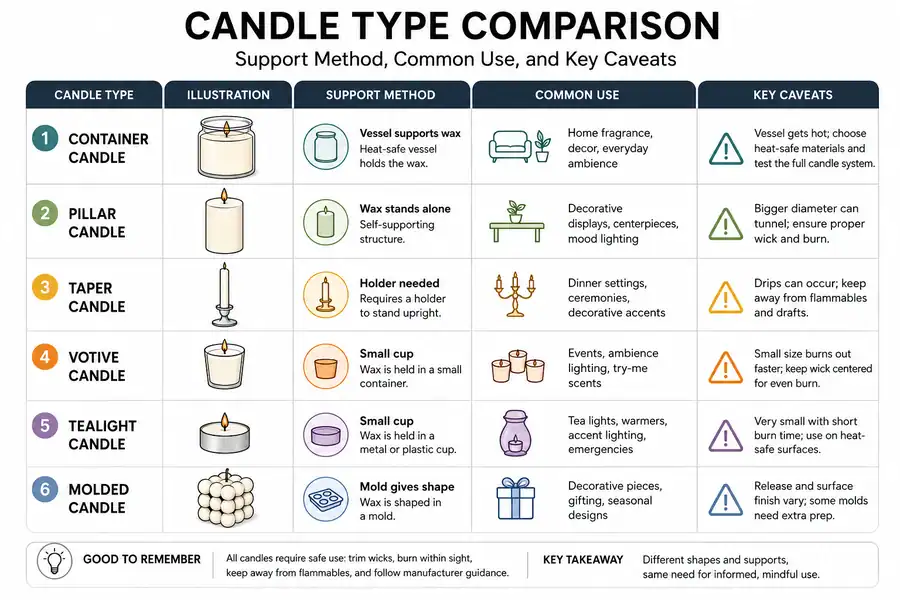
This comparison table is a candle-type guide, not a ranking. Container candles are not automatically better than pillar, taper, votive, tealight, or molded candles. They are different because the vessel remains part of the candle system.
A container candle often fits beginners, scent use, gifting, and small displays. A pillar candle may fit freestanding décor better. A taper candle may fit dining or ceremony. A molded candle may fit shapes or decorative forms.
Container candles can feel less drippy because the melted wax pool is contained inside the vessel during normal use. Less drippy does not mean mess-free; spills, soot, overheating, tunneling, and cleanup can still happen.
For a deeper container-versus-pillar choice, use the container vs pillar candles guide. For the full candle taxonomy, use the types of candles guide.
How Container Candles Burn Differently
Container candles burn inside a fixed vessel, so wick choice, wax type, vessel diameter, fragrance load, and melt-pool behavior must work together.
The vessel does more than hold wax. It fixes the inside burn area, which changes how the flame, wick, melted wax, scent release, and container heat interact during use.
| Dependency | What It Means | Where Details Belong |
|---|---|---|
| Vessel diameter | Sets the inside burn area. | Wick sizing guide. |
| Wick choice | Controls flame size and melt-pool width. | Wick testing guide. |
| Wax blend | Affects melting, jar adhesion, and scent release. | Wax guide. |
| Fragrance load | Changes burn behavior and scent strength. | Fragrance load guide. |
| Melt pool | Shows how wax is melting inside the vessel. | Burn testing or troubleshooting guide. |
| Heat | Must stay within safe use expectations. | Candle safety guide. |
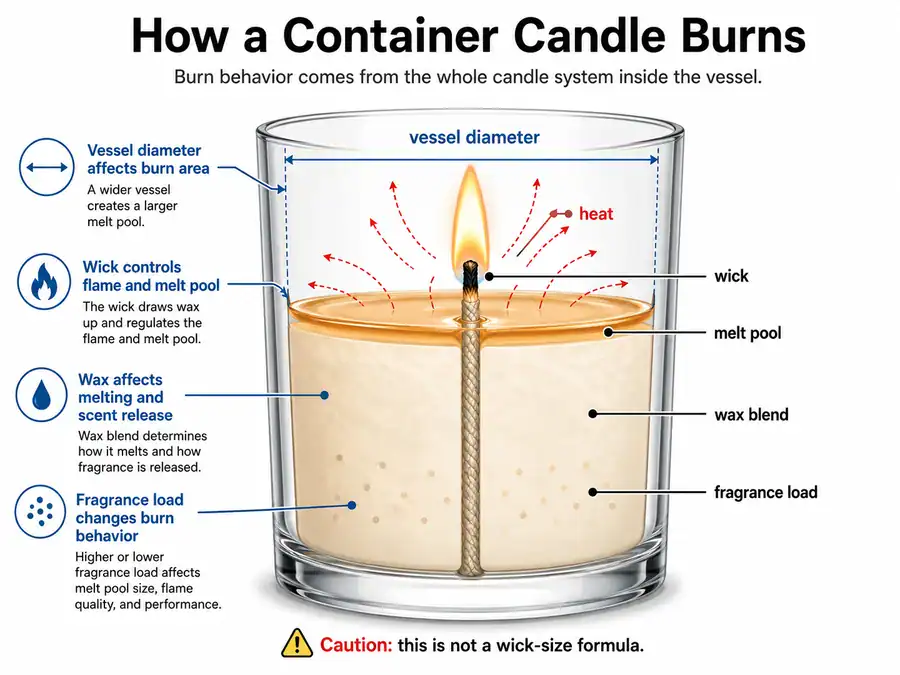
This burn dependency map is a format-level explanation, not a burn-test log, wick chart, or defect diagnosis.
A container candle’s fixed inside diameter affects wick choice because the wick must create an appropriate melt pool inside that vessel. This is the principle, not a universal wick formula.
A wick that is too small may leave unmelted wax around the edge. A wick that is too large may create too much heat, soot, or an aggressive flame.
Those examples explain why burn behavior matters. They do not replace a tunneling guide, soot guide, overheating guide, or production burn-test method.
For exact wick sizes, testing methods, tunneling, or overheating, use the wick sizing and burn testing guides.
Key Takeaways
A container candle is defined by its vessel-contained format, and its popularity comes from ease, presentation, fragrance use, beginner accessibility, and conditional safety expectations.
- A container candle is poured and burned inside a heat-safe vessel.
- A jar candle is a subtype of container candle, not the whole category.
- Container candles are popular because they are easy to understand, giftable, common for fragrance, beginner-friendly, and visually finished.
- The vessel supports the wax, affects burn behavior, and creates the finished presentation.
- Safety, scent, and reuse are conditional; vessel suitability, wick choice, fragrance load, burn behavior, and cleaning history still matter.
- Deeper making, vessel, wax, wick, fragrance, safety, selling, reuse, and refill questions belong in their own guides.
FAQ
Are jar candles container candles?
Yes, jar candles are container candles because the wax is poured and burned inside a jar.
The difference is category size. A jar candle is one subtype, while container candles include tins, ceramic vessels, and other heat-safe candle containers.
Are container candles good for beginners?
Container candles are often good for beginners because the wax stays inside the vessel and does not need to stand alone.
That lowers structural difficulty compared with molded or pillar candles. Beginners still need the full making tutorial for supplies, pouring steps, wick placement, and burn testing.
Do container candles smell stronger?
Container candles do not automatically smell stronger.
Scent depends on wax, wick, fragrance load, vessel diameter, cure conditions, and burn behavior. Use a scent throw guide when the main question is why a candle smells weak or strong.
Are container candles safer than pillar candles?
Container candles may feel more stable than pillar candles because the wax is held inside a vessel.
That does not make them risk-free. Safe use still depends on a suitable vessel, matched wick, stable surface, burn time, flame behavior, and user care.
Can any jar be used for a container candle?
No, any jar should not be used for a container candle.
The vessel must be suitable for candle use. Ordinary household jars can crack, overheat, or fail if they are not designed or verified for candle conditions.
Are container candles reusable?
Some finished container candle vessels may be reusable for non-burning purposes after cleaning.
That is different from refilling the vessel as a new candle. Refill safety depends on vessel condition, heat history, cracks, residue, and candle design.
Why do small businesses sell container candles?
Small businesses often sell container candles because the vessel supports labels, lids, scent collections, photography, batching, and gift presentation.
That is a product-presentation advantage. It does not prove profit, correct pricing, legal readiness, or business compliance.