

Soy blend wax is usually better than pure soy wax for scented container candles when scent throw, smooth finish, and beginner consistency matter most.
This guide compares pure soy wax and soy blend wax for candle makers choosing wax for scented jars, tins, and other container candles. Pure soy wax is soy-based wax without other performance waxes, while soy blend wax mixes soy with other waxes or additives to change handling, finish, or scent performance.
“Better” here means better for the maker’s goal: stronger scent, smoother finish, easier testing, cleaner positioning, or repeatable production. It does not mean safer, cheaper, or superior for every candle format, so the first step is defining the two wax types clearly.
What’s the Difference Between Pure Soy Wax and Soy Blend Wax?
Pure soy wax is the better label choice when you want a soy-forward candle, while soy blend wax is the better performance choice when its formula gives stronger scent or a cleaner finish.
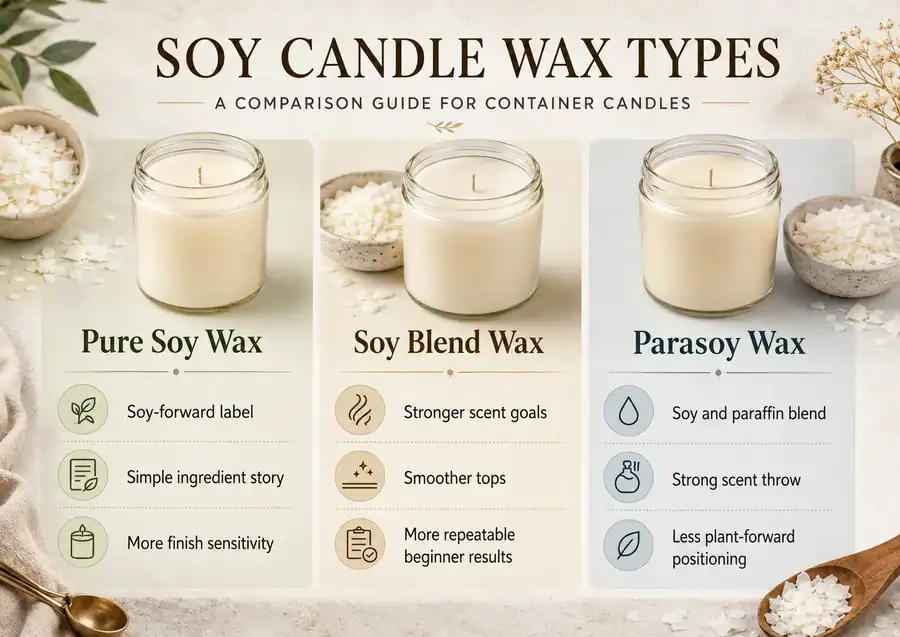
Pure soy wax is made from soy-based wax without other performance waxes added to change the candle’s behavior. For scented container candles, makers often choose it because the label is easy to explain and fits a plant-based brand position.
Soy blend wax is soy-based wax mixed with another wax or additive. That blend may be made for stronger hot throw, smoother tops, better glass adhesion, less frosting, or easier pouring. The trade-off is that “soy blend” is a category, not a fixed formula, so one supplier’s blend can behave very differently from another supplier’s blend.
Soy blend does not always mean parasoy. It can mean coconut-soy, soy with soy-based additives, soy mixed with paraffin, or another supplier-specific soy-based formula.
| Wax type | What it means | Best fit | Main trade-off |
|---|---|---|---|
| Pure soy wax | Soy wax without other performance waxes | Soy-forward branding, simple ingredient positioning, makers willing to test more | Can be more prone to frosting, rough tops, and softer scent performance |
| Soy blend wax | Soy wax mixed with other waxes or additives | Stronger scent goals, smoother finish, beginner-friendly production | Less transparent unless the supplier explains the blend clearly |
| Parasoy wax | A soy-and-paraffin blend | Strong scent throw and smoother finish | May not fit makers who want a pure soy or plant-forward candle line |
If you need the broader wax family before choosing, the better bridge is What Is Soy Wax? If the blend includes paraffin, the better next read is Parasoy Wax for Candles.
Why Soy Blends Vary by Supplier
Soy blends vary because each supplier can use a different base wax, additive package, melt point, and fragrance-load range.
That means “soy blend” on a product page does not tell you enough by itself. One soy blend may be built for creamy container tops, another for stronger fragrance throw, and another for easier bulk production. The product sheet matters more than the label phrase.
Before buying soy blend wax, check:
| Product detail | Why it matters |
|---|---|
| Wax blend description | Tells you whether the wax is plant-forward, parasoy, coconut-soy, or another soy-based mix |
| Container-candle suitability | Confirms the wax is made for jars, tins, and vessels instead of molds or pillars |
| Fragrance-load range | Shows the supplier’s recommended scent range for that wax |
| Cure guidance | Sets expectations before judging scent throw |
| Pour-temperature guidance | Helps prevent rough tops, sinkholes, or poor adhesion |
| Finish claims | Tells you whether the blend is meant to reduce frosting, wet spots, or surface defects |
The safer buying decision is not “soy blend always beats soy.” It is “this specific soy blend fits my candle goal better than this specific pure soy wax.”
Is Soy Wax or Soy Blend Better for Scent Throw?
Soy blend wax is often better for scent throw, especially hot throw, but only when the fragrance oil, wick, vessel, cure time, and wax formula are tested together.
Scent throw has two parts. Cold throw is how the candle smells before burning. Hot throw is how the candle smells while burning. A soy blend may carry fragrance more strongly because the blended wax system can release scent more easily during the burn.
Pure soy wax can still make a good scented candle, but it often asks for more patience. The same fragrance may smell soft in pure soy until the candle cures, the wick is changed, or the fragrance percentage is adjusted within the wax maker’s range.
| Scent factor | Pure soy wax | Soy blend wax |
|---|---|---|
| Cold throw | Can be good after cure | Often strong, depending on blend |
| Hot throw | Can be softer or slower to develop | Often stronger and more forgiving |
| Testing burden | Usually higher | Usually lower |
| Fragrance choice sensitivity | Higher | Often lower |
| Wick sensitivity | Higher in many container systems | Still important, but often more forgiving |
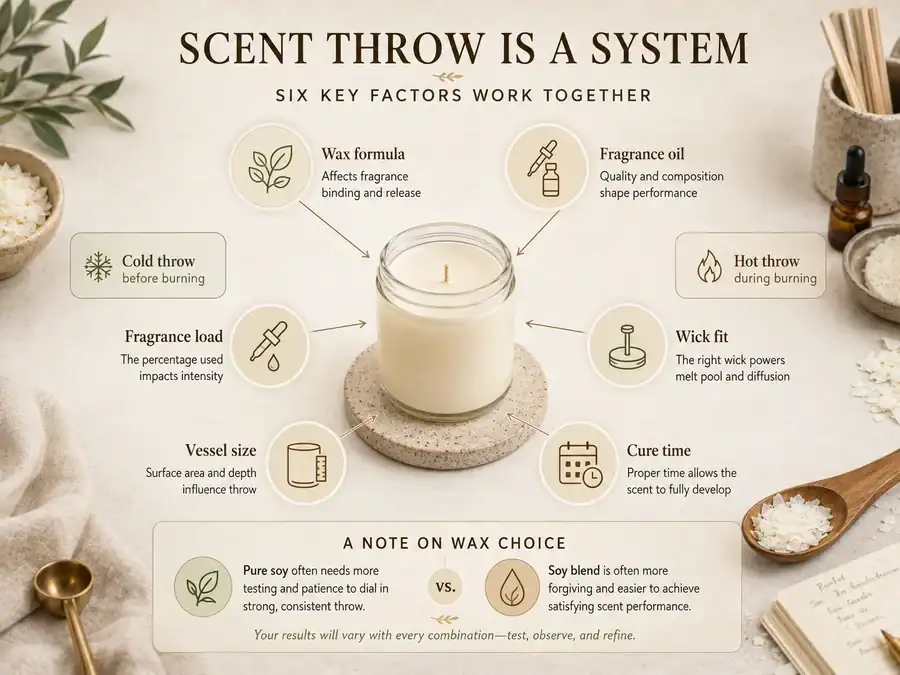
This does not mean wax alone controls scent. Fragrance oil choice and wick matching can change the result, so those belong on separate guides such as Best Fragrance Oils for Soy Candles and Best Wicks for Soy Candles rather than taking over this wax comparison.
How Cure Time and Fragrance Load Change the Answer
Cure time and fragrance load can make pure soy look weaker than it really is if the candle is judged too soon.
Pure soy candles often need more time before scent throw is judged, while many soy blends are designed to perform more consistently sooner. The exact wait still comes from the wax supplier’s instructions, not a universal rule.
Fragrance load should be handled the same way. A higher fragrance percentage does not always mean stronger scent. Too much fragrance can cause sweating, poor burning, weak hot throw, or wick problems. The right comparison is not “which wax holds the most fragrance?” It is “which wax gives the best scent at the supplier-approved fragrance range in my vessel?”
Use this rule before deciding:
| If this happens | What it usually means |
|---|---|
| Pure soy smells weak right after pouring | Judge again after the recommended cure period |
| Soy blend smells stronger in the same test | The blend may fit your scent goal better |
| Both candles smell weak | The fragrance oil, wick, or vessel may be the limiting factor |
| Higher fragrance load makes the candle worse | The wax system may be overloaded |
| Hot throw changes after a wick swap | Wick fit is part of the scent result, not a separate afterthought |
For scented container candles, soy blend usually wins when scent throw is the first priority. Pure soy still makes sense when the brand position matters more than maximum fragrance strength.
Which Wax Gives a Smoother-Looking Finished Candle?
Soy blend wax usually gives a smoother-looking scented container candle, while pure soy wax is more likely to show frosting or textured tops.
Finish quality matters when the candle will be sold, photographed, gifted, or placed in a premium product line. Pure soy wax can look clean when the process is dialed in, but it is more sensitive to cooling speed, pour temperature, vessel temperature, fragrance behavior, and room conditions.
Soy blend wax is often chosen because the added waxes or additives can reduce visible defects. That does not make every blend flawless, but it can make the same candle formula easier to repeat.
| Finish issue | Pure soy wax | Soy blend wax |
|---|---|---|
| Frosting | More common | Often reduced |
| Rough tops | More likely if cooling or pour conditions are off | Often smoother |
| Glass adhesion | Can vary more by jar and room temperature | Often more stable |
| Wet spots | Still possible | Still possible, but some blends hide them better |
| Reset after remelting | Can need more process control | Often more forgiving |
| Product photos | May need more sorting or touch-ups | Often easier to present consistently |
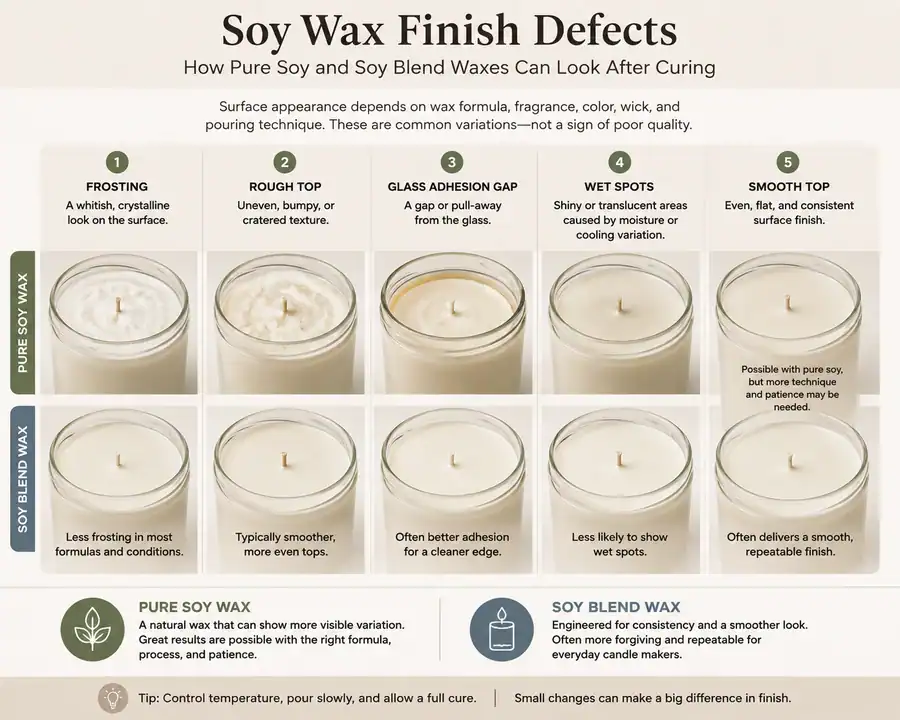
Frosting is the pale, crystal-like look that can appear on soy wax. It is mainly a visual issue, not proof that the candle is ruined. A maker selling a rustic or handmade-style candle may accept some frosting, while a brand aiming for a polished jar candle may prefer a blend.
The right comparison is finish tolerance. Choose pure soy if minor natural-looking variation fits the candle line. Choose soy blend if smooth tops, cleaner glass appearance, and batch repeatability matter more.
For a full defect-by-defect fix, use a soy wax troubleshooting guide instead of turning this wax comparison into a repair manual.
Which Wax Is Easier for Beginners to Use?
Soy blend wax is usually easier for beginners because it can forgive more process variation than pure soy wax.
A new candle maker is not only choosing a wax. They are learning pour temperature, fragrance mixing, jar warming, wick fit, cure time, and burn testing at the same time. Pure soy can work well, but it often gives beginners more visible feedback when one part of the process is off.
Soy blend wax can reduce that early frustration. A beginner may get smoother tops, stronger scent, and fewer rejected candles before learning every variable.
| Beginner task | Pure soy wax | Soy blend wax |
|---|---|---|
| Getting a smooth top | Takes more control | Usually easier |
| Repeating the same result | More sensitive | Often more stable |
| Judging scent throw | May need more cure patience | Often easier to evaluate |
| Learning from defects | Good teaching wax, but less forgiving | More forgiving |
| Selling early batches | Higher sorting risk | Lower sorting risk |
| Brand explanation | Simple soy-forward story | Needs clearer ingredient wording |
Pure soy is still a good beginner wax when the maker wants to learn soy behavior from the start. It can teach how cooling, pouring, and curing affect a candle. The trade-off is more testing and a higher chance of batches that look less polished.
Soy blend is better when the beginner wants a shorter path to a presentable scented container candle. It does not remove testing, but it can reduce the number of problems happening at once.
Beginner mistake to avoid: do not switch wax, wick, fragrance, jar, and fragrance load at the same time. Change one major variable per test, or the result will not show whether pure soy or soy blend caused the improvement.
Is Pure Soy Better for a Natural or Clean-Labeled Candle Brand?
Pure soy wax is usually better for a soy-forward brand story, while soy blend wax is usually better for performance-led candle lines.
Pure soy is easier to explain on a product page because the wax identity is simple. A maker can say the candle uses soy wax without needing to explain added waxes, performance additives, or blend differences. That makes pure soy a good fit for brands built around plant-based materials, minimal ingredients, or a softer handmade feel.
Soy blend wax can still fit a strong candle brand, but the message changes. Instead of leading with “pure soy,” the brand should lead with the candle experience: stronger scent, smoother tops, better consistency, or a more polished finish.
| Brand goal | Better wax fit | Why |
|---|---|---|
| Simple soy-forward label | Pure soy wax | Easier ingredient story |
| Plant-based brand feel | Pure soy wax | Matches the buyer’s material expectations |
| Strong fragrance experience | Soy blend wax | Often gives better hot throw |
| Premium visual finish | Soy blend wax | Often gives smoother tops and less frosting |
| Beginner product line | Soy blend wax | Usually reduces early batch issues |
| Handmade rustic style | Pure soy wax | Minor visual variation may fit the product |
| Performance-led candle line | Soy blend wax | Lets the result matter more than wax purity |
Do not treat “natural” as a safety claim. Pure soy may support a cleaner label story, but that does not prove the candle is safer, soot-free, toxin-free, or better for every room. Those claims need separate evidence and may depend on fragrance, wick, dye, vessel, burn behavior, and local labeling rules.
If your buyers care most about what the wax is, pure soy has the stronger story. If your buyers care most about how the candle smells and looks, soy blend often has the stronger product result.
Which Should You Choose? A Goal-Based Decision Matrix
Choose pure soy wax for soy-forward branding and choose soy blend wax for stronger scent, smoother finish, and easier repeatability.
The best wax depends on the job the candle must do. A candle for a natural-style brand has a different success test than a candle made for maximum fragrance throw or polished product photography.
| Maker goal | Choose pure soy wax if… | Choose soy blend wax if… |
|---|---|---|
| Strongest scent throw | You accept a softer throw and will test cure, wick, and fragrance carefully | Hot throw is the main buying reason |
| Smoothest surface finish | You can tolerate frosting or occasional textured tops | You want fewer visible defects |
| Beginner-friendly process | You want to learn soy behavior from the start | You want fewer early failures |
| Soy-forward brand story | Wax purity matters more than peak performance | You can explain the blend clearly |
| Fastest path to saleable batches | You are willing to sort or rework more candles | You need more consistent jars sooner |
| Premium-looking container candles | Minor handmade variation fits your line | Smooth tops and clean glass matter |
| Lower waste during testing | You already have a tested soy formula | You want a more forgiving wax system |
| Scaling small-batch production | Your buyers expect pure soy | Batch repeatability matters more than wax purity |
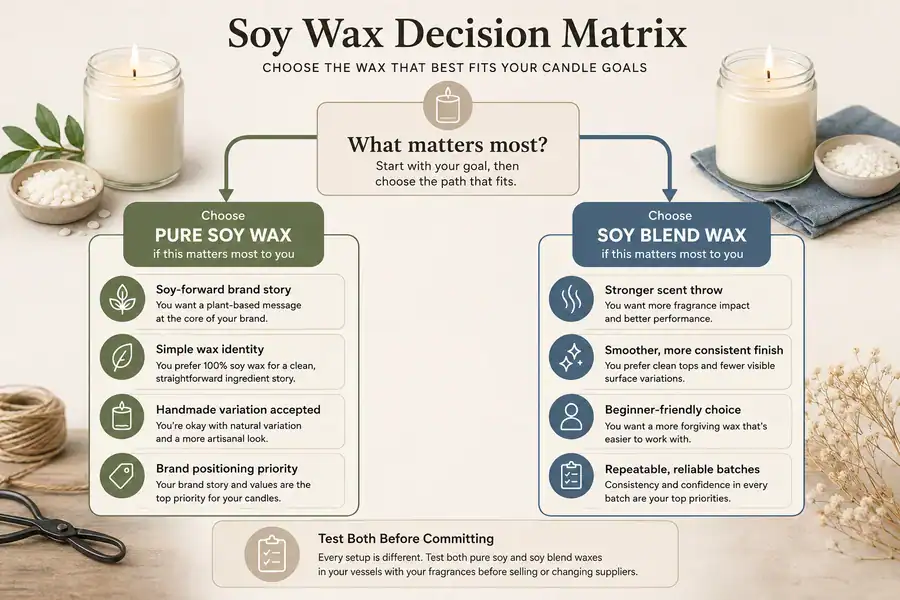
The shortest decision rule is this: choose pure soy when the label story is the product advantage. Choose soy blend when the candle’s scent, finish, and repeatability are the product advantage.
Cost, Waste, and Production Consistency
Soy blend wax can be the better value even when it is not the cheapest wax per pound.
Wax cost is only one part of candle cost. Rejected jars, weak scent throw, frosting complaints, remelts, extra testing, and batch variation can make a cheaper wax more expensive in practice.
Pure soy can be cost-effective when the maker already has a tested formula and the buyer values the soy label. Soy blend can be cost-effective when it reduces failed batches and makes finished candles easier to repeat.
| Cost factor | Pure soy wax | Soy blend wax |
|---|---|---|
| Price per pound | Often competitive | Varies by blend |
| Testing waste | Can be higher at the start | Often lower for beginners |
| Rejected candles | More likely if finish standards are strict | Often fewer finish rejects |
| Product consistency | Strong after testing | Often easier sooner |
| Brand value | Higher for pure soy buyers | Higher for scent or finish buyers |
| Scaling effort | Requires tight process control | Often more forgiving |
For a hobby maker, the better value may be the wax that creates fewer frustrating test candles. For a seller, the better value may be the wax that produces the fewest rejects while still matching the brand promise.
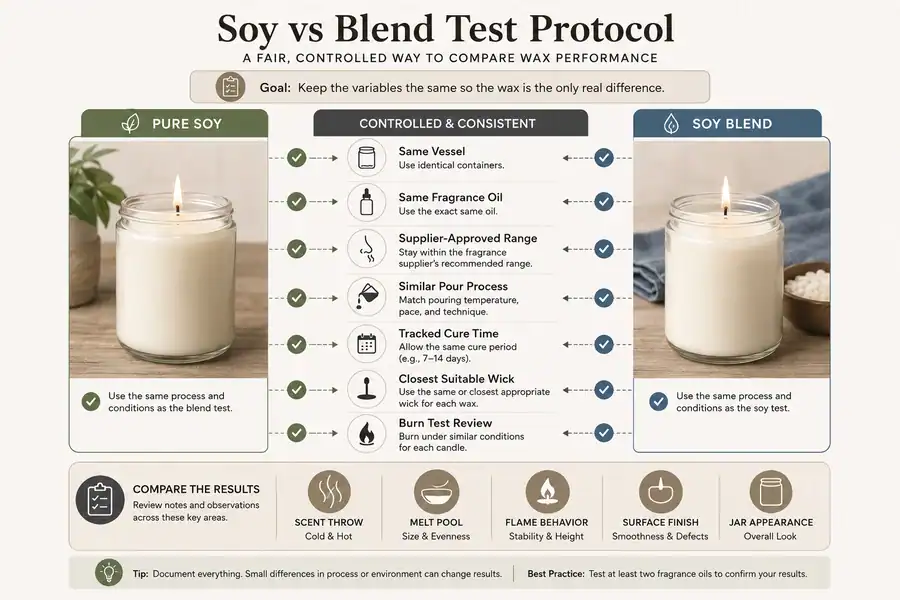
Test Before Switching: The Minimum Fair Soy-vs-Blend Comparison
Test pure soy and soy blend in the same candle system before switching, or the result may not prove which wax is better.
A fair wax comparison keeps the fragrance oil, vessel, wick series, dye choice, fragrance percentage, cure time, and burn-test setup as similar as possible. If too many variables change at once, the stronger candle may be winning because of the wick or fragrance, not because of the wax.
Use this minimum test:
- Pick one vessel size and one fragrance oil.
- Make one pure soy candle and one soy blend candle.
- Use the supplier-approved fragrance range for each wax.
- Keep pour process, room conditions, and cure tracking as consistent as possible.
- Compare cold throw only after the recommended cure window.
- Burn test both candles with the closest suitable wick.
- Judge scent throw, melt pool, flame behavior, surface finish, and jar appearance together.
| Test result | What to do next |
|---|---|
| Soy blend smells stronger and looks smoother | Use the blend if performance matters most |
| Pure soy smells good enough and fits the brand | Keep pure soy and refine the process |
| Both candles smell weak | Check fragrance oil and wick choice before blaming wax |
| Blend looks better but conflicts with branding | Decide whether finish or wax purity matters more |
| Pure soy frosts but buyers accept it | Treat frosting as a brand-style decision |
| One wax burns poorly | Do not choose it until wick testing is complete |
The lowest-risk recipe switch is not the wax that wins one cold sniff test. It is the wax that gives the best total candle result after cure, burn testing, and finish review.
FAQs About Soy Wax vs Soy Blend
These FAQs answer label, scent, finish, and beginner questions that belong inside this comparison without turning the page into a safety, wick, fragrance, or troubleshooting guide.
Are soy blend candles still soy candles?
Soy blend candles can still be soy-based candles, but they are not the same as pure soy candles.
The exact meaning depends on the wax formula and supplier description. A soy blend may include other plant waxes, paraffin, additives, or performance waxes. For clear product wording, name the wax accurately instead of implying it is 100% soy.
Is soy blend better than 100% soy wax?
Soy blend is better for many scented container candles when stronger scent throw and smoother finish are the main goals.
Pure soy is better when the product needs a simple soy-forward identity. The better choice depends on whether the candle is being judged by performance, appearance, beginner ease, or ingredient positioning.
Does pure soy wax have poor scent throw?
Pure soy wax does not always have poor scent throw, but it can be less forgiving than a soy blend.
A pure soy candle may need the right fragrance oil, wick, vessel, fragrance load, and cure time before scent throw is judged fairly. Weak scent does not automatically mean the wax is bad.
Does soy blend wax stop frosting?
Soy blend wax can reduce frosting, but it does not guarantee a frost-free candle.
Frosting depends on wax formula, cooling, temperature changes, fragrance behavior, and storage conditions. A blend may make the finish easier to control, but process still matters.
Which wax is better for beginners?
Soy blend wax is usually better for beginners because it tends to be more forgiving.
Pure soy is still a useful learning wax, especially for makers who want a soy-forward product from the start. The trade-off is that pure soy often needs more careful testing before it looks and smells consistent.
Final Recommendation
Soy blend wax is the better default for scented container candles, while pure soy wax is better when wax identity is central to the brand.
Choose soy blend wax if the candle needs stronger hot throw, smoother tops, cleaner glass appearance, and fewer early production problems. It is the stronger choice for most scented jar candles where the buyer judges the product by scent strength and finish quality.
Choose pure soy wax if the candle needs a simple soy-forward story and the maker is willing to accept more testing, longer cure evaluation, and possible visual variation. It is the stronger choice when ingredient positioning matters more than maximum scent performance.
| Best choice | Use it when… |
|---|---|
| Soy blend wax | You want stronger scent throw, smoother finish, easier testing, and more repeatable scented container candles |
| Pure soy wax | You want a soy-forward candle line, simpler label positioning, and a more natural handmade product feel |
| Test both | You are selling candles, changing suppliers, using a new fragrance oil, or scaling a recipe |
The practical answer is simple: soy blend wins on performance, pure soy wins on positioning. For scented candles, most makers should start with a high-quality soy blend, then choose pure soy only when the brand promise depends on it.