

For most home candle makers, silicone molds are best for detailed shapes and easy release, while metal molds are better for classic pillars, faster cooling, and lower cost per pour.
This page compares two candle mold materials for molded candles. On this page, “better” means better fit for release, finish, cycle time, durability, wax fit, and cost per usable pour for the candle style and batch pattern you make, not a broad product-superiority claim, a broad safety or compliance judgment, or full mold-taxonomy ownership.
Choosing the right mold depends on the candle you want to make, how many you pour, and how much cleanup you can tolerate. Silicone is easier to release and better for detailed shapes. Metal cools faster, holds straighter walls, and usually costs less per pour once you reuse it often. The best setup for many makers is a mix of both. For a broader overview of candle molds and shapes, compare this choice with the wider mold options before building a full kit.
Quick mold choice cheat sheet
- If you mainly pour classic pillars in medium or higher volume, lean on metal molds for fast cooling and crisp edges, then keep a few silicone molds for unusual shapes.
- If you’re a small-batch or hobby maker focusing on sculpted, novelty, or highly detailed candles, start with mostly silicone molds and add one or two sturdy metal pillar molds as workhorses.
- If easier handling and cooler outer surfaces matter more than speed, favor silicone first, then add metal only in sizes you can move comfortably.
- If you’re chasing the lowest cost per pour on one best-selling pillar, invest in a small set of robust metal molds, test cycle times carefully, and keep those molds in steady rotation.
| Decision point | Silicone molds | Metal molds |
| Best for | Detailed shapes, novelty candles, small batches, easy release | Classic pillars, straight sides, repeat pours, higher volume |
| Main strength | Flexible demolding with less risk of chipping detail | Faster cooling, sharper edges, and lower cost per pour over time |
| Main trade-off | Slower cooling and shorter lifespan under repeated flexing | Hotter handling, more prep, and less forgiving release on complex shapes |
| Usually wins for beginners | Yes | Only if the goal is simple pillar production |
| Usually wins for repeat best-sellers | Only for complex shapes | Yes |
| Wax fit | Works best with firm pillar blends for tall or detailed shapes | Works best when the wax releases cleanly and can hold a crisp wall |
Release & Finish: How Silicone and Metal Molds Change Demolding and Gloss
Silicone molds almost always win for easy candle mold release and intricate shapes, while well-prepped metal molds usually deliver the sharpest edges and the most smooth glossy candle finish on classic pillars.
In practice, silicone is the safer pick when demolding risk is the main problem, while metal is the better pick when wall finish and sharp edges matter more.
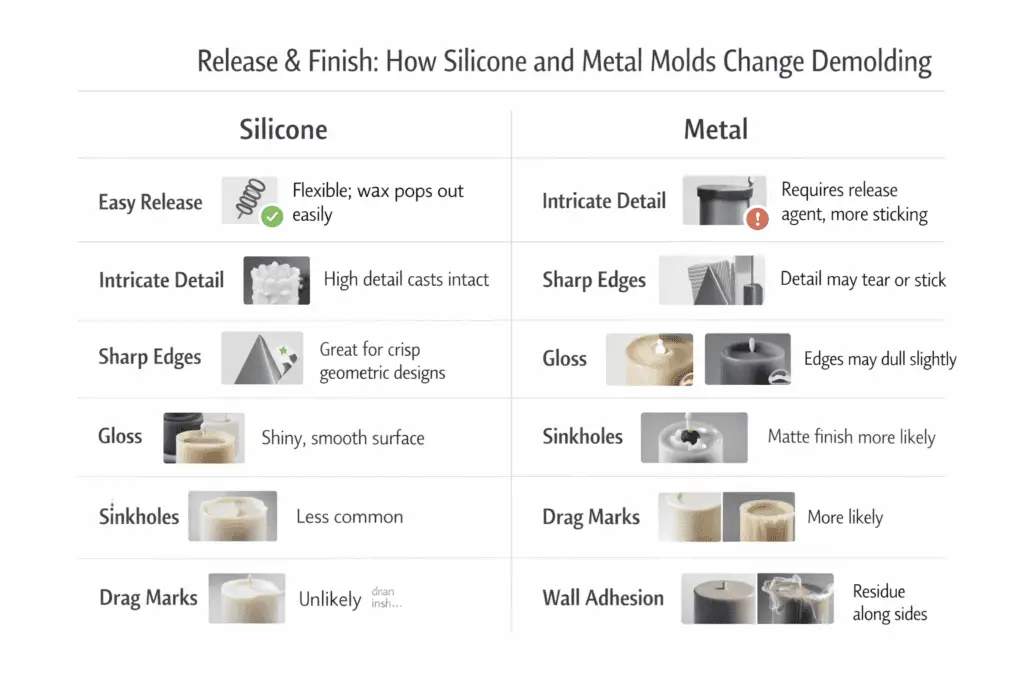
Silicone releases by flexing away from the candle instead of forcing the candle out of a rigid shell. That makes it useful for readers comparing the best candle molds for beginners and for bubble candles, figure candles, and other shapes with small details that can chip during demolding. In many cases, you can demold without release spray if the candle is fully cool and the mold is peeled back slowly from the edges.
Metal relies on rigidity instead of flexibility. When the mold is straight, lightly prepped, and paired with a wax that releases cleanly, the result is often a more polished pillar with sharper corners and flatter walls. That is the main reason metal stays popular for repeatable display pillars and other simple shapes where finish consistency matters more than intricate detail.
Finish problems usually come from cooling behavior, not from the mold alone. Silicone cools more slowly, which helps protect detail but can exaggerate sinkholes or soft edges when the pour is too hot. Metal cools faster, which supports crisp lines, but it can highlight drag marks or wall adhesion when the wax is too cool or the mold is not prepared well.
The practical choice is clear. Choose silicone when easy demolding and shape complexity matter most. Choose metal when you want a cleaner wall finish and more repeatable results for pillar candles made with molds.
Safe Pour Temperatures by Mold Material (Silicone vs Metal)
On this page, safe pour temperature means staying inside your wax supplier’s recommended pour range and using each mold material in normal working conditions, not making a broader fire-safety or compliance claim.
Within that supplier range, metal often behaves better nearer the warmer side, while silicone often behaves better nearer the middle or cooler side when finish or shrinkage becomes a problem.
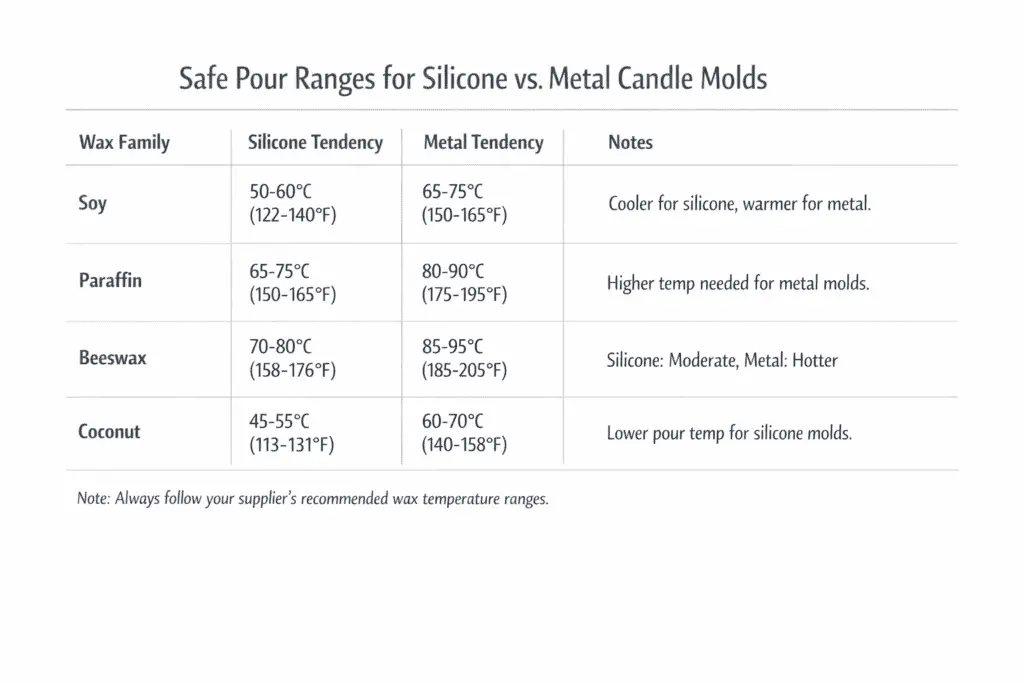
Metal sheds heat quickly, so it often behaves well near the warmer side of a wax’s recommended pour window. Silicone holds heat longer, so it usually behaves better closer to the middle or cooler end of that same window, especially with tall or highly detailed designs.
That difference changes cooling behavior, not the wax’s basic requirements. If finish or release problems show up, make small adjustments within the supplier range instead of jumping far hotter or cooler. Gentle pre-warming can help metal, while room-temperature silicone molds are usually the safer default.
Quick temperature checks before each pour
- Confirm the wax is in the supplier’s recommended pour range, not just fully melted.
- If using metal molds, test the warmer half of that range before changing anything else.
- If using silicone, start near the middle of the range, especially for tall or detailed candles.
- Re-check temperature between pours because wax cools quickly in small pitchers and jugs.
Durability, Cleaning & Storage: How Daily Care Differs
Silicone usually wears out through flexing and tearing, while metal usually lasts longer but needs better handling, drier storage, and more attention to dents or rust.
Choose silicone when demolding ease matters more than lifespan, and choose metal when you want a mold that stays in rotation longer with careful storage.
Silicone fails by stretching, creasing, and thinning over time. Repeated demolding, sharp edges inside the design, strong solvents, heat abuse, and poor storage all shorten its life. Small tears at rims, whitening on stress points, and walls that no longer spring back are common signs that the mold is losing accuracy.
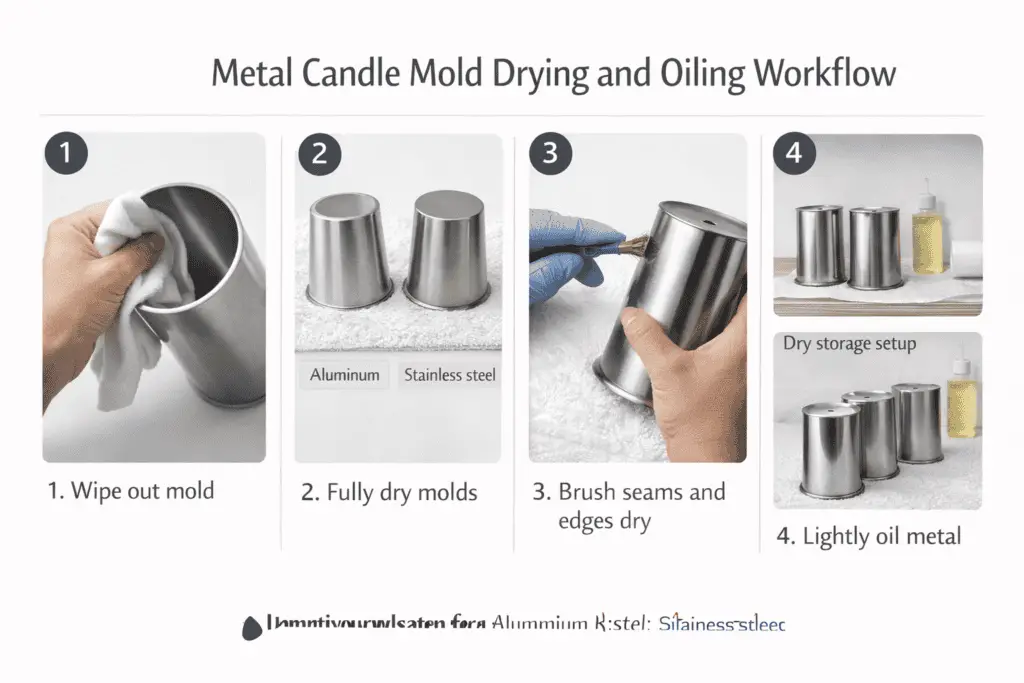
Metal rarely tears, but it can dent, warp, or corrode. A dropped metal mold can create a flat spot that prints onto every future candle. It also needs to stay dry after cleaning because trapped moisture in seams and edges can cause rust, especially on lower-cost steel or tin-plated molds.
Cleaning burden is different for each material. Silicone tends to hold fragrance oil and residue, so it benefits from warm wiping followed by mild soapy water and full air drying. Metal usually cleans best when you soften wax with gentle heat, wipe it out thoroughly, and avoid long soaks that can encourage corrosion or damage finishes.
Storage matters because both materials change shape when treated badly. Silicone should be stored flat or gently supported so it does not learn a bent shape over time. Metal should be stored dry and protected from knocks so straight walls stay straight. For mold-specific troubleshooting after the comparison decision, see how to prevent mold sticking in candle making and how to prevent air bubbles when using candle molds.
Quick care checks for both mold types
- Inspect silicone rims, corners, and undercuts for whitening, thinning, or micro-tears.
- Sight down metal molds for bends, bulges, or seams that no longer sit square.
- Wipe residue out before storage instead of letting fragrance, dye, or wax film build up.
- Retire any mold that no longer makes straight, stable, or cleanly releasing candles without rescue work.
Cost per Pour: Upfront Price vs Lifespan
To estimate mold cost per pour, divide the mold price by usable pours after defects, then add the time you spend cleaning, resetting, and waiting for the mold to cycle again.
That makes metal more likely to win in steady pillar production, while silicone can still win when detail and easy release protect your yield.
This section gives comparison-level planning math only. Detailed return, sourcing, or seller-margin decisions belong on a separate cost page rather than on this material-comparison page.
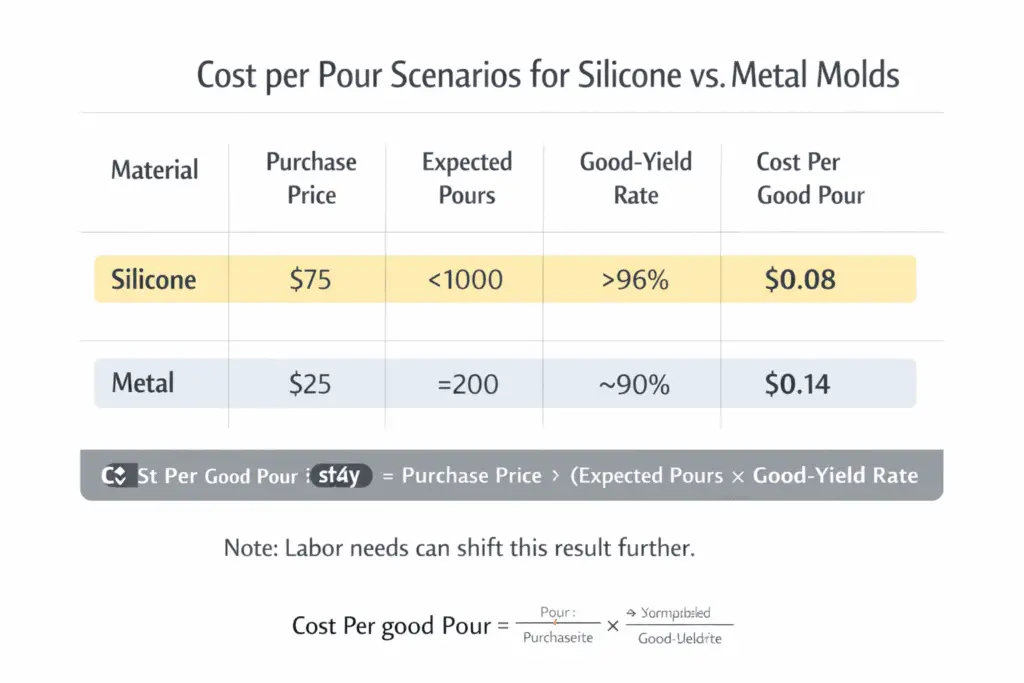
Sticker price rarely tells the whole story. A cheaper mold can cost more per finished candle if it wears out early, cools slowly, or creates enough defects to waste wax and labor. A more expensive mold can be the better buy if it keeps producing clean candles with less rework over many batches.
These figures are hypothetical planning math, not fixed benchmarks. As a simple planning example, a €30 silicone mold used for 120 pours with a 95% good-yield rate works out to about €0.26 per good pour. A €25 metal mold used for 200 pours with a 97% good-yield rate lands closer to about €0.13 per good pour before labor.
Those numbers are only examples, but the logic holds. Silicone often wins when shape complexity and easy release save you from breakage or scrap. Metal often wins when you keep one or two pillar molds in steady rotation and spread the purchase price over a long run of sellable candles.
The most useful habit is to log defects by mold type instead of guessing. When a candle fails, note whether the cause was the mold, the wax, the handling, or the wick setup. Over a season, that turns “Which mold is cheaper?” into a real decision based on yield, labor, and repeatability.
Throughput: Cycle Time & Demold Speed
Metal molds usually give shorter cycle times because they shed heat quickly, while silicone molds cool more slowly but are easier to unmold, so the better choice depends on whether speed or forgiveness matters more.
If you measure only cooling time, metal usually wins; if you measure how often demolding goes smoothly on complex shapes, silicone can still be the more efficient choice.
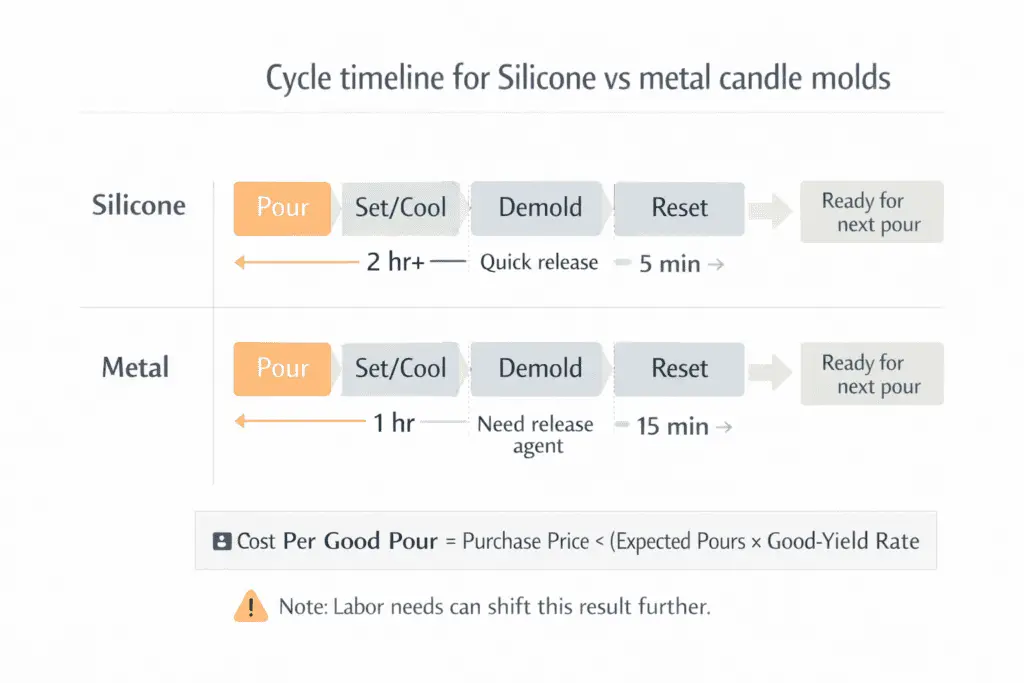
Throughput is the time from pour to the moment the mold is ready to use again. Metal often wins that race because it pulls heat away from the wax faster, which helps simple pillars set sooner. Silicone usually needs longer cooling because it insulates the wax, so you often need more molds in rotation to hit the same daily output.
The best way to set demold timing is to test your actual wax-and-mold combination instead of relying on one fixed number. Pour a few identical candles, demold them at different intervals, and record when the surface stays clean and the structure stays firm.
Once you know that timing, the production logic becomes clear. If a metal pillar mold can be reused much sooner than a silicone sculptural mold, metal will usually win for steady-volume work. If silicone prevents chips, breakage, or rescue work on detailed shapes, its slower cycle can still be worth it because the finished yield stays higher.
Fast demolding only helps when the candle still comes out clean. Forced chilling, rushed unmolding, or early handling can raise the defect rate enough to erase any time saved. A slower, repeatable cycle is better than a fast cycle that produces cracks, dents, or drag marks.
Wax Compatibility: Soy, Paraffin, Beeswax & Coconut
All four wax families can work in both silicone and metal molds, but paraffin and beeswax usually make firmer, easier-releasing pillars, while soy and coconut often need pillar blends or harder partners for reliable results.
For most makers, wax firmness matters more than mold material alone, so softer blends deserve more caution regardless of which mold you use.
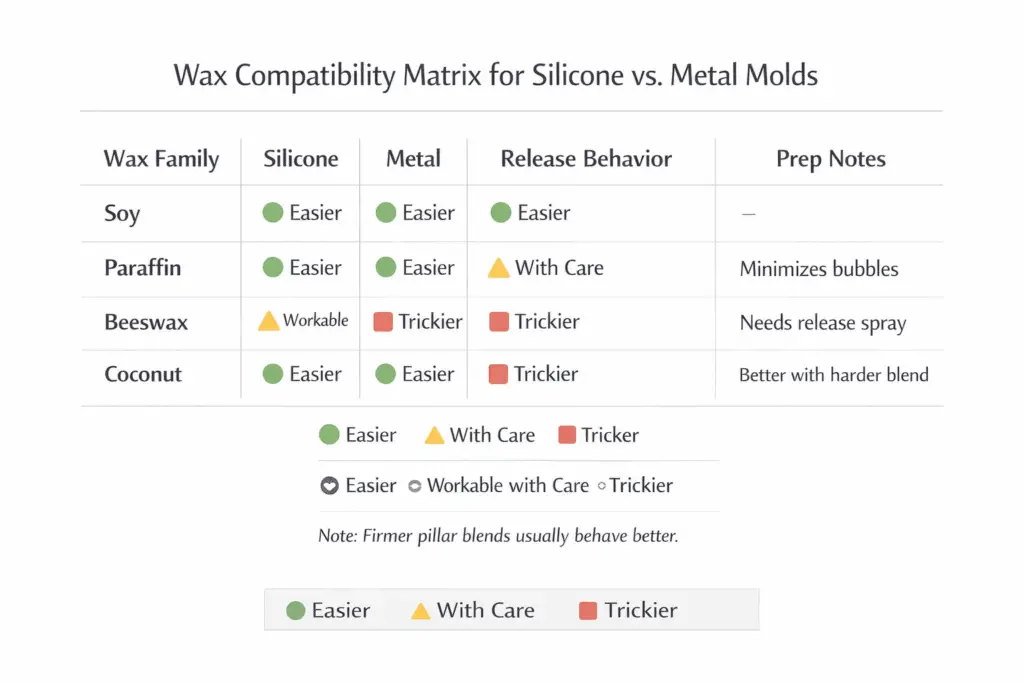
The real issue is firmness, shrinkage, and how well the finished candle can hold its shape after release. Soy and coconut are often softer, especially in container-style blends, so they can dent, drag, or slump in deep molds. Paraffin and beeswax are usually harder, which makes them more forgiving in freestanding pillars and detailed molded candles.
Silicone handles a wide range of waxes well, but it performs best when the wax is firm enough to come out cleanly after flexing the mold. That is why detailed silicone molds often pair best with pillar blends, beeswax, paraffin, or blends that include a harder component. Metal molds are less about softness and more about release behavior, so softer soy and coconut blends usually need closer control over pour temperature, mold prep, and cooling to avoid drag or sticking.
The best way to choose the right candle mold is to test small runs with your actual waxes instead of assuming one material is universal. Track ease of release, surface quality, and post-demold firmness. That will show quickly which waxes belong in silicone, which belong in metal, and which ones need a different blend before they belong in either.
Silicone vs Metal: Which Candle Molds Should You Choose?
For most makers, the strongest setup is a mix of silicone for complex, small-batch designs and metal for straight pillars and higher-volume runs, chosen to match your wax, batch size, and workspace.
Choose silicone when detail and easy release matter most, choose metal when repeatable pillars and faster rotation matter most, and choose both if you make more than one kind of candle.
Start with silicone when your main goal is easy release, unusual shapes, and lower frustration while learning. Start with metal when your main goal is repeatable pillars, faster turnaround, and a lower long-run mold cost. If you make both sculpted candles and simple best-sellers, one material will not serve both jobs equally well.
Makers moving into regular sales often shift toward metal for repeat sizes that sell steadily, then keep silicone for seasonal shapes and statement pieces. Hobby makers often do the opposite because silicone is easier to demold and more forgiving when batch size is small. That split is usually more useful than asking which material is “best” in the abstract.
If your main constraint is comfort and handling, silicone usually feels easier to live with because the outer surface stays cooler and the mold flexes during release. If your main constraint is throughput and edge definition, metal usually wins because it cools faster and holds a straighter shape. For a broader overview of types of candle molds, compare this decision with the wider mold options before you buy a full set.
Simple decision paths
- If you mostly pour a best-selling pillar in medium to high volume → build a bank of metal molds in that size, then add a few silicone molds only for special designs.
- If you make short runs of detailed, sculpted, or novelty candles → base your kit around silicone molds, supplementing with a couple of metal pillars for straightforward, everyday burning.
Taken together, the decision is practical rather than ideological. Use silicone when detail, easy release, and small-batch flexibility matter most. Use metal when crisp pillars, faster cycling, and lower long-run cost matter most. Use both when your candle making setup includes more than one kind of job.