

A safe container-candle setup uses a heat-tolerant container and a properly sized wick that keep the flame centered, soot low, and the vessel intact through repeated burns. On this page, safe means burn-system safety for the jar-and-wick setup, not full legal compliance, toxicology, or general home-use safety.
A safer container candle starts with materials that resist heat stress and a wick that doesn’t overdrive the melt pool. Small details—wall uniformity, rim chips, coatings, lids, airflow—decide whether a jar stays calm or fails under real use. The fastest path is a simple screening routine, then controlled burn tests that reveal heat, soot, and stability issues early. When you document results by jar size, wax, wick series, and fragrance load, safety becomes repeatable instead of guesswork.
This page screens the container-and-wick pair for a safe starting setup. It does not replace full wick-family charts, a full burn-test series, or market-specific compliance steps.
What makes a candle container-and-wick setup safe?
A candle container-and-wick setup is safe when the vessel stays intact under sustained heat and the wick keeps the flame centered away from the rim without heavy soot, rim licking, or overheating during normal burn cycles.
A safe setup uses a heat-tolerant container, a stable base, and a wick size that prevents rim licking, heavy soot, and thermal shock cracking.
No, not every glass jar is candle-safe. Reject thin drinkware, decorative glass, plastic, chipped vessels, and containers with unknown interior coatings before you pour.
For the broader standards and labeling view, start with candle safety standards and labeling , then use the checks below to choose a safe container-and-wick starting point.
Reject the setup before you pour if the container material is uncertain, the rim or sidewalls show defects, the base rocks, the interior finish is unstable, or the wick cannot stay centered with room from the sidewalls.
| Check | Safer sign | Reject or re-test |
|---|---|---|
| Container material | Heat-tolerant glass, ceramic, or metal made for candle use | Decor-only vessels or unknown materials marketed only for storage |
| Rim and sidewalls | Even walls, no chips, no visible stress points | Rim chips, thin waves, bubbles, or distortion |
| Base stability | Sits flat and feels proportionate for its height | Rocks on a flat surface or feels top-heavy |
| Interior finish | Stable, plain wax-contact surface | Flaking paint, unstable metallic films, or unknown interior coatings |
| Wick fit | Wick can stay centered with room from the sidewalls | Wide opening forces oversized or badly placed wicks |
| Burn-test result | Flame stays centered and soot stays low | Rim licking, heavy soot, cracks, warps, or coating changes |
Use the container signal to decide the next move before you change the whole setup.
| Container signal | Wick implication | Action |
|---|---|---|
| Material is uncertain, the rim is chipped, or the interior finish is unstable | The wick cannot make an unsafe vessel safe | Reject |
| Jar is stable, but the flame reaches the rim or soot stays heavy | The setup is likely over-wicked for this vessel | Wick down and re-test |
| Jar stays intact, but you changed wax, fragrance load, or wick series | The prior result no longer applies to the same pair | Re-test |
| Jar stays intact, the flame remains centered, and soot stays low | The wick is behaving within a safe starting range | Keep for continued testing |
Reused jars need extra caution because prior heat exposure, hidden stress, and unknown coatings can change how they behave. If you plan to reuse a jar, treat it as a separate screening job and check Using Recycled Jars for Candles: What You Need to Know before you pour.
Quick inspection card (before you pour)
Use this short inspection pass before every pour, even when the container came from a supplier you already trust.
- Rim: reject any jar with chips, sharp nicks, or uneven thickness at the lip.
- Sidewalls: look for thin “waves,” bubbles, or distortion that can concentrate heat stress.
- Base: confirm it sits flat (no rocking) and feels sturdy for its height.
- Interior finish: avoid flaking paint, unstable metallic films, or unknown coatings in the wax-contact zone.
- Fit check: confirm the wick can be centered and kept centered (especially with wide openings).
A practical way to decide is to treat the container and wick as a paired system: the jar spreads heat, and the wick sets how hard the system is driven. Standards help define what “safe enough” means in controlled checks, but your day-to-day safety comes from conservative jar selection plus repeatable burn testing. If the container ever shows cracking, new hairlines after cooldown, visible coating changes, or persistent heavy soot at normal burn lengths, retire it from candle use.
Use Choosing the Right Candle Containers for the broader vessel map, and use Candle Wick Types and Sizing Guide when you need full wick-family starting points after this safety screen.
Why container material changes heat and shock behavior
Container material changes how heat spreads and how the vessel reacts to temperature swings, which is why the same wick can behave calmly in one jar but cause cracking, soot, or rim overheating in another.
Material controls heat conduction and thermal shock resistance; safer choices reduce stress at thin spots, corners, and rims, especially when candles are moved, drafted, or cooled between burns.
Thermal shock is the “sudden change” problem: a hot container meets a cold counter, draft, or quick cooldown and stress spikes at weak points. Glass and ceramics tend to fail by cracking; metals tend to fail by deforming or heating up quickly to the touch. That’s why you screen for defects (chips, bubbles, thin zones) and then validate performance with a controlled burn, not a single “looks fine” pour.
A useful mental model is: material + manufacturing quality + wall uniformity decides how tolerant the jar is, and wick choice decides how aggressively it’s tested. If you need a broader starting point on vessel options, review Choosing the Right Candle Containers before you lock a jar for production.
How to verify container specs before you pour
Trust vendor claims only after you confirm what they mean, then verify with real burn testing that checks jar integrity, soot, flame height, and melt-pool behavior under consistent conditions.
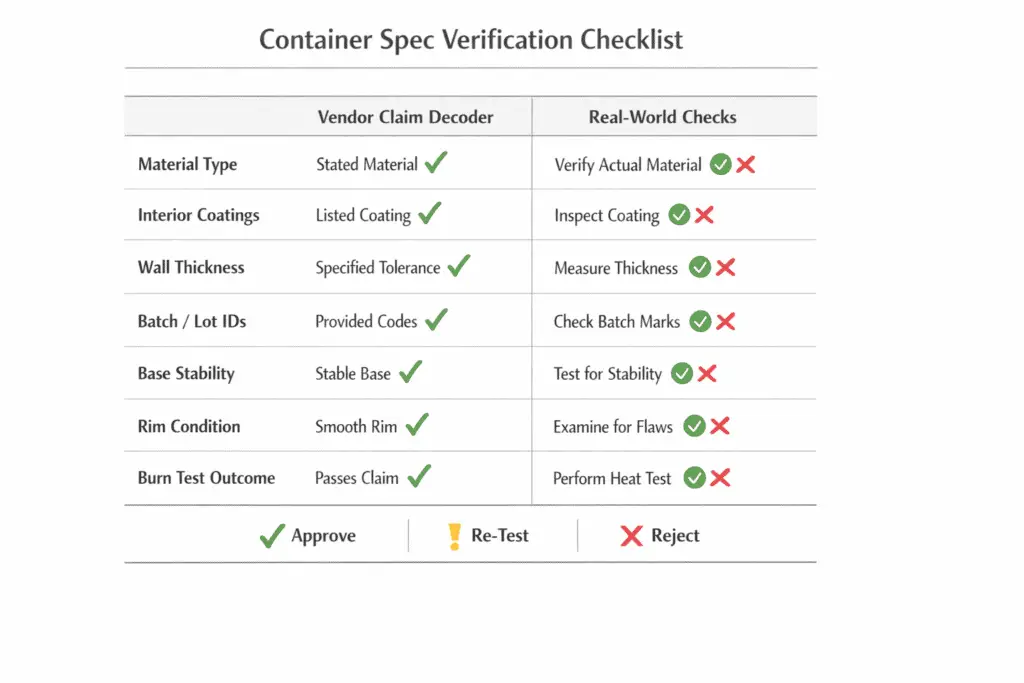
Ask for spec language (material, coatings, intended use), then run a repeatable burn test; reject containers that crack, shed coatings, rock, or push flames to the rim with a properly sized wick. Treat tempered and borosilicate as claims to verify inside this same vendor check, not as proof from the product title alone; use Heat-Resistant Glass for Candles: Annealing & Thermal Shock when you need the full glass-qualification screen.
Vendor claim decoder (fast questions that reveal real specs)
Use these questions to confirm whether the supplier is describing a candle-ready vessel or repeating a vague product title.
- What is the container material (type of glass/ceramic/metal) and is it meant for open-flame heat exposure?
- Is there any interior coating or decorative layer in the wax-contact zone?
- Are there thickness tolerances or a minimum wall thickness target?
- Are there batch/lot identifiers you can record for traceability?
Real-world checks you can actually do
These checks confirm whether the jar is physically suitable for safe screening before you pour.
- Uniformity check: measure wall thickness at multiple points so thin zones stand out early.
- Stability check: confirm the jar doesn’t rock on a flat surface.
- Rim check: reject micro-chips and uneven lips.
- Burn test check: a “safe” jar stays intact, keeps the flame centered, and doesn’t accumulate heavy soot at normal burn lengths.
If you need a conservative rule of thumb for candle vessels, treat thin decorative containers as higher-risk unless testing proves otherwise. The goal is simple: the container must tolerate repeated burns without cracking, deforming, or shedding anything into the wax-contact zone.
Glass vs ceramic as safe starting options
Glass is easier to visually inspect for defects and stress lines, while ceramic can hide micro-cracks under glaze; both can be safe when designed for heat and validated by burn testing.
Fast comparison that affects starter safety only
| Criteria | Glass | Ceramic |
|---|---|---|
| Defect visibility | Usually easier to spot bubbles, thin spots, and stress lines | Glaze can hide micro-cracks or surface issues |
| Failure pattern | Can crack suddenly when a weak point is stressed | Can craze gradually before larger failure |
| Finish risk | Interior decorative coatings need extra caution | Unknown glazes or interior finishes need extra caution |
| Best use case | When you want easy inspection and consistent wall checks | When the vessel is clearly heat-rated and the finish is known to be stable |
If your real choice is metal versus glass, compare that separately with Tin vs Glass Candle Containers: Safety Comparison rather than forcing every vessel decision into one rule.
How to run a starter burn screen for the pair
A starter burn screen uses consistent burn intervals, stable room conditions, and a simple log so you can catch overheating, soot, tunneling, and container damage before you move to a full test series.
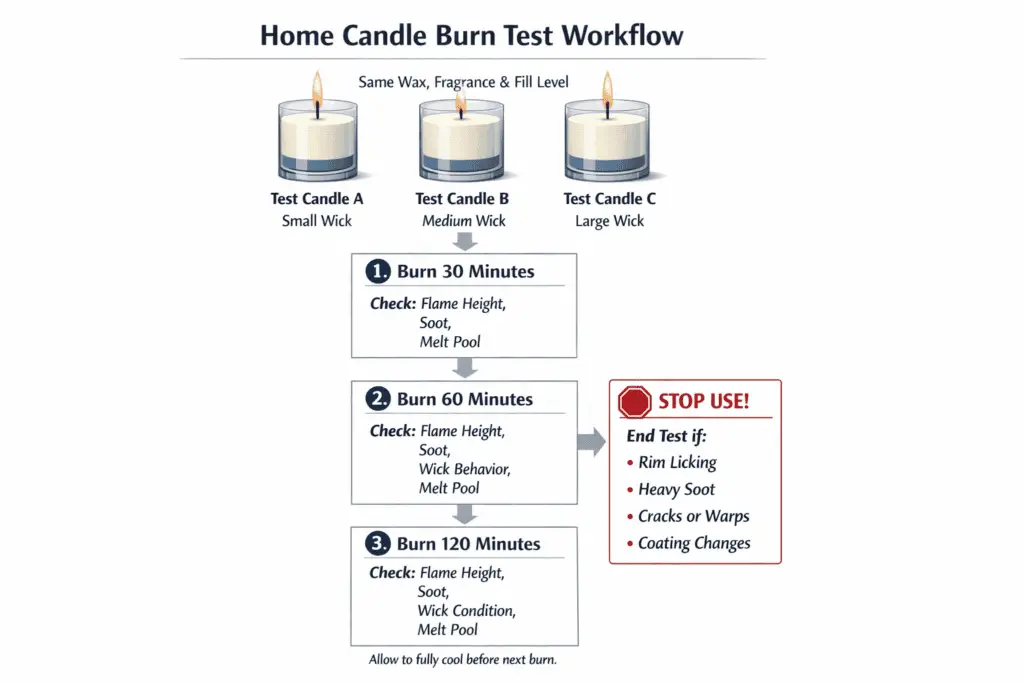
Run short, consistent screening burns, watch for soot, rim licking, and container distress, and retire any setup that shows cracking, deforming, or coating changes.
Method note: The timings below are a repeatable home-testing example for comparing one setup against another. They do not replace a formal lab or market-specific compliance test.
Stop-use signs during screening
Stop the screening run when the flame reaches the rim, soot stays heavy, or the container shows new distress after cooldown.
- Repeated rim licking or a flame that rides the sidewall.
- Heavy soot that keeps returning under the same room conditions.
- New cracks, warps, ticks, or coating changes after cooldown.
- Persistent instability even after you trim and remove drafts.
Use How to Run a Full Candle Test Series for a New Jar and Wick for the complete workflow after this starter screen.
How to choose the right wick size for your container
Choose wick size by container inner diameter, then bracket-test nearby wicks and pick the smallest one that burns cleanly, stays centered, and develops a stable melt pool without soot or overheating.
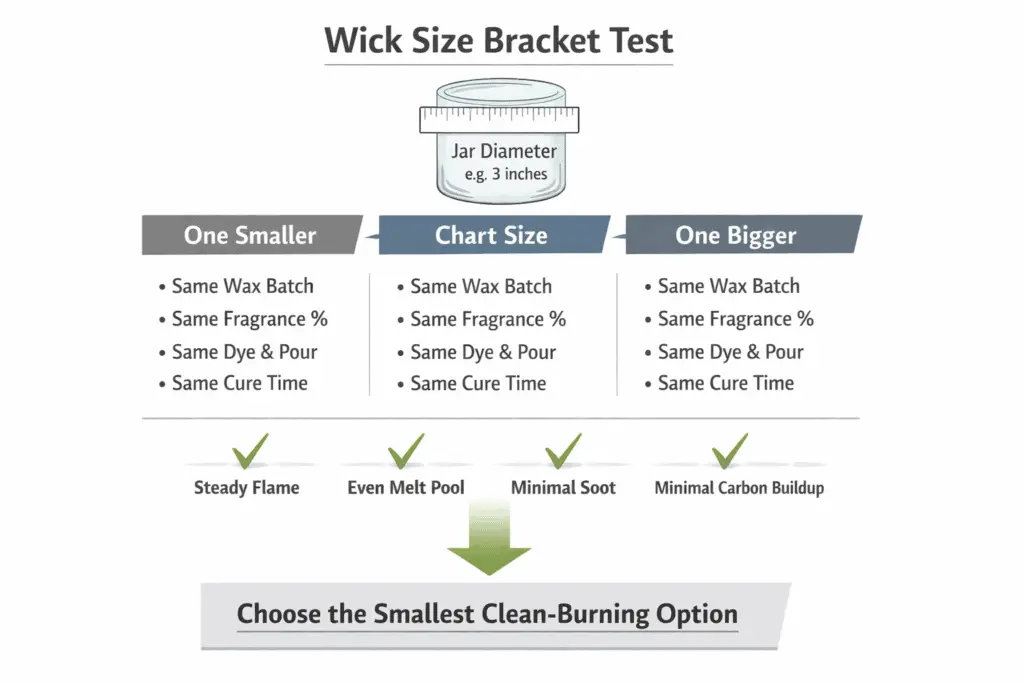
Measure inner diameter at the fill line, test three wick sizes in the same series, and select the smallest wick that reaches an even melt pool and clean flame during controlled burn sessions.
Use this page as the safety filter, then go deeper with Candle Wick Types and Sizing Guide when you need series-level starting points and full wick-family decisions. This page only owns safe starting selection and reject cues, not full wick charts or series-by-series tuning.
Bracket test (“one smaller / chart / one bigger”)
This is the simplest way to avoid committing to an oversized wick too early.
- Pick the supplier’s chart wick for your inner diameter and wax.
- Add one size smaller and one size larger in the same wick series.
- Keep everything else identical (wax batch, fragrance %, dye, pour method, cure time).
What “properly wicked” looks like (practical signals)
Use these signs to choose the smallest clean-burning option, not the most aggressive flame.
- Flame is steady, not tall and flickery.
- Melt pool approaches the container edge and doesn’t remain tunneled.
- Wick tip shows minimal carbon buildup; soot is minimal to none.
If a wick gives faster full melt but adds smoke, soot, or aggressive heat, it’s not “better throw”—it’s a riskier system. If a test candle later burns too hot or unevenly, move to Fixing Overheating or Uneven Candle Burn Issues rather than expanding that troubleshooting workflow here.
Wick material changes flame profile and soot, but the full comparison belongs on Cotton vs Wooden Wicks for candle making: Which Burns Better? rather than on this safe-start page.
If you change fragrance load, move to a multi-wick layout, change lid or airflow conditions, or need market-specific label and standards checks, re-test the pair or route to the dedicated page before you treat the setup as safe.
What changes force you to re-test the pair?
Re-test the pair when a change can alter flame behavior, melt-pool shape, soot, or container heat, because the previous result no longer belongs to the same jar-and-wick setup.
- Fragrance load or additive change: treat it as a fresh wicking check, not a small tweak.
- Lid use or airflow change: confirm the setup still burns cleanly under the conditions you will actually use.
- Wide jar or multi-wick layout change: treat it as a separate layout decision instead of stretching this page into spacing rules.
- Market or label requirement change: route the standards and labeling work to Candle Safety Standards: ASTM, EU CLP & Label Rules (Complete Guide) instead of handling it here.
This page keeps the safe starting screen for the pair. Use the linked child pages when the next question becomes full testing, wick-family selection, material comparison, or market compliance.
FAQ
Can I use any glass jar for a candle?
No. A glass jar still needs even walls, a stable base, a clean rim, and a burn test that confirms the wick does not overdrive the container.
Are recycled jars safe for candle making?
Sometimes, but not by default. Recycled jars need defect screening, extra caution around hidden stress, and their own validation path before reuse.
How do I know if a wick is too large for the container?
A wick is likely too large when the flame runs tall or unstable, soot builds quickly, the melt pool becomes aggressive early, or the flame repeatedly reaches toward the rim.
Do I need a full burn test for every new jar and wick combination?
Yes, because the vessel, wax, fragrance load, and wick interact as one system. Even small changes can shift soot, heat, and stability enough to change the safety outcome.