
Freeze and lift candle wax first, use low heat only on heat-tolerant carpet, then treat oily residue by fiber type.
Candle wax cleanup on carpet is a damage-prevention job: remove hardened wax before treating the stain. This guide covers carpet and rugs affected by candle wax, including nylon, polyester, olefin, wool, loop pile, and delicate fibers. The safest default is cold removal because unknown fibers, dyes, and backing can react badly to heat or solvent. Use heat only as a controlled transfer step after the bulk wax is gone and the fiber can tolerate it.
Use this order: harden the wax, lift loose pieces, vacuum flakes, transfer remaining wax with low heat only if the carpet is safe for heat, then treat residue and dry the area.
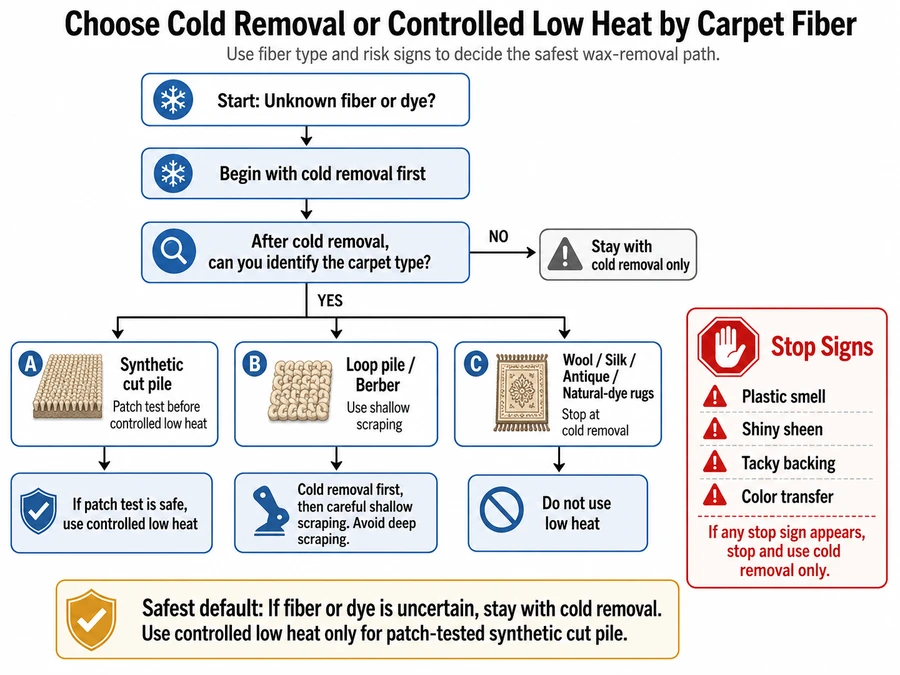
Identify carpet fiber + choose the safest method (cold vs heat)
If the fiber or dye is unknown, remove candle wax from carpet with cold steps before using heat.
Heat is only for carpet that can tolerate it, because the wrong fiber, dye, or backing can turn a wax spill into a shiny, melted, or color-bleeding spot.
| Carpet or rug type | Safest first method | Avoid |
|---|---|---|
| Unknown fiber or unknown dye | Freeze, lift, vacuum, then reassess | Iron, hair dryer, alcohol, strong spotters |
| Synthetic cut pile | Freeze first; low-heat transfer only after testing | Long heat contact or steam |
| Loop pile: yarn loops visible on the surface | Freeze, shallow scraping, frequent vacuuming | Pulling, yanking, deep scraping |
| Berber-style carpet | Cold method with very gentle edge work | Snagging loops with blades or stiff brushes |
| Wool rug or wool-blend carpet | Cold method, light blotting, patch test before cleaner | Heat, harsh solvent, heavy scrubbing |
| Silk blend, antique, or natural-dye rug | Stop at cold removal and consider a cleaner | DIY heat or strong chemistry |
Start fiber ID with the least risky clues. Check the rug tag, installer paperwork, receipt, or leftover carpet offcut. Then look at the surface. Cut pile has open yarn ends; loop pile has uncut loops that snag more easily. Wool often feels springy and matte, while many synthetics feel smoother or glossier. Olefin is a synthetic carpet fiber that can be heat-sensitive, so treat it cautiously when wax is involved.
If the fiber cannot be identified from a tag, receipt, offcut, installer record, or visible surface clues, treat the carpet as heat-sensitive and stay with cold removal first.
What you’ll need:
- Ice pack or ice cubes sealed in a bag
- Plastic scraper, old plastic card, or spoon edge
- Vacuum with hose or crevice tool
- White cloths or plain white paper for later heat transfer
- Mild dish soap solution or carpet spotter for residue, after patch testing
- Fan or airflow for drying
Stop right away if the carpet smells like melting plastic, turns shiny, feels tacky at the backing, or transfers color to a white towel. When that happens, stay with cold removal and do not add heat or stronger cleaner.
Step 1: Freeze, lift, and vacuum wax chunks
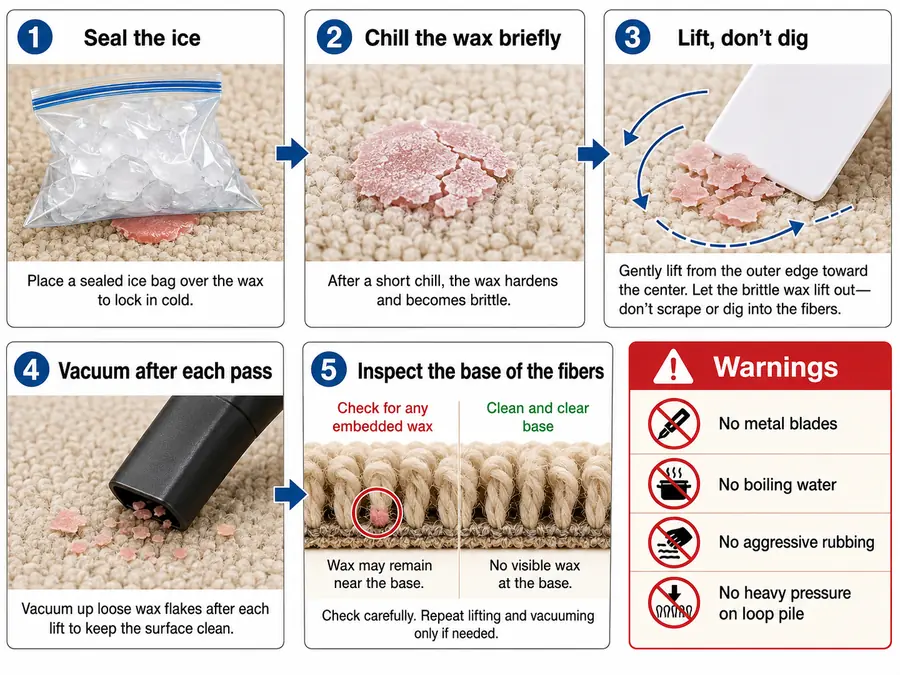
Freeze the candle wax, lift brittle chunks with plastic, then vacuum flakes from the carpet.
Cold hardens wax so it breaks away instead of smearing deeper into pile or backing.
- Seal the ice. Put ice cubes or an ice pack in a plastic bag so meltwater does not soak the carpet pad.
- Chill the wax briefly. Hold the bag on the wax until the surface feels hard and brittle. Blot condensation before it spreads.
- Lift, don’t dig. Use a plastic card, plastic scraper, or spoon edge at a shallow angle. Work from the outside toward the center.
- Vacuum after each pass. Brittle wax bits can hide low in the pile, especially where kids or pets may step on them later.
- Inspect the base of the fibers. If wax remains embedded, use low heat only after the carpet passes the fiber-safety check above.
For high pile or shag carpet, work in layers instead of forcing the scraper to the backing. Lift a small section of fiber, remove what breaks free, then vacuum before moving deeper.
For loop pile or Berber, keep strokes shallow and gentle. A hard scraping motion can catch a loop, pull yarn, and leave a fuzzed spot that looks worse than the wax.
Don’t use:
- Metal blades
- Boiling water
- Aggressive rubbing
- Heavy pressure on loop pile
- Solvents before the bulk wax is gone
If wax is still trapped in the fibers, use low-heat transfer only when the carpet can handle it.
Step 2: Low-heat transfer to pull remaining wax (iron/bag or hair dryer)
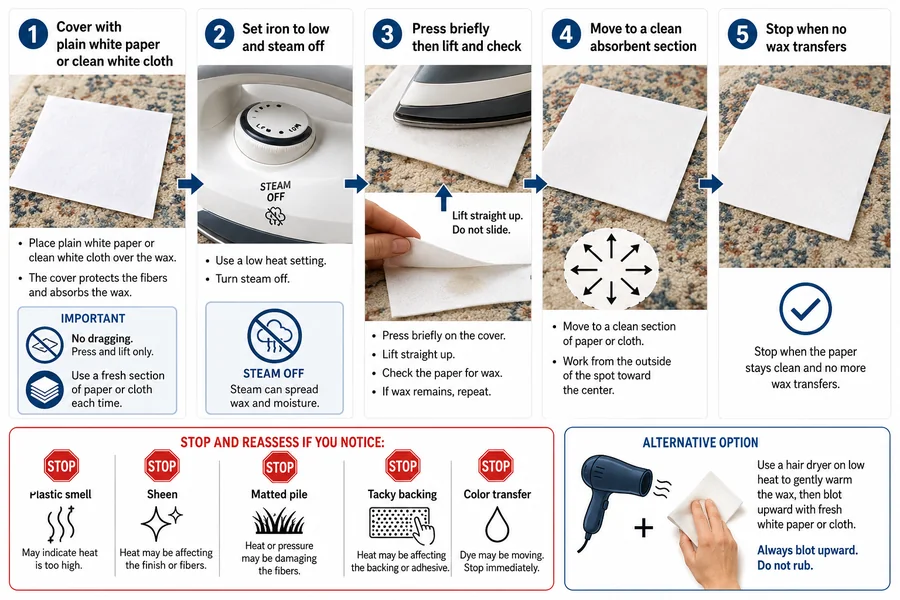
Pull remaining candle wax from carpet by covering the spot with white paper or cloth, using brief low heat with no steam, and moving to clean absorbent sections as wax transfers.
Use heat transfer only when the carpet can tolerate gentle heat and the bulk wax is already gone.
Confirm the fiber choice first. If the carpet is unknown, delicate, wool, silk-blend, antique, natural-dye, looped, or already shiny, skip heat. Heat should melt the remaining wax just enough to move it upward into paper or cloth, not drive it down into the backing.
- Place plain white paper, a brown paper bag without printing, or a clean white cloth over the wax.
- Set the iron to low and turn steam off. Steam adds moisture and heat, which can worsen wicking or soften backing.
- Press briefly, then lift and check the paper. Do not drag the iron across the carpet.
- Move to a clean part of the paper each time wax appears. Reusing a waxy spot can redeposit wax.
- Stop when the paper no longer picks up wax.
| Method | Best use | Main risk | Safer habit |
|---|---|---|---|
| Iron through paper or white cloth | Small wax left after scraping | Too much heat in one spot | Short presses, no steam, fresh paper |
| Hair dryer plus blotting | Heat-sensitive areas where control matters | Pushing warm wax deeper | Heat from above, blot upward, pause often |
A hair dryer gives less pressure than an iron, but it still needs care. Use low or medium air, warm the wax from above, then blot with a white cloth as soon as it softens. Do not rub, because softened wax spreads fast.
Stop heat immediately if you notice plastic smell, sheen, matted pile, tacky backing, or color transfer. After heat transfer, treat any remaining “shadow” as residue or dye, not more wax.
Remove the wax “shadow”: oily residue, fragrance oils, and dye stains
Remove a wax shadow by treating leftover oil, fragrance, dye, or cleaner residue only after solid wax no longer transfers from the carpet.
At that stage, the mark is residue or staining, not a chunk of wax to scrape harder.
The right cleaner depends on the fiber. Synthetic carpet may tolerate a mild spotter or careful alcohol test, while wool, natural dyes, and unknown rugs need a gentler path. The wrong solvent can spread dye, strip color, or leave a sticky film that grabs soil.
Red, blue, purple, green, and dark candle wax can leave dye after the wax is gone, so treat remaining color as a stain rather than more wax.
| What you see | Likely cause | Safer next step |
|---|---|---|
| Greasy halo with no hard wax | Oil or fragrance residue | Blot with a tested mild spotter, then rinse |
| Colored stain from red, blue, or dark wax | Candle dye | Patch test first; avoid heat and rubbing |
| Dark ring after cleaning | Residue wicked upward while drying | Rinse lightly, extract, dry faster |
| Sticky feel | Cleaner or softened wax left behind | Rinse, blot, extract, then air-dry |
| Gray or fuzzy area | Abrasion or pile distortion | Stop scrubbing; vacuum when dry |
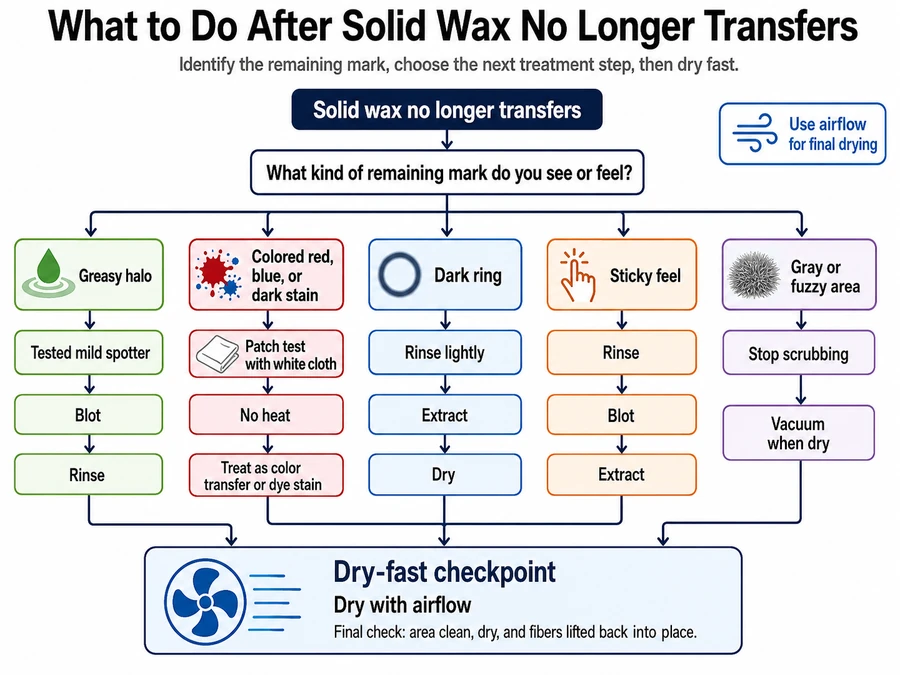
Patch test before treating the visible spot. Apply the cleaner to a hidden area with a white cloth, wait, then check for color transfer, texture change, or sheen. If the cloth picks up carpet dye, do not use that cleaner on the stain.
For synthetic carpet, start with a mild dish soap solution or a carpet spotter used according to its label. Blot from the outside inward with a white towel. Do not scrub in circles, because that can untwist yarn and spread oily residue.
For oily residue on a confirmed synthetic carpet, a small amount of isopropyl alcohol may help lift the film. Use it sparingly on a white cloth, not poured into the carpet. Keep it away from backing, latex, unknown dyes, wool, silk, and antique rugs.
A simple order works best:
- Remove all solid wax first.
- Patch test the cleaner.
- Blot the residue; do not rub.
- Repeat with clean towel sections.
- Rinse lightly.
- Extract or blot until towels come away clean.
- Dry with airflow.
Do not keep adding cleaner if the spot looks better while wet but returns later. That usually means residue, moisture, or dye remains below the fiber tips.
Rinse/extract + dry fast (stop wicking + re-soil + odor)
Rinse and dry the carpet after residue treatment so leftover cleaner, wax oil, and moisture do not rise back to the surface.
Fast drying reduces wicking, re-soiling, and musty odor.
Wicking means moisture carries dissolved residue upward as the carpet dries. The surface can look clean at first, then show a ring hours later. The fix is not more scrubbing. The fix is controlled rinsing, extraction, and airflow.
Use as little water as possible. Lightly mist clean water onto the treated fibers or dab with a damp white cloth. Then blot with dry towels or use a wet/dry vacuum if the carpet can handle it. Avoid soaking the pad or glued backing.
| Drying problem | What it means | What to do |
|---|---|---|
| Spot returns after drying | Residue wicked upward | Rinse lightly, extract, dry with airflow |
| Carpet feels sticky | Cleaner remains | Rinse again with less solution, then blot dry |
| Odor appears | Moisture or fragrance residue remains | Increase airflow and extract moisture |
| Ring forms around the spot | Too much liquid spread outward | Work smaller and dry from edge inward |
Place a clean towel over the damp area and press with body weight to pull moisture upward. Replace the towel when it becomes damp. A fan across the surface helps; direct heat is not needed and can set dye or affect backing.
For large damp areas, repeated stains, or a spill that reached the pad, a rental extractor or professional cleaner may be safer than more hand cleaning. The goal is to remove residue without turning one wax spot into a soaked backing problem.
Delicate rugs & natural fibers (wool/silk blends, antique, unknown dyes)
For wool, silk blends, antique rugs, and unknown dyes, stop at cold removal unless a hidden patch test proves the fiber and color are stable.
Heat and strong solvents can change pile texture or pull dye into a larger stain.
Natural fibers need a conservative cleanup path because the damage can become permanent. Wool can felt, shrink, or brown with the wrong cleaner. Silk blends and antique rugs can lose shape, bleed dye, or flatten when rubbed.
Use this safer order:
- Freeze the wax in a sealed bag.
- Lift brittle wax with a plastic edge.
- Vacuum loose flakes with low suction if the rug can tolerate it.
- Blot only with a dry white towel.
- Patch test any cleaner before using it on the visible stain.
- Stop if color transfers, pile changes, or the rug smells musty after damp cleaning.
| Rug condition | DIY limit | Better next step |
|---|---|---|
| Wool rug with stable dye | Cold removal plus light blotting | Wool-safe cleaner only after testing |
| Silk blend | Remove loose wax only | Professional rug cleaner |
| Antique rug | Do not add heat or solvent | Professional rug cleaner |
| Natural-dye rug | Stop if color transfers | Dye-stability assessment |
| Unknown fiber | Treat as delicate | Cold method first, then pro help if residue remains |
Do not use an iron on delicate rugs to “pull” wax into paper. That method can work on some synthetic carpets, but on natural fibers it can distort pile, move dye, and make the wax shadow harder to correct.
If the rug has value, sentimental importance, visible dye movement, or a label that says wool, silk, viscose, hand-knotted, or antique, treat wax removal as preservation work rather than stain removal.
Troubleshooting: smearing, fuzzing, crunchy spots, melted backing
Fix candle wax carpet problems by matching the symptom to the cause before adding more heat, cleaner, water, or pressure.
Most problems come from using a valid step with too much force, heat, cleaner, or repetition, so use the table before repeating a method.
| Symptom | Likely cause | Fix |
|---|---|---|
| Wax smeared wider | Wax was rubbed while warm | Re-freeze, lift gently, then blot residue |
| Carpet looks fuzzy | Scraping or brushing was too aggressive | Stop abrasion; vacuum when dry |
| Spot feels crunchy | Wax or cleaner residue remains | Warm only if safe, blot, rinse lightly, dry |
| Shiny or flattened patch | Heat affected fiber texture | Stop heat; do not scrub |
| Stain returns after drying | Wicking from residue below surface | Rinse lightly, extract, dry with airflow |
| Color stain remains | Candle dye transferred | Avoid heat; use tested spotter or call a cleaner |
| Musty odor appears | Carpet or pad stayed damp | Extract moisture and increase airflow |
| Backing feels tacky | Heat or solvent softened backing | Stop DIY cleaning and get professional help |
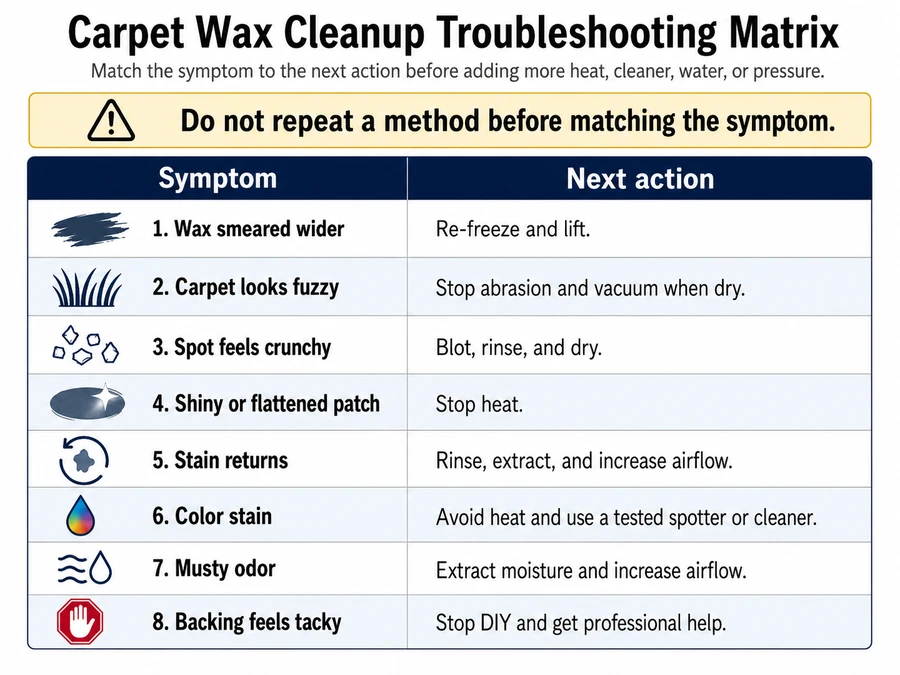
Do not try to fix every symptom with a stronger product. More cleaner can leave residue. More heat can set dye or affect backing. More scrubbing can fuzz pile and make the area catch light differently.
A safe reset is simple: let the area cool and dry, vacuum loose particles, then inspect the fiber tips. If wax is still hard, repeat freezing. If the wax is gone but a shadow remains, treat residue. If the carpet texture has changed, stop; texture damage does not clean out like a stain.
Common mistakes to avoid:
- Rubbing warm wax into the pile
- Using a knife or razor
- Pouring boiling water on the spot
- Holding an iron in one place
- Using printed paper that can transfer ink
- Applying bleach or strong solvent
- Soaking the pad while chasing a small stain
When the carpet has a melted smell, shiny patch, color bleed, or backing damage, the next step is no longer more DIY cleaning. It is damage control.
When to call a professional (and what to tell them)
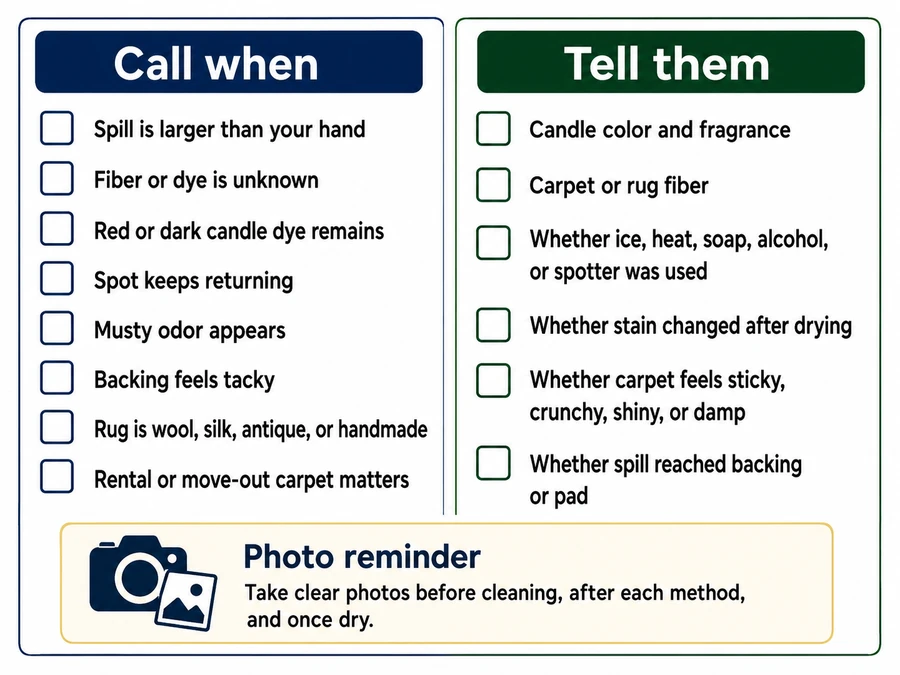
Call a carpet or rug cleaner when the wax spill is large, the fiber is unknown, dye keeps transferring, residue returns, or the carpet backing may be affected.
Professional help is the safer choice when DIY cleaning could turn a removable wax stain into fiber damage. This is especially true for wool, silk blends, antique rugs, natural dyes, loop pile, glued backing, or rental carpet where visible damage may matter later.
| Situation | Why DIY gets risky | What to do |
|---|---|---|
| Spill is larger than your hand | Wax may be deep in the pile or pad | Stop after removing loose wax |
| Fiber or dye is unknown | Heat and solvent may damage it | Ask for fiber and dye testing |
| Red or dark candle dye remains | Dye can set or spread | Avoid more heat |
| Spot keeps returning | Residue may be wicking upward | Ask about extraction |
| Carpet smells musty | Moisture may be trapped below | Dry the area and get an assessment |
| Backing feels tacky | Heat or solvent may have softened it | Stop cleaning |
| Rug is wool, silk, antique, or handmade | Texture and dye damage can be permanent | Use a rug specialist |
| Rental or move-out carpet | Photos and timing matter | Document the area before more work |
Before calling, take clear photos in natural light. Photograph the wax, the cleaned area, the candle type if available, and any cleaner you already used. This helps the cleaner understand whether they are dealing with wax, dye, oil, moisture, or texture change.
Tell them:
- Candle color and fragrance, if known
- Carpet or rug fiber, if known
- Whether you used ice, heat, soap, alcohol, or spotter
- Whether the stain changed after drying
- Whether the carpet feels sticky, crunchy, shiny, or damp
- Whether the spill reached the backing or pad
Do not hide DIY steps. A cleaner needs that history to avoid mixing products or repeating a method that already caused a reaction.
For small synthetic-carpet spills, a basic home kit may be enough: sealed ice pack, plastic scraper, white cloths, mild spotter, and airflow. For delicate rugs, repeated stains, dye transfer, or backing damage, a professional cleaner is the safer threshold.