
Yes, you can mix fragrance oils and essential oils in candles if the total load stays within your wax and supplier limits and the finished blend passes burn testing.
Candle makers usually do this to pair fragrance-oil performance with essential-oil character. For the main guide, see candle making. The main rule is to treat FO and EO as one combined fragrance load, not as separate allowances. Most blends work best when FO carries the backbone and EO stays a small accent. The next sections keep that focus narrow: when mixing makes sense, how to set a conservative starting ratio, and what minimum testing to run before you scale.
For the broader system around scent selection, load math, and testing workflows, use the main candle fragrance and scenting hub and the linked sibling pages. This page does not replace EO-only guidance, full fragrance-load calculators, or full scent-throw troubleshooting.
Can you mix fragrance oils with essential oils in candles?
Yes, you can safely mix fragrance oils and essential oils in candles as long as the total scent load stays within your wax and supplier limits and you test how the blend burns and smells.
On this page, safe means the FO+EO blend stays within the wax limit and the most restrictive supplier or IFRA limit for the oils used, then passes burn testing in the chosen wax, wick, and container. It does not mean the candle is suitable for every sensitive user or use case.
Fragrance oils and essential oils behave like one combined fragrance system once they are in wax, so the practical rule is simple: calculate one total load, not two separate allowances. Many candle makers use FO+EO blends to get the reliability of fragrance oils with the character of essential oils, especially for spa, herbal, or natural-leaning scent profiles. The main constraint is that the total fragrance percentage must stay inside the lower of your wax limit and the usage guidance for the most restrictive oil in the blend.
| Situation | Default decision | Governing rule |
| You want FO performance with a small botanical accent | Mix FO+EO | Keep FO as the base, count FO+EO as one total load, and test the finished candle. |
| You promise “100% essential oil” or EO-only positioning | Do not mix | Adding FO changes the claim and the product position. |
| Your wax limit or the most restrictive oil leaves too little room | Do not force the blend | The lower of the wax limit and the most restrictive supplier or IFRA limit controls the formula. |
Most container waxes are designed to handle roughly 6–10% total scent load by weight, with some paraffin and hybrid blends going a bit higher; always check the datasheet for your specific wax. A simple rule is that FO + EO together must not exceed the maximum load or the IFRA usage level for the most restricted ingredient in your blend. For example, if your 300 g soy candle uses an 8% load, you have 24 g total to “spend” on scent, whether that is 100% FO, a FO+EO mix, or EO-only. Treat each oil’s IFRA certificate and SDS as your safety guardrails.
In practice, most makers get the best results from FO-dominant blends. Fragrance oil usually carries the hot throw and consistency, while essential oil works better as a smaller accent that adds realism or a sharper top note. Once the EO share climbs too high, you are more likely to run into weak throw, odd combustion smells, or wick instability.
Before you ship or sell a FO+EO candle, run a simple four-step check:
- Confirm the wax’s maximum fragrance load and stay under it with your combined FO+EO.
- Check each oil’s IFRA category and maximum use level for candles or “room fragrance” products.
- Make a small test batch and record exact grams, pour temperature, and cure time.
- Burn-test multiple times in realistic conditions, watching for soot, tunneling, mushrooming, and any change in how the scent smells compared with the cold throw.
Why (and when) to blend FO + EO — and when you shouldn’t
Blend FO + EO when you want fragrance oil to provide most of the performance and essential oil to add a smaller botanical accent, and skip it when the blend creates safety, compliance, or positioning problems you do not need.
Fragrance oils shine at giving strong, reliable throw and staying consistent from batch to batch, while essential oils contribute familiar plant identities and subtle complexity. Combining them lets you build scents that feel both “perfumey” and botanical: a citrus FO supported by a little real lemon or orange EO, or a spa blend where FO carries the base and lavender EO adds a recognisable top note. Done well, FO+EO blends can last longer in the room than EO-only candles and cost less than heavy essential oil formulas while still supporting a wellness-leaning positioning.
However, essential oils are not magical and they are not automatically safer. Some suppliers argue that many essential oils perform poorly in candles, with weak diffusion, higher risk of irritation, or instability under heat, while others show that EOs can be used safely if you respect usage levels and product category limits. On top of that, any scented candle—FO, EO, or both—can trigger headaches or allergy-like symptoms in sensitive people, so “all natural” does not guarantee “no reaction.”
There are clear reasons to say no to FO+EO blends in specific lines. If you promise “100% essential oil candles” or lean heavily on aromatherapy claims, adding fragrance oils changes the claim and can confuse customers once they read your ingredient listing. If the blend only works by pushing documentation, warnings, or testing complexity beyond what the line needs, a simpler FO-only or EO-only system is usually the better choice.
A useful way to decide is to map the goal before you touch the formula:
| Goal or constraint | Default approach | Notes |
| Maximum possible hot throw in regular home spaces | FO-only or FO-dominant FO+EO | Use FO for strength, EO only as a small realism accent if desired. |
| Strong “natural-leaning” story with good performance | FO+EO blend | Keep FO as the base, EO for character, and be transparent on labels. |
| Strict “100% essential oil” or aromatherapy claims | EO-only and often non-candle formats | Consider diffusers or oils; candles rarely meet aromatherapy expectations. |
| Very conservative product line or claim set | Simple FO-only or EO-only system | Do not use FO+EO mixing when it complicates claims, warnings, or testing expectations. |
| Heavy regulatory or retail scrutiny | FO-only with strong documentation | Easier to support with IFRA, SDS, and consistent test data. |
How to design FO:EO ratios (with example splits by note family)
Design FO:EO ratios by starting FO-heavy, matching the EO share to the scent family, and testing the blend before you scale it.
You can build on scenting fundamentals you already use for straight fragrance oils by treating FO as the main structure and EO as a small accent. Think of FO as providing body, solvency, and reliability, while EO brings nuance, realism, and “sparkle.” A 95:5 or 90:10 FO:EO split keeps the fragrance stable and predictable, whereas EO-heavy ratios are more volatile and prone to smelling muddy or flashing off too quickly. The goal is not to chase the highest EO percentage, but to hit the smallest EO dose that makes the blend smell more lifelike.
In practice, FO:EO ratio sits on top of the scenting principles you already follow: build a solid base, then tweak top and heart notes. Start with the fragrance oil that best matches your target profile and use EO to correct or enhance it—maybe a touch of true lavender on top of a spa FO, or a little sweet orange EO over a creamsicle FO. For your very first FO+EO experiments, keep EO at 5–10% of the total fragrance load; only explore 15–30% EO once you know how your wax and wicks behave.
A simple FO:EO ratio workflow:
- Define the role of EO in this blend: realism booster, herbal edge, or subtle complexity.
- Pick a conservative starting split (95:5 for delicate waxes or intense EOs, 90:10 for more forgiving systems).
- Pour two or three test jars at the same fragrance load but with slightly different FO:EO splits, such as 95:5, 90:10, and 85:15.
- Compare cold throw, hot throw, and how the character evolves over a full burn cycle.
- Keep notes on which split best supports your scent goal and performance target.
Different scent families tolerate different EO fractions. For bright citrus and other fast-fading tops, start around 90:10 and only test 85:15 or 80:20 if your FO base is very light and your wax handles volatility well. Herbal and spa profiles often sit comfortably between 90:10 and 85:15, because many EOs in that family have medium volatility and share chemistry with common FO accords. Gourmand blends usually prefer FO-heavy splits like 95:5 or 90:10 so the dessert base stays creamy instead of turning bitter or medicinal. Woody and resinous profiles often benefit from a hint of EO (5–10%) mainly for realism and complexity, not power.
As EO fraction increases, your blend can thicken, and the fuel your wick pulls up the candle changes. That’s why you may need to choose the right wick when viscosity changes, especially if you push EO past 10–15% of the fragrance portion. A blend that behaved perfectly at 95:5 might tunnel or soot at 80:20 because the wick is now pulling a different fuel mix. Rather than assuming one FO:EO split will work everywhere, log each test with exact percentages, wax type, wick series, and performance notes so you can reuse successful patterns by scent family and season.
Calculating fragrance load % and batch grams (without exceeding wax max)
To calculate fragrance load and batch grams, multiply your wax weight by your chosen load percentage, then split that total scent between FO and EO without going over your wax supplier’s maximum.
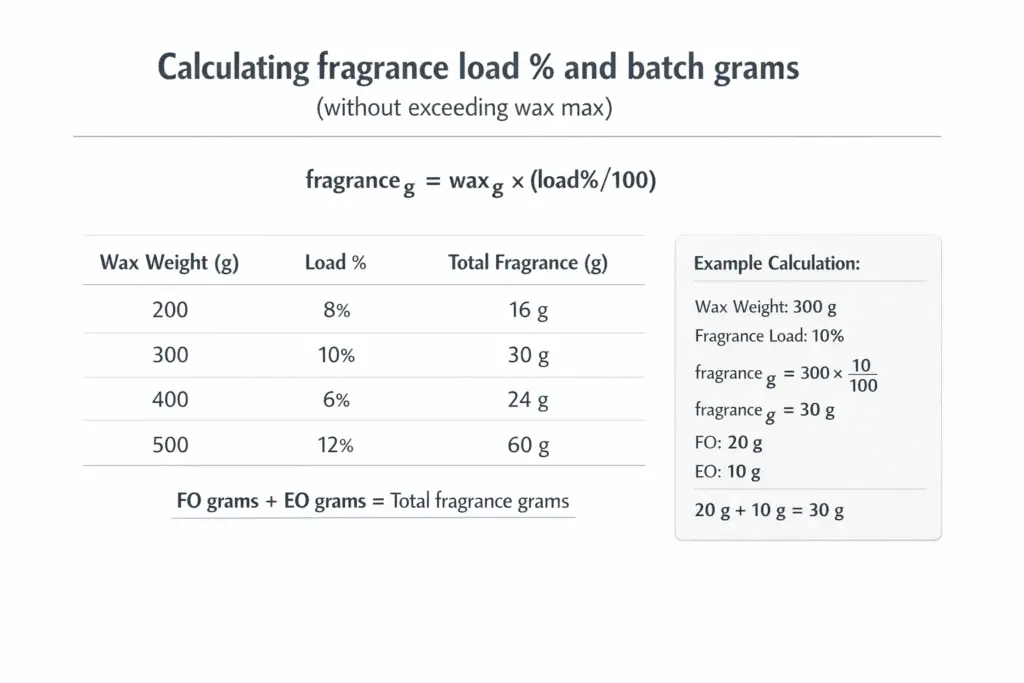
First, check your wax supplier documentation so you know the maximum total scent load for that wax. FO and EO do not get separate allowances here; they share one fragrance budget, and the lower of the wax limit and the most restrictive supplier or IFRA limit controls the blend.
Use this formula:
fragrance_g = wax_g × (load% ÷ 100)
That result is the combined mass of FO+EO you can use in the batch. Then split that total by your chosen FO:EO ratio.
EO_g = fragrance_g × 0.10
FO_g = fragrance_g − EO_g
Worked example: with 300 g of wax at an 8% total load, fragrance_g = 24 g. At a 90:10 FO:EO split, EO_g = 2.4 g and FO_g = 21.6 g. At a 95:5 split, EO_g = 1.2 g and FO_g = 22.8 g.
Use this page only for the combined-load rule and a quick check. For full load logic and batch math, use fragrance load explained and the candle batch calculator.
Wax compatibility for FO+EO: soy, paraffin, coconut, beeswax
All four major candle waxes can work with FO+EO blends, but paraffin and coconut blends usually tolerate higher fragrance loads, soy is more temperamental, and beeswax often gives the weakest throw with mixed aromatics.
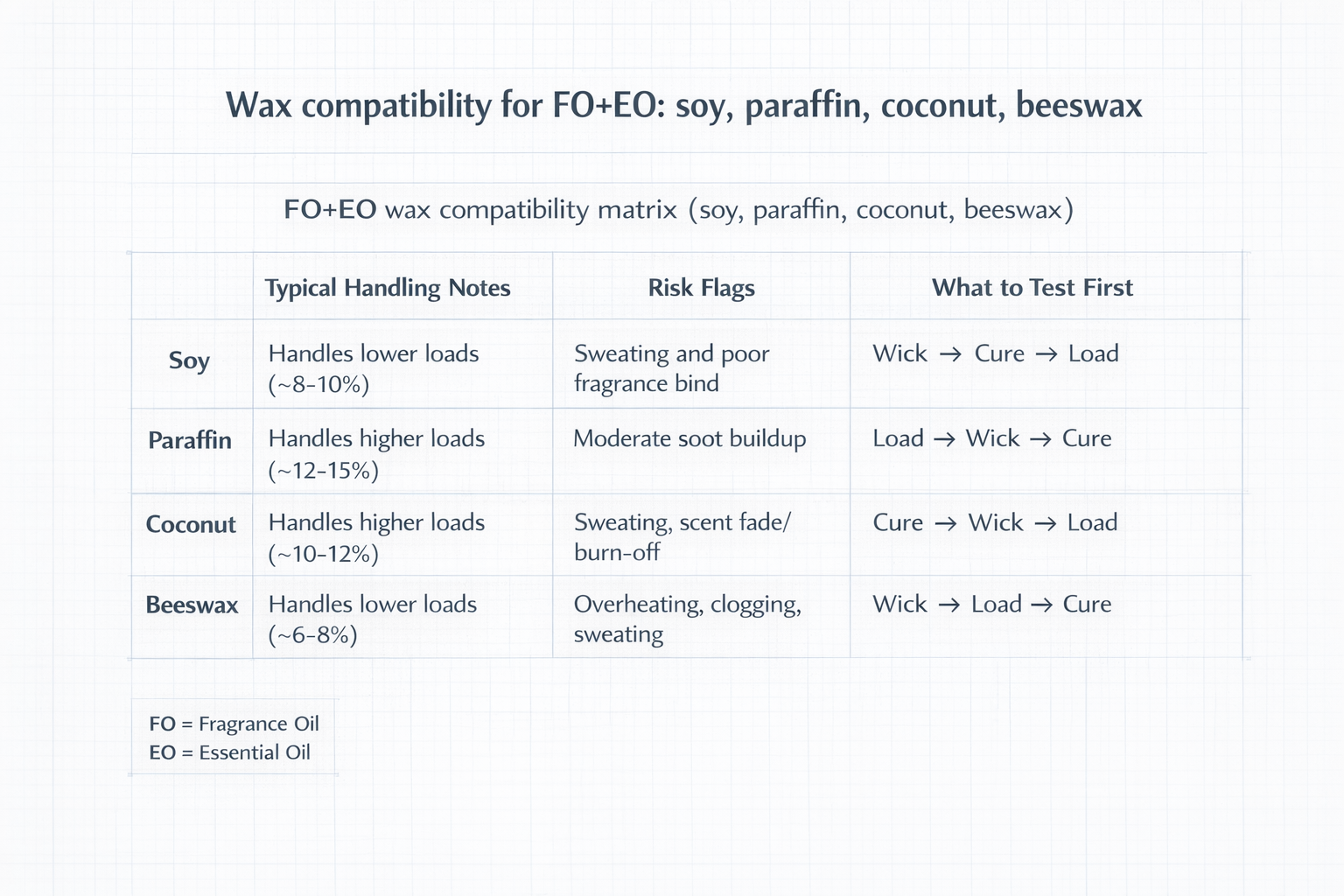
Soy usually needs the most conservative FO+EO loads and the cleanest mixing discipline, especially when the EO share rises. Paraffin and many coconut blends usually dissolve mixed aromatics more easily and give more room for FO-dominant blends. Beeswax is typically the most restrictive because its own aroma competes with lighter top notes and its fragrance ceiling is lower.
Use this section only to judge whether your chosen wax is likely to tolerate a FO+EO blend. Full wax selection and wick matching still belong in your normal wax and scent-testing workflow.
Safety & flashpoint myths for FO+EO: what actually matters
Flash point is a storage and handling number for your oils, not a rating of how safe your finished candle is to burn; wick choice, usage rate, and real burn testing matter far more than a single spec-sheet value.
In this section, safe means correct load limits, stable wick and container behavior, and acceptable burn-test results for the finished candle. It does not mean a raw flash-point number predicts every safety outcome or that the blend is suitable for every sensitive user.
As the HSE explains, flash point is the temperature at which vapours from a liquid can ignite under test conditions. That matters for storage and handling of the straight oil, but it does not tell you on its own whether a finished FO+EO candle will burn cleanly, soot, tunnel, or self-extinguish correctly.
For FO+EO candles, the practical controls are simpler: stay within the lower of your wax limit and the most restrictive supplier or IFRA limit, mix at sensible temperatures, and burn-test the finished candle in the real wax, wick, and container you plan to use. For deeper document and compliance work, use your IFRA certificate and SDS workflow.
Steps to test FO+EO candles (wick, pour temp, cure & burn matrix)
Test FO+EO candles with a simple 3×2 matrix: three wick sizes by two FO:EO ratios, cured for set days and scored for melt pool, soot, and throw.
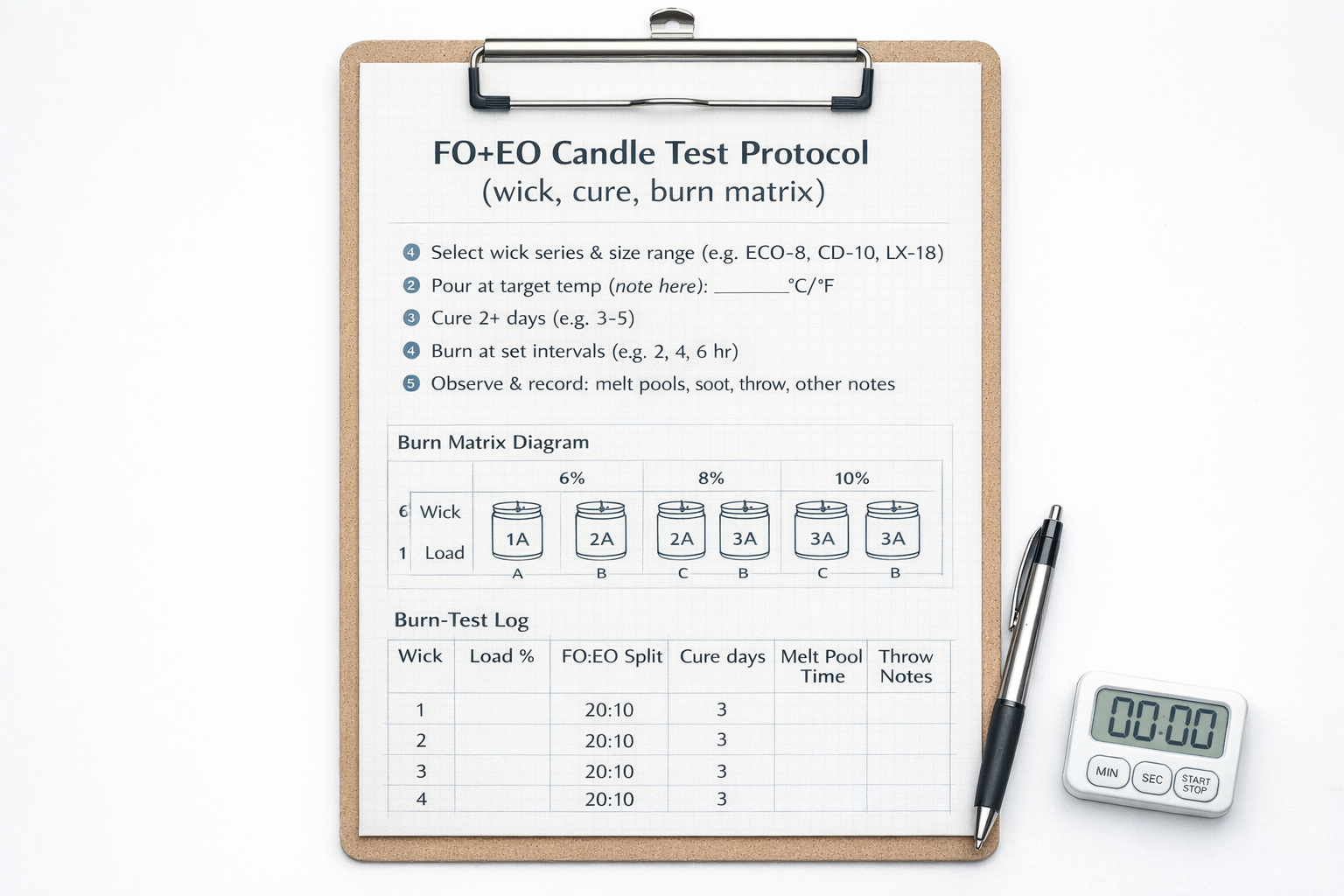
Instead of guessing, treat testing as the place where you anchor to scenting fundamentals and answer one clear question at a time. Pick a single wax, jar, and total fragrance load, then design your matrix around them so you’re only changing wick power and FO:EO ratio. This keeps your notes readable and makes it obvious which variable actually fixed a problem instead of burying you in conflicting results.
Before you light anything, revisit safety & compliance basics. Label every test jar with wax, load %, FO:EO split, wick series and size, pour temperature, and cure days so you can trace any issue back to its cause. Trim wicks, follow the usage limits from your supplier documentation, and burn on a heat-safe, draft-free surface. That way your matrix reveals what’s happening in the candle, not random noise from sloppy conditions.
A simple 3×2 matrix looks like this:
- Choose three wick sizes (for example, one you expect to work, one size down, one size up).
- Choose two FO:EO ratios (for example, 90:10 and 80:20 at the same total load).
- Pour six identical jars (3 wicks × 2 ratios) at the same wax temperature and stir time.
- Cure them for planned checkpoints—commonly day 3, day 7, and day 14.
- At each checkpoint, burn in pairs and log melt pool diameter, flame height, soot or mushrooming, and perceived hot throw after set times (30, 60, 120 minutes).
During burns, think like a tester, not a fan of the scent. The matrix should show you whether a hotter wick fixes weak throw or simply creates soot, and whether a richer EO fraction helps realism or just makes the candle fussier. Over a few rounds you’ll start to understand wick series differences—for example, which series tends to tunnel in your wax and which copes better with thicker FO+EO blends. That knowledge, plus disciplined logging, turns your testing days from “random burning” into a repeatable protocol you can trust for future launches.
How to improve cold & hot throw with FO+EO blends
Improve FO+EO throw by adjusting wick power, cure time, FO:EO ratio, and total load—in that order—before changing wax or rewriting the whole scent.
If FO+EO throw is weak, change one variable at a time and use this page only to judge whether mixing changes the result. For full diagnosis and testing depth, route outward to weak scent throw fixes, cure guidance, and scent-throw testing.
“Natural” claims with FO+EO mixes: what it means and what it isn’t
“Natural” claims on FO+EO candles should mean clear, honest ingredients and limits, not a promise of essential-oil-only formulas or zero risk.
On this page, “natural” means plain ingredient language, not EO-only, chemical-free, or risk-free positioning. If you mix fragrance oils and essential oils, say so directly. If the product line depends on “100% essential oil” or aromatherapy-led claims, FO+EO mixing is usually the wrong fit for that line.