
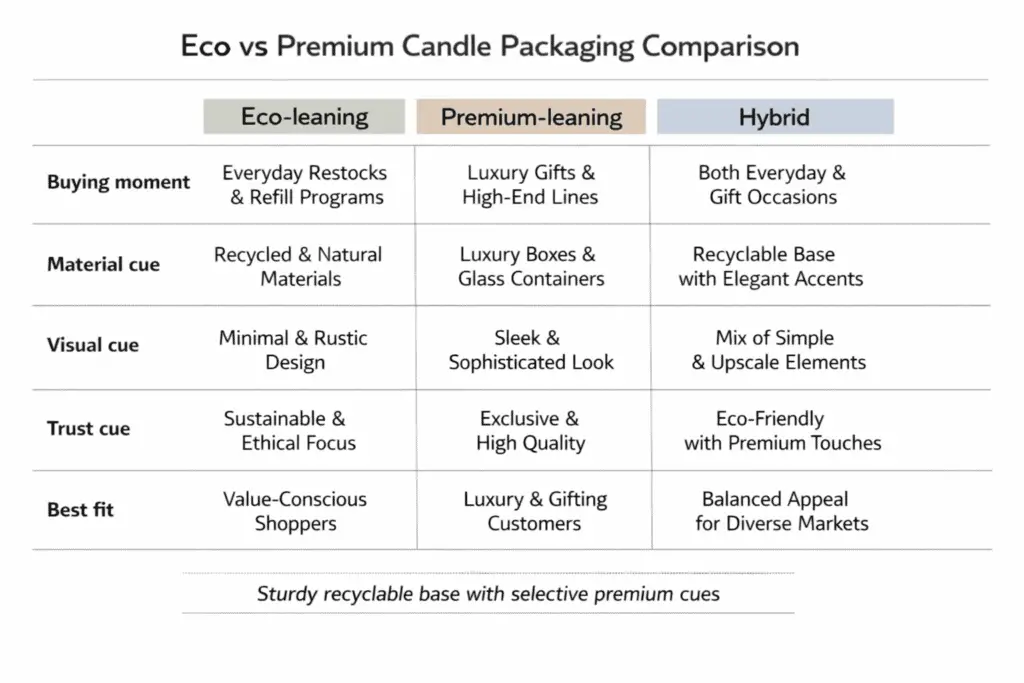
Eco-friendly candle packaging usually fits everyday, refill, and low-waste brands. Premium candle packaging usually fits gifting, shelf impact, and higher-margin lines. Most candle brands do best with a hybrid system that keeps the structure sturdy and recyclable while using premium cues selectively.
This page compares the two directions through protection, sustainability proof , branding, and unboxing. For the main guide, see candle making. It is built to help you choose a system, not chase every packaging detail at once. In many cases, the strongest answer is not one extreme. It is a base system that matches the core line, with more presentation only where the buying moment supports it.
Eco-friendly packaging fits everyday value, refill programs, and low-waste positioning. Premium packaging fits gifting, higher margins, and a more elevated brand feel. Many candle brands do best with a hybrid approach, using sturdy, recyclable materials with a few selective premium finishes.
Packaging is the first physical promise your candle makes, before anyone smells the wax. Kraft textures, recycled materials, and minimal printing can signal care and restraint, but they can also feel cheap if the structure is weak. Rigid boxes, foils, and inserts can feel gift-ready, but they add cost, weight, and complexity around recyclability. The right choice depends on the buying moment, whether your customer is making an everyday restock, buying a seasonal gift, or choosing a decorative keepsake jar.
Eco-friendly vs premium packaging: which fits your candle brand?
Eco-leaning packaging usually works best for everyday restocks and refill programs. Premium packaging usually works best for gifts and higher-margin positioning. The right choice is the one your buyer expects when they check out and when they first touch the product.
Start by matching the look of the package to what it must do. Material, structure, and finish should support your message, whether that message is practical, low-waste, refined, or gift-worthy. Buyers usually read sustainability through material cues and simplicity. They usually read luxury through contrast, texture, depth, and subtle shine.
For the broader system view, see candle labels and packaging.
Here is a fast comparison:
| What shoppers notice first | Eco-leaning packaging | Premium-leaning packaging | Common pitfall to avoid |
|---|---|---|---|
| Material cue | Uncoated fibers, mono-material feel | Tactile sleeve, heavier hand-feel | Eco that looks flimsy, or premium that looks wasteful |
| Visual cue | Breathing room, quiet palette | Contrast, texture, small accent | Clutter that feels like marketing |
| Trust cue | One clear proof point | Clean story plus accessible proof | Big claims without backup |
When is a hybrid packaging system the best fit?
A hybrid packaging system is usually the best fit when your brand has a practical core line and a smaller gift or limited line. Start with protection first, then the buying moment, then sustainability proof, then the margin you need to protect. Core products can stay lean and recyclable, while gift and limited runs can carry a little more finish and structure.
A small foil accent can feel tasteful, but too much shine often feels excessive rather than giftable. Bare kraft can feel honest, but it can also feel plain if the typography, spacing, and structure are not intentional.
Sustainability vs luxury perception: how buyers interpret packaging claims
Buyers trust sustainability claims when they are specific and verifiable. They trust luxury cues when those cues do not contradict the proof on the pack.
Vague terms like “eco-friendly” can weaken both trust and premium perception. Strong packaging claims are precise, easy to verify, and placed where shoppers naturally look. Texture and elevated finishes can still work in a sustainability story, but the proof needs to be clear.
Does premium packaging always reduce recyclability? No. A paper-based pack can still use restrained foil, texture, or a light surface finish when the base structure stays simple and the disposal path stays clear. Does eco packaging always reduce perceived value? No. Strong typography, spacing, and board choice can make an eco-forward pack feel deliberate rather than bare.
For the full label and claim details, see candle labels required.
| Vague phrasing | Better phrasing | What you should be able to prove | Design note |
|---|---|---|---|
| Eco-friendly packaging | FSC-certified board | License or approval to use the mark, plus supplier documentation | Keep the mark small and legible |
| Compostable box | Check local disposal guidance for this material | Material specs plus disposal guidance that matches local facilities | Do not over-promise |
| Clean, green materials | Made with recycled content | Supplier statement or certification details | Put specifics where shoppers naturally look |
The biggest mistake is either over-marking the pack until it feels busy, or under-explaining until it feels like greenwashing.
Recycled kraft vs rigid box: protection, shelf appeal, unboxing
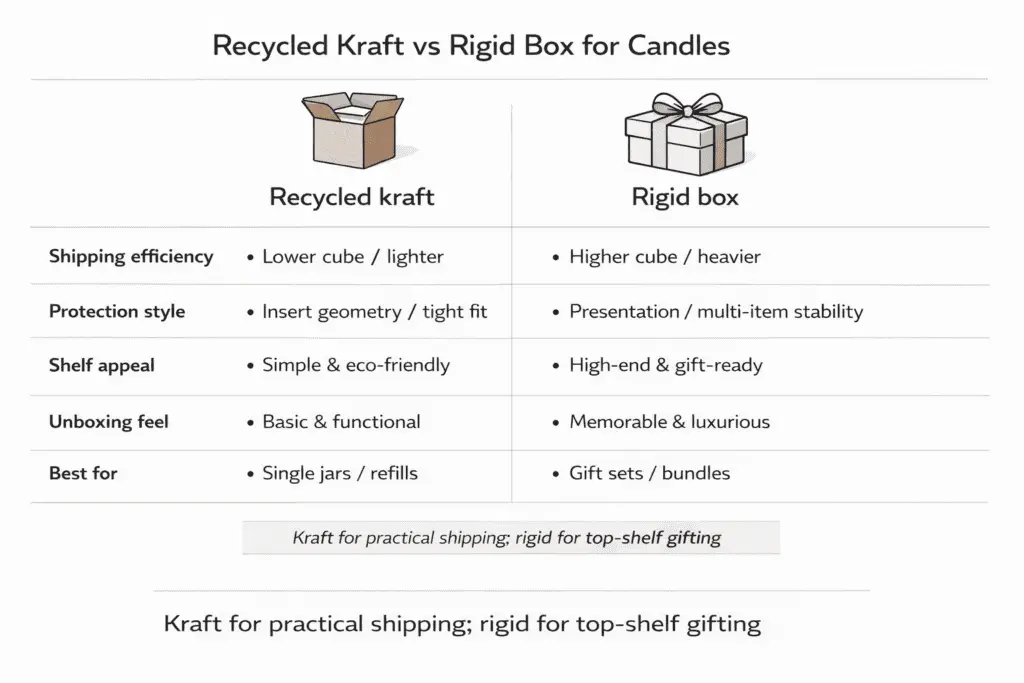
Recycled kraft is usually best for efficient, protective single-jar shipping. Rigid boxes are usually best for gift-ready presentation and stable multi-item sets.
For a broader structure decision, see how to choose candle packaging. For shipping-specific protection details, see how to package candles for shipping.
If your candles are mostly sold one jar at a time, kraft mailers with well-designed inserts often give the best mix of protection, lower shipping cost, and lower cube. If your candles are often bought as gifts or bundles, rigid boxes can justify their added bulk by making the unboxing feel intentional.
| What you’re prioritizing | Recycled kraft | Rigid box |
|---|---|---|
| Shipping efficiency | Lower cube and lighter | Higher cube and heavier |
| Protection style | Strength, insert geometry, tight fit | Structure, presentation, multi-item stability |
| Shelf and unboxing | Honest and minimal | Gift-ready and polished |
| Best for | Single jars, refills, everyday orders | Gift sets, bundles, limited editions |
If your priority is protection, focus on the parts that stop movement: a snug insert around the jar, a stable base, and a closure that stays shut under vibration.
Minimalist mailers vs gift-ready sets: shipping cost, damage risk, returns
Minimalist mailers usually win on shipping cost and packing speed. Gift-ready sets usually win on presentation and average order value. The right choice depends on whether your orders are mostly single-item restocks or multi-item gifts.
Minimalist mailers can still feel thoughtful if the outside is clean and the inside includes one intentional detail, like a band, reveal, or note. They do not need multiple layers to feel considered.
| What you’re prioritizing | Minimalist mailer | Gift-ready set |
|---|---|---|
| Shipping cost drivers | Lower cube, fewer parts | Higher cube, more parts |
| Damage risk drivers | Insert fit, corner crush | Lid shift, multi-item collisions |
| Returns and reviews | Strong when it arrives intact | Strong when presentation matches price |
| Best fit | Single candles, refills, repeat orders | Bundles, limited editions, holiday gifts |
Presentation should never increase the chance of damage. Control movement first, then add decorative value.
If your main decision is the vessel rather than the outer pack, see glass vs tin candle containers.
Sustainability proof vs luxury cues: compliance, audits, greenwashing risk
Proof marks reduce greenwashing risk when they are licensed and documented. Luxury cues work best when they do not conflict with recyclability and when the pack still communicates the essentials clearly.
If you use certification marks, you need to be able to support them. FSC claims depend on an audited supply chain. Chain of custody documentation links certified material to the finished job. If you want to keep the front panel clean, a QR code can route shoppers to proof details without cluttering the main design.
Keep legal requirements separate from marketing claims. They compete for the same limited surface area, and required information should never be hidden behind design choices.
The biggest risk is trying to look sustainable and luxurious at the same time without having the proof to support both.
Which option is usually best?
There is no universal winner. Eco-friendly packaging is stronger when your brand is built around refill behavior, everyday use, operational efficiency, and clear sustainability cues. Premium packaging is stronger when your brand depends on gifting, shelf impact, premium pricing, and a more ceremonial unboxing.
Which packaging system fits core line, gifting line, and limited editions?
In practice, the strongest candle brands do not choose one extreme. They build a packaging system with clear priorities:
- Core line: Use efficient, recyclable structures, plain boxes, or simple belly bands for high-volume singles and repeat orders.
- Gifting line: Use more presentation value, sturdier sets, and one selective premium cue when unboxing helps justify the price.
- Limited editions or hero SKUs: Reserve rigid boxes, specialty finishes, inserts, ribbons, or extra gift layers for the small set of products that can carry the added labor, storage, and margin pressure.
- Refill system: Use the leanest protective format you can standardize, with clear material proof and fast pack-out.
- Hybrid recommendation: Keep the base system sturdy and recyclable, then add premium touches only where they lift perceived value without making the pack feel wasteful.
If unit economics are the sticking point, see how much candle packaging costs.
If your packaging looks premium but feels wasteful, that is a brand problem. If it looks eco-friendly but feels flimsy, that is also a brand problem. The winning system is the one that matches customer expectation, protects the candle, supports margins, and makes the brand promise feel real.