

Retail shelf packaging helps candles sell before purchase, while ecommerce shipping packaging protects and presents candles after online orders through fulfillment, delivery, and unboxing.
Candle packaging is the protective, presentational, and logistical system around a candle, from the product box to inserts and outer cartons. Retail packaging is judged by shelf visibility, shopper handling, scent clarity, and buyer confidence before purchase. Ecommerce packaging is judged after an online order, when fulfillment, carrier movement, delivery condition, and unboxing decide whether the candle arrives intact. The right choice is retail, ecommerce, or hybrid based on channel, candle format, fragility, display need, shipping need, and giftability.
Here, “right” means best matched to the sales channel and candle format, not the cheapest, strongest, most premium, or most compliant package overall.
Retail Shelf Packaging vs Ecommerce Shipping Packaging: The Core Difference
Retail packaging is judged by shelf clarity, while ecommerce shipping packaging is judged by transit protection, delivery condition, and unboxing.
Retail shelf packaging is built for discovery before purchase; ecommerce shipping packaging is built for fulfillment after purchase. A broader choice to choose packaging that protects and sells your candle begins with this split: retail packaging must help a shopper understand the candle, while ecommerce packaging must help the candle arrive intact and feel well presented.
| Comparison point | Retail shelf packaging | Ecommerce shipping packaging |
|---|---|---|
| Buyer interaction | The shopper sees, touches, and compares the candle before buying. | The buyer has already ordered and judges the package when it arrives. |
| Main job | Show scent, brand, size, quality, and giftability. | Protect the candle through packing, handling, delivery, and unboxing. |
| Handling environment | Store shelf, market table, boutique display, gift shop, or wholesale display. | Fulfillment bench, carrier network, doorstep delivery, and customer opening. |
| Failure risk | The candle looks unclear, cheap, hidden, dusty, scuffed, or hard to understand. | The jar cracks, tin dents, lid shifts, label scuffs, box crushes, or unboxing feels careless. |
| Best-use scenario | In-store selling, market display, boutique placement, gift-shop browsing, and shelf comparison. | Online orders, Etsy sales, Shopify orders, mailed gifts, and direct-to-consumer delivery. |
The biggest mistake is treating a shelf-ready candle box as a ship-ready package. A retail box can present a candle beautifully and still lack the structure needed for parcel movement, compression, and delivery handling. Ecommerce packaging can protect the candle well and still look too plain or unclear for a retail shelf.
The channel decides the packaging job before the package style does. If candles are sold in person, the package must persuade before the sale. If candles are shipped, the package must protect after the sale. If candles move through both channels, the package needs a layered system rather than a single decorative box doing every job.
The next choice is the layer stack, because shipping protection only works after the product box, insert, mailer, and shipper have separate jobs.
Product Box, Insert, Mailer, or Shipper: Which Packaging Layer Does What?
Candle packaging can include a product box, insert, mailer, and outer shipper, and each layer has a separate channel job.
A product box is not automatically a shipping box. The product box presents the candle, the insert holds or separates it, and the mailer or outer shipper carries the delivery stress; deeper candle packaging materials choices belong after the layer job is clear.
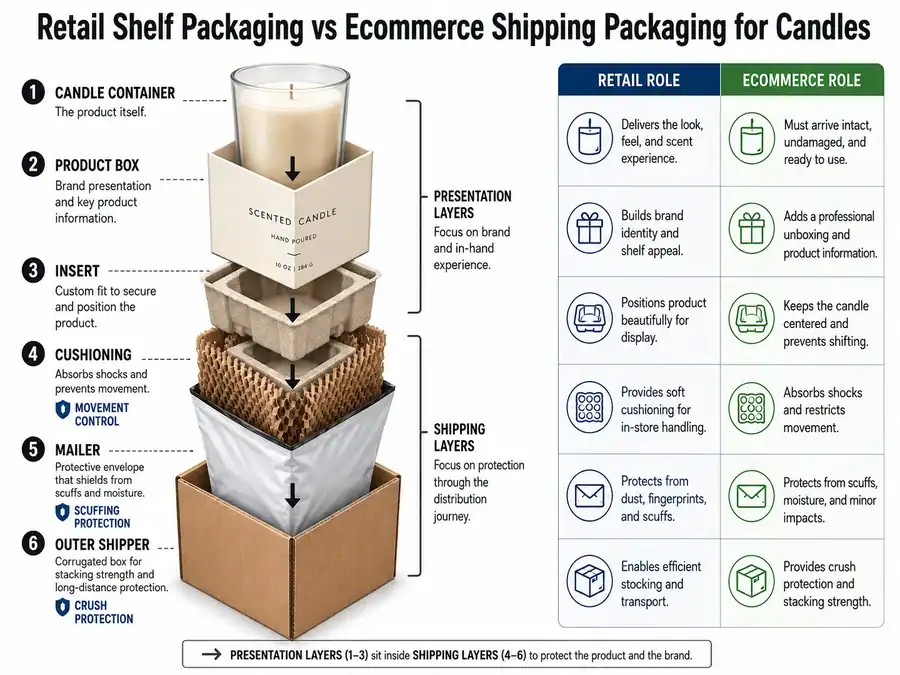
| Packaging layer | Retail role | Ecommerce role | Candle example | Failure if missing or misused |
|---|---|---|---|---|
| Primary candle container | Holds the wax and wick as the sellable candle. | Holds the candle during shipping but does not protect the whole order alone. | Glass jar, metal tin, ceramic vessel, votive cup. | The product itself takes all handling stress. |
| Product box or sleeve | Presents scent, brand, finish, and giftability on the shelf. | Protects the presentation layer inside the parcel. | Printed folding carton, rigid gift box, paper sleeve. | A bare candle may look unfinished in retail or scuff inside a parcel. |
| Insert or divider | Keeps sets neat and improves presentation. | Reduces movement between jars, tins, lids, or gift-set pieces. | Molded pulp insert, chipboard divider, paperboard cradle. | Candles shift, lids rub, labels scuff, or gift sets arrive disordered. |
| Cushioning or void fill | Usually limited unless the retail package is gift-focused. | Fills open space and helps reduce movement inside the shipping layer. | Paper fill, corrugated pad, tissue, honeycomb paper. | The candle can move inside the mailer or shipper. |
| Mailer | Rarely used as the visible retail package. | Carries lighter ecommerce orders when the product package already has support. | Corrugated mailer, tab-lock mailer. | A thin mailer can crush or expose the product box to scuffs. |
| Outer shipper | Usually hidden from shoppers. | Acts as the outer transit layer for carrier handling and delivery. | Shipping carton, corrugated shipper, protective outer box. | The product box becomes the shipping layer and may crush, dent, or tear. |
Layering prevents one package from being judged by the wrong job. A printed retail carton may be the right visual layer for a boutique shelf, but it may need an insert and outer shipper for ecommerce. A plain corrugated shipper may be useful for delivery, but it should not replace the shelf-facing product box when a shopper needs scent, size, and gift cues before buying.
Use label information only as a boundary inside the packaging layer decision. Front-panel scent, brand, and size help retail buyers understand the candle, but full candle label compliance belongs outside the retail-versus-ecommerce packaging choice. The layer question is about which package presents, holds, cushions, or ships the candle.
When the layer stack is clear, the next decision is what each channel expects the package to do before purchase or after delivery.
What Retail Shelf Packaging Must Do for Candles
Retail candle packaging should make the scent, brand, size, quality, and giftability clear before a shopper buys the candle.
Retail shelf packaging is pre-purchase packaging for a store shelf, market table, boutique display, gift shop, or wholesale display. Its job is to help a shopper understand and trust the candle without needing an online product page.
A retail-ready candle package should make the buying decision easy at arm’s length and up close.
| Retail-ready requirement | What it should do | Why it matters on a shelf |
|---|---|---|
| Scent clarity | State the scent name and scent family clearly. | Shoppers compare candles quickly and may not open every vessel. |
| Brand recognition | Show the maker, collection, or brand style consistently. | A clear identity helps the candle feel intentional rather than unfinished. |
| Size and format clarity | Make the jar, tin, votive, wax melt, or gift set easy to identify. | Shoppers need to understand what they are buying before they pick it up. |
| Shelf durability | Resist light scuffing, dust, rubbing, and repeated handling. | Retail packaging is touched, moved, stocked, and compared. |
| Giftability | Look finished enough to give without repacking. | Candles often sell as small gifts, host gifts, and seasonal items. |
| Display fit | Stand, stack, or face forward without hiding the candle’s main information. | A package that cannot display well may lose attention even if the candle is strong. |
| Buyer readiness | Include the visible information a retailer or shopper needs at the point of sale. | A package that looks incomplete can reduce trust. |
Retail packaging fails when it hides the candle’s scent, makes the brand hard to read, or looks too plain for the price point. A strong retail box, sleeve, wrap, lid label, or hang tag supports the product before the sale. That is why candle label design belongs close to retail packaging: the front-facing words and visual order help shoppers decide whether the candle fits the occasion.
Retail shelf packaging is not the same as a full retail strategy. If the candle is going into boutiques, gift shops, or local stores, wholesale candle packaging can add retailer-facing expectations, but this section only covers the package’s shelf function. The package should help the candle look ready to buy, not explain line sheets, pitch emails, or store merchandising plans.
Required warnings, barcode needs, and mandatory label details can affect whether a candle is retail-ready, but compliance belongs in its own deeper check. In this comparison, the useful boundary is simple: retail shelf packaging must persuade before purchase, while ecommerce shipping packaging must protect and reassure after purchase.
What Ecommerce Shipping Packaging Must Do for Candles
Ecommerce candle packaging should protect the candle during fulfillment, parcel handling, delivery, and unboxing while keeping the order clean and brand-consistent.
Ecommerce shipping packaging is the post-purchase packaging system used after an online candle order. The product package presents the candle, while the insert, cushioning, mailer, or outer shipper protects it through delivery.
An ecommerce-ready candle package should control movement and preserve presentation after the buyer has already paid.
| Ecommerce layer | What it should do | Common failure if ignored |
|---|---|---|
| Product package | Keep the candle looking finished inside the parcel. | The candle arrives bare, scuffed, or gift-incomplete. |
| Insert or divider | Hold jars, tins, lids, or gift-set pieces in place. | Items rub, rattle, rotate, or arrive out of order. |
| Cushioning or void fill | Reduce empty space inside the mailer or shipper. | The candle moves during handling and may damage the box or label. |
| Mailer or outer shipper | Take the outside handling stress of delivery. | The retail box becomes the transit layer and may crush or tear. |
| Unboxing elements | Keep the order neat, branded, and easy to open. | The candle may arrive intact but feel careless or messy. |
Ecommerce packaging must handle movement, impact, compression, scuffing, jar damage, tin dents, lid movement, and wax-surface damage at a comparison level. Detailed cushioning choices, jar immobilization, and packing sequences belong under package candles for shipping without breakage, because this section is only explaining the ecommerce side of the retail-versus-shipping decision.
A retail candle box is not automatically a shipping box. Thin folding cartons, decorative sleeves, window boxes, and presentation boxes can look good on a shelf but still need a protective outer layer for online orders. The outer shipper should take the delivery stress so the product box can still look clean when the customer opens it.
Heat is a separate shipping risk, not the main definition of ecommerce packaging. If wax softening, seasonal delivery, or warm-route planning becomes the main concern, shipping candles in hot weather deserves a separate answer. Here, heat is only one possible transit condition, while the main ecommerce job is protecting and presenting the candle after an online sale.
The material stack should match the candle format. Glass jars usually need more movement control than tins, gift sets need separation between pieces, and wax melts may need clean presentation more than heavy jar protection. Candle packaging materials matter because the insert, mailer, fill, and shipper must support the candle’s format without turning the package into a bulky or confusing retail display.
Shelf Protection vs Transit Protection for Candle Jars, Tins, and Gift Sets
Retail protection prevents shelf wear, while transit protection prevents damage from parcel movement, pressure, vibration, and delivery handling.
Protection requirements for candle packaging are the structural and surface-protection needs that prevent cracked jars, dented tins, scuffed labels, shifted lids, and damaged gift sets in the intended channel. In retail, protection usually means surface preservation; in ecommerce, it means physical survival during shipping.
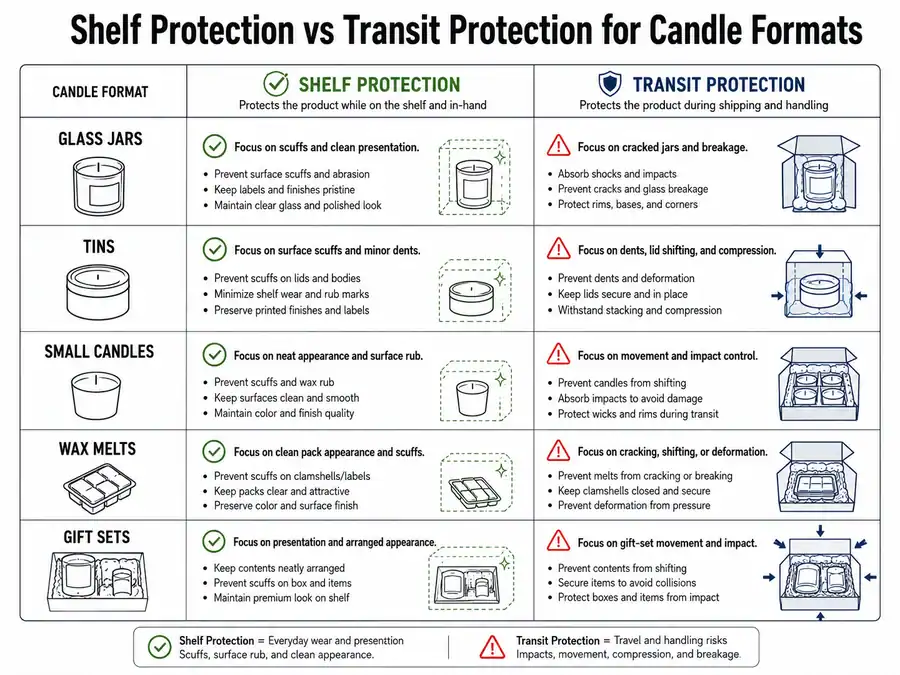
| Candle format or risk | Retail shelf protection | Ecommerce transit protection | What changes by channel |
|---|---|---|---|
| Glass jar candle | Protect the label, lid, and outer finish from rubbing or shopper handling. | Control jar movement and separate glass from direct outer-box stress. | Glass needs more support when the package moves through sorting, stacking, and delivery. |
| Tin candle | Prevent dents, lid scratches, and shelf scuffs. | Reduce crushing, lid popping, and sidewall dents inside the shipper. | A tin may look durable but still dent under compression. |
| Votive or small candle | Keep small units clean, upright, and easy to compare. | Stop small units from shifting, rattling, or pressing into each other. | Small candles need order control, not just outer packaging. |
| Wax melts | Keep clamshells, labels, and scent cues clean on display. | Prevent cracking, bending, heat exposure, and messy presentation. | Heat-sensitive products need a separate plan for shipping candles in hot weather. |
| Gift set | Keep the set neat, gift-ready, and easy to understand. | Separate pieces so jars, lids, tins, and inserts do not collide. | A gift box may need an outer shipper to keep the presentation layer clean. |
Shelf packaging does not protect enough for ecommerce when it is only built for display, light handling, and presentation. Use an outer shipper when the candle is fragile, heavy, glass, part of a gift set, or likely to move inside the package. Detailed cushioning, jar immobilization, and packing sequences belong under package candles for shipping without breakage, while material selection belongs under candle packaging materials.
Retail Handling vs Parcel Handling: What Changes Physically?
Retail handling is controlled contact; parcel handling is movement through a delivery system.
Retail handling includes stocking, shopper touch, market-table handling, and light stacking. Parcel handling includes sorting, stacking, vibration, compression, drops, last-mile movement, and delivery placement.
| Handling event | Retail shelf or market table | Ecommerce parcel route | Packaging response |
|---|---|---|---|
| Touching | Shoppers pick up, turn, and compare the candle. | Many people and machines may handle the parcel indirectly. | Retail needs scuff resistance; ecommerce needs outer-layer strength. |
| Stacking | Store staff may stack boxes neatly. | Parcels may face pressure from other boxes. | Transit packaging needs compression support around the candle. |
| Movement | The candle usually moves short distances. | The package may move through sorting, vehicles, and delivery stops. | Inserts and void fill help reduce internal shifting. |
| Drops | Retail drops are possible but not the normal condition. | Delivery handling can include sudden impact. | Fragile candles need a shipper that protects the product box. |
| Surface wear | Labels, sleeves, and cartons can rub on shelves. | Labels and boxes can scuff inside the parcel if the candle moves. | Presentation surfaces need protection inside the shipper. |
This is why shipping fragile candles is a different job from displaying candles. Retail packaging can keep a candle attractive on a shelf, but ecommerce packaging must keep the candle and its presentation layer stable after the buyer has already ordered.
Why Shelf-Only Candle Packaging Fails in Ecommerce Shipping
Shelf-only candle packaging can look excellent in retail but fail when it becomes the outer shipping layer.
Shelf-only means the package is designed for display and shopper handling, not parcel movement. Failure here means transit failure or poor delivery condition, not bad branding.
| Shelf-only feature | Ecommerce failure mode | Visible symptom | Add-on layer usually needed |
|---|---|---|---|
| Thin folding carton | Crushes or creases under parcel pressure. | Corners collapse, edges dent, or the box looks used. | Outer shipper with support around the product box. |
| Decorative sleeve | Slides, tears, or exposes the product package. | Sleeve shifts, scuffs, or arrives loose. | Product box plus snug shipper or protective wrap. |
| Window box | Weak window area takes impact or pressure. | Window cracks, caves in, or shows scuffed candle surfaces. | Insert and outer carton that protect the window area. |
| Gift box | Presentation layer absorbs transit stress. | Gift box arrives crushed, dusty, or no longer gift-ready. | Protective shipper around the gift box. |
| No insert | Candle moves inside the package. | Jar shifts, lid rubs, label scuffs, or wax surface marks appear. | Insert, divider, cradle, or snug void fill. |
The fix is not always a new retail box. Often the fix is adding the right shipping layer around the retail package, so the shelf-facing package stays clean and the outer shipper absorbs the delivery stress.
How Packaging Choice Affects Damage, Returns, and Reviews
Packaging choice affects returns and reviews when it fails the channel’s protection or presentation job.
Damage risk here means cracked jars, dented tins, scuffed labels, damaged wax, crushed gift boxes, and poor unboxing. It is an operational and reputation risk, not a legal or insurance topic.
| Packaging mismatch | Likely damage or complaint | Business result | Better channel fit |
|---|---|---|---|
| Retail box used as the shipper | Crushed carton, scuffed label, shifted lid, or broken jar. | Refund request, replacement shipment, or poor review. | Retail box inside a protective outer shipper. |
| Loose gift set in a mailer | Pieces collide or arrive out of order. | Gift feels damaged even if candles are usable. | Inserted gift set inside a stable shipping carton. |
| Bare tin in a loose box | Dents, lid marks, or label rub. | Buyer may see the candle as careless or low quality. | Tin with movement control and clean presentation layer. |
| Heavy jar with weak outer packaging | Cracked glass or damaged product box. | Return, refund, replacement, and lost trust. | Stronger shipper with support around the jar. |
| Overbuilt retail package for local shelves | Bulky, costly, or hard to display. | Higher candle packaging cost without better shelf conversion. | Retail layer matched to shelf handling, with shipping added only when needed. |
The useful decision is not “strongest package always wins.” The better choice is the package that protects the candle against the channel’s real handling while keeping the sales presentation intact.
Shelf Appeal vs Unboxing Appeal: How Branding Changes by Channel
Visual branding should change based on whether the customer sees the package before purchase or after purchase during unboxing.
Visual branding in candle packaging is the use of package color, typography, label hierarchy, materials, scent cues, and inserts to communicate brand, scent, quality, and giftability. Shelf appeal means scannability before purchase; unboxing appeal means satisfaction after delivery.
| Branding element | Retail shelf appeal | Ecommerce unboxing appeal |
|---|---|---|
| Scent naming | Must be readable from the front or top of the package. | Should match the scent promise shown on the product page. |
| Label hierarchy | Brand, scent, size, and key product cues should be easy to scan. | Order contents should feel clear when the parcel opens. |
| Material finish | Finish should signal quality under store lighting and handling. | Finish should still look clean after shipping. |
| Color and typography | Help the candle stand out while staying easy to read. | Reinforce the online brand impression the buyer expected. |
| Giftability | Package should look ready to buy and give. | Package should arrive clean enough to feel giftable. |
| Inserts or cards | Usually secondary unless part of the visible retail package. | Can explain care, scent story, or appreciation after delivery. |
| Interior branding | Less important before purchase unless the box opens on display. | More important because the buyer sees the reveal after delivery. |
Retail packaging needs visible scent, brand, product name, size, and gift cues before the shopper commits. Ecommerce packaging feels premium when the candle arrives clean, matches the online promise, and opens in a neat order with a branded interior or small insert. Broader candle label design choices belong beside this topic because front-panel clarity is what makes shelf appeal work.
A premium ecommerce package does not need a full rebrand. If premium presentation becomes the main goal, luxury candle packaging is the better next layer. If gifting becomes the main goal, candle gift packaging should handle gift wrap, seasonal sets, and presentation upgrades beyond this comparison.
Use this visual cue checklist before choosing a brand direction for each channel.
| Visual cue | Retail priority | Ecommerce priority |
|---|---|---|
| Scent cue visible without opening | High | Medium |
| Brand name easy to find | High | High |
| Gift-ready look | High | High |
| Interior reveal | Low to medium | High |
| Insert or note | Low to medium | Medium to high |
| Clean arrival condition | Medium | High |
| Match with online product photos | Medium | High |
Retail Discovery Happens Before Purchase; Ecommerce Unboxing Happens After Purchase
Retail packaging shapes the customer’s experience before the sale; ecommerce unboxing shapes the experience after the sale.
Customer experience in candle packaging means the buyer’s packaging touchpoints, not the entire customer lifecycle. Retail buyers need the package to explain the candle before purchase, while ecommerce buyers need the package to confirm the purchase after delivery.
| Channel | When packaging is judged | What the buyer needs | Packaging response |
|---|---|---|---|
| Retail shelf | Before buying | Scent recognition, quality signal, and gift confidence. | Clear front panel, neat finish, and shelf-ready presentation. |
| Market table | Before buying | Fast comparison among scents and sizes. | Visible scent names, simple grouping, and touch-resistant surfaces. |
| Boutique or gift shop | Before buying | Giftability and trust in the maker. | Finished box, sleeve, wrap, or label system. |
| Ecommerce order | After buying | Safe arrival and confirmation that the product matches the listing. | Protective shipper, clean reveal, and product-page consistency. |
| Mailed gift | After buying, often by the recipient | A package that feels intentional and ready to give. | Clean product box, orderly insert, and gift-safe presentation. |
Unboxing matters for ecommerce because the buyer cannot judge the physical package before purchase. Retail packaging does not need every unboxing element, but it does need clear discovery cues. If insert copy becomes a separate planning task, thank-you insert ideas should handle card wording and repeat-order prompts outside this packaging comparison.
Why Ecommerce-Only Packaging Can Undersell Candles on Retail Shelves
Ecommerce-only packaging can protect well but still undersell a candle when it does not communicate before purchase.
Ecommerce-only packaging includes plain mailers, protective shippers, kraft fulfillment boxes, insert-heavy packages, or packaging that relies on a product page to explain the candle. That can work online, but it may look unclear, plain, or not gift-ready on a shelf.
A shipping-first package is retail-ready only when these cues are visible without opening it.
| Retail-readiness cue | Pass condition | Weak shelf signal |
|---|---|---|
| Front-facing scent cue | Shopper can identify the scent quickly. | Scent is hidden, small, or only inside the package. |
| Brand and product name | Brand and candle type are easy to understand. | Package looks like a shipping box, not a finished product. |
| Size or format cue | Jar, tin, wax melt, votive, or set is clear. | Shopper cannot tell what is inside. |
| Giftability signal | Package looks ready to buy and give. | Mailer or shipper looks too plain for gifting. |
| Shelf-safe surface finish | Exterior resists normal touch and display wear. | Shipping label area, scuffs, or kraft surface dominate. |
| Required retail information | Only brief required details appear where needed. | Full candle label compliance questions take over the package decision. |
Shipping-first packaging is not bad packaging. It is simply judged by the wrong moment when it moves onto a retail shelf. If the package will be pitched to boutiques or gift shops, wholesale candle packaging can cover buyer expectations, while this comparison stays focused on whether the candle can be understood before purchase.
When a Hybrid Candle Packaging System Works — and When It Does Not
Hybrid candle packaging works when a retail-ready product package is protected by ecommerce inserts, cushioning, or an outer shipper, and it fails when one decorative box must do every channel job alone.
A hybrid candle packaging system supports both retail presentation and ecommerce delivery when it combines a retail-ready product package with inserts, cushioning, or an outer shipper. It can help a seller choose packaging that protects and sells your candle, but it only works when the shelf-facing layer and transit-facing layer are both planned.
| Packaging setup | Retail strength | Ecommerce strength | Failure risk | Best use case |
|---|---|---|---|---|
| Retail product box plus protective outer shipper | Strong | Strong | Low when the candle is held securely inside the shipper. | Brands selling the same candle in boutiques and online. |
| Printed product box with fitted insert | Strong | Medium to strong | Medium if the insert controls movement but the outer box is weak. | Tins, small jars, or giftable candles with moderate shipping needs. |
| Rigid gift box inside shipping carton | Strong | Strong | Low to medium if the gift box is protected from compression. | Gift sets, seasonal candles, and premium orders. |
| Decorative sleeve around bare candle | Medium | Weak | High if the sleeve becomes the only protection. | In-person markets where shoppers can see and handle the candle. |
| Plain ecommerce mailer used on retail shelf | Weak | Medium to strong | High for retail because the package does not explain the candle before purchase. | Online-only orders, not boutique display. |
| Thin folding carton used as the shipper | Strong visually | Weak | High because shelf packaging absorbs delivery stress. | Retail display only unless an outer shipper is added. |
| Product box, insert, cushioning, and outer shipper | Strong | Strong | Low when each layer has a clear job. | Mixed-channel candle brands with fragile jars or giftable presentation. |
Can one candle box work for both retail and ecommerce? One box can support both channels only when it is part of a layered system. A retail-ready box may show scent, brand, and giftability, but it usually still needs an insert, cushioning, mailer, or outer carton to handle ecommerce delivery.
When should candle sellers use hybrid packaging? Use hybrid packaging when the candle needs the same product presentation across retail and online orders, the SKU set is small, and the product box can stay clean inside a protective shipping layer. Hybrid can reduce package variation, but any real budget or SKU tradeoff belongs under candle packaging cost, not inside the channel comparison itself.
| Hybrid packaging works when… | Hybrid packaging does not work when… |
|---|---|
| The product box is retail-ready and the outer shipper handles delivery stress. | A decorative retail carton is expected to survive shipping alone. |
| Inserts or dividers stop jars, tins, lids, or gift-set pieces from moving. | Fragile glass jars are packed with no movement control. |
| Front-panel scent and brand cues remain visible for shelf display. | A plain mailer is placed directly on a retail shelf with no retail-facing cues. |
| The ecommerce layer protects the presentation layer. | A gift box is exposed directly to parcel compression. |
| The package is designed for mixed retail and direct-to-consumer selling. | The seller wants one universal package without changing layers by channel. |
Does a hybrid candle package still need an outer shipper? Most shipped hybrid setups still need an outer shipper when the product box is part of the customer-facing presentation. If the outer layer takes the scuffs, pressure, and delivery handling, the product box can still look clean when opened.
When is separate packaging better? Separate packaging is better when the retail display package is delicate, the jar is fragile, the product is heavy, the gift box must stay pristine, or the ecommerce order needs more protection than the shelf package can provide. Detailed protection choices should move to package candles for shipping without breakage, while insert, carton, and cushioning choices can be compared under candle packaging materials.
The lowest-risk hybrid choice is not the fewest layers; it is the clearest split between the layer that sells the candle and the layer that protects it.
Decision Matrix: Choose Retail, Ecommerce, or Hybrid Candle Packaging
Packaging fit depends on channel, candle format, fragility, display need, transit need, and giftability.
A channel-fit decision matrix compares where the candle is sold, how fragile it is, and whether the package must persuade before purchase, survive shipping after purchase, or do both. Fit means best matched to the use case, not universally best, and the broader strategy to choose packaging that protects and sells your candle should stay separate from exact costs, suppliers, and compliance rules.
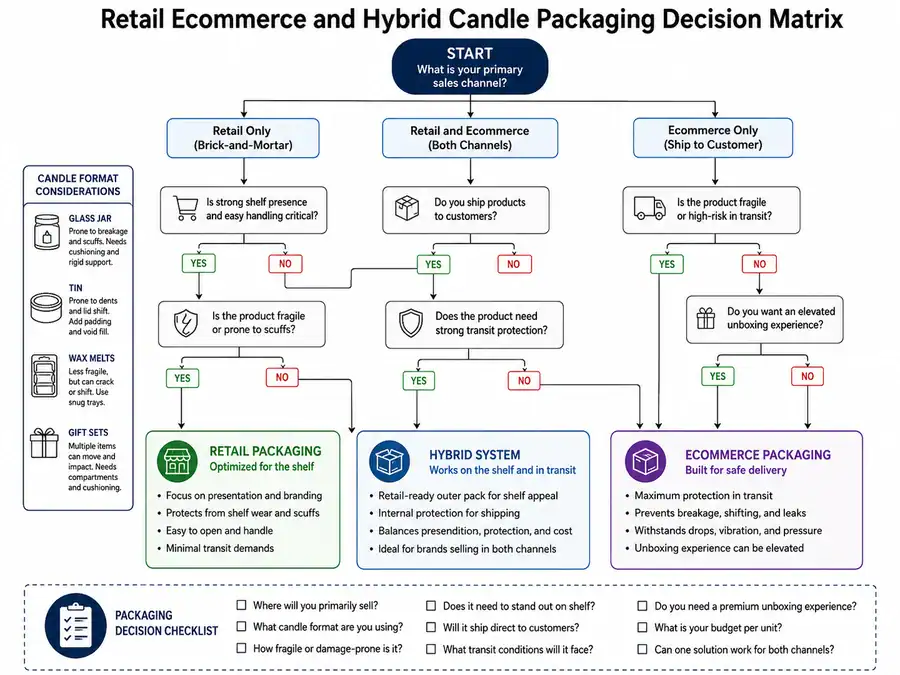
| Sales channel | Candle format | Display need | Transit need | Recommended packaging system | What to check next |
|---|---|---|---|---|---|
| Retail only | Tin candle | Medium | Low | Retail product label, sleeve, or carton with shelf-safe finish. | Use candle label design thinking if scent and brand hierarchy are unclear. |
| Retail only | Glass jar | High | Low | Retail-ready box, wrap, lid label, or sleeve that protects surfaces from handling. | Check wholesale candle packaging if boutiques or gift shops will review the line. |
| Retail only | Gift set | High | Low | Giftable retail box with dividers or a neat presentation insert. | Move to candle gift packaging if gifting becomes the main package goal. |
| Ecommerce only | Tin candle | Low to medium | Medium | Product package plus snug mailer, insert, or void fill. | Review candle packaging materials when choosing inserts, mailers, or fill. |
| Ecommerce only | Glass jar | Medium | High | Product box, movement control, cushioning, and outer shipper. | Use package candles for shipping without breakage for packing steps and protection details. |
| Ecommerce only | Wax melts | Medium | Medium | Clean product package plus mailer or shipper that limits bending and messy arrival. | Check heat-sensitive planning separately if warm delivery is the main risk. |
| Retail and ecommerce | Tin candle | Medium | Medium | Hybrid product package with insert support and ecommerce outer layer. | Compare candle packaging cost if reducing packaging SKUs is the main reason. |
| Retail and ecommerce | Glass jar | High | High | Retail-ready product box protected by insert, cushioning, and outer shipper. | Choose hybrid only if the presentation layer stays clean after shipping. |
| Retail and ecommerce | Gift set | High | High | Retail gift box inside a protective shipping carton with dividers. | Keep gift presentation separate from transit protection. |
| Pop-up markets plus online orders | Mixed small batch | Medium | Medium | Simple retail-facing product package plus channel-specific shipping layer. | Avoid making the market display look like a fulfillment box. |
| Wholesale plus direct orders | Consistent jar line | High | High | Retail-ready carton, clear scent hierarchy, insert, and shipper. | Route retailer expectations to wholesale and label checks rather than solving them here. |
| Online-only premium orders | Glass jar or gift set | Medium | High | Ecommerce-first shipper with clean interior presentation and protected product box. | Add retail packaging later if the candle moves into stores. |
Should I choose retail packaging, ecommerce packaging, or hybrid packaging? Choose retail packaging when shoppers must understand the candle before buying. Choose ecommerce packaging when the candle must survive fulfillment and delivery after buying. Choose hybrid packaging when one product presentation can work in both channels and shipping protection is added around it.
What packaging should I use if I sell candles online and in stores? Use a retail-ready product package for scent, brand, size, and gift cues, then add ecommerce layers only for shipped orders. A hybrid system works best when the retail-facing package is protected, not when the retail box becomes the shipper.
Does a fragile candle need separate packaging? A fragile candle often needs at least separate shipping layers, even if the product box stays the same across channels. Fragile means higher damage sensitivity from glass, gift-set arrangement, surface finish, wax condition, or premium presentation.
When should cost, compliance, or shipping details be checked on another page? Move budget questions to candle packaging cost, detailed packing steps to package candles for shipping without breakage, material comparisons to candle packaging materials, and required label or barcode questions to candle label compliance. The matrix chooses the packaging system category; it does not replace cost tables, supplier recommendations, formal testing, marketplace rules, or legal label checks.
Channel Expectations Checklist: Retailers, Marketplaces, and Direct Customers
Retailer, marketplace, and direct-customer expectations overlap, but they are not the same packaging requirement set.
Expectations here mean practical channel readiness: presentation, durability, labeling clarity, fulfillment readiness, and buyer confidence. They do not mean a full platform rulebook, wholesale pitch process, barcode tutorial, or labeling law guide.
| Expectation to check | Retailer relevance | Ecommerce relevance | Why it matters | Where deeper detail belongs |
|---|---|---|---|---|
| Clear scent and product identity | High | Medium | Retail shoppers compare quickly before purchase. | Label hierarchy and retail presentation. |
| Gift-ready appearance | High | Medium to high | Candles are often bought as gifts in stores and online. | Gift-focused packaging planning. |
| Durable product package | Medium | High | The product package should stay clean through handling or delivery. | Materials and protection choices. |
| Outer shipping readiness | Low | High | Online orders need a package that can handle parcel movement. | Shipping protection steps. |
| Basic required information | Medium to high | Medium to high | Buyers and sales channels need clear product information. | Label compliance checks. |
| Barcode or retail scan needs | Medium to high for some retail channels | Low to medium | Some retail paths need scan-ready packaging. | Retailer or barcode-specific guidance. |
| Marketplace or platform rules | Low | Medium to high | Online marketplaces may set their own listing and fulfillment requirements. | Official marketplace documentation. |
| Direct-customer unboxing | Medium | High | The buyer judges the brand when the package opens. | Ecommerce unboxing and gift packaging. |
Retailers usually care about shelf clarity, product readiness, and whether the candle looks finished in a store environment. Marketplaces and online buyers care more about fulfillment readiness, delivery condition, and whether the received package matches the online promise. Direct customers judge both the product’s condition and the feeling of the unboxing.
Use wholesale candle packaging when retailer readiness, boutique expectations, or line presentation becomes the main question. Use compliance-focused resources when required information, warnings, or barcodes become the main issue. Use the decision matrix here only to pick the packaging system: retail, ecommerce, or hybrid.