

Beginner candle packaging is a simple system where every layer protects the candle, presents it clearly, prepares it for delivery or shipping, or communicates needed information.
Candle packaging combines the product-facing layer and the shipping-ready layer so a candle can be handled, gifted, sold locally, delivered, or mailed. For beginners, simple means enough protection and a clean, sellable presentation rather than the cheapest setup or a premium custom package. The useful starting point is to ask whether each label, wrap, box, insert, cushion, or mailer protects, presents, ships, or communicates. Legal label rules, hot-weather logistics, carrier policies, luxury branding, full cost modeling, and sustainability claims belong outside this beginner setup.
This beginner guide mainly covers finished jar and tin candles for local sales, gifts, delivery, and basic mailed orders; pillars, molded candles, wax melts, wholesale packs, and subscription boxes may need separate packaging rules.
Start with the simplest candle packaging system that still protects, presents, and ships
Beginner candle packaging is a simple system of layers, not a pile of supplies.
A beginner candle packaging system should include only the layers needed to protect the candle, make it look sellable, and support the sales channel. Candle packaging strategy starts by giving every layer one job: protect, present, ship, or communicate.
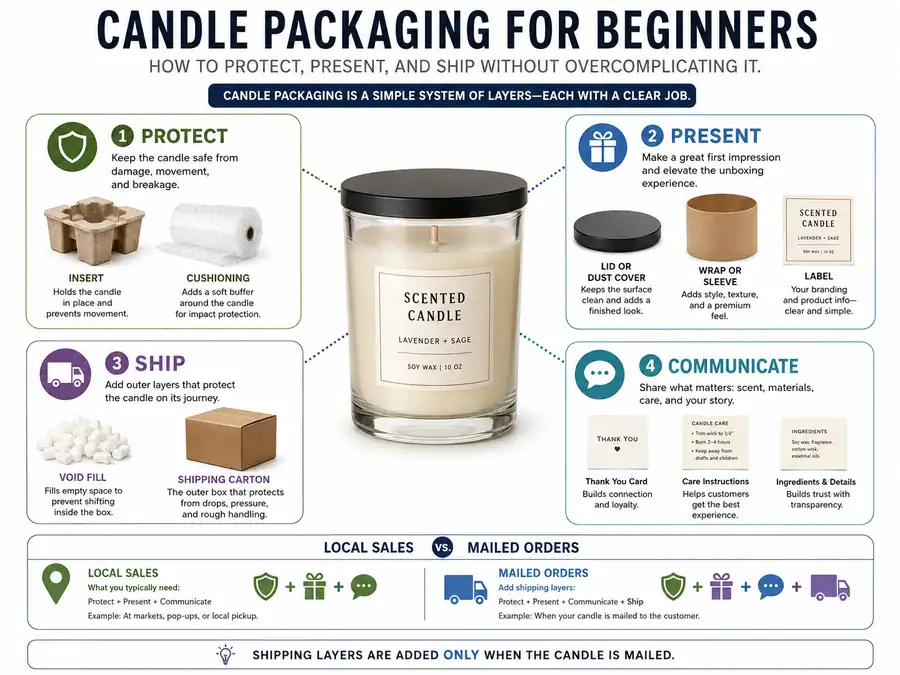
| Packaging layer | Beginner use case | Keep or skip reason | Upgrade trigger |
|---|---|---|---|
| Candle container with lid or dust cover | Local sale, gift, market, delivery, mailed order | Keep now because it protects the wax surface and finish. | Upgrade when lids scuff, loosen, or look unfinished. |
| Front label | Local sale, gift, market, delivery, mailed order | Keep now because it identifies the candle and makes it sellable. | Upgrade when labels wrinkle, lift, smear, or look misaligned. |
| Warning or care information | Sale or gift use | Keep now when the candle will leave your hands. | Upgrade when care details need clearer placement. |
| Simple wrap, sleeve, or tissue | Gift, market, delivery, mailed order | Optional now because it improves handling and presentation. | Upgrade when labels rub, jars scuff, or gifts need cleaner presentation. |
| Product box | Gift, market display, mailed order with inner presentation need | Skip until the candle needs more surface protection or shelf-ready presentation. | Upgrade when loose wrapping looks unfinished or jars need a fitted layer. |
| Insert or care card | Gift or customer order | Optional now because it should communicate, not clutter. | Upgrade when buyers need burn care, scent notes, or gift information. |
| Cushioning | Delivery or mailed order | Keep only when movement or contact damage is likely. | Upgrade when the candle rattles, shifts, or reaches the customer marked. |
| Shipping carton | Mailed order only | Skip for handoff, pickup, and most market sales. | Add when the candle enters postal or parcel transit. |
| Void fill | Mailed order only | Keep when the outer carton has empty space. | Upgrade when the candle can move after the box is closed. |
| Decorative extras | Gifts or brand polish | Skip until they serve a clear presentation purpose. | Upgrade when the base package already protects well and gift demand is clear. |
Use this table as a first-pack filter, not as a shopping list. A minimum viable setup is enough to protect, present, and prepare the candle for the current sales channel; it is not bare, unsafe, cheap-looking, or unfinished. Beginners do not need every packaging layer before the first sale because local pickup, market sales, gifts, delivery, and mailed orders do not face the same risks.
Product packaging and shipping packaging are not the same. Product packaging is the layer the customer sees around the candle, such as the label, sleeve, wrap, insert, or product box. Shipping packaging is the outer protection used only when the candle is mailed, such as the carton, cushioning, void fill, and tape. That separation keeps packaging that protects and sells candles from turning into an oversized setup before the candle needs it.
Use three questions before adding a layer. Does it protect the jar, lid, wax, label, or finish? Does it make the candle cleaner, clearer, or more giftable? Does it prepare the candle for the way it will be handed over, delivered, or mailed? If the answer is no, the layer can wait.
How this table was built: The starter stack above is modeled around beginner use cases, not brand maturity. Each row was sorted by layer necessity, channel fit, and beginner complexity so the first setup stays useful without becoming a full cost plan. If price, bulk buying, or supply budgets become the main decision, candle packaging cost breakdown belongs in a separate cost-focused planning step.
The simplest first setup is usually a clean container, a readable label, basic care or safety information, and one protective or presentation layer only when the channel needs it. Shipped candles add a shipping carton, cushioning, and void fill; hand-delivered candles may not need those layers at all. Once the first stack is clear, the next step is knowing what the package must protect.
Know what candle packaging actually needs to protect
Candle packaging should protect the container, lid, wax surface, label, finish, scent cleanliness, and basic movement during handling or transit.
Protection is more than preventing broken glass. Good beginner packaging keeps the candle clean, readable, stable, and presentable through ordinary handling, storage, delivery, or basic mailing, but it does not promise damage-proof shipping.
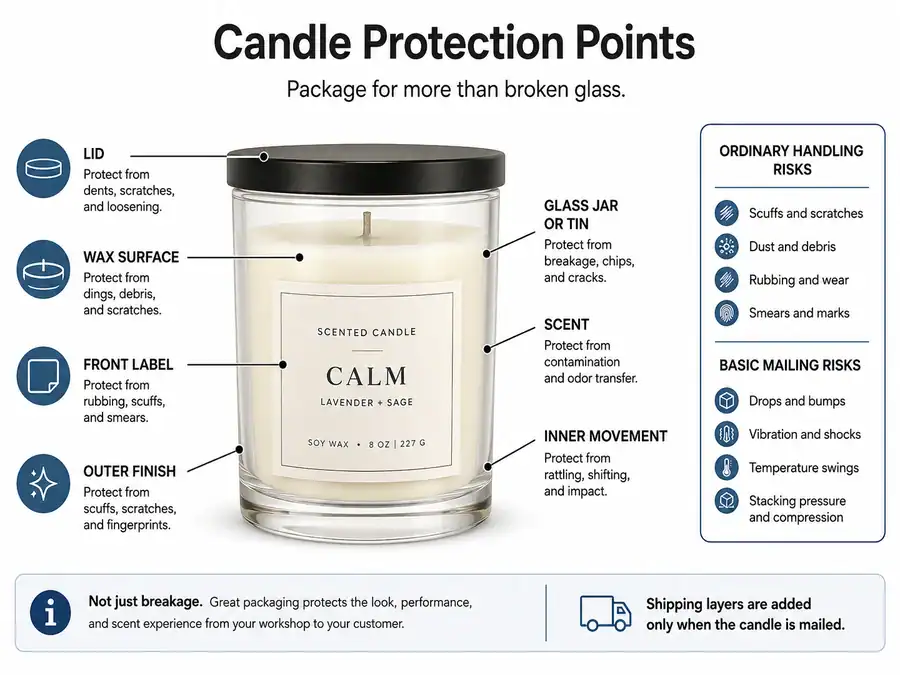
| Candle part | Common risk | Beginner protection step | When to use a deeper plan |
|---|---|---|---|
| Glass jar or tin | Scratches, dents, chips, or impact marks | Use a snug product box, sleeve, wrap, or cushioning when contact is likely. | Move into formal shipping planning if mailed orders keep arriving damaged. |
| Lid | Dents, looseness, scuffs, or rubbing | Check lid fit before wrapping and avoid tight layers that push the lid sideways. | Move into lid and top-surface checks when scuffing is the main issue. |
| Wax surface | Dust, fingerprints, wax marks, or surface rubbing | Use a lid, dust cover, tissue, sleeve, or box that does not touch the wax top. | Move into top-surface protection when visible finish issues repeat. |
| Label | Smears, peeling, wrinkles, or abrasion | Let labels set before wrapping and avoid rough materials against printed areas. | Move into label presentation checks when readability or alignment suffers. |
| Outer finish | Fingerprints, residue, tissue marks, or scuffs | Handle with clean hands and avoid dusty or shedding materials. | Move into cleanliness checks when the candle looks messy after packing. |
| Scent impression | Dusty, stale, or mixed packaging smell | Store packaging cleanly and avoid strong-smelling wrap or inserts. | Move into storage practices if scent transfer becomes the main issue. |
| Inner movement | Rattling, sliding, or lid-to-box contact | Fill empty space so the candle cannot shift during delivery or mailing. | Move into ecommerce shipping packaging strategy when parcel transit becomes frequent. |
| Heat exposure | Softened wax, sweating, or scent change | Treat this as outside basic beginner protection. | Use hot-weather candle shipping planning when heat, insulation, or cold packs matter. |
Cosmetic damage matters because a candle can arrive unbroken but still look unfinished. A scuffed lid, dusty wax top, crooked label, or rubbed jar changes the buyer’s first impression even when the candle still burns. That is why beginner protection should cover visible contact points, not only the container.
Protective packaging and decorative packaging are different jobs. Protective layers reduce rubbing, movement, dust, and normal handling damage. Decorative layers make the candle look giftable or more polished. One layer can do both, but decoration should not replace protection when a candle will be handled, carried, delivered, or mailed.
Basic protection covers ordinary handling, storage, local delivery, and simple transit movement. It does not cover guaranteed breakage prevention, extreme heat, international shipping, hazmat interpretation, carrier rules, or insurance claims. When temperature becomes the main risk, shipping candles in heat needs its own packaging plan rather than a small tweak to beginner wrapping.
Protect lids, wax tops, dust covers, and visible contact points
Lids, wax tops, dust covers, label edges, and jar shoulders need packaging protection because they show scuffs, dust, pressure, and rubbing first.
Beginner candle packaging should protect the lid, wax top, dust cover, and other visible contact points because scuffs, dust, dents, and smears make the candle look unfinished. This is packaging contact damage, not a fix for wax formulation, curing, frosting, sinkholes, or fragrance issues.
| Visible area | Damage risk | Packaging cause | Beginner fix |
|---|---|---|---|
| Metal or wood lid | Dents, scratches, loose fit | Tight wrap, rough boxes, stacked jars, pressure from inserts | Check lid fit before wrapping and avoid pressure directly on the lid edge. |
| Wax top | Dust, fingerprints, surface scuffs | No lid, loose tissue, direct contact with wrap, dirty packing area | Use a lid, dust cover, or non-contact wrap so nothing rubs the wax. |
| Dust cover | Bending, lifting, stains | Wrap pulled too tight or insert material touching the cover | Keep the cover flat and use a sleeve or box when the cover must stay visible. |
| Lid sticker | Smears, crooked finish, adhesive marks | Sticker applied before the surface is clean or before ink sets | Apply stickers after the lid is clean and let printed labels set before wrapping. |
| Jar shoulder | Rub marks, tissue lint, fingerprints | Rough handling or shedding presentation material | Wipe the jar before packing and choose low-lint wrap near glossy surfaces. |
| Front label edge | Peeling, rubbing, curling | Sleeve or tissue sliding across the label | Keep wrap loose enough to protect without scraping the label edge. |
Packaging protection includes lid scuffs because the lid is one of the first surfaces a buyer sees. Tissue or wrap can damage a candle top when it rubs the wax, traps debris, or presses a dust cover into the surface. A sleeve, tissue wrap, shrink band, product box, or lid sticker helps only when it keeps contact points cleaner rather than adding pressure.
Use a simple inspection order before wrapping. Look at the wax top, check the lid, press the dust cover lightly, inspect the label edge, then handle the candle once as a customer would. If the candle looks clean before packing but scuffed after packing, the problem is usually contact, pressure, dust, or movement.
When the issue becomes decorative rather than protective, candle label and gift packaging ideas or giftable candle packaging ideas can take over. For this beginner setup, surface protection stays focused on how to choose candle packaging that protects and sells without confusing packaging damage with candle-making defects.
Choose packaging materials by job, not by trend
Choose candle packaging materials by the job they perform, not by appearance alone.
Candle packaging materials fall into product-facing, label, presentation, cushioning, shipping, and optional communication layers. Simple materials are low-decision, repeatable supplies that match the candle’s current sales channel; simple does not mean low-quality, unsafe, or purely decorative.
| Material | Primary job | Protects, presents, or ships | Beginner verdict | Common mistake |
|---|---|---|---|---|
| Front label | Identify scent, size, maker, or product line | Presents and communicates | Keep for any candle that will be sold or gifted. | Treating the label as decoration only. |
| Warning or care sticker | Communicate basic use information | Communicates | Keep when the candle leaves your hands. | Hiding needed information under wrap or inserts. |
| Kraft product box | Cover and protect the candle as a product | Protects and presents | Useful when jars scuff, gifts need polish, or market display needs order. | Buying boxes before checking jar, lid, and label fit. |
| Sleeve or belly band | Add a light presentation layer | Presents and lightly protects | Useful for simple local sales or gifts. | Expecting a sleeve to protect a mailed candle by itself. |
| Tissue paper | Clean presentation and light surface protection | Presents, lightly protects | Good for handoff, gift wrap, or inner presentation. | Using tissue as the only shipping protection. |
| Honeycomb wrap | Surface cushioning around jars | Protects | Useful for delivery or mailed orders when paired with an outer box. | Wrapping too tightly over labels or lids. |
| Crinkle paper | Void fill and presentation filler | Presents and helps limit movement | Useful inside gift boxes or shipping boxes with small gaps. | Using loose fill without checking whether the candle still moves. |
| Packing paper | Cushioning and void fill | Protects and ships | Useful for basic transit protection. | Leaving air gaps after the box is closed. |
| Corrugated shipping carton | Outer transit protection | Ships | Needed for mailed candles, not most handoffs. | Confusing a product box with a shipping carton. |
| Insert or care card | Explain care, gifting, or brand basics | Communicates | Optional when it answers a customer need. | Adding cards that repeat the label or crowd the package. |
Tissue paper is not enough for shipping by itself because it does not immobilize the candle or protect the jar from box movement. Beginners usually do not need custom boxes before testing fit and channel because a standard box, sleeve, wrap, or label may solve the first packaging need. Presentation materials are not the same as protective materials, even when they make the candle look better.
Choose materials in this order: decide the sales channel, check the candle container, choose the product-facing layer, add presentation only when it improves clarity, then add shipping materials only when the candle will be mailed. A local market candle may need a label, warning sticker, and simple wrap. A mailed candle needs those product-facing choices plus a shipping carton, cushioning, void fill, and secure closure.
Cost and sourcing can matter, but they should not lead the material decision. Use candle packaging cost breakdown only after fit, protection, and channel are clear. Use retail vs ecommerce candle packaging when shelf display or mailed-order strategy becomes the main question. The beginner goal is to choose candle packaging that protects and sells with the fewest materials that still do the job.
Buy small packaging quantities until fit, label, and channel are tested
Beginners should buy packaging in testable quantities before bulk orders.
Beginner candle packaging buying means sourcing small, flexible quantities of the packaging layers needed for the candle size and sales channel. Quantity decisions depend on candle size, label fit, product-box fit, shipping need, and first sales channel, so sample packs for candle packaging reduce mistakes before bulk buying.
| Supply type | Starter quantity logic | What to test | Bulk-buy warning |
|---|---|---|---|
| Product boxes | Start with samples or a small test order that covers one first batch. | Jar diameter, lid height, label clearance, and box closure. | Do not buy bulk boxes before the container and lid fit are confirmed. |
| Front labels | Order enough for a first batch plus a few extras for application tests. | Label size, curve fit, smear resistance, and edge lift. | Do not order final labels before jar size and label placement are locked. |
| Warning or care labels | Buy a small sheet count that matches early production. | Placement, readability, and whether the label stays flat. | Do not buy large label runs if wording or placement may change. |
| Sleeves or belly bands | Test a small pack against the filled, labeled candle. | Sleeve tension, label rubbing, and whether it improves presentation. | Do not scale sleeves that scrape labels or slide out of place. |
| Tissue or wrap | Buy enough to test local handoff, gift, and delivery use. | Lint, scuffing, wax-top contact, and repeatability. | Do not buy decorative wrap in bulk before checking whether it sheds or rubs. |
| Void fill | Test enough for one shipping-box size and one product-box style. | Movement after the box is closed and shaken gently. | Do not buy large bags of fill until the shipping carton size is chosen. |
| Inserts or care cards | Print a small run or use a short test batch. | Whether the card answers a real customer need. | Do not bulk print cards that may repeat the label or clutter the package. |
| Shipping cartons | Buy samples or a small carton count for the first mailed orders. | Outer fit, cushioning space, tape closure, and package movement. | Do not buy cartons before the inner product packaging is stable. |
A starter quantity is enough packaging to test a first batch and repeat the pack without committing to a full inventory plan. A sample pack is a small supplier pack used to confirm dimensions, finish, and handling before ordering more. A test order is a small paid order used to validate one real packaging stack. Bulk risk is the chance of owning unusable supplies after the candle, label, box, or sales channel changes.
No, beginners should not buy boxes in bulk immediately. Boxes are one of the easiest packaging items to get wrong because jar width, lid height, label clearance, and wrap thickness all change the fit. No, labels should not be ordered before jar size is final because even a small label mismatch can make a clean candle look poorly finished.
This is not a full cost-per-unit calculator or supplier ranking. Use candle packaging supplies as a practical first-batch list, then move detailed price-per-unit math, bulk planning, labels, inserts, boxes, and shipping-protection costs into a separate candle packaging cost breakdown once the test pack works. If the question becomes broader than first-batch sourcing, use choose candle packaging that protects and sells as the next decision layer rather than turning this section into wholesale procurement.
Use low-waste options only when they still protect and present the candle
Low-waste packaging should not sacrifice protection, presentation, or claim accuracy.
Low-waste candle packaging choices are practical beginner material swaps that reduce unnecessary layers while still protecting and presenting the candle. Low-waste wording should avoid broad claims such as “eco-friendly” unless the claim is narrow, qualified, and tied to the actual material choice.
| Beginner option | Use only if | Claim boundary |
|---|---|---|
| Kraft product box | It fits the candle without crushing the lid, label, or wrap. | Do not imply universal recyclability because coatings, adhesives, and local systems vary. |
| Paper void fill | It stops movement after the shipping box is closed. | Say paper-based fill, not automatically eco-friendly. |
| Honeycomb paper wrap | It protects the jar without rubbing labels or lids. | Do not claim verified environmental superiority. |
| Fewer insert cards | The label or package still communicates needed care information. | Reducing layers is not better if communication becomes unclear. |
| No product box | The candle is local-only, clean, labeled, and protected during handoff. | Do not frame “no box” as better for every candle. |
The practical rule is simple: reduce layers only when the candle still arrives clean, readable, stable, and giftable. If a lower-waste option lets the candle rattle, scuffs the label, dents the lid, or makes the package look unfinished, it is not a good beginner packaging choice for that candle.
Low-waste choices should support choose candle packaging that protects and sells, not replace the protection test. If the discussion turns into certifications, lifecycle analysis, jurisdiction-specific claims, or legal wording, keep the in-page advice short and route that work outside this beginner setup.
Match packaging to the candle container before ordering supplies
Measure the finished candle packaging stack before ordering boxes, sleeves, or wraps.
Candle packaging should fit the full packaged candle, not just the bare jar or tin. Fit includes the jar or tin, lid height, label placement, wrap thickness, product box clearance, and shipping protection so the package is snug without crushing or rubbing.
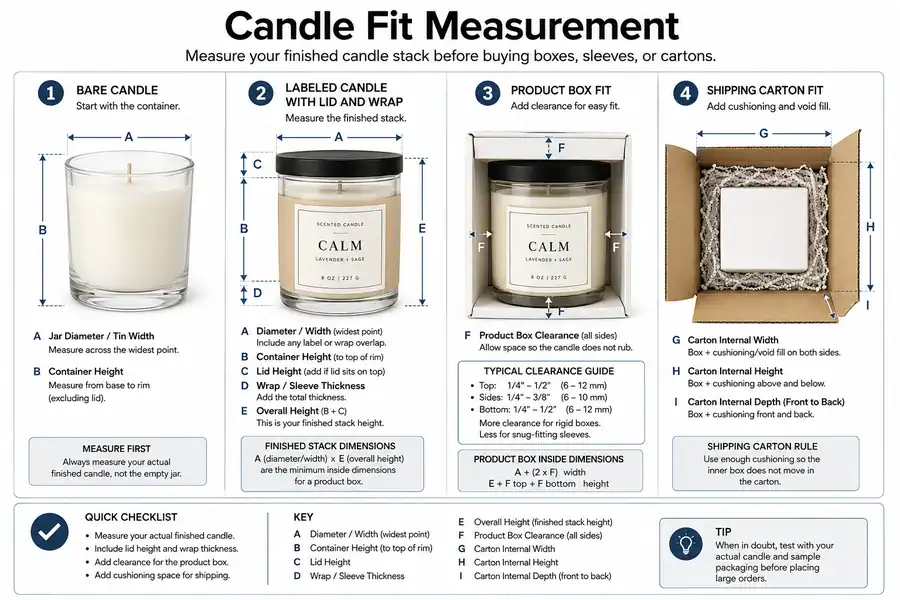
| Measurement point | Why it matters | Beginner check | Mistake prevented |
|---|---|---|---|
| Jar diameter or tin width | Sets the minimum inside width for sleeves, boxes, and wrap. | Measure the widest point, not the narrowest wall. | Buying a box that looks right but will not close. |
| Container height | Decides whether the candle sits cleanly inside a product box. | Measure from base to the highest finished point. | Leaving the lid pressed against the box top. |
| Lid height | Adds height beyond the jar body. | Measure with the actual lid on, not from the jar listing alone. | Crushing, loosening, or scuffing the lid. |
| Label width and placement | Labels can rub when the fit is too tight. | Add the label before testing the box, sleeve, or wrap. | Peeling label edges and scraped print. |
| Warning or care label placement | Bottom or back labels can change how the candle sits or slides. | Check whether labels stay flat after handling. | Hidden, curled, or damaged information. |
| Wrap thickness | Tissue, honeycomb wrap, sleeves, and bands add bulk. | Test the candle after the final wrap layer is added. | A box that fit the jar but not the wrapped candle. |
| Product box clearance | Product boxes need room for the candle without rattling or pressure. | Close the product box and check lid, label, and side contact. | A tight box that damages presentation. |
| Cushioning space | Shipped candles need room for protection outside the product layer. | Check space around the product box or wrapped candle. | A shipping carton with no room for padding. |
| Shipping carton fit | Transit packaging must stop movement after the box is closed. | Close the carton and gently move it to detect shifting. | Rattling, impact marks, or crushed cushioning. |
| Finished stack repeatability | One good fit should work across the batch. | Test more than one candle if lids, labels, or wraps vary. | Packing one sample well but struggling with the rest. |
Do not measure only the jar. A box that fits the bare container may fail after the lid, label, sleeve, tissue, or cushioning is added. A candle should fit snug enough to stop movement, not tight enough to rub labels, crush lids, bend dust covers, or make the package hard to open.
Product-box fit and shipping-box fit are different. A product box is the customer-facing enclosure around the candle. A shipping box is the outer transit carton used when the candle is mailed. Product-box fit protects presentation and surface contact; shipping-box fit manages movement, cushioning, and basic transit handling.
If outer-box sizing turns into dimensional shipping, carton strategy, or warehouse-style packing, keep that work out of the beginner fit check and use retail vs ecommerce candle packaging for the bigger channel decision. If the main issue becomes ordering samples, quantity, or price-per-unit after measurements are known, use candle packaging cost breakdown after fit is tested. The first beginner win is a container fit that closes cleanly, protects the visible surfaces, and does not rattle.
Decide whether each candle needs a product box, sleeve, wrap, or no box
A candle product box and a candle shipping box are not the same thing.
Not every candle needs a product box, but every mailed candle needs shipping protection. The right enclosure depends on whether the candle is sold locally, gifted, displayed, delivered, or mailed, and whether the package needs more protection, cleaner presentation, or both.
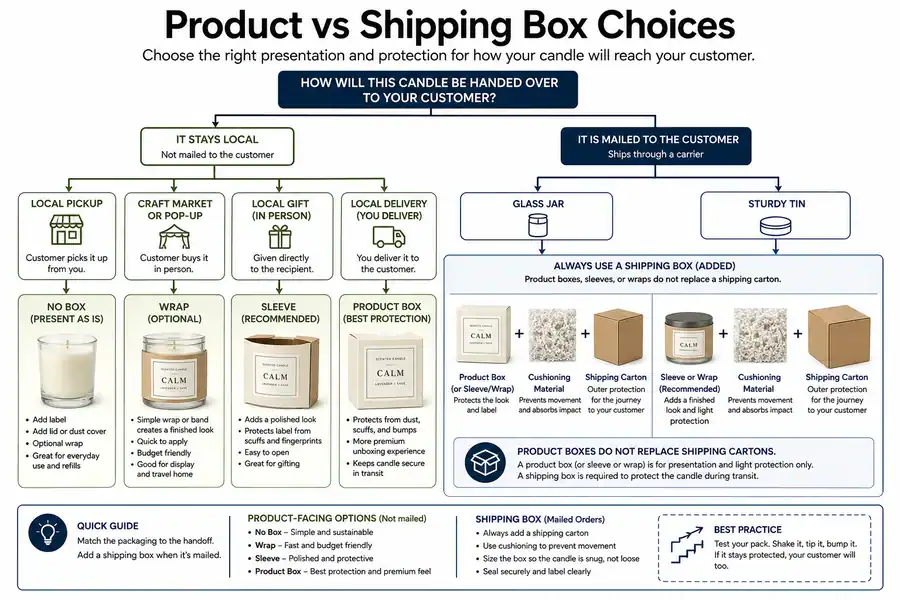
| Sales channel | Product-box need | Alternative | Shipping-box need | Reason |
|---|---|---|---|---|
| Local pickup | Usually optional | Label, warning sticker, simple wrap, or bag | No, unless it will be mailed after pickup | The candle is handed over with little transit risk. |
| Craft market table | Sometimes helpful | Sleeve, belly band, tissue, or no-box presentation | No | A product box can tidy the display, but a clean label may be enough. |
| Local gift | Optional but useful | Tissue, sleeve, ribbon alternative, care card, or simple bag | No | Giftability matters, but luxury layers are not required. |
| Local delivery | Optional | Product box, sleeve, or wrap with light cushioning | Usually no shipping carton, but add protection for movement | The candle may move in a bag or delivery container. |
| Mailed order | Useful but not always required | Wrapped candle inside cushioning and outer carton | Yes | A product box does not replace transit packaging. |
| Market bundle | Sometimes helpful | Coordinated labels, shared tissue, or one insert | No | The buyer sees the set in person, so clarity matters more than heavy enclosure. |
| Online listing order | Depends on presentation promise | Product box or clean wrap shown consistently | Yes when mailed | The package should match what the buyer expects to receive. |
| Sturdy tin candle | Often optional | Label plus dust cover, sleeve, or wrap | Yes when mailed | The container may need less product-facing enclosure but still needs transit protection. |
| Glass jar candle | More likely helpful | Sleeve, wrap, or product box | Yes when mailed | Glass needs more surface and movement protection. |
| Retail shelf display | Often useful, but beyond beginner setup | Product box or display-ready packaging | Depends on fulfillment path | Shelf strategy belongs in a separate channel plan. |
A product box is the customer-facing box around the candle. A sleeve is a lighter band or partial enclosure. A wrap is a flexible presentation or protection layer, such as tissue or paper wrap. No-box presentation means the candle still has a clean label, finish, and handling plan; it does not mean bare, careless, or unprotected. A shipping box is the outer carton used when the candle is mailed.
Do all candles need product boxes? No. Does a product box count as shipping protection? Not by itself. Can no-box packaging look professional? Yes, if the label, lid, wrap, and finish look clean and the sales channel does not require a stronger product-facing enclosure.
Choose the enclosure by risk. If the candle is handed to the customer, start with label clarity, surface protection, and giftability. If the candle is mailed, separate the customer-facing layer from the outer shipping carton. If shelf display or mailed-order strategy becomes the main question, use retail vs ecommerce candle packaging rather than forcing one box rule onto every candle.
For decorative variants, candle label and gift packaging ideas can help when the real question is how the package should look for gifting. For beginner decision-making, choose candle packaging that protects and sells by asking whether the box, sleeve, wrap, or no-box choice matches the candle’s channel and handling risk. The enclosure decision should come before label styling, because the layer around the candle affects what the customer sees first.
Make the candle look clean, readable, and sellable without turning this into branding
Label presentation is part of candle packaging because it changes how clear, clean, and sellable the candle looks.
A beginner candle label should make the candle readable, aligned, and ready to sell before advanced branding. This is presentation guidance, not full legal labeling compliance, logo design, or brand identity work.
| Label issue | Visual signal | Packaging cause | Beginner fix |
|---|---|---|---|
| Crooked front label | The scent name or maker name looks tilted. | Label applied without a center mark or before the jar position is checked. | Mark a light placement guide and apply labels before wrapping. |
| Label too low or too high | The candle looks unbalanced from the front. | Label placed by guesswork instead of repeated placement. | Choose one label height and repeat it across the batch. |
| Label edge lifts | The label corner catches on tissue, sleeve, or wrap. | The product box, sleeve, or wrap rubs the label edge. | Check rub points before bulk packing or ordering more labels. |
| Smudged print | The label looks handled or damp. | Label ink, adhesive, or finish did not set before packaging. | Let labels set before wrapping and avoid wiping over fresh print. |
| Hidden warning or care information | Needed information is covered by wrap, tissue, or a band. | Presentation layers were added after labeling without a visibility check. | Place communication where it remains readable after packaging. |
| Cluttered front view | Too many stickers, cards, bands, or design elements compete. | Decoration was added before the main label job was clear. | Keep the front label readable before adding extras. |
| Homemade-looking finish | Label, lid, wrap, and jar do not line up visually. | Each layer was chosen separately instead of checked as one package. | Inspect the full candle packaging stack from the customer’s view. |
| Rubbing inside the box | The label looks scraped after boxing. | Product-box fit is too tight or the label faces a rough surface. | Use a better fit, rotate the label position, or change the wrap layer. |
| Weak scent clarity | The buyer cannot quickly identify the candle. | Scent name is small, hidden, or competing with decoration. | Make the scent name easy to read on the main viewing side. |
| Overdesigned presentation | The package looks busy before it looks clear. | Branding extras were added too early. | Add only layers that protect, present, ship, or communicate. |
Presentation means clean, readable, giftable, and sellable appearance. It does not mean full brand identity, logo design, seasonal packaging galleries, or legal label interpretation. Candle labels may have safety or regional requirements, but this beginner packaging setup only covers how the label functions as part of the package.
A label has two basic packaging jobs. It identifies the candle for the buyer, and it helps the finished package look intentional. Warning or care communication has a different job: it helps the candle leave your hands with clearer use information. Do not hide that information under a sleeve, tissue wrap, or insert.
Labels can be damaged by packaging fit. A tight box, sliding sleeve, rough tissue, or wrap pulled across the front label can scrape print, lift edges, or make the candle look handled. If label wording, gift presentation, or decorative variants become the main issue, candle label and gift packaging ideas belongs outside this beginner presentation check. If label paper, box, insert, and shipping-protection prices become the main issue, use candle packaging cost breakdown after the label placement works.
Keep packaged candles clean, fresh, and smudge-free
Fresh packaged candles look clean, smudge-free, readable, and free from avoidable packaging odor or transfer.
Clean candle packaging protects the visible finish, label, jar surface, and scent impression from dust, smudges, fingerprints, and avoidable transfer. Fresh means clean, smudge-free, readable, and fresh-feeling; it does not prove fragrance longevity or fix candle-making defects.
| Cleanliness risk | Packaging cause | Prevention step | Beginner fix |
|---|---|---|---|
| Fingerprints on glass | Candle handled after the final wipe. | Handle the jar by the base or lid area after cleaning. | Wipe again only if it will not damage the label or finish. |
| Dust on wax top | Candle packed without a lid, dust cover, or clean holding area. | Cover the wax before storage, wrapping, or boxing. | Add a lid, dust cover, or cleaner staging step. |
| Label smudges | Candle wrapped before ink, adhesive, or finish settles. | Let labels set before tissue, sleeves, or boxes touch them. | Replace smudged labels instead of hiding them with wrap. |
| Label edge rub | Sleeve, tissue, or product box scrapes the label edge. | Check label contact after one complete pack. | Adjust fit or change the layer touching the label. |
| Tissue lint | Low-quality or shedding paper touches glossy surfaces. | Test tissue against one finished candle before packing the batch. | Switch to cleaner wrap or keep tissue away from visible jar areas. |
| Dusty void fill | Crinkle paper or packing paper sheds into the product area. | Keep presentation fill separate from dusty outer-box fill. | Use cleaner fill near the candle and rougher fill outside the product layer. |
| Scent transfer | Different scents stored tightly together before sale. | Separate finished scents during storage and packing. | Bag, box, or group candles by scent when transfer is noticeable. |
| Residue from tape or stickers | Adhesive touches the jar, lid, or visible wrap. | Keep tape on the outer package, not on clean product-facing surfaces. | Remove residue only if the finish will not be damaged. |
| Smudged lid sticker | Lid sticker applied before the lid surface is clean or dry. | Clean the lid before applying top stickers. | Reapply the sticker after checking the lid surface. |
| Handled-looking package | Packing order forces repeated touching after the candle is finished. | Finish label, wrap, box, and final inspection in one repeatable order. | Move final wipe and inspection closer to the end of the workflow. |
Candles often look dusty or smudged after packaging because the final handling step is missing. A candle can be clean after labeling and messy after wrapping if tissue sheds, labels rub, fill dust spreads, or the jar is handled too many times. Cleanliness is part of presentation quality because buyers read smudges, dust, and residue as lower care.
Scent preservation is a packaging issue only when the package prevents avoidable transfer, dust, or handling contamination. It is not proof of fragrance longevity, candle cure quality, or fragrance formulation performance. If fragrance science, curing, or long-term storage becomes the main question, keep it outside this beginner packaging setup.
Use a short final-check sequence before packing the batch. Check the wax top, jar surface, label face, label edge, lid, wrap contact, and scent grouping. Then pack one candle completely and inspect it again after handling. If the candle looks worse after packaging than before, the issue is usually contact, dust, pressure, or sequence.
Add useful inserts only when they clarify care, gifting, or customer experience
Packaging inserts are optional unless they perform a clear communication job.
A packaging insert is a printed or digital extra that supports the candle package with care instructions, thank-you messaging, gift notes, QR guidance, or simple customer reassurance. Care cards, thank-you cards, QR cards, and gift notes can help, but they should not repeat labels or turn the package into clutter.
| Insert type | Main job | Beginner verdict | Skip-if condition |
|---|---|---|---|
| Care card | Explain basic candle use and care. | Keep when care instructions are not already clear. | Skip if the label or package already explains the same information clearly. |
| Thank-you card | Add a short personal or customer-friendly note. | Optional for gifts, small orders, and local customers. | Skip if it crowds the package or repeats a brand message with no use. |
| QR care card | Point buyers to care details without printing a long card. | Optional when the QR destination is stable and useful. | Skip if the buyer needs information without using a phone. |
| Gift note | Make the candle feel ready to give. | Useful for gifts and local orders. | Skip if it turns into a long brochure or seasonal gift theme. |
| Scent note | Clarify scent name, mood, or collection. | Optional when the label is too small for scent details. | Skip if the scent is already obvious on the front label. |
| Burn reminder card | Reinforce simple first-burn or trimming guidance. | Useful when customers are new to candles. | Skip if it repeats a care card word for word. |
| Discount card | Invite a future purchase. | Usually wait until the package basics are working. | Skip if it shifts the package into a retention system. |
| Brand story card | Explain the maker or small-batch origin. | Optional and short. | Skip if it becomes a full brand brochure. |
| Warning duplicate card | Repeat required or care-related warnings. | Use only when information would otherwise be missed. | Skip if it creates confusion with the main warning label. |
| Decorative insert | Add visual polish only. | Usually skip early. | Skip if it has no care, gift, or customer-use job. |
A care card is not the same as a warning label. A care card explains helpful use steps, while warning or safety information should stay visible where the customer can find it. A thank-you card is useful when it adds warmth, but it becomes clutter when it competes with care instructions, labels, or gift notes.
Do all candles need care cards? Not always, but they help when care instructions are not already clear. Should beginners include multiple inserts? Only if each insert has a separate useful job. A QR card can reduce printed clutter, but a printed care card is better when the customer needs the information immediately.
Simple extras should clarify care, gifting, or customer experience. They should not open a luxury unboxing plan, email flow, seasonal gift guide, or full customer-retention system. If decorative inserts become the main question, candle label and gift packaging ideas can carry that idea layer. For this beginner setup, use choose candle packaging that protects and sells as the filter: every insert should protect trust, present the candle clearly, or communicate something the buyer needs.
Make candles giftable without building a luxury unboxing system
Giftable candle packaging makes the candle ready to give without luxury packaging.
Giftable packaging means clean, intentional, repeatable presentation that still protects the candle. It can use a label, wrap, box, insert, or finishing touch, but it should not turn into a seasonal design gallery, premium unboxing bundle, or full visual brand system.
| Gift layer | Beginner use | Protection impact | Complexity level | Skip-if condition |
|---|---|---|---|---|
| Clean front label | Makes the candle identifiable and sellable. | Helps by reducing confusion and making the package feel complete. | Low | Skip redesigning if the current label is readable and aligned. |
| Tissue wrap | Adds a soft gift-ready layer for handoff. | Helps lightly, but does not replace cushioning. | Low | Skip if it sheds lint, rubs the label, or touches the wax top. |
| Belly band | Adds a tidy finish around a jar or box. | Neutral unless it holds wrap in place. | Low | Skip if it slides, wrinkles, or hides needed information. |
| Simple product box | Makes the candle feel ready to hand over. | Helps when fitted without pressure. | Medium | Skip if the candle is local-only and already looks clean without it. |
| Care card | Gives the recipient useful burn guidance. | Helps by reducing confusion after gifting. | Low | Skip if it repeats visible care information. |
| Gift note | Adds a personal handoff touch. | Neutral | Low | Skip if the package is not being given as a gift. |
| Ribbon or tie | Adds decoration to a wrapped or boxed candle. | Can hurt if it crushes, loosens, or rubs the package. | Medium | Skip if it slows packing or makes the package harder to repeat. |
| Crinkle paper in a gift box | Fills space and improves presentation. | Helps only if it stops movement. | Medium | Skip if the candle still shifts after closing the box. |
| Scent card | Adds scent details for a gift recipient. | Neutral | Low | Skip if it repeats the main label. |
| Multi-insert bundle | Creates an unboxing feel. | Often neutral or negative for beginners. | High | Skip until the base package protects, presents, and communicates well. |
Does giftable packaging require a product box? Not always. A clean label, tidy tissue wrap, and one useful card can feel gift-ready for local handoff or a market purchase. Does giftable mean luxury? No; giftable means ready to give, while luxury packaging usually adds custom materials, premium finishes, layered inserts, and a more complex opening experience.
Gift packaging can reduce protection when decorative layers rub labels, press on lids, loosen the package, or hide useful information. That is why giftable candle packaging should pass the same checks as the rest of the package: clean label, protected surface, stable fit, readable information, and repeatable process. Ribbons, multiple inserts, and decorative wraps should be used only when they stay easy to repeat and do not clutter the package.
If the decision becomes decorative, seasonal, or inspiration-led, candle label and gift packaging ideas is the better place for visual examples. If the question is whether the gift layer helps the candle look sellable without weakening protection, choose candle packaging that protects and sells is the better filter. Use giftable candle packaging ideas only after the simple package already looks clean, readable, protected, and easy to hand over.
Check packaging presentation before product photos or online listings
Photo-ready candle packaging is clean, readable, aligned, and uncluttered before the camera matters.
Photo-ready candle packaging means the label, box, wrap, insert, and visible product-facing details look clear enough for a listing or social post. This is a packaging inspection step, not a candle photography tutorial, listing SEO lesson, social strategy plan, or logo design project.
Check the front label, scent name, jar surface, lid, wax top, wrap, box, insert count, and whether the package matches what the customer will actually receive. Fix packaging clarity before lighting, editing, or listing work because crooked labels, smudges, dents, and clutter are package problems first.
Photo-ready does not mean styled, premium, or heavily edited. It means the customer can understand the candle from the visible packaging: scent, finish, wrap, box, care card, and main presentation layer. If the problem is gift inspiration, candle label and gift packaging ideas can carry that visual work; if the problem is camera setup, listing optimization, or brand design, it belongs outside this beginner packaging check.
Add shipping protection only when the candle will be mailed
Shipping packaging is added only when the candle will be mailed.
Shipping-ready candle packaging adds an outer shipping box, cushioning, movement control, sealing, and a basic check around the product-facing package. A mailed candle needs shipping protection in addition to product packaging; local pickup, market sales, and hand-delivered gifts may not need the same outer carton and cushioning.
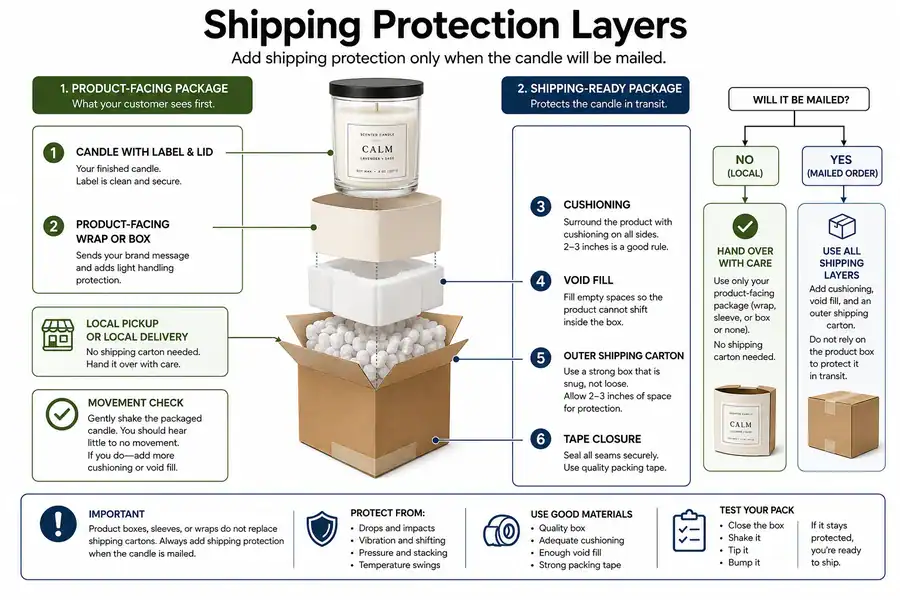
| Shipping layer | Failure signal | Beginner fix | When to use a deeper plan |
|---|---|---|---|
| Product-facing package | Label rubs, lid scuffs, wrap shifts, or box looks crushed. | Fix the label, lid, wrap, or product box before adding transit layers. | Use broader packaging strategy when the product layer itself is unclear. |
| Outer shipping box | Candle touches the sides or has no room for cushioning. | Use a carton that leaves room for protective material around the product package. | Use retail vs ecommerce candle packaging when channel strategy becomes the main question. |
| Cushioning around the candle | Jar, tin, lid, or product box gets marked during handling. | Add protective wrap or padding around the candle before filling empty space. | Move to deeper transit planning if repeated damage continues. |
| Void fill | Candle rattles, slides, or shifts after the box is closed. | Fill open space so the candle cannot move under ordinary handling. | Use the next movement-control section for fill choices. |
| Label and lid protection | Label scratches, lid dents, or dust cover bends in transit. | Keep hard contact away from the front label, lid edge, and top surface. | Move to lid and surface protection when cosmetic damage is the main issue. |
| Sealing | Box opens, tape lifts, or edges feel weak. | Seal the carton cleanly and check corners, seams, and closure points. | Do not turn this into carrier-policy detail. |
| Local-sale package | Candle is overpacked for handoff or market pickup. | Skip the shipping carton when the candle is not being mailed. | Use channel-path guidance when local and mailed orders are mixed. |
| Mailed-order package | Candle is sent with only tissue, sleeve, or product box. | Add outer transit protection and movement control. | Use ecommerce packaging guidance when mailed orders become frequent. |
| Heat-sensitive order | Wax softens, melts, sweats, or changes during warm transit. | Keep this outside basic shipping readiness. | Use hot-weather candle shipping for temperature, insulation, and cold-pack decisions. |
| Shipping cost concern | The package becomes too large, heavy, or material-heavy. | First make the package safe enough for ordinary mailing, then review cost. | Use candle packaging cost breakdown when pricing and supply math become the main decision. |
Does every candle need shipping packaging? No. A candle handed to a customer locally may need clean product presentation but not an outer shipping carton. Does product packaging replace a shipping box? No. A product box can improve presentation and surface protection, but it is not the same as an outer transit layer.
A basic beginner shipping sequence is simple: finish the product-facing package, protect labels and lids, choose an outer box, cushion the candle, fill empty space, seal the carton, then check for movement. This covers basic domestic small-seller mailed-order readiness. It does not cover carrier-specific rules, international shipping, hazardous-material interpretation, insurance claims, or heat-proof packaging.
Local packaging and mailed-order packaging should branch before the outer box is chosen. If the candle is picked up at a market, the goal is clean, readable, giftable presentation. If the candle is mailed, the goal becomes product presentation plus transit protection. If the question becomes summer logistics, cold packs, or shipping candles in heat, that needs a separate shipping plan rather than a small add-on to this beginner setup.
Stop the candle from moving inside the shipping box
Void fill is protective only when it stops movement.
Cushioning and void fill are the protective materials that stop a packaged candle from rattling, rubbing, or taking direct contact inside the shipping carton. Decorative filler improves appearance only; it becomes protective only when it also immobilizes the candle without crushing labels, lids, wraps, or product boxes.
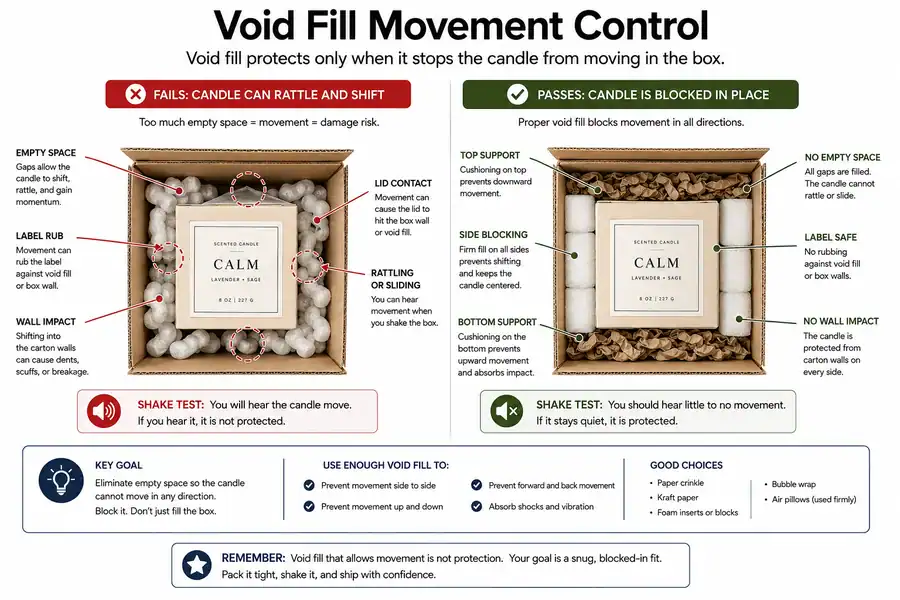
| Fill type | Movement signal | Beginner fix | When to use a deeper plan |
|---|---|---|---|
| Kraft paper | Candle slides or bumps the carton wall. | Crumple paper firmly enough to block side movement. | Use broader guidance when the shipping setup needs more than ordinary movement control. |
| Crinkle paper | Candle still rattles after the box is closed. | Add denser fill or combine it with wrap around the candle. | Crinkle paper is protective only if it stops movement and does not collapse too much. |
| Honeycomb wrap | Jar surface is protected, but the candle still shifts. | Wrap the candle, then fill the remaining empty space. | Use deeper shipping planning if the package keeps failing in transit. |
| Bubble wrap | Candle feels cushioned, but the product box crushes or label rubs. | Keep cushioning firm without pressing on the label, lid, or box corners. | Move out of beginner guidance when formal transit testing is needed. |
| Air pillows | Empty space looks filled, but the candle moves between pillows. | Use pillows only where they block movement instead of floating around the candle. | Use larger shipping strategy when carton sizes vary often. |
| Tissue paper | Candle looks nicer, but movement remains. | Use tissue for presentation, then add true cushioning or void fill. | Tissue paper is not enough for shipping by itself. |
| Packing peanuts | Candle settles to one side after handling. | Pack firmly and recheck movement after closing the carton. | Use a different fill if settling creates gaps. |
| Product box only | Candle arrives with rubbed corners, lid marks, or jar contact. | Add an outer shipping carton with cushioning around the product package. | Use retail vs ecommerce candle packaging when product packaging and transit packaging need separate planning. |
| Too much soft fill | Box looks full, but the candle still sinks or shifts. | Use firmer blocking around the candle instead of loose volume. | Use a deeper shipping test process if movement keeps returning. |
| Tight fill | Lid, label, sleeve, or product box gets crushed. | Reduce pressure and protect the contact point with a better fit. | Use choose candle packaging that protects and sells when the package needs a better balance between protection and presentation. |
The candle should not have obvious rattling or sliding after the box is closed. A small amount of material inside the box is not enough if the candle can still move. Too much loose material can fail for the same reason, because it fills space without controlling movement.
Pretty fill does not automatically protect the candle. Crinkle paper, tissue, or paper shred can make a package look finished, but the protective job is movement control. If the candle rattles, rubs the label, dents the lid, or hits the carton wall, the fill is not doing enough.
Use a simple movement check before repeating the package. Close the shipping box, hold it level, and gently move it side to side. Listen for rattling, feel for sliding, then reopen the box and inspect the lid, label, wrap, product box, and jar. If the candle moved, add firmer support at the sides, top, bottom, or corners.
This beginner check is not formal lab testing or carrier certification. It only checks ordinary small-seller movement risk inside a shipping carton. Heat insulation, cold packs, and hot-weather candle shipping belong outside this section because temperature protection is a different packaging problem.
Follow a repeatable candle packaging workflow for local sales and shipped orders
A beginner candle packaging workflow works best when inspection, cleaning, labeling, wrapping, inserts, shipping protection, sealing, and testing happen in the same repeatable order.
A beginner candle packaging workflow is the repeated order for inspecting, cleaning, labeling, wrapping, protecting, boxing, cushioning, sealing, and checking each candle. The goal is a small-batch sequence with few decisions, not a warehouse system, inventory app, subscription-box process, or large production workflow.
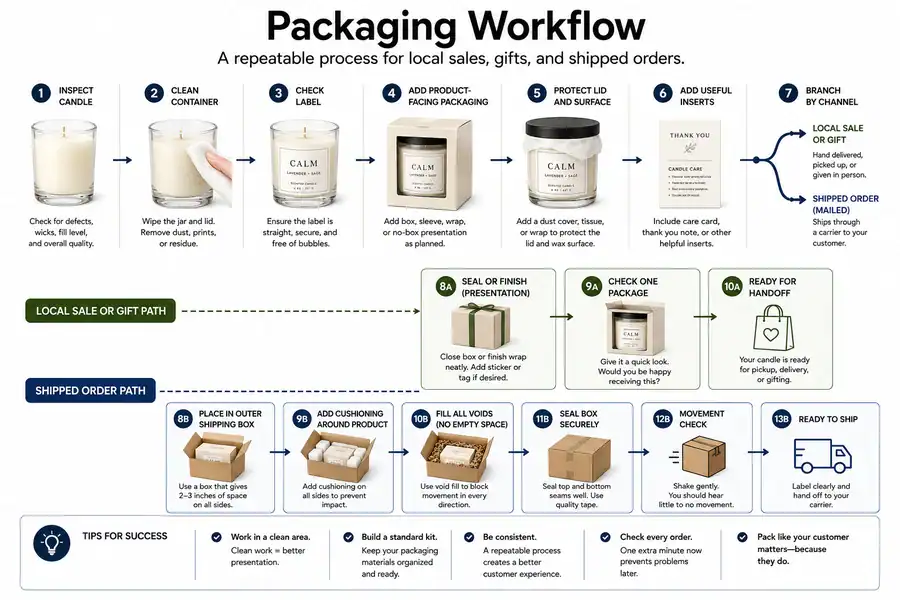
| Workflow step | Local sale action | Shipped order action | Mistake prevented |
|---|---|---|---|
| Inspect the finished candle | Check the jar, tin, lid, wax top, and visible finish before adding packaging. | Check the same parts before any product or transit layer is added. | Hiding surface damage under wrap or boxes. |
| Clean the container | Wipe fingerprints, dust, or residue from the visible surface. | Clean the product-facing surface before cushioning or boxing makes access harder. | Sending candles that look handled or dusty. |
| Check label placement | Confirm the front label is straight, readable, and fully set. | Confirm the label will not rub against wrap, box, or cushioning. | Wrapping before checking label alignment. |
| Add product-facing packaging | Use a label, sleeve, tissue, product box, insert, or simple gift layer when needed. | Use the same product-facing layer before adding transit protection. | Confusing product presentation with shipping protection. |
| Protect lid and surface | Check the lid, dust cover, wax top, and label edge after wrapping. | Check those same contact points before the candle goes into the shipping carton. | Creating scuffs, dents, or label rub during packaging. |
| Add useful inserts | Add a care card, thank-you card, or gift note only when it helps the buyer. | Add the insert where it will not press on the candle or loosen the fit. | Crowding the package with cards that do not help. |
| Branch by channel | Stop at clean, giftable, sellable presentation for markets, pickup, gifts, or local delivery. | Add outer box, cushioning, void fill, seal, and movement check. | Adding shipping materials to every local package. |
| Seal or finish the package | Close the wrap, bag, sleeve, or product box cleanly. | Seal the outer carton after movement is controlled. | Closing the package before the candle is stable. |
| Check one finished package | Inspect the finished local package from the customer’s view. | Check movement, label rub, lid contact, and box closure before repeating. | Repeating a weak package across a full batch. |
| Repeat the same order | Use the same steps across the batch unless the channel changes. | Use the same steps, then add shipping checks only for mailed orders. | Inconsistent-looking candles and slow packing. |
The basic order is inspect, clean, label, wrap or box, add inserts if useful, branch by channel, cushion for shipping, seal, then test one finished package. Labels should be checked before wrapping because wraps, sleeves, boxes, and cushioning can hide crooked labels or create rub points. Local and shipped orders should not be packaged the same way because shipped orders need extra transit steps.
A repeatable order prevents rework. If labels are checked late, the candle may need to be unwrapped. If shipping fill is added before the product-facing package is stable, the candle can still arrive cleanly boxed but scuffed or unreadable. If every candle gets shipping materials, local orders become slower, bulkier, and more expensive than needed.
Use choose candle packaging that protects and sells when the workflow reveals a bigger packaging decision, such as whether a sleeve, box, wrap, or insert should stay in the package. Use retail vs ecommerce candle packaging when local display and mailed-order strategy become two separate packaging systems rather than one beginner branch.
This is not a fulfillment-system workflow. It is a small-batch order for first batches, first sales, local gifts, market orders, and basic mailed orders. If the work turns into warehouse packing, subscription-box operations, inventory software, or large-batch production, it has moved outside beginner candle packaging.
Test one finished package before selling or mailing candles
Test one finished candle package before repeating the setup.
A beginner candle packaging test pack is a trial package checked for movement, rubbing, lid stability, label damage, surface scuffs, and shipping-layer weakness before selling or mailing candles. Ship-ready means checked for ordinary beginner handling and mailed orders, not certified, carrier-approved, insured, or guaranteed damage-proof.
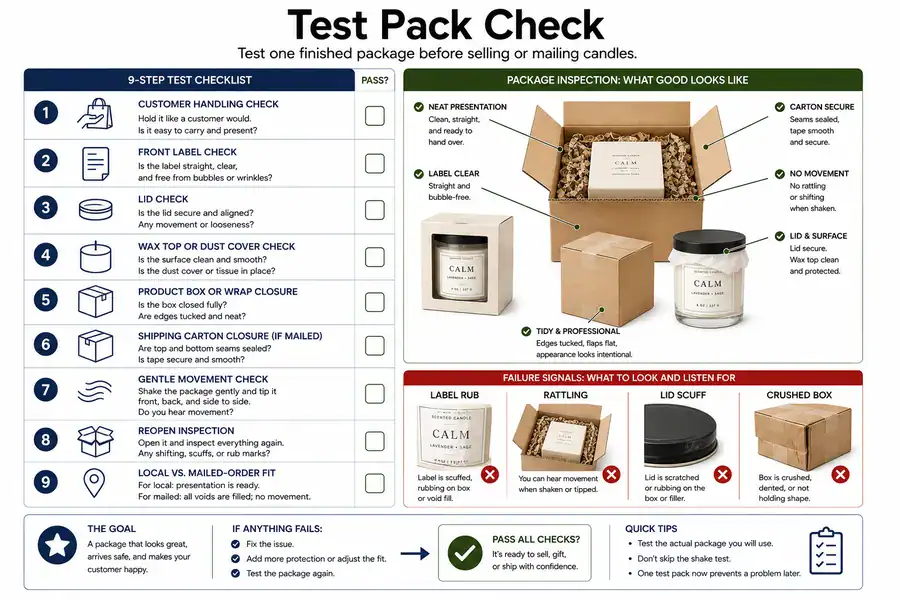
| Test step | Failure signal | Likely cause | Beginner fix |
|---|---|---|---|
| Hold the finished package as a customer would. | The wrap slides, the sleeve loosens, or the candle feels unfinished. | Product-facing packaging is not stable enough. | Adjust the wrap, sleeve, label placement, or product box before packing the batch. |
| Check the front label after handling. | Label edges lift, print rubs, or the label looks scraped. | Tissue, sleeve, box wall, or cushioning is rubbing the label. | Add clearance, rotate the label away from contact, or change the touching layer. |
| Check the lid. | The lid shifts, dents, rattles, or looks scuffed. | Packaging pressure or empty space is affecting the top of the candle. | Reduce pressure on the lid and block movement around the candle. |
| Check the wax top or dust cover. | Dust, scuffs, dents, or surface marks appear. | The wax top or dust cover is being touched during packing. | Add a lid, dust cover, or non-contact product layer. |
| Close the product box or wrap. | The package bulges, crushes, or will not close cleanly. | The candle, lid, label, or wrap is too large for the product-facing layer. | Recheck finished stack measurements before ordering more supplies. |
| Close the shipping carton. | The candle touches the carton wall or has no cushioning space. | The outer box is too small or the product package is too large. | Choose a carton with room for protective material around the candle. |
| Move the closed shipping carton gently. | Rattling, sliding, or shifting is obvious. | Void fill is not immobilizing the candle. | Add firmer support at the sides, top, bottom, or corners. |
| Reopen the package after the movement check. | The candle looks worse than before it was packed. | Internal rubbing or pressure was missed. | Fix the contact point before mailing or repeating the setup. |
| Check outer-box strength by hand. | Corners cave, tape lifts, or the carton feels weak. | The shipping layer is not strong enough for ordinary handling. | Use a stronger carton, better closure, or tighter movement control. |
| Compare the test package to the sale channel. | A local order is overpacked, or a mailed order is underprotected. | One package is being used for every channel. | Branch local presentation and mailed-order protection before packing the batch. |
A shake or movement check is not formal certification. It is a beginner validation step that catches the most visible failures before the customer receives the candle. Beginners should test packaging before bulk orders because one bad fit can affect every box, sleeve, label, insert, and shipping carton in the next purchase.
Ship-ready does not mean guaranteed damage-proof. It means the candle has passed a basic check for movement, rub, lid stability, surface protection, and outer-box weakness under ordinary small-seller conditions. If the topic turns into formal transit testing, carrier claims, insurance, or certification, keep the beginner test short and move the deeper channel question to retail vs ecommerce candle packaging.
Heat is a separate test. A package can pass the movement check and still fail in warm transit if the wax softens, sweats, or changes. Use hot-weather candle shipping or shipping candles in heat only when temperature exposure, insulation, or cold packs become the main packaging risk.
How this failure log was built: The test steps are grouped by product-facing damage, shipping movement, lid stability, label rub, and outer-box weakness. The log gives a practical readiness check, not laboratory testing, carrier approval, damage-claim guidance, or a promise that the package cannot fail. The result should help beginners choose candle packaging that protects and sells by upgrading only the part that fails the test.
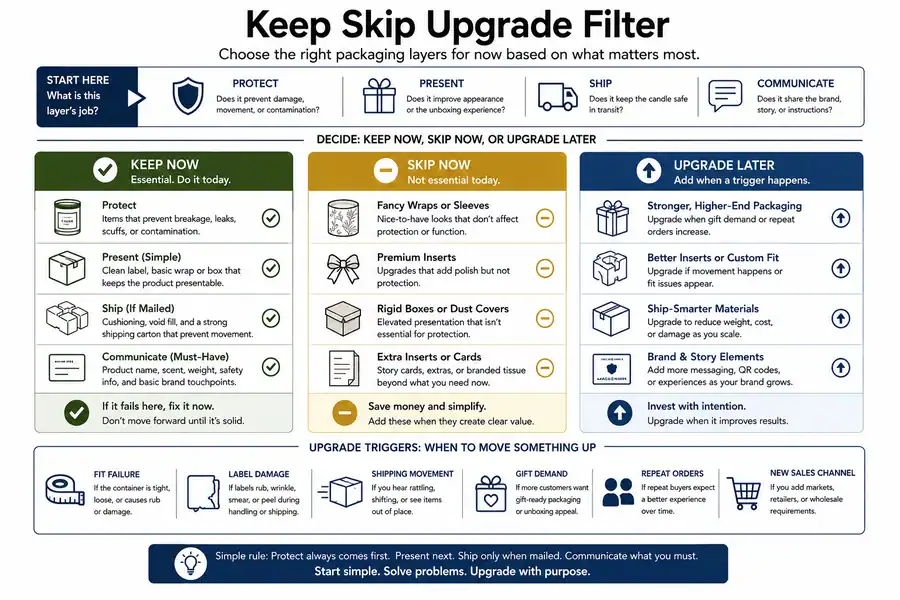
Use a keep-now, skip-now, upgrade-later filter
Beginners should judge every candle packaging layer by the job it performs now: protect, present, ship, or communicate.
Beginners should keep packaging layers that protect, present, ship, or communicate clearly now, and skip layers that add cost, time, or clutter without solving a current need. Without overcomplicating means purposeful simplicity, not bare, cheap-looking, unsafe, under-labeled, or under-protected packaging.
| Packaging extra | Beginner verdict | Why | Upgrade trigger | When to use a deeper plan |
|---|---|---|---|---|
| Clean front label | Keep now | It makes the candle readable and sellable. | Upgrade when labels smear, lift, or look inconsistent. | Use label planning only when wording, finish, or design becomes the main issue. |
| Warning or care information | Keep now when the candle leaves your hands. | It communicates basic use information. | Upgrade when placement or readability is weak. | Keep compliance detail outside this beginner setup. |
| Product box | Optional now | It can protect and present, but not every candle needs one. | Upgrade when jars scuff, gifts need polish, or market display looks messy. | Use cost or channel planning if box choice becomes a larger decision. |
| Sleeve or belly band | Optional now | It tidies the package with low complexity. | Upgrade when it improves presentation without rubbing labels. | Use candle label and gift packaging ideas if decorative variants become the main need. |
| Tissue wrap | Optional now | It can make local sales and gifts feel cleaner. | Upgrade when handoff or gifting needs a repeatable finish. | Use giftable candle packaging ideas when gift presentation expands beyond a simple finish. |
| Multiple inserts | Usually skip now | More cards can clutter the package. | Upgrade when each card has a separate care, gift, or customer-use job. | Use a presentation-focused page if inserts become design-led. |
| Ribbon or decorative tie | Usually skip now | It can slow packing and add no protection. | Upgrade when it stays repeatable and does not hide needed information. | Keep luxury unboxing outside the beginner stack. |
| Custom printed box | Usually skip now | It adds cost and commitment before fit and channel are proven. | Upgrade after repeat sales, stable dimensions, and clear presentation need. | Use candle packaging cost breakdown when pricing, bulk orders, or cost-per-unit planning takes over. |
| Premium mailer | Usually skip now | It may add polish before transit protection is solved. | Upgrade when mailed-order volume and customer expectation justify it. | Use channel planning if mailing becomes frequent. |
| Extra void fill for local sales | Skip now | It solves a shipping problem that local handoff may not have. | Upgrade only when candles will be mailed or moved in delivery. | Use retail vs ecommerce candle packaging when local and mailed paths separate. |
| Brand story brochure | Usually skip now | It can become clutter before the candle package is clear. | Upgrade when buyers need a short story and the base package already works. | Keep full brand identity outside this beginner packaging path. |
| Decorative box filler | Optional later | It can present well, but only helps if it also controls movement. | Upgrade when it supports gift presentation or shipping stability. | Use choose candle packaging that protects and sells when protection and presentation must be balanced. |
Keep-now packaging solves an immediate job. Skip-now packaging adds clutter, time, or cost before the candle needs it. Upgrade-later packaging becomes useful after a trigger appears, such as fit failure, label damage, shipping movement, gift demand, repeat customer expectation, or a new sales channel.
Simple packaging can still look professional when it is clean, protective, and intentional. Beginners can skip inserts if the label or product page already communicates the needed information. Beginners can sometimes skip product boxes for local sales, but they should not skip shipping protection when the order is mailed.
Useful simplicity and under-packaging are different. Useful simplicity removes extras that do not help. Under-packaging removes layers the candle needs to stay clean, readable, stable, safe to hand over, or ready for mailing. The filter should cut decorative overload first, not protection, communication, or movement control.
Upgrade packaging only when a clear trigger appears
Upgrade candle packaging when a clear protect, present, ship, or communicate trigger appears.
A candle packaging upgrade ladder is the staged path from starter packaging to better protection, presentation, shipping confidence, and later brand polish. Beginners should fix fit, protection, and label issues before spending on custom boxes, luxury materials, or a full redesign.
| Upgrade stage | Trigger | What changes | Wait-before-buying note | When to use a deeper plan |
|---|---|---|---|---|
| Fit upgrade | Product boxes, sleeves, or wraps are too tight, loose, or hard to repeat. | Change box size, sleeve size, wrap method, or container fit. | Do not buy bulk packaging until the finished candle stack fits. | Use cost planning only after fit is stable. |
| Protection upgrade | Lids scuff, labels rub, jars mark, or wax tops collect dust. | Add better spacing, dust cover protection, cleaner wrap, or a product box. | Do not upgrade decoration before contact damage is fixed. | Use choose candle packaging that protects and sells when protection and presentation need balancing. |
| Label upgrade | Labels smear, lift, wrinkle, or look inconsistent across the batch. | Change label material, size, placement process, or wrap contact points. | Do not redesign the whole brand for a label-fit problem. | Use candle label and gift packaging ideas when label presentation becomes the main need. |
| Cleanliness upgrade | Candles look dusty, handled, linty, or smudged after packing. | Add a final wipe step, cleaner staging area, better wrap, or better storage. | Do not add more inserts or decoration to hide mess. | Keep this inside the packaging workflow unless storage becomes the main issue. |
| Shipping upgrade | The mailed package rattles, shifts, crushes, or arrives marked. | Improve outer box fit, cushioning, void fill, sealing, or movement checks. | Do not buy premium mailers before movement control works. | Use channel-specific shipping guidance only when mailed orders become frequent. |
| Gift upgrade | Buyers request gift-ready presentation or local gifts look unfinished. | Add tissue, a simple box, one useful card, or a tidy finishing layer. | Do not add multiple decorative layers before the base gift package works. | Use gift-focused ideas when gifting becomes the main package reason. |
| Channel upgrade | You move from local handoff to delivery, mail, markets, or online orders. | Branch the packaging path by channel instead of using one stack. | Do not make every local candle shipping-grade. | Use channel planning when local and mailed orders need separate systems. |
| Quantity upgrade | The same packaging stack works across repeat batches. | Buy larger quantities of the supplies already tested. | Do not bulk buy supplies that still need fit, label, or shipping tests. | Use candle packaging cost breakdown when price-per-unit planning takes over. |
| Presentation upgrade | The package protects well but looks unclear, plain, or inconsistent. | Improve label alignment, front view, wrap neatness, or box finish. | Do not jump to custom packaging when standard supplies can fix the issue. | Keep the change tied to presentation clarity. |
| Brand polish upgrade | Repeat sales and customer expectations justify a more finished look. | Consider custom materials, printed boxes, or a more consistent package family. | Do not treat this as the first beginner step. | Keep rebrand planning and return math outside this beginner setup. |
A packaging upgrade is a staged improvement tied to a real need. An upgrade trigger is the event that proves the current setup is not working well enough, such as test-pack failure, label damage, shipping movement, gift demand, repeat orders, or a new sales channel. Better packaging means better fit for the candle, customer, and channel, not automatically more expensive packaging.
What should be upgraded first? Upgrade the weakest function: fit, protection, label clarity, or shipping reliability. Should beginners buy custom boxes first? Usually no. Should upgrades wait until after testing? Yes, because the test shows which part of the package actually failed.
Starter packaging and upgraded packaging should share the same purpose. The starter setup protects, presents, ships when needed, and communicates clearly. The upgraded setup does those same jobs with fewer weak points, better repeatability, or a clearer customer experience. If the upgrade discussion turns into return math, full rebrand planning, luxury unboxing, or custom procurement, it has moved outside beginner candle packaging.
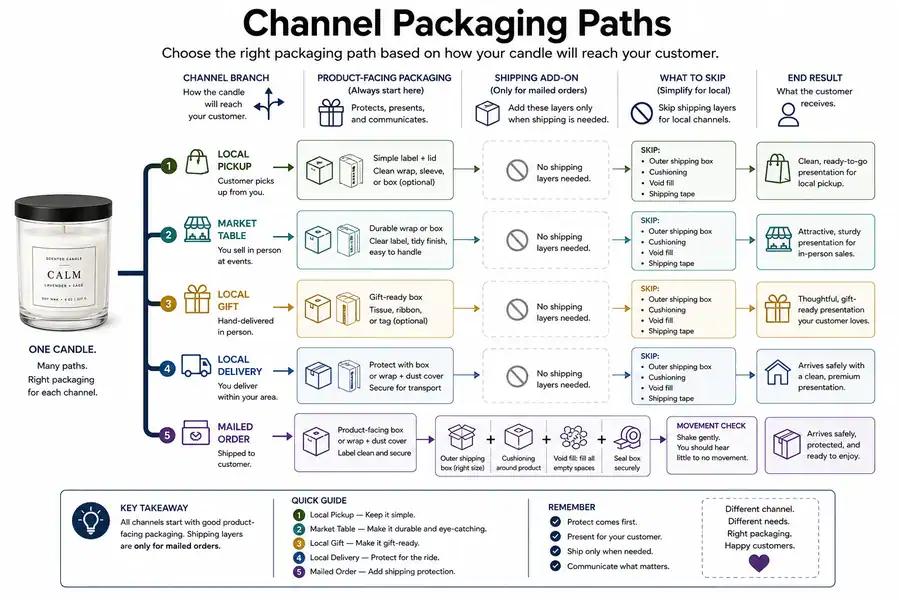
Choose different packaging paths for local pickup, markets, gifts, delivery, and mail
Local and shipped candles should not automatically use the same packaging stack.
Local sales usually need clean presentation and handling protection, while mailed orders add outer transit protection and movement control. Shipping means a mailed order that needs a shipping carton, cushioning, sealing, and a movement check; it does not apply to every candle sale.
| Channel | Product-facing packaging | Shipping add-on | What to skip | When to use a deeper plan |
|---|---|---|---|---|
| Local pickup | Clean label, warning or care information, lid or dust cover, and optional simple wrap. | Usually none. | Skip shipping carton, void fill, and heavy cushioning. | Use broader strategy only if local presentation is unclear. |
| Craft market table | Clean label, readable scent name, neat finish, and optional sleeve, box, or bag. | None for the sale itself. | Skip ecommerce cartons and shipping-grade packing unless the buyer asks for mailing. | Use retail vs ecommerce candle packaging when display and online fulfillment split. |
| Local gift handoff | Label, wrap, tissue, care card, or simple box when it improves giftability. | None if handed over locally. | Skip outer carton and transit fill. | Use gift-focused guidance if decorative choices become the main decision. |
| Shipped gift | Giftable product-facing layer plus protected label, lid, and top surface. | Add outer carton, cushioning, void fill, sealing, and movement check. | Skip loose decoration that shifts, crushes, or hides needed information. | Use hot-weather candle shipping only when temperature becomes the main risk. |
| Local delivery | Label, lid, clean wrap, and light handling protection. | Add light blocking or cushioning if the candle may shift during delivery. | Skip full mailed-order packaging when the maker controls the handoff. | Use a stronger path only if delivery movement causes damage. |
| Mailed order | Product-facing packaging that stays clean and readable inside transit layers. | Add outer box, cushioning, void fill, seal, and movement check. | Skip no-box transit and tissue-only protection. | Use ecommerce guidance when mailed orders become frequent. |
| Online listing order | Product-facing package should match what the buyer sees and expects. | Add mailed-order protection when the order ships. | Skip staged packaging that the customer will not receive. | Use channel strategy when photos, display, and shipment differ. |
| Market bundle | Coordinated labels, tidy grouping, and one useful insert if needed. | None unless mailed after purchase. | Skip extra shipping fill for in-person sales. | Use bundle or gift guidance only if presentation becomes the main topic. |
| Nearby business drop-off | Clean product-facing package and handling protection. | Usually no outer shipping carton unless transport is rough. | Skip carrier-style packaging when no parcel transit occurs. | Use retail planning only if shelf display becomes the goal. |
| Wholesale or subscription | Outside beginner packaging. | Outside beginner packaging. | Skip expanding this beginner setup into operations planning. | Keep wholesale, subscription, carrier policy, and international logistics separate. |
Should local pickup candles be packed like shipped candles? Usually no. Does every candle sale need a shipping box? No. Can a gift candle need shipping protection? Yes, if the gift is mailed. Is market-table packaging the same as ecommerce packaging? No, because market-table packaging is handled in person, while ecommerce orders usually face parcel movement.
Local means handoff, pickup, market sale, or nearby delivery where the maker controls or limits transit exposure. Gift means the candle is intended to be given, but the gift can be local or shipped. Define the channel before choosing the package because a local gift and a shipped gift need different protection.
One-size-fits-all packaging creates two common problems. Local candles can become overpacked, bulky, and slow to finish. Mailed candles can become underprotected if they use only the local presentation layer. Use choose candle packaging that protects and sells to keep the product-facing layer clear, then add shipping protection only when the sales path requires it.
If the channel grows beyond beginner sales, keep the next step narrow. Ecommerce strategy, shelf display, wholesale, subscription fulfillment, international shipping, carrier rules, and shipping candles in heat are separate planning problems. This section only decides how the beginner packaging stack changes between local pickup, market sales, gifts, local delivery, and mailed orders.
Build the simplest candle packaging stack that fits your current sales channel
Build the smallest candle packaging stack that fits the candle, channel, and test result.
The best beginner candle packaging stack is the simplest one that protects the candle, presents it clearly, and adds shipping protection only when the sales channel requires it. Do not add a layer unless it protects, presents, ships, communicates, fixes a test failure, or matches a proven channel need.
| Final check | Beginner action | Pass signal |
|---|---|---|
| Protect | Check the jar or tin, lid, wax top, label, finish, scent cleanliness, and movement risk. | The candle does not look scratched, dusty, rubbed, loose, or handled after packaging. |
| Present | Keep the front label readable, the finish clean, and the package easy to understand. | The candle looks sellable or giftable without needing extra decoration. |
| Fit | Measure the finished candle stack, not only the bare container. | The box, sleeve, wrap, or carton is snug without crushing lids, labels, or surface layers. |
| Test | Pack one finished candle before repeating the setup. | The package passes a basic handling, movement, label-rub, lid, and surface check. |
| Channel | Separate local pickup, market sales, gifts, delivery, and mailed orders. | Local candles are not overpacked, and mailed candles get outer transit protection. |
| Skip | Remove layers that do not solve a current protect, present, ship, or communicate need. | Inserts, ribbons, product boxes, and premium materials are used only when they have a clear job. |
| Upgrade | Upgrade only after a trigger appears. | Fit failure, damage, label issues, gift demand, repeat orders, or mailed-order needs decide the next change. |
A local candle can start with a clean label, visible care or warning information, a lid or dust cover, and a simple wrap or product box only if it improves handling or presentation. A mailed candle needs the product-facing layer plus an outer shipping carton, cushioning, void fill, sealing, and a movement check. A gift candle needs a clean, ready-to-give finish, but it does not need a luxury unboxing system.
Use the next deeper topic only when that need becomes the main decision. Use candle packaging cost breakdown when price-per-unit, bulk buying, boxes, labels, inserts, and shipping protection costs become the problem. Use retail vs ecommerce candle packaging when display packaging and mailed-order packaging need separate plans. Use hot-weather candle shipping only when temperature, insulation, or cold packs become the shipping risk. Use candle label and gift packaging ideas when the presentation question becomes decorative or gift-focused. Use choose candle packaging that protects and sells when the whole packaging decision needs a broader strategy.
The next step is not to buy every possible supply. Build one small stack, pack one finished candle, inspect it, adjust the weak point, then repeat the same setup only when it protects, presents, ships when needed, and stays easy to pack.