

To dispose of candle wax safely, let it cool and harden, remove it as solid material, bag or wrap it, and put it in household trash unless local rules say otherwise.
Candle wax here means leftover, cooled, removable wax from burned candles, jars, holders, or small cleanup spots. Safe disposal means keeping wax out of drains, containing it for the trash, and cleaning glass only enough for local recycling rules. Melted wax belongs in no sink, toilet, tub, shower, or garbage disposal because it can harden after it moves.
This guide covers household disposal, jar cleanup, recycling readiness, wax-type caveats, and disposal myths. It does not cover wax reuse projects, stain-removal guides, candle-making waste, or plumbing repair after wax has already gone down a drain.
The safest default: let candle wax cool, solidify, and put it in household trash
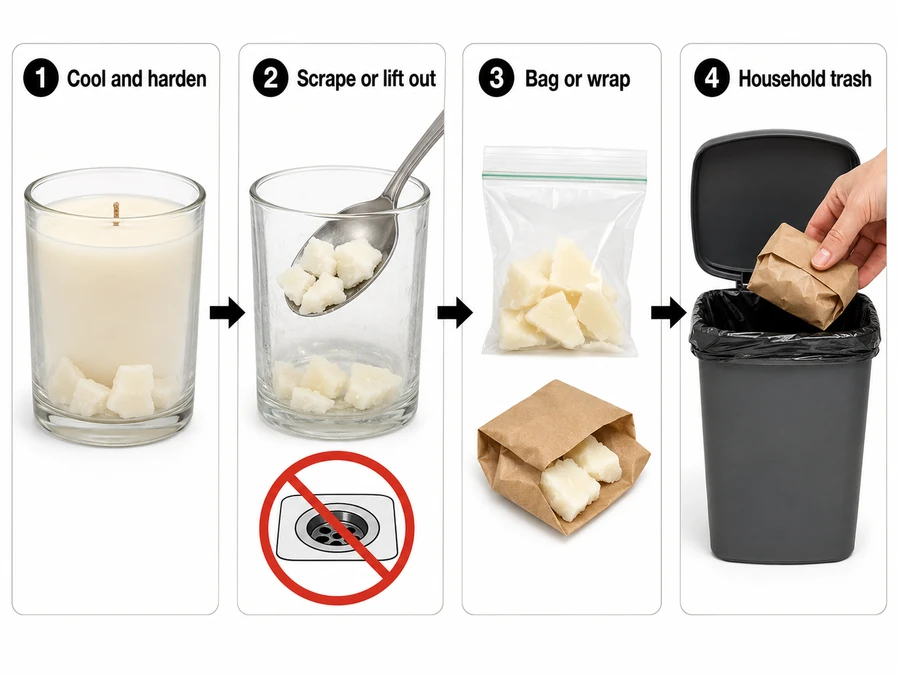
Candle wax should be disposed of as a cooled solid, not as a liquid. The safest default is to let leftover wax harden, scrape or lift it out, contain it, and place it in household trash.
This method works because solid wax stays together and does not spread through pipes, recycling bins, or trash bags. It also keeps the task narrow: remove the wax, contain the mess, and send the wax to the regular waste route unless your local waste service gives a different rule.
For most burned candles, wait until the wax is fully cool and firm. If the wax is in a jar, use a spoon, butter knife, or scraper to loosen the edge, then lift out the pieces. Small flakes can be wiped up with a paper towel and thrown away with the removed wax.
Do not rinse loose wax into the sink after scraping. Even small shavings can soften with warm water, move into the drain line, and harden again where they are harder to reach.
Bag or wrap removed wax before putting it in the trash
Removed candle wax should be contained before it goes into the bin. Put wax chunks, shavings, wick pieces, and waxy paper towels in a small bag or wrap them in used paper before placing them in household trash.
Containment prevents loose wax from sticking to the inside of the bin, clinging to other trash, or leaving greasy residue on nearby items. It also keeps broken wick tabs, soot, dust, match ends, and jar scrapings together.
Use this disposal checklist:
| Wax situation | Best action | Why it works |
|---|---|---|
| Small hardened pool in a jar | Scrape it out and bag it | Keeps wax out of the drain |
| Thin wax flakes | Wipe up with paper towel | Captures crumbs before they spread |
| Large wax chunk | Wrap or bag it first | Prevents sticking inside the bin |
| Wax with wick tabs | Bag with the wick debris | Keeps metal and soot contained |
| Scented or dyed wax | Trash it as solid waste | Avoids residue in recycling |
| Dusty or dirty wax | Bag and throw away | Not worth saving or sorting |
The outcome is simple: if the wax is cool, solid, and contained, it can usually go in household trash. The main exception is local waste guidance that treats a specific material differently.
Do not pour candle wax down sinks, toilets, or garbage disposals
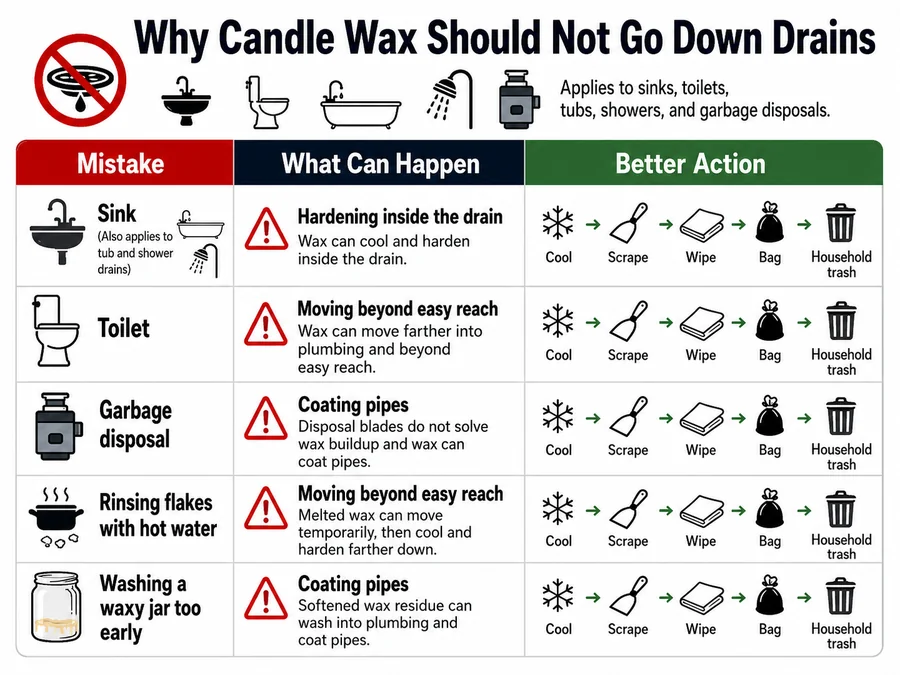
Candle wax should not go down sinks, toilets, tubs, showers, or garbage disposals. Wax can travel as a liquid, cool inside the plumbing, and harden into a blockage or sticky buildup.
A garbage disposal does not make wax safe for drains. It may break up soft material near the sink opening, but the wax can still coat pipes after it leaves the visible part of the drain.
The same rule applies to toilets. Flushing wax does not remove the risk; it only moves the wax into a pipe system where cleanup can be harder. Paper towels, scraped wax, and wick debris belong in the trash, not the toilet.
Common disposal failures look like this:
| Mistake | What can happen | Better action |
|---|---|---|
| Pouring melted wax into a sink | Wax hardens inside the drain | Let it cool, then scrape it out |
| Rinsing wax flakes with hot water | Wax moves farther before setting | Wipe flakes into the trash |
| Using a garbage disposal | Wax can coat the pipe after grinding | Bag solid wax instead |
| Flushing wax in a toilet | Wax can harden beyond easy reach | Put cooled wax in household trash |
| Washing a waxy jar too early | Residue enters the drain | Remove wax first, then wash lightly |
If wax has already gone down a drain, this article stays with prevention and safe disposal. Drain recovery is a separate problem because it depends on how much wax entered, where it hardened, and whether water still moves.
What to do if the wax is still hot or liquid
Hot or liquid candle wax should be left alone until it cools enough to handle safely. Do not carry a jar of liquid wax to a sink, pour it outside, or add water to force cleanup.
The safer sequence is:
- Blow out the candle or remove the heat source.
- Leave the container on a heat-safe surface.
- Wait until the wax becomes firm or mostly firm.
- Loosen the cooled wax with a spoon or scraper.
- Bag the removed wax and put it in household trash.
- Wipe remaining residue with a disposable towel before washing the container.
Cooling first changes the disposal route. Liquid wax is a spill and drain risk; solid wax is a removable household waste item.
How to remove wax from a candle jar before trashing or recycling it
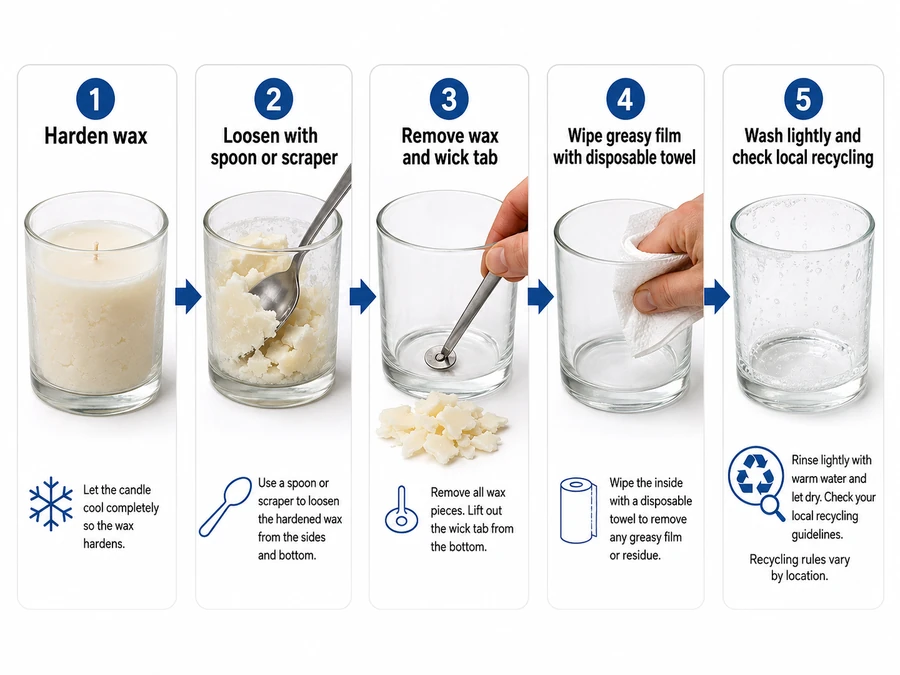
Wax should come out of a candle jar before the jar is washed, trashed, or checked for recycling. Let the wax harden, loosen it gently, and remove the solid pieces before cleaning the container.
The goal is not to restore the jar perfectly. The goal is to keep wax out of drains and separate the removable wax from the glass, lid, wick tab, and label as much as your local bin rules require.
Use one of these low-mess methods:
| Method | Best for | Steps | Disposal result |
|---|---|---|---|
| Freezer method | Thick wax at the bottom of a jar | Freeze the jar, let the wax shrink, then pop or scrape it out | Solid wax goes in trash |
| Spoon scrape | Thin wax layer or soft remnant | Let wax cool, then loosen the edge with a spoon | Scraped wax goes in trash |
| Warm-water outer bath | Stubborn wax stuck to the glass | Sit the closed jar in warm water without filling the jar | Softened wax is wiped or scraped into trash |
| Hot-water-in-jar method | Stubborn wax in a sturdy jar | Add hot water, let wax float, cool, harden, then lift out the wax before discarding water | Solid wax goes in trash; visible wax or wax bits stay out of the drain |
| Paper towel wipe | Final greasy film | Wipe residue before washing | Waxy towel goes in trash |
Do not fill the jar with boiling water and pour the wax-water mix down the sink. That can move softened wax into the drain, where it may harden again after the water cools.
Remove wick tabs, wick clips, matches, dust, and soot with the wax. These materials make wax less suitable for saving and more likely to create mess in a bin or recycling stream.
Can you recycle a candle jar after removing wax?
A candle jar may be recyclable only after the wax, wick tab, and loose residue are removed. Recycling depends on the container material and local rules, so wax removal does not automatically make every jar recyclable.
Local programs can handle candle jars differently, and some do not accept certain glass, lids, labels, or waxy residue. Remove the wax first, then check the accepted material rules for your local recycling service.
The safe household sequence is:
- Remove cooled wax as a solid.
- Pull out the wick tab if it loosens.
- Wipe greasy residue with a disposable towel.
- Wash the jar only after loose wax is gone.
- Check whether your local program accepts that glass type, lid, and label.
A jar with a small greasy film is different from a jar with chunks of wax still inside. Chunks should go in the trash first because they can contaminate other recyclables or leave residue during sorting.
If the jar is cracked, heavily sooted, coated with wax, or made from a glass type your local program does not accept, put it in the trash or follow your local waste guidance. The wax itself should stay out of the recycling bin unless your local service gives a specific route.
Small wax remnants vs larger leftover wax: when to throw it away or save it
Small wax remnants are usually best thrown away once cooled and contained. Larger clean pieces may be worth saving, but disposal is still the right choice when the wax is dirty, mixed, burnt, or not worth storing.
The difference is practical. Tiny scraps often create more mess than use, while larger clean pieces may have enough material for a separate reuse project. This page stays with disposal, so the decision point is whether to throw the wax away now or set clean wax aside for another use.
| Wax amount or condition | Best choice | Reason |
|---|---|---|
| Thin film in a jar | Wipe and trash | Too little wax to save cleanly |
| Small flakes after scraping | Bag and trash | Easy to contain |
| Large clean chunk | Save only if you have a reuse plan | Enough wax may be useful later |
| Mixed scents or colors | Usually trash | Results are unpredictable if reused |
| Sooty or burnt wax | Trash | Poor quality and messy |
| Wax with wick tabs or debris | Trash | Contaminated material |
| Wax from a spill cleanup | Trash | May contain dust, fabric fibers, or dirt |
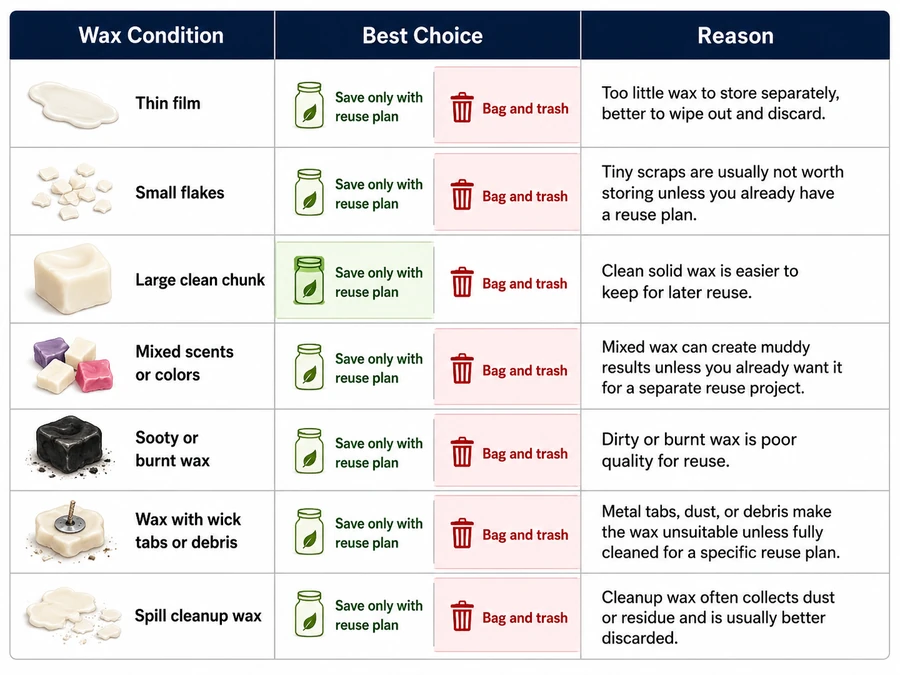
The fastest rule is: save clean, sizable wax only when you already know what you will do with it. Otherwise, let it harden, bag it, and put it in household trash.
When leftover wax is worth saving instead of throwing away
Leftover wax may be worth saving when it is clean, unscented or scent-compatible, and large enough to store without creating a mess. Put it in a labeled bag or container instead of mixing it with dirty candle debris.
Saving wax is a reuse decision, not a disposal requirement. If you do not plan to reuse it soon, the safer household route is to throw it away as solid waste rather than keep sticky, scented scraps in a drawer or cabinet.
Keep saved wax separate from soot, wick tabs, match heads, dust, and food packaging. Once clean wax is mixed with debris, it becomes harder to use and easier to misplace.
Throw away wax that is dirty, burnt, mixed, or contaminated
Dirty or contaminated candle wax should go in household trash after it cools. This includes wax mixed with soot, dust, wick tabs, match pieces, pet hair, glitter, broken glass, or surface-cleanup debris.
Throwing away contaminated wax gives a cleaner outcome than trying to sort or reuse it. It keeps foreign material out of drains, avoids messy storage, and reduces the chance of putting wax-covered debris into recycling.
If broken glass is present, wrap the glass and wax together in puncture-resistant material before placing it in the trash. Label the package if needed so no one handles it as soft waste.
Does wax type change how you dispose of it?
Wax type usually does not change household disposal: cooled solid candle wax belongs in the trash unless local waste rules say otherwise. Soy, paraffin, beeswax, coconut wax, dyed wax, and scented wax still need the same drain-free route.
The wax formula matters most when people wonder whether it can be recycled, composted, or saved. For disposal, the practical question is simpler: is the candle wax cooled, removable, contained, and free from a bin rule that sends it somewhere else?
| Wax or additive | Disposal route | What to avoid |
|---|---|---|
| Soy wax | Cool, remove, bag, and trash | Do not rinse melted residue into a sink |
| Paraffin wax | Cool, remove, bag, and trash | Do not pour it into drains |
| Beeswax | Cool, remove, bag, and trash | Do not assume it belongs in compost |
| Coconut or vegetable wax blend | Cool, remove, bag, and trash | Do not treat the blend as food waste |
| Dyed or scented wax | Trash as solid waste | Do not put wax pieces in recycling |
| Glitter or decorative wax | Trash as solid waste | Do not compost or wash away particles |
| Wax with wick tabs or soot | Bag and trash | Do not save it with clean wax |
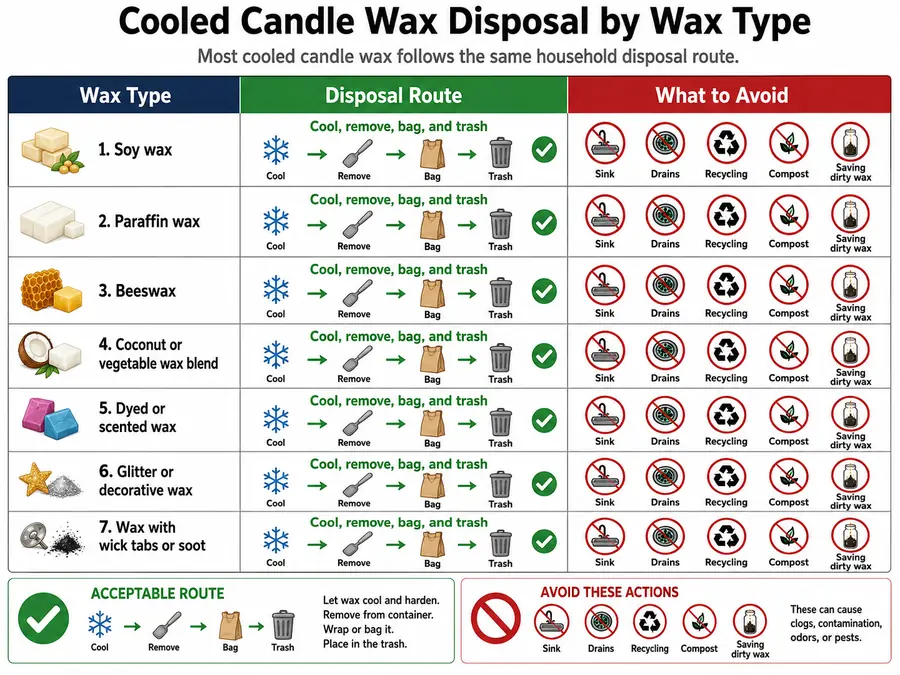
Clean wax type labels do not remove the main disposal rule. Candle wax becomes low-mess household waste only after it cools, hardens, and leaves the container as a solid.
What NOT to do with candle wax
Do not pour, flush, burn, compost, dump, or recycle candle wax unless a local rule specifically allows that route. These shortcuts create plumbing, bin, residue, or mess problems.
The safe alternative is almost always the same: cool the wax, remove it as a solid, contain it, and place it in household trash. That route keeps disposal focused on household cleanup rather than turning a small candle remnant into a drain, recycling, or outdoor mess.
| What not to do | Why it is a problem | Safer route |
|---|---|---|
| Pour melted wax down the sink | It can harden inside the drain | Let it cool, scrape it out, and trash it |
| Flush wax down the toilet | It can move beyond easy cleanup | Bag solid wax for household trash |
| Use the garbage disposal | Grinding does not stop wax from coating pipes | Remove wax before washing the jar |
| Put wax chunks in recycling | Wax can contaminate recyclable containers | Remove wax first, then check the jar |
| Compost candle wax | Candles may contain blends, scent, dye, glitter, or debris | Trash the cooled wax |
| Dump wax outside | Wax can stick to soil, pavement, plants, or outdoor surfaces | Contain it for the bin |
| Burn leftover wax as a shortcut | It can create smoke, residue, or uncontrolled melting | Dispose of cooled solid wax |
| Wash a waxy jar before scraping | Loose wax can enter the drain | Wipe and scrape before washing |
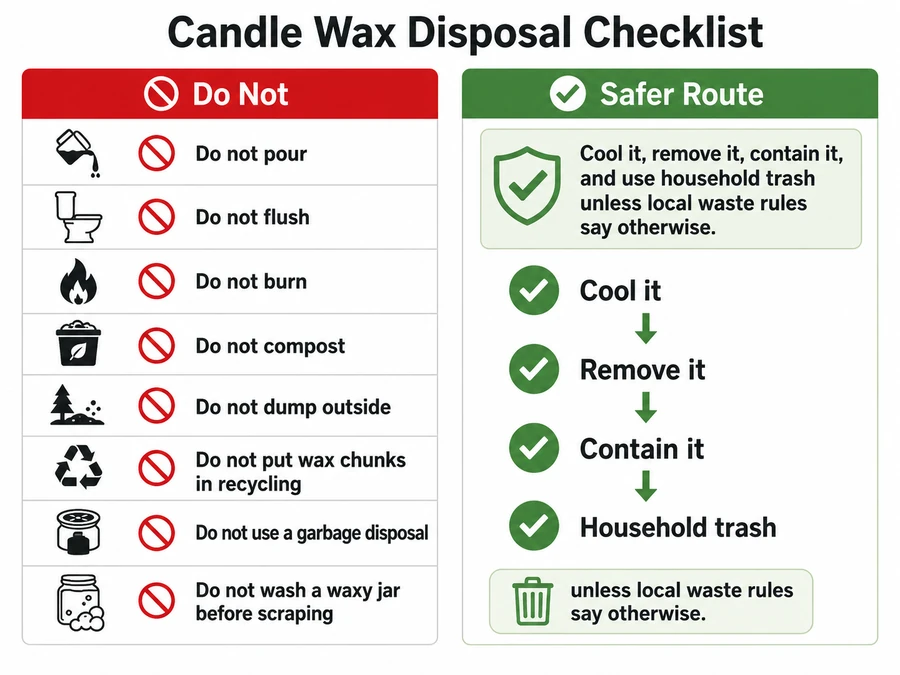
The best final check is this: if the candle wax is still liquid, loose, sticky, mixed with debris, or attached to a jar, it is not ready for the sink, recycling bin, compost, toilet, or outdoors. Cool it, remove it, contain it, and use the trash route unless your local waste service gives a different instruction.