
Yes, candles can set off a residential smoke/fire alarm when smoke, soot, or airborne particles reach the detector.
On this page, “fire alarm” means a home smoke alarm or smoke detector, not a sprinkler, carbon monoxide alarm, security alarm, or commercial alarm panel. A candle can release smoke, soot, or other airborne particles when the wick smolders or the flame burns poorly.
The flame itself does not usually trigger a smoke alarm; the risk rises when particles reach the detector’s sensing chamber. Treat every alarm as real until you have checked for flame, unsafe heat, smoke, and nearby materials that could catch fire.
When Candles Are Most Likely to Set Off a Smoke Alarm
Candles are most likely to set off a smoke/fire alarm when smoke, soot, or airborne particles travel directly into the detector.
A candle usually triggers an alarm through particles released into the air, not through the ordinary flame alone. Risk rises when the wick smokes, the flame grows too large, airflow carries particles toward the detector, several candles burn in a small room, or the wick smolders after extinguishing.
A “false alarm” should mean a nuisance alarm only after you have checked for flame, unsafe heat, spreading smoke, and nearby materials that could catch fire. Never cover, disable, move, or remove batteries from a smoke alarm to keep candles burning. Use a manufacturer-approved hush or silence feature only after confirming there is no fire and following the device instructions.
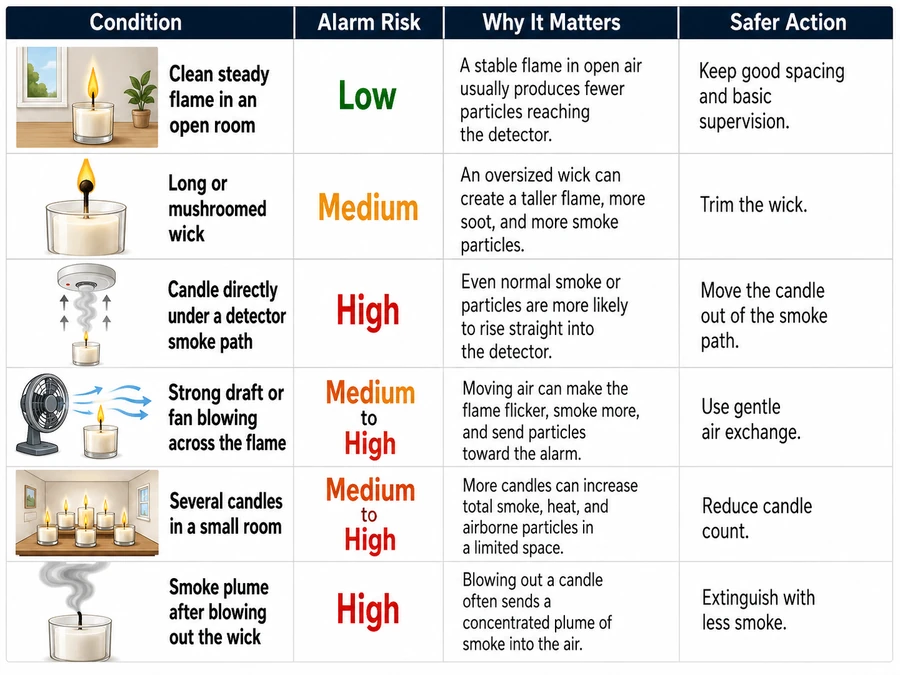
| Candle-use condition | Alarm risk | Why it matters | Safer prevention action |
|---|---|---|---|
| Clean, steady flame in an open room | Low | Little visible smoke reaches the detector | Keep the candle stable and supervised |
| Long or mushroomed wick | Medium | A larger flame can produce more smoke and soot | Trim the wick before relighting |
| Candle directly under a detector’s smoke path | High | Particles reach the sensing area before dispersing | Move the candle out of that smoke path |
| Strong draft or fan blowing across the flame | Medium | The flame flickers and may burn unevenly | Use gentle air exchange, not a direct draft |
| Several candles in a small room | Medium to high | More flames can add more airborne particles | Reduce candle count and watch for smoke buildup |
| Smoke plume after blowing out the wick | Medium | The alarm may sound after the flame is gone | Extinguish with less smoke and check the wick |
Method note: This table is a qualitative risk model, not a detector calibration chart. It compares common candle-use conditions by visible smoke, soot likelihood, candle placement, airflow, and whether particles can reach the alarm.
The simplest way to lower alarm risk is to reduce candle smoke first, then keep any remaining smoke away from the detector.
Fire Alarm vs Smoke Detector: What Candles Usually Trigger
In most candle-related searches, “fire alarm” usually means the smoke alarm or smoke detector sounding, not the sprinkler system turning on.
A smoke alarm is the system most relevant to normal candle use because candle smoke, soot, and combustion particles can enter its sensing area. A fire alarm is not always the same thing as a smoke detector, but people often use the terms interchangeably when an alarm sounds during candle burning.
Here, “fire alarm” means a residential smoke alarm or smoke detector sounding during candle use. This page does not cover carbon monoxide alarms, security systems, commercial alarm panels, wiring faults, or detector repair.
Smoke and soot can affect a smoke alarm, while heat alarms and sprinklers respond to different conditions. Smoke alone does not activate a sprinkler, and ordinary candle use should not be treated as a normal sprinkler trigger.
For sprinkler or heat-alarm concerns, use the section on sprinklers and heat alarms rather than treating every system as a smoke detector.
Why Candle Smoke and Soot Can Trigger Smoke Alarms
Candle smoke and soot can trigger smoke alarms because many alarms respond to airborne particles, not just visible fire.
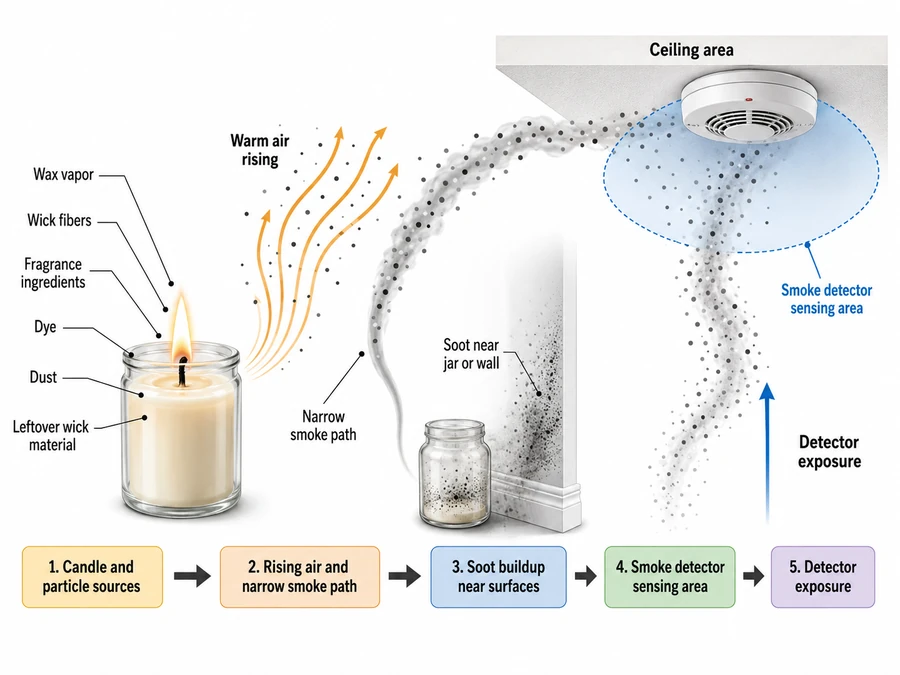
An unstable or dirty candle burn can release particles from the flame, wick, wax, fragrance, dye, dust, or debris. If enough particles reach the detector, the alarm may interpret them as smoke and sound.
Visible smoke is the clearest warning sign, but soot matters too. Black soot around the jar, wall, ceiling, or wick area shows that the candle is burning with excess soot. Those particles can rise with warm air and enter the detector.
Candle smoke does not need to fill the whole room to matter. A narrow smoke path can rise from the flame, follow warm air toward the ceiling, and reach a nearby alarm before the smoke spreads out. That is why a single smoky candle near a detector can matter more than a cleaner candle farther away.
Common candle-related particle sources include:
| Source | What it means | Alarm outcome |
|---|---|---|
| Long wick | The flame pulls too much fuel | More smoke and soot |
| Mushroomed wick tip | Carbon buildup sits on the wick | Dirtier flame and smoky relight |
| Drafty flame | Air pushes the flame off balance | Uneven burn and more particles |
| Dirty wax pool | Wick debris or match pieces burn | Extra smoke near the flame |
| Smoky extinguishing | The wick smolders after flame-out | Alarm may sound after the candle is out |
| Poor placement | Smoke rises toward the detector | Faster detector exposure |
The prevention goal is to reduce smoke at the candle and keep any remaining smoke from reaching the alarm.
How Wick Length and Flame Size Increase Smoke Risk
A long wick can make a candle smoke more because it feeds a larger, less stable flame.
The wick controls how much melted wax reaches the flame. When the wick is too long or has a carbon mushroom at the tip, the flame can grow tall, flicker, and burn with more soot. That raises the chance that candle particles reach the smoke alarm.
A steady candle flame should stay controlled, centered, and free from repeated smoking. If the flame jumps, leans, spits, gives off black smoke, or leaves soot on the jar, the candle is no longer burning cleanly.
Before relighting a candle, let the wax cool enough to handle safely, then remove loose wick debris and trim the wick according to the candle maker’s care directions. Do not trim a burning wick, and do not reach across an open flame.
| Wick or flame sign | What it suggests | What to do |
|---|---|---|
| Tall flame | Wick may be too long | Extinguish safely, cool, then trim |
| Black smoke | Dirty or uneven combustion | Stop burning until the cause is corrected |
| Mushroomed wick | Carbon buildup on the wick | Remove the carbon tip before relighting |
| Soot on jar | Flame is producing excess particles | Shorten burn time and check draft exposure |
| Flickering flame | Airflow is disturbing the burn | Move the candle away from direct drafts |
| Flame near container edge | Candle may be burning unevenly | Stop burning if the container overheats or looks unsafe |
A wick problem is an alarm-prevention issue, not just a candle appearance issue. Cleaner wick care lowers smoke output, while poor wick care gives the detector more particles to sense.
Where to Place Candles So Smoke Does Not Reach the Alarm
Place candles where smoke cannot travel directly into a smoke alarm or collect near the ceiling in a corner, shelf gap, or narrow air path.
Candle placement matters because warm air carries smoke and soot upward. A candle across the room can still send particles toward the detector. This can happen under the alarm’s air path, near a ceiling return, or in a tight corner where smoke collects.
Do not place a lit candle directly below a smoke alarm or on a high shelf near the ceiling. Keep it away from curtains, bookcases, paper décor, and places where people may bump it. The goal is to protect burnable materials and keep smoke away from the detector.
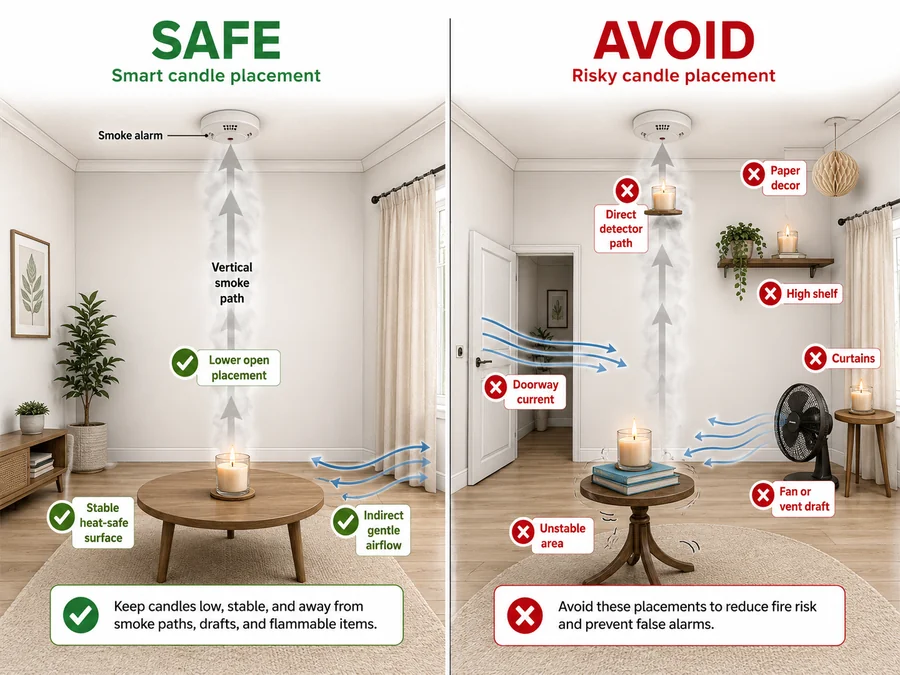
| Placement area | Alarm risk | Safety concern | Better choice |
|---|---|---|---|
| Directly under a smoke alarm | High | Smoke rises into the detector | Move the candle out of the vertical smoke path |
| High shelf near the ceiling | Medium to high | Smoke collects before dispersing | Use a lower, stable heat-safe surface |
| Near a fan, vent, or open window | Medium | Drafts can push smoke toward the alarm | Keep airflow gentle and indirect |
| Corner or alcove | Medium | Smoke may pool in a small space | Use a more open area with stable air |
| Near curtains, paper, or décor | High | Fire spread risk if the flame contacts material | Keep clear space around the candle |
| Bedside, floor, or unstable surface | High | Tip-over and contact risk | Use a flat, sturdy, heat-resistant surface |
Avoid treating candle placement as a way to bypass alarms. If a candle smokes enough that the alarm keeps sounding, stop burning it and fix the smoke source rather than moving the candle farther away from safety equipment.
Ventilation vs Drafts: Airflow That Helps or Hurts
Gentle ventilation can disperse light candle smoke, but direct drafts can make the candle burn unevenly and create more soot.
Airflow helps only when it clears the room without disturbing the flame. A direct fan, strong vent, open window gust, or busy doorway can make the flame lean, flicker, or smoke. That poor burn can create more particles, then carry them toward the alarm.
Use ventilation after checking that there is no fire, unsafe heat, or spreading smoke. Fresh air can help clear nuisance smoke, but it should not be used to keep a smoky candle burning.
| Airflow condition | Effect on candle | Alarm result |
|---|---|---|
| Still, stale room | Smoke may collect | Alarm risk rises if particles build up |
| Gentle air exchange | Smoke disperses without flame disruption | Lower nuisance-alarm risk |
| Direct fan on flame | Flame flickers and burns unevenly | More soot and smoke possible |
| HVAC vent blowing nearby | Smoke path becomes unpredictable | Particles may reach the detector faster |
| Open window gust | Flame can lean or flare | Stop burning if the flame becomes unstable |
A stable flame is the test. If airflow makes the candle flicker hard, smoke, pop, or leave soot, the airflow is hurting the burn rather than helping the room.
Do Multiple Candles Make Alarms More Likely?
Multiple candles can make smoke alarms more likely to sound because more flames can add more particles to the room.
Candle count is one factor among several. Room size, ceiling height, airflow, wick condition, candle type, burn time, and detector sensitivity all affect how quickly smoke or soot reaches the alarm. One smoky candle in a direct smoke path can be more likely to trigger an alarm than several cleaner candles in a larger room.
| Scenario | Alarm risk | Why |
|---|---|---|
| One clean candle in a larger room | Low | Particles disperse before reaching the detector |
| Several clean candles in a larger room | Low to medium | More flames add more airborne output |
| Several candles in a small room | Medium to high | Smoke and scent particles concentrate faster |
| Many long-wick candles | High | Oversized flames can create more soot |
| Candles under a ceiling smoke path | High | Smoke can rise directly into the alarm |
| Candles blown out at the same time | Medium to high | Several smoldering wicks can create a smoke plume |
Scent alone should not be treated as the main alarm trigger. A scented candle becomes more likely to set off a smoke alarm when it burns smoky, soots, overheats, sits in poor airflow, or sends particles toward the detector.
Use fewer candles in small rooms, trim wicks before use, and put out any candle that smokes repeatedly. A candle display is not worth keeping lit if the room starts collecting haze or soot.
Small Rooms, Apartments, Dorms, and Hotels
Candles are more likely to set off alarms in small rooms because smoke has less space to disperse before reaching the detector.
Apartments, dorms, and hotel rooms often have closer detectors, shared alarm systems, smaller air volume, and less control over airflow. Even a short smoke plume after blowing out a candle can reach the alarm faster than it would in a larger open room.
Check the property rules before using candles in rentals, dorms, or hotels. Many shared buildings restrict open flames, and this article does not replace lease terms, campus rules, hotel policies, or local safety requirements.
| Space | Why alarm risk can rise | Safer candle-use decision |
|---|---|---|
| Small bedroom | Smoke concentrates quickly | Use only if allowed and fully supervised |
| Dorm room | Open flames may be prohibited | Follow campus rules instead of improvising |
| Hotel room | Detectors may be close and sensitive | Avoid candles unless the property allows them |
| Apartment | Smoke can travel through small rooms or vents | Keep smoke low and never disable alarms |
| Bathroom | Steam, airflow, and tight space can complicate alarms | Avoid burning candles near detectors or vents |
| Studio unit | Living, sleeping, and cooking air mix together | Limit candle count and watch for haze |
A sensitive alarm in a shared building is not a reason to cover or silence it. If candles keep triggering alarms, stop using them in that space and choose a no-flame option.
Can Blowing Out a Candle Set Off a Smoke Alarm?
Yes, blowing out a candle can set off a smoke alarm when the wick smolders and sends a smoke plume toward the detector.
This often happens after the flame is gone, so people may think the alarm sounded for no reason. The actual trigger is usually the smoke from the hot wick, not the candle flame itself.
Blowing across the wick can push smoke upward or sideways into a doorway, ceiling current, vent path, or nearby alarm. Several candles blown out at once can create a larger smoke plume, especially in a small room.
| Extinguishing method | Smoke risk | Alarm concern |
|---|---|---|
| Hard blow across the wick | Medium to high | Smoke may shoot toward the detector |
| Several candles blown out together | Medium to high | Multiple smoldering wicks add smoke |
| Wick left glowing after flame-out | Medium | The wick keeps releasing particles |
| Candle snuffer used correctly | Low to medium | Less air movement around the wick |
| Wick dipped and centered safely | Low | Less lingering smoke when done correctly |
| Candle jar covered too soon | Unsafe | Heat and smoke can build in the container |
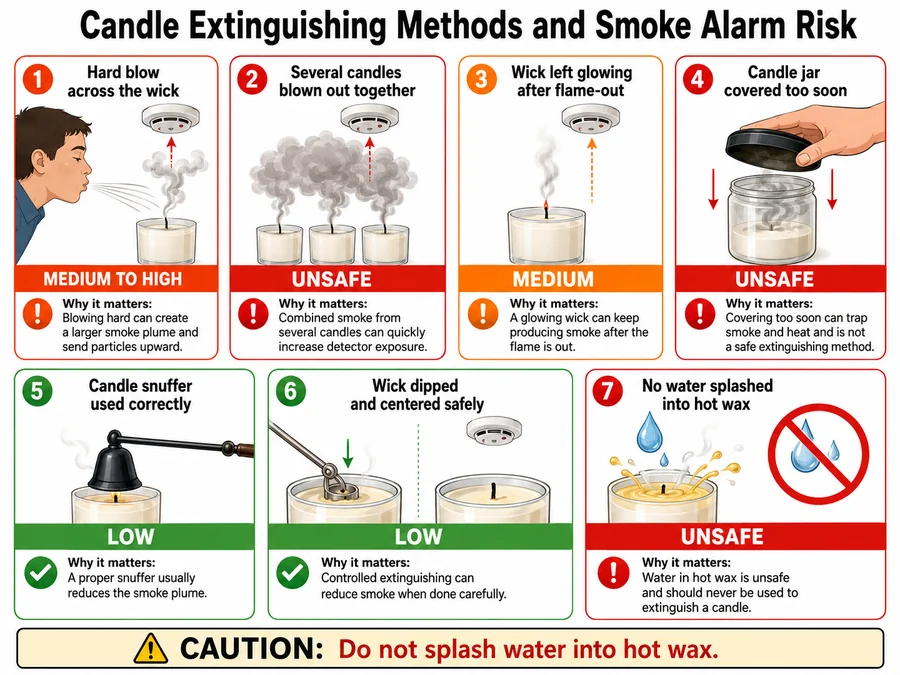
Use a low-smoke extinguishing method that fits the candle maker’s care directions. After the flame is out, make sure the wick is no longer glowing. Keep the candle on a heat-safe surface. Check that nothing is burning, then let the air clear naturally.
Never splash water into hot wax or onto hot glass; the container can crack, wax can splatter, and a smoke problem can become a burn hazard.
How to Prevent Candle Smoke Alarm False Alarms
Prevent candle smoke nuisance alarms—alarms caused by candle smoke after no fire is found—by lowering smoke output, controlling airflow, and keeping smoke paths away from detectors.
A nuisance alarm is most preventable before the candle is lit. The key is to burn fewer smoky candles, use cleaner wick habits, avoid direct drafts, and respond early when the flame or room air changes.
| Prevention step | What it reduces | Why it works |
|---|---|---|
| Trim the wick before relighting | Oversized flame and soot | A shorter, cleaner wick burns with less smoke |
| Remove wick debris from the wax pool | Extra burning particles | Loose carbon can smoke when it catches flame |
| Use a stable, heat-safe surface | Tip-over and uneven flame | A steady candle is less likely to smoke |
| Keep candles out of direct drafts | Flicker and dirty burn | Stable air supports cleaner combustion |
| Avoid placing candles under alarms | Direct detector exposure | Smoke has more room to disperse |
| Burn fewer candles in small rooms | Particle buildup | Less total smoke reaches the detector |
| Put out smoky candles early | Repeated alarm triggers | Stopping the source protects the room |
| Extinguish with less smoke | Smoldering wick plume | Less smoke rises after flame-out |
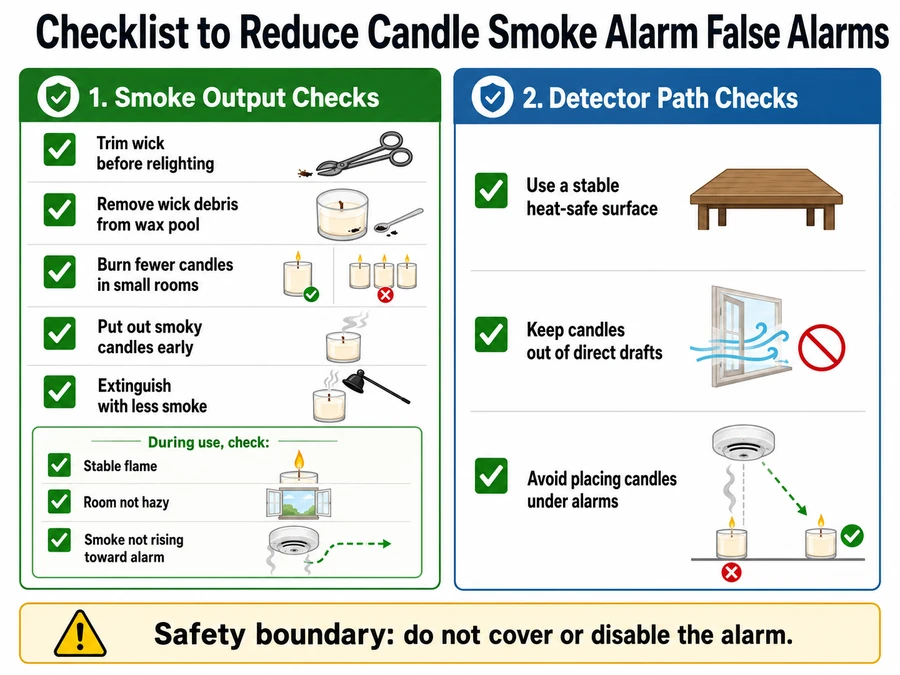
A safe candle setup should pass three checks: the flame is stable, the room is not getting hazy, and smoke is not rising toward the alarm. If any check fails, extinguish the candle safely and correct the condition before relighting.
Never cover a smoke alarm, remove its batteries, tape over its vents, or keep burning candles after it sounds, because the device must remain able to warn you.
What to Do If a Candle Sets Off the Alarm
If a candle sets off the alarm, treat it as real and check for fire, heavy smoke, or unsafe heat. Leave immediately when danger is present; extinguish the candle only when you can reach it safely.
Do not assume the alarm is false just because a candle was burning nearby. A candle can smoke without spreading fire, but it can also be too close to curtains, paper, shelves, bedding, décor, or an overheated container.
| Step | Action | Why it matters |
|---|---|---|
| 1 | Stop and look for flame, heat, spreading smoke, or scorched material | Confirms whether this is only nuisance smoke |
| 2 | Extinguish the candle safely | Removes the likely smoke source |
| 3 | Move burnable items away only if it is safe to do so | Reduces fire spread risk |
| 4 | Check the candle jar, wax pool, wick, and nearby surface | Finds overheating, soot, or unsafe placement |
| 5 | Ventilate after the safety check | Clears remaining smoke without ignoring danger |
| 6 | Leave the alarm working | Keeps protection in place if the risk returns |
| 7 | Do not relight until the cause is fixed | Prevents repeated alarm activation |
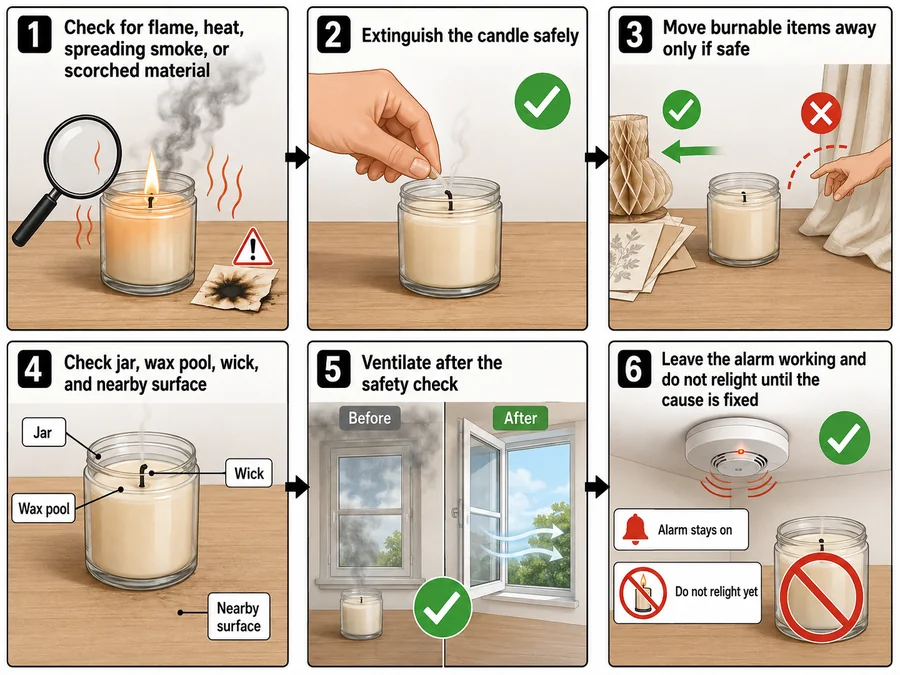
Call emergency services if you see spreading fire, heavy smoke, unsafe heat, scorched materials, or any condition you cannot control quickly and safely. This article covers candle-related nuisance alarms, not full fire-response training.
After confirming the room is safe, treat the event as a warning. Trim the wick, change the placement, reduce drafts, or burn fewer candles. Stop using a candle that keeps smoking.
When the Smoke Detector May Be Too Sensitive
A smoke detector may seem too sensitive when small amounts of candle smoke trigger it faster than expected.
A sensitive smoke alarm is still doing its safety job; the fix is to reduce smoke and detector exposure, not block the alarm.
Sensitivity does not always mean the detector is broken. The alarm may be close to the candle, placed in a smoke path, affected by dust, exposed to drafts, or designed to respond quickly to airborne particles.
| Sign | Candle-related explanation | Boundary |
|---|---|---|
| Alarm sounds only with one smoky candle | The candle may be producing excess particles | Fix the candle burn first |
| Alarm sounds after blowing out candles | Smoldering wick smoke may reach the detector | Change the extinguishing method |
| Alarm sounds in a small room | Smoke may concentrate quickly | Reduce candle use in that space |
| Alarm sounds near vents or doorways | Airflow may carry smoke to the detector | Move the candle away from the smoke path |
| Alarm sounds with no candle smoke present | Detector condition or placement may be involved | Follow the detector maker’s instructions |
| Alarm keeps sounding without a clear cause | The issue may not be candle-related | Seek qualified help for the alarm system |
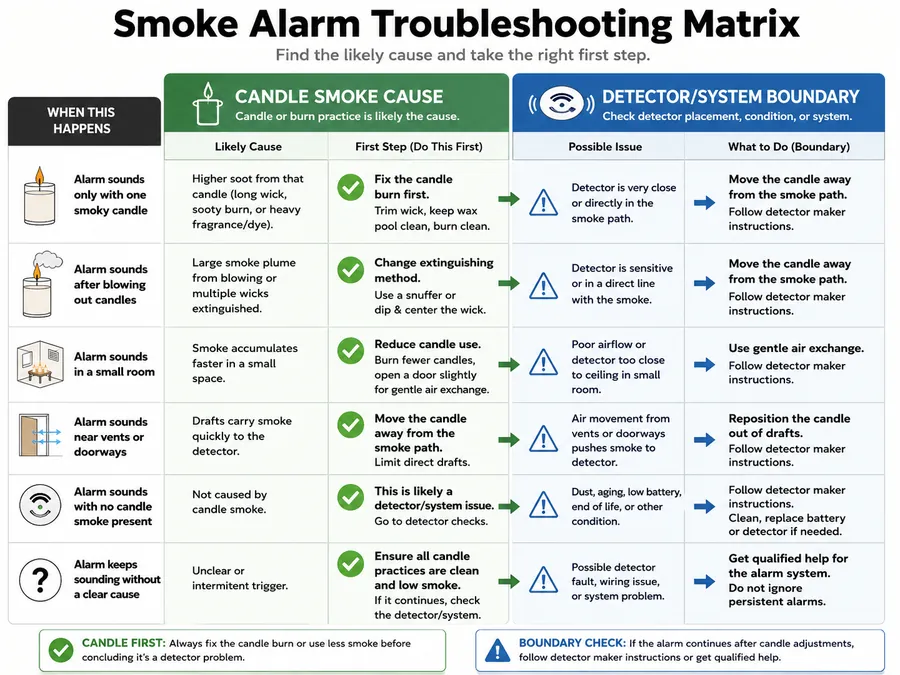
If alarms keep sounding without visible candle smoke, stop burning candles in that area. Follow the manufacturer’s instructions, contact building management, or ask a qualified professional for help. Never cover, remove, or block the detector.
FAQs About Candles and Smoke Alarms
Candles can trigger smoke alarms when smoke or soot reaches the detector. The risk depends mainly on smoke output, airflow, detector exposure, and the smoke plume created when a wick is extinguished. Can one candle set off a smoke alarm? Yes, one candle can set off a smoke alarm if it produces enough smoke or sits in the detector’s smoke path. One clean candle in an open room is usually lower risk.
Can scented candles set off a fire alarm? Yes, scented candles can set off a fire alarm when they burn with a smoky flame, produce soot, overheat, or send airborne particles toward the detector. Scent alone should not be treated as the main trigger.
Can birthday candles set off a smoke alarm? Yes, birthday candles can set off a smoke alarm when many wicks are blown out together and the smoke plume rises toward the detector.
Can candles set off sprinklers? Candle smoke alone should not be treated as a sprinkler trigger. Sprinklers respond to heat conditions, while smoke alarms respond to smoke or airborne particles.
Are candles more likely to set off alarms in apartments, dorms, or hotels? Yes, alarm risk can rise in apartments, dorms, and hotels because detectors may be closer, rooms may be smaller, and open-flame rules may be stricter.
Should I disable the smoke alarm while burning candles? No; never cover, disable, remove, or block a smoke alarm to keep candles burning, and use a manufacturer-approved hush feature only after confirming there is no fire. Keep every smoke alarm active whenever candles are burning.
Can Candles Set Off Sprinklers or Heat Alarms?
Candle smoke can set off a smoke alarm, but ordinary candle smoke should not be treated as the same thing as sprinkler or heat-alarm activation.
A candle’s smoke, soot, or airborne particles mainly matter for a smoke alarm, which responds to smoke conditions. A heat alarm responds to heat conditions, and a sprinkler is part of a fire-suppression system—a system designed to control or put out a fire—not a smoke detector.
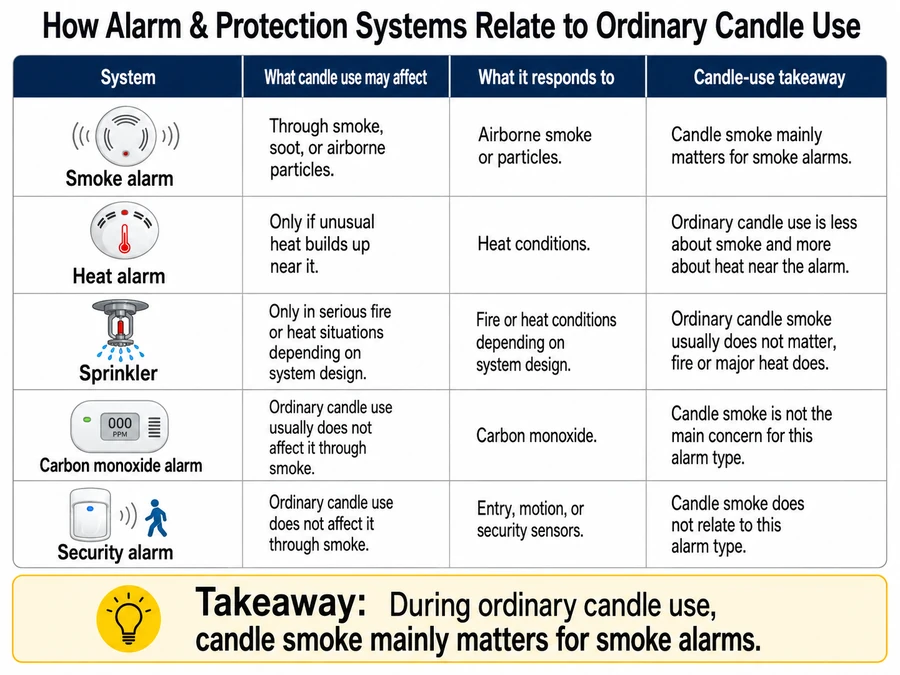
| System | What ordinary candle use may affect | What it responds to | Candle-use takeaway |
|---|---|---|---|
| Smoke alarm | Yes, if candle smoke or soot reaches it | Airborne smoke or particles | This is the main alarm risk from candles |
| Heat alarm | Not from light smoke alone | Heat conditions | Ordinary candle smoke is not the same trigger |
| Sprinkler | Not from smoke alone | Fire/heat conditions, depending on system design | Do not rely on sprinklers as a candle safety plan |
| Carbon monoxide alarm | Not the page focus | Carbon monoxide, not candle scent or smoke | Do not confuse carbon monoxide alerts with candle smoke alarms |
| Security alarm | No normal candle-smoke relationship | Entry, motion, or security sensors | This is outside candle smoke alarm behavior |
Method note: This comparison separates alarm types by the trigger most relevant to ordinary candle use. It is not a sprinkler design, heat detector specification, inspection, or fire-code table.
A fire alarm can go off without sprinklers activating because many home “fire alarm” situations are really smoke alarm events. Candle smoke may reach the smoke detector while the room has no sprinkler-triggering fire condition.
Low sprinkler likelihood does not make unsafe candle use acceptable. If a candle is smoking, overheating its container, burning near fabric, or creating spreading smoke, put it out safely and treat the situation as a fire risk until checked.
If your question is about sprinkler design, fire-code compliance, or commercial fire systems, that belongs to a fire-protection systems guide, not a candle smoke alarm page.
Candles can trigger alarms through smoke, soot, and airborne particles. Reduce smoke, control placement and airflow, take every alarm seriously, and never tamper with safety devices.