Candles can last anywhere from a few burns to many months on the shelf, depending on the wax type, wick setup, fragrance, and how they are stored.
This guide is for anyone trying to understand how long a candle will burn and how long it stays good before use. It helps you separate burn time from shelf life so you can judge a candle more accurately. Wax type, wick setup, fragrance load, and storage conditions all shape how long a candle performs well. Once that difference is clear, it is easier to see why some candles burn out faster, lose scent sooner, or age better in storage.
How long does the average candle last?
Most candles can last from a few hours to many evenings of use, but the real number depends on size, wax, wick, and burn conditions.
Across different types of candles, there is no single average because size, wax type, wick design, vessel shape, fragrance load, and airflow all affect how quickly wax is consumed. A small candle may finish quickly, while a medium or large container candle can last through many burn sessions, but the only truly reliable number comes from real burn-time testing.
| Candle type | Typical burn expectation | What changes it most |
|---|---|---|
| Tealights and very small candles | Shortest overall burn time | Small wax volume and airflow |
| Votives and small jars | Several burn sessions | Wick match and container shape |
| Medium and large container candles | Usually the longest per candle | Wax density, wick size, and burn habits |
When comparing candles, many people assume brand or scent decides longevity first. In reality, wax type plays a major role. Harder or denser waxes often burn more slowly, while softer waxes may melt and disappear faster.
The wick matters just as much. A candle can contain plenty of wax and still burn quickly if the wick runs too hot for the jar. Flame size, melt pool depth, and heat distribution all affect how long a candle actually lasts.
A candle may have a long total burn time on paper, but poor burn habits can still waste wax quickly. That is why total lifespan depends not just on the formula, but also on how the candle is used.
How long should you keep your scented candle burning?
Most scented candles should burn long enough to form a full melt pool across the surface, which usually means about 1 hour per inch of candle diameter. In most cases, they should not burn longer than 4 hours at a time.
The label should always come first, because the safe maximum depends on the jar, wax, and wick setup. For many small to medium container candles, that usually means a burn session of about 2 to 4 hours, followed by enough cooling time before relighting.
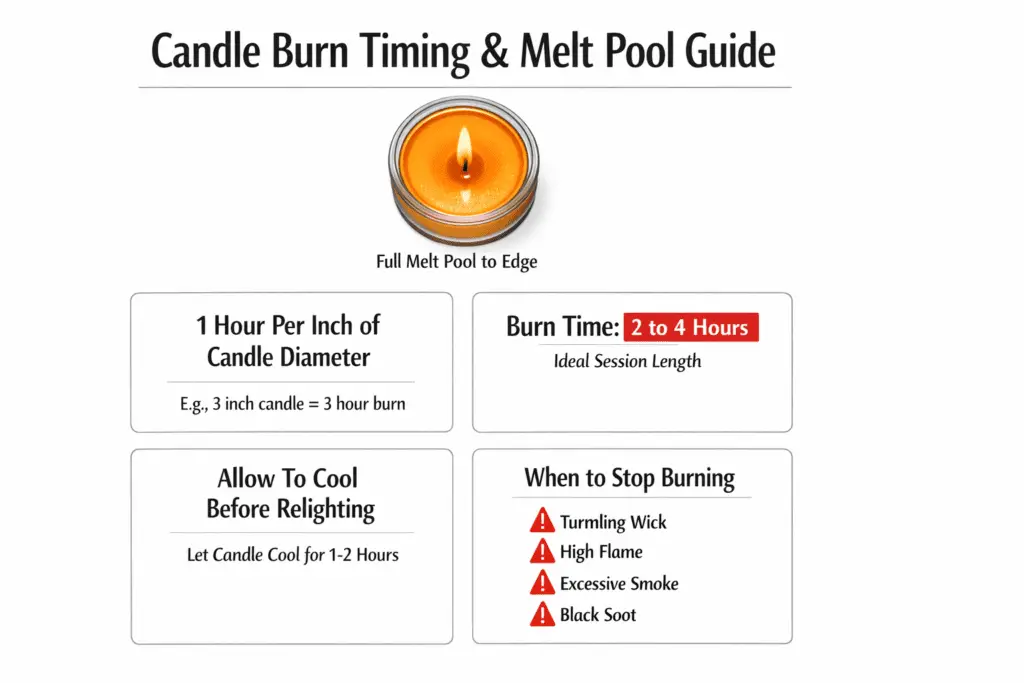
The first burn is especially important. If the wax does not melt all the way to the edge, the candle can form a memory ring. Once that happens, future burns often follow the same narrow path and waste wax around the sides.
Long enough burns help candles perform better, but overly long burns create their own problems. If the wick starts mushrooming, the flame grows too large, or smoke and soot appear, it is better to extinguish the candle and let it cool than to force a longer session.
For more consistent sessions, see how to trim candle wicks for an even burn before relighting.
Why not let your candles burn just a little?
Very short burns often cause tunneling because the candle never gets hot enough to melt fully across the surface.
A candle needs enough time to create a full melt pool before it is extinguished. For example, a candle with a diameter of 3 inches often needs about 3 hours on the first burn. After that, many candles perform best in sessions of around 2 to 4 hours.
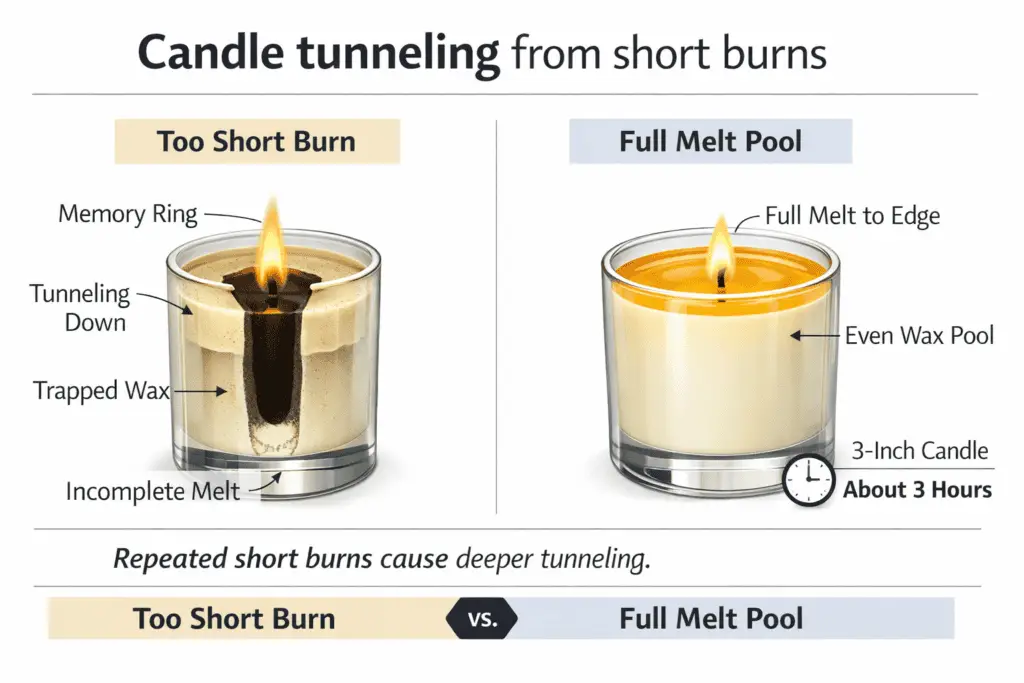
This problem shows up most clearly in container candles. If the first few burns are too short, a hard wax ring forms around the wick and the flame keeps burning down the center instead of using the whole surface. That is what people usually mean when they talk about candle burn memory.
Burning a candle long enough to melt evenly helps reduce wasted wax, improves scent throw, and lowers the chance of deeper tunneling later. A candle that is blown out too soon may look fine at first, but repeated short sessions usually make the problem worse.
If tunneling has already started, see how to fix uneven candle burns and tunneling.
Why do candles expire?
Candles expire by losing quality, not by spoiling like food.
Age, heat, light, air, and dust can weaken fragrance, fade color, and affect burn performance. This is especially true for scented candles and softer natural waxes.
Many scented candles are at their best within roughly a year to a year and a half, while unscented candles or paraffin-heavy blends often stay usable for longer when they are stored well. The exact timeline varies, so the condition of the wax, wick, and fragrance matters more than a fixed expiration date.
Fragrance is usually the first thing to fade. A candle may still look normal and light without trouble, but the scent can become flat or weak over time. Good storage slows this process, especially when candles are kept cool, dark, dry, upright, and covered when possible.
An older candle may still be usable, but it may no longer deliver the scent, appearance, or burn quality it had when new.
How to tell if a candle has expired?
A candle is usually past its best when the scent fades, the color changes, or the flame no longer burns cleanly.
The easiest way to check is to look at three things together: smell, appearance, and burn performance. A candle may still light after aging, but that does not mean it is still in peak condition.
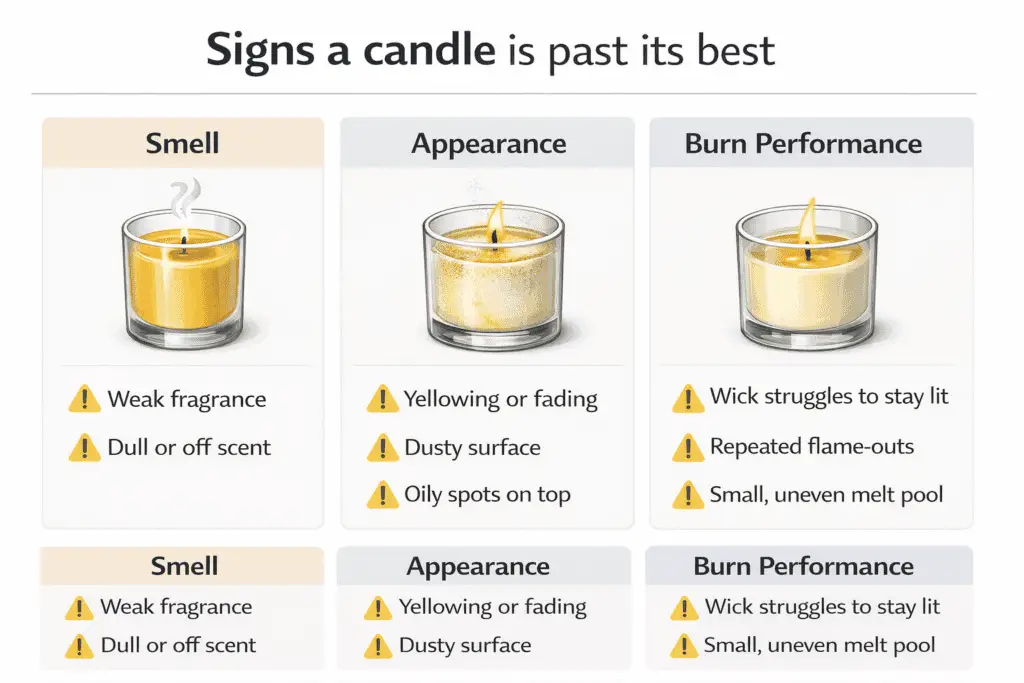
One common sign is weak fragrance. If a candle smells dull, flat, or much lighter than it did when new, the fragrance may have faded with age.
The wax can also show visible changes. Yellowing, fading, blotchy color, a dusty surface, or oily spots can all suggest that the candle has been affected by time or poor storage.
Burn behavior is often the clearest test. If the wick struggles, the flame goes out repeatedly, the melt pool stays too small, or the candle burns unevenly even after basic wick care, the candle may simply be past its best.
That does not always mean it must be thrown away immediately. If it still burns acceptably and the scent is good enough for you, it may still be usable. It just is not performing at its highest level anymore.
Do some candles last forever?
No candle lasts forever, but some last much longer than others.
Paraffin and beeswax often stay usable longer than softer waxes, and candles kept cool, dark, dry, upright, and covered usually hold their quality far better than candles exposed to heat, sunlight, humidity, or open air. A candle may still light after years in storage, but fragrance, appearance, and clean burn performance usually decline before the wax itself becomes unusable.
Which scented candles last the longest?
The scented candles that usually last the longest are well-made container candles with a balanced wick, moderate fragrance load, and a wax blend that burns steadily instead of too hot.
In practice, longevity depends less on the scent name and more on a balanced wick, a steady-burning wax, and a moderate fragrance load. Medium or large container candles often last longer than smaller formats because they hold more wax, but overloaded formulas can still burn too hot or perform poorly. For a deeper look at wax choices that affect burn speed and stability, see how to choose the right wax for your candles.
How do you store candles long-term?
Store candles in a cool, dark, dry place with stable temperature and as little exposure to air, dust, and sunlight as possible.
The simplest rule is to keep candles upright, covered when possible, and away from windows, heaters, attics, car interiors, and damp basements. Strong light and repeated temperature changes can fade scent, soften wax, and affect how the candle burns later.
A normal indoor room with low humidity is usually better than any place that gets hot by day and cold at night. Lids, original boxes, or clean wrapping can help protect the wax from dust and slow fragrance loss.
Good storage also helps prevent sweating, which is the oily moisture that sometimes appears when wax or fragrance reacts to heat and humidity shifts. If a candle has been stored in a warm place, let it return to room temperature before judging its surface or scent.
For long-term storage, it also helps to keep older candles toward the front so they are used first, and to avoid stacking softer wax candles in ways that can dent or deform them.
For a deeper storage checklist, see how to store candles for longevity and fragrance preservation.
Do candles lose their fragrance over time?
Yes, candles can lose fragrance over time, especially when they are exposed to heat, light, or open air.
The scent usually fades gradually rather than disappearing all at once. Fragrance oils can evaporate, react with oxygen, or weaken inside the wax, which is why older candles often smell lighter before they start burning differently.
This is more noticeable in scented candles than in unscented ones. An unscented candle may mainly lose appearance or burn quality with age, while a scented candle can lose the very feature most people bought it for.
Storage makes a major difference. Keeping candles cool, dry, covered, and away from direct sunlight slows fragrance loss. Leaving them near windows, heaters, or damp areas speeds it up.
Some people try to revive an older candle with a weak scent, but age-related fragrance loss cannot always be reversed. If the wax still looks healthy and the wick burns well, the candle may still be worth using, but it probably will not smell as strong as it did when new.
The Final Verdict
Candles do not last forever, but many stay useful for a long time when they are burned properly and stored well.
The most useful way to judge candle lifespan is to separate burn time from shelf life. Burn time depends on wax, wick, size, and burn habits. Shelf life depends more on fragrance stability, light, heat, dust, air exposure, and storage conditions.
If you want a candle to last longer while burning, let the surface melt evenly, trim the wick, and avoid very short or overly long burn sessions. If you want it to last longer in storage, keep it cool, dark, dry, upright, and covered whenever possible.
Material choice matters too. Different waxes age and burn differently, so there is no single answer that fits every candle.
In the end, the best candle is not the one that sits on a shelf the longest. It is the one that still smells good, burns cleanly, and matches the way you actually use and store it.
Quick Answers
How long do unused candles stay good?
Many candles stay usable for a long time when they are stored well, but scented candles usually lose peak fragrance before the wax itself becomes unusable.
Is it safe to burn an old candle?
An older candle can still be usable if the wax looks stable, the wick lights normally, and the candle burns cleanly, but weak scent and uneven burning are signs that it is past its best.
What shortens candle life the fastest?
Heat, direct sunlight, poor storage, very short burns, and overly long burn sessions are some of the fastest ways to shorten candle lifespan and reduce performance.