
Not every wax sold under this name behaves the same, so choosing by label alone can lead to weak throw, rough tops, or extra test rounds. The useful way to judge coconut apricot wax is by supplier blend, fragrance performance, burn behavior, and jar fit. Some makers use it for boutique scent-heavy containers, while others rule it out for hot-weather selling or low-testing setups. Seeing the strengths and limits side by side makes it easier to decide whether this wax fits your candle line.
What coconut apricot wax is and why blends vary
Coconut apricot wax is a premium container-candle blend whose exact formula varies by supplier, so performance, finish, and wick behavior are not identical across products.
In practice, the name points to a soft container blend made for smooth-looking candles and strong scent performance, not one universal recipe. Read the candle wax types guide before you compare brands, then judge each wax by its own supplier sheet. Melt point is the temperature range where the wax shifts from solid to liquid, and small changes there can affect softness, pouring, and heat tolerance.
| Supplier source | Ingredient description | Melt point | Fragrance-load guidance | What that usually signals |
|---|---|---|---|---|
| CandleScience product page | Apricot, coconut, paraffin, soy | 121–131°F (49.4–55.0°C) | 10% | Single-pour container focus with smooth tops |
| Candle Shack product page | Soy, coconut, apricot, mineral waxes | ~50°C | 8–10% | More emphasis on stability, melt-pool formation, and warmer-climate use |
| Makesy wax buying guide | Apricot, coconut, soy, small amount of food-grade paraffin | 129°F (54°C) | 9–10%, can handle up to 12% | Higher published scent-load ceiling and a 72-hour cure plan |
These published specs show why “coconut apricot wax” is not a standard formula across sellers.
This comparison keeps supplier names, ingredients, melt point, and fragrance guidance in the form each supplier publishes. When one seller gives a range and another gives a single number, the table keeps that difference instead of forcing a fake match. That matters because buying by name alone hides the testing burden.
Blend differences show up first in top finish, scent output, burn pace, and wick behavior. A softer blend with a higher published load ceiling can look creamy and hold more oil, yet it may ask for more wick testing and more care in warm conditions. A slightly tougher blend can be easier to manage in some jars or climates, which is why how to choose the right wax for your candles starts with the supplier sheet, not the label on the slab.
Check these details before you buy:
- ingredient list
- melt point
- published fragrance-load range
- container-only or broader use note
- recommended wick family
- cure guidance, if the supplier gives one
Use what coconut wax is and how it performs when the broader coconut-blend picture matters. Save coconut wax vs soy wax for the bigger category decision, because the next step here is narrower: how this blend throws scent and how much testing it needs in your jar.
How coconut apricot wax performs for fragrance throw
Coconut apricot wax can deliver strong hot throw, but the outcome depends on the blend, fragrance load by wax type, cure time, wick, and jar.
Cold throw is the scent you smell before lighting, and hot throw is the scent you smell while the candle burns. Read the candle wax types guide first if you need the wider wax-family view before judging scent strength inside this blend class.
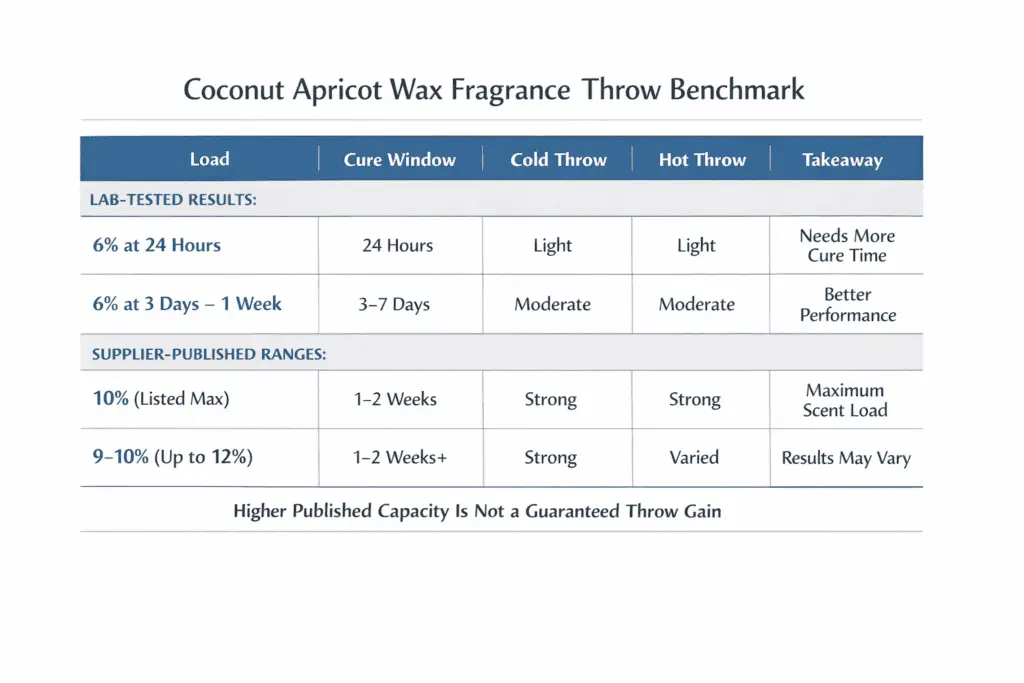
| Source or test condition | Load | Cure window | Cold throw | Hot throw | What to take from it |
|---|---|---|---|---|---|
| CandleScience lab, olfactive test | 6% | 24 hours | strong, rated 3/3 | not judged in this step | early cold throw can show up fast |
| CandleScience lab, burn test | 6% | 3 days for burn test; cold throw improved at 1 week | strong, rated 3/3 | rated 3/3 | moderate load can already perform very well |
| CandleScience product page | 10% listed max | product page says cure time is 1–2 days | supplier claim | supplier claim | short cure guidance, yet jar-by-jar testing still matters |
| Makesy published range | 9–10%, can handle up to 12% | 72 hours | supplier claim | supplier claim | higher load ceiling is a starting range, not a promise |
The table separates lab-tested outcomes from supplier-published working ranges, so “strong throw” is not treated like a fixed result.
This benchmark uses load in %, cure in hours or days, and published source wording where no side-by-side lab score was given. The strongest scored result here comes from CandleScience’s in-house 3-leaf scale, while the higher-load rows show published capacity rather than a guaranteed scent gain. That distinction matters because supplier ceilings tell you what the wax may hold, not what your finished candle will throw in every jar.
The plain verdict is that coconut apricot wax often throws well even at moderate load, which is why it fits premium fragrance lines. The 10% CandleScience product-page maximum is the working recommendation for finished candles, while higher lab-note holding results show what the wax can tolerate under controlled testing rather than what every finished jar should use. Results change fast when the fragrance oil is delicate, the wick runs cool, or the jar needs more surface heat than the flame is giving it. CandleScience notes that higher fragrance loads can lower the finished candle’s melting behavior in warm conditions, so pushing to the ceiling can trade scent for stability and wick trouble.
Use this quick check when throw feels weak:
- Let the candle cure longer before judging, especially if you tested at 24 hours.
- Test an adjacent wick size before raising the oil load.
- Re-test in the final jar, not a different vessel.
- Try a known strong fragrance oil before blaming the wax.
- Move back toward the supplier’s starting range if a high load made the candle heavy, oily, or hard to burn.
If scent strength is the main buying goal, best wax for strong scent throw is the wider decision page. For a faster side-by-side on waiting periods, keep cure time by wax type chart nearby. Use coconut wax vs soy wax when you want the broader tradeoff between coconut blends and simpler soy setups.
How coconut apricot wax burns in container candles
Coconut apricot wax often burns cleanly in tested jars, but melt pool pace and soot control depend more on wick-and-jar matching than on the wax name alone.
A controlled first burn matters more than forcing a fast edge-to-edge melt pool. With coconut apricot wax, a later-reaching melt pool can still consume the wax fully, so the better checkpoints are steady flame size, limited soot, and repeatable behavior across later burns.
The symptom table below sorts the most common burn signals before you change wick series, fragrance load, or jar.
| Burn symptom | Likely cause | What to change next |
|---|---|---|
| Tunneling down the center | Wick is too small, burn session too short, or jar needs more heat across the surface | Wick up within the same series and retest with a full burn session |
| Melt pool goes very deep early | Wick is too large for the jar or recipe | Wick down within the same series |
| Mushrooming on the wick tip | Over-wicking or too much heat for the recipe | Wick down and keep wick trims consistent |
| Soot on the jar | Flame is too large or flickering, often from over-wicking | Wick down, trim correctly, and recheck flame stability |
| Full melt pool forms late but stays controlled | Wick may be close, but the recipe still needs more burn data | Repeat the same setup and log later burns before changing series |
| Flame dies out before full wax use | Under-wicking or a weak heat pattern for the jar and load | Wick up and retest in the same jar |
Keep jar diameter, wick series, fragrance load, and session length fixed while you change only one variable. CandleScience’s burn-test process calls for a 1/4 inch (6 mm) wick trim, hourly notes, and a stop at 4 hours, which makes your comparisons cleaner and safer.
For the wider wax-family view, the candle wax types guide helps first. If the vessel choice is still open, best wax for glass jars vs tins matters before deeper wick changes, and best candle wax for hot climates and summer shipping matters before you promise stable summer performance.
Use the first test burn to sort the problem before you change everything at once. Wick up for tunneling, wick down for deep pools or soot, and retest the same recipe before blaming the wax.
Steps for wick testing coconut apricot wax in jars
Start with the supplier’s wick size chart, then test adjacent wick sizes in your exact jar, fragrance load, and cure window before locking anything.
CandleScience recommends making 2–3 test candles with the same container and recipe, labeling each wick size, waiting at least 24 hours, and moving up or down within the same series before you jump to a different family. Trim to 1/4 inch (6 mm), check the candle each hour, and end each session at 4 hours.
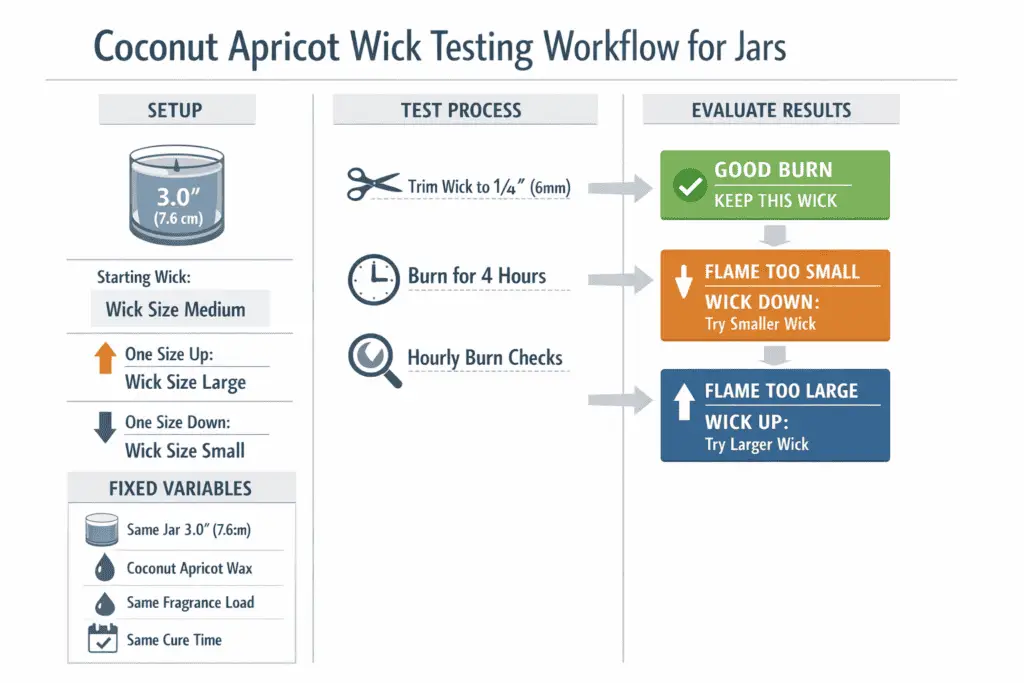
Use this copyable first-pass matrix instead of guessing from one burn:
| Jar diameter | Wick series | Size tested | Fragrance load | Cure window | Burn result after 3–4 hours | Next move |
|---|---|---|---|---|---|---|
| 3.0 in (7.6 cm) | Chart starting series | Chart size | Your final % | 24+ hours | Baseline result | Keep only if flame, pool, and carbon stay controlled |
| 3.0 in (7.6 cm) | Same series | One size down | Same % | Same cure | Smaller flame, slower pool | Use if the chart size ran too hot |
| 3.0 in (7.6 cm) | Same series | One size up | Same % | Same cure | Larger flame, faster pool | Use if the chart size tunneled or stalled |
This matrix is a planning tool, not a universal wick chart. Keep the wax, jar, dye, fragrance, and cure window the same across the row set so wick size is the only real variable you are testing.
Test the chart size plus the nearest smaller and larger size in the same series first, and change series only after the trend is clear. If vessel fit or setup simplicity is still the bigger question, best wax for glass jars vs tins can come before fine wick tuning, and best candle wax for beginners can help before you choose a softer blend that asks for more test rounds. The real cost of this wax is not only the slab price. It is the extra time spent proving the final jar, fragrance load, and wick can work together without drift.
Best uses for coconut apricot wax candles
Coconut apricot wax fits premium container candles best, especially when smooth appearance and scent experience matter more than low cost or hot-weather durability.
CandleScience lists its Coconut Apricot Wax for containers and gives a maximum fragrance load of 10% or 1.6 oz/lb (45 g/454 g), which makes it a natural fit for scent-led jars rather than free-standing pillars. Keep the candle wax types guide nearby for the wider wax picture, then use best wax for pillar candles vs container candles, best candle wax for hot climates and summer shipping, and best wax for strong scent throw to judge whether this blend matches your product promise.
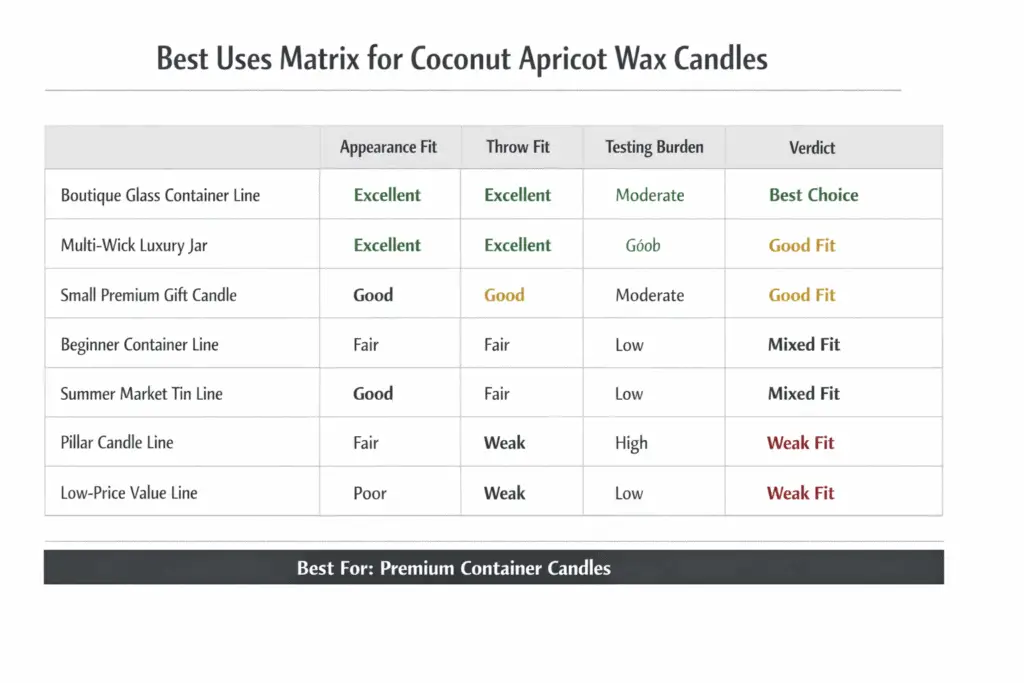
| Use case | Appearance fit | Throw fit | Testing burden | Verdict |
|---|---|---|---|---|
| Boutique glass container line | 5/5 | 4/5 | 3/5 | Strong fit |
| Multi-wick luxury jar | 5/5 | 4/5 | 4/5 | Strong fit |
| Small premium gift candle | 4/5 | 4/5 | 3/5 | Strong fit |
| Beginner container line | 4/5 | 4/5 | 3/5 | Good fit if you stay with jars |
| Summer market tin line | 3/5 | 4/5 | 4/5 | Mixed fit |
| Pillar candle line | 1/5 | 2/5 | 5/5 | Weak fit |
| Low-price value line | 3/5 | 4/5 | 4/5 | Weak fit unless price can rise |
That pattern is consistent with how major suppliers describe the blend: smooth-looking, single-pour, scent-forward, and container-focused. It is strongest when the candle sells an upscale jar experience, and weaker when the line must be cheap, rugged, or easy to ship through summer heat.
How the fit was judged: appearance fit reflects top smoothness, frosting risk, and visual finish; throw fit reflects supplier scent guidance and common use in fragrance-led jars; testing burden reflects wick work, jar sensitivity, and warm-weather handling risk. A strong fit means the wax supports the product goal with no major mismatch. A weak fit means another wax family is usually easier, cheaper, or tougher for that job.
Why makers like the smooth, luxury finish
Makers like this wax because it can give smooth tops, creamy color, and a polished jar look with a single pour. CandleScience describes its blend as single-pour with smooth tops, minimal frosting, and good color retention, which is a big part of why it reads as a higher-end container wax.
| Finish trait | Why it reads premium in jars |
|---|---|
| Smooth top | Less rework and a cleaner shelf look |
| Creamy surface | Softer visual texture than many plain soy finishes |
| Lower visible frosting | Better for dyed candles and polished presentation |
| Strong glass-first presentation | Works best where the vessel is part of the product |
That matters most when glass presentation is part of the sale, which is why best wax for glass jars vs tins often comes right after what coconut wax is and how it performs. The finish matters less when you are still deciding best wax for pillar candles vs container candles, because this blend earns its keep most clearly in vessels that show the top and sidewall.
When the premium cost is worth it
Coconut apricot wax is usually worth the extra cost only when the finished candle can charge more for look, scent, or brand feel. Current CandleScience pricing puts Coconut Apricot Wax at $3.41/lb by the 45 lb case, while SimplySoy Artisan Wax is listed at $2.18/lb by the 45 lb case, so the wax-only gap is real before freight and test waste are added.
| Wax option | Current case price | Price per lb | Wax used in an 8 oz candle at 10% fragrance load | Wax-only cost per candle |
|---|---|---|---|---|
| Coconut Apricot Wax | $153.28 / 45 lb | $3.41 | 7.2 oz | about $1.53 |
| SimplySoy Artisan Wax | $98.14 / 45 lb | $2.18 | 7.2 oz | about $0.98 |
That is about $0.55 more in wax per candle before jars, fragrance, labels, packaging, and failed test burns. The extra spend makes the most sense when how to choose the right wax for your candles points to a premium jar line and best wax for strong scent throw is part of the value you plan to sell.
How the worksheet was judged: the table uses current listed case pricing, an 8 oz finished candle, and a 10% fragrance load, which leaves about 7.2 oz of wax in the fill. The formula is simple: wax cost per candle = price per lb × 7.2 ÷ 16. That keeps the cost view honest without pretending every brand has the same freight, waste, or sell price.
The clean decision rule is simple. Keep coconut apricot wax for premium containers, scent-led collections, and lines where the vessel look helps justify the price. Test a cheaper container wax first for value lines, broad wholesale, or products that must stay tough and predictable in summer shipping.
The main downsides: softness, heat, and handling limits
The biggest downside of coconut apricot wax is that its softer, more delicate nature can create handling, storage, and warm-weather problems even when the finished candle looks excellent.
CandleScience lists a melt point of 121–131°F (49.4–55.0°C) for its Coconut Apricot Wax, while Candle Shack lists its apricot-coconut blend at around 50°C, yet both suppliers are still describing soft container blends rather than rugged pillar systems. Keep the candle wax types guide for broad wax choices, then move to best candle wax for hot climates and summer shipping and best wax for glass jars vs tins when heat, transit, or vessel behavior may decide the result.
| Problem | Likely driver | What to do next |
|---|---|---|
| Shipping slump or surface tilt | Warm transit, soft blend, loose packing | Add tighter packaging, shorter transit exposure, and seasonal shipping limits |
| Dents or drag marks on the top | Soft surface during handling | Lid fast, handle less, and box only after the candle is fully set |
| Wet spots or sidewall changes | Cooling shift, vessel variation, or later temperature swing | Retest the jar, pouring routine, and storage conditions before blaming one batch |
| Top looks wavy after heat exposure | Warm room, sun, or parked-car heat | Move stock to a cooler room and avoid direct light or car storage |
| Outdoor market performance drops | Ambient heat pushes the blend past its easy-handling range | Use a tougher wax for that season or reserve this wax for indoor sales |
| Shipping looks fine in winter but fails in summer | Same recipe, different transit conditions | Split seasonal rules instead of assuming one all-year setup |
These risks do not mean the wax fails in every climate. They mean the handling margin is smaller, so storage, packaging, and season matter more than they do with tougher blends. Candle Shack even markets its apricot-coconut blend as more stable in warmer climates, which shows why heat risk is blend-specific rather than universal.
How the risk calls were judged: the published supplier facts here are melt point, container-only use, and blend character. The table then translates those facts into shop-floor problems makers often see under warm storage, transit pressure, or glass variation. The table is a decision aid, not a lab certificate, so each risk call is qualified by conditions instead of treated like a rule for every coconut-apricot blend.
The safest verdict is practical. Coconut apricot wax is a strong choice when the candle lives in a controlled indoor retail or home setting. A tougher wax is often the better fit for outdoor markets, rough parcel travel, hot porches, or any line that has to survive summer logistics with very little margin for error.
FAQ
Is coconut apricot wax only for container candles?
Most supplier guidance treats coconut apricot wax as a container blend. It fits jars much better than free-standing pillars.
Does coconut apricot wax have strong scent throw?
It often throws very well, even at moderate load, but the result still depends on the fragrance oil, wick, cure window, and jar.
Is coconut apricot wax good for beginners?
It can work for beginners in jars, but it usually asks for more wick testing than a simpler, tougher container wax.
Can coconut apricot wax handle summer heat well?
Its softer handling margin makes it riskier for hot-weather selling, storage, and shipping than tougher blends.
Why do suppliers list different specs for coconut apricot wax?
The label covers different proprietary blends, not one fixed formula, so melt point, fragrance-load guidance, and heat behavior can change by seller.