

The right candle fragrance on this page is a candle-safe scent option that fits your wax, intended room, scent role, and supplier documentation limits well enough to justify small test jars. It does not mean the strongest fragrance, the best bottle smell, or a full load, wick, cure, or add-fragrance-temperature answer.
This page is for candle makers who need a scent that fits their wax, room size, brand style, and safety limits. It helps you narrow a large catalog into a short test list you can validate in small jars. The page focuses on fragrance choice first, then routes deeper work such as load, wick, and process checks to separate guides. The first section gives you a fast filter you can use in minutes.
This page narrows the shortlist first and does not decide final fragrance load, wick choice, cure time, or add-fragrance temperature.
How to choose the right candle fragrance at a glance
Choose fragrance oil by checking wax compatibility, room size, scent family, and safety documents before you adjust load or wick. For the parent scenting guide, use the complete guide to candle fragrance and scenting as the main reference.
On this page, the right fragrance is one that fits your wax, intended room, scent role, and supplier documentation limits well enough to justify small test jars.
Do not choose by bottle smell alone; shortlist by family and documents, then confirm in your wax and room.
Use this filter order before you buy testers:
- Remove any oil that does not have candle-use documentation, a supplier-issued IFRA Certificate of Conformity or equivalent supplier documentation, and an SDS.
- Keep only the oils that usually perform well in your wax family.
- Narrow the list by room size, scent strength, and the mood you want the candle to create.
- Decide whether the product should lean fragrance-oil-led, EO-supported, or EO-heavy.
- Test only the best 2–3 options in small jars before you change load or wick.
Quick supplier screen: favor oils sold specifically for candles, with easy access to a supplier-issued IFRA Certificate of Conformity or equivalent candle-use documentation, an SDS, small test sizes, and basic performance notes for common waxes.
Start with the choice itself, not the formula math. A fragrance can be dosed correctly and still be wrong for your wax, your room, or your brand style. For the detailed math, see the detailed breakdown of fragrance load.
| Decision factor | What usually works best | What to watch out for | Best next step |
| Soy or beeswax jars | Clean florals, woods, tea, spa, and lighter gourmand blends | Dense bakery oils can feel muted or need more wick/load tuning | Start with a mid-strength fragrance and test one wick family |
| Paraffin or stronger-throw blends | Gourmand, amber, resin, vanilla, and bold seasonal scents | Heavy scents can overwhelm small rooms quickly | Start lower before increasing load |
| Small rooms | Citrus, airy fresh scents, soft florals, tea notes | Smoke, leather, and very sweet blends can feel too heavy | Prioritize a lighter scent family first |
| Large or open rooms | Woods, amber, gourmand, and stronger blended fragrances | Delicate top-note-only scents can disappear in airflow | Test hot throw in the real room |
| Mood or season | Fresh citrus, herbs, and airy florals for spring or daytime; woods, amber, spice, and gourmand notes for autumn, winter, or evening | A seasonal mismatch can make a candle feel wrong even when the formula burns well | Match the scent family to when and where the candle will usually be burned |
| Statement scent vs subtle background scent | Amber, gourmand, and smoky woods for statement candles; tea, citrus, and soft florals for gentle background scent | Strong families can dominate small rooms or long burn sessions | Decide whether the candle should lead the room or sit quietly in it |
| Natural-leaning brand | EO-supported or FO-dominant blends with clear documentation | “Natural” does not automatically mean stronger or safer | Compare IFRA, SDS, and wax fit before buying |
| Seasonal collection | One clear hero note with one supporting base | Too many competing notes create muddy candles | Test 2–3 variants, not 10 at once |
How to match fragrance oil to your wax type
Start with one wax and one fragrance family before you scale.
Run small test jars to confirm they cure cleanly and throw well in that wax system. That focused approach helps you choose the right candle fragrance for each wax system instead of chasing every scent that looks appealing in the catalog.
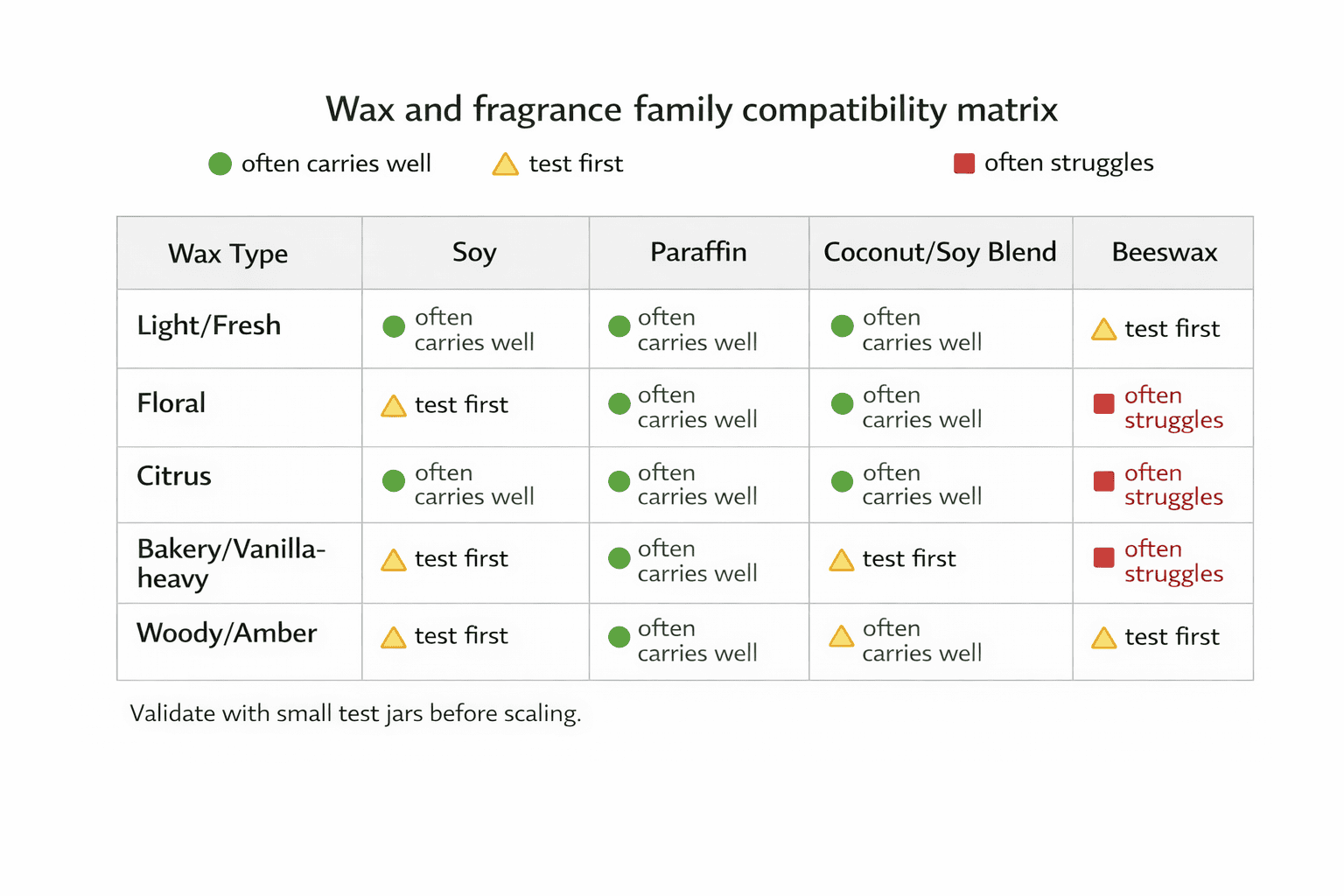
Here, wax–fragrance compatibility means how well a wax dissolves and holds a fragrance oil so the candle cures cleanly without weeping or frosting caused by the scent.
Hot throw is simply how strongly a candle scents the room while it is burning, as opposed to the cold scent from an unlit candle.
Before pairing fragrance oils in candle making with waxes, take time to understand wax types such as soy, paraffin, coconut blends, and beeswax, because their chemistry changes how easily different fragrance families stay in solution.
In broad strokes, soy often rewards clear mid-strength profiles first, while paraffin and some blends may carry richer vanilla, amber, or gourmand scents more easily.
As you design your range, review CLP/IFRA basics (CLP (Classification, Labelling and Packaging) rules and International Fragrance Association (IFRA) guidance) so each blend meets labeling and usage rules.
Good supplier guidance and basic compliance checks belong together, because an oil that misbehaves in your wax can tempt you to push load beyond a sensible working limit.
These starting pairings make the first test easier because they turn broad compatibility advice into a practical shortlist.
| Wax type | Usually easiest fragrance families to test first | Use extra caution with | Why this is a good starting point |
| Soy container wax | Tea, soft florals, clean woods, spa, and fresh blends | Dense bakery, heavy vanilla, and very resinous blends | Soy often rewards clear mid-strength profiles before very rich scents |
| Coconut/soy blends | Fresh florals, woods, amber, and moderate gourmand blends | Very delicate top-note-only scents in large open rooms | These blends often carry a wider range well, but room testing still matters |
| Paraffin container wax | Gourmand, vanilla, amber, spice, and stronger seasonal blends | Overly strong profiles in small rooms | Paraffin usually throws bold scents well, so it suits richer fragrance families |
| Beeswax | Light woods, herbs, honey-adjacent blends, and restrained florals | High-load gourmand or sharp synthetic-feeling blends | Beeswax has its own natural aroma, so cleaner supporting scents tend to fit better |
In practice, sketch a small compatibility matrix: each row is a wax, each column a fragrance family, and you fill cells with notes after burning test jars.
For each wax–oil pair, note cure time, surface condition, and perceived hot throw so patterns emerge quickly without wasting full production batches.
If you are new to testing, keep early experiments simple by choosing one baseline wax and three fragrance families, then expanding the grid once you see clear winners.
To confirm a promising pairing, run a quick side-by-side check before you buy more:
- Pour two matching small jars with the same wax, wick, and fragrance load for each oil you want to compare.
- Cure and burn them the same way, then keep the option that smells cleaner and behaves better in that wax.
Which fragrance type should you choose for your situation?
The right fragrance depends on whether you need strong throw, a natural-leaning story, a softer room scent, or a seasonal signature.
Use the scenarios below to make a first choice, then confirm the winner with a small test batch.
- If you want the easiest beginner starting point: choose a candle-safe fragrance oil in a clean floral, fresh, woody, or spa family. These scents are usually easier to read, easier to test, and less likely to feel muddy in a first recipe.
- If you want stronger throw in larger rooms: choose bolder fragrance families such as gourmand, amber, resin, or warm woods, and pair them with a wax system known for solid throw performance.
- If you want a softer candle for bedrooms, bathrooms, or desks: choose lighter citrus, tea, herbal, or airy floral profiles and avoid dense bakery or smoky scents unless the room is well ventilated.
- If you want a natural-leaning brand story: choose EO-supported blends or carefully documented fragrance oils rather than assuming pure essential oils will automatically perform better.
- If you want a seasonal collection: choose one hero note first, then add one supporting note that keeps the profile clear instead of crowded.
You can narrow the shortlist further by the feeling, season, and note profile you want the candle to create.
| Goal or use case | Usually easiest scent families | What they tend to feel like |
| Clean daytime scent | Citrus, green, herbal, airy fresh blends | Bright, active, and easy to live with in kitchens, bathrooms, and work spaces |
| Calm or spa mood | Tea, soft florals, eucalyptus-style fresh blends, light woods | Quiet, gentle, and suited to bedrooms, baths, and slower evening use |
| Cozy autumn or winter scent | Amber, spice, vanilla, gourmand, and warm woods | Richer, fuller, and better for cooler weather or shorter evening burns |
| Statement candle for larger rooms | Woods, resin, smoke, gourmand, and bold blended accords | Noticeable, room-filling, and better when you want the scent to lead the space |
These quick cost, effort, and risk notes help you narrow the shortlist further:
- Lowest effort: a candle-safe fragrance oil with good supplier documentation
- Highest testing effort: essential-oil-heavy blends, dense gourmand scents, and unusual custom blends
- Highest labeling risk: any fragrance you have not checked against IFRA, SDS, and your market’s labeling rules
How to match scent strength to room size without drifting off-topic
Use room size as a filter for fragrance family and perceived strength, not as a separate candle-size buying guide.
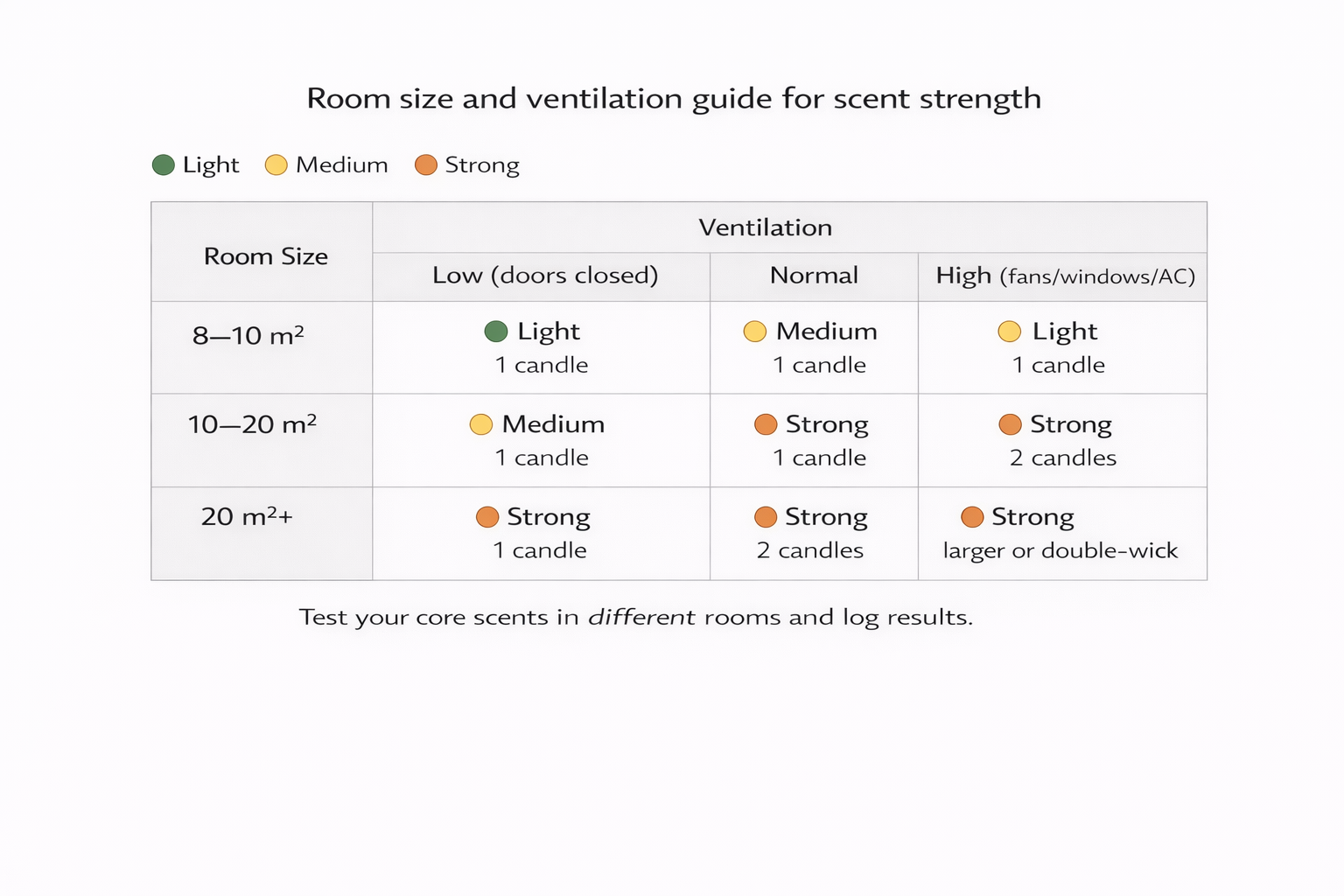
In small rooms, lighter citrus, tea, herbal, and airy floral blends are usually easier to live with. In medium rooms, balanced woods, florals, spa blends, and moderate gourmands usually feel comfortable. In large or drafty rooms, richer woods, amber, resin, and fuller gourmand profiles tend to hold their presence better.
Airflow matters as much as room size. Open doors, fans, and air conditioning can flatten delicate scents, while dense bakery or smoky blends can still feel heavy in tight spaces. Keep this decision tied to fragrance choice: use lighter families for small enclosed rooms, balanced families for everyday spaces, and stronger families only when the room and airflow justify them.
Use simple room notes to support future fragrance choices, then move deeper method work to the scent-throw testing guide for different rooms.
Quick decision snapshot:
- For small enclosed rooms, start with lighter scent families and avoid very dense or smoky profiles unless you want a strong statement scent.
- For medium everyday rooms, balanced florals, woods, spa blends, and moderate gourmands usually feel present without becoming heavy.
- For large rooms or spaces with strong airflow, choose fuller fragrance families such as amber, resin, warm woods, or richer gourmand blends.
How to validate your fragrance choice before you scale it
Test one fragrance in one wax and change only one variable at a time.
You do not need a full lab workflow to check a shortlist. You need a simple side-by-side test that tells you which fragrance deserves deeper work in a separate process guide.
- Pour small matching test jars for the 2–3 best options.
- Cure and burn them the same way, then compare scent quality and basic burn behavior in the same room.
- If a promising option still performs poorly after consistent handling, use the guide on how to fix weak scent throw in your candles before you push the load higher or abandon the fragrance family.
For the deeper process details, use the guide to adding fragrance at the right temperature and the guide to cure time for scented candles.
Once you have two or three likely fragrance options, keep this page focused on the choice and move the deeper workflow into those dedicated pages instead of turning one decision article into a full scent-development manual.
Safety check before you buy or scale a fragrance
A fragrance is a valid choice only when its IFRA limit, your wax limit, and its SDS hazard profile all fit the same finished candle.
Treat compliance as a filter, not as a cleanup step after you already love the scent. A fragrance that smells great but fails documentation or labeling checks is not the right fragrance for production.
Treat the supplier-issued IFRA Certificate of Conformity or equivalent candle-use documentation as one decision document, not as a substitute for your own finished-product safety and labeling review.
An IFRA Certificate of Conformity is a filter, not a full finished-product approval.
- Check the supplier-issued IFRA Certificate of Conformity first. Find the candle category entry and record the maximum allowed percentage for that finished product type.
- Check the wax limit next. Your working cap is the lower number between the IFRA limit and the wax supplier’s maximum load.
- Read the SDS before you buy in bulk. Section 2 tells you the hazard classification, while Section 9 gives physical data such as flash point.
- Use flash point correctly. Flash point helps with handling, heating, and storage decisions. It is not a target for fragrance load and it does not tell you how strong the candle will smell.
Do not buy in bulk or scale this fragrance yet if:
- the supplier cannot provide a supplier-issued IFRA Certificate of Conformity or equivalent candle-use documentation
- the wax limit and IFRA limit do not overlap at a workable load
- the SDS raises a handling or labeling issue you are not prepared to manage
- your first test jars show seepage, weak hot throw, or unstable burning at a normal load
- the scent only works after pushing the load higher than your safe working cap
If you need the deeper explanation, use the guide to fragrance flash point in candle making.
Should this candle be fragrance-oil-led or EO-supported?
Choose fragrance oils when you want stronger throw and easier repeatability, EO-supported blends when you want a middle path, and essential-oil-heavy blends when brand story matters more than maximum throw.
Fragrance oils are usually the better fit when you want stronger throw, easier repeatability, and clearer candle-specific performance notes. Essential-oil-heavy blends fit better when brand story matters more than maximum throw, and EO-supported blends sit between those two routes. A natural-leaning route does not automatically mean safer or stronger.
- Choose fragrance oils when you want stronger throw and easier repeatability.
- Choose essential-oil-heavy blends when a natural-leaning product story matters more than maximum throw.
- Choose EO-supported blends when you want a middle path without moving fully into EO-heavy performance limits.
Once that route is clear, move the deeper comparison to the detailed comparison of essential oils vs fragrance oils.