
Candle scenting is the part of candle making that controls fragrance load, temperature, cure, testing, and scent-related label checks. On this page, strong means noticeable cold and hot throw with repeatable burn performance, not raw bottle smell, personal scent preference, or perfume-style complexity. Safe means staying within wax limits, fragrance-use guidance, and obvious burn or labeling red flags, not blanket legal approval in every market, a full fire-safety guide, or a vague marketing claim.
If you make candles at home or in small batches, this page helps you control the variables that decide scent strength, stability, and safety. You will see how fragrance load, wick heat, cure time, and temperature windows work together instead of troubleshooting them in isolation. You will figure out whether a weak result comes from formula, process, burn behaviour, or labeling risk. The next sections move from safe load calculations to throw testing, defect diagnosis, and compliance checks.
This page is an overview and decision hub. It shows which scenting variable to check next and routes deeper implementation to the linked child guides instead of owning every workflow in full.
Use this page as a candle scenting decision map
Use this page as a candle scenting decision map by identifying the first variable that limits your result, then opening the child guide that solves that variable in depth. For the broader craft context, start with the full candle making guide before narrowing down scenting variables.
| If your main question is… | Check first | Best section on this page | Go deeper here |
|---|---|---|---|
| How much fragrance can I use safely? | Wax maximum, IFRA Category 12, batch weight | How to calculate safe fragrance load for candles | Fragrance load calculator |
| Why is my candle weak when burning? | Wick size, cure time, room size, melt pool | Fix weak hot throw in candles | How to fix weak scent throw in your candles |
| When should I add fragrance? | Wax-specific add window and pour window | How mix and pour temperatures affect scent throw | How to properly add fragrance oil to candle wax |
| How long should I cure before testing? | Wax family and fragrance family | Maintain cure quality with temperature-controlled storage | How long should you cure scented candles? |
| How do I test scent throw properly? | Room size, airflow, fixed scoring sheet | Steps to run a candle scent test with a printable scoring sheet | Scent throw testing protocol |
| What do I need for IFRA or CLP compliance? | IFRA certificate, SDS, market, final hazard classification | How to comply with IFRA Category 12 and EU CLP labeling | Candle safety standards and labeling |
How to scent candles properly from start to finish
To scent candles properly, set a safe fragrance load, add the oil in the supplier’s working window, cure the candle fully, and verify the result with a controlled burn test. The goal is not just a strong jar smell. The goal is a repeatable candle that throws well, burns cleanly, and stays inside your wax and label limits.
- Check the wax technical data sheet and the fragrance IFRA document before you choose any percentage.
- Calculate the fragrance oil by finished candle weight, then make a small test set instead of committing to one load immediately.
- Add and stir the fragrance inside the wax supplier’s working temperature range so the oil disperses evenly.
- Pour, cool, and cure the candle for a fixed number of days before you judge throw or burn quality.
- Run a controlled test burn and score melt-pool speed, hot throw, soot, and any sweating or other defects.
- Keep the winning formula only after the candle passes both performance checks and the correct recordkeeping or labeling checks for your market.
For the broader process, start with your main candle-making workflow before narrowing down wax, wick, or scent variables.
How to calculate safe fragrance load for candles (Calculating)
Calculate safe fragrance load by combining your wax’s maximum percentage, the fragrance’s IFRA guidance, and a tested range of about 6–10%, then converting the chosen percentage into finished-candle weight.
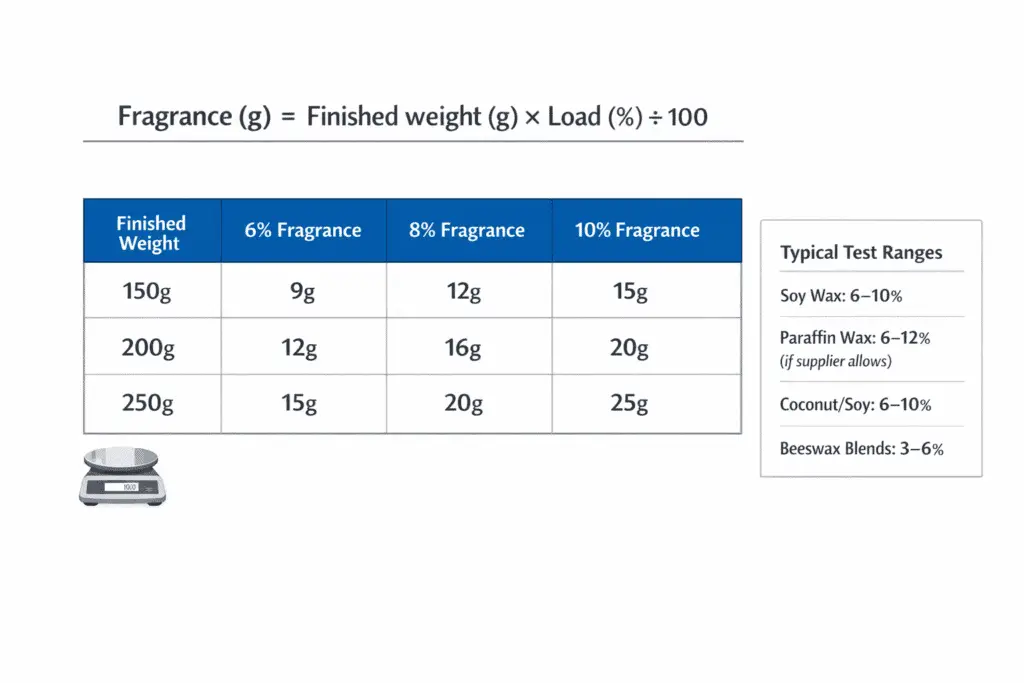
Fragrance load is the percentage of fragrance oil in your finished candle by weight, not volume. “Safe” means three things at once: you respect the wax manufacturer’s maximum load, you stay within the fragrance’s IFRA Category 12 usage rate, and you stay within normal candle practice, typically somewhere in the 5–12% range, with many container candles landing below 10% unless supplier data supports more.
Methods note: The percentage bands and wax-family starting points below are working test ranges drawn from common supplier data sheets and normal maker practice. They are not legal limits, and your wax technical data sheet plus the fragrance IFRA certificate always override general bands.
Use this four-step method every time you design a new candle:
- Start from the wax limit. Check the technical data sheet for your wax before you test any percentage.
- Check the IFRA certificate for the fragrance. Find Category 12 and use any lower listed maximum as your hard ceiling for candles.
- Choose a test range, not a single percentage. Pick two or three loads that stay below both the wax maximum and the IFRA limit.
- Apply the weight-based formula. Fragrance oil (g) = Finished candle weight (g) × Load (%) ÷ 100.
If your container holds 200 g of finished candle and you are testing 8%, the formula is 200 × 8 ÷ 100 = 16 g of fragrance oil.
| Wax family | Conservative first test | Common upper test band | Check before increasing |
|---|---|---|---|
| Soy container wax | 6% | 8–10% | Wax TDS maximum, cure time, wick performance |
| Paraffin container wax | 6% | 8–10% (sometimes 10–12% if the TDS allows) | Surface oiling, soot, melt-pool heat |
| Coconut/soy blend | 6% | 8–10% | Supplier window, sweating risk, room-size throw |
| Beeswax or beeswax-heavy blend | 3% | 4–6% | Natural honey note, lower fragrance tolerance |
| Palm or high-additive blend | 5% | 7–9% | Crystallization behavior, glass adhesion, wick heat |
Many candle wax types tolerate different practical load ranges, so keep the chosen percentage tied to the wax family you are actually testing. If you need edge cases or a deeper explanation of the metric itself, use the dedicated fragrance-load resources linked from the decision map and record every result in your batch notes.
When IFRA itself is not the limiting factor, many certificates show high Category 12 allowances such as the example guidance in the IFRA guidance document, but your wax limit and tested performance still decide the practical ceiling for the candle.
Fix weak hot throw in candles (Fixing)
To fix weak hot throw, rebalance fragrance load, wick size, cure time, and burn conditions within safe limits before assuming the fragrance oil or wax is the problem.
Hot throw is how far your candle’s scent travels while burning, and it depends on how efficiently fragrance molecules evaporate from the melt pool into the room. Too little fragrance, poor binding, under- or over-wicking, short cure times, or burning a small jar in a huge room can all leave your candle smelling disappointingly faint, even if the oil itself is strong.
| Symptom | Most likely cause | First correction | What to retest next |
|---|---|---|---|
| Strong cold throw but weak hot throw | Under-wicking or short cure | Extend cure and test one wick size up | 2-hour melt pool and room throw |
| Tiny flame and shallow melt pool | Wick too small | Upsize the wick or change wick series | Full-pool time and soot score |
| Tall flame, soot, or mushrooming | Wick too hot or fragrance load too high | Step down wick size or reduce load | Container heat and soot after 2–3 hours |
| Oil sheen or sweating on top | Overload, poor binding, or heat swings | Reduce load and tighten add/cure temperatures | Surface stability after 7–14 days |
| Good throw in a bathroom but weak in a living room | Vessel/room mismatch | Use a wider vessel or multiple candles | Throw test by room size |
| Great first burn, weak later burns | Inconsistent wick trim, airflow, or cure/storage | Standardise trim, burn session, and storage | 30-minute and 2-hour scoring across burns |
Cold throw is the scent you judge from the unlit candle, while hot throw is the scent you judge after the melt pool forms during the burn. Score them separately, because a candle can smell strong in the jar and still project weakly once lit.
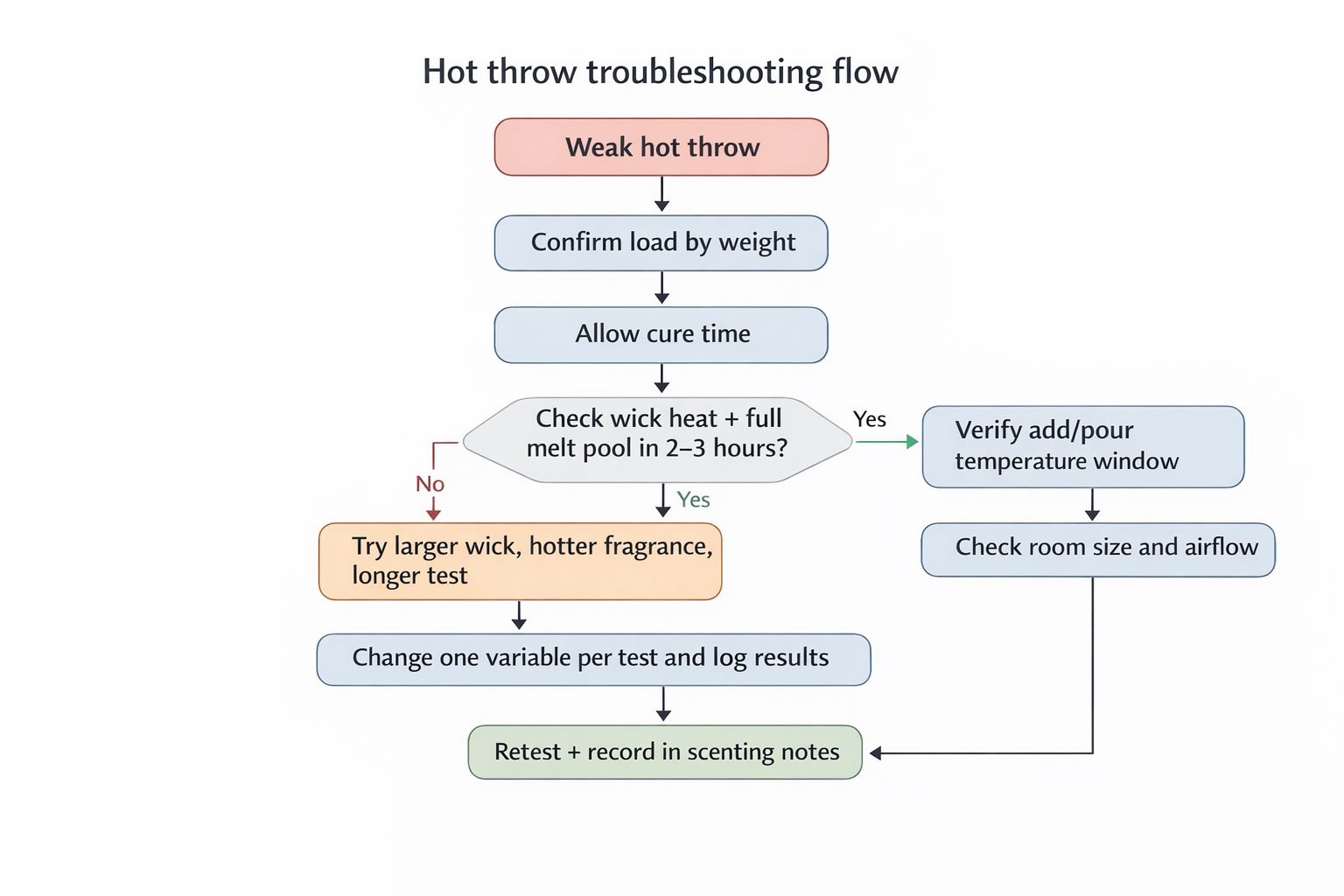
Work through this troubleshooting sequence and record each retest so you are changing one variable at a time:
- Re-check fragrance load by weight and make sure the formula still sits inside your wax limit and the fragrance’s IFRA or CLP constraints.
- Give the candle enough cure time and compare each sample at the same age instead of judging one candle after three days and another after ten.
- Evaluate wick sizing and burn behaviour, aiming for a full melt pool in about 2–3 hours without excessive flame height, soot, or mushrooming.
- Check room and vessel fit, because a jar that works in a bathroom may still struggle in an larger or more open room.
- Review process variables such as add temperature, stirring time, and overload before you reformulate the fragrance itself.
A useful retest round is three candles with the same jar, wick, and cure time but different fragrance loads. If one middle-load sample gives noticeably better throw without soot or sweating, you have a clearer next move than random reformulation.
How mix and pour temperatures affect scent throw (How)
Mix and pour temperatures control how fragrance dissolves into wax and how the melt pool forms, so staying in tested temperature windows keeps scent throw strong and consistent. Think of temperature as the process lever that connects the formula on paper to what actually happens in the pot and jar.
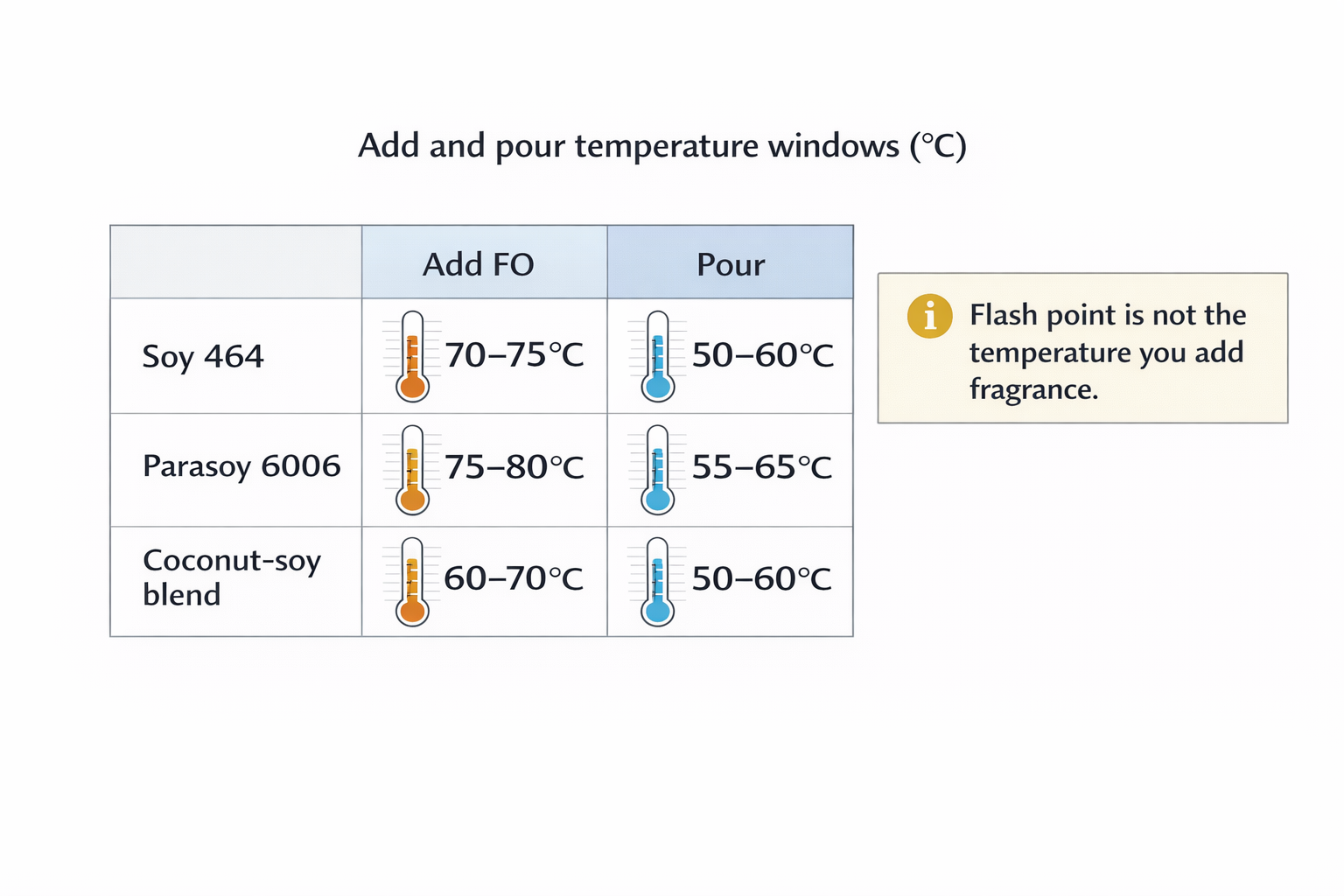
When you add fragrance too cool, it may not fully solubilize, leading to separation and weak hot throw; too hot and you risk burning off top notes or creating cosmetic issues later. Flash point is the temperature at which vapours can ignite under test conditions. Safety agencies define flash point as the temperature at which vapours can ignite under test conditions, not the temperature you “must” add fragrance at, so chasing flash point numbers for mixing usually causes more confusion than benefit.
Methods note: Treat add and pour temperatures here as working ranges, not universal legal limits. Confirm the exact window in your wax technical data sheet, then run small low/mid/high temperature tests with the same fragrance load, wick, jar, and cure time so you can compare hot throw, surface finish, sweating, frosting, and soot under controlled conditions.
Use the same supplier-first sequence each time: melt the wax fully, add fragrance in the recommended add window, stir for 1–2 minutes, pour in the recommended pour window, then cure and compare candles at the same age. This keeps the test fair. It also tells you whether temperature changed the result or whether the real problem is load, wick, or fragrance choice.
A more reliable approach is to work inside the incorporation window your wax and fragrance supplier recommends, then refine within that band. For the broader process context, use the full candle science and temperatures guide alongside your supplier data. Many soy container waxes are tested somewhere around 65–80 °C for adding fragrance and 50–65 °C for pouring, while paraffin or parasoy systems often run slightly higher and some coconut-heavy blends slightly lower.
As a starting reference, treat manufacturer temperature tables as starting points rather than rigid laws. A simple way to dial in your windows is to run three small test batches at low, middle, and high add temperatures while holding every other variable still, then repeat the same logic with pour temperature.
Wick size vs scent projection — choose correctly (Compare)
Wick size drives scent projection by controlling melt-pool width and heat, so the right wick on this page means one that reaches a full pool in 2–3 hours without soot or overheating. In practical terms, scent throw improves when the melt pool spans the full diameter of the jar at a reasonable depth, evaporating fragrance steadily rather than leaving a tunnel or overheating the wax. For broader wick selection rules, use the full wick types and sizing guide alongside your jar-specific tests.
| Wick condition | What you usually see | What it does to scent throw |
|---|---|---|
| Too small | Small flame, shallow pool, slow full-pool time | Hot throw stays weak because too little fragrance reaches the air |
| Right size | Full melt pool in about 2–3 hours with stable flame | Hot throw is steadier and easier to judge fairly |
| Too large | Tall flame, soot, overheating, faster fuel use | Throw may seem strong early but the burn becomes dirtier and less reliable |
Use this section to judge wick heat as one scenting variable, then use the linked wick guide for wick-family and sizing decisions.
How fragrance choice affects throw and stability
Fragrance choice affects throw and stability because some blends project farther, discolor more, or need lower working loads than others. This part of scenting matters after your wax, wick, and temperature basics are under control. It helps you choose blends that fit the result you want without turning this page into a separate perfumery guide.
For most candle makers, candle-safe fragrance oils give the most consistent hot throw and the clearest supplier documentation. Natural materials and essential-oil-led blends can add realism or nuance, but they may run lighter, oxidise faster, or discolor wax more easily. The useful comparison is not “natural vs synthetic” as a slogan. The useful comparison is how each option performs at the same wax, wick, load, cure time, and room test. For that broader question, see essential oils vs fragrance oils.
Maintain cure quality with temperature-controlled storage (Maintaining)
To maintain cure quality, cool and store candles at stable temperatures away from light and drafts, protecting them from heat swings that distort fragrance and wax structure. It helps to understand wax chemistry first, because soy, paraffin, coconut blends, and beeswax all crystallize and lock in fragrance at different speeds. Use your cure notes to track the minimum cure days and storage range that consistently give strong throw for each wax family.
Aim to control the curing environment rather than hoping your general room climate is “good enough.” Many makers target a calm, shaded space roughly in the 18–24 °C range with low drafts and mild humidity. Let freshly poured candles cool uncovered until fully set and room-temperature to the touch, then add lids or dust covers so volatile notes don’t evaporate during the cure.
Steps to run a candle scent test with a printable scoring sheet (Steps)
To run a reliable candle scent test, standardise the burn conditions, use a repeatable scoring system, and record each result on a simple candle scent test scoring sheet. The goal is to remove guesswork so you can compare scents, waxes, and wicks based on clear criteria, not mood or memory. Start by deciding which variables you’ll hold constant—room size, burn time, test position, and number of candles—and which you’re actually evaluating, such as fragrance load, wax type, or wick series.
For a full step-by-step room test, use the guide for testing candle scent throw in real spaces.
| Candle ID | Wax | FO % | Cure days | Wick | Room | Cold throw | Hot throw 30 min | Hot throw 2 h | Burn cleanliness | Notes | Decision |
|---|---|---|---|---|---|---|---|---|---|---|---|
| Test A | /10 | /10 | /10 | /10 | Keep / Retest / Reject | ||||||
| Test B | /10 | /10 | /10 | /10 | Keep / Retest / Reject | ||||||
| Test C | /10 | /10 | /10 | /10 | Keep / Retest / Reject |
Set pass/fail criteria before approving a formula
Approve a formula only when it holds up across the same cure age and test room, reaches a full melt pool in about 2–3 hours, gives clearly stronger hot throw than the weaker runs, and stays free from excessive soot, unstable flame, overheating, or obvious sweating. If it wins on scent but fails on burn behaviour or safety, mark it for retest rather than keep.
Fix fragrance-linked sweating, frosting, and discoloration (Fixing)
To fix fragrance-linked sweating, frosting, and discoloration, tighten your formula within safe load limits, stabilise temperatures, and treat certain visual changes as cosmetic rather than failures. Start by comparing scented and unscented test candles from the same wax batch; if the plain candle behaves well, the fragrance is usually driving the problem.
Sweating usually points to high fragrance load, poor incorporation, or temperature swings; frosting is usually cosmetic re-crystallisation in natural waxes, especially soy; and discoloration often comes from fragrance components, dyes, oxidation, or UV exposure. Check load, add window, cooling, and storage first, then move to a defect-specific retest only if the issue remains.
How to comply with IFRA Category 12 and EU CLP labeling (How)
Scope: This section is an EU-first overview for finished scented candles. IFRA helps you confirm fragrance-use suitability for candles, while CLP determines whether the finished candle mixture must be classified and labeled for the market where you sell it. Use supplier IFRA certificates, SDS documents, and your final product classification together; do not treat any one document as a substitute for the others.
To comply with IFRA Category 12 and EU CLP labeling, use the IFRA certificate to confirm fragrance-use suitability for candles, then classify the final candle mixture under CLP and build any hazard label from that final classification. A UFI belongs on the CLP label when the sold candle is a hazardous mixture and the rule applies to that product type.
- Confirm the wax maximum load and your chosen working load.
- Read the fragrance IFRA certificate and locate Category 12.
- Pull the latest SDS for the fragrance and finished mixture inputs.
- Determine whether the final candle is classified as hazardous at the sold concentration.
- Build the label from the final classification, not from assumption or bottle smell.
- Archive batch records, IFRA, SDS, and label versions together for each scent line.
Use the wider compliance guide linked in the decision map when you need the full legal workflow, country-specific labeling details, or a deeper checklist for marketplace and regulator requests.
How to test one variable at a time without getting lost
Test one variable at a time by fixing the jar, wax, cure time, room, and scoring method, then changing only one factor across a small run set. This keeps the result readable. It also tells you whether your next decision should be load, wick, or process instead of all three at once.
- Choose one control formula that already burns acceptably in your target jar, then keep that jar, wax, cure window, room, and wick-trim length the same for the whole round.
- Pick one factor to vary first. A simple first round is three fragrance loads such as 6%, 8%, and 10% with the same wick. Another clean first round is three wick sizes with the same fragrance load.
- Score each run at the same checkpoints: cold throw, hot throw at 30 minutes, hot throw at 2 hours, melt-pool width, soot, mushrooming, and any sweating or other visible defects.
- Keep a run only if it reaches a full melt pool in about 2–3 hours without excessive soot, unstable flame height, or overheating, and only if the hot throw is clearly better than the lower-performing runs. Reject any run that solves scent by creating a safety or defect problem.
Stop raising fragrance load when the next increase does not improve hot throw clearly, or when it starts adding soot, sweating, unstable flame, or container heat. At that point, keep the load fixed and switch the next retest to wick, wax, add temperature, or cure time.
Quick answers to common candle scenting questions
These are short routing answers, not full implementation guides.
Does more fragrance oil always mean stronger hot throw?
No. Once you push past the wax and wick sweet spot, extra oil can reduce performance, increase sweating, or make the candle burn dirtier instead of smelling stronger.
How long should soy candles cure before testing?
Soy candles often need more time than paraffin systems, so compare results at a fixed cure age instead of test-burning at random points.
Should I use flash point as my fragrance-add temperature?
No. Flash point is a handling property, not a universal candle-making add temperature. Use your wax supplier’s working window and confirm it with controlled tests.
Can a candle need CLP labeling even if IFRA Category 12 looks unrestricted?
Yes. IFRA and CLP solve different problems. IFRA addresses fragrance-use suitability, while CLP addresses final hazard classification and label communication for the product you sell.
What should I change first when a candle smells weak?
Check fragrance load, cure time, and wick performance before changing everything else, because those three variables usually explain weak hot throw faster than random reformulation.