

The best candle wax for wax melts is usually a tart wax, pillar wax, or wax-melt blend chosen for strong scent throw, firm structure, clean release, and warmer performance.
Wax melts are wickless scented wax pieces made for warmers, clamshells, snap bars, silicone molds, or scent testers. Candle wax types are wax families or blends, such as soy, paraffin, coconut, beeswax, pillar wax, and tart wax, that behave differently when they are used without a wick.
For wax melts, “best” does not mean the best candle wax overall. A container candle wax can be excellent in a jar but too soft, sticky, muted, or slow to release when poured into clamshells or molds. The better question is which wax gives the result you need: stronger scent, cleaner release, sharper snap, easier beginner testing, or a more natural-positioned bar.
Paraffin and paraffin-heavy blends often win for strong throw, firmness, and clean release. Soy can work well when it is made for melts or blended for better structure, but plain container soy may be too soft or muted. Coconut wax is usually better as part of a blend than as a stand-alone melt wax. Beeswax can add firmness, but it can affect scent character and is not usually the easiest primary wax for high-throw melts.
If you want the lowest-risk testing starting point, choose a wax labeled for tarts, pillars, or wax melts rather than a soft container wax. Then judge it by the finished melt: does it smell good cold, release fragrance in the warmer, pop out cleanly, hold its shape, and suit the package you plan to sell or gift?
Here, “best” means best for wax-melt performance and format fit, not best for safety claims, legal compliance, price, environmental impact, or supplier brand ranking.
What “Best Wax” Means for Wax Melts
For wax melts, “best wax” means best-fit wax for a wickless warmer product, not the best candle wax for every candle type.
A wax that works well in a jar candle can fail in a clamshell, snap bar, or silicone mold. Wax melts need a wax family that holds fragrance, sets firmly, releases cleanly, and melts well in a warmer without a wick.
Use the Candle Wax Types guide for the wider wax-category overview. This section stays on wax-melt selection, where the decision is throw, hardness, release, and format fit.
| Wax family | Best for | Throw expectation | Hardness/release expectation | Main tradeoff | Bridge target |
|---|---|---|---|---|---|
| Soy wax | Makers who want a common plant-based wax or softer natural-positioned melt | Can be good, but often depends on soy type, cure, and fragrance oil | Plain container soy may be too soft or sticky; soy tart wax performs better | Easy to source, but may need a melt-specific version or blend | Soy vs Paraffin Wax Melts |
| Paraffin wax | Strong throw, firm bars, clean mold release | Often strong in both package scent and warmer release | Usually firm enough for clamshells, tarts, and snap bars | Performance is strong, but some buyers prefer plant-based positioning | Soy vs Paraffin Wax Melts |
| Coconut wax | Smooth texture and premium blend positioning | Usually better in blends than alone for wax melts | Can be soft unless blended with firmer waxes | Nice finish, but often needs structure support | Candle Wax Types |
| Beeswax | Firmness, natural wax positioning, specialty blends | Natural odor can compete with fragrance | Adds firmness, but may not be the easiest main wax for scented melts | Hard and natural, but less neutral for fragrance throw | Candle Wax Types |
| Pillar or tart wax | Molded melts, shapes, tarts, and firmer snap bars | Often built for stronger structure and release | Usually better release than soft container wax | May need testing for warmer melt pool and fragrance style | Basic Wax Melts Recipe |
| Commercial wax melt blends | Balanced throw, firmness, release, and beginner reliability | Often made for scented wickless products | Usually the lowest-risk testing starting point for clamshells and molded melts | Less control than building your own blend | Fragrance Load for Wax Melts |
The wax family comes first because it sets the working limits for scent strength, bar firmness, and release. After that, the recipe, fragrance percentage, mold, cooling method, and warmer test decide whether the final batch is ready.
Recipes, exact percentages, additives, and product rankings are separate decisions. This page chooses the wax family first; use Basic Wax Melts Recipe after choosing the wax type, and use Fragrance Load for Wax Melts when the question becomes percentage or oil limit.
How Wax Type Affects Cold Throw and Warmer Throw
Scent throw in wax melts has two parts: cold throw in the solid melt and warmer throw when the wax is heated.
Wax type affects how fragrance is held in the solid melt and how it releases into the room after the warmer forms a melt pool. Fragrance oil quality, fragrance load, cure or set time, melt size, and warmer heat still change the final result.
Cold throw is the scent you smell from the solid wax melt before warming. Warmer throw is the scent released after the wax heats and forms a liquid pool in the warmer.
| Throw term | What it means | What can improve it | What can weaken it |
|---|---|---|---|
| Cold throw | Scent from the unmelted wax | Compatible fragrance oil, enough cure or set time, good surface scent release | Wax that binds fragrance too tightly, poor fragrance match, low-quality oil |
| Warmer throw | Scent released after heating | Wax that melts evenly, good melt pool, suitable warmer heat, compatible oil load | Too much oil, poor melt pool, wax too resistant to release, weak warmer |
| Strong throw | Useful scent before warming and during warmer use | A wax, oil, load, cure, and warmer combination that works together | Treating “strong” as simply adding more fragrance oil |
Paraffin and paraffin-heavy tart blends often throw strongly because they tend to release fragrance well and set firm enough for melts. Soy can throw well when the wax is made for tarts or blended, but plain container soy can give a softer bar or a quieter warmer scent. Coconut wax can feel smooth and premium, but it usually needs a firmer wax partner for melt structure. Beeswax can add hardness, but its natural odor may change the fragrance impression.
| Wax family | Cold throw tendency | Warmer throw tendency | Selection note |
|---|---|---|---|
| Paraffin | Often strong | Often strong | Common choice when throw and release matter most |
| Soy | Moderate to good | Moderate to good when melt-specific or blended | Better when labeled for tarts, pillars, or melts |
| Coconut | Good in many blends | Blend-dependent | Usually not the firmest stand-alone wax for melts |
| Beeswax | Can be affected by natural wax scent | Often less neutral for fragrance-heavy melts | Better as a blend component than a default high-throw base |
| Pillar or tart blends | Usually good | Usually good | Often designed for molded, scented wax products |
| Commercial wax melt blends | Usually balanced | Usually balanced | Good starting point when testing burden matters |
A strong cold throw can become weak warmer throw when the wax smells good in the package but does not release fragrance well under heat. The reverse can happen too: a melt can smell mild in the clamshell, then perform better once the warmer creates a full melt pool.
If the question is about percentages, fragrance-oil limits, or oil-specific performance, route to Fragrance Load for Wax Melts rather than expanding here. For warmer-side checks, use Testing Wax Melts in Warmers after the wax has fully set.
Fragrance Load Compatibility: Why More Oil Is Not Always Stronger
More oil can weaken performance if the wax cannot hold or release it cleanly.
Fragrance load compatibility means the wax can hold and release fragrance oil without becoming oily, soft, sweaty, or weak-smelling. Strong throw comes from compatibility, not from adding the highest possible amount of oil.
Warning: More fragrance oil can cause sweating, soft bars, greasy clamshells, poor release, or weak warmer throw if the wax cannot handle it.
A wax melt can smell strong cold but weak in the warmer when excess oil sits poorly in the wax structure. It can also release oil onto the surface, feel greasy, or lose firmness in snap bars and clamshell cubes.
Use Fragrance Load for Wax Melts for exact percentages and supplier limits. Use Wax Melts Sweating Oil when the main problem is oily surfaces, soft texture, or fragrance separation.
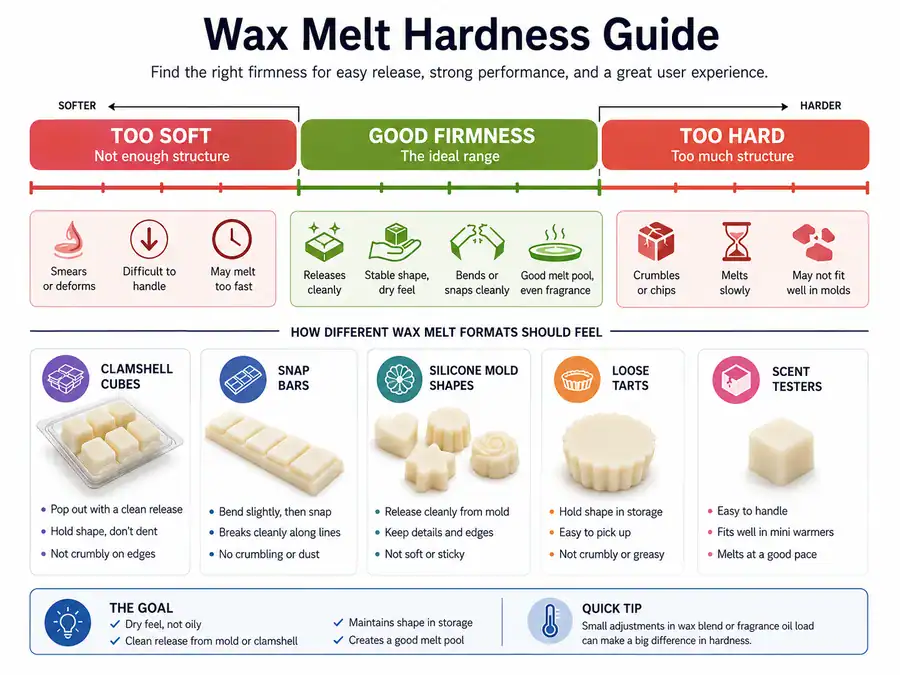
How Hard Should Wax Melts Be?
Wax melts should be firm enough to hold shape, release cleanly, and survive handling, but not so brittle that they crumble or snap unpredictably.
Hardness matters because wax melts are handled before they are warmed. A soft wax can dent, smear, stick inside clamshells, or lose shape in silicone molds. A wax that is too hard can crack, crumble, or melt slowly in low-heat warmers.
For wax melts, hardness means stable structure, not maximum hardness. The goal is a melt that feels dry, lifts cleanly, breaks where intended, and still forms a usable melt pool in the warmer.
| Melt format | Good hardness looks like | Too soft looks like | Too hard looks like | Best wax direction |
|---|---|---|---|---|
| Clamshell cubes | Cubes press out cleanly and keep edges | Greasy, dented, sticky, or smeared cells | Cubes crack or shatter when pushed out | Tart wax, pillar wax, or firm wax melt blend |
| Snap bars | Bar breaks along the lines without bending | Bar bends, fingerprints, or smears | Bar snaps into shards | Paraffin blend, soy tart blend, or pillar-style blend |
| Silicone mold shapes | Shapes release intact and hold detail | Pieces stretch, stick, or lose detail | Thin parts break during removal | Firm melt wax or blend with good release |
| Loose tart shapes | Pieces stay dry and firm in storage | Pieces clump, sweat, or deform | Pieces chip or crumble in bags | Tart wax or balanced melt blend |
| Scent testers | Small pieces stay neat and easy to sample | Pieces feel oily or weak | Pieces feel chalky or break too easily | Beginner-friendly wax melt blend |
Soy container wax is often the problem wax when melts turn soft, bendy, or sticky. Soy tart wax can work better because it is made for molded or wickless products. Paraffin and paraffin-heavy blends usually give firmer structure and cleaner snap. Coconut wax usually needs a firmer wax partner. Beeswax can add firmness, but it can make the scent profile less neutral.
Use the Candle Wax Types guide when you need the wider wax-family comparison. Use Wax Melts Too Hard or Brittle when the batch is already breaking, crumbling, or melting poorly.
A good hardness test is simple: remove one finished melt, press it out of the mold or clamshell, break it if the format requires snapping, then warm it. If the piece releases well but performs poorly in the warmer, the wax is structurally good but not yet the best match for warmer throw.
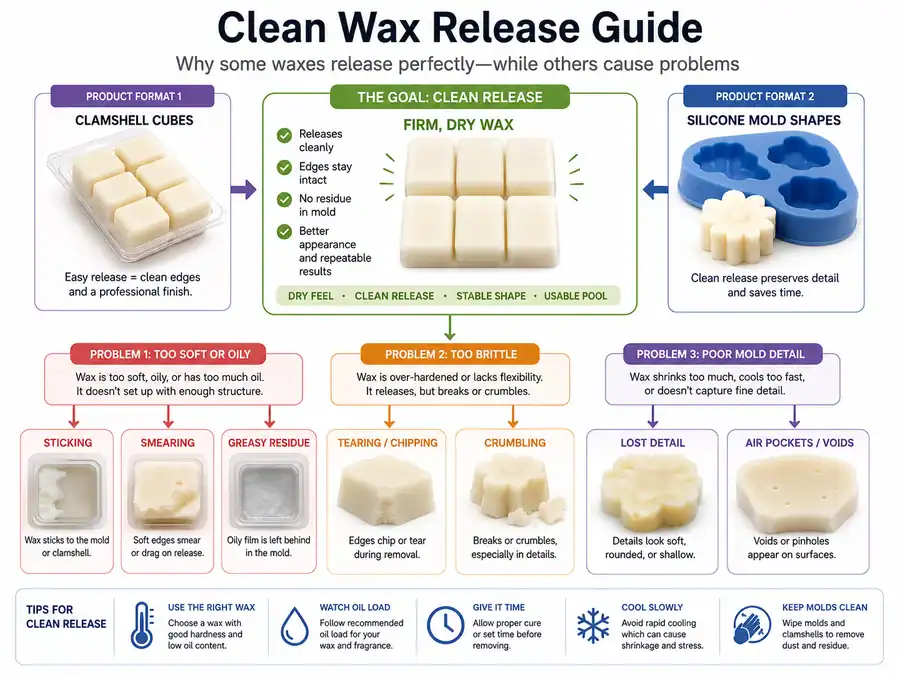
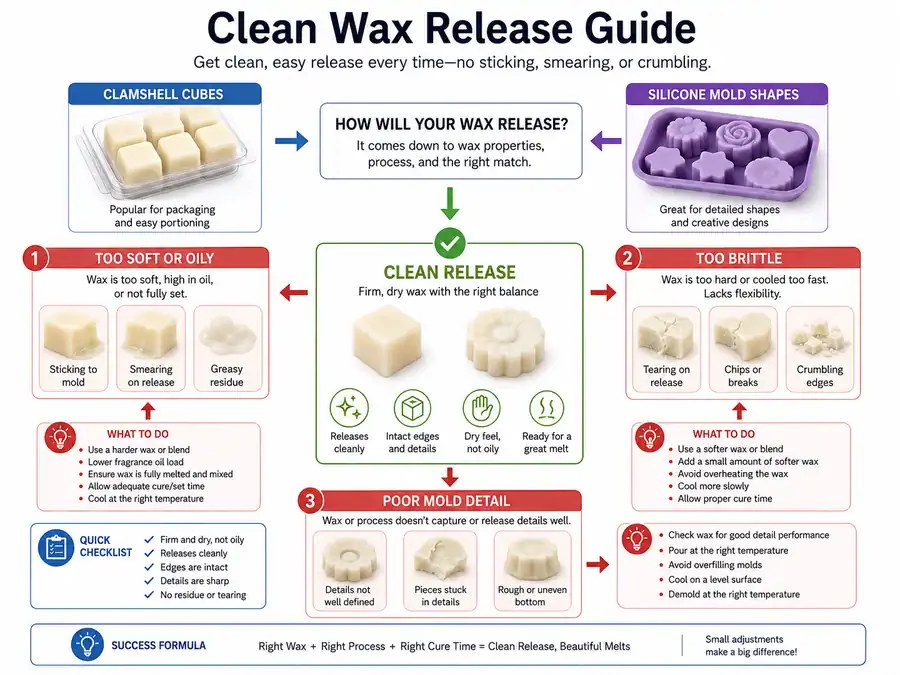
Which Waxes Release Cleanly from Molds and Clamshells?
Waxes release cleanly when they set firm, shrink or separate enough from the mold surface, and stay dry instead of soft or greasy.
Easy release means the melt comes out intact without sticking, tearing, crumbling, sweating oil, or leaving wax behind. The wax type matters, but release also depends on mold material, cooling, fragrance load, and whether the wax was made for molded products.
| Wax type | Release from clamshells | Release from silicone molds | Main risk | Better use case |
|---|---|---|---|---|
| Soft soy container wax | Often poor | Often sticky or delicate | Softness, smearing, weak edges | Avoid unless blended or labeled for melts |
| Soy tart wax | Better than container soy | Usually workable | Can still be soft with high fragrance load | Plant-based melts and beginner tests |
| Paraffin wax | Often strong | Usually clean | Can become brittle if the full formula is too hard | Strong throw, clean snap, molded shapes |
| Pillar wax | Usually strong | Usually strong | May need throw and warmer testing | Tarts, shapes, snap bars |
| Coconut wax | Often weak alone | Often soft alone | Sticking, denting, low structure | Blend component |
| Beeswax | Firm release in blends | Can release well when balanced | Natural scent and high firmness | Specialty blends |
| Wax melt blend | Usually balanced | Usually balanced | Supplier formula still needs testing | Best starting point for most makers |
Clamshells need a wax that can press out without smearing across the plastic. Silicone molds need a wax that is firm enough to release detail without tearing. Snap-bar molds need both release and clean break behavior.
For mold choice, use Wax Melt Molds. For packaging choice, use Wax Melt Clamshell Packaging. This section only decides which wax behavior makes release easier.
Clean release does not prove the wax is finished. A wax can pop out perfectly and still give weak warmer throw, or it can smell strong but leave greasy marks in the clamshell. The best wax for release must still pass the scent and warmer test.
Soy, Paraffin, and Blends Compared
Soy, paraffin, and wax blends work differently in wax melts: soy is usually chosen for plant-forward positioning, paraffin for throw and release, and blends for balanced performance.
Use Best Wax for Wax Melts: Soy vs Paraffin vs Blends for the deeper side-by-side page. This section keeps the choice tied to wax melts, clamshells, snap bars, molds, and warmers.
| Wax option | Best strength | Common weakness | Best fit | Avoid when |
|---|---|---|---|---|
| Soy wax | Common, plant-based, easy to source | Can be soft, sticky, or muted if it is container soy | Soy tart melts, softer natural-positioned melts, beginner trials | You need the strongest throw and sharpest release without blending |
| Paraffin wax | Strong throw, firm set, clean release | Some buyers do not prefer petroleum-based wax | High-throw melts, snap bars, clamshell cubes, molded tarts | Your brand position requires plant-based wax only |
| Coconut wax | Smooth feel and premium blend appeal | Often too soft alone | Blend support, smoother finish, specialty melts | You need firm stand-alone snap bars |
| Beeswax | Firmness and natural wax appeal | Natural odor can compete with fragrance | Small blend additions or specialty products | You need a neutral high-throw fragrance base |
| Soy-paraffin blend | Balance between plant-based appeal and performance | Still needs testing by fragrance oil | General wax melts, clamshells, snap bars | You need a single-wax label claim |
| Commercial tart or melt blend | Balanced throw, hardness, and release | Less control over the exact formula | Most beginner and small-shop melt testing | You want to build every property from raw waxes |
A single wax can work, but blends usually reduce the tradeoff. The more your product depends on clean release, strong scent, and stable packaging, the more a tart wax or wax-melt blend makes sense.
When Soy Wax Works for Wax Melts
Soy wax works best for wax melts when it is made for tarts, pillars, or wax melts instead of soft container candles.
Soy is a good choice when the maker wants a plant-based wax direction, easy ingredient sourcing, and a softer brand position. Use Soy Wax for Wax Melts when the whole page needs to focus on soy wax behavior, and use Fragrance Load for Wax Melts when the question becomes how much fragrance oil the soy wax can hold.
Why Paraffin Is Common in Wax Melts
Paraffin is common in wax melts because it often gives strong scent throw, firm bars, and clean mold or clamshell release.
For performance-first wax melts, paraffin usually holds up well in snap bars, tart molds, and clamshell cubes. Use Paraffin Wax for Wax Melts for the deeper paraffin page, and keep health, safety, and environmental debates out of this wax-selection section unless a separate safety page handles them.
Why Blends Often Win the Tradeoff
Wax blends often win because one wax rarely gives top throw, firmness, release, and warmer behavior at the same time.
A blend can use paraffin for throw and release, soy for plant-based appeal, coconut for smoothness, or beeswax for firmness. Use Stearic Acid for Wax Melts or other additive pages only when the question becomes formula adjustment; this page chooses the wax direction first.
Wax Melt Wax Comparison Matrix: Throw vs Hardness vs Release
The best wax for wax melts depends on which tradeoff matters most: scent throw, hardness, release, warmer behavior, or beginner reliability.
There is no single universal winner. A strong paraffin melt may beat soy for throw and release, while a soy blend may better match a plant-based product line. A commercial wax melt blend is often the most balanced starting point.
| Goal | Best wax direction | Why it fits | Watch for |
|---|---|---|---|
| Strongest scent throw | Paraffin or paraffin-heavy tart blend | Often releases fragrance clearly cold and warm | Buyer preference and brand fit |
| Cleanest clamshell release | Tart wax, pillar wax, paraffin blend, or melt blend | Sets firmer than soft container wax | Brittleness if the wax is too hard |
| Firm snap bars | Pillar-style wax or firm wax melt blend | Holds shape and breaks more cleanly | Crumbling or sharp shards |
| Plant-based positioning | Soy tart wax or soy-forward blend | Easier to align with plant-based product claims | Softer bars and quieter throw in some formulas |
| Smooth premium finish | Coconut blend | Can improve texture and appearance | Usually needs firmer wax support |
| Beginner testing | Commercial wax melt blend | Built for wickless scented products | Still test each fragrance oil and warmer |
| Molded shapes | Firm tart wax or pillar-style blend | Releases detail better than soft container wax | Thin details can break if wax is too brittle |
| Scent testers | Balanced tart or melt blend | Keeps small pieces neat and usable | Greasy finish if fragrance load is too high |
Choose by the finished product first. Clamshell cubes need release and storage stability. Snap bars need firmness and controlled breakage. Silicone shapes need detail and clean removal. Warmer-first products need melt pool and scent release after heating.
A wax that scores well in only one column may still fail the product. Strong throw with greasy cubes is not a good clamshell wax. Clean release with weak warmer scent is not a good high-throw wax. Firm snap with poor melting is not a good warmer product.
Failure Prevention: Soft, Greasy, Stuck, or Brittle Melts
Most wax-melt failures come from a mismatch between wax type, fragrance load, mold, cooling, and warmer use.
| Failure | Likely wax-choice cause | What to change first | Bridge target |
|---|---|---|---|
| Soft melts | Wax is too soft for molded or packaged melts | Try tart wax, pillar wax, or a firmer blend | Wax Melts Too Soft |
| Greasy surface | Wax may not hold the fragrance load cleanly | Lower the oil load or choose a wax with better oil capacity | Wax Melts Sweating Oil |
| Stuck clamshell cubes | Wax is too soft, too oily, or not release-friendly | Use a firmer melt wax or tart blend | Wax Melt Clamshell Packaging |
| Brittle snap bars | Wax is too hard for the format | Use a less brittle blend or test a different tart wax | Wax Melts Too Hard or Brittle |
| Weak warmer scent | Wax and fragrance oil may not release well together | Test a different wax-oil pair before raising oil amount | Fragrance Load for Wax Melts |
| Poor mold detail | Wax is too soft during removal or too brittle in thin areas | Match wax hardness to mold shape | Wax Melt Molds |
This table is a first-pass diagnosis, not a full troubleshooting flow. If the batch already failed, use the matching defect page. If you have not chosen a wax yet, use these failure signs to avoid the wrong starting wax.
Format, Warmer, and Packaging Fit
The best wax changes with the melt format because clamshells, snap bars, molded shapes, and warmers stress the wax in different ways.
A wax melt is not finished when it looks good in the mold. It still needs to release from its package, stay firm during handling, and form a usable melt pool in the warmer.
Use Candle Wax Types for the wider wax-family guide. For this page, the wax choice stays tied to wickless melt products and the format the maker plans to pour.
| Format | Wax needs | Better wax direction | Main warning |
|---|---|---|---|
| Clamshell cubes | Press-out release, dry finish, stable cube shape | Tart wax, paraffin blend, soy tart blend, commercial melt blend | Soft container wax can smear or stick |
| Snap bars | Firm slab, controlled break, clean edges | Firm tart wax, pillar-style wax, paraffin blend | Too-hard wax can shatter instead of snap |
| Silicone mold shapes | Detail hold, clean removal, enough flexibility | Firm wax melt blend or tart wax | Thin details can break if the wax is brittle |
| Loose shapes or tarts | Dry surface, storage stability, no clumping | Tart wax or balanced blend | Soft wax can deform or sweat in bags |
| Scent testers | Small pieces that stay neat and smell clear | Commercial melt blend or tart wax | Very soft wax can feel greasy in sample bags |
| Warmer-first melts | Full melt pool and scent release under heat | Wax that melts evenly in the intended warmer | Great release does not guarantee strong warmer throw |
Packaging fit matters because a wax that behaves well in one format may fail in another. A soft soy wax may be acceptable in a sample cup but poor in a snap bar. A very firm wax may release beautifully from a mold but crack during handling.
For clamshell choice, use Wax Melt Clamshell Packaging. For mold styles, use Wax Melt Molds. For warmer testing, use Testing Wax Melts in Warmers.
Test Wax in the Warmer Before Calling It Best
A wax is not the best wax for wax melts until it performs in the warmer.
Release and hardness are pre-use tests. Warmer performance is the use test. The wax should melt into a usable pool, release fragrance into the room, and avoid leaving an unpleasant texture after cooling.
| Warmer test step | What to check | What the result means |
|---|---|---|
| Add one finished melt piece | Size and fit | The piece should fit the dish without overflowing |
| Warm until pooled | Melt speed and pool shape | Wax should form a usable melt pool under normal warmer heat |
| Smell after pooling | Warmer throw | Scent should release after heat, not only in the package |
| Let it cool | Reset texture | Wax should not separate, sweat heavily, or become messy |
| Rewarm if needed | Repeat performance | Scent should remain usable for the intended product style |
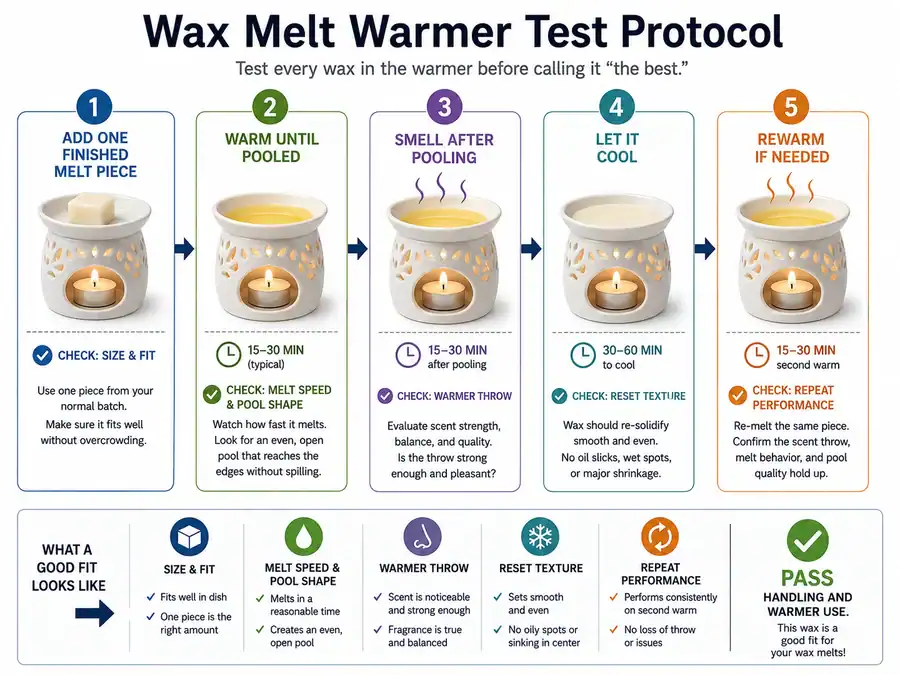
A wax that is too hard can release well but melt slowly. A wax that is too soft can melt easily but feel greasy, deform in packaging, or release poorly from clamshells. The better choice is the wax that passes both handling and warmer use.
Match Wax to Clamshells, Snap Bars, or Molds
Choose the wax after choosing the product format, not before.
Clamshells need press-out release. Snap bars need controlled breakage. Silicone molds need detail and clean demolding. Loose shapes need storage stability. Each format changes what “best” means.
| Maker plan | Choose this wax direction | Do not choose |
|---|---|---|
| Selling clamshell cubes | Firm tart wax or melt blend | Soft container wax that smears in cells |
| Making snap bars | Firm wax melt blend or pillar-style blend | Brittle wax that breaks into shards |
| Pouring detailed shapes | Tart wax with good mold release | Very soft wax that stretches or tears |
| Making plant-forward melts | Soy tart wax or soy-forward blend | Plain soft soy container wax without testing |
| Prioritizing strongest scent | Paraffin or paraffin-heavy blend | Wax chosen only for label appeal |
| Reducing beginner failures | Commercial wax melt blend | Complex custom blend before testing basics |
The format is the filter. Once the format is clear, the wax choice becomes easier because the maker can judge the same wax against the same product outcome.
Best Wax by Goal: Strong Throw, Clean Release, Snap Bars, or Beginner Testing
The best wax is the one that matches the maker’s main goal and still passes hardness, release, and warmer tests.
For a performance-first melt, start with paraffin, tart wax, or a paraffin-heavy blend. For a plant-forward line, start with soy tart wax or a soy blend. For the lowest testing burden, start with a commercial wax melt blend before building your own formula.
Use Basic Wax Melts Recipe when the next step is batch method. Use Fragrance Load for Wax Melts when the next step is fragrance percentage. Use Wax Melts Too Hard or Brittle when the batch has already failed.
Beginner Ease and Testing Burden
Beginners should choose a wax that reduces testing burden, not a wax that promises no testing.
A beginner-friendly wax melt wax is firm enough to release, forgiving enough to pour, and clear enough to evaluate in a warmer. It should be labeled for tarts, wax melts, pillars, or molded wax products.
| Beginner choice | Why it helps | What to avoid |
|---|---|---|
| Commercial wax melt blend | Starts closer to the desired melt behavior | Starting with custom ratios too soon |
| Soy tart wax | Easier plant-based starting point than container soy | Assuming all soy wax works the same |
| Paraffin tart wax | Strong performance baseline for throw and release | Ignoring buyer preference or brand fit |
| Small wax samples | Lets you compare before buying bulk | Buying a large box before testing |
| One fragrance at a time | Shows how the wax behaves with fewer variables | Changing wax, oil, load, and warmer all at once |
| Simple test log | Makes failures easier to trace | Relying on memory after several batches |
The first goal is not the perfect wax. The first goal is a clean test: one wax, one fragrance oil, one format, and one warmer. After that, the maker can compare throw, hardness, release, and handling without guessing which variable caused the result.
Final Recommendation and Next Steps
For most wax melts, the best starting wax is a tart wax or commercial wax melt blend because it is made for wickless scented products.
Choose paraffin or a paraffin-heavy blend when strong throw, firm bars, and clean release matter most. Choose soy tart wax or a soy-forward blend when plant-based positioning matters, but test for softness and warmer throw. Choose coconut or beeswax mainly as blend partners unless the supplier wax is already made for wax melts.
Use Candle Wax Types when you need the wider wax-family guide. For this page, the best wax is the one that matches the melt format and passes four checks: scent throw, hardness, release, and warmer performance.
The next step is not buying the largest wax box. Buy a small amount, pour one format, test one fragrance oil, and check the finished melt in the warmer. If it smells good cold, throws well warm, releases cleanly, and stays firm in its package, that wax is a good fit for your wax melts.
For batch method, use Basic Wax Melts Recipe. For scent percentage, use Fragrance Load for Wax Melts. For failed batches, use Wax Melts Too Hard or Brittle, Wax Melts Too Soft, or Wax Melts Sweating Oil.