
The best candle wax for low soot depends on the wax family, wick match, fragrance load, candle format, and burn conditions, not wax type alone.
Candle wax types include soy, beeswax, coconut-based blends, rapeseed, paraffin, and parasoy blends used to shape candle burn behavior. Here, “low soot” means lower visible soot or residue risk, not a soot-free, zero-emission, or medically safer candle. A cleaner burn comes from a wax that works with the right wick, fragrance level, vessel, airflow, and burn habits.
This comparison focuses on choosing a wax family for cleaner-looking indoor candle performance. Safety, toxicology, wick charts, and fragrance formulas need their own focused guides.
What “Low Soot” and “Cleaner Burning” Mean for Candle Wax
Low-soot candle wax is not soot-free wax; it is a wax type or blend that can lower visible soot risk when the wick, fragrance load, vessel, and burn conditions are correct.
Candle wax types are wax families used as candle fuel and structure, including soy, beeswax, coconut-based blends, rapeseed, paraffin, and parasoy. In this article, “cleaner burning” means a more controlled candle burn with less visible black residue under proper use. It does not mean zero emissions, medical safety, non-toxic certification, or guaranteed soot-free indoor air.
For a wider material-by-material view, use a Candle Wax Types comparison before choosing a wax family. For ingredient safety or health-related claims, use a dedicated Candle Wax Safety / Non-Toxic Wax guide instead of treating “low soot” as a health label. For black smoke, jar staining, or wick mushrooming after the candle is already made, use Candle Soot Troubleshooting or Candle Wick Sizing because those problems usually need a burn-system fix, not just a different wax.
| Term | Means Here | Does Not Mean Here | Why It Matters |
|---|---|---|---|
| Low soot | Lower visible soot or residue risk | Soot-free candle wax | Prevents absolute wax claims |
| Cleaner burning | More controlled burn under correct conditions | Zero emissions or medical safety | Keeps the choice focused on visible burn behavior |
| Best wax | Best fit for lower-soot candle goals | Universal winner for every candle | Keeps the recommendation conditional |
| Soot-free | No visible soot in any condition | A realistic wax-only promise | No candle wax should be chosen on this promise alone |
| Non-toxic | Ingredient or safety claim outside this page | Same as low soot | Routes health and toxicology questions away from this comparison |
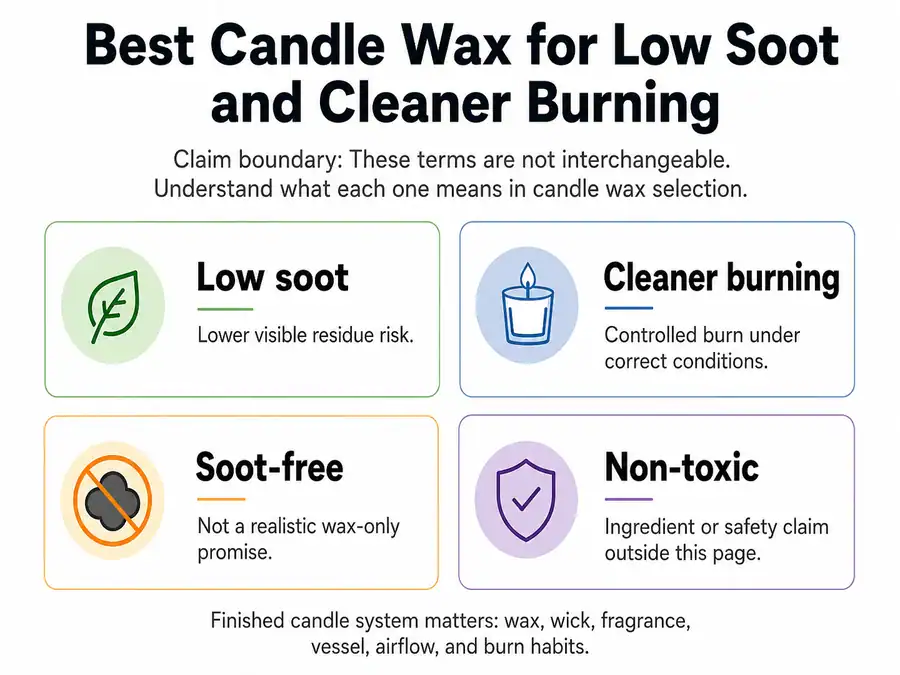
Use the table as a claim-limit card, not as lab data. It separates decision language from health, toxicity, and air-quality claims so the wax comparison stays focused on cleaner-looking candle performance.
No candle wax should be described as completely soot-free. The cleaner-burn comparison should be judged by the finished candle system, especially wick length, flame stability, fragrance load, and burn conditions.
Which Candle Wax Burns the Cleanest? Wax Type Comparison Matrix
Beeswax, soy, coconut-based blends, and rapeseed can be good cleaner-burn candidates, but no candle wax is universally soot-free.
The cleanest wax choice is the wax family that gives the candle maker a stable flame, a suitable melt pool, and good wick compatibility for the candle format. Paraffin and parasoy should not be dismissed automatically, because refinement, blend quality, wick match, and fragrance load can change the finished candle’s soot behavior. The better comparison is not “natural versus dirty,” but “which wax family is easiest to control for this candle design?”
For the parent decision path, compare this matrix with a broader Candle Wax Types guide. For deeper material pages, route soy, beeswax, coconut-apricot, rapeseed, paraffin, and parasoy questions to their own wax-family guides instead of turning this page into a full wax encyclopedia.
| Wax family | Cleaner-burn fit | Soot tendency | Wick sensitivity | Fragrance/additive sensitivity | Best fit | Claim boundary |
|---|---|---|---|---|---|---|
| Soy wax | Strong for many container candles | Usually lower when properly wicked | Medium | Medium to high | Beginners, tins, jars, softer container candles | Not soot-free and not automatically healthier |
| Beeswax | Strong premium option | Often low with the right wick | Medium to high | Lower if left unscented; higher with added fragrance | Pillars, tapers, premium natural candles | Natural does not mean medically safer |
| Coconut / coconut-apricot blends | Strong when the blend is well disclosed and tested | Often low in luxury containers | Medium | Medium | Smooth container candles and luxury jars | “Coconut wax” often means a blend, not pure coconut |
| Rapeseed wax | Good plant-based alternative | Often promising but test-dependent | Medium | Medium | EU-style plant wax positioning, containers, blends | Plant-based does not prove cleaner in every formula |
| Refined paraffin | Variable but not automatically poor | Can be low or high depending on wick and formula | Medium | Medium to high | Strong scent throw, pillars, votives, blends | Do not treat all paraffin as dirty by default |
| Parasoy | Variable; often practical when well formulated | Depends on soy/paraffin ratio and wick | Medium to high | Medium to high | Scented containers needing stronger performance | Parasoy is not one fixed wax type |
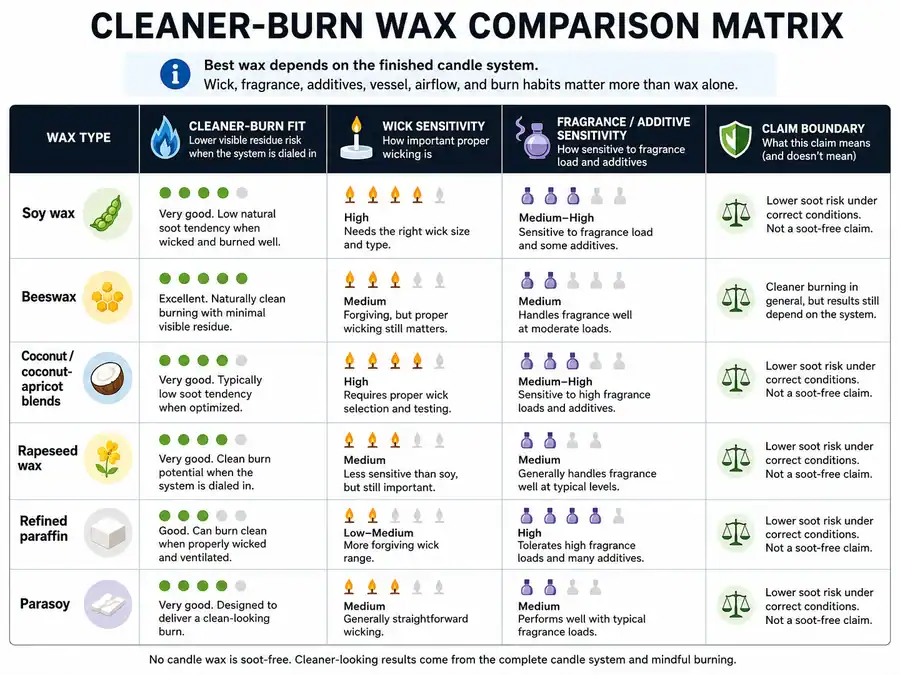
A practical cleaner-burn shortlist starts with soy for accessible container candles, beeswax for premium unscented or lightly scented candles, coconut-based blends for luxury jars, and rapeseed for plant-based alternatives that will be test-burned. Paraffin and parasoy stay in the decision set when the candle needs stronger scent throw, firmer structure, or a blend that burns cleanly after wick testing.
Soy Wax: Good Low-Soot Fit, but Not Soot-Free
Soy wax is a strong low-soot choice for many container candles because it tends to support a softer, steadier burn when the wick and fragrance load are matched.
Soy wax is a vegetable-based candle wax often used in jars, tins, and blended container candles. Its cleaner-burn value comes from practical control: it is widely available, easier for many beginners to test, and commonly paired with container-wick series. The outcome is a wax family that can work well for lower visible soot, especially when the candle uses a moderate fragrance load and a trimmed wick.
Soy is still not a soot-proof material. A soy candle can smoke, leave black residue, or form wick mushrooming if the wick is too large, the fragrance oil is overloaded, the dye system is heavy, or the jar traps too much heat. That makes soy a better “first cleaner-burn candidate” than a final guarantee.
Use What Is Soy Wax? for a full soy material guide, and use Soy Wax Troubleshooting if the issue is frosting, sinkholes, wet spots, or poor tops. For this cleaner-burn comparison, soy belongs near the top when the user wants an accessible container wax with a lower-soot goal and enough room for normal scent performance.
Beeswax: Premium Natural Wax With Wick and Format Limits
Beeswax can be an excellent cleaner-burn candle wax, especially for simple or lightly scented candles, but its natural origin does not make it automatically safer or soot-free.
Beeswax is a natural wax with higher firmness, a mild honey-like scent, and different melt behavior from soy or paraffin. Its cleaner-burn strength is strongest when the candle design respects those traits. In tapers, pillars, and simple premium candles, beeswax can burn with low visible soot when the wick is sized correctly and the flame stays controlled.
The trade-off is that beeswax is less forgiving than many soft container waxes. It can cost more, may not carry added fragrance the same way as soy or coconut blends, and can burn poorly if the wick is mismatched. A large, unstable flame can still produce soot, even when the wax itself has a clean-burn reputation.
Use What Is Beeswax? for the full wax-family page, and use Soy Wax vs Beeswax when the real decision is budget, format, scent style, and candle feel. For low-soot selection, beeswax is best framed as a premium cleaner-burn option, not as proof of healthier indoor air.
Coconut and Coconut-Apricot Wax: Cleaner-Burn Potential Depends on the Blend
Coconut-based candle wax can be a good cleaner-burn option for luxury container candles, but the exact blend matters more than the coconut name.
Coconut wax is usually a blend family, not pure coconut oil turned into candle wax. Many supplier formulas combine coconut with soy, apricot, paraffin, palm, or other waxes to change softness, scent throw, melt point, and jar adhesion. That makes coconut-based wax useful for low-soot goals only when the maker checks the actual blend behavior.
Coconut and coconut-apricot waxes often suit smooth container candles, glass jars, and luxury scented candles because they can give an even melt pool with the right wick. The cleaner-burn outcome still depends on flame control. A rich fragrance load, oversized wick, or hot vessel can make a coconut blend smoke like any other wax family.
Use Coconut Apricot Wax for a full blend guide, and use Coconut Wax vs Soy Wax when the choice is between luxury finish, cost, scent style, and container performance. For low-soot selection, coconut-based wax is best treated as a high-comfort container option that needs supplier clarity and burn testing.
Rapeseed Wax: Plant-Based Alternative With Testing Caveats
Rapeseed wax can be a useful low-soot candidate, especially for makers who want a regional plant wax, but it should be tested against soy, beeswax, and blends.
Rapeseed wax is a vegetable candle wax made from rapeseed oil and used in container candles, blends, and some European-style wax lines. Its cleaner-burn value comes from being a plant wax with workable container behavior, not from being automatically cleaner than every other wax family.
The main limit is availability and formula variation. Rapeseed wax may differ by supplier, blend type, hardness, scent hold, and wick demand. A rapeseed candle can burn cleanly in one jar and soot in another if the wick, fragrance, or vessel changes. That makes it a good wax to test when the maker wants a soy alternative, but not a default winner for every indoor candle.
Use What Is Rapeseed Wax? for the full wax-family guide, and use Rapeseed Wax vs Soy Wax when the decision is local sourcing, container behavior, scent load, cost, and testing effort. For this page, rapeseed belongs in the cleaner-burn shortlist when the user is willing to test the final candle design.
Paraffin and Parasoy: Soot, Scent Throw, and Claim Boundaries
Paraffin and parasoy can produce soot, but they should not be labeled dirty by wax name alone.
Paraffin wax is a petroleum-derived candle wax, while parasoy is a blend of paraffin and soy. In a low-soot comparison, both belong in the decision set because finished burn behavior depends on refinement, wick match, fragrance load, dye level, vessel heat, and flame size. For a broader material comparison, use the Candle Wax Types guide before judging one wax family by reputation.
Paraffin often gives strong scent throw and firm structure, which can help pillars, votives, and some container candles. Parasoy can balance scent throw, smoother tops, and soy-based positioning. The trade-off is that both may punish poor wick choice or heavy fragrance loads faster than simpler wax systems. A candle made with refined paraffin and a correct wick can burn cleaner than a plant-wax candle with an oversized wick.
Use What Is Paraffin Wax? for the full material page, and use Parasoy Wax when the question is blend ratio, scent throw, finish, and container behavior. For this cleaner-burn article, paraffin and parasoy are not the first “low-soot” picks for sensitive indoor expectations, but they remain valid when performance needs and burn testing support them.
Why Wax Alone Does Not Decide Soot: Wick Match Matters
Wax type can lower soot risk, but the wick controls flame size, fuel draw, melt pool behavior, and much of the visible soot outcome.
The wick is the fuel-delivery part of the candle system. Even a cleaner-burn wax family can soot if the wick is too large, draws too much melted wax, or creates a tall, unstable flame. A smaller wick can reduce smoking, but it may tunnel, drown, or fail to melt the wax edge-to-edge. The right choice depends on the wax, jar diameter, fragrance load, dye, and candle format.
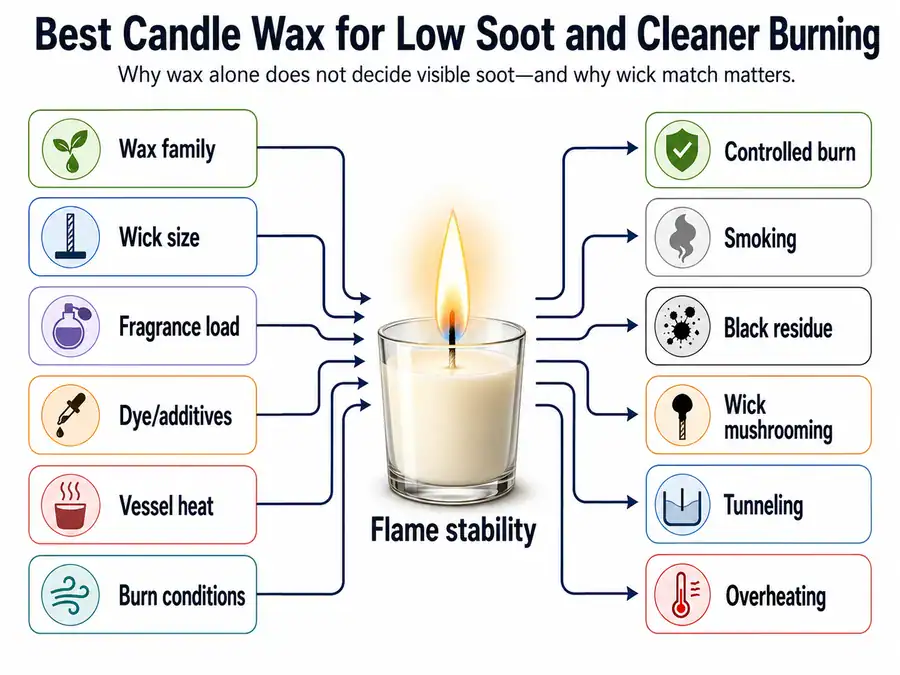
Use the Candle Wax Types guide to choose the wax family first, then move to Candle Wick Sizing when the question becomes wick series, diameter, burn pool, and test results. This page should not replace a wick chart because the cleaner-burn decision is about wax selection, not full candle engineering.
For full wax-and-wick pairings, use Clean-Burning Wax & Wick Setups; this page only chooses the wax-family starting point.
| Wick-related factor | How it affects soot | Cleaner-burn takeaway |
|---|---|---|
| Oversized wick | Creates a larger flame and faster fuel draw | Can make any wax smoke |
| Undersized wick | May tunnel or drown instead of burning cleanly | Less soot is not useful if the candle fails |
| Wick material | Changes curl, rigidity, and flame behavior | Match wick type to wax and vessel |
| Jar diameter | Changes melt pool width and heat retention | Wider jars need separate wick testing |
| Fragrance load | Changes fuel mix and flame behavior | Scented candles need fresh wick tests |
| Burn duration | Affects melt pool depth and heat buildup | Long burns can expose wick mismatch |
If the candle already leaves black residue, mushrooms heavily, or smokes during normal use, treat that as a troubleshooting problem. Use Candle Soot Troubleshooting for cause-and-fix diagnosis instead of assuming the wax family is the only issue.
Fragrance Oil, Dye, and Additives Can Change Clean-Burn Results
A cleaner-burn wax can still soot when fragrance oil, dye, or additives make the candle harder to burn cleanly.
Fragrance load is the amount of fragrance oil held in the wax. Higher fragrance levels can change the fuel mix, affect wick demand, and increase the chance of smoking if the wick is not retested. Dye and additives can do the same when they alter melt behavior, flame size, or residue. The wax may still be a good low-soot candidate, but the finished candle is a new burn system.
For cleaner-burning goals, choose a wax that works with the scent level and candle format you plan to use. Soy, coconut-based blends, rapeseed, parasoy, and paraffin can all behave differently once fragrance is added. A wax that burns cleanly unscented may need a different wick when fragrance oil or color is introduced.
Use Candle Fragrance Load when the question becomes percentages, supplier limits, or scent testing. Use Candle Additives when the issue is UV inhibitor, stearic acid, vybar, dye blocks, or hardness modifiers. For this comparison, the rule is simple: judge cleaner-burn wax by the finished candle formula, not by the plain wax alone.
Indoor Burn Conditions: Drafts, Wick Trimming, Flame Height, and Burn Time
Indoor burn conditions can make a good low-soot wax burn poorly if the flame becomes too large, unstable, or oxygen-starved.
A candle burns cleaner when the flame stays controlled. Drafts can push the flame sideways, long wicks can make the flame too tall, and long burn sessions can overheat the vessel or deepen the melt pool. Poor airflow may also affect flame stability. These conditions do not change the wax family, but they do change the real burn outcome.
For lower visible soot, the wax choice should be paired with basic burn habits: trim the wick before burning, avoid strong drafts, stop using a candle when the vessel overheats, and follow the maker’s burn-time instructions. These habits support cleaner performance without turning wax selection into a full safety guide.
Use Candle Safety and Ventilation for fire-safety rules, room-use guidance, pets, allergies, or health framing. Use How to Burn a Candle Properly when the user needs a usage checklist. For this page, indoor conditions are a constraint on the wax recommendation: even the best cleaner-burn wax needs a stable flame environment.
Best Low-Soot Wax by Candle Format
The best low-soot wax changes by candle format because jars, tins, pillars, tapers, and luxury containers hold heat differently.
A candle format changes how wax melts, how much fuel reaches the wick, and how stable the flame stays. A soft wax that works well in a jar may be too weak for a pillar. A firm wax that works well in a taper may need a different wick plan in a glass container. For cleaner-burning goals, choose the wax family and the format together.
For a broader format decision, use Best Wax for Pillar vs Container Candles. For vessel-specific choices, use Best Wax for Glass Jars vs Tins instead of expanding this low-soot page into a full container guide.
| Candle format | Better low-soot wax candidates | Why they fit | Main caution |
|---|---|---|---|
| Glass jars | Soy, coconut blends, coconut-apricot, rapeseed, parasoy | Good container behavior and scent flexibility | Jar heat can increase soot if the wick is too large |
| Candle tins | Soy, rapeseed, softer blends | Tins suit many container waxes and smaller burn systems | Metal can heat quickly, so wick tests matter |
| Pillars | Beeswax, refined paraffin, firm blends | Firmer waxes hold shape better | Cleaner burn depends on structure and wick control |
| Tapers | Beeswax, firm paraffin blends | Harder waxes support slim candle shapes | A tall or flickering flame can still smoke |
| Luxury scented jars | Coconut-apricot, coconut-soy, parasoy | Smooth finish and strong scent options | High fragrance levels can raise soot risk |
| Simple unscented candles | Beeswax, soy, rapeseed | Fewer additives can make burn control easier | Wax still needs the right wick and burn setting |
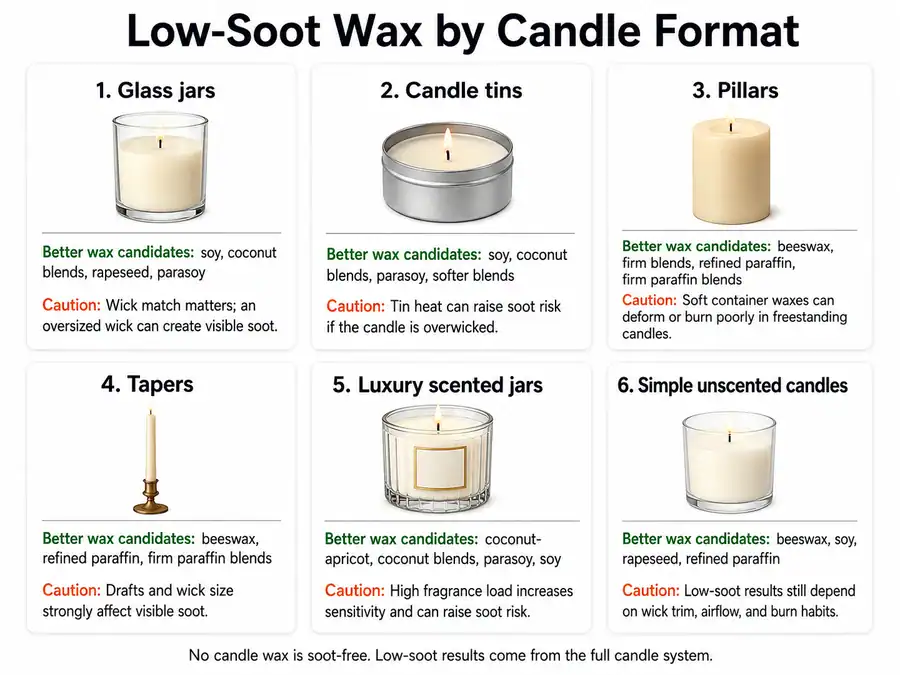
If you want the easiest low-soot starting point, choose soy for standard container candles, beeswax for simple premium candles, and coconut-based blends for luxury jars. If you need stronger scent throw or firmer structure, paraffin or parasoy may still be a valid choice after burn testing.
Cost, effort, and risk also change by format. Soy is usually easier to source and test. Beeswax can cost more and may limit scent choices. Coconut-based blends can give a premium finish, but supplier formulas vary. Paraffin and parasoy can perform well, but they need careful claim wording when the goal is lower soot.
How to Choose the Best Candle Wax for Low Soot
Choose low-soot candle wax by matching the wax family to the candle format, then checking wick fit, fragrance load, supplier clarity, and burn-test results.
Start with the candle you want to make, not with a universal wax winner. A lower-soot container candle, a clean-looking pillar, and a luxury scented jar can require different wax families. The right choice is the wax that gives a stable flame and acceptable residue under the exact formula and vessel you plan to sell or burn.
Use Candle Wax Types for the parent comparison, then route narrow problems to the right page: Candle Wick Sizing for flame control, Candle Fragrance Load for scent percentage, Candle Soot Troubleshooting for black smoke, and Non-Toxic Candle Wax for health or ingredient claims.
| Step | Decision rule | Best next move |
|---|---|---|
| 1 | Define the candle format first | Jar, tin, pillar, taper, or luxury vessel |
| 2 | Pick a wax family for that format | Soy, beeswax, coconut blend, rapeseed, paraffin, or parasoy |
| 3 | Check the claim boundary | Low soot means lower visible residue risk, not zero emissions |
| 4 | Match the wick to the wax and vessel | Do not assume wax alone prevents soot |
| 5 | Add fragrance and dye only within supplier guidance | Retest the candle after every formula change |
| 6 | Burn-test the finished candle | Judge the full candle system, not the plain wax |
| 7 | Compare the result against the goal | Stable flame, acceptable melt pool, limited visible residue |
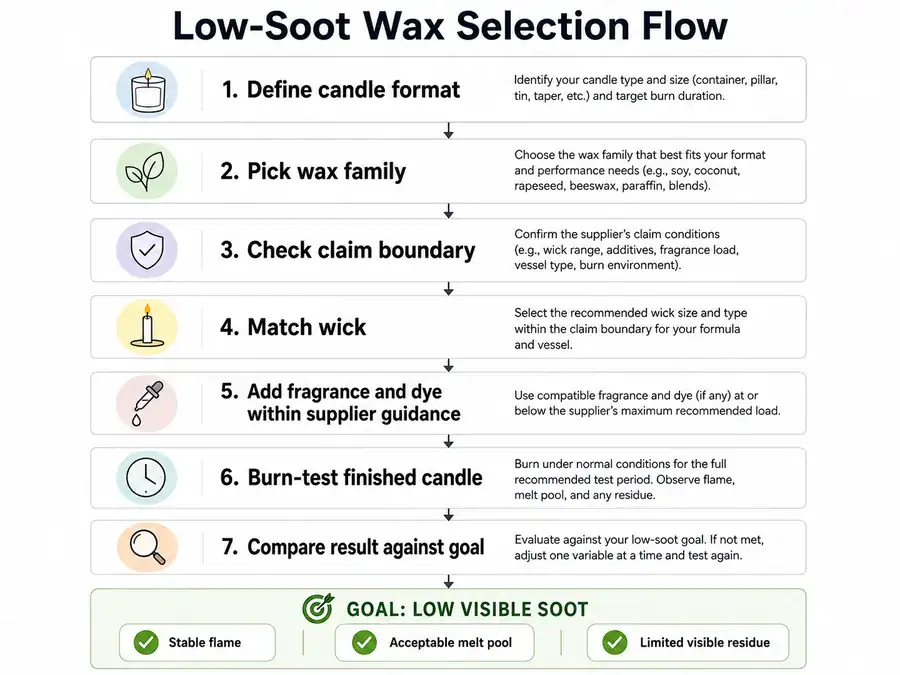
Choose soy wax if you want an accessible container wax with good low-soot potential. Choose beeswax if you want a premium, simple candle and can work within its scent and cost limits. Choose coconut or coconut-apricot blends if the candle is a luxury jar and the supplier discloses enough blend behavior to test well. Choose rapeseed wax if you want a plant-based alternative and can test the exact supplier formula. Choose paraffin or parasoy only when performance goals such as scent throw, firmness, or blend behavior justify the extra care in burn testing and claim wording.
The safest recommendation is conditional: the best candle wax for low soot is the wax that fits the candle format, burns with a properly sized wick, carries fragrance without smoking, and performs cleanly in the real vessel and room conditions.
FAQ: Low-Soot Candle Wax Questions
Is any candle wax completely soot-free?
No candle wax should be treated as completely soot-free. Low-soot wax only means a lower visible residue risk when the wick, fragrance load, vessel, and burn conditions are controlled.
Is low-soot candle wax the same as non-toxic candle wax?
No, low-soot candle wax is not the same as non-toxic candle wax. This page uses “low soot” for visible burn behavior, while ingredient safety, toxicology, and health claims belong in a dedicated Non-Toxic Candle Wax guide.
Does soy wax always produce less soot than paraffin?
No, soy wax does not always produce less soot than paraffin. A well-wicked refined paraffin candle can burn with less visible residue than a soy candle with an oversized wick, heavy fragrance load, or unstable flame.
What matters more for soot: wax type or wick size?
Wick size often controls more of the visible soot outcome than wax name alone. Wax family still matters, but the wick decides flame size, fuel draw, and whether the candle burns steadily.
What should I do if my candle already leaves black residue?
Treat black residue as a troubleshooting issue, not just a wax-choice issue. Use Candle Soot Troubleshooting or Candle Wick Sizing to check wick size, flame height, fragrance load, airflow, and vessel heat.