

The best candle additives for scent throw are the additive families that fit the problem you are actually solving—retention, compatibility, fading, or release—and that stay within supplier and candle-use limits when tested in your exact wax, wick, fragrance, and container.
Here, safe use means staying inside supplier documents, SDS records, and fragrance paperwork for candles; it is not a general health ranking. Use this page to choose the additive family that fits the diagnosed problem, then verify it with a small test batch. Start by identifying whether you need retention, stability, protection, or burn delivery, then match the additive family to that job and route deeper comparison, safety, or troubleshooting questions to the linked child pages.
What additives actually boost candle scent throw?
Additives can improve scent throw by increasing fragrance retention, improving wax–oil compatibility, or changing how the melt pool releases aroma—without creating soot, sweating, or a drowned wick.
If you’re changing more than one thing at a time, learn candle additive fundamentals so you can tell whether the wax, wick, fragrance, or additive is doing the work.
Most “stronger smell” problems fall into three buckets: the fragrance won’t stay in the wax (retention), it won’t stay evenly mixed (compatibility), or it isn’t being delivered well while burning (release). The table below helps you match an additive family to the bucket you’re actually in.
| Additive family | What it mainly changes | Most useful when… | Common downside to watch |
| Fixatives (resins, microcrystalline wax) | Slows evaporation; steadies release | Top notes fade fast; hot throw spikes then drops | Haze, opacity shifts, harder wicking |
| Binders/compatibilizers | Helps FO stay dispersed | You see striations, seepage, or “weeping” | Oily tops, sweating, muted aroma |
| Hardness modifiers (fatty acids, blends) | Crystal structure and hardness | Pillars need strength or burn rate control | Brittleness, altered melt pool |
| Stabilizers (UV/antioxidants) | Reduces degradation over time | Citrus/bright notes fade in storage/display | Overuse can discolor or flatten notes |
On this page, “best” means the additive family that fits the confirmed failure mode. If wick size, melt pool, fragrance fit, or storage is the real bottleneck, do not add anything yet.
If you need a wider selector by wax type or performance goal, use choose candle additives before you test a narrower scent-throw fix.
Use this quick chooser before you test, so you don’t add chemistry to a problem that is really wick, wax, or storage related.
| If the problem is… | Check first | First additive family to test | Do not add yet when… |
| Cold throw is fine, but hot throw stays weak | Wick size, melt pool, burn cleanliness | Light fixative only after the burn system is already clean | The melt pool is still shallow, tunneling, or cool |
| Wet beads, seepage, streaks, or layers | Wax–oil compatibility | Compatibilizer/binder | You are already near supplier fragrance or additive limits |
| Scent fades during storage or display | Light and heat exposure | UV stabilizer and/or antioxidant | The candle is stored in bright light or heat and that condition has not been corrected |
| Top notes burn off too fast | Whether the wax is already a performance blend | Polymer fixative or microcrystalline wax | The wax is already pre-blended for performance and the surface stays stable |
Before you add anything, run a quick diagnosis so you don’t “fix” the wrong problem. The checkpoints below map symptoms to likely causes.
- These checks help you identify whether you need retention, compatibility, or delivery.
- If the cooled candle smells fine but fades quickly during burn, retention or wick delivery is more likely than fragrance load.
- If you see wet beads, seepage, or layers, compatibility is the first suspect.
- If the melt pool is tiny or tunnels, delivery is usually the bottleneck even with a good formula.
- If the cooled candle smells fine but fades quickly during burn, retention or wick delivery is more likely than fragrance load.
When you do test additives, keep the math boring and consistent. Use a gram scale, pick one additive family, and mix candle additives for optimal results so you can compare batches cleanly.
Methods: Make 3 identical candles per condition (same wax, jar, wick, fragrance, and cure time). Score cold throw (unlit scent at room temperature) and hot throw (burning scent in the room) on a 1–5 scale after a consistent burn cycle, and log wick behavior. Limitations: results vary by fragrance chemistry and room airflow; follow supplier documents and burn-safety guidance such as ASTM F2417 and National Candle Association recommendations for practical burn testing.
If the surface turns slick or beads up, stop “adding” and step back to prevent surface oil sweat by reducing the change and re-checking compatibility before you chase more scent.
How fixatives work (polymer resins, microcrystalline wax)
Fixatives help fragrance last longer by structuring or thickening the wax so lighter aroma molecules escape more slowly and more evenly over time.
To keep your testing clean, review additive families first and decide whether you’re solving evaporation, separation, or wick delivery.
Two common fixative styles behave differently, so treat them like separate tools rather than interchangeable ingredients.
| Fixative type | What it tends to do | When it usually helps | What it can break |
| Polymer resins (EVA-style) | Increases oil binding and viscosity | Paraffin-heavy blends that lose top notes fast | Can haze, raise melt viscosity, alter wick needs |
| Microcrystalline wax | Builds a tighter crystalline network | Blends that need smoother, slower release | Can reduce clarity, stiffen blend, change melt pool |
Use fixatives when fragrance leaves the wax too quickly, not when the candle is separating or the melt pool is undersized. If you see layers, seepage, or streaks, solve compatibility first; if the pool stays shallow or tunnels, solve wick delivery first.
For full test steps, use a full candle test series. When the decision is no longer “fixative or not” but “which additive solves this job,” move to the narrower Vybar vs stearic comparison.
Vybar vs stearic acid for fragrance retention
Vybar mainly helps fragrance stay bound and evenly held in many paraffin blends, while stearic acid mainly changes hardness and burn behavior, so they solve different “weak scent” problems.
Choose Vybar first when the wax needs better oil holding, less migration, or a more uniform paraffin-heavy blend. Choose stearic acid first when the wax needs more hardness or a slower burn profile. For grade details, trade-offs, and fuller side-by-side testing, see Vybar vs stearic acid after you confirm whether the problem is retention or structure.
If the narrower question is how Vybar behaves in candle formulas, use Vybar’s role in candle performance instead of expanding this selector page.
Cold throw vs hot throw: which additives help each?
Cold throw depends on how fragrance sits near the surface and evaporates at room temperature, while hot throw depends on what the melt pool releases during combustion and convection.
Start by deciding whether you’re trying to improve cold throw or chasing performance only once the candle is lit, because the best additive choice can differ.
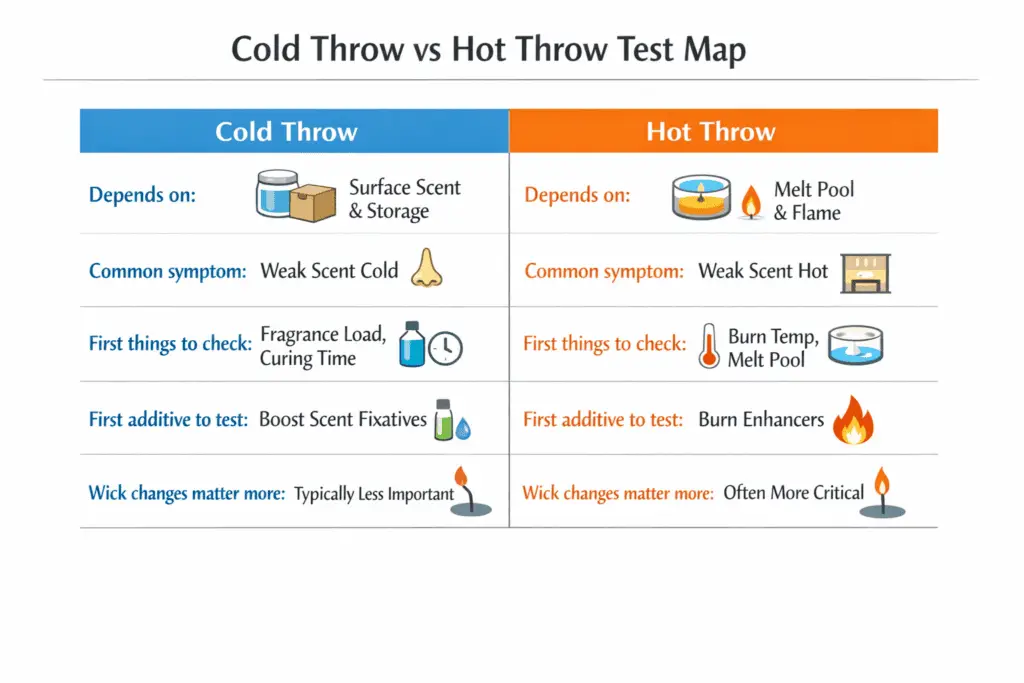
Cold throw is often helped by preventing separation and keeping fragrance evenly distributed so the surface “smells like the candle,” not just the bottle. Additives that support compatibility and stability can make cold throw more reliable—especially if you’ve had wet tops, sweating, or uneven scent patches.
Hot throw is more about delivery: melt pool temperature, wick behavior, and controlled release over time. Fixatives and structure modifiers can make hot throw steadier by slowing the “all at once” flash-off of lighter notes, but they can also thicken the melt pool and force a wick change. If you’re trying to make hot throw stronger, treat any additive change as a burn-system change, not just a formula tweak. If the melt pool is cool or undersized, a wick change usually matters more than an additive.
This quick mapping helps you pick what to test first:
- If cold throw is weak but hot throw is decent
- Focus: stability and surface behavior
- First tests: a small compatibilizer/binder-style change, then a cure-and-storage check
- Focus: stability and surface behavior
- If cold throw is strong but hot throw is weak
- Focus: wick delivery and controlled release
- First tests: wick tuning, then a light fixative/structure change if the burn is already clean
- Focus: wick delivery and controlled release
- If both are weak
- Focus: fragrance choice, wax fit, and burn system
- First tests: confirm fragrance is suitable for candles, then run a controlled wick ladder before adding complexity
- Focus: fragrance choice, wax fit, and burn system
Don’t skip time as a variable. Many blends change dramatically with cure time for candles, so compare batches only after the same rest period, stored the same way, and tested in the same room conditions.
Dosage by wax type (paraffin, soy, coconut, blends)
Dosage by wax type is not a fixed chart: paraffin-heavy, soy-heavy, coconut, and blended waxes tolerate additive changes differently, so start at the lowest stated supplier limit and step upward in small tests while keeping fragrance load and wick constant.
To keep comparisons fair, compute additive percentages (and fragrance load) by weight for every batch, then record the full formula and pour/burn conditions.
Wax type changes how much fragrance and additive a blend can “hold” before you get sweating, seepage, haze, or wicking issues. That’s why “the right dose” is less about a universal number and more about staying inside the limits for your specific wax and then stepping upward in controlled increments.
Use this practical dosing ladder for both fragrance and additives:
- Start at a conservative level that is clearly under your wax supplier’s recommended maximum.
- Increase in small, fixed steps (for example, 0.5% of wax weight at a time).
- After each step: check for surface oil, frosting/haze, and a clean burn before you try the next step.
- If you see oiliness, poor adhesion, or flame struggle, step back and solve compatibility or wicking before adding more.
This table gives you a simple “what to watch” lens by wax family (not hard rules):
| Wax family | Usually easier/harder to hold FO | Common failure mode when pushed | What to adjust first |
| Paraffin-heavy blends | Often easier | soot/mushrooming if over-wicked; haze with some additives | wick + burn profile |
| Soy-heavy blends | depends on FO | frosting, surface oil, muted hot throw if pool is cool | cure + wick + stability |
| Coconut/soft blends | can hold FO well but stays soft | oily tops, soft surface, adhesion quirks | stability/binder choice |
| Blends | variable | “looks fine, burns weird” after tiny changes | change one variable at a time |
Methods: Make a baseline candle and two step-up batches (one small increase, one moderate increase). Keep the wick identical for the first comparison so you can detect viscosity/holding changes. If the melt pool clearly changes, repeat the best formula with the appropriate wick adjustment and re-score cold/hot throw.
Using UV stabilizers and antioxidants to protect fragrance
Use UV stabilizers and antioxidants only when light exposure or oxidation is part of the fragrance-loss problem, because they are shelf-life tools rather than universal scent boosters.
For the deeper workflow, see preventing candle discoloration with UV additives after you confirm that storage and display conditions are part of the problem.
Light can flatten bright notes during storage or display, but these additives still need supplier directions, current SDS files, and the fragrance’s IFRA paperwork before you test. For rates, sequence, and product-specific handling, use UV inhibitor best practices.
If the candle loses room scent during burn rather than during storage, route the diagnosis to weak hot throw before you add more shelf-life chemistry.
Compatibility helpers when separation is the real problem
Use a wax-specific compatibilizer only when you see streaks, wet beads, seepage, or layers, because a compatibility helper is for dispersion problems—not a general fixative and not a guaranteed way to make candles smell stronger. When results feel inconsistent, clarify whether the problem is separation, retention, or wick delivery before you add another variable.
A compatibility helper is for dispersion problems, not for a stable candle that still throws weakly. If the surface already stays dry and uniform, weak throw is more often wick delivery, wax fit, or fragrance choice than a missing binder.
Use only products documented for candle wax and stay inside supplier limits. If overuse creates sweating, soft tops, or separation, route the repair to additive appearance problems instead of stacking more chemistry.
Plant and beeswax as fixatives in blended systems
Plant waxes and beeswax can act like “natural fixatives” by raising hardness and tightening the wax structure, which can slow fragrance loss and steady hot throw.
Treat them as structure tools first, and judge scent only after the melt pool still stays in range.
Use small additions by weight and keep fragrance load unchanged while you test. Beeswax can add its own honey note and deeper color, candelilla can push a blend toward brittleness, and carnauba can constrict the melt pool if you overdo it.
If the flame weakens or the pool stays shallow, adjust wick size for harder blends before you decide the fragrance itself changed.
When wick changes matter more than additives
Wick choice changes capillary flow, flame shape, and melt-pool size, which changes how fragrance vapor spreads through the room during a burn.
The fastest way to avoid wasted experiments is to think in systems (wick + wax + FO + additive), because a small change in viscosity or hardness can require a different wick family or size.
When an additive thickens or hardens the wax, re-check wick choice before you blame the fragrance. A cleaner answer on this page is simple: if the pool is shallow, tunnels, or loses heat after the formula change, wick delivery is the next variable to test.
For full wick sizing or weak-throw diagnosis, use wick sizing and fix weak scent throw rather than expanding the additive formula again.
Safety & IFRA/allergen considerations for additives
On this page, safety means staying within supplier limits, current SDS records, and the candle-use paperwork that applies to each material; it does not replace a full regional compliance review.
Start with the fragrance’s IFRA paperwork for candles, supplier documents, and dated batch notes for every formula change.
Use the lowest allowed limit across your documents, record every formula change as a new batch, and route deeper labeling or market-specific questions to candle additive safety before you sell.
FAQ
What additive helps scent throw the most?
There is no universal winner. Fixatives help when the problem is fast fragrance loss, compatibilizers help when the problem is separation, and UV/antioxidant systems help when the problem is fading during storage or display.
Does Vybar make candles smell stronger?
Sometimes, but mostly by helping some paraffin-heavy blends hold fragrance more evenly. If the narrower question is where it helps and where it does not, use Vybar’s role in candle performance.
Can additives fix weak hot throw if the wick is wrong?
Usually not. If the candle cannot build and hold a proper melt pool, route the fix to weak scent throw or wick sizing before you change the formula again.
Do soy candles always need additives for strong scent throw?
No. Many soy and blended container waxes are already formulated for performance, so wax choice, fragrance choice, cure time, and wick fit often matter more than adding another ingredient. If you need a wider selector, use choose candle additives before testing a narrower scent-throw fix.
Can too much additive reduce scent throw?
Yes. Overuse can haze the wax, mute aroma, tighten the melt pool, create oily tops, or force a wick change that makes the candle perform worse. If those defects appear, route the repair to additive appearance problems.