
The best candle additive is the one that fits your main goal, wax type, and candle format, because no single additive improves hardness, opacity, and mold release equally well.
Candle additives and enhancers are formulation modifiers that change how wax performs, not the wax itself and not a cure for every candle problem. On this page, best means best-fit for your main goal, your wax system, and whether you are making molded candles or containers, not a universal best additive across every formula. One family may help firmness, another may shift the finish toward more opacity, and another may support easier unmolding, so the right choice starts with the result you want most.
This page shortlists additive families for hardness, opacity, and easier mold release support only. Exact loading, mixing order, full single-additive comparisons, and mold-release rescue belong on separate pages.
Start with wax type and candle format before choosing any additive
Choose the additive only after you lock wax type and candle format, because the same additive family can behave differently in soy, paraffin, blends, molded candles, and containers.
Wax type and candle format are decision filters, not background details. Additives & Enhancers gives the broader family overview, but this page stays on choosing the best-fit route for hardness, opacity, or release support after those filters are fixed. A recommendation that sounds strong in paraffin can become a weak fit in soy, and a useful molded-candle additive can be unnecessary or awkward in a container candle. That is why the safest first move is to sort the candle by wax system and by whether the candle must hold shape on its own or stay supported by the container.
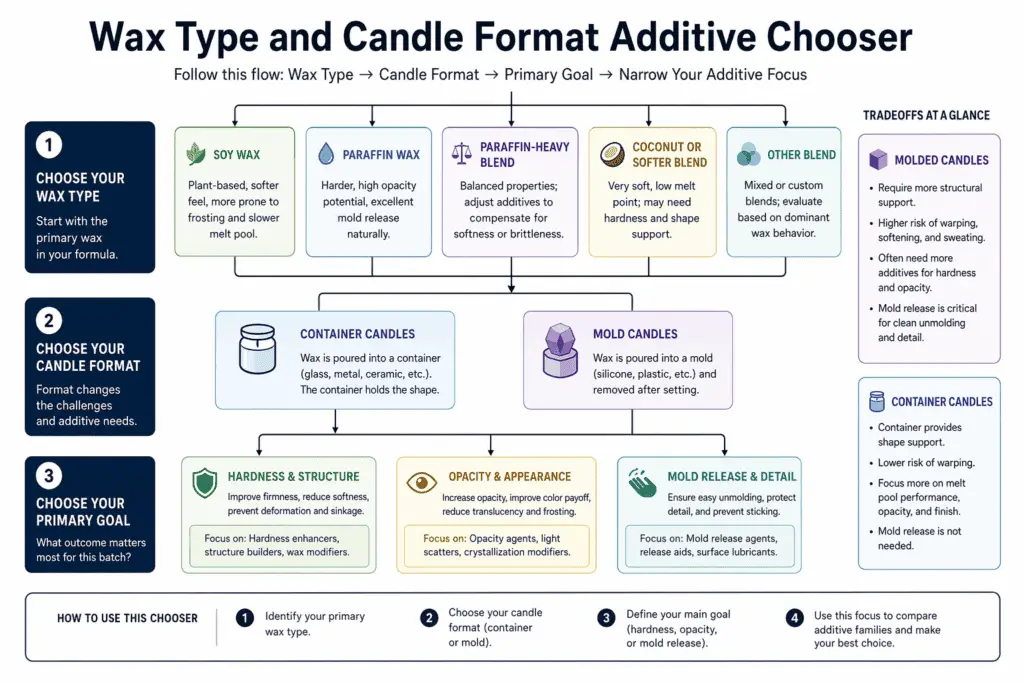
Use this quick filter before you compare additive names.
| Wax + format | What matters most first | What usually changes the recommendation | First shortlist move |
| Soy container | Surface appearance and glass performance | Added firmness may not solve the real problem | Keep additive pressure light and choose only for one clear goal |
| Soy mold | Shape hold and cleaner release | Softness and release can rise together | Filter for molded-candle fit before comparing families |
| Paraffin container | Finish control and opacity | Structure may already be strong enough | Compare opacity-first and structure-first families separately |
| Paraffin mold | Firmness, edges, and release | Hardness and release often interact | Move hardening and release-support families to the top |
| Paraffin-heavy blend mold | Body strength with some finish control | One family may support two goals, but rarely all three | Shortlist by main goal, then check side effects |
| Coconut or softer blend container | Finish shift and texture change | Some additives can change feel before they improve the target result | Start with the smallest scope change and avoid solving two problems at once |
| Blend container | Lead wax behavior | The dominant wax usually sets the limit | Follow the lead wax, then narrow by top goal |
| Blend mold | Shape hold, release, and edge quality | Release support can matter more than appearance | Filter for mold use first, then choose by hardness or release |
If the real issue is the wrong wax, the wrong candle format, or a mold-release setup that is already failing, do not choose an additive first.
Method note: This matrix is a heuristic shortlist. It compares relative fit across common wax and format contexts, not exact formula performance or lab scores.
A simple way to think about the filter is this: soft waxes usually make tradeoffs show up sooner, molded candles put more pressure on structure and release, and container candles often punish overcorrection. That does not mean one wax is better than another. It means additive advice only makes sense after the wax and format are fixed. For the broader selection path across more additive goals, How to Choose the Best Candle Additives is the better sibling page.
Which additive family usually fits hardness, opacity, or mold-release goals?
Hardening routes usually move up first for hardness goals, opacity-support routes usually move up first for finish-opacity goals, and release-support routes usually move up first for easier unmolding in molded candles. The familiar additive name matters only after the goal, wax type, and candle format are clear.
| Main goal | Family that usually moves up first | Where it often fits best | What to check before choosing |
| More hardness | Stearic-acid-style hardening route | Molded paraffin or paraffin-heavy blends | Brittleness, rough finish, and whether the candle actually needs more body |
| More opacity | Vybar-style or other opacity-support route | Paraffin and paraffin-heavy systems where a less translucent look matters | Whether the change is a finish goal or really a dye question |
| Easier mold release | Stearic-acid-style release-support route | Molded candles that need cleaner unmolding | Whether the issue is support or a real mold-fix problem |
| Hardness plus some opacity | Hardening route checked against finish change | Molded candles that need more body first | Whether the finish change is enough without over-hardening |
| Opacity plus some structure | Opacity-support route checked against body strength | Candles where appearance leads but structure still matters | Whether the structure gain stays too small for the format |
| Release plus some hardness | Molded-candle hardening route | Shapes that need cleaner release and a firmer body | Whether release is the real pain point or only a side issue |
Stearic acid is a fatty-acid additive that often moves up first when firmer structure or easier unmolding matters most. Vybar is a polymer additive family that often moves up when finish control, structure support, or opacity matters in many paraffin-based systems.
If the next question is what stearic acid changes in practice, What Does Stearic Acid Do in Candles? is the right follow-up before you compare it against another family.
The point of the table is not to crown one winner. It is to show that additive families fit goals differently. If the real question becomes a direct head-to-head comparison, Stearic Acid vs Vybar: Which One Should You Use? is the right next stop. If the real question is what one family changes in practice, What Does Vybar Do in Candles? answers that without forcing this page into a single-additive deep dive.
When lower or higher use-rate sensitivity should change the additive recommendation
Lower or higher use-rate sensitivity can change the recommendation even when the goal stays the same. If one family produces a useful shift with a lighter addition, it usually stays easier to fit into the formula. If another family needs much heavier use before the effect is visible, surface feel, brittleness, or release behavior can change before the result feels worth it.
That does not mean lighter is always better. It means use-rate pressure is one more filter. A route that looks ideal on paper can become a weak fit if it needs so much material that the candle starts to lose the look, feel, or flexibility you were trying to protect.
| Situation | Why use-rate sensitivity matters | What it usually changes |
| You only need a small firmness lift | Heavy loading may create new problems before it solves the first one | A lighter-response family usually wins |
| You need a large finish shift | A small-loading route may not move opacity enough | A stronger visual-response family may move up |
| You are working in a softer wax | Extra additive can change feel fast | Caution matters more than raw benefit claims |
| You are making molded candles | Release and hardness can move together | A family with a steadier response often fits better |
| You are already close to the result | Chasing the last bit of change can cost more than it gives | Staying conservative often wins |
Exact ratios, temperatures, and order of addition belong on How to Properly Mix Candle Additives into Wax. If you are still deciding on the wax itself, Best Waxes for Candle Making: Soy, Paraffin, Coconut, and More gives the right context before you force an additive to do work the wax choice should handle. If format is still open, Best Candle Types for Molds and Containers helps narrow that choice before you change the formula.
How to choose candle additives for more hardness
For more hardness, choose the additive family that best supports firmer structure in your current wax system and candle format, then check the brittleness tradeoff before using it.
A hardness-first choice makes sense when the candle needs more body, cleaner edges, or better shape retention. It becomes a poor choice when the candle already holds shape well enough and the real problem sits somewhere else, such as mold fit, wax choice, or process. Hardness is a performance goal, not a universal upgrade.
Use this benchmark to narrow the route.
| Situation | Family that usually moves up first | Likely gain | Main downside to watch | Good fit when | Poor fit when |
| Molded paraffin candle feels too soft | Stearic-acid-style hardener | Firmer body and cleaner edges | Brittleness if pushed too far | The candle needs more structure first | The candle already feels firm enough |
| Paraffin-heavy blend pillar | Hardening route listed for that blend | Better shape hold | Rougher finish or over-hardening | Shape retention matters most | Appearance matters more than firmness |
| Soy mold that deforms too easily | Context-checked hardening route | Some added body | Gain may stay modest in softer systems | A small lift is enough | The user expects a paraffin-like jump |
| Container candle that seems only slightly soft | Often no hardening route yet | Prevents the wrong fix | Added hardness may miss the real issue | The structure problem is confirmed | The issue is burn behavior or finish |
| Candle needs hardness and opacity | Hardening route checked against finish shift | More body with some visual change | Finish may change before firmness feels worth it | Structure is the first priority | Opacity is the real reason for the change |
| Candle needs hardness and release | Molded-candle hardener shortlist | Firmer body with some release help | Release still depends on mold and process | The candle is close to working already | The candle is sticking badly |
| Decorative mold with fine edges | Hardening route with edge protection in mind | Better detail hold | Extra stiffness can increase chip risk | Edge hold matters more than flexibility | The mold already creates release strain |
Method note: This benchmark is a heuristic shortlist for hardness-first decisions. It compares likely fit and tradeoffs, not exact percentages or recipe instructions.
The main tradeoff is brittleness. A firmer candle can look cleaner and hold shape better, but too much hardness can make edges chip more easily or make unmolding less forgiving in some setups. That is why “best for hardness” does not mean “strongest possible hardener.” It means the route that improves structure without creating a worse failure.
A good hardness-first choice usually answers three questions in order:
- Does the candle actually need more body, or is the problem somewhere else?
- Will the wax and format reward extra firmness, or punish it?
- Is the added firmness worth the risk of a rougher finish or a more brittle candle?
If the answer to the first question is weak, stop there. A slight softness in a container candle does not always justify a hardening route. If the answer to the second question is weak, the wax or format may be setting the real limit. If the answer to the third question is weak, the additive is solving the wrong problem.
Once the family is chosen, exact loading and order belong on How to Properly Mix Candle Additives into Wax. If firmness is not the first goal, opacity can change the shortlist quickly.
What candle additives best improve opacity?
For more opacity, choose the additive family that best supports a less translucent finish in your wax system instead of treating opacity as a dye or UV problem.
Opacity on this page means an additive-driven finish result, not color correction and not fade prevention. A candle can have enough dye and still look too translucent, just as a candle can look cloudy enough without having stronger color. The first job is to separate finish from color so the additive choice stays pointed at the right problem.
Use this matrix when opacity is the lead goal.
| Finish goal | Family that usually moves up first | What often improves | What can shift with it | Best fit when | Weak fit when |
| Less translucent paraffin candle | Vybar-style opacity-support route | More solid-looking finish | Surface look or structure balance | Appearance leads the decision | The candle already looks opaque enough |
| More opaque molded candle | Opacity-support route checked against mold use | Fuller visual body | Hardness or release can shift too | Finish matters first and mold use still matters | Release is the real pain point |
| Paraffin-heavy blend with cloudy look as the goal | Opacity-first route | Stronger visual density | Slight texture or firmness change | Finish matters more than peak structure | Structure is the real need |
| Soy or softer blend that looks too clear | Wax context checked first, then family fit | Some visual change | Gain may stay smaller than expected | A modest opacity lift is enough | The user expects a dramatic paraffin-like shift |
| Colored candle looks too transparent | Additive route, not dye correction | More body in the finish | Color may read differently after the finish changes | The issue is translucency | The real issue is weak color |
| Candle needs opacity and some structure | Opacity-first route checked against body | Fuller appearance with some support | Hardness may still stay second | Finish is the top goal | The candle needs real structural correction |
Method note: This matrix is a heuristic shortlist for finish-opacity decisions. It compares likely visual-fit changes, not lab color readings or exact loading.
Opacity is not the same as “whitest,” and more opaque is not always better-looking. Some candles look better with a little depth and light movement in the wax, while others need a more solid appearance to match the style or mold. That is why the better question is not “Which additive makes candles most opaque?” but “Which additive family gives the finish I want without creating a worse tradeoff?”
A strong opacity choice usually becomes easier when you check these distinctions early:
- Is the candle too translucent, or just too lightly colored?
- Is the finish the main goal, or is structure actually the real need?
- Will the wax show a strong enough finish shift to justify the additive?
If the candle is already near the right look, a heavy-handed opacity route can create side effects before it creates a meaningful improvement. If the wax is not likely to show much finish change, the additive can disappoint even when the name sounds familiar.
That is why Best Waxes for Candle Making: Soy, Paraffin, Coconut, and More still matters before you expect one opacity route to behave the same way everywhere. When opacity is not the top goal, release support or structure may deserve the lead spot instead.
How to choose candle additives that support easier mold release
For easier mold release, choose the additive family that supports cleaner unmolding in molded candles, but do not treat additives as a replacement for mold prep or troubleshooting.
Additives can support mold release, but they do not replace mold condition, mold prep, or a real fix path when candles are sticking badly. This page stays on additive-assisted release only. That matters because many readers use “best additive for mold release” when the real issue is already a troubleshooting problem, not a selection problem.
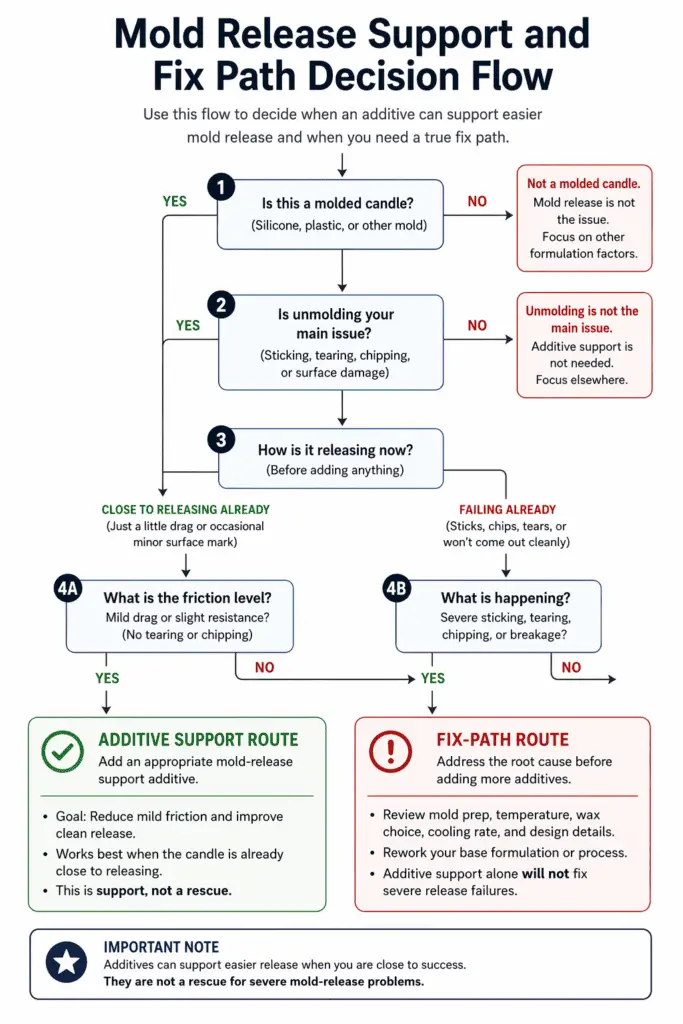
Use this benchmark to decide whether an additive route still makes sense.
| Molded-candle situation | Family that usually moves up first | Likely benefit | Main tradeoff to watch | Additive route still makes sense when | Additive route becomes weak when |
| Paraffin mold needs easier unmolding | Stearic-acid-style release-support route | Cleaner release with firmer feel | Too much can increase brittleness | The candle is close to releasing well already | The candle is locking hard into the mold |
| Paraffin-heavy blend needs release help | Release-support route checked against structure | Better separation with some added body | Surface or edge behavior can change | Small support could solve it | The issue is severe sticking or chipping |
| Molded candle needs release and more hardness | Molded-candle hardening route | Firmer structure with some release help | Hardness can rise faster than release benefit | The candle needs both and is close to working | Release is clearly the main problem |
| Detailed mold with drag points | Release-support family checked against shape complexity | Easier separation in some setups | Fine details may still stay fragile | The problem is mild friction | The problem is mold design or defect pressure |
| Softer blend in a simple mold | Light release-support route | Some cleaner release | Gain may stay modest | Only a small improvement is needed | The wax-format match is the real issue |
| Candle is already sticking or chipping badly | Additive choice drops in priority | Prevents solving the wrong problem | Lost time and wrong diagnosis | The issue is still minor | A fix path is clearly needed |
Method note: This matrix is a heuristic shortlist for additive-supported release decisions. It compares likely fit and tradeoffs, not a promise that one additive will fix a failing mold setup.
The key boundary is simple: support is not the same as rescue. If the candle already needs rescue, the additive choice has lost priority. A support route makes sense when the candle is close to releasing well and needs a cleaner separation. It stops making sense when the candle is already sticking hard, breaking, or showing a process or mold problem that no additive should be expected to carry.
That is why a release-first choice should answer these questions early:
- Is the candle molded, and is unmolding the main issue?
- Is the candle close to releasing already, or already failing?
- Is the release problem mild enough that additive support could still matter?
If the second answer points to failure, route out. How to Fix Common Mold Release Issues is the better next move when the candle is sticking, chipping, or refusing to release cleanly. If the project may be better as a different candle style altogether, Best Candle Types for Molds and Containers is the cleaner filter before changing the formula.
Additives can support easier release, but they do not replace process fixes. Once release, hardness, and opacity begin to compete, the most reliable move is to rank those goals instead of trying to treat them as equal.
How to choose when you want hardness, opacity, and easier mold release together
When you want hardness, opacity, and easier mold release together, rank the goals first and choose the additive family that best fits the top priority and acceptable tradeoff.
One additive route rarely leads all three results equally in the same candle. The real decision is not which additive promises the most benefits on paper. The real decision is which path protects the result that matters most while keeping the second goal acceptable and the third goal from becoming a problem.
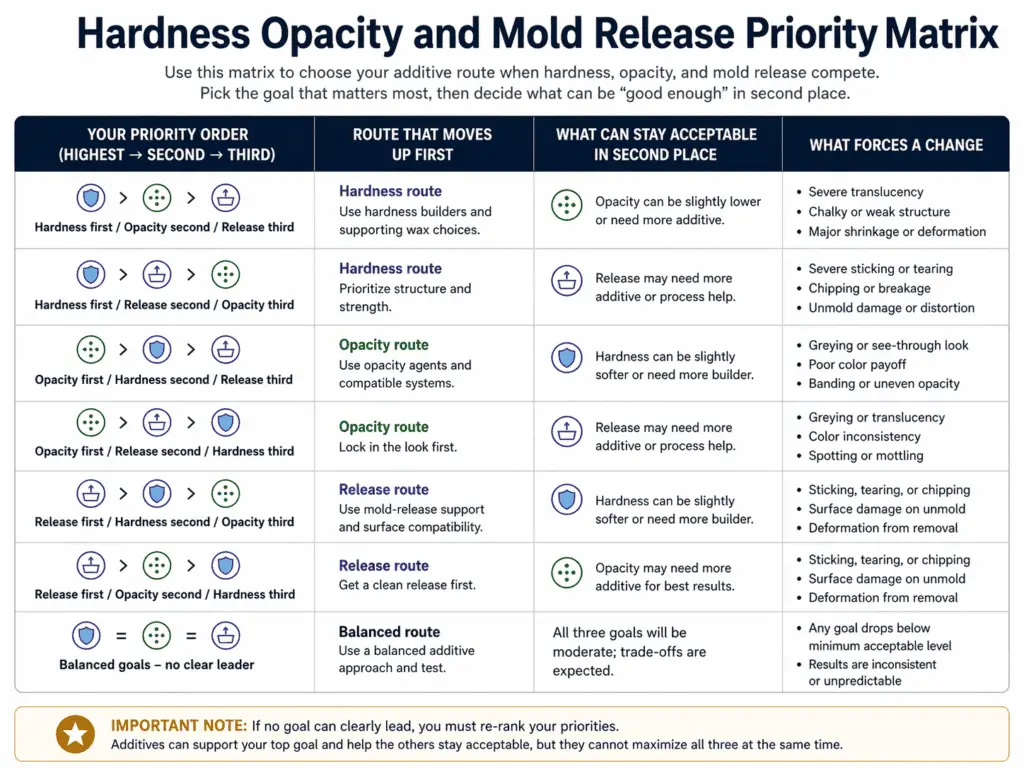
Use this ranked-goal matrix to keep the choice honest.
| Priority order | Route that usually moves up first | What can stay acceptable in second place | What usually forces a change |
| Hardness first, opacity second, release third | Hardening route | Some finish gain and some release help | Brittleness climbs too fast for the mold or use case |
| Hardness first, release second, opacity third | Molded-candle hardening route | Cleaner unmolding with moderate finish change | Release pressure is stronger than the structure problem |
| Opacity first, hardness second, release third | Opacity-first route | More body without chasing peak firmness | The candle still lacks enough structure for the format |
| Opacity first, release second, hardness third | Opacity-first route checked for mold use | Better finish with some release help | Mold behavior needs more support than finish control can give |
| Release first, hardness second, opacity third | Release-support route for molded candles | Firmer body with less sticking pressure | The candle is already failing badly and needs a fix path |
| Release first, opacity second, hardness third | Release-support route with finish check | Cleaner unmolding with some visual gain | The finish still stays too clear after release needs are met |
| Balanced goals with no clear leader | Re-rank before choosing | Avoids a muddled formula | No route looks good because the priorities were never set |
Method note: This matrix is a heuristic shortlist for ranked-goal decisions. It compares likely fit when goals compete, not exact formula math.
The biggest mistake in multi-goal selection is treating all three results as equal from the start. That usually leads to a vague recommendation, a disappointing compromise, or a choice that sounds flexible but fits none of the goals well enough. A ranked choice works better because it forces one clear question: which result would make the candle feel most improved if only one had to win cleanly?
A useful way to rank the goals is:
- Pick the result that matters most to the finished candle.
- Pick the result that would still feel acceptable in second place.
- Name the downside you least want to trigger.
That last point matters. A hardness-first path can still fail if the brittleness cost is too high. An opacity-first path can still fail if the candle remains too soft for the format. A release-first path can still fail if the issue is already large enough to be a troubleshooting problem.
If your ranked goals still leave two close options, use the dedicated comparison or troubleshooting pages next rather than turning this shortlist into a deeper fix guide.
What you trade off when you prioritize one candle result over another
Prioritizing one result means giving another result less control over the final choice.
A hardness-first path can give a firmer candle body, cleaner edges, and better shape hold, but it can raise brittleness before it improves every other result. An opacity-first path can give a fuller, less translucent finish, but it may not deliver the strongest structure or the easiest release. A release-first path can help molded candles separate more cleanly, but it does not replace mold prep and it may not produce the strongest visual or structural gain.
Use this quick tradeoff view when two options still look close.
| Priority you lead with | What you usually gain first | What often moves to second place | What can go wrong if pushed too far |
| Hardness | Firmer structure | Finish and release support | Brittleness or rougher feel |
| Opacity | Fuller visual body | Peak firmness and release | Good appearance with weak structural improvement |
| Release | Easier unmolding | Finish perfection and maximum firmness | Expecting support to solve a true fix problem |
The cleanest choice is usually the one that protects the top goal while keeping the second goal acceptable. Once the second goal starts overruling the first, the priority order was probably set wrong and the additive path should be ranked again.