

Candle wax usually does not dry through water evaporation; it sets fast when melted wax loses heat before it has time to level, stay workable, or finish the pour. Common causes include low pour temperature, cold rooms, drafts, cold jars or molds, small wax amounts, wax type, and recipe changes.
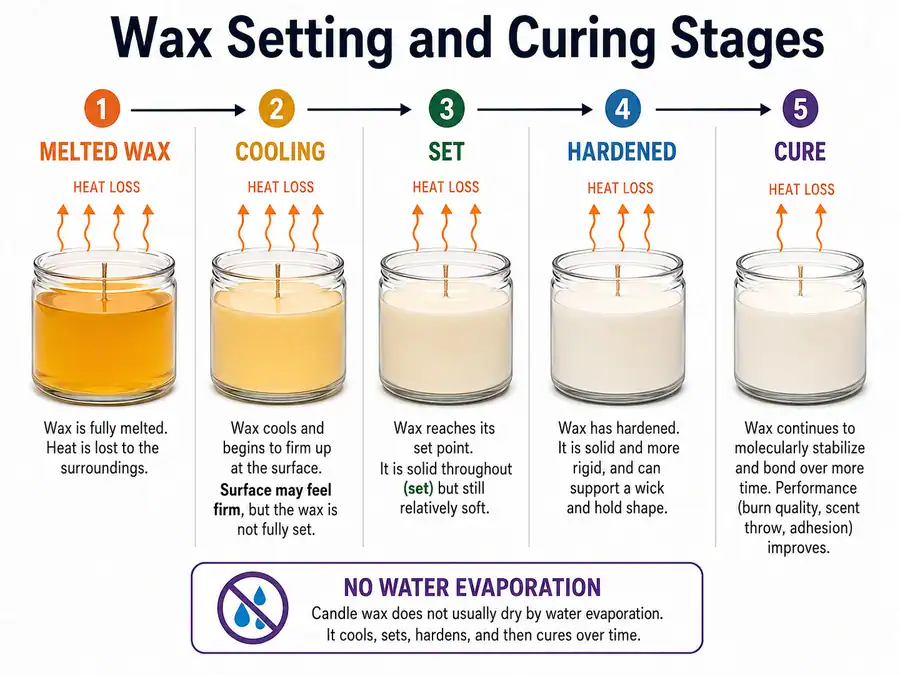
Candle wax is the melted candle-making material that cools, firms, and later cures after it is poured. In candle making, “dry” usually means the wax has set, hardened, or solidified, not that water has evaporated.
In this article, “fast” means the wax sets before it levels, before you finish pouring, or noticeably sooner than the same wax usually behaves in the same jar, room, and pour range.
Fast drying usually means the wax lost working time because heat left the pour sooner than expected. The first variables to check are wax type, pour temperature, room conditions, container or mold temperature, wax amount, and any recent recipe change.
Does Candle Wax Really Dry, or Does It Set and Cure?
Candle wax does not usually dry like paint or clay; when candle makers say wax dried fast, they usually mean it cooled, set, or hardened faster than expected.
Candle wax becomes solid as it loses heat. The broader candle wax types question matters later, but the first fix is language: fast “drying” usually means fast setting, not water leaving the wax.
| Term | What it means in candle making | What it does not mean |
|---|---|---|
| Dry | Beginner shorthand for wax looking firm or solid | Moisture evaporating like paint |
| Cool | Wax losing heat after melting or pouring | The candle being finished |
| Set | Wax becoming firm enough to hold shape | Full cure or burn readiness |
| Harden | Wax becoming solid or resistant to touch | Proof the candle is ready to burn |
| Cure | Later rest period after setting | The first firming stage after pouring |
A candle can feel hard before it is cured because surface firmness and internal stabilization are not the same stage. If your real question is when the candle is safe or ready to burn, that belongs to candle cure time, not the first hardening stage after pouring.
Fast setting becomes easier to diagnose once “dry” means set, harden, or solidify. If the full process still feels unclear, a how to make candles guide can explain the larger pour sequence without turning this fast-setting problem into a beginner tutorial.
Why Wax Type Can Make Candle Wax Set Faster
Wax type affects how quickly candle wax sets because each wax or wax blend melts, cools, and firms within its own temperature range.
A wax with less working time can thicken or skin over sooner under the same room and pour conditions. This does not mean one wax is always better; it means the candle wax type changes how much heat the melted wax keeps before it starts to firm.
| Wax type or use | Likely setting behavior | What to check first |
|---|---|---|
| Soy wax | Can look cloudy, thick, or surface-set sooner in cooler rooms | Pour range and room temperature |
| Paraffin wax | May stay workable differently from soy, depending on grade | Supplier pour guidance |
| Beeswax | Naturally firmer and higher-melting than many soft container waxes | Mold warmth and pour temperature |
| Coconut blend | Often softer, but behavior depends heavily on the blend | Blend instructions from the supplier |
| Container wax | Made to stay in jars, so side contact matters | Jar temperature and pour range |
| Pillar wax | Made to stand alone, so it may firm differently than jar wax | Mold temperature and wax grade |
Use wax type as a clue, not as the only answer. Two waxes can behave differently even when the room, jar, and pouring process stay the same.
For a full comparison of soy, paraffin, beeswax, coconut, container, and pillar wax, use a candle wax types guide. This section only covers wax type as a cause of fast setting. If the same process suddenly feels rushed after switching wax, check the wax type and supplier pour range before changing the entire recipe.
How Pour Temperature Can Make Wax Harden Too Quickly
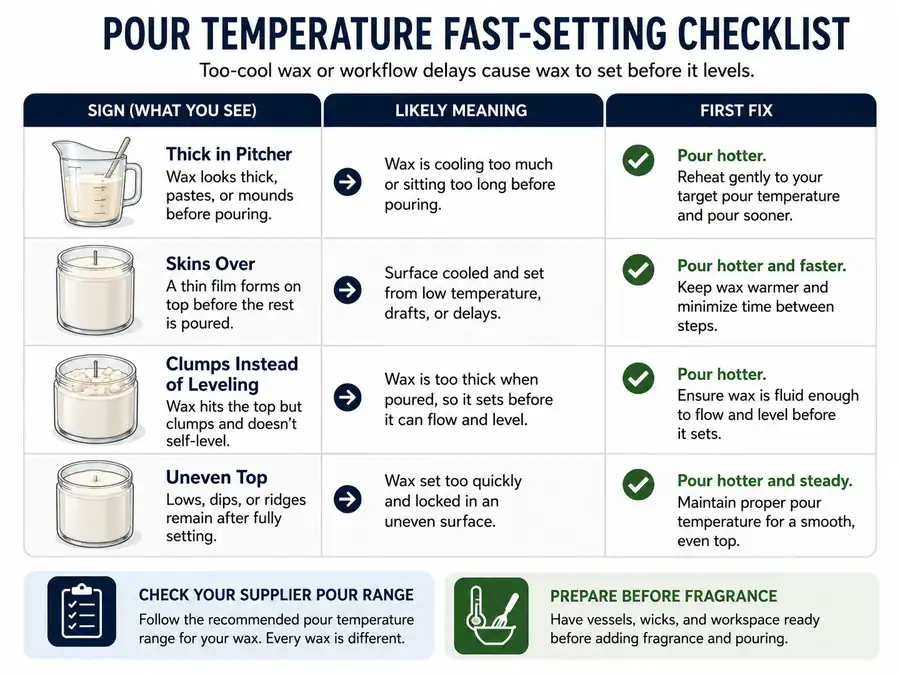
If candle wax is poured too cool, it can thicken, skin over, or harden before it has time to level in the container.
Pour temperature is the wax temperature at the moment the melted wax enters the jar or mold. It is different from melt temperature, which is the temperature used to liquefy the wax, and fragrance-add temperature, which is the temperature used when mixing fragrance oil.
Use this pour-temperature checklist before changing the wax type or recipe:
| Pour-temperature check | What it means | Fast-setting fix |
|---|---|---|
| Wax looks thick in the pitcher | It may have cooled too much before pouring | Recheck the supplier’s pour range |
| Wax skins over right after pouring | The surface may be losing its remaining heat too soon | Pour within the wax maker’s guidance |
| Wax clumps instead of leveling | The wax may be below its workable range | Warm the process, not the finished candle |
| Uneven top forms quickly | The wax may be setting before it settles flat | Reduce delay between mixing and pouring |
| Fragrance or dye was mixed slowly | The wax may have cooled during the wait | Prepare tools before adding fragrance |
| The issue appeared after switching wax | The new wax may need a different pour range | Read that wax’s technical sheet |
Use the wax maker’s pour guide or supplier technical data sheet as the benchmark because universal pour temperatures can mislead candle makers. Waxes have recommended melting, fragrance-addition, and pouring ranges, but this section only covers the final pour temperature that affects fast setting.
If you need a full temperature chart for melting, fragrance addition, and pouring, use a candle making temperature guide. A full how to make candles guide can explain the larger workflow, while candle fragrance load belongs to fragrance amount and mixing decisions, not this narrow pour-temperature fix.
How Cold Rooms, Fans, and Drafts Speed Up Wax Setting
A cold room, fan, open window, or air-conditioning draft can make candle wax set faster by removing heat from the wax surface.
Candle wax cools from the outside inward, so the surface and edges can set before the center has finished leveling. Room temperature is the air and surface condition around the pour; wax temperature is the heat still held inside the melted wax itself.
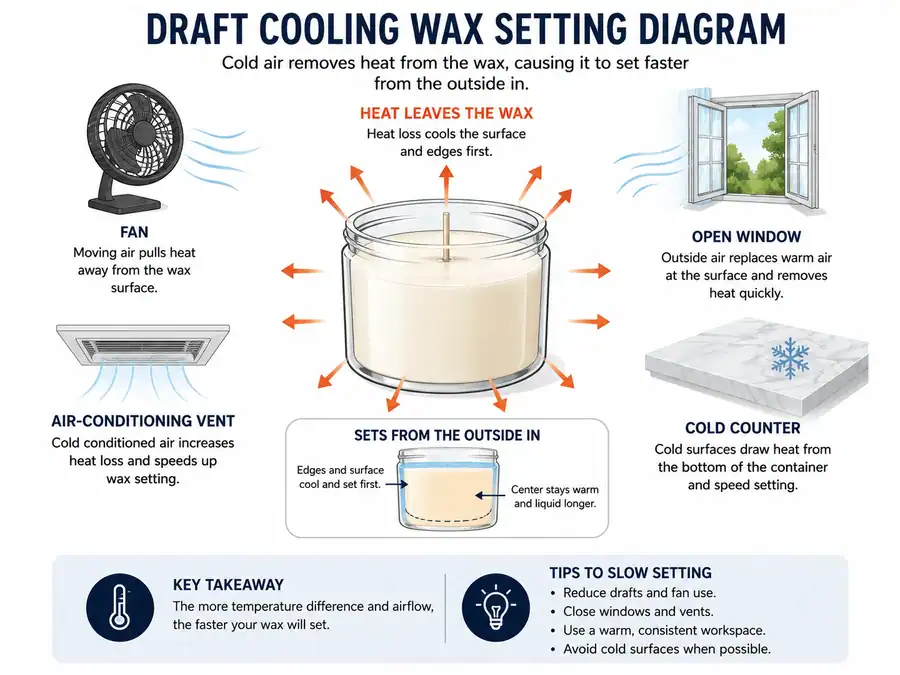
Use this room-condition checklist when wax sets too fast:
| Room condition | Fast-setting sign | What to change next |
|---|---|---|
| Open window | Top skins over on one side | Close the window before pouring |
| Fan near the table | Surface sets unevenly | Turn the fan off during setting |
| Air-conditioning draft | Wax firms faster on the draft side | Move jars away from vents |
| Cold winter workspace | Wax thickens sooner than usual | Stabilize the workspace before pouring |
| Cold stone or metal counter | Bottom and sides firm quickly | Use a safer, less cold work surface |
| Jars placed in a cold area | Edges set before the center levels | Move the setup to a steadier room |
Cold-room cooling is different from pouring too cool. In the first case, the environment pulls heat from wax after it enters the jar; in the second case, the wax may already be too cool when poured.
Do not use a refrigerator or freezer to solve fast setting. Very cold cooling can make wax contract too quickly and can cause cracking or uneven finish.
Seasonal candle making tips can cover broader winter setup questions, but this section only handles cold air and drafts as fast-setting causes. If the main issue is frosting, wet spots, or another surface defect after the candle has set, use the defect-specific guide instead.
Can Cold Jars or Molds Make Wax Set Too Fast?
Cold jars or molds can make candle wax set too fast because the container pulls heat from the melted wax as soon as the wax touches it.
This is a contact-temperature issue. The candle wax may leave the pour pitcher at a good temperature, then firm quickly against cold glass, metal, silicone, or a thin mold wall before the center levels.
| Container or mold condition | Fast-setting sign | Fix before the next pour |
|---|---|---|
| Cold glass jar | Wax firms around the side wall first | Let jars reach room temperature |
| Cold metal mold | Outer wax hardens before the center settles | Warm the mold safely before pouring |
| Thin container wall | Wax loses heat quickly at the edges | Use steadier room conditions |
| Jar stored in a cold garage | Wet-looking side patches may appear later | Store jars in a warmer indoor area first |
| Mold placed on a cold counter | Bottom firms before the top levels | Move the setup to a less cold surface |
| Many jars poured slowly | Later jars receive cooler wax | Pour in smaller groups |
Do not overheat jars or molds. The safer fix is gentle warming and stable room conditions, not extreme heat.
Container candle safety belongs to a separate container guide, while this section only covers how cold contact surfaces shorten wax working time. If the candle later shows wet spots, frosting, sinkholes, or adhesion marks, use the matching defect guide instead of treating every mark as fast drying.
For broader room-temperature, cooling-speed, finish, and scent-throw effects, route to the room temperature and cooling conditions guide rather than expanding this fast-setting page.
Why Small Test Pours and Leftover Wax Harden Faster
Small wax amounts harden faster because thin pours, leftovers, and shallow test batches hold less heat than a full candle pour.
This is a wax-mass issue. A spoonful of candle wax, a thin test layer, or the last bit in a pour pitcher cools faster than a filled jar because there is less hot material holding warmth.
| Pour size | Why it sets faster | What to do |
|---|---|---|
| Thin test layer | Low wax mass loses heat quickly | Judge it as a test, not a full candle |
| Small sample jar | More surface area cools against air and glass | Compare it with similar small jars only |
| Leftover wax in pitcher | It keeps cooling while you pour other candles | Pour leftovers sooner or remelt if safe |
| Shallow top-up layer | Thin wax layer firms quickly | Match top-up timing to the wax behavior |
| Small embed or detail pour | Tiny wax areas cool almost at once | Work in short, prepared steps |
| Half-filled mold | Less hot wax stays in the mold | Expect faster setting than a full pour |
A small pour setting quickly does not always mean the wax type or recipe is wrong. The better comparison is same wax, same jar size, same room, and same pour temperature.
If only tiny tests harden fast, the cause is probably low wax mass rather than a failed candle formula. Testing supplies and batch planning can be handled in a candle testing guide. This section stays on the narrow fix: small wax amounts need faster handling, warmer setup conditions, or test expectations that match their smaller heat reserve.
Did the Wax Start Setting Fast After a Recipe Change?
If candle wax started setting fast after a recipe change, the new fragrance oil, dye, additive, or wax blend may have changed how the wax feels, thickens, or cools.
This is a formulation-change clue, not a full recipe diagnosis. The question is not “which additive is best?” The question is whether the candle wax began behaving differently only after one ingredient, percentage, or mixing step changed.
| Recipe change | What you may notice | What to check first |
|---|---|---|
| New fragrance oil | Wax thickens sooner after mixing | Fragrance temperature and supplier guidance |
| More fragrance oil | Wax feels heavier or slower to level | Fragrance load guidance |
| New liquid dye | Texture changes after color is added | Dye type and amount |
| Dye chips or blocks | Small unmelted pieces affect the pour | Full melting before pouring |
| Hardener or additive | Wax firms faster than the base wax | Additive instructions |
| New blended wax | Setting behavior changes across the whole batch | Wax blend technical sheet |
Do not fix a recipe-change problem by changing everything at once. Change one variable, repeat the same jar, room, and pour temperature, then compare the result.
If the wax only set fast after the recipe change, the cause is probably the added material or the way it was mixed. Detailed additive ratios belong in Candle Additives, and fragrance percentage decisions belong in Candle Fragrance Load.
How to Diagnose What Made Candle Wax Set Too Fast
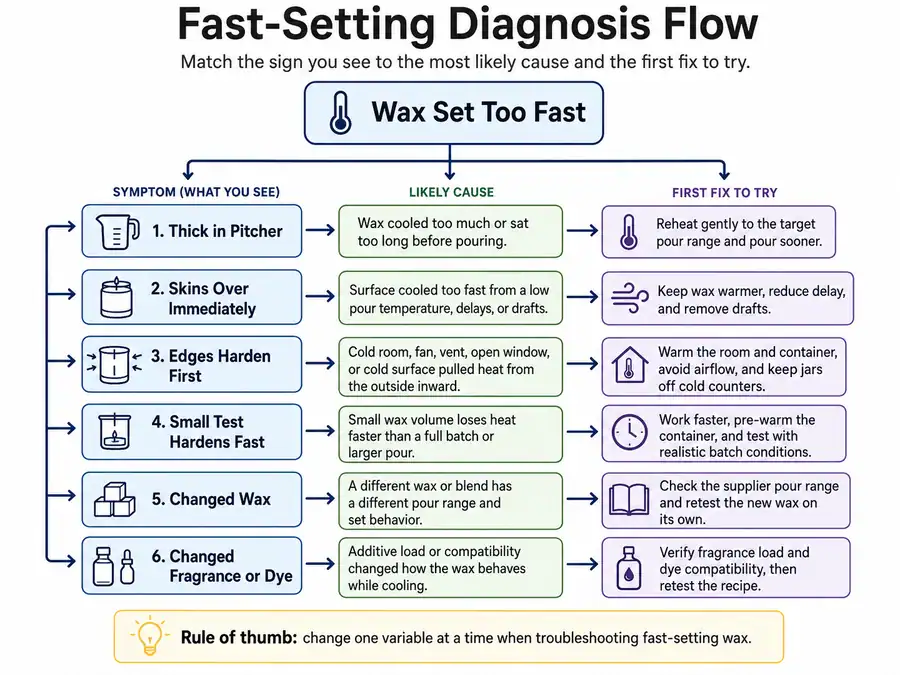
Diagnose fast-setting candle wax by matching the visible sign to the most likely heat-loss or recipe variable, then change one cause before the next pour.
The best diagnosis starts with what changed: wax type, pour temperature, room conditions, jar or mold temperature, wax amount, or recipe. A fast surface skin points to air or pour temperature; fast side hardening points to a cold container; sudden thickening after mixing points to fragrance, dye, or additive changes.
| Visible sign | Likely cause | Best first fix |
|---|---|---|
| Wax skins over almost immediately | Cold room, draft, or low pour temperature | Remove drafts and check pour range |
| Wax thickens in the pitcher | Wax cooled before pouring | Prepare tools earlier and pour sooner |
| Edges harden before the center | Cold jar, mold, or work surface | Let containers reach room temperature |
| Tiny test pour hardens quickly | Low wax mass | Compare only with similar test sizes |
| Problem started after changing wax | New wax type or blend behavior | Read the new wax’s technical sheet |
| Problem started after adding fragrance or dye | Recipe or mixing change | Test one ingredient change at a time |
| Surface looks uneven after fast setting | Wax cooled before leveling | Check pour temperature and room stability |
| Hard candle still smells weak or burns poorly | Cure confusion, not setting speed | Use a candle cure time guide |
Use this fast diagnosis flow:
- Name the stage first: setting, hardening, or curing.
- Check whether the wax was thick before it reached the jar.
- Check whether the room had cold air, fans, vents, or open windows.
- Check whether jars, molds, or counters were cold.
- Compare full pours against small test pours only when the size matches.
- Review any wax, fragrance, dye, or additive change since the last normal batch.
This diagnosis prevents one common mistake: treating every fast-setting sign as a wax defect. If the real issue is Candle Sinkholes, Candle Frosting, or Wet Spots, use the matching defect guide. If the real issue is burn quality, move to wick and burn-test troubleshooting instead.
FAQ
These quick answers clarify fast candle wax setting without expanding into cure-time charts, wax-type comparisons, wick sizing, or finished-candle burn problems.
Why did my candle wax harden before I finished pouring?
Candle wax can harden before you finish pouring when it cools too much in the pitcher, sits in a cold room, or is poured into cold jars or molds.
Check the wax maker’s pour range first, then check room drafts and container temperature. If the wax was already thick before it reached the jar, the pour process was probably too cool or too slow.
Is fast-setting candle wax ruined?
Fast-setting candle wax is not always ruined. It may still be usable if it has not burned, scorched, taken in debris, or been mixed beyond the supplier’s guidance.
If the wax hardened in the pitcher, remelt it only when the wax supplier allows reheating for that wax type. If the finished candle has defects, diagnose the visible sign before assuming the whole batch failed.
Does curing make candle wax dry faster?
Curing does not make candle wax dry faster. Curing happens after the candle has already set and is firm enough to hold its shape.
Setting is the cooling stage. Curing is the later rest period that lets the finished candle stabilize. A candle can feel hard while still needing cure time.
Why does soy wax seem to dry so fast?
Soy wax can seem to dry fast when it is poured too cool, exposed to drafts, or poured into cold containers.
The wax type matters, but soy wax is not always the only cause. Compare the same soy wax under warmer room conditions, correct pour guidance, and room-temperature jars before changing wax.
Can I slow candle wax setting without changing the wax?
Yes. You can often slow candle wax setting by pouring within the supplier’s range, removing drafts, warming cold jars safely, preparing tools before mixing, and avoiding long delays before pouring.
Change one variable at a time. If the wax only sets too fast in small test pours, the issue may be wax mass rather than the wax type.
What to Change Before Your Next Pour
Before your next pour, treat fast-drying candle wax as a setting problem first, then check the heat-loss variable that changed.
Start with the simplest controls: confirm the supplier’s pour range, remove cold air and drafts, let jars or molds reach room temperature, compare similar batch sizes, and review any new fragrance, dye, additive, or wax blend.
This keeps the fix tied to candle wax setting behavior instead of turning one fast pour into a full recipe rebuild.
| Before pouring | Why it helps |
|---|---|
| Confirm the wax maker’s pour range | Prevents pouring below the workable range |
| Prepare jars, fragrance, dye, tools, and labels first | Reduces cooling delays |
| Keep fans, vents, and windows away from the pour area | Reduces fast surface setting |
| Let jars or molds reach room temperature | Reduces fast side-wall hardening |
| Compare small tests with small tests, not full candles | Prevents false recipe blame |
| Change one recipe variable at a time | Makes the next fix easier to identify |
If the wax sets fast but looks smooth, the process may be normal for that wax, container, and room. If it skins over, clumps, hardens at the edges, or changes after a recipe switch, use the matching cause above and adjust only that variable before the next batch.