

Coconut apricot wax is better for scent perception, smooth finish, and premium positioning; soy wax is better for lower cost, broad availability, and familiar plant-based positioning.
This page compares coconut apricot wax and soy wax as candle-making wax materials for container candles. “Better” means better for a stated candle outcome, not universally safer, healthier, cleaner, or right for every format. Use coconut apricot wax when finish and scent perception matter most; use soy wax when raw material cost and repeatable sourcing matter more. This comparison does not cover wax melts, pillars, tapers, supplier rankings, exact wick charts, fragrance-load formulas, safety/legal claims, or health claims.
| Decision point | Better first choice |
|---|---|
| Stronger scent perception | Coconut apricot wax |
| Lower raw wax cost | Soy wax |
| Smooth finished surface | Coconut apricot wax |
| Broad availability | Soy wax |
| Beginner testing budget | Soy wax |
| Premium product positioning | Coconut apricot wax |
| Warm-weather shipping | Test both before choosing |
What Are Coconut Apricot Wax and Soy Wax?
Coconut apricot wax and soy wax are candle-making wax materials used mainly for container candles.
Coconut apricot wax is usually a supplier-formulated specialty blend, not one identical raw wax. Soy wax is a soy-derived wax category that can vary by grade, blend, and container-wax formula.
| Wax type | Typical identity | Why formula matters | What not to assume |
|---|---|---|---|
| Coconut apricot wax | A specialty candle wax blend, often made from multiple wax inputs | Supplier formula can affect scent throw, softness, finish, adhesion, and handling | Do not assume every coconut apricot wax performs the same way |
| Soy wax | A soy-derived wax category sold as pure soy, soy blends, or container-wax formulas | Different soy formulas can change frosting, adhesion, hot throw, and pour behavior | Do not assume soy wax is always pure soy or always cheaper after testing |
Coconut apricot wax and soy wax are compared here as container-candle inputs first. That wax identity matters because later decisions about scent, cost, heat tolerance, finish, and beginner testing depend on the exact formula being poured.
Coconut apricot wax is not the same as coconut wax. Coconut apricot wax usually describes a formulated blend, while coconut wax is a broader wax type that may appear in different blends and supplier formulas.
Soy wax is not always pure soy. Many candle suppliers sell soy blends or soy-based container waxes designed to change adhesion, finish, scent throw, or handling.
Plant-derived does not automatically mean better. On this page, “natural” depends on supplier formula and positioning, while “premium” means market perception or finish expectation, not proof that one wax is universally superior.
For a full single-wax explanation, use the coconut apricot wax for candles guide. For soy-only properties and use cases, use the guide that explains what soy wax is.
For broader wax-type selection, use the best wax for container candles guide instead of turning this comparison into a full wax encyclopedia.
Which Wax Has Better Hot Throw?
Coconut apricot wax usually has better perceived hot throw than soy wax when both are tested in the same container, fragrance, wick range, and cure window. Hot throw is the scent a candle gives off while burning, not the fragrance percentage in the wax.
Coconut apricot wax is often chosen for stronger hot throw, but “stronger” means higher perceived scent under equivalent test conditions. Hot throw depends on wax, fragrance oil, wick, cure time, jar size, and burn conditions, not wax alone.
| Wax | Fragrance load | Cure window | Wick family | Burn hour | Room-fill score |
|---|---|---|---|---|---|
| Coconut apricot wax | Same test percentage | Same number of days after pour | Same tested wick family | Same burn hour | Compare after equal testing |
| Soy wax | Same test percentage | Same number of days after pour | Same tested wick family | Same burn hour | Compare after equal testing |
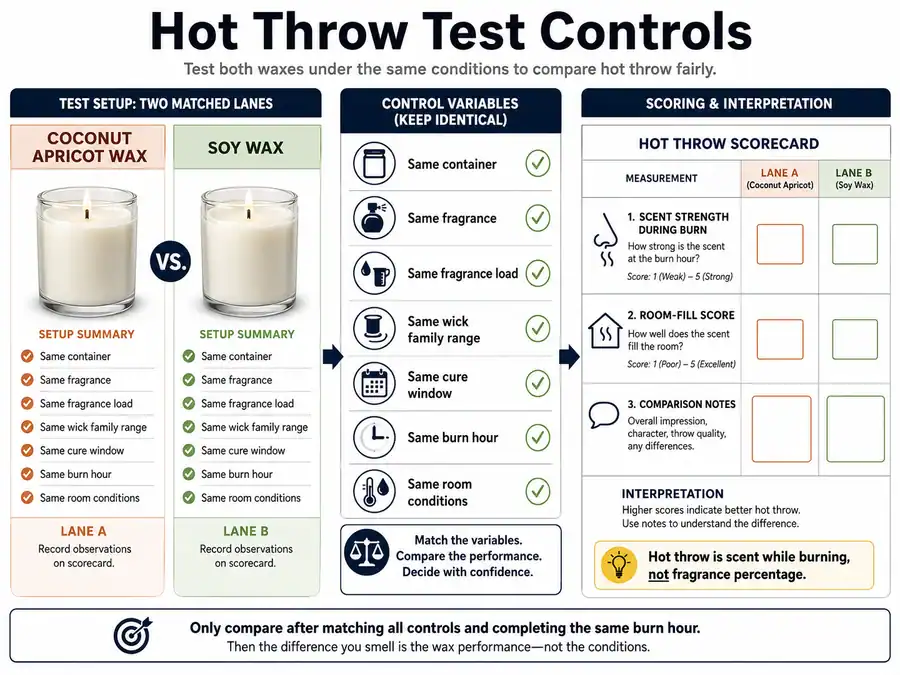
Coconut apricot wax may give a stronger scent impression in many premium container-candle tests, especially when the formula, wick, and fragrance are well matched. Soy wax can still have good hot throw, but it may need more tuning when the wick, fragrance load, or cure window is not matched to the wax.
Weak hot throw is not always a wax problem. It can come from a wick that burns too cool, a fragrance that does not perform well in that formula, a short cure window, a large room, or a jar size that changes the melt pool.
Use the fragrance load by wax type guide for exact fragrance percentages. Use the wick sizing by wax type guide when the same jar and fragrance behave differently after a wax switch.
For test documentation, use the test candle hot throw guide rather than relying on a single first burn.
Cold Throw Before Lighting
Coconut apricot wax can give a stronger cold-throw impression in some formulas, but soy wax can also perform well when fragrance, cure time, and storage conditions match. Cold throw is the unlit scent a candle gives off at room temperature.
Good cold throw does not automatically prove good hot throw. Coconut apricot wax may smell stronger before lighting in some tests, but “better scent” means better unlit scent for the tested fragrance, cure window, and storage condition.
| Test type | When measured | What it tells the maker | What it does not prove |
|---|---|---|---|
| Cold throw | Before lighting | How the candle smells on a shelf, at a market, or before gifting | That the candle will smell strong while burning |
| Hot throw | During a burn test | How the candle releases scent through the melt pool and flame | That the unlit candle will smell strong in storage |
Cold throw matters most when the candle needs shelf appeal. A customer may judge the candle before burning it, so unlit scent can affect first impression, gifting appeal, and small-batch selling confidence.
Coconut apricot wax is often chosen when makers want a soft, rich scent impression before lighting. Soy wax can still have good cold throw, especially when the fragrance oil, cure window, and storage temperature suit the wax formula.
Test cold throw fairly by pouring both waxes with the same fragrance load, vessel, lid condition, cure window, and room temperature. Smell each candle unlit before any burn test, then record the result separately from hot throw.
For cure timing, use the candle cure time guide. For broader scent adjustments, use the candle scent throw guide. For fragrance behavior across oils, use the compare fragrance oils page instead of treating this wax comparison as an oil ranking.
Cure Time and Scent Development
Coconut apricot wax and soy wax should be compared after the same cure window because scent development depends on wax formula, fragrance oil, and storage conditions. Cure time is the post-pour rest period before meaningful candle scent and burn testing.
The right cure window varies by wax formula, fragrance oil, room temperature, and testing goal. “Ready” means ready for a useful scent or burn test, not legally finished, permanently stable, or identical across suppliers.
| Wax | Days after pour | Cold throw score | Hot throw score | Ambient temperature |
|---|---|---|---|---|
| Coconut apricot wax | ___ days | ___ / 5 | ___ / 5 | ___ °C / ___ °F |
| Soy wax | ___ days | ___ / 5 | ___ / 5 | ___ °C / ___ °F |
| Same wax retest | ___ days | ___ / 5 | ___ / 5 | ___ °C / ___ °F |
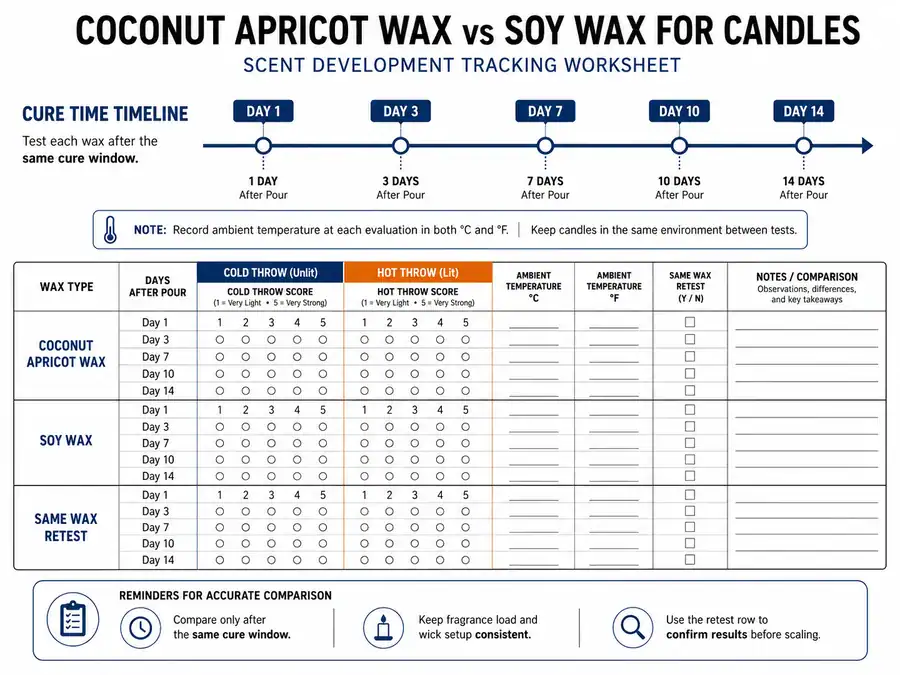
Cure time affects scent development because wax, fragrance oil, and room conditions can change how a candle smells after pouring. A candle that smells weak too early may improve after a longer rest, but that result must be tested rather than assumed.
Coconut apricot wax and soy wax should be tested across the same chosen checkpoints. This keeps the comparison tied to the wax choice instead of mixing in a different fragrance, room condition, or test schedule.
Test cold throw and hot throw separately. Cold throw shows unlit scent at rest, while hot throw shows burn-time scent after the wick, melt pool, and fragrance release interact.
For a full cure-time guide, use the candle cure time page. For scent testing, use the scent throw testing guide. For formula-level fragrance limits, use the fragrance load by wax type guide rather than adding oil-specific cure tables here.
Which Wax Costs Less Per Finished Candle?
Soy wax usually costs less per finished container candle, but raw wax price is not the same as finished-candle cost.
Soy wax is often lower in raw material cost, but the cheaper wax is the one that produces the lower usable finished-candle cost. That means wax price, fragrance use, test loss, rejects, vessel cost, wick cost, label cost, and sellable quality all matter.
| Calculator input | Unit | Why it matters |
|---|---|---|
| Wax price per lb | USD/lb | Shows raw wax cost before testing or rejects |
| Wax grams per candle | g | Converts bulk wax price into one-candle wax cost |
| Fragrance load | % | Changes oil cost and may affect test results |
| Test batch loss | % | Spreads failed or sacrificed candles across sellable units |
| Container cost | USD | Often outweighs small wax-price differences |
| Wick and label cost | USD | Keeps the comparison tied to finished candles |
| Reject-rate estimate | % | Captures failed finish, scent, or burn outcomes |
| Priority selector | cost, scent, finish, heat, beginner ease | Points the final wax choice toward the maker’s goal |
Static fallback formula: wax_cost = (wax_g / 453.592) × price_per_lb.
Soy wax is usually the first cost-sensitive choice when a maker wants lower input cost, easier bulk sourcing, and larger-batch price control. Coconut apricot wax can still make financial sense when its finish, scent perception, or premium positioning reduces rejects or supports a higher selling price.
Is soy wax cheaper than coconut apricot wax? Often, yes, when only raw wax price is compared. The answer can change when test loss, failed batches, appearance rejects, and product positioning are counted.
When is coconut apricot wax worth the higher cost? It is worth testing when smoother finish, stronger scent perception, or premium shelf positioning improves the number of candles you can sell at the target quality.
How do test failures affect wax cost? Failed wick tests, weak scent tests, rough tops, sweating, and reject jars raise the usable cost of the wax that looked cheaper at the supplier level.
For full profit and retail pricing, use the candle pricing calculator. For a smaller production estimate, use the small-batch candle cost guide.
For supplier comparison, use the wax supplier checklist rather than turning this section into live wax pricing, vendor rankings, or wholesale accounting.
Which Wax Handles Heat and Shipping Better?
Neither wax wins heat and shipping by name alone; the better choice is the formula that survives warm storage and packed-transit testing with fewer visible defects. Heat stability means how the finished candle behaves during warm storage or shipping, not flame safety.
The better wax for heat and shipping is the one that shows less visible deformation, sweating, fragrance migration, or surface damage under the maker’s actual storage and transit conditions. Melt point alone does not predict shipping performance.
| Condition | Coconut apricot risk | Soy risk | Test action | Route if deeper |
|---|---|---|---|---|
| Warm shelf storage | May soften or show surface sweating depending on formula | May soften or show surface change depending on formula | Store test jars in the same warm room used for inventory | Summer candle shipping guide |
| Short warm transit | Soft blends may mark, smear, or shift surface texture | Some formulas may hold shape but show bloom or roughness | Pack one test candle and inspect on arrival | Candle packaging for heat |
| Fragrance-heavy formula | Fragrance migration may appear as sweating | Fragrance migration may appear as sweating | Retest with the same fragrance load and jar | Container candle troubleshooting |
| Hot market table | Surface may soften under direct heat | Surface may frost, soften, or sweat by formula | Test the display setup before selling | Summer candle shipping guide |
| Warm storage after cure | Top texture can change if the wax is soft | Surface variation may become more visible | Check candles after storage, not only after pour | Candle safety standards |
Which wax is better for summer shipping? Choose the wax that survives your own warm-storage and packed-transit test with fewer visible problems. Coconut apricot wax may look more premium in normal storage, but soft specialty blends still need heat testing before summer shipping.
Does sweating mean the candle is unsafe? Not automatically. In this comparison, sweating means a visible performance or sellability issue, not proof of fire danger or legal noncompliance.
How should makers test candles before warm-weather shipping? Pour both waxes in the same jar, cure them the same way, store them under the warmest expected condition, ship or simulate transit, then inspect the top, sides, scent change, lid contact, and jar cleanliness.
For packaging and transit procedures, use the summer candle shipping guide. For heat-focused packing choices, use the candle packaging for heat guide.
For safety and burn standards, use the candle safety standards guide rather than treating shipping appearance as a full safety or compliance answer.
Which Wax Gives a Smoother Finished Candle?
Coconut apricot wax usually gives a smoother finished container candle than soy wax under comparable pouring, cooling, and curing conditions. Finish means the visible candle surface and jar appearance after cooling and curing.
Coconut apricot wax is often chosen for a smoother premium-looking finish, while soy wax can make attractive candles but may show frosting, wet spots, or surface variation more readily depending on formula and process. A smoother finish does not prove better burn safety, luxury status, or a flawless formula.
| Visible result | What it means | Coconut apricot wax | Soy wax | What to check first |
|---|---|---|---|---|
| Smooth top | Even, clean-looking top surface | Often a strength when poured correctly | Possible with the right formula and process | Pour temperature, cooling speed, fragrance load |
| Frosting or bloom | Pale or cloudy surface change | Possible by formula, but less associated with the wax category | More commonly discussed with soy wax | Storage temperature, cooling pattern, colorants |
| Wet spot | Visible adhesion gap against the jar | Can happen if the wax shrinks or cooling is uneven | Can happen if wax, jar, and cooling conditions do not match | Jar temperature, cooling rate, wax shrinkage |
| Sinkhole or rough top | Uneven surface or collapsed area | Can occur from process mismatch | Can occur from process mismatch | Pour method, cooling, reheating need |
| Wax tendency vs process cause | Separates material behavior from maker variables | Formula may support smoother tops | Formula may need more appearance tuning | Change one test variable at a time |
“Premium look” means a smoother and more consistent visible finish under comparable pour, cure, and storage conditions. It does not mean the candle is automatically safer, more expensive, or better for every buyer.
Does soy wax frost more than coconut apricot wax? Soy wax is more commonly associated with frosting because visible crystallization is a familiar soy-candle issue. Coconut apricot wax can still show surface changes, but the risk depends on the supplier formula and process.
Are surface defects always caused by wax? No. Rough tops, sinkholes, frosting, and wet spots can come from wax behavior, pour temperature, cooling speed, container temperature, fragrance load, or storage conditions.
For soy-specific appearance fixes, use the fixing soy wax frosting guide. For general visible defects, use the candle surface defects guide. For broader jar-candle problem solving, use the container candle troubleshooting guide.
Wet Spots and Jar Adhesion
Wet spots are visible adhesion gaps between the candle wax and the container, not actual moisture.
Coconut apricot wax may show fewer wet spots in some jar tests when the formula adheres well and cools evenly, but no wax is wet-spot proof. Soy wax can also adhere well when the jar, pour process, and storage conditions match the formula.
| Adhesion issue | What the maker sees | Likely variable | First comparison step |
|---|---|---|---|
| Wet spot | Patchy gap against the glass | Wax shrinkage or temperature difference | Compare both waxes in the same jar |
| Sidewall pull-away | Wax separates visibly from the container wall | Cooling and adhesion mismatch | Standardize jar temperature before pouring |
| Uneven adhesion | Some jars look clean and others patchy | Room or container inconsistency | Pour a small side-by-side test batch |
| Reappearing gap after storage | Candle looked fine at first, then changed | Storage temperature shift | Recheck jars after storage, not only after cooling |
Does coconut apricot wax have fewer wet spots? It can, especially when the formula is designed for smooth container adhesion, but jar adhesion still depends on the container, pour temperature, cooling rate, and storage conditions.
Are wet spots actual moisture? No. In candle making, wet spots are appearance gaps where wax is not visually attached to the container wall.
Good adhesion means less visible separation from the container under similar pour and storage conditions. It does not mean the candle is defect-free or guaranteed to pass every burn test.
For full prevention and repair steps, use the candle wet spots guide. For comparing wet spots with cracks, frosting, or sinkholes, use the candle surface defects guide. For repeated jar problems, use the container candle troubleshooting guide.
Frosting and Bloom Risk
Soy wax has the higher common frosting association, while coconut apricot wax can still show bloom or surface change by formula and storage condition. Frosting and bloom are visible surface changes on finished candle wax.
Soy wax is more commonly associated with frosting, while coconut apricot wax blends are often chosen for smoother appearance. In this section, “defect” means an appearance or sellability issue, not automatic proof of an unsafe candle or failed burn test.
| Visual sign | Likely meaning | Wax relevance | Functional concern? | Route for fix |
|---|---|---|---|---|
| White frosting | Visible surface change or crystallized look | More often discussed with soy wax | Usually cosmetic unless paired with burn issues | Fix soy wax frosting |
| Surface bloom | Cloudy or hazy surface change | Can appear by formula, storage, or temperature shift | Usually appearance-related | Candle surface defects |
| Color fading appearance | Dye or surface change looks uneven | More visible in colored candles | Mostly sellability-related | Soy wax troubleshooting |
| Smooth but soft surface | Clean look with possible heat sensitivity | Can occur with softer specialty blends | Depends on storage and shipping | Candle surface defects |
Does soy wax frost more than coconut apricot wax? Soy wax is more strongly linked with frosting in candle-making discussions, but formula, cooling, storage temperature, and colorants still decide the visible result.
Can coconut apricot wax bloom? Yes, a coconut apricot blend can still show bloom or surface change if the formula, fragrance, storage, or temperature conditions create visible movement in the wax.
Is frosting a safety issue? Frosting alone is usually a cosmetic issue. Treat it as a burn concern only when it appears with tunneling, unstable flame behavior, soot, excess vessel heat, or poor scent performance.
For soy-specific prevention and repair, use the fix soy wax frosting guide. For broader visible problems, use the candle surface defects guide. For repeated soy appearance issues, use the soy wax troubleshooting guide.
Which Wax Is Easier for Beginners to Test?
Soy wax is usually easier for beginners to test on budget and availability, while coconut apricot wax can feel easier when smooth finish and scent perception matter most. Beginner-friendly wax helps a maker reach repeatable container-candle results with fewer variables to control.
Soy wax is often easier for beginners on cost and availability, while coconut apricot wax may feel easier when finish and scent perception are priorities. Both waxes still require wick, fragrance, cure, and burn testing.
| Beginner test factor | Coconut apricot wax | Soy wax | Why it matters |
|---|---|---|---|
| Pouring learning curve | Can feel smooth, but formula-specific | Familiar and widely documented | Affects first-batch confidence |
| Wick sensitivity | Still needs matched wick tests | Still needs matched wick tests | Prevents weak burn, tunneling, or soot |
| Finish consistency | Often chosen for smoother appearance | May need more appearance tuning | Affects sellable first batches |
| Scent testing | Often tested for strong scent impression | Can need more fragrance and wick tuning | Separates cold throw from hot throw |
| Cure expectations | Supplier formula matters | Supplier formula matters | Changes test timing |
| Rework likelihood | Lower if the formula suits the jar | Lower if process is controlled | Reduces wasted wax and time |
Is coconut apricot wax easier than soy wax? It can be easier for a maker who wants a smooth finish and strong scent impression, but it is not easier if the higher wax cost makes testing stressful.
Is soy wax good for beginners? Yes, soy wax is a practical beginner choice because it is widely available, familiar, and often lower cost for repeated test batches.
What should beginners test first? Start with one container, one fragrance, one wax, and a small wick test set. Cure each candle consistently, burn in cycles, and record flame size, melt pool, soot, vessel heat, scent, and surface finish.
For a full first candle walkthrough, use the beginner candle-making guide. For a smaller practice path, use the test your first candle guide.
For burn testing notes, use the burn test log template. For broader wax choice before buying supplies, use the best container candle wax guide.
How Wick Testing Changes by Wax
Coconut apricot wax and soy wax can require different wick test paths because wax, jar, fragrance, and burn target interact.
Wick compatibility means a reasonable wick family to test, not a guaranteed wick size. A wick that works in soy wax may burn too hot, too cool, or too unevenly after switching to coconut apricot wax in the same jar.
Use this comparison-level test path before changing many variables at once.
| Test step | What to keep controlled | What to record |
|---|---|---|
| Choose one vessel | Same jar or tin diameter | Vessel size and material |
| Choose candidate wick families | Same wick series range per wax test | Wick family and size tested |
| Pour matched test candles | Same fragrance, load, and wax weight | Pour notes and surface result |
| Cure consistently | Same rest period and storage condition | Days after pour |
| Burn in cycles | Same burn length per test | Flame, melt pool, soot, vessel heat, scent |
| Adjust one variable at a time | Change only wick, wax, or fragrance per round | Result after each change |
Does coconut apricot wax need a different wick than soy? Sometimes, yes. A softer or differently blended wax can change melt pool speed, flame size, and scent release.
Can you use the same wick when switching waxes? You can test it as a baseline, but do not treat it as the final wick until the burn test confirms flame behavior, vessel heat, soot, melt pool, and scent.
What burn-test failures mean the wick is wrong? A weak flame, excessive flame, tunneling, heavy mushrooming, soot, poor hot throw, or unsafe vessel heat can all point to wick mismatch.
For exact wick tables, use the wick sizing by wax type guide. For records, use the burn test log template. For safety-adjacent checks, use the candle safety standards guide. For wax-level comparison testing, use the how to test candle wax guide.
Are Coconut Apricot Wax and Soy Wax Both Good for Container Candles?
Both coconut apricot wax and soy wax can work well in jars and tins when the full candle system is tested.
A container candle is a candle poured into a jar, tin, or vessel that holds the wax while it burns. This comparison applies mainly to container candles, not automatically to wax melts, pillars, tapers, or freestanding candles.
| Format | Covered here? | Why or why not | Risk if misapplied | Recommended route |
|---|---|---|---|---|
| Jar candle | Yes | The wax is held in a container during burning | Wrong wick or poor adhesion if untested | Best container candle wax |
| Tin candle | Yes | The wax is still used as a container wax | Heat and wick behavior may differ from glass | Best container candle wax |
| Wax melt | No | No wick or flame is involved | Scent and firmness needs may differ | Wax melts guide |
| Pillar candle | No | The wax must stand without a container | A soft container wax may slump or fail | Pillar candle wax guide |
| Taper candle | No | Shape, hardness, and burn structure differ | Container-wax assumptions can fail | How to choose candle wax |
Can both waxes be used in jars? Yes, both can be used in jars when the wax, wick, fragrance, container, cure window, and burn result are matched.
Can the same wax be used for melts? Not automatically. Wax melts need scent release and firmness without a wick, so container-candle results do not prove melt performance.
Does this comparison apply to pillars? No. Pillars need freestanding structure, so a soft container wax may not hold shape outside a jar or mold.
Can soy wax be used for pillars? Only if the soy formula is designed or blended for pillar use. Container soy should not be treated as pillar wax by default.
Can coconut apricot wax be used for wax melts? Only if the supplier formula and test result fit wax-melt use. Many coconut apricot comparisons are about container candles, not wickless formats.
For container-focused selection, use the best container candle wax guide. For non-container formats, use the wax melts guide or pillar candle wax guide. For a broader format-first choice, use the how to choose candle wax guide.
Wax Melts, Pillars, and Other Format Limits
This wax comparison is mainly about container candles, not every candle or home-fragrance format.
Coconut apricot wax and soy wax may be used in other products only when the supplier formula and testing support that use. A container-wax result should not be reused as proof for melts, pillars, tapers, or freestanding candles.
| Format limit | Why it matters | Safe decision rule |
|---|---|---|
| Wax melts | No wick changes scent-release needs | Test melt scent throw and firmness separately |
| Pillar candles | The wax must hold shape outside a vessel | Use a pillar-ready formula, not a soft container wax by default |
| Tapers | Shape, hardness, and burn path differ from jars | Use wax designed for taper structure |
| Freestanding candles | Collapse or slumping risk is higher | Do not assume container wax will stand alone |
| Supplier-specific blends | One formula may not match another | Follow the supplier’s stated use case |
“Candles” in this article means container candles unless a section states otherwise. That scope keeps the comparison focused on jar and tin performance: scent throw, cost, heat behavior, finish, adhesion, wick testing, and sellable quality.
For wax melts, use the wax melts guide. For pillars, use the pillar candle wax guide. For a format-first selection path, use the how to choose candle wax guide.
Formula and Handling Differences
Formula and process sensitivity can change how coconut apricot wax and soy wax compare in real container candles.
Wax names alone do not prove performance. Coconut apricot wax is often sold as a specialty blend, while soy wax may be sold as a base wax, a soy blend, or a container-wax formula.
Blends and Additives
A fair comparison uses the actual supplier formula, not the wax name alone.
A blend is a wax formula made from more than one wax or performance input. “Pure” and “blend” should come from supplier disclosure, not from guesswork based on the product name.
| Formula situation | Coconut apricot implication | Soy implication | Comparison risk | Bridge route |
|---|---|---|---|---|
| Base wax | Less common under the coconut apricot label | Possible when sold as plain soy wax | Comparing a blend to a base wax may skew results | What Is Soy Wax? |
| Formulated blend | Common in specialty container waxes | Common in soy container blends | The blend may drive performance more than the name | Soy Wax vs Soy Blend |
| Additive-supported wax | May already include performance support | May use additives or blend partners | Additives can affect finish, hardness, adhesion, and scent | Wax Additives for Candles |
| Supplier-specific formula | One product may not match another | Soy grades can vary by supplier | Test results may not transfer between suppliers | Coconut Apricot Wax for Candles |
Is coconut apricot wax a blend? Usually, yes, in candle-supplier use. Many coconut apricot waxes are formulated specialty blends, so treat the supplier’s product sheet as the source for formula identity.
Does soy wax need additives? Not always. Some soy waxes are sold as base waxes, while others are already blended or designed for container-candle performance.
Is a blended wax better than pure soy? It depends on the candle goal. A blend may improve finish, scent perception, adhesion, or handling, but it can also cost more or require new testing.
For a soy-only comparison, use the soy wax vs soy blend guide. For additive choices, use the wax additives for candles guide instead of adding recipes or reverse-engineering formulas here.
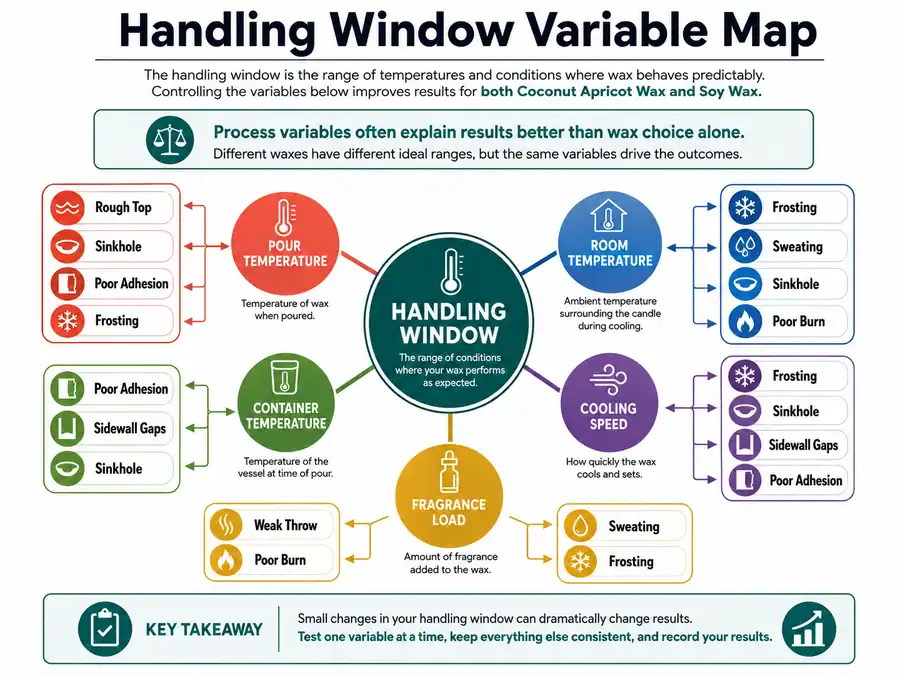
Pouring and Handling Window
Exact pour temperatures vary by supplier formula, so compare handling window instead of using one universal temperature.
A handling window is the practical range of pouring, cooling, container temperature, and room conditions that still produces repeatable container candles. “Forgiving” means wider process tolerance, not impossible to fail.
| Variable | Coconut apricot note | Soy note | Failure sign | Next test action |
|---|---|---|---|---|
| Pour temperature | Follow the supplier’s range for the specific blend | Follow the supplier’s range for the specific soy wax | Rough top, sinkhole, poor adhesion | Change pour temperature in one controlled test |
| Room temperature | Softer blends may show process changes in warm rooms | Soy may show visible surface variation with cooling changes | Frosting, uneven top, sidewall gaps | Keep room conditions stable during comparison |
| Container temperature | Jar temperature can affect adhesion and finish | Jar temperature can affect wet spots and pull-away | Patchy adhesion or side gaps | Standardize jar temperature before testing |
| Cooling speed | Slow or uneven cooling can affect surface quality | Cooling pattern can affect frosting and tops | Surface marks, cracks, bloom | Change cooling setup before changing wax |
| Fragrance load | A soft blend may react visibly to heavy fragrance | Soy may need tuning by oil and wick | Sweating, weak throw, poor burn | Test the same fragrance load in both waxes |
Which wax is more forgiving to pour? Coconut apricot wax may feel more forgiving for smooth tops in some formulas, while soy wax may feel more forgiving for cost-controlled repeated tests. The better handling choice is the wax that repeats well in your room, jar, and fragrance setup.
Can one pour-temperature chart apply to every wax? No. Brand-specific instructions matter because wax blends, additives, and container formulas vary.
What should a maker change first after a failed pour? Change one process variable at a time. Start with pour temperature, room temperature, container temperature, or cooling setup before changing wax, fragrance, and wick together.
For supplier-specific ranges, use the wax supplier’s instructions. For exact process walkthroughs, use the candle pouring temperature guide. For repeated failed batches, use the container candle troubleshooting guide.
Brand, Sourcing, and Selling Considerations
Brand positioning can affect wax choice, but it should not replace candle performance testing.
Coconut apricot wax may support a higher-end product story for some container candles, while soy wax remains familiar, accessible, and easy for many customers to understand. Selling language should stay tied to finish, scent, sourcing evidence, and test results.
Premium Perception
Premium perception is not the same as objective wax superiority.
Coconut apricot wax can support a premium positioning story when its smooth finish, scent impression, packaging, and price point fit the customer. Soy wax can still feel premium when the candle is well made, well presented, and clearly described.
| Claim or perception | What it can honestly mean | Coconut apricot implication | Soy implication | Claim-risk note |
|---|---|---|---|---|
| Premium wax | Higher perceived finish, story, or price fit | Can sound specialty or boutique | Can sound familiar and trusted | Do not imply healthier or safer |
| Luxury candle | Product positioning and presentation | May support a luxury story if finish and scent match | Can work with strong packaging and scent | Luxury is branding, not proof |
| Natural wax | Formula- and supplier-dependent wording | Needs supplier formula support | Needs supplier formula support | Do not imply pure or risk-free |
| Clean candle | Claim-sensitive wording | Should not imply non-toxic | Should not imply non-toxic | Route claim wording to compliance review |
| Better wax | Better for a stated use case | Better for finish or scent goals | Better for cost or availability goals | Name the criterion |
Is coconut apricot wax more premium than soy wax? It can be perceived that way when the candle has a smooth finish, refined scent story, and price point that matches the customer’s expectations.
Does soy wax sound less premium to customers? Not always. Soy wax can carry familiar plant-based appeal, especially when the candle has a clean finish, strong scent testing, and clear product language.
Can you call coconut apricot wax clean or luxury? “Luxury” is usually a positioning term, but “clean” can imply safety or health claims. Use the candle label claims guide before using claim-sensitive wording.
For product copy, use the candle product description guide. For brand story decisions, use the handmade candle brand positioning guide.
Sourcing Questions
Sustainability depends on supplier evidence, not the wax name alone.
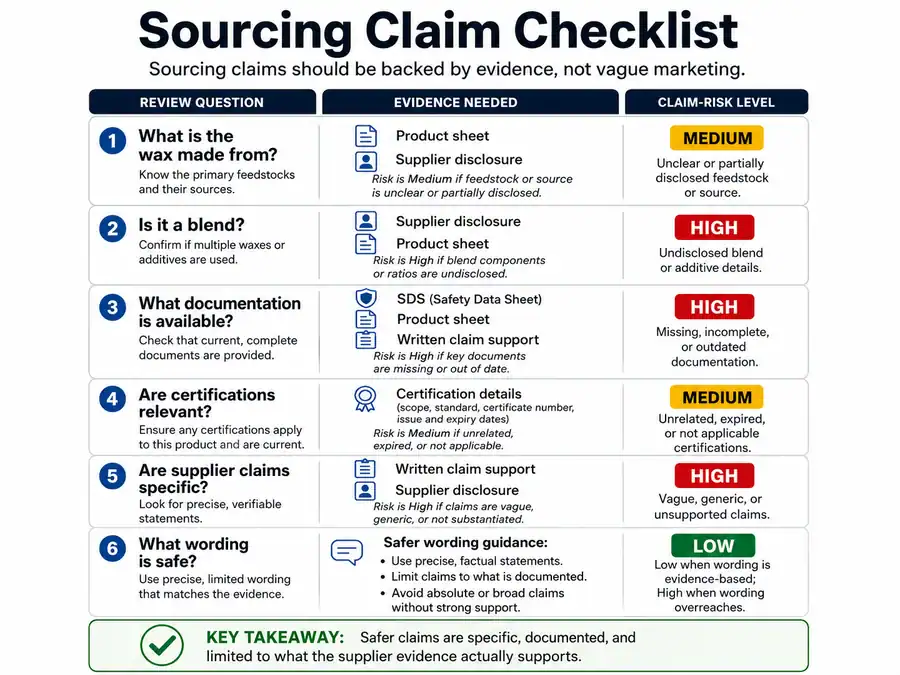
Neither coconut apricot wax nor soy wax is automatically more sustainable in every case. “Eco-friendly” means a sourcing and disclosure question supported by supplier documentation, formula clarity, certification relevance, and buyer standards.
Use these questions before making values-based wax claims.
| Sourcing question | Coconut apricot note | Soy note | Evidence to request | Claim risk |
|---|---|---|---|---|
| What is the wax made from? | A blend may include multiple wax inputs | Soy content can vary by formula | Product sheet or supplier disclosure | Medium |
| Is it a blend? | Often sold as a specialty blend | May be pure soy or a soy blend | Formula description | Medium |
| What documentation is available? | Check supplier documents | Check supplier documents | SDS and product sheet | Low |
| Are certifications relevant? | Depends on inputs and supplier | Depends on sourcing and supplier | Certification details, if claimed | High |
| Are supplier claims specific? | Broad claims need proof | Broad claims need proof | Written claim support | High |
| What claim is safe to make? | Keep wording narrow | Keep wording narrow | Claims review or label guidance | High |
Is coconut apricot wax more eco-friendly than soy wax? Not by name alone. Coconut, apricot, and soy sourcing claims vary by supplier, formula, region, and documentation.
Is soy wax sustainable for candles? Soy wax can support values-based positioning when the supplier provides sourcing evidence, but the word “sustainable” should not be treated as automatic.
What should you ask a wax supplier before making sustainability claims? Ask what the wax is made from, whether it is blended, what documents support the claim, whether certifications apply, and which wording the supplier can support.
For deeper sourcing review, use the ethical wax sourcing guide. For claim wording, use the candle label claims compliance guide. For supplier checks, use the wax supplier checklist.
Supplier Consistency and Availability
Availability means repeatable sourcing for your region and batch size, not guaranteed current stock.
Soy wax is often easier to source broadly, while coconut apricot wax may depend more on specialty suppliers and formula-specific availability.
Use this checklist before scaling a candle line.
| Supplier consistency question | Why it matters |
|---|---|
| Is the formula documented? | A formula change can affect scent, finish, and wick testing |
| Is the wax regularly stocked? | Repeat purchasing reduces production delays |
| Are SDS and product sheets available? | Documents support identity and claim review |
| Are use instructions stable? | Stable instructions help repeat pour and test results |
| Is there a backup wax? | A backup plan reduces disruption if supply changes |
Is soy wax easier to source than coconut apricot wax? Often, yes, because soy wax is widely available, but specific soy grades and blends still vary by supplier.
Should you choose a wax that is easier to replace? Choose easier replacement when repeat production, cost control, and batch planning matter more than a specialty wax story.
Can a new supplier batch change candle performance? Yes. A new batch, supplier, or formula can change finish, scent throw, adhesion, wick behavior, and cure results.
For supply planning, use the candle supply planning guide or small-batch production planning guide before building a vendor list.
Burn Performance and Safety-Adjacent Expectations
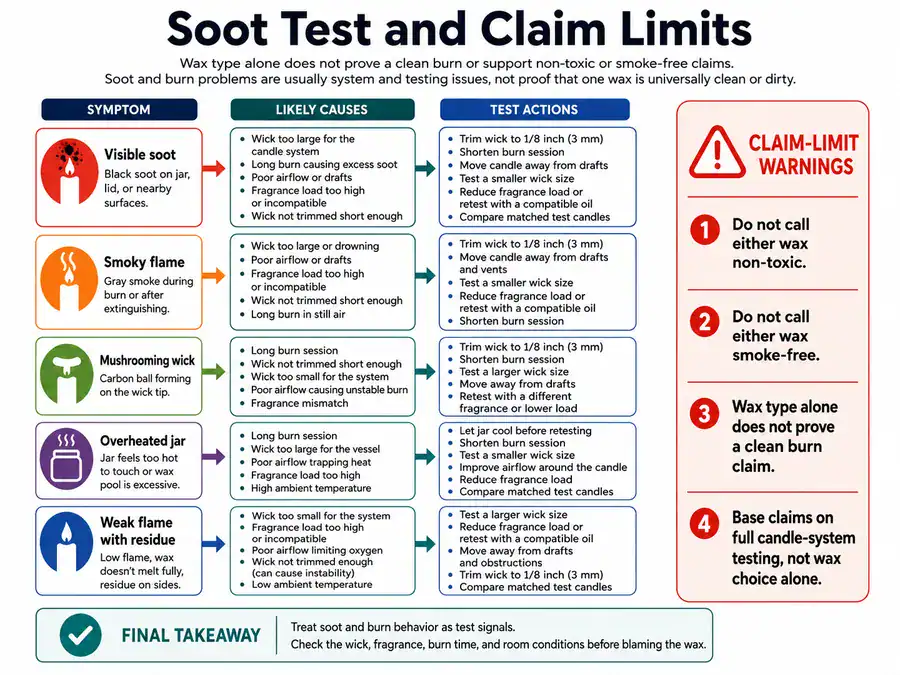
Wax type alone does not determine whether a candle soots.
Clean burn means lower visible soot under tested burn conditions. It does not mean non-toxic, smoke-free, health-safe, or legally compliant.
Soot and Clean-Burn Claims
Neither coconut apricot wax nor soy wax is automatically soot-free.
Visible soot depends on wax, wick, fragrance load, airflow, burn time, and candle maintenance. Coconut apricot wax and soy wax should be compared through the same jar, wick test range, fragrance load, cure window, and burn routine.
| Symptom | Likely cause | Wax relevance | Test action | Claim-risk note |
|---|---|---|---|---|
| Visible soot on jar | Wick too large, long burn, airflow, or fragrance mismatch | Wax may affect melt pool and flame behavior | Retest with a smaller wick or shorter burn cycle | Do not call either wax non-toxic |
| Smoky flame | Wick, draft, fragrance load, or poor trimming | Wax is only one part of the burn system | Trim wick and repeat the burn test | Do not imply smoke-free performance |
| Mushrooming wick | Wick and fragrance mismatch or long burn cycle | Wax can change how fuel reaches the flame | Compare wick families under equal burn time | Do not blame wax alone |
| Overheated jar | Wick too large or vessel mismatch | Wax softness may affect melt pool behavior | Stop test and retest the wick setup | Route safety questions to safety guidance |
| Weak flame with residue | Wick too small or poor fuel delivery | Wax formula can affect burn rate | Retest wick size and fragrance load | Do not turn soot notes into health claims |
Does coconut apricot wax burn cleaner than soy wax? Not automatically. Coconut apricot wax may perform well in a properly wicked premium container candle, but the wick, fragrance, airflow, and maintenance routine still control visible soot.
Does soy wax make soot? Soy wax candles can soot when the wick is too large, the fragrance load is poorly matched, the candle burns too long, or the wick is not trimmed.
Is clean-burning the same as non-toxic? No. In this comparison, clean-burning only means lower visible soot under proper candle testing and use.
How to compare soot fairly: pour both waxes in the same container, use the same fragrance load, cure them consistently, test controlled wick options, trim the wick before each burn, and record soot, flame height, mushrooming, jar heat, and scent after each cycle.
Use supplier SDS, candle safety guidance, and candle-care instructions when checking claim-sensitive wording. For deeper safety questions, use the candle safety guide. For maintenance, use the wick trimming guide. For claim language, use the candle label claims compliance guide. For wick changes, use the wick sizing by wax type guide.
Final Decision: Should You Choose Coconut Apricot Wax or Soy Wax?
Choose coconut apricot wax for premium finish and scent perception; choose soy wax for cost, availability, and scalable testing.
The best wax depends on the maker’s priority and test results. “Best” means best for a stated container-candle use case, not universally better for every candle format or every customer.
| Maker priority | Better first choice | Why | Test before committing |
|---|---|---|---|
| Stronger scent perception | Coconut apricot wax | Often chosen for richer scent impression in premium container candles | Hot throw and cold throw in the same jar |
| Lower usable cost | Soy wax | Often lower raw cost and easier to test in repeated batches | Finished-candle cost, not raw wax price only |
| Smooth premium finish | Coconut apricot wax | Often selected for smoother tops and customer-facing appearance | Surface quality after cure and storage |
| Broad sourcing | Soy wax | Usually easier to find across suppliers and regions | Supplier consistency and batch documentation |
| Beginner testing budget | Soy wax | Lower-cost testing can reduce pressure during early batches | Wick, scent, cure, and appearance notes |
| Specialty brand story | Coconut apricot wax | Can support boutique or premium positioning | Claim wording and supplier documentation |
| Warm-weather shipping | Test both | Formula and packaging matter more than name alone | Packed warm-storage or transit test |
| Lowest claim risk | Neither by name alone | Clean, natural, eco, and safety claims need support | Label and product-description review |
Choose coconut apricot wax if you want a premium-looking container candle, a softer specialty wax story, and strong scent perception after testing. It is the better first test when finish, shelf impression, and product positioning matter more than raw wax cost.
Choose soy wax if you want lower-cost testing, wider sourcing, familiar plant-based positioning, and easier batch planning. It is the better first test when repeatability, budget, and supplier flexibility matter more than a specialty wax identity.
Use the cost-per-candle calculation from the cost section before buying production quantities. A wax that costs less per pound can still cost more if it creates more failed tests, rejects, weak scent, or appearance problems.
Use the best wax for candles guide when you need a broader wax comparison. Use the beginner candle-making guide when the next step is a full first-candle process. Use the how to test candle wax guide before scaling either wax into a sellable line.