

In matched candle conditions, the candle wick that burns the longest is the one that uses wax most slowly while still burning properly, so there is no universal winner.
This page answers the wick-only duration question and routes full family comparisons, broader wick-testing steps, and wick-fix workflows to separate pages.
A candle wick is the part of a candle that pulls melted wax to the flame, so the comparison here is about wick behavior, not total candle lifespan. Here, “longest” means the longest useful burn a wick can produce when wax, vessel size, fragrance load, trim, and burn routine stay matched. Under those like-for-like conditions, a longer-burning result usually comes from a wick setup that feeds wax more slowly without starving the flame. A wick that seems to last longer because it tunnels, burns weakly, or leaves an unusable melt pool is not a valid winner.
What “burns the longest” means for candle wicks
For a candle wick, “burns the longest” means the longest useful burn the wick can deliver when the rest of the candle setup stays matched.
Inside Wick Types and Sizing, the candle wick is the variable being compared, not the candle as a whole. A candle wick is the fuel-delivery part that pulls melted wax to the flame, so the question is about wick behavior rather than total candle lifespan. Here, “longest” means the longest valid useful burn under matched conditions, not the safest wick, the cleanest wick, the hottest flame, or the best overall result.
That distinction matters because wick burn time and candle burn time are not the same claim. A candle can seem to last longer when the wick is weak, tunnels, or leaves wax behind, but that is not a valid long-burn win. Mixed comparisons can distort the answer too, because changing wax, vessel width, wick count, fragrance load, trim, or burn routine changes more than the wick.
| Term | Means here | Does not mean here |
| Longest | Longest valid useful burn from the wick variable in matched candles | Longest-lasting candle under any setup |
| Useful burn | A steady, workable burn that still performs correctly | A weak flame, tunneling burn, or a candle that only seems slow because it is underwicked |
| Matched conditions | Same wax system, vessel width, wick count, fragrance load, trim, and burn routine | Tests that mix jars, waxes, wick counts, or burn habits and still call the result fair |
The page stays narrow on purpose. If you are really comparing full candle lifespan, What Type of Candle Burns the Longest? answers that broader question. If you need a controlled process for proving one wick outlasts another, How to Burn Test Candle Wicks handles the testing side instead of folding that full process into this page.
Once the meaning is locked, wick family and material are the next variables that can change usable burn time.
Which wick types tend to burn longer under matched conditions?
Under matched candle conditions, cotton-based wicks often trend longer in useful burn than wood wicks, but no wick family wins in every setup.
Within Wick Types and Sizing, this comparison stays narrow on wick families under like-for-like candle conditions. Here, “longest” still means the longest useful burn, not the best crackle, the cleanest burn, or the best overall result.
In many matched container setups, cotton-based wick families tend to give a steadier longer useful burn than wood wicks, but that is a tendency, not a universal winner. Jar width, wax system, fragrance load, wick count, trim, and actual burn testing can flip the result.
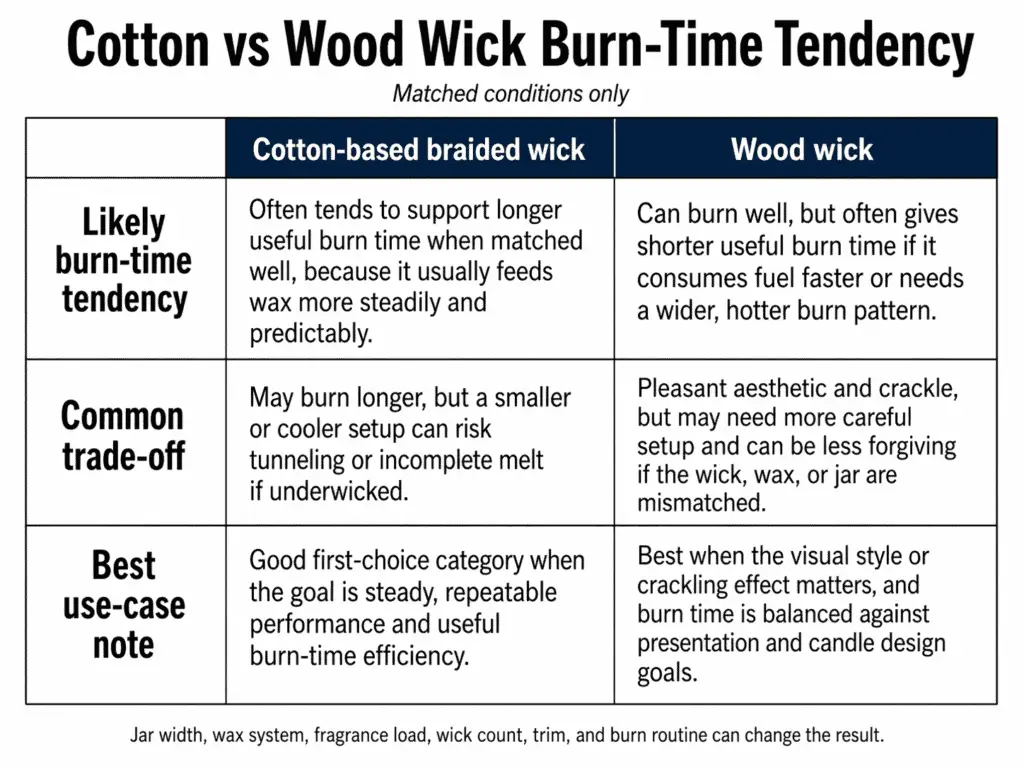
| Wick family | Likely burn-time tendency | Common trade-off | Best use-case note |
| Cotton-based braided wick | Often trends longer in useful burn when correctly sized | Can burn too hot or mushroom if oversized | Strong starting point when steady usable burn matters most |
| Wood wick | Can burn shorter or end early if the strip or setup is not matched well | Early extinguishing or uneven burn can cut usable hours | Best when the candle is built around wood-wick behavior rather than swapped in casually |
That is why family-level claims need named assumptions. Wood does not always burn longer than cotton, and cotton does not always win either. Keep the family claim small unless the candles stay matched and the testing stays fair.
For a wider family overview, What Are the Different Types of Candle Wicks? separates the main options before you narrow the choice by burn goal. For a tighter head-to-head, Cotton vs Wooden Wicks: Which Burns Better? belongs later in the decision path, once the candle conditions are truly comparable.
After family choice, wick size becomes the next lever because fuel draw can lengthen or shorten burn time even inside the same family.
Why wick size changes burn time
Wick size changes burn time because wick size changes how much melted wax reaches the flame over time.
A candle wick’s size is its working fuel-delivery strength, not just the label on the pack. When that strength goes up, the flame usually pulls and burns more wax, so burn time often gets shorter. When that strength goes down, the candle may seem to last longer, but that only counts if the burn still works well enough to make and hold a proper melt pool.
That is why Wick Types and Sizing matters so much to burn duration. A thicker or stronger wick usually burns faster because fuel draw rises with flame strength. A smaller or weaker wick can look like the longer-burning option, but that can be a false win when the candle tunnels, leaves wax on the sides, or gives a weak flame that never does the job properly.
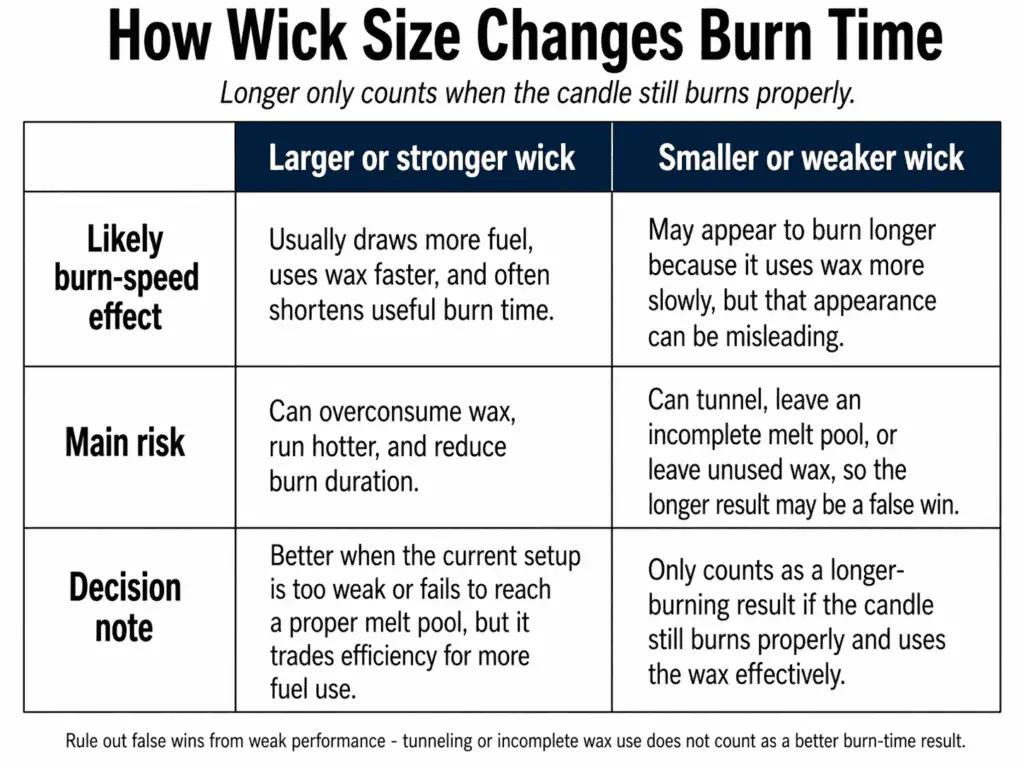
| Wick sizing direction | Likely burn-speed effect | Risk | Decision note |
| Larger or stronger wick | Faster wax use and shorter burn tendency | Hotter burn, faster melt, possible overburn | Use it when the candle needs more heat, not just when you want a longer burn |
| Smaller or weaker wick | Slower wax use and longer apparent burn tendency | Weak flame, tunneling, incomplete wax use | Count it as a win only when the candle still burns properly |
A quick way to judge the result is to watch for signs of excess or lack. If the flame is too forceful and the wax disappears too fast, the wick may be too strong. If the flame stays weak, the melt pool lags, or the candle tunnels, the wick may be too weak, which means the extra time is not a valid duration advantage.
When jar width becomes the main question, Wick Size Chart by Jar Diameter & Wax Type is the better place to sort exact sizing. When the real issue is a weak flame, drowning, or tunneling, Fixing Wick Issues: Mushrooming, Drowning & More handles the fault-finding side. If the burn goal changes with soy formulas, Best Wicks for Soy Candles (CD vs ECO vs LX Start-Points) is the narrower match.
The only fair way to compare long-burn claims after that is to hold the rest of the candle as steady as possible.
How to compare wick burn time fairly
A fair wick burn-time comparison changes the wick while keeping the rest of the candle setup as close to the same as possible.
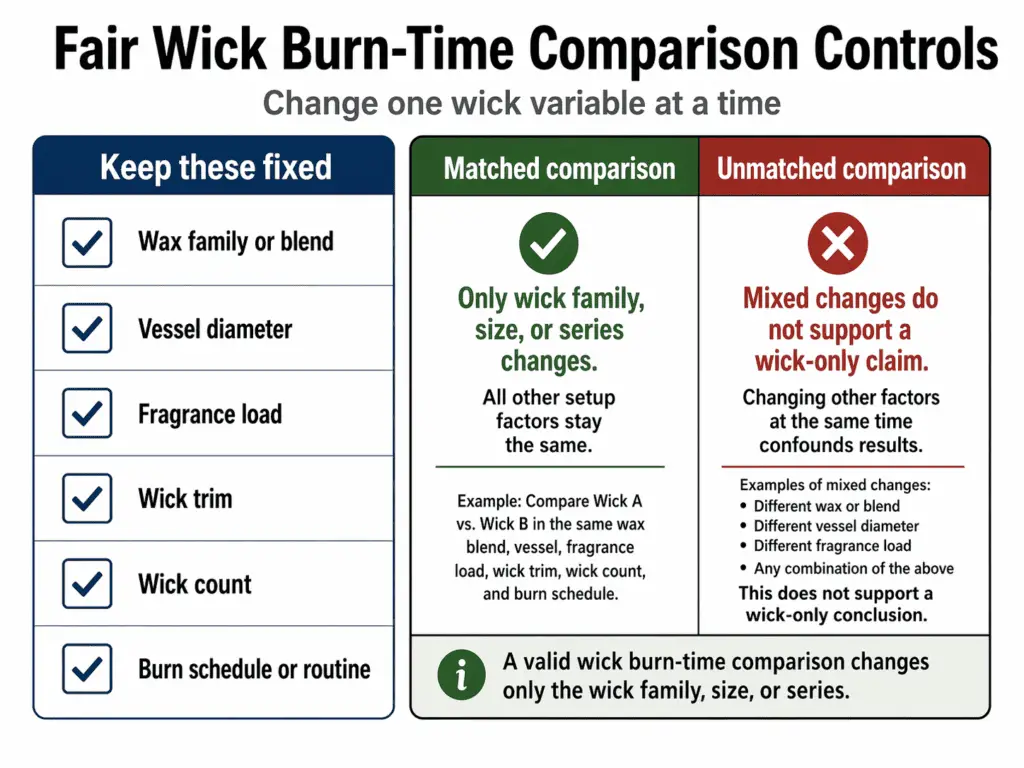
For this page, “longest” only counts after the non-wick variables stay controlled. If wax blend, vessel width, fragrance load, wick trim, wick count, or burn routine changes between tests, the result no longer shows what the wick alone did.
Use this section as a validity check, not a full testing workflow. Keep the candle system stable, change one wick variable at a time, and judge both burn duration and usable performance from the same kind of burn cycle.
Keep these items steady before trusting a longest-burn claim:
- wax family or blend
- vessel diameter
- fragrance load
- wick trim
- wick count
- burn schedule or routine
| Test type | What changed | What stayed the same | Does the result count? |
| Matched comparison | Wick family, size, or series only | Wax, jar width, fragrance load, trim, wick count, burn routine | Yes, this can support a wick claim |
| Unmatched comparison | Wick plus wax, jar, fragrance load, trim, or wick count | Not enough stayed fixed | No, this is a mixed result |
An anecdotal result does not count just because one candle lasted longer once. If the jar, wax, fragrance load, trim, or wick count changed, the extra time may come from the setup rather than the wick.
If you want the full testing routine, burn logs, and repeatable steps, How to Burn Test Candle Wicks is the better next page. If wax-led choices take over the question, Best Wicks for Soy Candles (CD vs ECO vs LX Start-Points) is the narrower route. If a result looks longer only because the candle tunnels or weakens, Fixing Wick Issues: Mushrooming, Drowning & More helps sort the false winner from a real one.
When tunneling creates a false long-burn winner
Tunneling can make a candle wick look longer-burning even when the result is invalid.
A candle wick can seem to last longer because it is underwicked and uses wax too slowly. When the melt pool stays weak or narrow, that extra time does not count as a real long-burn advantage.
Inside Wick Types and Sizing, this is an exception block, not a troubleshooting center. An underwicked candle may tunnel, leave wax on the sides, and burn slowly for the wrong reason, so “longest” still means the longest valid useful burn from a properly working wick.
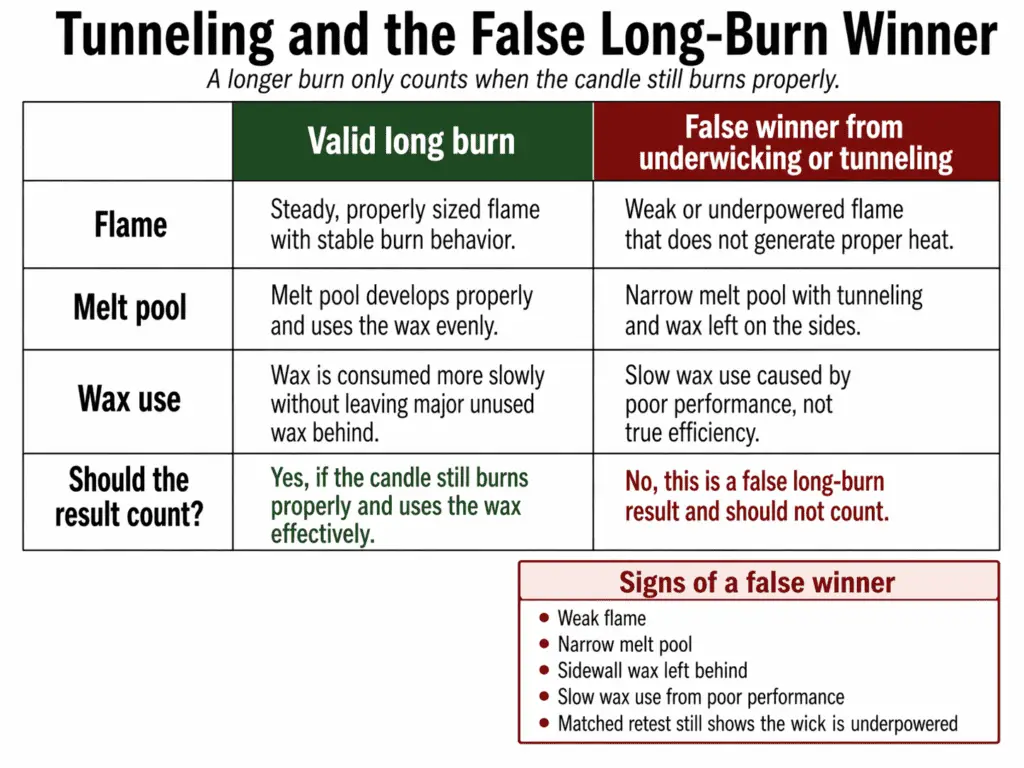
| Result | What you see | Should it count? |
| Valid long burn | steady flame, usable melt pool, balanced wax use | Yes |
| False winner from underwicking or tunneling | weak flame, narrow melt pool, sidewall wax left behind, slow wax use from poor performance | No |
A slow candle is not automatically a good long-burn result. If the wick preserves wax by failing to melt the candle properly, the comparison should be excluded rather than treated as a winner. That distinction keeps a weak result from beating a better wick only because it underperformed.
Count the result as invalid when these signs show up:
- the flame stays weak across repeated burns
- the melt pool does not catch up
- wax keeps building on the sides
- the candle lasts longer only because less wax is being used
- a matched retest still shows the wick is underpowered
If your main problem is fixing the candle rather than judging whether the test result counts, go to Fixing Wick Issues: Mushrooming, Drowning & More. If you need the full comparison routine, use How to Burn Test Candle Wicks. If the issue turns wax-specific, especially with soy, move to Best Wicks for Soy Candles (CD vs ECO vs LX Start-Points) instead of widening this page.