

For budgeting, a candle wick usually works out to cents per usable wick rather than a high per-unit expense, and the modeled examples on this page land at about €0.12 to €0.18 per wick before extras or multi-wick use.
A candle wick here means the purchasable wick component, not the finished candle. On this page, cost means wick purchase price, ready-to-use setup cost, or wick cost per candle, not full candle cost, profit, or burn quality. This is for readers who want a clear buying frame before they compare formats or do the math. The article moves in one line from baseline price range to price drivers to per-candle calculation.
What does a candle wick cost?
For budgeting, candle wick cost is usually measured in cents per usable wick rather than by full pack price, and the modeled examples on this page run from about €0.12 to €0.18 per wick before extras or double-wick use.
A candle wick here means the burn component sold as pre-tabbed units, prepared-cut lengths, or spool material. Within Wick Types and Sizing, the price question is narrower: cost means purchase price per wick, pack, or spool-derived unit estimate, not burn quality, troubleshooting, or full candle cost.
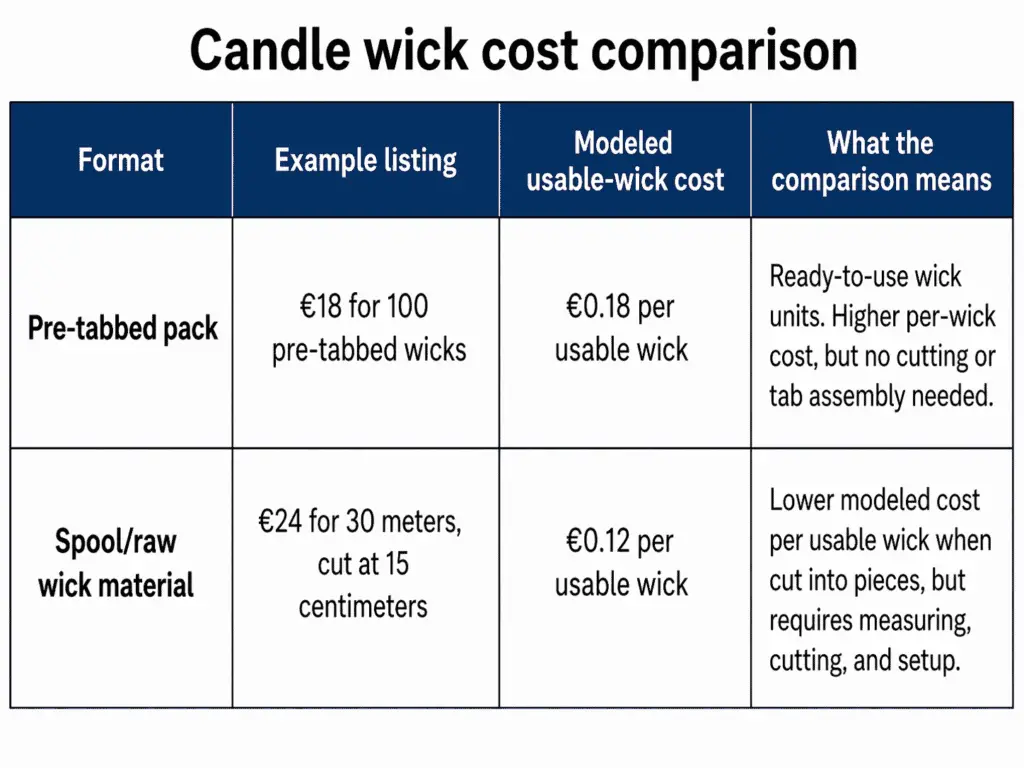
| Format | Example listing on this page | Modeled usable-wick cost | What the comparison means |
| Pre-tabbed pack | €18 for 100 pre-tabbed wicks | €0.18 per ready-to-use wick | Higher visible unit price, but setup is already included |
| Prepared-cut lengths | Listing-specific prepared lengths | Convert listing price to cost per usable wick after checking what is included | Comparable only after included parts and usable count are clear |
| Spool / raw wick material | €24 for 30 meters, cut at 15 centimeters | €0.12 per cut wick | Lower material cost in this model, but only after cut length is assumed |
Price note: this page uses modeled examples to show how wick pricing converts to usable-wick cost, not a fixed market rate. Supplier line, quantity tier, included tabs or clips, and your cut-length assumption can all change the final number.
If your real question is wick fit rather than wick price, move that decision to Wick size chart by jar diameter & wax type. If you need the full ingredient stack for one finished candle, use How much does it cost to make a candle?.
Once the format is normalized, the next useful question is which wick attributes actually move the price up or down.
Why candle wick prices vary
Candle wick prices vary because material, size, prep state, quantity, and extras change the true ready-to-use cost.
This is wick-only price logic, not a burn test, jar-matching chart, or troubleshooting page. Here, cost means price change caused by wick attributes or ready-to-use state, not stronger flame, better scent throw, or better business economics.
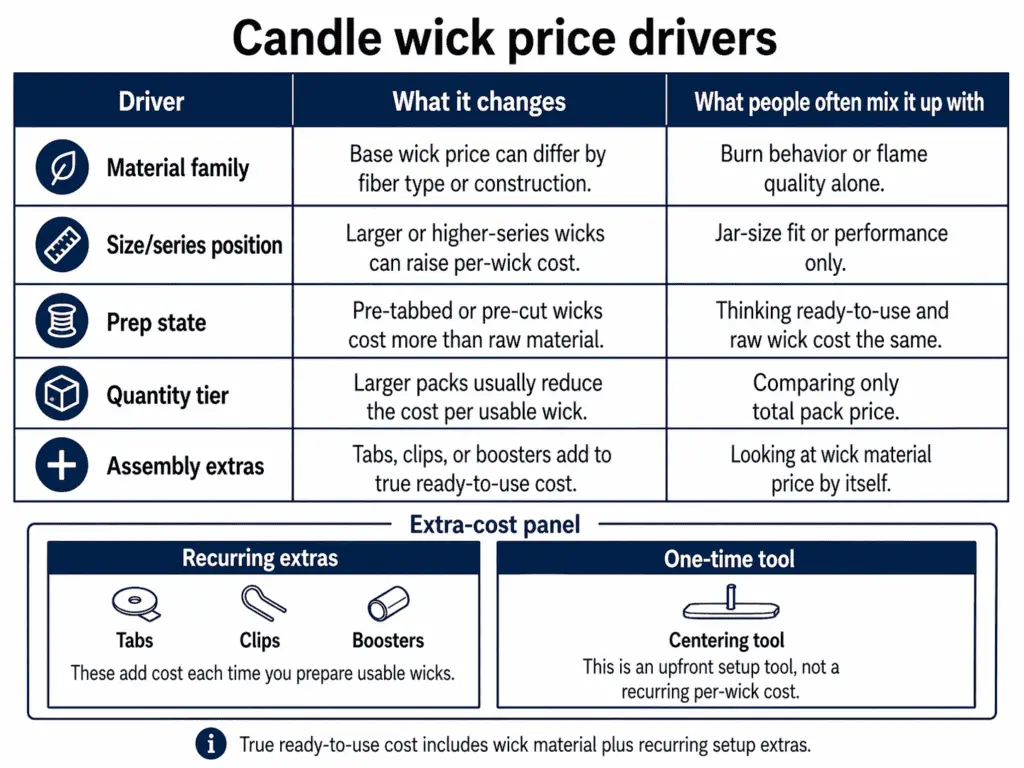
| Driver | What it changes | What people often mix it up with |
| Material family | Base purchase price and setup needs | Burn style or sound |
| Size / series position | Price tier inside a supplier line | A universal rule that bigger always costs more |
| Prep state | Ready-to-use cost | Burn quality |
| Quantity tier | Unit cost when order size rises | Automatic savings for every buyer |
| Assembly extras | True setup cost | Optional tools or unrelated equipment |
A thicker wick is not automatically more expensive in every supplier line, and a lower list price is not always the lower usable price. Material and size usually change the base listing first, while prep state, order size, and extras change what you really spend to get a wick ready for a candle.
Cotton vs wood vs specialty wick costs
Cotton, wood, and specialty options are purchase categories with different base-price and setup-cost patterns, so the cost comparison starts with what is included, not with how the candle might perform.
| Wick family | Usual price pattern | Extra setup to check | When the price gap matters most |
| Cotton | Often the baseline reference | Fewer special hardware needs | Small batches and standard container work |
| Wood | Often higher base or setup cost | Clips, boosters, or matched parts may matter | Buyers comparing ready-to-use setup, not just strip price |
| Specialty | Can sit above standard options | Construction details vary by line | Niche formats where the listing includes added parts or custom build |
If you want a performance-first comparison instead of a price-first one, read Cotton vs wooden wicks. If you are pricing wooden formats and need the hardware side spelled out, go to How to choose wood wick clip size and centering tools.
Pre-tabbed vs spool wick pricing
Pre-tabbed usually costs more per ready-to-use unit, while spool wick can look cheaper until cutting, tabbing, priming, or prep assumptions are counted.
| Format | What the list price shows | What the usable price must include | Usually suits |
| Pre-tabbed | A higher visible unit price | Convenience already built in | Beginners, testing, smaller runs |
| Spool / unprimed | Lower-level material cost | Cut length, tabbing, priming, and prep burden | Repeat use where prep time is already planned |
That is why sticker price alone is incomplete. If you need the prep side rather than the price trade-off, use Prep trim candle wicks.
Hidden extras that change true wick setup cost
Some wick listings exclude recurring extras such as tabs, clips, or boosters, so the ready-to-use cost can be higher than the wick listing suggests.
| Cost item | Count it as what | Why it matters |
| Tabs | Recurring extra | Needed again when you make more wicks |
| Clips | Recurring extra for some wood-wick setups | Changes the true ready-to-use price |
| Boosters | Recurring extra in some setups | Can raise setup cost beyond the wick strip itself |
| Centering tool | One-time tool | Useful, but not part of every wick’s recurring cost |
Recurring extras belong in the usable wick price, while one-time tools should stay separate. For process help, use Centering and securing wicks tools methods; if your question has shifted to full candle costing, return to How much does it cost to make a candle?.
If wick count depends on jar width or wax fit rather than price, use Wick size chart by jar diameter & wax type instead of forcing a sizing answer out of a pricing question.
After the driver chain is clear, the useful next step is turning one wick listing into cost for one actual candle.
How to calculate wick cost per candle
Per-candle wick cost equals wick unit cost multiplied by the number of wicks used in one candle, with a realistic waste allowance added.
Per-candle wick cost here means the wick component allocated to one finished candle under stated assumptions. It does not include wax, vessel, packaging, labor, freight, or margin, and a double-wick candle changes the math because it uses two wicks instead of one. Spool pricing only works after you choose a cut length, so the formula must start with either a ready-to-use wick count or a length-per-wick assumption.
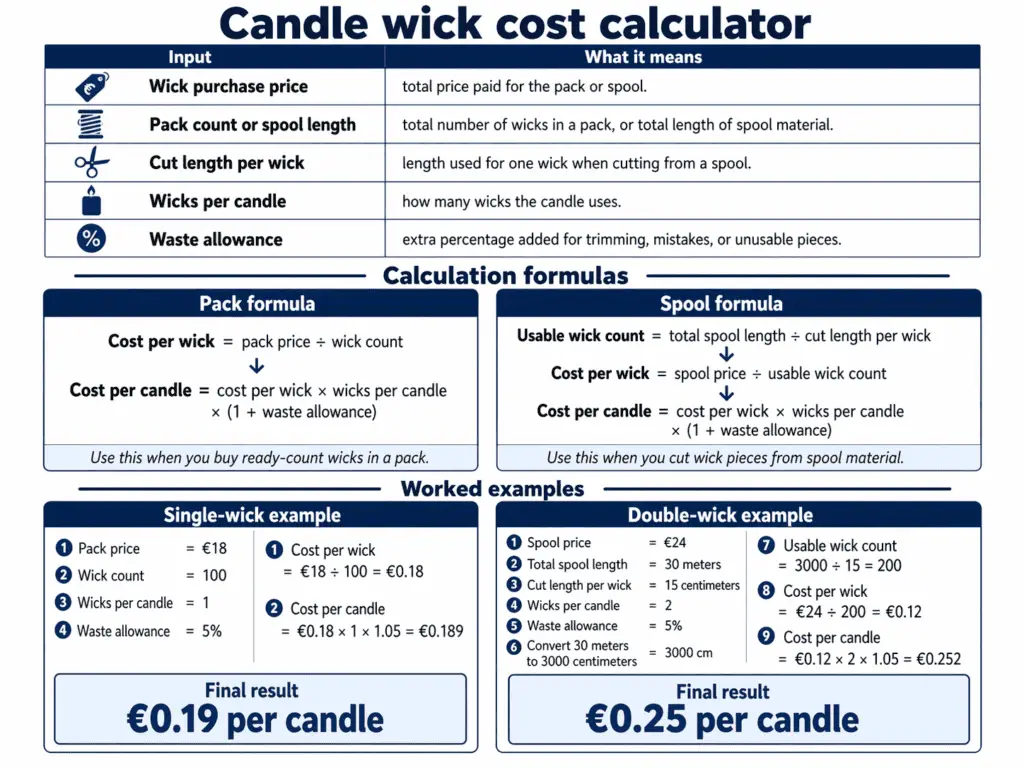
Wick cost calculator
| Input | What to enter |
| Wick purchase price | Total price for the pack or spool |
| Pack count or spool length | Number of ready-to-use wicks, or total wick length |
| Cut length per wick | Only for spool or length-based purchases |
| Wicks per candle | Usually 1 or 2 |
| Waste allowance | A small percent for trim, setup loss, or unusable pieces |
Pack formula
Cost per wick = pack price ÷ wick count
Cost per candle = cost per wick × wicks per candle × (1 + waste allowance)
Spool formula
Usable wick count = total spool length ÷ cut length per wick
Cost per wick = spool price ÷ usable wick count
Cost per candle = cost per wick × wicks per candle × (1 + waste allowance)
Method note: The examples below use modeled numbers to show the math in a repeatable way. Replace the price, wick count, cut length, and waste allowance with your own listing details before you budget a batch.
Single-wick example
A pack costs €18 and contains 100 pre-tabbed wicks. That gives a wick unit cost of €0.18. If one candle uses 1 wick and you add 5% waste, the wick cost per candle is:
€0.18 × 1 × 1.05 = €0.189, or about €0.19 per candle
Double-wick example
A spool costs €24 and contains 30 meters of wick. If each candle wick needs 15 centimeters, the spool yields 200 usable cuts, so the wick unit cost is €24 ÷ 200 = €0.12. If one candle uses 2 wicks and you add 5% waste, the wick cost per candle is:
€0.12 × 2 × 1.05 = €0.252, or about €0.25 per candle
The two examples show the main places people misread wick math: double-wick vessels raise wick cost because wick count rises, and spool listings need a length assumption before the price means anything at candle level.
When bulk buying actually lowers wick cost
Bulk wick buying lowers unit cost only when expected usage is high enough to justify the larger order size and upfront spend.
Here, bulk savings means a lower wick unit price from a higher quantity tier. It does not mean lower freight, better storage economics, or better profit by itself, and MOQ simply means the seller sets a minimum order quantity before you can access that lower tier.
| Order tier | Unit cost | Who it usually fits | Main trade-off |
| Small pack | €0.18 per wick | Testing, hobby batches, lighter usage | Higher unit cost, lower cash commitment |
| Mid pack | €0.14 per wick | Repeat small-batch making | Better unit price, more upfront spend |
| Bulk pack | €0.12 per wick | Steady use over many candles | Lowest unit price, highest quantity commitment |
A lower unit price matters only when you will actually use enough wicks for the bigger pack to earn its keep. If your usage is light or irregular, the cheapest-looking bulk tier may only move cash forward without changing your real per-candle planning in a useful way.
If your question has shifted from wick-only math to total product math, go to How much does it cost to make a candle? If you need a fuller worksheet for business costing, use Candle cost of goods calculator / template. If wick count depends on jar width rather than price, use Wick size chart by jar diameter & wax type. If you need freight, MOQ, or quote-level sourcing analysis, use Compare candle supplier quotes unit price freight MOQ landed cost.