
For standard wax candles, purpose-made candle wicks, pre-waxed cotton wicks, braided cotton wicks, and untreated natural cotton are the lowest-uncertainty wick materials; household substitutes only qualify when known, untreated, natural, absorbent, structured, and preferably primed.
Here, “can be used” means suitable for standard wax-candle wick screening, not certified product safety, oil-lamp use, or a complete wick-making process.
A candle wick is the fuel-delivery strand that draws melted wax upward to the flame by capillary action. A material that catches fire is not automatically a wick because the flame must burn wax, not just consume the substitute. Sort materials into recommended, possible-only-if, and avoid before trying a household string, cord, or yarn. When the fiber type, coating, dye, or burn behavior is unknown, choose a purpose-made wick rather than improvising.
What Can Be Used as a Candle Wick?
The lowest-uncertainty candle wick materials are purpose-made candle wicks, pre-waxed cotton wicks, braided cotton wicks, and screened untreated natural cotton.
A candle wick is a wax-feeding component, so “used” means the material can draw melted wax, support a stable flame, and avoid obvious melting or treatment risks. Some household materials can qualify, but only when the fiber is known, untreated, natural, absorbent, structured, and preferably primed. After you choose a material, choose the right wick size, meaning match the wick to the candle shape and wax setup, instead of treating material choice as the whole setup.
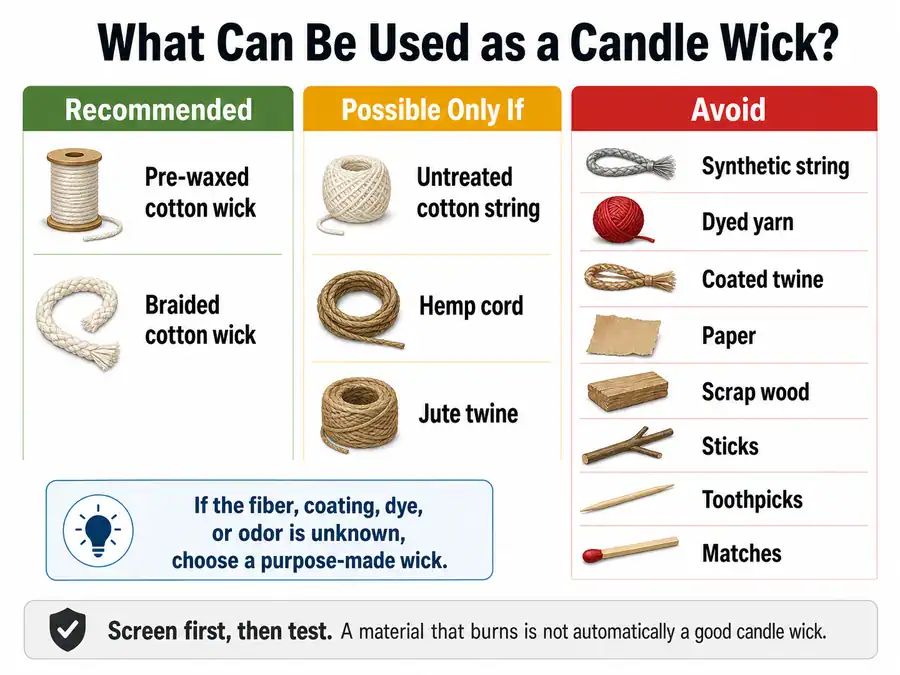
Use these categories before trying a substitute:
- Recommended: pre-waxed cotton wick, braided cotton wick, purpose-made wooden wick, screened untreated cotton string.
- Possible only if: hemp cord, jute twine, or natural yarn with known fiber content, no dye, no coating, and enough structure to hold together.
- Avoid: synthetic string, dyed yarn, coated twine, unknown cord, paper as a standard wick, scrap wood, sticks, toothpicks, and matches.
If a possible-only-if material passes the basic screen, use controlled wick testing before relying on it in a finished candle. If the material needs waxing or stiffening first, save the full priming process for how to make a candle wick rather than turning this material check into a full wick-making tutorial. When the fiber type is unknown, the substitute melts, the flame jumps, the cord burns away, or the candle gives off a strange odor, use a proper wick instead.
The Difference Between Something That Burns and Something That Works as a Wick
A candle wick is not just something that burns; it must draw melted wax to the flame so the wax can fuel the candle.
Paper or synthetic cord may ignite, but ignition alone does not make either material a reliable wick. “Works” means the material feeds wax upward, keeps enough structure to burn predictably, and lets the wax become the main fuel instead of the substitute simply consuming itself. This is why a cotton wick can feed wax while paper may flare, char, weaken, or go out.
| Test question | Something that burns | Something that works as a wick |
|---|---|---|
| What happens first? | It catches fire or chars. | It absorbs melted wax. |
| What fuels the flame? | The material itself may burn away. | Melted wax feeds the flame. |
| What happens over time? | It may smoke, melt, collapse, or go out. | It stays structured long enough for a steadier flame. |
| Best example | Paper, treated fiber, or synthetic cord. | Cotton wick or screened natural-fiber cord. |
This distinction matters before any material list because a candle substitute can look promising for a few seconds and still fail the wax-feeding job. A simple way to judge it is to ask whether the material keeps pulling wax after the first flame, not whether it lights quickly. For practical validation, use controlled wick testing rather than guessing from ignition alone.
This comparison is based on three observable checks: ignition, wax feed, and burn stability. It is not a laboratory safety certification, and it should not be used to rank regulated candle products or replace broader candle safety precautions.
Candle Wick Material Decision Table
Use untreated cotton or purpose-made candle wicks first; treat household substitutes as possible-only-if materials only when their fiber, treatment, structure, and priming status are known.
This table is a decision aid, not a guarantee that every listed candle wick material will work in every candle. “Best” means lowest uncertainty for beginner wick function, not universal fit for every wax, vessel, fragrance load, or candle design. Standard candle use requires a lower-uncertainty material, while emergency-only options still need screening and should not be treated as finished-candle approval.
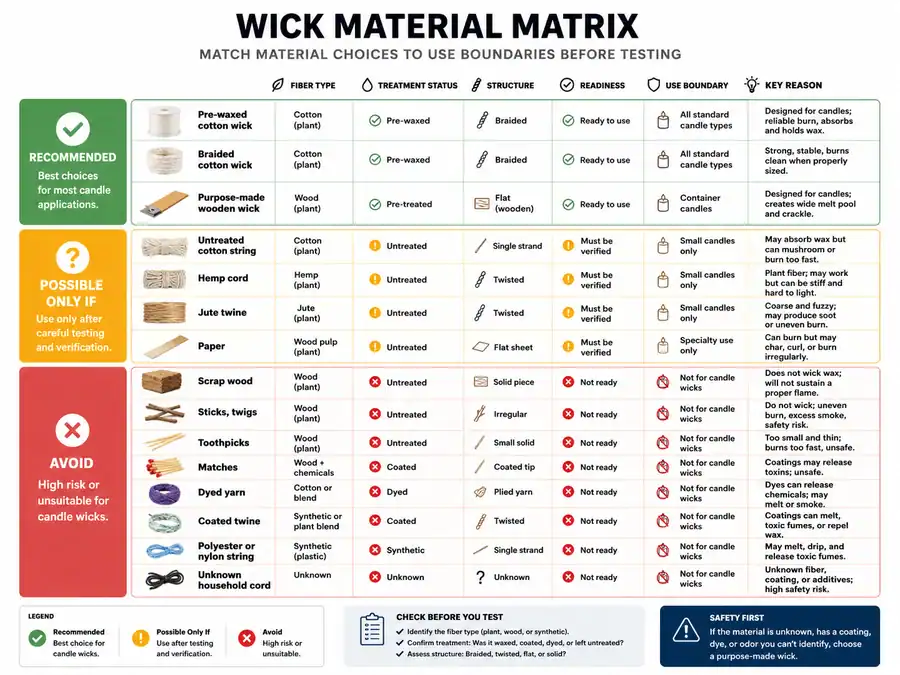
| Material | Fiber type | Treatment status | Structure or readiness | Use boundary | Recommendation | Why | Bridge target |
|---|---|---|---|---|---|---|---|
| Pre-waxed cotton wick | Natural cotton | Pre-waxed | Primed and often pre-tabbed | Standard candle use | Recommended | It is made to feed wax with lower uncertainty. | purpose-made candle wicks |
| Untreated cotton string | Natural cotton | Untreated | Must be screened and usually primed | Standard use only after screening; emergency only if no proper wick is available | Possible-only-if | Cotton can wick wax, but household string is less predictable. | controlled wick testing |
| Braided cotton cord | Natural cotton | Untreated or pre-waxed | Braided | Standard use if candle-intended; screened use if household cord | Recommended if candle-intended; possible-only-if if household cord | Braiding improves structure and wax flow. | choose the right wick size |
| Hemp cord | Natural fiber | Must be verified | Twisted or braided | Possible-only-if; not a default standard wick | Possible-only-if | Hemp may work only when untreated and wax-feed behavior is checked. | Wick testing |
| Jute twine | Natural fiber | Must be verified | Often rough or loose | Possible-only-if; not a default standard wick | Possible-only-if | Jute may burn unevenly if loose, treated, or poorly primed. | How-to-make-wick |
| Paper or paper towel | Paper | Usually untreated, but weak | Weak and fast-burning | Emergency ignition only; avoid for standard candles | Avoid as a standard wick | It may ignite but usually lacks stable wax-feed structure. | Safety |
| Purpose-made wooden wick | Wood | Candle-intended | Prepared strip with clip needs | Standard candle use when made for candles | Recommended when designed for candles | It is a manufactured wick type, not random wood. | wooden wick setup and troubleshooting |
| Scrap wood or sticks | Wood | Unknown | Unprepared and unstable | Avoid | Avoid | Random wood is not the same as a prepared wooden wick. | Safety |
| Dyed yarn | Natural, synthetic, or blend | Dyed | Unknown | Avoid | Avoid | Dye and fiber blends add uncertainty. | Safety |
| Coated twine | Natural or synthetic | Coated | Unknown | Avoid | Avoid | Coatings can change burn behavior and odor. | Safety |
| Polyester or nylon string | Synthetic | Synthetic | May melt or deform | Avoid | Avoid | Synthetic fibers are not candle wick substitutes. | Safety |
| Unknown household cord | Unknown | Unknown | Unknown | Avoid | Avoid | Unknown fiber and treatment status make the outcome too uncertain. | Wick buying |
This table is modeled from wick-function criteria: fiber type, treatment status, structure, priming readiness, ignition behavior, flame stability, visible smoke or melting risk, and recommendation category. It is not laboratory-tested data or a substitute for full candle testing.
For size selection after choosing a material, use the wick sizing guide. For controlled burn validation, use the wick testing guide. For prepared wood-strip candles, use the wooden wicks guide rather than treating scrap wood as a substitute.
Why Cotton Is Usually the Best Candle Wick Material
Cotton is usually the best candle wick material because it absorbs melted wax, holds structure, and burns more predictably than most household substitutes.
Here, “best” means lowest uncertainty for basic wick function, not the correct size, safest certified product, or universal match for every wax and container. In candle use, “cotton” means untreated natural cotton fiber that can absorb wax; it does not mean dyed, coated, synthetic-blend, or decorative cotton-like cord. Cotton fibers support capillary action, which is the wick’s ability to pull melted wax upward toward the flame. Can cotton string be used as a candle wick? Yes, but only if it is untreated, natural, structured, and preferably primed.
| Cotton option | Best use | Main advantage | Main caution |
|---|---|---|---|
| Untreated cotton string | Possible household substitute | Can absorb wax when screened and primed | Loose or decorative string may burn away too fast |
| Braided cotton wick | Better DIY or candle-making option | Holds shape better than loose cotton | Still needs the right diameter for the candle |
| Pre-waxed cotton wick | Lowest-uncertainty beginner option | Already primed for candle use | Still must match the candle size and wax setup |
Is pre-waxed cotton better? Yes, because it reduces uncertainty and is ready for candle use without a separate priming step. Is cotton yarn safe? Only when the fiber is truly natural cotton, untreated, absorbent, and not blended with synthetic material. For the full priming process, use the how to make a candle wick guide. For matching cotton wick size to a candle, use the wick sizing guide. When the material label is unclear or the string looks decorative, a ready-made option from a wick buying guide is the safer decision.
Can You Use String, Twine, or Yarn as a Candle Wick?
You can use string, twine, or yarn as a candle wick only when it is untreated natural fiber and can absorb wax.
Many household strings are synthetic, coated, dyed, blended, or made for crafts, so the material label matters more than the shape. In this section, “string” and “yarn” mean untreated natural-fiber materials, not polyester, nylon, acrylic, elastic, plastic-coated, craft-waxed, or decorative cord. Use the household-material checklist below before trying any household cord.
| Material | Pass or fail? | Why |
|---|---|---|
| Cotton string | Pass only if untreated, natural, structured, and ready to prime | It can absorb wax when the fiber and structure are suitable |
| Jute twine | Pass only if untreated and uncoated | Some twine is coated or too rough to feed wax evenly |
| Hemp cord | Pass only if untreated natural hemp | Natural does not automatically mean candle-safe |
| Natural yarn | Pass only if natural, untreated, and absorbent | Loose yarn may collapse or burn away |
| Sewing thread | Usually fail | It is often too thin, treated, or poorly structured for candle use |
| Coated twine | Fail | Coatings can change burn behavior, odor, and smoke |
| Unknown cord | Fail | Unknown fiber content makes the burn too unpredictable |
Can yarn be used as a candle wick? Only if it is natural, untreated, and absorbent. Can sewing thread be used? It is generally not recommended because it is often too thin or treated. Can twine be used? Only if it is untreated natural jute, hemp, or cotton and not coated.
If a string wick smokes, melts, smells bad, burns away before the wax melts, or dies before wax feeds the flame, the likely cause is synthetic fiber, coating, dye, poor absorbency, or no priming. For a full test burn process, use the wick testing guide. For waxing or priming string, use the how to make a candle wick guide instead of turning this section into a full wick-making process.
Why Synthetic, Dyed, Treated, Glued, or Coated Fibers Should Be Avoided
Do not use synthetic string, yarn, elastic, nylon, polyester, acrylic, polypropylene, or plastic-coated cord as a candle wick substitute.
In this article, “string” and “yarn” mean untreated natural fiber only. Synthetic fibers are poor candle wick substitutes because they may melt, smell, smoke, fail to absorb wax, or lose structure before melted wax can feed the flame. If the fiber content is unknown, treat the cord as synthetic risk and use a wick buying guide instead of guessing.
Failure signs that mean the material should be rejected:
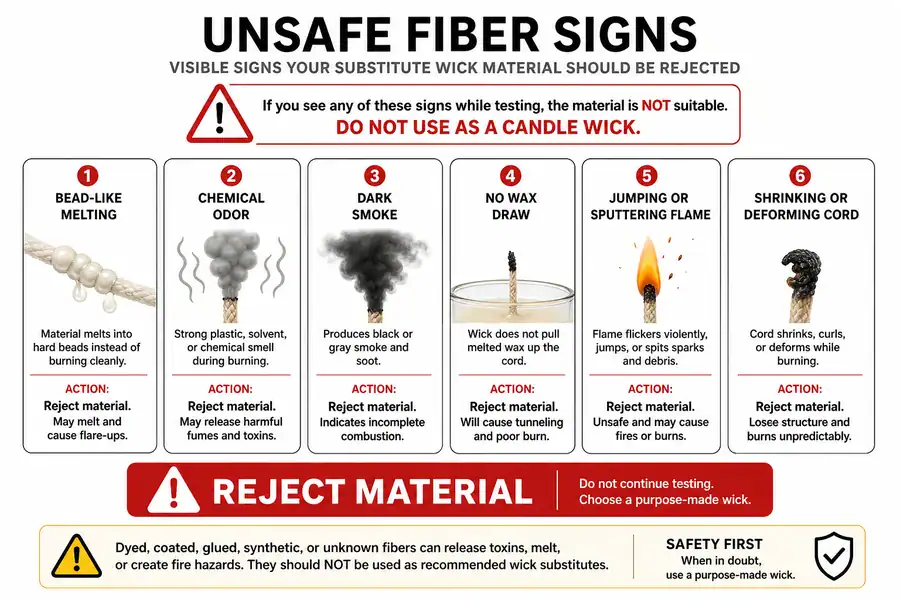
- bead-like melting on the fiber
- chemical odor when heated
- dark smoke from the substitute
- wick does not draw wax upward
- flame jumps, sputters, or collapses
- cord shrinks, hardens, or deforms near the flame
Dyed, treated, glued, coated, or unknown fibers should not be used as recommended candle wick substitutes. Proper candle-wax priming is different from unknown household coatings, craft finishes, glue, dye, or flame-retardant treatment. In this section, “treated” means dyed, coated, glued, chemically finished, flame-retardant, craft-waxed, or otherwise altered in a way that changes burn behavior. If the treatment status is unknown, choose a purpose-made wick.
| Failure sign | Likely issue | Better action |
|---|---|---|
| Bad smell | Dye, coating, glue, finish, or unknown additive | Reject the material |
| Black smoke | Treated fiber or poor wax feed | Reject the material |
| Sputtering flame | Coating, weak structure, or unstable wax feed | Reject the material |
| Sticky or hard residue | Glue, craft finish, or unknown coating | Reject the material |
| Wick burns away before wax melts | Poor absorbency or no priming | Screen again or reject |
Can dyed string be used as a candle wick? No, not as a recommended wick substitute. Can coated twine be used? No, because unknown coatings raise the risk of odor, smoke, residue, and unstable burning. Is waxed craft cord the same as a primed wick? No; candle-wax priming means the wick is coated with plain candle wax for candle use, while craft wax or coating may serve a different purpose.
Washing treated string does not reliably make it suitable because the fiber, dye, finish, or coating history may still be unknown. For broader burn precautions, use the candle safety guide. For burn validation after a material passes fiber and treatment screening, use the wick testing guide.
This failure log is based on visible screening signs: odor, smoke, flame stability, residue, melting, and wax-feed behavior. It is practical rejection logic, not chemical analysis or a safety certification.
Does a Substitute Wick Need to Be Waxed First?
Most substitute wick materials should be waxed or primed before candle use so they ignite and feed wax more predictably.
Priming means coating the wick material with candle wax before use. A dry cotton string, hemp cord, jute twine, or loose natural fiber may light at first, but it can burn away before melted wax feeds the flame. Many commercial wicks are pre-waxed, while DIY substitutes often need priming because they are not ready to use as candle wicks straight from a drawer or craft bin.
Priming helps a substitute wick by giving it:
- easier ignition
- better wax flow
- less early burn-away
- a steadier first burn
- a straighter shape while the wax starts melting
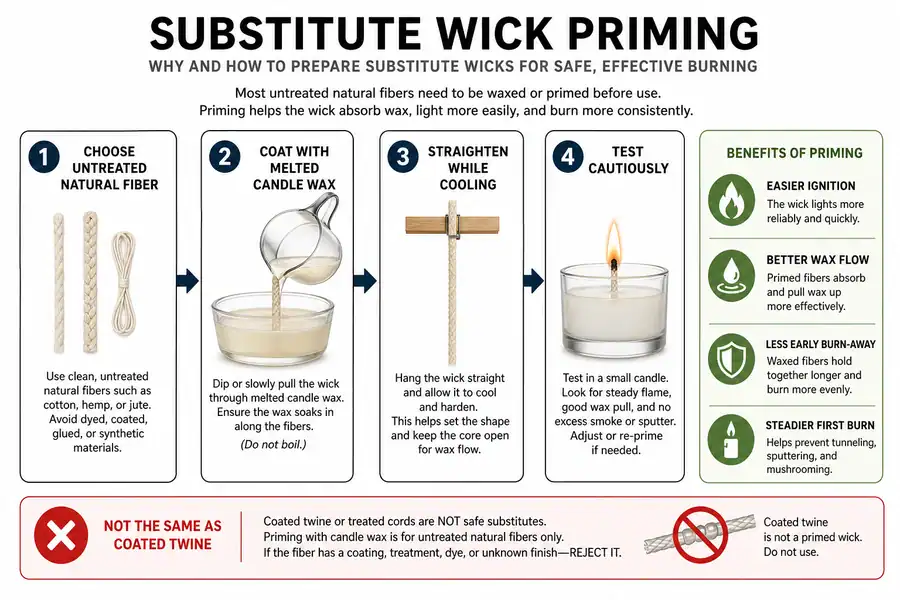
Keep the process limited to a readiness check:
- Choose untreated natural fiber.
- Coat it with melted candle wax.
- Straighten it while it cools.
- Test cautiously before using it in a candle.
Dry string may work poorly because it can burn itself faster than it feeds wax. Coated twine is not the same as a primed wick because unknown coatings, craft finishes, glue, or dye can change the burn. For the full priming process, use how to make a candle wick; for validation after priming, use the wick testing guide.
This readiness check uses observable wick behavior: ignition, wax flow, early burn-away, flame stability, visible smoke, and odor. It is a practical screening method, not a product safety certification.
Why Absorbency and Structure Matter for a Candle Wick
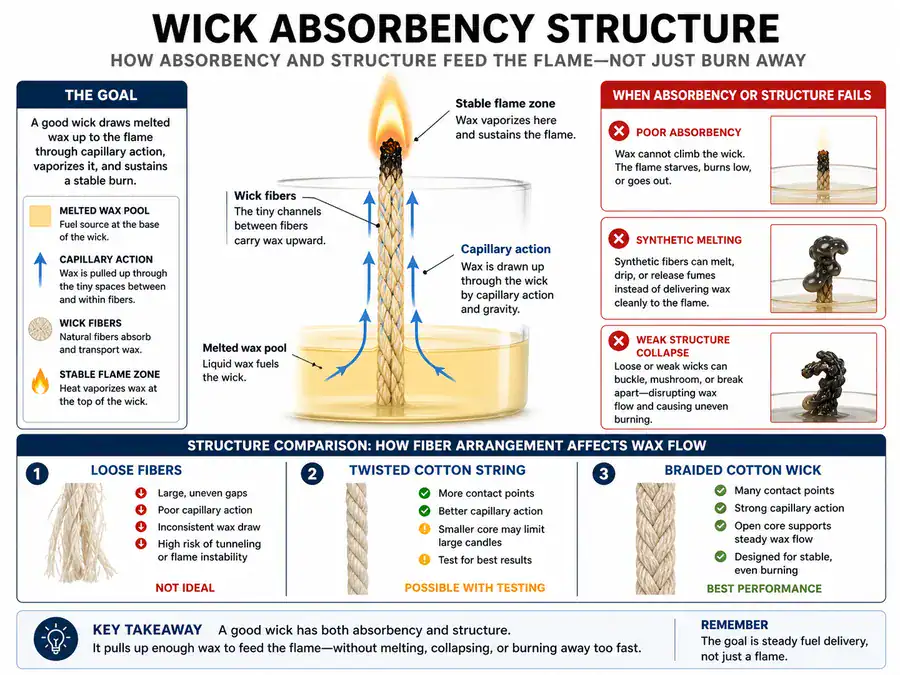
Absorbency matters because a candle wick must pull melted wax to the flame so wax, not just the wick material, fuels the candle.
Capillary action is the movement of melted wax through tiny spaces in the wick fibers. This is how a candle wick works: heat melts nearby wax, the wick draws that liquid wax upward, and wax vapor helps sustain the flame. A material “works” only when it feeds melted wax and supports a stable candle flame, not when it briefly ignites.
| Symptom | Likely cause | Action |
|---|---|---|
| The wick burns but the wax barely melts | The material is burning itself instead of feeding wax | Reject the material or test a better natural fiber |
| The flame goes out quickly | Poor absorbency or no priming | Prime the material and use the wick testing guide |
| The material melts or shrinks | Synthetic fiber or plastic blend | Reject it |
| The wick smokes heavily | Treated fiber, coating, dye, or poor wax flow | Reject it |
| The flame is weak after lighting | Wick may be too small, poorly primed, or poorly structured | Check material first, then use the wick sizing guide |
| The material chars and collapses | Weak structure or poor wax movement | Use a braided or purpose-made wick |
Cotton and purpose-made wick fibers are more predictable because they absorb wax and hold enough structure for the flame to keep feeding. Synthetic cord may fail because it can melt instead of wicking. Paper may light quickly, but it often burns without stable wax feed.
Structure also matters because a wick needs to stay intact while feeding melted wax to the flame. Braided or twisted wick structures usually perform better than loose fibers because they hold together and move wax more predictably. Here, “better” means more predictable wax flow and flame behavior for candle use, not a universal match for every wax, candle size, or container.
| Wick structure | Wax-feed reliability | Flame stability | Common failure sign | Better action |
|---|---|---|---|---|
| Loose cotton fibers | Low | Low | Fibers collapse or burn away | Do not use loose fiber as a finished wick |
| Twisted cotton string | Medium if untreated and primed | Medium | String leans, curls, or burns unevenly | Screen, prime, and test before use |
| Braided cotton wick | Higher | Higher | May still be too small or too large | Match the wick to the candle setup |
| Natural yarn | Variable | Low to medium | Loose strands separate or smoke | Use only if natural, untreated, and structured |
| Coated or synthetic cord | Avoid | Avoid | Melting, odor, or smoke | Reject the material |
A wick must hold enough shape to stay upright, keep contact with melted wax, and avoid collapsing into the melt pool. Loose fiber may ignite, but it often lacks the structure needed for steady wax delivery. Twisted cotton string can work as a screened substitute, while braided cotton is usually more reliable because the fibers support one another during burning.
For size-specific choices after the material passes screening, use the wick sizing guide. For commercial braid categories, flat wicks, square wicks, or other purpose-made formats, use the candle wick types guide instead of turning this material check into a full wick taxonomy.
Use this comparison as practical screening based on fiber structure, wax-feed behavior, flame stability, visible smoke, and whether the material stays intact. The ratings are not lab results, brand rankings, or proof that one wick structure fits every candle.
What “Safe” Means for Wick Substitutes
“Safe” wick substitutes are lower-uncertainty materials for basic candle-use screening, not certified, legally guaranteed, toxicology-tested, or risk-free materials.
Safer wick substitutes are untreated natural fibers that can absorb wax; synthetic, treated, coated, unknown, or unstable materials should be avoided. A natural material is not automatically safe because it can still be dyed, coated, chemically treated, too loose, or unable to feed melted wax.
Use this safety boundary as a conservative screen: pre-waxed cotton wicks and braided cotton wicks carry the lowest uncertainty, untreated natural strings are possible-only-if materials, and synthetic, dyed, coated, unknown, paper, or scrap-wood substitutes should be rejected for standard candle use.
Use the candle safety guide for broader burn precautions around uncertain materials. Use the wick testing guide when a screened material needs burn validation. Use the wick buying guide when the material fails any safety screen or when the candle needs a predictable result.
This safety boundary is based on material identity, treatment status, absorbency, structure, and visible burn behavior. It does not replace full candle testing, product standards, or local safety rules.
Quick Household-Material Checklist
Before using a household material as a candle wick, check that it is known, untreated, natural, absorbent, structured, and able to be primed.
Passing this checklist does not certify the material or replace a controlled wick test. “Safe enough” means the material passes basic screening for candle-wick use and still needs cautious validation before it goes into a finished candle. If a material fails any check, move it to avoid or use the purpose-made wick buying guide instead.
| Check item | Pass condition | Fail condition | Action |
|---|---|---|---|
| Fiber content | The label or source confirms natural cotton, hemp, or jute. | The fiber is unknown or blended. | Avoid or buy a proper wick. |
| Synthetic risk | The material is not polyester, nylon, acrylic, elastic, or plastic-based. | It may melt, shrink, bead, or smell when heated. | Avoid. |
| Treatment status | The material is untreated, undyed, unglued, and uncoated. | It is dyed, coated, craft-waxed, glued, or finished. | Avoid. |
| Absorbency | It can take up melted candle wax. | Wax sits on the surface or runs off. | Avoid or choose a better natural fiber. |
| Structure | The material is twisted, braided, or firm enough to hold together. | It is loose, fuzzy, weak, or collapses easily. | Avoid. |
| Priming readiness | It can be coated with candle wax before use. | It resists wax or cannot stay straight after waxing. | Avoid. |
| Early failure signs | No melting, bad odor, heavy smoke, sputtering, or fast burn-away appears in a cautious check. | Any failure sign appears. | Stop using it. |
| Next step | The material passes all checks. | One or more checks fail. | Test first or buy a proper wick. |
For a passed household substitute, use the wick testing guide before relying on it. For natural-fiber priming basics, use how to make a candle wick without turning the screening step into a full wick-making process.
Use this checklist as a screening tool based on fiber identity, treatment status, absorbency, structure, priming readiness, and visible failure signs. It is not lab testing, product certification, or a full candle safety test.
What Can You Use as an Emergency Candle Wick?
Untreated cotton string is the most reasonable emergency candle wick substitute, but only for cautious short-term use when a proper wick is unavailable.
An emergency means a temporary candle-wick replacement situation, not permission to use random flammable objects. The substitute still has to be material-screened, able to absorb wax, and free from obvious failure signs. For a reliable replacement, use the wick buying guide when the material is uncertain.
| Emergency option | Use cautiously or avoid? | Condition |
|---|---|---|
| Untreated cotton string | Use cautiously | Only when fiber content is known and the string can be primed. |
| Clean cotton shoelace | Use cautiously | Only if it is known untreated natural cotton. |
| Untreated hemp cord | Use cautiously | Only if it is untreated, natural, and candle-relevant. |
| Untreated jute twine | Use cautiously | Only if it is uncoated and structured enough to hold together. |
| Paper or paper towel | Avoid as a standard wick | It may burn, but it is not a reliable wick. |
| Match or toothpick | Avoid | These are not equivalent to candle wicks. |
| Scrap wood or sticks | Avoid | Random wood is not a prepared wooden wick. |
| Synthetic cord | Avoid | It may melt, smell, smoke, or fail to wick wax. |
| Dyed or coated material | Avoid | Unknown treatment can change burn behavior. |
Can a shoelace work as a wick? Only if it is known untreated natural cotton; otherwise avoid it. Can paper work in an emergency? It may burn, but it usually does not feed melted wax in a stable way. Can a match or toothpick replace a wick? No, because those materials burn as objects rather than acting as wax-feeding candle wicks.
Stop improvising when the fiber is unknown, the material smells bad, melts, gives dark smoke, burns away quickly, or makes the flame unstable. For broader flame and candle precautions, use the candle safety guide. For testing a screened substitute, use the wick testing guide.
Material-Specific Edge Cases
Paper, hemp, wooden items, and wick tabs need short boundary answers because each can be confused with the main wick-material decision.
Can Paper or Paper Towel Work as a Wick?
Paper may burn, but it is not a reliable candle wick because it usually cannot feed melted wax in a stable, controlled way.
Paper is a clear example of the difference between “can ignite” and “can function as a wick.” A candle wick must keep drawing melted wax to the flame; paper usually chars, weakens, collapses, smokes, or burns away before it can support that job. Treat paper and paper towel as avoid materials for standard candle use.
Can paper be used in an emergency? It may light, but it should not be treated as a dependable candle wick. Paper belongs near the avoid category because it proves the point from the burns-vs-wicks section: ignition alone is not wick function. Untreated cotton string is a better emergency candidate when it is known, natural, absorbent, and screened.
Can Hemp Cord Work as a Candle Wick?
Hemp cord can work as a candle wick only if it is untreated natural fiber and is primed or tested for candle wax use.
Hemp is a possible-only-if material, not the safest default recommendation. “Natural” means plant-based fiber with no unknown coatings or treatments; it does not mean automatically safe, clean-burning, or recommended. Use the household-material checklist before trying hemp cord.
Hemp cord needs natural hemp fiber, no dye, no glue, no coating, no unknown craft wax, enough structure to hold together, enough absorbency to take candle wax, and cautious testing before candle use. Hemp wick used for lighting or smoking accessories is a different intent and should not guide candle use.
Are Wooden Wicks the Same as Wood?
Purpose-made wooden wicks can be used in candles, but random wood, sticks, matches, toothpicks, or scrap wood should not be treated as candle wicks.
In candle use, “wood” means a prepared wooden wick product designed to sit in wax and feed a flame through its shape and clip. A stick, splinter, match, or toothpick may burn, but it is not made to act as a wax-feeding candle wick. The useful distinction is prepared wick product versus random wooden object.
| Wood item | Can it be used as a candle wick? | Why |
|---|---|---|
| Purpose-made wooden wick | Yes | It is designed as a candle wick product. |
| Pre-clipped wooden wick | Yes, when matched to the candle | The clip helps the wooden wick sit correctly. |
| Scrap wood | No | It is not prepared for controlled wax-fed burning. |
| Stick or splinter | No | It may burn as wood rather than work as a wick. |
| Toothpick | No | It is not a candle wick substitute. |
| Match | No | It is an ignition item, not a wick. |
For sizing, clips, crackle, and troubleshooting, use the wooden wicks guide. For choosing between cotton and wooden wicks, use the candle wick types guide. For safe wick setup, use the wick testing guide.
Do You Need a Wick Tab or Sustainer?
A wick tab or sustainer is not a candle wick; it is the metal base that anchors a wick in many container candles.
A tab helps positioning, but it does not prove the wick material, size, wax type, or candle design is correct. A wick tab is the small metal base attached to the bottom of many wicks. A sustainer is another name for that anchoring base. A pre-tabbed wick is a wick that already has this metal base attached.
Container candles often need a tab because the wick must stay centered, upright, and less likely to move in melted wax. A loose substitute can drift, tilt, or fall over, even if the material itself can burn. For full anchoring, centering, and pouring steps, use the container candle setup guide. For lower-uncertainty beginner supplies, use the wick buying guide when choosing pre-tabbed wicks.
When You Should Stop Improvising and Buy a Wick
Stop improvising and buy a purpose-made candle wick when the material is unknown, synthetic, treated, smoky, melting, unstable, or repeatedly failing.
Buying a wick means choosing a purpose-made wick supply, not using this page as a ranked product list. The goal is to reduce uncertainty when a DIY substitute cannot prove it can feed melted wax safely and steadily. Use the wick buying guide when the substitute fails any core material screen.
Buy a proper wick when any of these triggers apply:
- The fiber content is unknown.
- The material is synthetic or blended.
- The string is dyed, glued, coated, craft-waxed, or finished.
- The material gives off a bad odor.
- The flame creates black smoke.
- The fiber melts, shrinks, beads, or hardens.
- The wick burns away before melted wax feeds the flame.
- The flame sputters, jumps, leans, or dies repeatedly.
- A container wick will not stay centered or anchored.
- A beginner wants a more predictable result.
Suitable wick supply categories include:
- pre-waxed cotton wick
- pre-tabbed wick
- wick tabs or sustainers
- beginner wick kit
- purpose-made wooden wick
Choose the supply category first, then match the wick to the candle rather than guessing from household material. Correct diameter and candle fit belong in the wick sizing guide. Burn validation belongs in the wick testing guide. Anchoring and centering for jars belong in the container candle setup guide.
r