
Poor scent throw in a mood-centric candle is fixed by identifying whether the problem is weak cold throw, weak hot throw, or both, then checking cure time, fragrance load, wax fit, wick behavior, room conditions, and mood-scent fit.
Poor scent throw means the candle’s fragrance is not noticeable enough before burning, during burning, or in the room where the mood effect is supposed to be felt. It does not mean the fragrance oil is low quality, therapeutic, or safe to push beyond the wax and wick system.
Cold throw is the fragrance you smell from an unlit candle. Hot throw is the fragrance you smell while the candle burns and the melt pool releases scent into the room.
A mood candle can smell weak for more than one reason. The fix is not always adding more fragrance oil; it may be giving the candle enough cure time, matching the fragrance to the wax, correcting the wick system, testing the room, or choosing a scent profile that fits the intended mood.
Classify whether the candle has weak cold throw, weak hot throw, or both.
Classify poor candle scent throw as weak cold throw, weak hot throw, or both before changing the recipe.
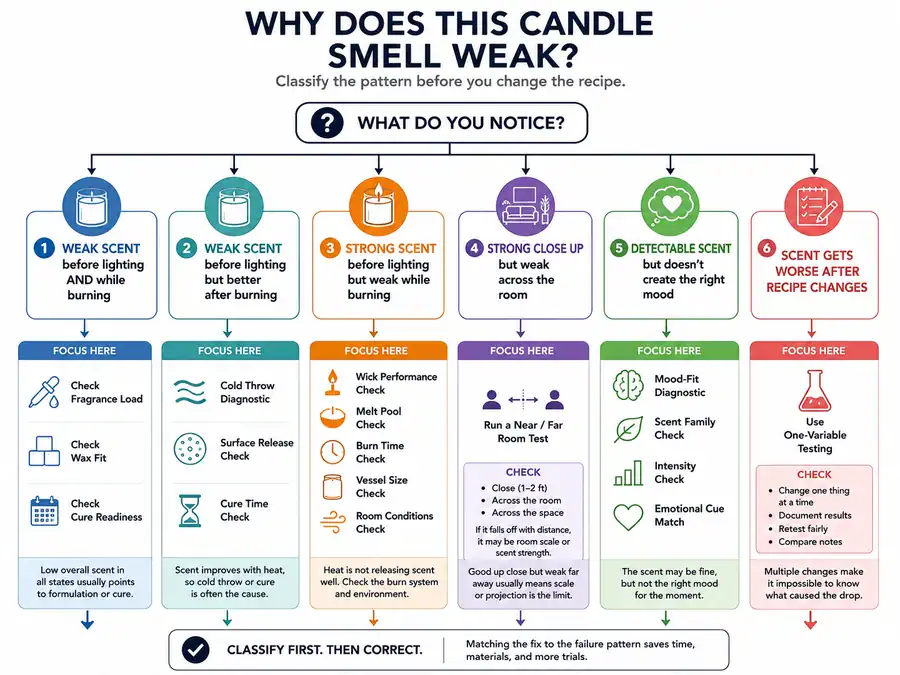
A mood-centric candle can have weak cold throw, weak hot throw, or both, and each result points to a different fix. If the candle smells weak before lighting but acceptable while burning, start with cure time, fragrance binding, and surface scent release. If it smells good unlit but fades while burning, check wick behavior, melt pool, burn time, and room scale.
| What you notice | Likely problem type | What it usually points to | First fix to check |
|---|---|---|---|
| Weak scent before lighting and weak scent while burning | Cold throw + hot throw | Fragrance load, wax fit, cure readiness, or scent-family mismatch | Check load, wax compatibility, and cure checkpoint |
| Weak scent before lighting but better after burning | Cold throw issue | Surface release, cure time, or fragrance/wax binding | Retest after curing before changing the formula |
| Strong scent before lighting but weak while burning | Hot throw issue | Wick, melt pool, burn time, vessel size, or room conditions | Check burn system before adding oil |
| Strong scent close up but weak across the room | Perception or room-scale issue | Room size, airflow, candle size, or placement | Run a near/far room test |
| Scent is detectable but the mood feels wrong | Mood-fit issue | Scent family, intensity, or atmosphere cue mismatch | Use a mood-fit diagnostic |
| Scent gets worse after recipe changes | Variable-control issue | Too many changes made at once | Return to one-variable testing |
Do not start by adding more fragrance oil. A stronger load can help only when the wax can hold the oil, the candle has cured enough for a fair test, and the burn system can release scent cleanly.
A clean diagnosis separates “not enough fragrance is reaching the nose” from “the scent is present but not matching the intended mood.” That keeps this page focused on fixing candle fragrance and scent throw in mood-centric candles instead of drifting into a full fragrance oil guide, wick chart, or scent-design article.
For exact wick selection, use a wick sizing guide only after the hot-throw pattern is confirmed. The next check is fragrance load, wax compatibility, cure readiness, and flashpoint assumptions.
Check fragrance load, wax compatibility, cure readiness, and flashpoint assumptions.
More fragrance oil is not always the fix for poor scent throw.
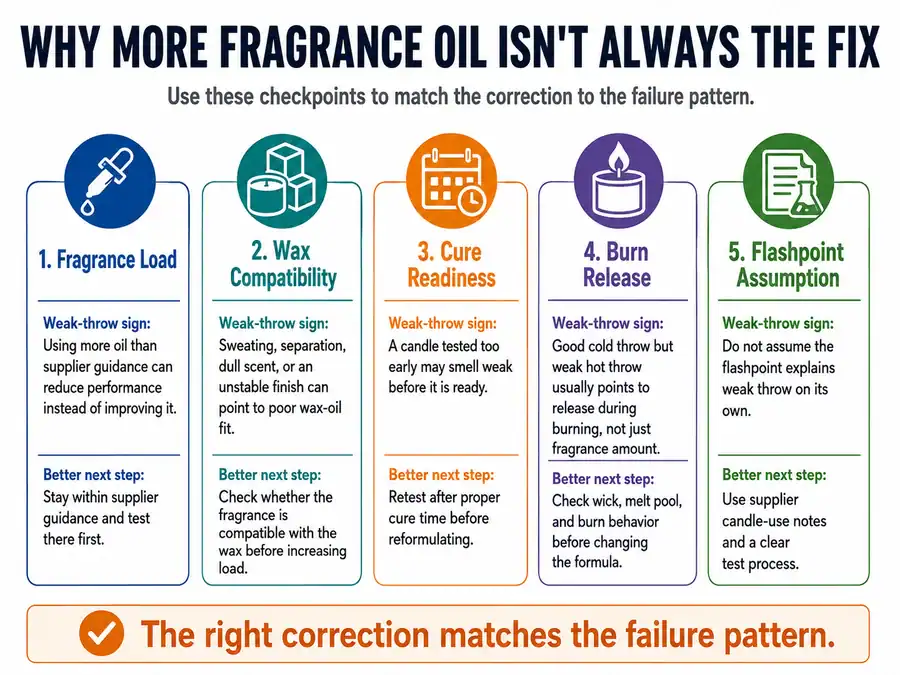
Poor scent throw can come from too little fragrance, too much fragrance, poor wax binding, early testing, or a mistaken flashpoint assumption. The right correction is the one that matches the failure pattern, not the one that only increases the fragrance percentage.
| Checkpoint | What it means | Weak-throw sign | Better next step |
|---|---|---|---|
| Fragrance load | How much fragrance oil is used in the wax | Candle smells flat at cold and hot test stages | Check supplier guidance before increasing load |
| Wax compatibility | Whether the wax can hold and release that fragrance | Sweating, separation, dull scent, or unstable finish | Compare candle wax types for scent throw instead of forcing the same formula |
| Cure readiness | Whether the candle is ready for a fair scent test | Hardened candle still smells weak too soon after pouring | Retest at a cure checkpoint before reformulating |
| Burn release | Whether the melted wax and wick release fragrance well | Good cold throw but weak hot throw | Move to wick and burn-system diagnosis |
| Flashpoint assumption | Whether flashpoint is being blamed as the main cause | Maker assumes scent “burned off” without other evidence | Check supplier candle-use notes and test process |
Use supplier limits as the boundary for fragrance load. Going beyond the wax or fragrance supplier’s candle-use guidance can create binding problems, sweating, uneven burning, or a candle that smells worse rather than stronger.
If precise percentage math is needed, calculate fragrance load in a dedicated calculator rather than turning this troubleshooting page into formula math. If the issue looks wax-specific, compare candle wax types for scent throw before changing every part of the recipe.
Cure time checkpoint.
A hardened candle is not always ready for a fair scent throw test.
A candle can look finished before the fragrance has settled into the wax well enough for a fair scent throw test. If both cold throw and hot throw seem weak, wait for an appropriate cure checkpoint based on the wax and supplier guidance before changing fragrance load, wick, or vessel.
Use this checkpoint as a filter:
| Cure checkpoint question | If yes | If no |
|---|---|---|
| Has the candle rested long enough for the wax and fragrance system being used? | Test cold throw and hot throw under the same room and burn conditions | Wait and retest before changing the recipe |
| Did the scent improve after more rest time? | Keep the formula stable and record the result | Check wax compatibility or fragrance load |
| Did hot throw stay weak even after curing? | Move to wick, melt pool, and burn-system diagnosis | Do not assume the fragrance oil failed |
| Did cold throw stay weak but hot throw improve? | Treat it as a cold-throw or surface-release issue | Avoid changing wick first |
A full candle curing guide is better for wax-by-wax timing. Here, cure time is only a troubleshooting checkpoint: it prevents early testing from being mistaken for a bad fragrance formula.
Flashpoint myth correction.
Flashpoint does not automatically explain weak scent throw.
A fragrance oil’s flashpoint is a safety and handling data point, not a simple scent-strength score. Poor throw is more often linked to wax fit, fragrance load, cure readiness, wick behavior, burn conditions, or room-scale perception.
Flashpoint myth correction: If a candle smells weak, do not assume the fragrance “burned off” only because of flashpoint. Check supplier candle-use guidance, mixing process, cure checkpoint, and burn behavior before blaming flashpoint.
Use SDS or IFRA documentation when the next question is safety, handling, or usage limits. Keep the scent-throw fix focused on the candle system: wax, fragrance, wick, cure, room, and mood fit.
Check the burn system and wick behavior for weak hot throw.
Weak hot throw often comes from the wick, melt pool, vessel, or burn time rather than the fragrance oil alone.
A candle can have enough fragrance in the wax and still smell weak while burning if the wick, melt pool, vessel, or burn time does not release fragrance into the room well.
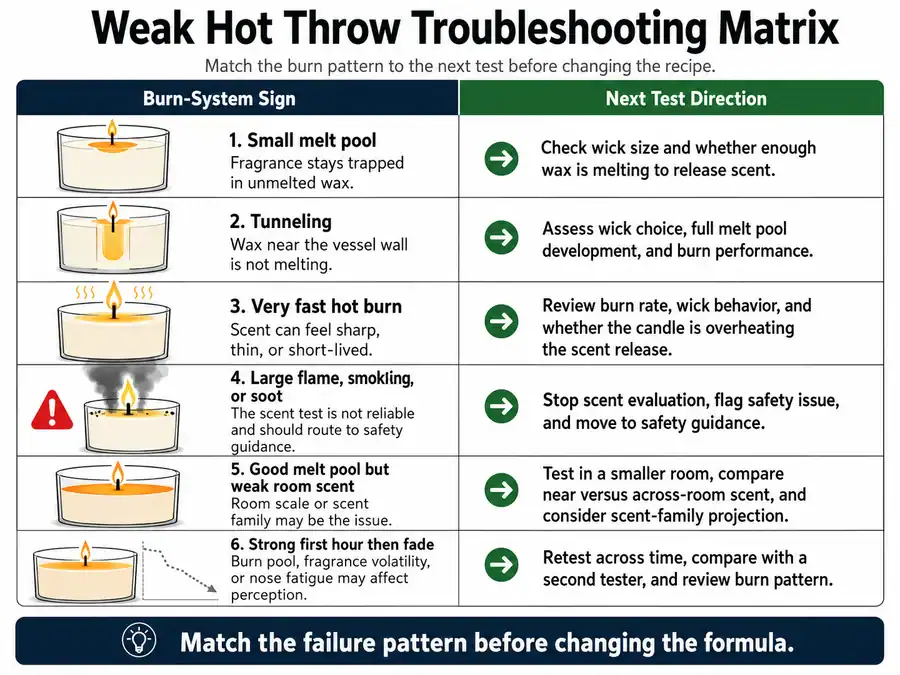
| Burn-system sign | What it can mean | Scent-throw result | Next fix to test |
|---|---|---|---|
| Small melt pool after a normal burn period | Wick may be too small for the wax and vessel | Fragrance stays trapped in unmelted wax | Test wick behavior before increasing fragrance |
| Tunneling down the center | Wax near the vessel wall is not melting | Hot throw stays weak and uneven | Correct burn pattern before changing scent load |
| Very fast, hot burn | Wick may be too aggressive | Scent can feel sharp, thin, or short-lived | Reduce burn intensity and retest |
| Large flame, smoking, or soot | Burn behavior is unsafe or unstable | Scent test is no longer reliable | Route to candle safety guidance |
| Good melt pool but weak room scent | Wick may release wax well, but room scale or scent family may be the issue | Candle smells present nearby but not across the room | Run the near/far room test |
| Strong first hour, then fade | Burn pool, fragrance volatility, or nose fatigue may affect perception | Mood effect feels inconsistent | Retest in the same room with one change |
Exact wick choice belongs in a wick sizing chart because wick performance depends on wax type, vessel diameter, fragrance load, dye, and wick series. This section only confirms whether wick and melt-pool behavior are causing weak hot throw.
If the candle shows large flames, heavy soot, container overheating, or unstable burning, stop treating it as a scent-throw problem. Move that issue to candle safety guidance before making the candle smell stronger.
Check room conditions and mood-scent alignment.
Room size, airflow, candle scale, and mood-scent mismatch can make acceptable scent throw feel weak.
A mood-centric candle may have acceptable scent throw up close but feel weak in the intended space if the room is large, the candle is undersized, airflow disperses scent, or the scent family does not match the atmosphere the candle is meant to create.
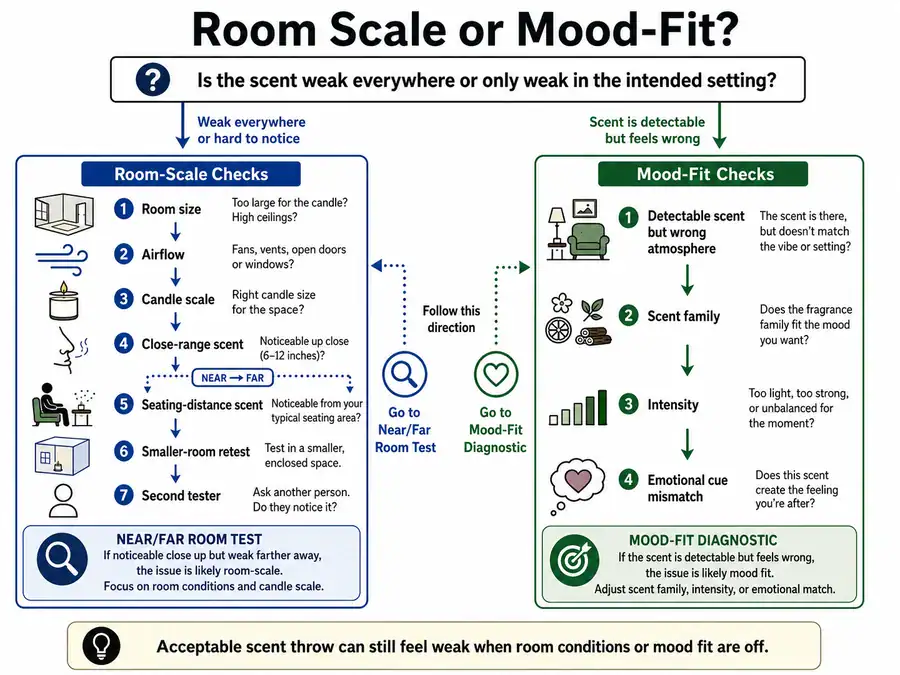
Near/far room test.
Test whether the candle is weak everywhere or only weak across the room.
Use the same candle, burn time, room, and distance notes before changing the recipe. This separates a true hot-throw failure from a room-scale perception problem.
| Test point | What to check | What the result means |
|---|---|---|
| Unlit candle, close range | Can you smell the candle before lighting? | If no, cold throw or cure may still be the issue |
| Burning candle, close range | Can you smell it near the vessel? | If yes, the candle is releasing fragrance |
| Burning candle, normal seating distance | Can you smell it where the mood setting matters? | If no, room scale or placement may be the issue |
| Same candle in a smaller room | Does the scent become easier to notice? | If yes, the candle may be undersized for the first room |
| Same room with less airflow | Does the scent last longer? | If yes, air movement may be diluting perception |
| Second tester, same distance | Does another person detect the scent? | If yes, perception or fatigue may affect the test |
For broader placement patterns, use room-by-room candle placement guidance. Keep this test focused on whether weak scent throw is a candle problem or a room-scale problem.
Mood-fit diagnostic.
A subtle mood scent is not automatically poor scent throw.
A candle can be detectable and still feel disappointing if the scent family, intensity, or emotional cue does not match the mood goal. That is a mood-fit problem, not always a fragrance-load problem.
| Mood goal | Scent feels weak when… | Better diagnosis |
|---|---|---|
| Calm or relaxing | The scent is detectable but too sharp or bright | Mood fit is off, not necessarily throw |
| Cozy or warm | The scent is present but feels thin or cool | Scent-family balance may be wrong |
| Fresh or clean | The scent is noticeable but fades into the room too softly | Intensity or room scale may need testing |
| Romantic or intimate | The scent is strong nearby but does not create atmosphere | The scent may lack the intended cue |
| Focused or clear | The candle smells pleasant but too heavy | The scent may conflict with the intended mood |
| Seasonal or nostalgic | The scent is strong but does not match the expected memory cue | Mood association may be mismatched |
Use a mood candle scent-family guide when the candle is detectable but the atmosphere still feels wrong. Do not treat scent-family design, aromatherapy claims, or candle psychology as part of this troubleshooting page.
Test one variable, adjust, and retest.
Change one variable at a time, then retest cold throw and hot throw under the same conditions.
A mood-centric candle becomes harder to fix when fragrance load, wax, wick, cure time, room, and scent family all change together. One-variable testing shows whether the weak throw came from the recipe, burn system, room scale, or mood fit.
| Test round | Keep the same | Change one thing | Record before | Record after | Decision |
|---|---|---|---|---|---|
| Cure retest | Wax, fragrance load, wick, vessel, room | Rest time only | Cold throw and hot throw notes | Same notes after the checkpoint | If scent improves, do not reformulate yet |
| Fragrance load test | Wax, wick, vessel, cure time, room | Fragrance load within supplier guidance | Cold/hot strength and surface condition | Scent strength, sweating, burn behavior | Keep only if throw improves without instability |
| Wick test | Wax, fragrance load, vessel, cure time, room | Wick only | Melt pool, flame, hot throw | Melt pool, flame, hot throw | Keep only if burn improves and scent releases better |
| Room test | Candle formula and burn time | Room size, placement, or airflow | Close-range and seating-distance scent | Same distances in the new setting | If smaller room improves scent, treat it as a room-scale issue |
| Mood-fit test | Formula, room, burn time | Scent-family balance only | Detectability and mood match | Detectability and mood match | If scent is present but atmosphere is wrong, adjust scent design later |
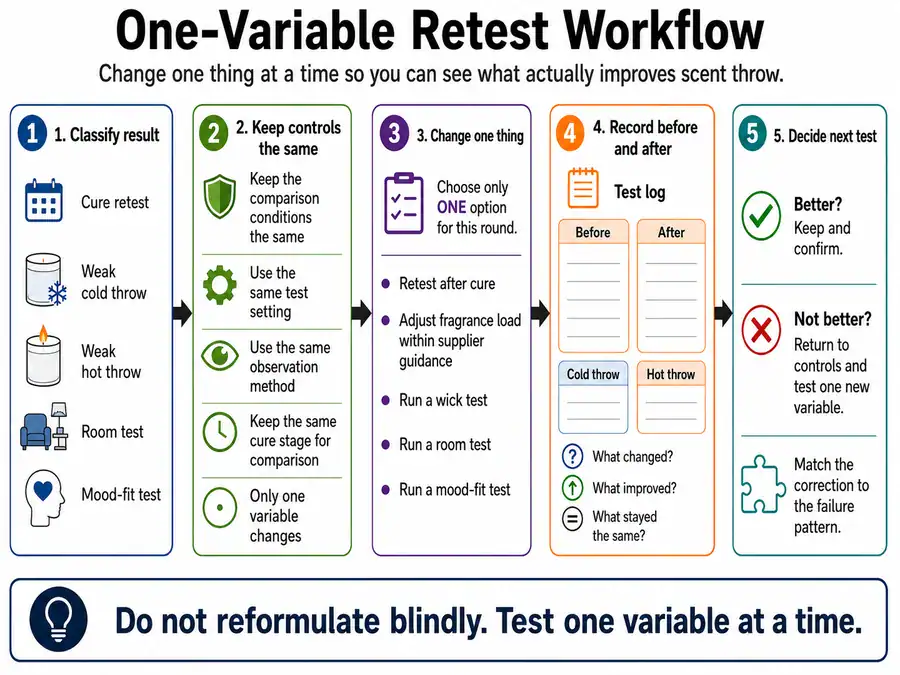
A small static mini-checker can support this section:
| If your result is… | Test next |
|---|---|
| Weak cold throw and weak hot throw | Cure checkpoint, fragrance load, or wax fit |
| Good cold throw but weak hot throw | Wick, melt pool, vessel, or burn time |
| Good scent nearby but weak across the room | Room size, airflow, placement, or candle scale |
| Detectable scent but wrong mood | Scent-family fit, not scent strength alone |
| Unsafe flame, soot, or overheating | Candle safety guidance before scent changes |
For reusable documentation, move the full record into a candle test log template. Keep this page focused on the final troubleshooting decision: identify the weak-throw pattern, make one controlled adjustment, and retest before changing the next variable.
FAQ
These answers cover the most common poor scent throw checks: cold throw, hot throw, fragrance load, cure time, wick behavior, room distance, and mood fit.
How do you fix poor scent throw in candles?
Fix poor scent throw by first identifying whether the candle has weak cold throw, weak hot throw, or both.
After that, check cure time, fragrance load, wax compatibility, wick behavior, room conditions, and mood fit one variable at a time.
What is cold throw vs hot throw?
Cold throw is how strong a candle smells before burning. Hot throw is how strong it smells while burning.
A candle can have poor cold throw, poor hot throw, or both, and each result points to a different fix.
Does adding more fragrance oil improve scent throw?
Adding more fragrance oil only helps when the wax can hold and release it properly.
Too much fragrance oil can cause poor binding, sweating, surface issues, or uneven burn behavior, so stay within supplier guidance and test before raising the load.
Can cure time affect candle scent throw?
Cure time can affect scent throw because a hardened candle is not always ready for a meaningful scent test.
Retest after the right cure checkpoint before changing fragrance load, wax, or wick.
Can the wrong wick reduce hot throw?
Yes. The wrong wick can reduce hot throw if it creates a poor melt pool, tunnels, burns too briefly, or fails to release enough fragrance from the melted wax.
Use a wick sizing chart only after the hot-throw pattern is confirmed.
Why can I only smell my candle up close?
A candle may smell strong nearby but weak across the room when the room is too large, airflow disperses the scent, the vessel is too small, or the candle is placed too far from the user.
Run the near/far room test before changing the formula.
Is subtle mood scent the same as poor scent throw?
Not always. A subtle mood scent can be detectable but still feel weak if the scent family, intensity, or atmosphere cue does not match the intended mood.
If the scent is present but the mood feels wrong, use a mood candle scent-family guide instead of only raising fragrance load.