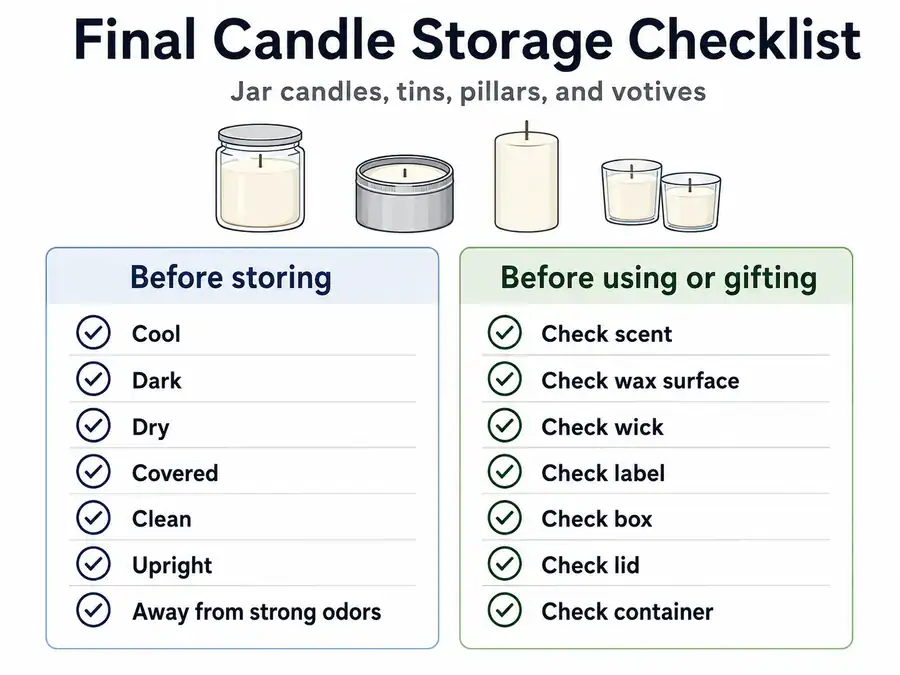

Store finished candles in a cool, dark, dry, covered place away from sunlight, heat, moisture, dust, and strong odors so they keep their fragrance, color, shape, and burn quality longer.
Here, lasting longer means retaining scent, color, shape, surface quality, and burn readiness, not extending the candle’s total burn time.
This guide covers completed candles that have already been made or purchased and are being stored before burning, gifting, display, or seasonal reuse. Finished candles include unburned candles and partially burned candles stored between uses. Good storage slows scent loss, discoloration, softening, dust buildup, wick damage, label damage, and presentation decline.
This guide does not cover raw wax, fragrance oils, wax melts, shipping packaging, commercial inventory, candle curing, or mold storage. Those topics need different storage rules because they are not the same finished-candle storage problem.
What Does Proper Candle Storage Mean for Finished Candles?
Proper candle storage means keeping a finished candle protected from heat, light, air exposure, moisture, dust, and physical damage so it stays usable, clean, and fragrant for longer.
Finished candles are completed candles that have already been made or purchased and are being stored before burning, gifting, display, or seasonal reuse. This guide stays focused on finished candles after they exist.
This guide covers finished candles only
Covered here
- Unburned candles stored before use
- Partially burned candles stored between uses
- Gift candles, seasonal candles, jar candles, tins, pillars, and votives
- Wax surface, fragrance, wick, label, lid, container, and presentation
Not covered here
- Raw wax
- Fragrance oils
- Wax melts
- Shipping packaging
- Commercial inventory
- Candle curing
- Candle mold storage
Best practices here means practical home-storage habits that slow scent loss, discoloration, dust buildup, softening, label damage, and presentation decline. It does not mean candles can be preserved forever, that every wax type needs the same handling, or that home users need commercial warehouse rules.
A stored candle can lose quality even before it is burned if the wax surface picks up dust, the wick bends, the label stains, the lid gets scratched, or the fragrance fades through repeated exposure to air and heat. Good storage keeps the finished candle’s parts protected together: wax remains clean, scent stays stronger, color looks fresher, the wick is ready to light, and the container still looks giftable.
Raw wax, fragrance oils, and wax melts need different handling because they are not the same finished-candle entity. They are mentioned here only to clarify that this article is about finished candles, not raw materials or wax melts.
Where Should You Store Candles to Keep Temperature Stable?
Store finished candles in a cool, stable indoor place such as a closet, cabinet, or shaded drawer, away from direct heat, sunlight, cars, attics, radiators, and temperature swings.
Cool storage means stable household storage, not refrigeration, freezing, or warehouse-grade temperature control. A good candle-storage spot protects finished candles from heat spikes so the wax keeps its shape, the fragrance lasts longer, the color stays cleaner, the container avoids stress, and the surface remains presentable.
A closet is usually better than an attic, car, bathroom, windowsill, or sunny shelf because it is darker and less exposed to sudden heat. A cabinet, drawer, pantry-style shelf, or covered storage box can work for the same reason. The goal is steady indoor protection, not the coldest place in the home.
| Storage location | Risk level | Why it works or fails |
|---|---|---|
| Interior closet | Low | Dark, stable, and away from direct heat |
| Cabinet or drawer | Low | Blocks light and reduces dust exposure |
| Shaded storage box | Low | Protects the candle from light, dust, and handling damage |
| Sunny shelf or windowsill | High | Adds light exposure and surface warming |
| Car | High | Heat can rise fast and soften or deform wax |
| Attic or hot garage | High | Heat swings can cause sweating, warping, scent loss, and appearance decline |
| Radiator or appliance-adjacent shelf | High | Nearby heat can soften wax and weaken presentation |
| Damp basement or bathroom | Medium to high | Moisture can affect labels, wicks, lids, and packaging |
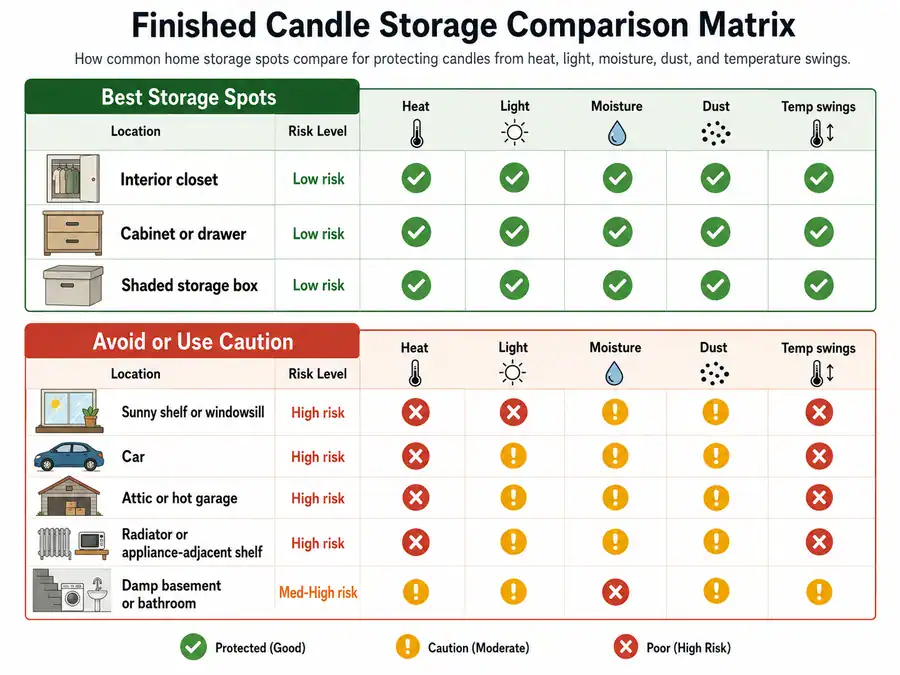
Candles can soften, sweat, warp, or lose scent faster when they sit near heat or move through repeated warm-cool cycles. This does not mean every candle will visibly melt in a poor location, but it does mean the storage spot is working against fragrance strength, wax stability, and gift-ready appearance.
Refrigeration and freezing are not the default fix. They can introduce moisture, odor transfer, condensation, or cracking risks depending on the candle and container. Use ordinary stable indoor storage first unless the candle maker gives a specific reason to chill a candle briefly.
Temperature rules for raw wax and fragrance oil are a separate ingredient-storage topic. Finished-candle storage advice should not be applied as a full storage rule for raw supplies.
Keep Candles Away From Direct Sunlight and Bright Display Heat
Keep finished candles away from direct sunlight because sunlight can warm the wax, fade color, damage labels, and make the candle look older before it is burned or gifted.
Display and storage are not the same. A candle can sit out briefly for décor, but preservation-first storage should prioritize shade, stable temperature, and cover so the candle keeps its color, wax surface, label condition, and fresh appearance.
Sunlight is risky because it adds both light exposure and heat exposure. Light can fade or discolor the candle and its label, while display heat can soften the wax surface or make the candle look less clean. A windowsill, sunny shelf, or bright display spot is fine only when appearance matters more than long-term storage quality.
Use a cabinet, covered box, drawer, closet, shaded shelf, or original packaging when the candle is being saved for later. If the candle is part of seasonal décor, rotate it back into protected storage after display rather than treating the display spot as its long-term home.
| Option | Best for | Preservation risk |
|---|---|---|
| Sunny display shelf | Short-term décor | Heat, fading, label damage, and faster presentation decline |
| Covered cabinet or box | Long-term storage | Lower light exposure, lower dust exposure, and better presentation protection |
| Shaded shelf | Short-term access | Moderate risk if the candle stays exposed to air and dust |
Decorative display is a styling choice, not the best storage method. For candles saved across holidays or long gaps between use, the storage goal is lower exposure, not the most visible placement.
How Do You Store Scented Candles So the Fragrance Lasts Longer?
To help scented candles keep their fragrance longer, store finished candles covered, cool, dry, and away from sunlight, open air, heat, and strong competing odors.
Fragrance preservation means slowing scent loss and odor contamination in a finished candle. It does not mean restoring fragrance after it has faded, making a weak candle stronger, fixing a formula issue, or re-curing a candle after storage.
A lid helps most when the candle is not being used. Boxes, cloches, closed cabinets, and clean containers work the same way by reducing open-air exposure, dust, and contact with strong household smells. This matters for unburned gift candles and partially burned candles between uses.
| Storage choice | Fragrance protection | Best use |
|---|---|---|
| Candle lid | High | Jar candles between burns |
| Original box | Medium to high | Gift candles or seasonal candles |
| Cabinet | Medium | Everyday home storage |
| Open shelf | Low | Short display only |
| Near strong odors | Poor | Avoid for scented candles |
Storage slows scent loss but does not reverse it. A candle that has already lost much of its scent may still burn, but it may not smell as strong as it did when new. If a newly made candle has little scent before storage, that points toward candle curing or fragrance guidance rather than a finished-candle storage problem.
| Problem | Likely storage cause | What to do |
|---|---|---|
| Candle smells weaker | Age, open-air exposure, heat, or weak original scent | Cover it, store it cool, and inspect before gifting |
| Candle smells stale | Dust, debris, or odor contamination | Clean loose surface debris only if safe, then cover and separate from odors |
| Candle picked up another smell | Stored near food, cleaning supplies, smoke, or perfume | Move it to neutral storage; do not expect full scent restoration |
| Candle has little scent after making | Curing or formula issue, not storage alone | Use candle curing or fragrance guidance instead of treating storage as the fix |
Do not store scented candles near spices, cleaning supplies, smoke, perfume, laundry products, or food odors. A closed cabinet works only if the cabinet itself is neutral-smelling and dry.
Raw fragrance oil storage is not the same as preserving the scent of a finished candle. Finished scented candles need covered, cool, dry, low-odor storage after they have already been made or purchased.
Protect the Wax Surface, Wick, and Container From Dust and Debris
Protect stored candles with a lid, dust cover, box, cabinet, or clean wrapping so dust and debris do not settle on the wax surface, wick, lid, label, or container.
Dust can affect the wax surface, wick, container, label, lid, scent perception, and gift presentation. Partially burned candles are still finished candles, but they need extra care before storage because the wax pool, trimmed wick, and container rim may collect debris after use.
Let a burned candle cool completely before covering it. Covering warm wax can trap heat, press debris into the surface, or mark the top of the candle. Once the candle is cool, check the wax surface, remove obvious loose debris if it can be done safely, then replace the lid or use a clean cover.
Before storing a partially burned candle
| Step | What to check | Why it matters |
|---|---|---|
| Let it cool completely | Wax is firm and container is safe to handle | Prevents trapped heat and surface marking |
| Check the wax surface | Loose wick trimmings, dust, or debris | Keeps the candle cleaner for the next burn |
| Check or trim the wick if needed | Wick is upright and not too long | Helps keep the candle burn-ready |
| Replace the lid or cover | Lid, dust cover, box, or cabinet | Reduces dust and odor exposure |
| Store upright | Cool, dark, dry place | Protects the wax surface and container |
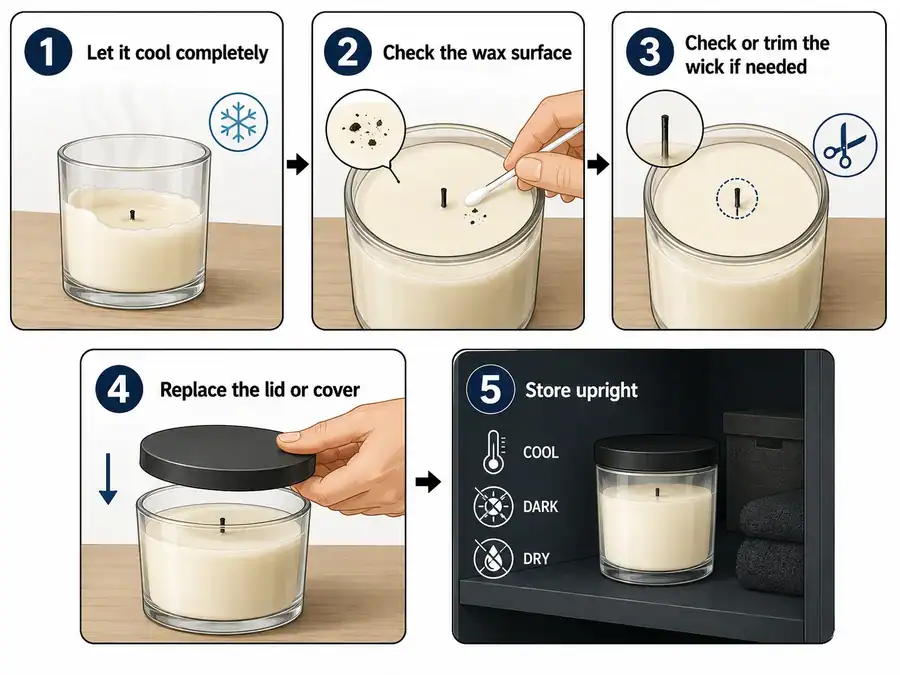
A dusty candle is usually a storage-protection problem first, not a reason to turn storage prep into deep cleaning. Light surface checks are enough for this guide. If the candle needs jar restoration, heavy soot cleaning, or more than quick debris removal, that is a candle care or cleaning issue rather than a storage issue.
Should You Store Candles With Lids, Boxes, or Wrapping?
Store finished candles with a lid, original box, clean dust cover, cabinet, or breathable wrapping when that barrier protects the candle from air, dust, light, odor transfer, or physical damage.
Lids, boxes, wraps, bins, cabinets, and dust covers are protective barriers for finished candles. The best option depends on the candle’s condition, scent strength, surface finish, label condition, storage duration, and whether the candle is being saved for use, display, gifting, or seasonal rotation.
Lids are useful for scented jar candles between uses because they reduce air exposure, dust, and odor transfer. Original boxes are useful for gift candles and seasonal candles because they reduce light exposure and surface damage. Tissue or soft wrapping can protect delicate surfaces, but it should not press into soft, decorated, or freshly finished wax.
| Storage option | Best for | Protects against | Watch out for | Use when / avoid when |
|---|---|---|---|---|
| Candle lid | Jar candles and between-burn storage | Air, dust, and odor transfer | Does not block all heat or light | Use for scented jar candles; avoid relying on it near heat |
| Original box | Gift and seasonal candles | Light, dust, and surface damage | Box can absorb odors or moisture | Use if clean and dry; avoid damp or musty boxes |
| Tissue or soft wrap | Decorative or gift candles | Scratches and surface marks | Can press into soft wax | Use loosely; avoid tight wrapping |
| Dust cover | Tins, jars, and display candles | Dust on wax and wick | Limited heat and odor protection | Use for short-term covered storage |
| Closed cabinet | Everyday grouped storage | Light, dust, and handling damage | Cabinet must be dry and neutral-smelling | Use away from heat; avoid damp or scented cabinets |
| Dry storage bin | Multiple candles | Dust, contact, and grouped handling | Can trap odors if dirty or sealed with strong scents | Use clean bins; avoid mixing strong scents together |
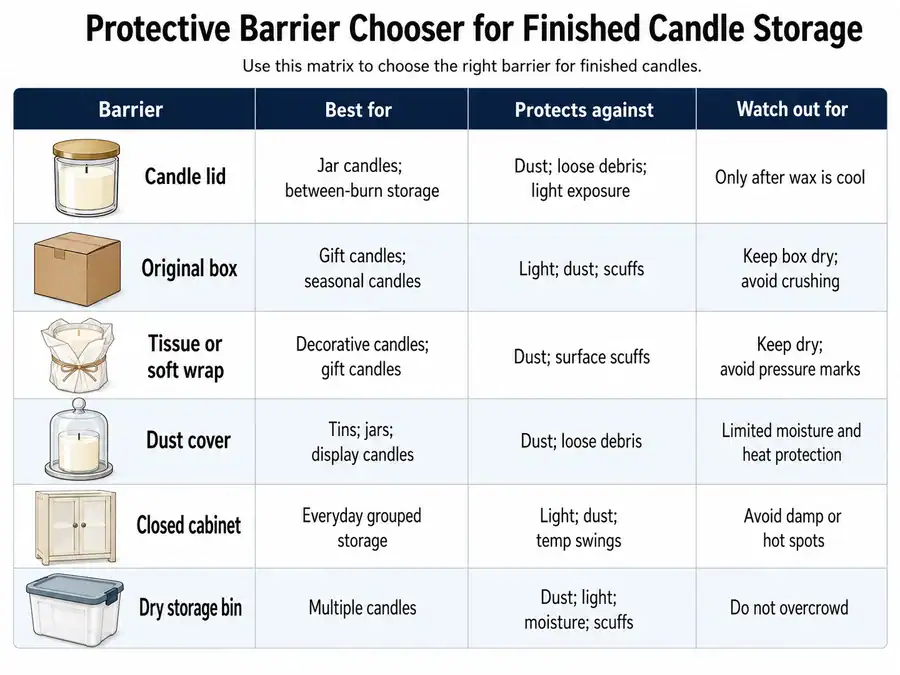
Airtight containers are not always best. They can help with grouped storage when clean and dry, but they are not a universal requirement and should not replace the more important conditions: stable temperature, shade, dryness, and protection from competing odors.
Shipping packaging, retail packaging design, and fulfillment materials belong in packaging guidance, not this storage decision. For home storage, choose the simplest barrier that keeps the finished candle clean, dry, covered, and protected without damaging its wax surface or presentation.
How Long Can You Store Candles Before They Lose Scent or Quality?
Candles do not have one universal expiration date, but stored candles can lose scent, color, surface quality, and gift-ready presentation over time, especially when exposed to heat, light, air, moisture, or odor contamination.
For finished candles, practical shelf life means quality retention rather than a strict expiration date. Wax type, fragrance, dye, storage conditions, candle age, and whether the candle has been burned all affect how well it holds its scent, shape, color, and presentation.
Storage can slow quality loss, but it cannot make an old candle new again. A candle that has lost most of its cold throw, or scent strength before burning, may still be usable, but it may not be the best choice for gifting or display.
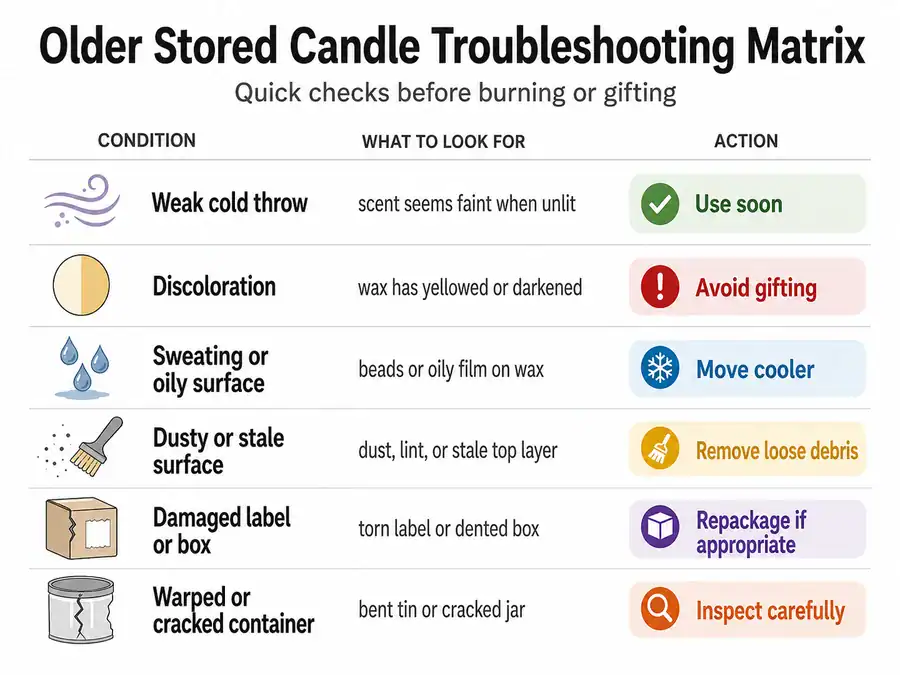
Before burning or gifting an older candle, inspect the scent, wax, wick, container, label, and packaging. The goal is to decide whether the candle is still clean, stable, presentable, and ready to use.
| Problem noticed | Likely storage cause | What it means | What to do |
|---|---|---|---|
| Weak cold throw | Age, air exposure, heat, or weak original formula | Scent quality may be reduced | Use soon or avoid gifting |
| Discoloration | Light exposure, dye aging, or heat | Appearance has declined | Burn if otherwise safe; avoid gifting if presentation matters |
| Sweating or oily surface | Heat exposure or fragrance migration | Storage conditions may be too warm | Move to a cooler, more stable place |
| Dusty or stale surface | Stored uncovered | Needs light cleanup or better cover | Remove obvious debris before use |
| Damaged label or box | Moisture, abrasion, or poor storage | Gift-readiness has declined | Repackage only if appropriate |
| Warped or cracked container | Heat or physical stress | Possible safety concern | Inspect carefully before use |
Longevity means keeping usable scent, appearance, shape, and burn readiness for as long as practical. It does not mean indefinite preservation, a fixed expiration date, or restored fragrance after scent has faded.
Raw fragrance-oil shelf life, candle curing, and full off-season storage need separate guidance. Those topics are outside this finished-candle storage article.
Store Candles Somewhere Dry to Protect Labels, Wicks, and Containers
Store finished candles in a dry household location because moisture can damage labels, affect wick readiness, mark containers, create stale storage conditions, and make the candle less gift-ready.
Dry storage means a normal dry closet, cabinet, drawer, or storage box away from bathrooms, damp basements, condensation-prone shelves, wet surfaces, and water sources. Moisture does not need to damage the wax directly to reduce candle quality; it can affect the parts that make the candle clean, usable, and presentable.
Bathrooms are usually poor candle-storage spots because steam and condensation can affect labels, boxes, lids, and wick readiness. Damp basements carry similar risks, especially when candles sit on cold shelves, near floor moisture, or inside musty packaging.
| Candle part | Moisture risk | Storage action |
|---|---|---|
| Label | Peeling, staining, or wrinkling | Store in a dry box or cabinet |
| Wick | Stale or contaminated readiness | Keep covered and dry |
| Container | Marks, residue, or corrosion risk | Avoid damp surfaces |
| Box or wrapping | Odor and moisture transfer | Use clean, dry packaging |
| Wax surface | Cosmetic decline or stale storage | Keep covered and dry |
A closet, interior cabinet, drawer, lidded dry box, or shelf away from water sources is usually a better choice. The storage spot should protect the whole finished candle, not only the wax.
Visible mold, major moisture damage, bathroom ventilation problems, and home humidity control are outside this page. For finished-candle storage, the practical rule is simple: keep candles dry enough that labels, wicks, lids, boxes, containers, and presentation stay clean and ready to use.
How Should You Store Burned, Unburned, Gift, and Seasonal Candles?
Store burned, unburned, gift, and seasonal candles using the same cool, dark, dry, covered storage principles, then adjust the details based on whether the candle has been burned, needs to stay gift-ready, or will be saved for another season.
This section applies the main storage rules to specific finished-candle situations. It does not introduce a new universal storage condition. Temperature, light, air exposure, dust protection, containers, duration, and moisture already form the preservation logic; this section shows how those rules change slightly by candle state and purpose.
These recommendations apply to finished candles in normal home storage for personal use, gifting, or seasonal reuse. They do not cover commercial warehousing, shipping preparation, retail display planning, full holiday inventory systems, wax melts, raw wax, fragrance oils, molds, or ingredient storage.
| Use case | Main storage risk | Best storage action | What to check before use or gifting |
|---|---|---|---|
| Partially burned candle | Dust, soot, wick debris, stale odor | Cool fully, check the wick and wax surface, cover, and store upright | Wick, wax surface, odor, and container |
| Unburned candle | Scent fade, discoloration, heat damage | Keep covered, shaded, dry, and away from heat | Cold throw, color, label, and surface |
| Gift candle | Label damage, box damage, scent loss | Keep in the original box or clean wrap, away from heat and moisture | Box, label, scent, and wax surface |
| Seasonal candle | Long storage, forgotten age, heat or light exposure | Label by season, store cool, dark, dry, and covered, then rotate before reuse | Scent, color, wax, and packaging |
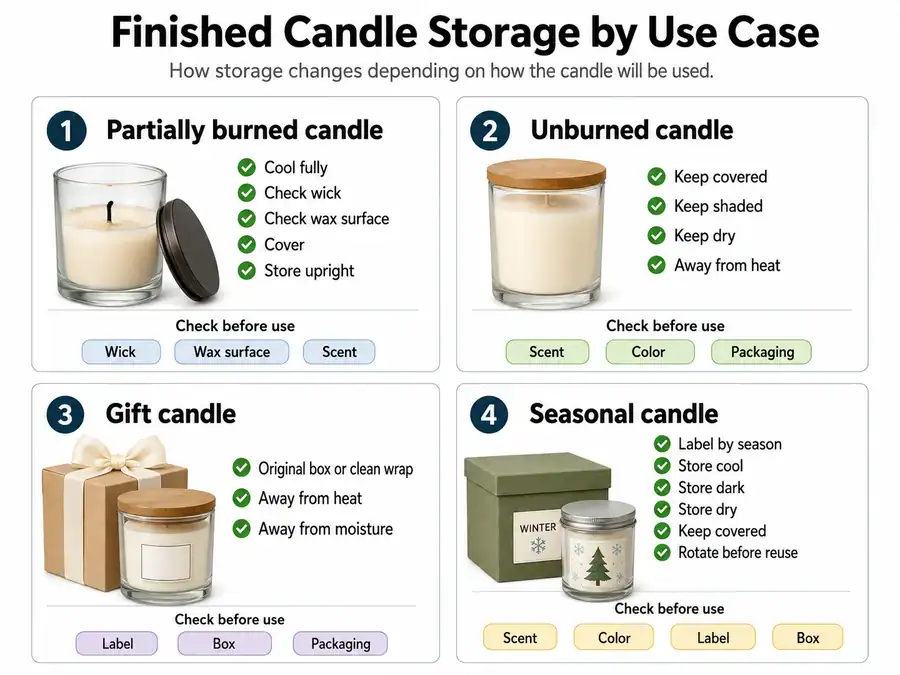
Let a burned candle cool completely before covering or boxing it. Once the wax is firm, check for loose wick trimmings, dust, soot flakes, or debris on the surface. Store partially burned candles upright so the wax surface, wick, and container stay ready for the next burn.
Unburned candles need less handling, but they still need protection from sunlight, heat, open air, moisture, dust, and strong odors. Gift candles need extra care because the label, box, lid, surface, and scent all affect whether the candle still feels presentable.
Seasonal candles can be handled here only at a basic use-case level. Storing many candles for months, protecting holiday scents across seasons, organizing bulk stock, or building a full rotation system is a deeper off-season storage topic.
FAQs About Storing Candles
These FAQs answer common finished-candle storage edge cases about lids, bathrooms, expiration, refrigeration, after-burn storage, and lost fragrance.
Should candles be stored with lids?
Yes. Lids help protect finished candles from dust, air exposure, and odor contamination when the candle is not being used.
A lid is most useful for scented jar candles and partially burned candles between uses. It does not replace cool, dark, dry storage.
Can candles be stored in the bathroom?
Usually no. Bathrooms often have humidity and temperature swings that can damage labels, packaging, wick readiness, and presentation.
A dry closet, cabinet, drawer, or covered storage box is usually better for finished candles.
Do candles expire?
Candles do not have one universal expiration date, but scent, color, surface quality, and presentation can decline over time.
If an older candle smells weak, looks dusty, has discolored, or no longer looks gift-ready, use it soon or avoid gifting it.
Can you store candles in the fridge?
Refrigeration is not the default storage method. Most finished candles should be stored in a cool, stable indoor place instead.
A closet, cabinet, shaded drawer, or dry box is usually safer and more practical than chilling candles.
How do you store candles after burning?
Let the candle cool completely, check the wick and wax surface, remove obvious loose debris, cover it, and store it upright in a cool, dry place.
Do not cover warm wax or place a recently burned candle into a box while it is still hot.
Can storage bring back lost candle scent?
No. Good storage can slow scent loss, but it usually cannot restore fragrance that has already faded.
If a candle had weak scent shortly after making, the issue may involve curing or fragrance choices rather than storage.
Final Candle Storage Checklist
Store jar candles, tins, pillars, and votives cool, dark, dry, covered, clean, upright, and away from strong odors. That protects fragrance, color, wax condition, labels, containers, and burn readiness without confusing finished-candle care with raw-material, wax-melt, shipping, or inventory storage.
Before storing a candle, check that it is cool, dry, clean, and covered. Before using or gifting an older candle, check the scent, wax surface, wick, label, box, lid, and container. If the candle looks damaged, smells stale, has a warped container, or no longer feels presentable, use it for personal burning only or replace it before gifting. Storage checks do not replace burn-safety checks; do not burn a candle with a cracked container, unsafe wick condition, or embedded debris.