Under the modeled assumptions, fragrance oil costs about $1.46 per candle, while actual package prices vary by supplier, package size, shipping, tax, and currency.
Candle fragrance-oil cost is the fragrance-only expense assigned to oil purchased or consumed for candle making. It excludes wax, wicks, vessels, labor, packaging, overhead, selling price, margin, and profit. Listed price, landed unit cost, usable unit cost, consumed cost, and purchase cash answer different budgeting questions. A valid calculation states the fragrance-load percentage basis before moving from package price to per-candle use, batch demand, package choice, and cash budget.
How Much Candle Fragrance Oil Costs by Package Size
In a June 13, 2026 supplier example, candle fragrance oil cost $3.49 per weight ounce in a 1-ounce bottle and $1.92 in a 16-ounce bottle.
The same CandleScience fragrance cost $12.29 for 4 weight ounces, or $3.07 per weight ounce. These are supplier-listed purchase prices before any separately charged shipping or tax, not universal market prices.
| Package size | Listed price | Listed unit cost | Cost basis | Data status |
|---|---|---|---|---|
| 1 weight oz | $3.49 | $3.49 per weight oz | Supplier-listed purchase price | Observed supplier listing |
| 4 weight oz | $12.29 | $3.07 per weight oz | Supplier-listed purchase price | Observed supplier listing |
| 16 weight oz | $30.77 | $1.92 per weight oz | Supplier-listed purchase price | Observed supplier listing |
Methods box
| Field | Rule used |
|---|---|
| Price-check date | 2026-06-13 |
| Currency | USD |
| Source record | CandleScience Library fragrance-oil product listing |
| Package unit | Weight ounces; the supplier states that bottles are filled by weight |
| Acquisition charges | Shipping and tax are not included because no order destination was entered |
| Observed versus modeled data | This table records observed supplier listings; later calculations use clearly labeled modeled assumptions |
| Rounding | Unit prices are rounded to the nearest cent per weight ounce |
The observed package comparison shows why the listed bottle price must be normalized before it becomes a usable candle-cost input.
Agent: candle maker; Predicate: compares; Patient: supplier-listed fragrance-oil package costs; Instrument: normalized price per weight ounce; Location: purchase comparison; Time: 2026-06-13.
What Fragrance-Oil Cost Includes
Candle fragrance-oil cost is the expense assigned to the fragrance oil used in candle making, measured on a declared purchase, landed, or usable unit-cost basis.
This is a fragrance-only cost measure. It excludes wax, wicks, vessels, labor, packaging, overhead, retail price, markup, and profit.
Bottle price alone is not a fair comparison because packages may contain different amounts. Each option must use the same currency, mass unit, and cost basis.
Use listed cost for shelf-price comparison, landed cost for acquisition comparison, usable cost for adjusted inventory valuation, and consumed cost for candle or batch allocation.
| Cost measure | Calculation basis | What it represents |
|---|---|---|
| Listed purchase price | Displayed package price | The initial bottle price before separately declared acquisition charges |
| Listed unit cost | Purchase price ÷ package mass | The listed price per gram or weight ounce |
| Landed unit cost | Purchase price plus included acquisition charges ÷ package mass | The acquired cost per gram or weight ounce |
| Usable unit cost | Landed package cost ÷ usable package mass | The cost per usable gram or weight ounce after one declared non-saleable-consumption adjustment |
A weight ounce measures mass, while a fluid ounce measures volume. Do not mix them in one calculation, and do not convert milliliters to grams without the product’s density.
Methods box
| Field | Rule used |
|---|---|
| Package mass | Record grams or weight ounces from the supplier’s package data |
| Acquisition charges | Include declared shipping, tax, duty, or order fees where applicable |
| Usable quantity | Subtract one declared non-saleable fragrance-consumption adjustment |
| Source record | Retain the dated supplier product page and invoice or order record |
A normalized unit cost gives every later load, candle, and batch calculation the same fragrance-only cost basis.
Calculating Landed and Usable Fragrance-Oil Cost
Landed candle fragrance-oil cost includes declared acquisition charges, while usable cost reflects one declared adjustment for non-saleable fragrance consumption.
Purposeful test pours are consumption, while transfer residue and spills are physical losses. Combine them only when the accounting policy states that allocation explicitly.
Landed package cost equals the purchase price plus included acquisition charges. Usable unit cost equals landed package cost divided by usable package mass.
The following figures form a modeled example rather than a quoted supplier price.
| Cost-ladder stage | Calculation | Result |
|---|---|---|
| Purchase price | Assumed package price | $32.00 |
| Included shipping | Assumed charge | $6.00 |
| Included tax or order fees | Assumed charge | $2.00 |
| Landed package cost | $32.00 + $6.00 + $2.00 | $40.00 |
| Package mass | Supplier-listed mass | 454 g |
| Declared non-saleable fragrance consumption | Assumed measured adjustment | 14 g |
| Usable package mass | 454 g − 14 g | 440 g |
| Landed unit cost | $40.00 ÷ 454 g | $0.088 per g |
| Usable unit cost | $40.00 ÷ 440 g | $0.091 per g |
The 14 g adjustment is applied by reducing usable package mass. It must not be added again to a later batch requirement because that would count the same adjustment twice.
A non-saleable-consumption percentage is not universal, and fragrance oil remaining in usable condition is inventory rather than waste.
| Failure | Cause | Correction |
|---|---|---|
| The same 14 g adjustment is added to the package and batch calculations | One allowance was applied at two stages | Apply the adjustment to usable mass or batch demand, not both |
| Unused oil is labelled as waste | Usable remainder was confused with measured loss | Record intact remainder as inventory |
| Unit cost uses $32.00 instead of $40.00 | Acquisition charges were omitted | Use landed package cost |
| A default adjustment percentage is applied to every oil | The allowance lacks measured evidence | Base it on test pours, transfer residue, or recorded spills |
| Wax and vessel losses are added | Fragrance-only cost was mixed with complete candle cost | Count only the fragrance oil affected |
Methods box
| Field | Modeled assumption |
|---|---|
| Included charges | $6.00 shipping and $2.00 tax or order fees |
| Package mass | 454 g |
| Adjustment basis | 14 g from test pours, transfer residue, and measured spills, recorded as one declared non-saleable-consumption allowance |
| Allowance stage | Reduced usable package mass only |
Use the usable unit cost as the fragrance-only input for later per-candle and batch calculations.
Agent: candle maker; Predicate: normalizes; Patient: fragrance-oil cost; Instrument: listed, landed, and usable cost bases; Location: package and inventory accounting; Time: before per-candle calculation.
How Fragrance Load Changes the Amount of Oil Used
On a wax-weight basis, each 1 percentage-point increase adds 1 g of fragrance oil per 100 g of wax.
Fragrance load is a selected fragrance-oil percentage applied to a declared candle-formula weight basis, most commonly wax weight.
The percentage has no complete meaning until its denominator is named. An 8% wax-basis load and an 8% finished-product-basis fragrance content produce different oil quantities.
Wax-basis formula
Fragrance quantity = wax mass × fragrance-load decimal
Convert the percentage before calculating: 8% becomes 0.08, not 8.
Fragrance-Load Basis Formula Card
With 200 g of wax at 8%, the wax-basis calculation uses 16.00 g of oil, while the finished-product-basis calculation uses 17.39 g.
The figures below are arithmetic examples, not permitted-use limits or formulation recommendations.
| Declared basis | Meaning | Formula using 200 g of wax and 8% | Fragrance quantity |
|---|---|---|---|
| Wax-weight basis | Fragrance equals 8% of wax mass | 200 g × 0.08 | 16.00 g |
| Finished-product basis | Fragrance equals 8% of wax plus fragrance | F = 0.08 × (200 g + F) | 17.39 g |
| Difference | The denominator changes the answer | 17.39 g − 16.00 g | 1.39 g |
Two calculators can display different answers for the same percentage label while both calculations remain arithmetically correct. The difference often comes from the selected denominator rather than a multiplication error.
Here, “correct” means mathematically valid under the stated denominator; it does not mean suitable, permitted, or likely to improve candle performance.
For a 12-candle batch using 16 g per candle:
16 g per candle × 12 candles = 192 g of fragrance oil
Round the batch total after scaling. Rounding each candle first can compound small differences across a larger batch.
Keep every mass term in the same unit. A gram-based formula must use grams throughout; an ounce-based formula must use weight ounces throughout. Fluid ounces and milliliters cannot replace mass values without product-specific density.
Methods box
| Field | Modeled assumption |
|---|---|
| Percentage denominator | Wax mass or finished-product mass, stated separately |
| Percentage form | 8% entered as 0.08 |
| Candle count | 12 candles for the batch example |
| Suitability status | Arithmetic example only; not an approved load |
| Supplier check | Confirm the selected percentage against the applicable wax and fragrance documentation |
The calculation establishes how much candle fragrance oil is costed. It does not determine whether that percentage is suitable, permitted, or likely to improve scent performance.
Once the denominator and mass unit are fixed, the fragrance quantity becomes a valid input for the per-candle cost calculation.
Agent: candle maker; Predicate: calculates; Patient: fragrance-oil quantity; Instrument: a declared percentage denominator and mass formula; Location: candle formula; Time: before cost allocation.
Calculating Fragrance Cost per Candle
Fragrance cost per candle equals normalized fragrance-oil unit cost multiplied by the fragrance mass consumed in one candle.
Here, “per candle” means fragrance-only consumed cost. It does not mean the bottle price, purchase cash, selling price, or complete candle cost.
Fragrance cost per candle = normalized fragrance unit cost × fragrance mass used per candle
Define the variables before adding values:
| Variable | Meaning | Example unit |
|---|---|---|
| Normalized unit cost | Listed, landed, or usable fragrance cost divided by its mass | USD per gram |
| Fragrance mass | Oil consumed by one candle under the declared load basis | Grams per candle |
| Fragrance cost per candle | Monetary value of the oil consumed by one candle | USD per candle |
Worked Cost-per-Candle Formula
The modeled fragrance cost is $1.46 per candle.
The modeled example reuses the earlier usable unit cost of $0.091 per gram and a wax-basis fragrance quantity of 16 g per candle.
($0.091 ÷ g) × (16 g ÷ candle) = $1.456 ÷ candle
The gram units cancel, leaving $1.46 of fragrance oil per candle after rounding to the nearest cent.
Dividing the package price by the planned candle count is normally incorrect. That method assigns the entire purchase to the batch even when usable oil remains in inventory, and it ignores the actual mass consumed by each candle.
Per-Candle Cost Sensitivity
Fragrance cost rises in direct proportion to candle size, fragrance-load percentage, or normalized oil price.
Every percentage below is an arithmetic example, not a universal fragrance-load recommendation.
| Variable changed | Wax mass | Wax-basis load | Fragrance used | Unit cost | Fragrance cost per candle |
|---|---|---|---|---|---|
| Baseline | 200 g | 8% | 16 g | $0.091/g | $1.46 |
| Larger candle | 250 g | 8% | 20 g | $0.091/g | $1.82 |
| Lower modeled load | 200 g | 6% | 12 g | $0.091/g | $1.09 |
| Higher oil cost | 200 g | 8% | 16 g | $0.120/g | $1.92 |
Candle size, declared load, and normalized oil price each change the result independently. This makes the calculation more useful than a single bottle-price estimate because the cost follows the oil actually consumed.
Fragrance-Oil Cost Calculator: Per-Candle Inputs
A per-candle calculator needs normalized unit cost, formula weight, fragrance-load percentage, and candle count.
| Input | Entry |
|---|---|
| Normalized fragrance unit cost | Currency per gram or weight ounce |
| Formula weight | Wax mass or another clearly named denominator |
| Fragrance-load percentage | Percentage converted to decimal |
| Candle count | One for per-candle output; more than one for batch output |
| Output | Fragrance mass and fragrance-only cost per candle |
The static formula remains the controlling calculation when a calculator is unavailable.
Methods box
| Field | Modeled assumption |
|---|---|
| Unit-cost basis | Usable fragrance-oil cost |
| Percentage basis | Fragrance percentage calculated from wax mass |
| Rounding | Final monetary result rounded to the nearest cent |
Calculating consumed fragrance cost first keeps package cash, remaining inventory, and complete candle cost separate from the amount assigned to one candle.
Calculating the Weighted Cost of a Fragrance Blend
The cost of a multi-oil candle fragrance blend is calculated by weighting each oil’s normalized unit cost by its actual share of the blend.
The blend ratios must already be selected, every component price must use the same currency and mass unit, and the shares must total 100%. This calculation values an existing blend; it does not select fragrance combinations or assess formulation suitability.
Weighted blend unit cost = Σ(component unit cost × component share)
Weighted Blend-Cost Table
The modeled 70/30 fragrance blend costs $0.098 per gram rather than the $0.110 produced by a simple average.
This modeled example uses two fragrance oils in unequal proportions.
| Component | Normalized unit cost | Blend share | Weighted contribution |
|---|---|---|---|
| Fragrance oil A | $0.080/g | 70% | $0.056/g |
| Fragrance oil B | $0.140/g | 30% | $0.042/g |
| Total | — | 100% | $0.098/g |
The shares pass validation because 70% + 30% = 100%.
Here, “correct” means mathematically valid for the declared component shares; it does not mean the blend is suitable, safe, or likely to perform well in a candle.
A simple average would produce the wrong cost:
Incorrect simple average = ($0.080 + $0.140) ÷ 2 = $0.110/g
Correct weighted cost = ($0.080 × 0.70) + ($0.140 × 0.30) = $0.098/g
The simple average overstates the blend cost by $0.012 per gram because it treats both oils as equal portions. The more expensive oil represents only 30% of the declared blend.
For a candle using 16 g of the blend:
| Method | Calculation | Fragrance cost per candle |
|---|---|---|
| Incorrect simple average | 16 g × $0.110/g | $1.76 |
| Correct weighted cost | 16 g × $0.098/g | $1.57 |
| Difference | $1.76 − $1.57 | $0.19 |
For a 12-candle batch requiring 192 g of blend:
192 g × $0.098/g = $18.82 of fragrance oil
The standard per-candle and batch formulas remain unchanged. Only the unit-cost input changes from a single-oil cost to the weighted blend unit cost.
Methods box
| Field | Modeled assumption |
|---|---|
| Component cost basis | Normalized fragrance-only cost per gram |
| Blend shares | 70% oil A and 30% oil B |
| Share validation | 70% + 30% = 100% |
| Calculation boundary | Ingredient cost for an already declared blend |
Agent: candle maker; Predicate: calculates; Patient: fragrance cost per candle or declared blend; Instrument: normalized unit cost and fragrance mass; Location: candle formula; Time: after the load basis is fixed.
Steps to Budget Fragrance Oil for a Candle Batch
A candle-batch fragrance budget separates the fragrance oil the batch will consume from the package quantity and cash amount that must be purchased.
Consumed batch cost values the oil entering the candles. Net purchase requirement adds one declared allowance and subtracts usable inventory, while package cash outlay and expected remainder depend on the packages available for purchase.
- Calculate the fragrance mass used by one candle.
- Multiply that mass by the planned candle count.
- Add one testing or handling allowance.
- Subtract usable fragrance inventory already on hand.
- Calculate the net quantity that must be acquired.
- Round the net requirement to available package combinations.
- Calculate the package cash outlay.
- Calculate the expected usable remainder.
- Keep consumed batch cost separate from purchase cash.
- Record the assumptions and package-price date.
Batch Requirement and Purchase-Budget Table
The modeled 24-candle batch needs 396 g in total, requires a 296 g net purchase, costs $40.00 in current cash, and leaves 158 g.
The modeled batch below uses landed unit cost and applies the only loss allowance at batch level. It does not reuse the earlier usable-package-mass allowance.
| Budget measure | Calculation | Result |
|---|---|---|
| Candle count | Planned production | 24 candles |
| Fragrance per candle | Declared candle formula | 16 g |
| Base batch consumption | 24 × 16 g | 384 g |
| One testing or handling allowance | Declared batch allowance | 12 g |
| Total planned requirement | 384 g + 12 g | 396 g |
| Usable inventory on hand | Counted before purchasing | 100 g |
| Net purchase requirement | 396 g − 100 g | 296 g |
| Package plan | One modeled 454 g package | 454 g acquired |
| Package cash outlay | Modeled landed package price | $40.00 |
| Expected usable remainder | 100 g + 454 g − 396 g | 158 g |
The consumed fragrance cost is based on the 384 g entering the candles:
384 g × $0.088/g rounded landed unit cost = $33.79 consumed batch cost
The 12 g allowance has a modeled value of $1.06 at $0.088 per gram. Planned fragrance use including the allowance therefore costs about $34.85, compared with $33.79 assigned to oil entering the candles and $40.00 paid for the package.
The current cash outlay is $40.00 because the available package contains more oil than the 296 g net requirement. The difference between consumed cost and cash outlay is not automatically a loss because 158 g remains usable under the modeled assumptions.
Rounding must occur after batch use, the allowance, and existing inventory are combined. Rounding each candle’s oil quantity or ignoring inventory can inflate the purchase requirement.
Fragrance-Oil Cost Calculator: Batch Inputs
A batch calculator needs fragrance per candle, candle count, one allowance, usable inventory, package size, and landed package price.
| Input | Modeled entry |
|---|---|
| Fragrance per candle | 16 g |
| Candle count | 24 |
| Allowance | 12 g at batch level |
| Usable inventory | 100 g |
| Available package | 454 g |
| Landed package price | $40.00 |
| Outputs | Consumption, net purchase need, package outlay, and remainder |
The static steps and table remain the controlling method when the calculator is unavailable.
Methods box
| Field | Modeled assumption |
|---|---|
| Cost basis | Landed fragrance-oil cost |
| Allowance stage | Batch requirement only |
| Inventory treatment | Usable inventory is subtracted before package rounding |
| Remainder treatment | Usable remainder remains inventory, not waste |
| Scope | Fragrance-oil spending only |
A fragrance-only batch budget ends with five separate values: consumed cost, total requirement, net purchase need, current cash outlay, and usable remainder.
Sample vs Bulk Fragrance Oil—Where the Breakpoint Changes
A larger fragrance-oil package can reduce landed unit cost, but it is not automatically the cheapest practical choice for a specific candle-making plan.
Here, the right package means the option that fits expected consumption, scent variety, immediate cash, and usable remainder; it does not mean better quality, safety, or scent strength.
“Cheaper” must identify the measure being compared: lower unit cost, lower immediate cash outlay, or lower consumed cost at expected use. Those measures can point to different package choices.
Package Breakpoint Comparison
For 90 g of expected use, the medium package minimizes immediate cash, while the bulk package minimizes unit and consumed cost.
The following package prices are modeled examples using one currency and a landed-cost basis. Planned use is 90 g of one fragrance during the stated planning period.
| Package option | Package mass | Modeled landed price | Landed unit cost | Packages required | Quantity acquired | Immediate cash outlay | Cost assigned to 90 g used | Expected remainder |
|---|---|---|---|---|---|---|---|---|
| Sample | 28 g | $8.00 | $0.286/g | 4 | 112 g | $32.00 | $25.71 | 22 g |
| Medium | 113 g | $18.00 | $0.159/g | 1 | 113 g | $18.00 | $14.34 | 23 g |
| Bulk | 454 g | $40.00 | $0.088/g | 1 | 454 g | $40.00 | $7.93 | 364 g |
For 90 g of expected use, the bulk package has the lowest landed unit cost and consumed value. The medium package requires the least immediate cash and leaves far less inventory.
The modeled medium-to-bulk cash breakpoint occurs when expected use exceeds 226 g:
- Two medium packages supply 226 g for $36.00.
- A third medium package raises supply to 339 g and cash outlay to $54.00.
- One bulk package supplies 454 g for $40.00.
Under these assumptions, bulk requires less purchase cash once the plan needs more than 226 g but no more than 454 g of the same fragrance. The breakpoint changes when package prices, shipping, existing inventory, or package availability change.
Scent variety can move the choice toward smaller packages. A maker needing 30 g each of three fragrances cannot treat one 90 g package as interchangeable inventory unless the fragrances are identical.
Frequent repeat production of one scent makes bulk remainder easier to consume, while irregular production can leave cash held in unused oil.
Methods box
| Field | Modeled assumption |
|---|---|
| Cost basis | Modeled landed package cost |
| Planning period | 90 days |
| Expected use | 90 g of one fragrance |
| Package availability | 28 g, 113 g, and 454 g |
| Remainder treatment | Usable fragrance oil remains inventory |
| Data status | Arithmetic example, not quoted supplier pricing |
The right package is the one that balances expected consumption, scent variety, immediate cash, and usable remainder rather than unit price alone.
Agent: candle maker; Predicate: budgets and compares; Patient: batch fragrance requirement and package cash; Instrument: batch formula, inventory subtraction, and package rounding; Location: production plan; Time: before purchasing.
Comparing Fragrance Budgets for Testing, Hobby, and Small Production
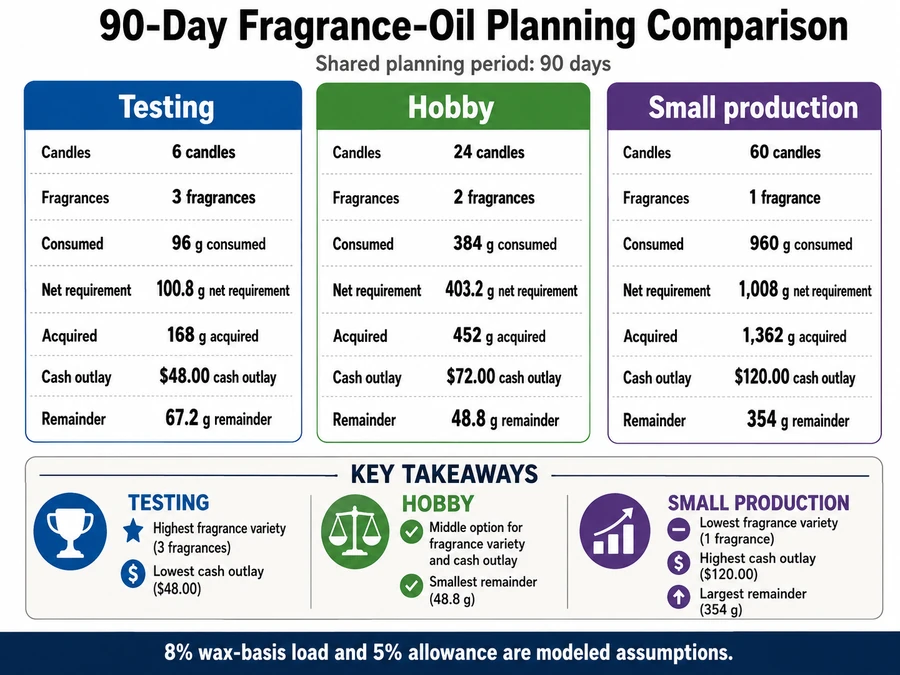
There is no universal candle fragrance-oil budget because testing, hobby use, and small production require different quantities, package choices, and cash outlays.
Budget means planned fragrance-only spending. It excludes equipment, wax, vessels, labor, overhead, selling price, margin, profit, and complete startup or operating expense.
Three-Scenario Fragrance Budget Grid
The modeled 90-day cash budgets are $48.00 for testing, $72.00 for hobby use, and $120.00 for small production.
Each modeled scenario uses the same 90-day period, USD currency, 200 g of wax per candle, an illustrative 8% wax-basis load, a 5% batch-level allowance, and no starting inventory.
| Scenario | Candles | Fragrances | Declared load basis | Consumed fragrance | 5% allowance | Usable inventory | Net requirement | Package plan | Quantity acquired | Cash outlay | Expected remainder |
|---|---|---|---|---|---|---|---|---|---|---|---|
| Testing | 6 | 3 | 8% of 200 g wax | 96 g | 4.8 g | 0 g | 100.8 g | 6 × 28 g samples | 168 g | $48.00 | 67.2 g |
| Hobby | 24 | 2 | 8% of 200 g wax | 384 g | 19.2 g | 0 g | 403.2 g | 4 × 113 g packages | 452 g | $72.00 | 48.8 g |
| Small production | 60 | 1 | 8% of 200 g wax | 960 g | 48 g | 0 g | 1,008 g | 3 × 454 g packages | 1,362 g | $120.00 | 354 g |
The testing scenario consumes only 96 g, yet it requires six sample packages because each fragrance needs 33.6 g after its share of the allowance. One 28 g sample per fragrance would be insufficient.
The hobby scenario uses more oil but divides demand across two fragrances. Its package plan must cover each fragrance separately, so total inventory cannot be treated as interchangeable.
The small-production scenario has the largest cash outlay, but repeat use of one fragrance allows larger packages to serve the same formula. Its 354 g remainder stays recorded as usable fragrance inventory rather than production waste.
Why does buying fragrance oil in bulk leave me over budget even when the price per ounce is lower?
Bulk lowers unit cost only. It can still raise the current cash requirement because the maker must purchase more oil than the planning period will consume, especially when production is divided among several fragrances.
The same scenario calculation can be repeated with different candle counts, fragrance counts, inventory balances, package options, and planning periods. The 8% load and 5% allowance are arithmetic assumptions rather than universal formulation or loss recommendations.
Methods box
| Field | Modeled assumption |
|---|---|
| Planning period | 90 days |
| Wax mass | 200 g per candle |
| Load basis | Illustrative 8% of wax mass |
| Allowance | Modeled 5% applied once at scenario level |
| Starting inventory | 0 g |
| Package availability | 28 g for $8, 113 g for $18, and 454 g for $40 |
| Remainder treatment | Acquired quantity minus net requirement |
| Data status | Modeled comparison, not a universal budget benchmark |
Using one formula set across all three scenarios makes the spending difference traceable to candle volume, fragrance count, package choice, and remainder.
These calculations cover fragrance oil only. Complete candle cost requires separate figures for wax, wicks, vessels, packaging, labor, and overhead, while inventory systems, startup budgets, selling prices, margins, and profit require their own calculations.
Agent: candle maker; Predicate: compares; Patient: fragrance-only budgets by production scenario; Instrument: consistent 90-day assumptions; Location: testing, hobby, and small-production plans; Time: before committing purchase cash.