

Candle containers and jars are vessel families selected for finished container candles, not just any decorative household vessel. This page helps you shortlist those vessel families by material, format, size band, cost tier, and end use before testing.
Here, best means best for the named shortlist goal and current stage, while beginner means easier to source, easier to repeat, and lower in variation. Use this page to narrow the family first, then move to the relevant next-step pages for approval, exact fill math, wick engineering, prep steps, and post-use cleaning.
On this page, material family means what the vessel is made from, container type means the shape family, and size band means the shortlist range before exact measuring.
This page is for shortlisting before testing only, so safety or approval does not get decided here.
Compare Candle Container Materials
Glass, tin, and ceramic-style candle containers each fit different priorities: glass is common and display-friendly, tins travel well, and design-led vessels need a narrower shortlist before testing.
A container material helps you shortlist by portability, presentation, cost, and beginner fit, but it does not verify qualification. The point here is to choose the right material family for the job in front of you, not to treat any material as approved by default.
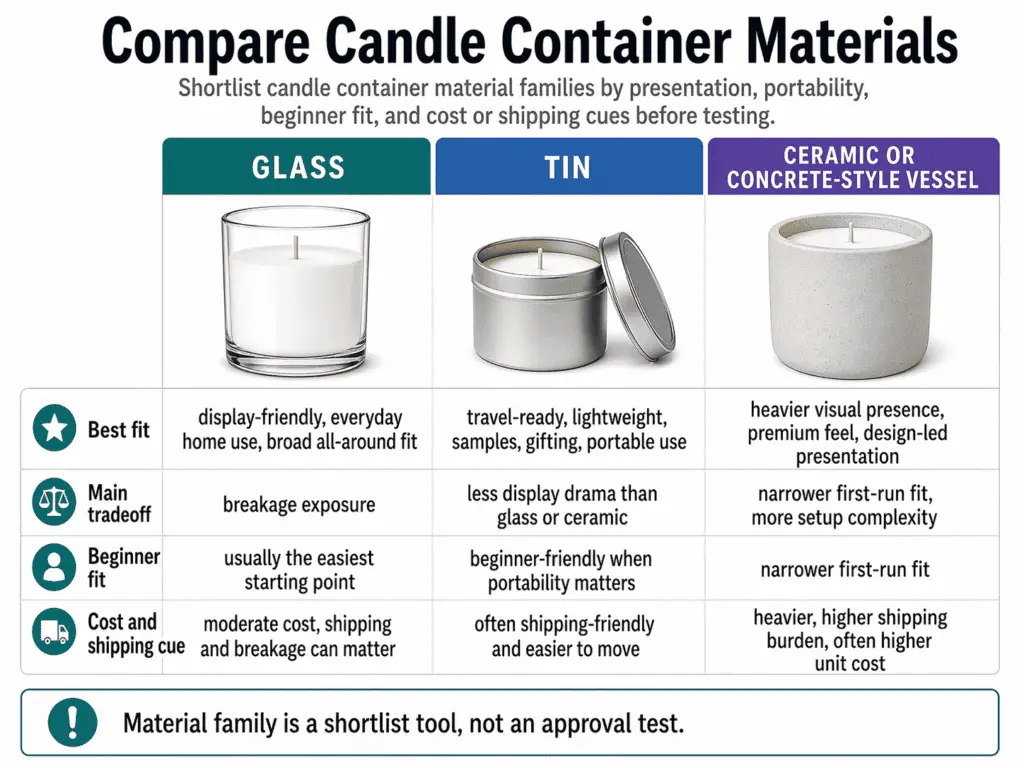
| Material family | Best fit | Main tradeoff | Beginner fit | Cost and shipping cue |
|---|---|---|---|---|
| Glass | Everyday display candles, giftable shelves, familiar retail look | More breakage exposure than metal | Strong starting point in common jar shapes | Usually sits in the middle, but damage risk can raise real cost |
| Tin | Travel use, samples, mail-friendly lines, lighter handling | Less visual weight and less glass-like presentation | Strong first choice when portability matters | Often easier on shipping and breakage loss |
| Ceramic or concrete-style vessel | Presentation-led display, design-led candles, heavier visual presence | More variation, more weight, and a narrower first-run fit | Better after you know your baseline | Usually higher unit cost and higher shipping weight |
Use this table to narrow the material family first. Type families, overall selection, glass-versus-tin tradeoffs, beginner fit, approval, shape-led burn behavior, recycled jars, jar-first selection, and cost tiers belong on their own pages.
Method note: This table groups common vessel families by standard supplier naming, visible construction, and ordinary selection tradeoffs. It is a shortlist tool, not a safety test and not a pass/fail standard.
If you want the easiest baseline, choose common glass. If you want lighter handling or a more travel-ready format, choose tin. If you want stronger shelf weight or a design-led look, choose ceramic-style vessels only when that look matters enough to justify the added complexity. If you want the least risky first order, avoid mixing several material families at once.
Keep one boundary in mind: safe does not get decided here by appearance, wall thickness, or marketing language. Questions about approval belong to the container safety and heat qualification page. Questions about how a vessel behaves once shape and diameter start affecting burn behavior belong to the jar geometry, wicking, and performance page.
Common Candle Container Types and What They’re Best For
Candle container types are shape families such as straight-sided jars, tumblers, apothecary jars, and tins, and each format fits a different mix of labeling ease, display style, and portability.
Type names are not interchangeable. A straight-sided jar, a tumbler, and a travel tin can all hold a candle, but they signal different use-case patterns and different tradeoffs when you compare display, portability, repeatability, and label space.
| Container type | What it means in plain language | Best for | Watch for |
|---|---|---|---|
| Straight-sided jar | A round jar with even side walls and a simple profile | Easy labels, repeat orders, everyday lines | Less decorative than niche shapes |
| Tumbler | A clean, modern jar with a simple open look | Modern display, broad home use, balanced shelf presence | Label area changes with profile |
| Apothecary jar | A more classic or decorative jar profile | Gift candles, styled shelves, more decorative lines | Can feel less baseline for first runs |
| Standard tin | A metal tin for regular container-candle use | Portable lines, lighter shipping, practical first buys | Less presentation-led visual weight |
| Travel tin | A smaller tin built around portability | Samples, favors, compact use | Not the main choice for stronger shelf presence |
Straight-Sided vs Tapered Profile. Straight-sided jars are usually easier to compare, easier to label, and easier to repeat. Tapered profiles can look softer or more decorative, but that shape can make the vessel feel less baseline when your goal is a simple first shortlist.
Non-Round / Statement Vessels
Non-round or statement vessels are square, faceted, or sculptural containers selected mainly for design impact, not plug-and-play baseline jars and not automatic safety-approved options.
These vessels matter most for design-led sellers or readers who care more about visual distinction than a simple first purchase. They can deserve a place on the shortlist, but only as a controlled exception. Here, works means shortlist-worthy when you accept more follow-up around shape and testing; it does not mean equivalent to a standard round jar.
Use common round jars and tins when you want the cleanest starting point for labels, restocks, and first comparisons. Keep statement vessels for cases where the look is part of the product itself. Exact size fit and shape-led performance belong on their own pages.
Best Candle Containers for Beginners
The best beginner candle containers are common, easy-to-source jars or simple tins that reduce early complexity; beginner-friendly does not mean universally safest or permanently best.
A beginner-fit container is common, forgiving, easy to buy again, and easy to compare from one order to the next. It is not a safety certificate, and it is not the forever-best choice for every brand or every candle line.
| Container style | Why it works well first | Best first use | Watch for |
|---|---|---|---|
| Straight-sided glass jar | Common shape, easy to reorder, easy to compare side by side | First everyday line | Breakage matters more than with tins |
| Simple tumbler jar | Familiar display look with few design variables | First giftable or home-use line | Label feel changes with profile |
| Standard tin | Light, practical, less breakage exposure | Portable lines or cautious first buying | Less glass-like shelf presence |
| Travel tin | Narrow, purpose-led first pick | Samples, favors, compact use | Too narrow for a main shelf line |
| Sculptural or novelty vessel | Looks distinctive but adds more variables early | Later-stage styling | Raises variation before you know your baseline |
Method note: This shortlist ranks containers by sourcing ease, repeatability, and how many extra decisions they add at the start. It is a buying-first benchmark, not a performance claim.
Quick Shortlist Tool
This selector narrows one first-purchase path for beginner candle container choices, not a full beginner-only decision page.
| If your first priority is… | Start with… | Hold off on… | Why |
|---|---|---|---|
| Lowest early complexity | Straight-sided glass jar | Sculptural vessels | Easy baseline for comparison |
| Less breakage worry | Standard tin | Decorative glass mixes | Lighter, simpler handling |
| Giftable but still simple | Simple tumbler jar | Presentation-led heavy-base jars | Cleaner middle ground |
| Samples or favors | Travel tin | Full-size statement vessels | Better match for compact use |
| Presentation-led shelf look | Heavy-base or design-led jar | Mixed beginner orders | Better once baseline is clear |
Premium Heavy-Base vs Starter Stock Jars
Presentation-led heavy-base jars and starter stock jars solve different problems: one leans toward shelf presence, while the other makes first-run comparison easier.
Presentation-led here means style and shelf weight, not automatically better-performing. Starter stock jars are usually the smarter first choice because they are easier to source, easier to replace, and easier to compare, while approval and deeper styling choices belong on their own pages.
How to Choose the Right Candle Container Size Band
Choose candle container size bands by use case first: smaller sizes fit samples or favors, mid sizes fit everyday candles, and larger containers suit fuller display formats before exact measuring begins.
Size on this page means a selection band, not an exact fill formula or measurement rule. Use it to narrow small, medium, or large before moving to exact sizing work elsewhere. A nominal ounce label here is a shortlist label, not an exact fill guarantee for every vessel.
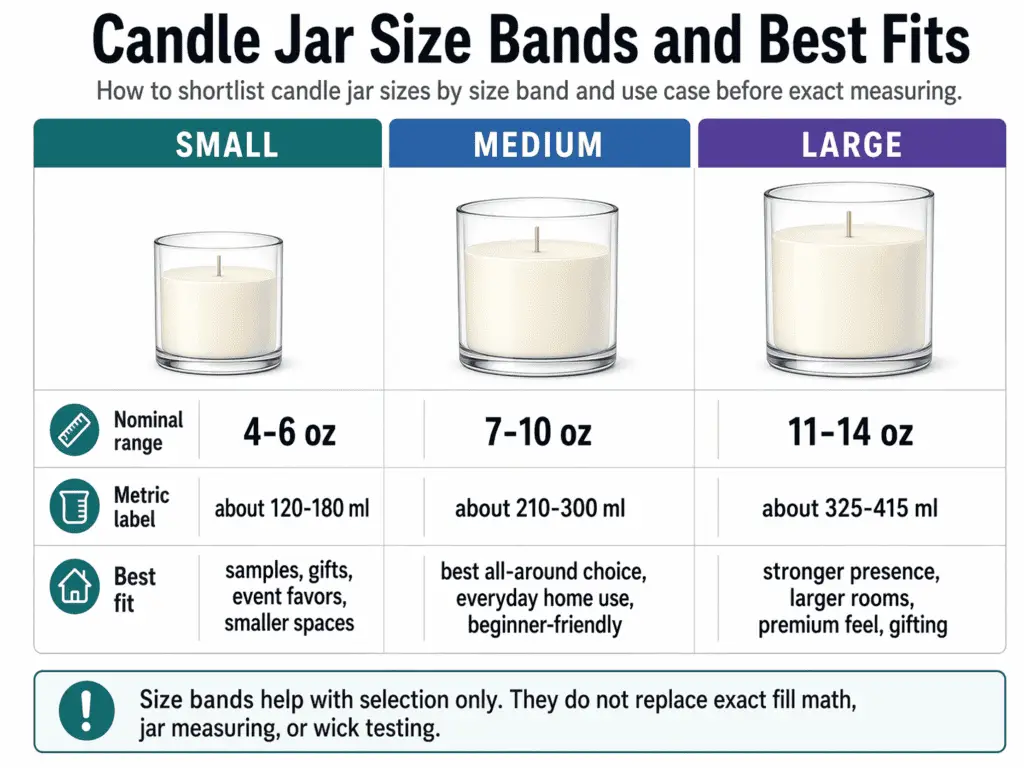
| Size band | Common nominal range | Approximate metric label | Usually fits best |
|---|---|---|---|
| Small | 4–6 oz | about 120–180 ml | Samples, favors, compact add-ons |
| Medium | 7–10 oz | about 210–300 ml | Everyday candles, first main-line jars, broad gifting use |
| Large | 11–14 oz | about 325–415 ml | Stronger shelf presence, fuller display candles, weightier gifts |
Method note: These bands follow common nominal supplier naming and common container-candle retail shorthand. They help with selection only. They do not replace jar measurement, fill, and capacity work.
Use these bands to narrow the container family by product format only. Exact measurement, headspace, fill capacity, and diameter-led behavior belong on their own pages.
Wide-Mouth vs Narrow-Mouth Opening. Opening style affects convenience and visual feel, not exact capacity on its own. Wide-mouth containers can feel easier to work with and more open in style, while narrow-mouth jars can feel taller, neater, or more classic. Better here means better for the look or handling goal you care about, not better in every case.
Sample / Favor Mini Containers
A mini candle container is a smaller-format vessel chosen for samples, favors, or short-format use, not just any tiny jar and not a universal beginner recommendation.
Mini formats work best when the product goal is trial use, favors, or short-format gifting. Keep them as a narrow shortlist branch here, not as the default main-line vessel choice. Gift fit and exact sizing math belong on their own pages.
Candle Container Cost Tiers and What You Actually Get
The cheapest candle container is not always the best value, because breakage risk, reorder stability, and presentation can matter more than visible unit price alone.
Cheap means low sticker price. Best value means the stronger overall fit after you count repeatability, damage exposure, finish quality, and how well the vessel supports the line you want to build.
| Cost tier | What you usually get | Best fit | Main risk |
|---|---|---|---|
| Entry tier | Lower visible unit price, plain finish, fewer extras | First tests, low-friction buying, budget starts | A cheap first buy can lose value if damage or variation rises |
| Mid tier | More balanced finish, steadier feel, broader format choice | Everyday lines, repeat buying, small seller baselines | Can cost more than needed for simple first testing |
| Presentation-led tier | Heavier feel, stronger presentation, more design-led appeal | Gift-led candles, higher-end shelves, presentation-led positioning | Higher price does not solve every problem |
Method note: These value bands compare visible price against repeatability, breakage exposure, and presentation cues. They are shortlist bands, not a full COGS model.
Use these tiers to sort shortlist options by visible price, repeatability, and damage exposure. An entry-tier vessel can be the right first buy, but not when variation or breakage erases the savings. Fuller price and sourcing comparisons belong on their own pages.
Supplier Consistency and Reorder Stability
Supplier consistency and reorder stability mean the vessel stays close in size, finish, and overall feel from one order to the next, not that every supplier follows one shared global standard.
This matters because a container that works once can become a poor long-term choice if later orders shift enough to change the product. Keep reorder stability as a shortlist check here. Deeper sourcing detail and transit detail belong on their own pages.
Choose a Container by Use Case
The right candle container changes by use case: gifting, travel, everyday use, luxury positioning, and seller repeatability each point to different best-fit vessel types. Here, right means the closest shortlist fit for the job, not approval, exact performance, or exact shipping procedure.
Start with the job the candle needs to do, then choose the vessel family that matches that job most closely. Keep this section at shortlist depth only, then move to the relevant next-step pages when the question becomes material-specific, safety-specific, size-specific, or workflow-specific.
| Use case | Best-fit pattern | Why it fits | Watch for |
|---|---|---|---|
| Everyday home use | Straight-sided jar or simple tumbler | Familiar look, broad appeal, easy baseline | Breakage matters more than with tins |
| Gift candle | Styled glass jar or clean lidded vessel | Feels more intentional and shelf-ready | The nicest look is not always the easiest first buy |
| Travel or portability | Standard tin or travel tin | Lighter handling, lower breakage exposure | Portability is not the same as shipping procedure |
| Seller baseline | Common jar family with easy repeat ordering | Easier to compare, label, and restock | Distinctive looks can wait until the line is stable |
| Presentation-led display | Heavy-base or design-led vessel | Stronger visual weight and shelf presence | Higher spend only makes sense when the look matters |
Label Space and Branding Fit
Label space and branding fit mean the vessel gives you a clear, readable surface for branding, not that it solves exact label sizing or label compliance.
Straighter side walls are usually easier to label than highly curved or sculptural shapes. Exact dimensions, placement, and compliance wording belong on their own pages.
Shipping and Breakage Tolerance
Shipping and breakage tolerance mean how practical the vessel is for transit and mail-order handling, not whether it is safety-approved for candle use.
Tins and sturdier, lighter-feeling options often fit shipping-led goals better than fragile glass-first picks. Durable here means more practical in transit, not safer in every sense, and packing workflow and approval belong on their own pages.
Clear vs Amber vs Frosted / Opaque Visibility
Clear vs amber vs frosted / opaque visibility is a finish choice about contrast, visibility, and shelf appearance, not a performance claim.
Clear vessels show more of the candle surface and wax, while amber and frosted or opaque finishes change shelf appearance and how marks or residue show up. Better here means better for the look you want, not better by default.
Lid Compatibility and Closure Style
Lid compatibility and closure style are about lidded versus unlidded presentation, not exact insert fit or clearance engineering.
A lid can make a candle feel more complete, more gift-ready, or easier to store between uses. An unlidded vessel can still be the right choice for a simpler presentation, and exact closure fit belongs on its own page.
Travel Tin vs Full-Size Jar
Travel tin vs full-size jar is the split between portability-first and home-display-first choices, not a rule about airline policy or carrier law.
Choose a travel tin when compact handling, lower breakage exposure, or a smaller format is the main goal. Choose a full-size jar when shelf presence and everyday home use matter more.
Luxury Presentation Containers
Luxury presentation containers are vessels chosen for presentation-led visual positioning through weight, finish, or silhouette, not because they automatically perform better than simpler options.
Luxury matters when the candle needs stronger shelf or gift presence. It matters less when you are still building the simplest first-run baseline, and price pressure belongs in the cost-tier decision rather than in styling alone.
Seasonal / Colored Vessel Choices. Seasonal and colored vessels work best as controlled qualifiers for holiday, occasion, or short-run lines. They are not the default starting point for a baseline everyday container.
Reusable / Recycled Jar Consideration (Selection-Level Only). Reused or recycled jars belong here only as candidate vessels for later review, not as approved candle vessels. Approval and post-use cleanup belong on their own pages.
This page is for shortlist decisions before testing. Once your shortlist is clear, move to the page that matches the next job: approval, exact fill work, shape-led behavior, pre-pour workflow, transit procedure, sourcing depth, label fit, or post-use cleanup.