

Empty candle tins usually cost less up front than empty glass jars, but the real answer depends on size, seller type, lid status, shipping, and loss after delivery.
Glass jars and tins here mean empty candle containers, not finished candles or full candle kits. Cost here means what you pay to get the vessel into your hands, not wax, fragrance, labor, labels, or margin. That keeps the page on one job: help you sort container cost by material and buying tier. If your real question is How Much Does It Cost to Make a Candle?, that is a wider calculation, and if you need Glass vs Tin Candle Containers: Cost, Safety, and Performance, price on its own will not settle that choice.
These opening ranges are April 2026 screens from US online listings in US dollars, not fixed market benchmarks. They use a mixed seller sample that includes retail short packs and wholesale case packs for empty containers only. Read them before freight, tax, and loss normalization, not as full landed cost. Unless a listing rolls tax into the shown total, treat them as pre-tax listing screens.
As an April 2026 screen from a mixed US online seller sample in US dollars, short-pack tins with lids often sit around $0.80 to $1.35 each in the 4 oz to 8 oz range, while bare glass jars in similar sizes often sit around $0.60 to $1.35 each before a separate lid is counted. These are retail-short-pack and wholesale-case listing screens rather than fixed benchmarks, so lid status, freight, tax treatment, and seller tier still decide the usable comparison. By roughly 10 oz to 12 oz+, the gap is less stable, so lid status, freight, and seller tier matter more than material alone.
For the wider vessel family, see Candle Containers & Jars.
Glass vs Tin: Which Candle Container Costs Less Up Front?
For the same size and a like-for-like listing, tins usually come in lower on listed unit price than glass jars.
That first answer is useful, but only as a starting point. A fair match uses the same size band, the same seller type, and the same bundle rules. A jar without a lid is not a clean match for a tin with a lid included, and a small retail listing is not a clean match for a wholesale case.
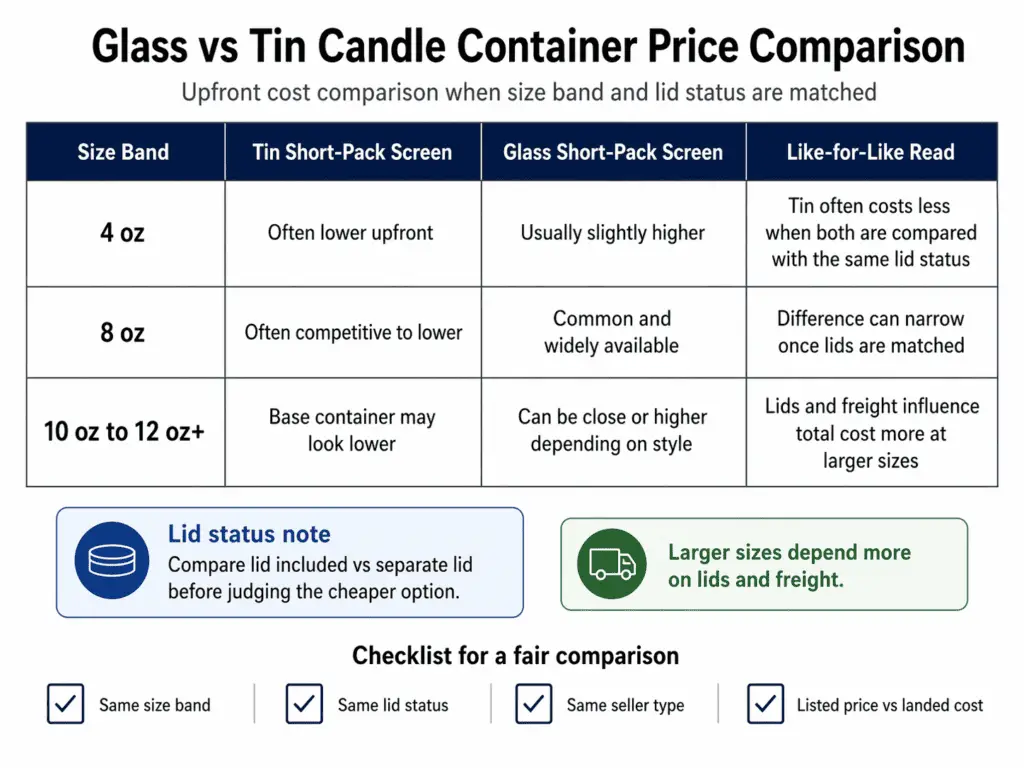
Here, like-for-like means the same size band, the same lid basis, the same seller tier, and the same freight basis.
| Size band | Tin, short-pack screen | Glass, short-pack screen | Like-for-like read |
|---|---|---|---|
| 4 oz | About $0.80 to $1.00 each, lid usually included | About $0.60 to $0.80 each as a bare jar | Bare glass may look lower, but tins often stay lower after lid normalization |
| 8 oz | About $1.25 to $1.35 each, lid often included | About $1.15 to $1.35 each as a bare jar | Shelf price can look close, but tins often keep the cleaner first-pass cost |
| 10 oz to 12 oz+ | About $2.00 to $2.25 each for common short-pack tins | About $1.70 to $2.50 each as a bare jar, depending on case style | The gap is less stable here, so freight and lids decide more of the result |
An 8 oz screen shows why lid status belongs in the first pass. A 12-pack tin listing at about $15.60 works out to about $1.30 each with the lid already in the pack. A 24-pack 8 oz glass jar listing at about $31.47 works out to about $1.31 each before a separate lid is added. On bare shelf price, the jar can look tied. On a lidded container screen, the tin stays lower unless the glass lid cost and freight stay unusually light.
In small runs, tins often win on shelf price. In larger runs, the gap can get smaller, especially when glass is sold in stronger case packs. Even then, the right question is not “Which material is cheapest?” The right question is “Which same-size empty container costs less in this buying band?”
A quick first-pass check helps:
- Match the same size band.
- Check whether the lid is included, separate, or bundled.
- Compare the same buying tier.
- Keep listed price separate from landed cost and usable cost.
If your next question is about jar fit rather than price, use the size, wax-fit, or wick-size pages instead of folding fill weight or wick choice into a cost page.
How Container Size Changes Per-Unit Cost
Container size changes per-unit cost, but bigger does not always mean cheaper.
Small tins often keep the clearest price edge in entry sizes. As size goes up, glass may get closer in some case-pack ranges. That does not mean glass becomes the cheap option by default. It means the gap can tighten enough that seller tier, lid status, and freight start to matter more than material alone.
| Size band | What often happens | What to watch |
|---|---|---|
| 4 oz | Tins keep the clearest price edge | Small glass may look close only in certain bundles |
| 8 oz | Tins still often lead | Lid status can change the result fast |
| 10 oz | Material gap may tighten | Seller tier matters more here |
| 12 oz+ | Some glass lines get closer in bulk | Freight and damage matter more after this point |
Two simple checks keep the comparison clean. First, compare same-size vessels rather than jumping from a small tin to a larger jar. Second, keep price-only thinking separate from setup questions.
If your question has moved from raw container cost to broader tradeoffs, use Glass vs Tin Candle Containers: Cost, Safety, and Performance or How Much Does It Cost to Make a Candle? instead of widening this note.
How Sourcing Tiers Change Candle Jar and Tin Pricing
Sourcing tier can change container cost as much as material does.
Here, sourcing tier means both the seller channel and the order-size level. A retail or sample order often costs more per piece but keeps risk low. A wholesale or direct order may drop the unit price, but only if the case size, minimum order, and storage fit your real buying pattern. Wholesale is not always cheaper in practice.
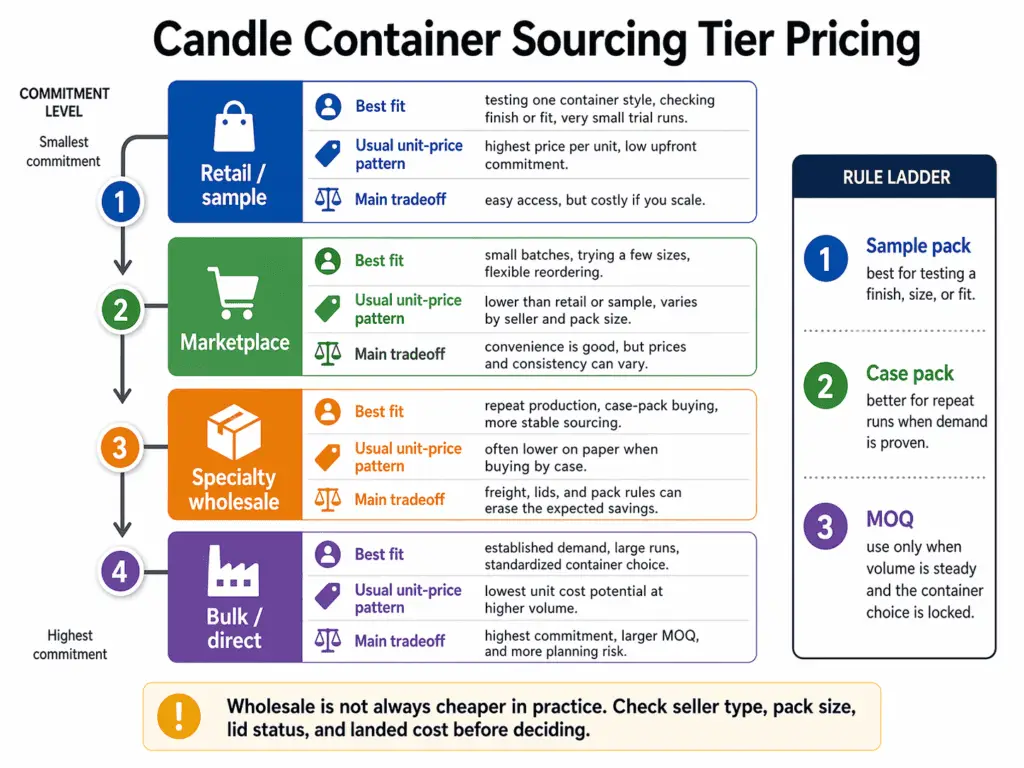
| Sourcing tier | Best fit | Usual unit-price pattern | Main tradeoff |
|---|---|---|---|
| Retail / sample | First test batch | Highest per unit | Lowest overbuy risk |
| Marketplace | Small to mid orders | Mid to high per unit | Easy ordering, mixed bundle rules |
| Specialty wholesale | Repeat mid-size orders | Lower per unit | Case-pack and minimums start to matter |
| Bulk / direct | Stable repeat volume | Lowest listed unit price | Highest commitment |
Small-batch buying favors flexibility. Repeat buying favors lower unit cost only when you know the vessel works and you can use the extra stock in a reasonable time. That is why sourcing tier is a threshold choice, not a rule that always points to bulk.
A simple buying ladder works well:
- Use retail or sample packs when you are testing a container.
- Use marketplace listings when you need small to mid volume and easy reordering.
- Move to specialty wholesale when your batch size repeats often enough to clear case-pack rules.
- Move to bulk or direct only when your use rate is steady enough to absorb the minimum order.
If you need source discovery rather than tier logic, use Candle Container Suppliers for Small Businesses instead of turning this page into a directory.
When Sample Packs, Case Packs, and MOQs Actually Save Money
Sample packs cost more per piece, but they can still be the cheaper move.
That sounds backward until you look at what they save you from. A sample pack lets you test size, lid fit, finish, and handling without tying up money in stock you may not use. A case pack starts to make more sense only after you know the container works for your batch size and product line. Minimum-order buying works best when you already have steady use, not when you are still trying out options.
Use this rule set:
- Pick a sample pack when the vessel is untested or your next batch is small.
- Pick a case pack when you already know the vessel works and expect to use most of it soon.
- Treat minimum-order buying as a repeat-order move, not a first-order move.
- Ignore a lower unit price when slow sell-through or storage limits leave too many containers sitting unused.
If the problem shifts from order size to inventory planning, route to the buying or inventory pages rather than expanding this cost screen.
Why Listed Price Is Not the Real Container Cost
Listed price is only the starting number because the real container cost is usually landed cost, and sometimes usable cost.
For empty candle containers, landed cost means the delivered cost per unit after you add vessel price, inbound shipping, and any needed parts that are not really included. It does not mean retail price, outbound customer shipping, or business margin. That is why a jar can look cheap on the product page and still end up costing more once the order is normalized.
Landed cost per delivered unit = (container total + inbound freight + required lid cost + packing-related add-ons) ÷ delivered units
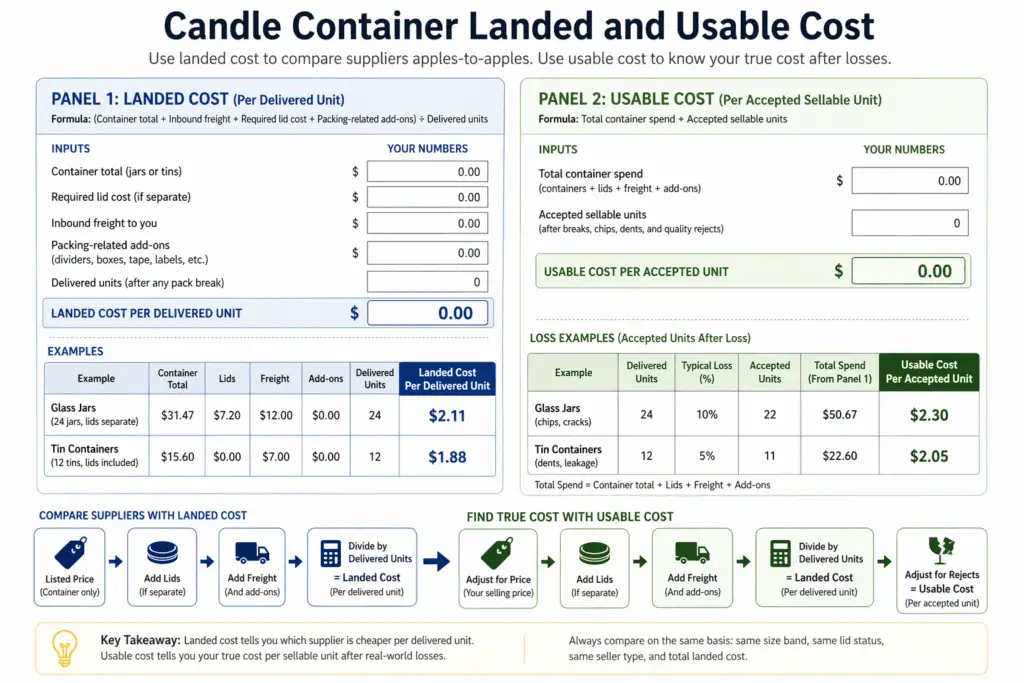
On this page, that math covers container inbound cost only, not outbound customer shipping, full candle cost, or margin.
| Input | Example value | Why it stays in the math |
|---|---|---|
| Glass jar order | $31.47 for 24 jars | Bare vessel price is only the starting number |
| Separate lids | $7.20 total | A jar without a lid is not equal to a tin with a lid in the pack |
| Inbound freight | $12.00 total | Delivered cost changes once the order is moved to you |
| Delivered units | 24 | The divisor must match what actually arrived |
A quick example shows the shift. If 24 glass jars cost $31.47, separate lids add $7.20, and inbound freight adds $12.00, the landed cost is $50.67 ÷ 24 = $2.11 per delivered unit. If a 12-pack tin order costs $15.60 with lids included and inbound freight adds $7.00, the landed cost is $22.60 ÷ 12 = $1.88 per delivered unit.
If two listings look close on shelf price, the lower delivered-unit cost after lid and freight normalization is the lower-cost container on this page. Do not stop at the product-page number.
| Cost factor | What to count | Why it changes the result |
|---|---|---|
| Listed container price | Empty jar or tin price only | This is the headline number, not the final one |
| Inbound freight | Shipping on the order | Heavy or fragile orders can move the real cost fast |
| Lid status | Included, separate, or bundled | Unlike offers should not be treated as equal |
| Packing add-ons | Dividers, sleeves, or extra protection | Fragile formats may need more protection |
| Case weight | Total shipped weight | Glass often carries more freight pressure |
Lid status changes a lot of buying decisions. A jar with a lower listed price but no lid is not directly cheaper than a tin with the lid already in the pack. Freight matters for the same reason. If one option is heavier, the lower headline price may disappear by checkout.
A clean way to compare offers is simple:
- Match the same size.
- Match lid status.
- Add inbound freight.
- Add any required packing-related add-ons.
- Divide by delivered units.
If your question has moved from container inbound cost to full product math or outbound movement, route to the finished-candle cost or shipping pages instead.
How Breakage, Dents, and Rejects Change Usable Cost
Usable cost means total container spend divided by accepted sellable units, not all delivered units.
This step matters when damage or rejects are high enough to change the true cost per usable vessel. Glass and tin do not usually fail in the same way. Glass is more exposed to breakage. Tins are more exposed to dents, bent rims, and shape damage. The loss pattern is different, so the accepted-unit math should match the container type and the order condition.
Usable cost per accepted unit = total container spend ÷ accepted sellable units
A simple example shows when the result can flip. If 48 delivered glass jars cost $96 total and 5 arrive unusable, the usable cost is $96 ÷ 43 = about $2.23 per accepted unit. If 48 delivered tins cost $90 total and 2 arrive too dented to use, the usable cost is $90 ÷ 46 = about $1.96 per accepted unit. The lower delivered-unit option does not stay lower if losses rise enough.
A container that looks cheaper on delivered-unit math can become more expensive after losses are counted. That is why damage should be treated as a cost issue, not only a packing issue. When reject rates are low, the difference may be small. When reject rates rise, the ranking between glass and tin can flip.
Use usable-cost thinking when:
- orders are large enough that a small loss rate changes the per-unit result
- glass arrives with breakage risk
- tins arrive with dents or shape damage
- you need the cost of sellable vessels, not just delivered vessels
If you need damage-control steps rather than loss math, route to the QC or shipping-damage pages instead of expanding this note.