
For most first launches, 8 oz is the easiest starting point, 10 oz is the safest all-around seller size, and 12 oz fits best when stronger presence matters enough to accept more testing and sales friction.
On this page, candle jar size means the nominal vessel-size class being compared, not the exact wax fill weight, fill formula, wick chart, or material answer. On this page, best means best-fit for the job: beginner ease, seller price point, label room, burn expectations, and manageable testing burden. Here, sales friction means harder pricing, slower sell-through, or more testing burden. “Safest all-around seller size” means the lowest-friction commercial default for early selling fit, not fire safety, compliance safety, or toxicology. An 8 oz jar usually wins for lower-commitment starts, a 10 oz jar usually wins as the broadest middle-ground option, and a 12 oz jar usually wins only when a bigger look or stronger premium signal clearly matters. If your real question is exact wax amount, use Candle Wax Calculator. If your real question is exact wick fit, that belongs on separate wick-sizing pages.
These comparisons are directional fit judgments across nominal jar sizes, not exact burn-hour, fill-weight, or wick-engineering claims. Here, “best” and “safest all-around seller size” stay inside commercial-fit language rather than fire safety, compliance safety, or toxicology. For the broader parent topic, see Candle Containers & Jars.
| Jar size | Best for beginners | Best for sellers | Burn expectation | Branding room | Testing burden | Best fit |
|---|---|---|---|---|---|---|
| 8 oz | Strong | Good | Shorter | Tighter | Lowest | Lean starts, gifts, lower commitment |
| 10 oz | Strong | Strongest | Middle | Balanced | Low to medium | Broadest all-around fit |
| 12 oz | Conditional | Conditional | Longer directionally | Largest | Highest | Premium-leaning offers with more tolerance for friction |
These rankings compare the three nominal jar sizes by beginner ease, seller price-band fit, label room, burn expectation band, gifting fit, and likely testing burden. They are fit judgments for choosing a size class, not universal performance rankings or exact engineering claims.
Candle Jar Size Fit Selector
Use 8 oz when the main goal is the lowest-friction start, 10 oz when the goal is the broadest all-around selling fit, and 12 oz only when stronger premium presence matters enough to accept more friction.
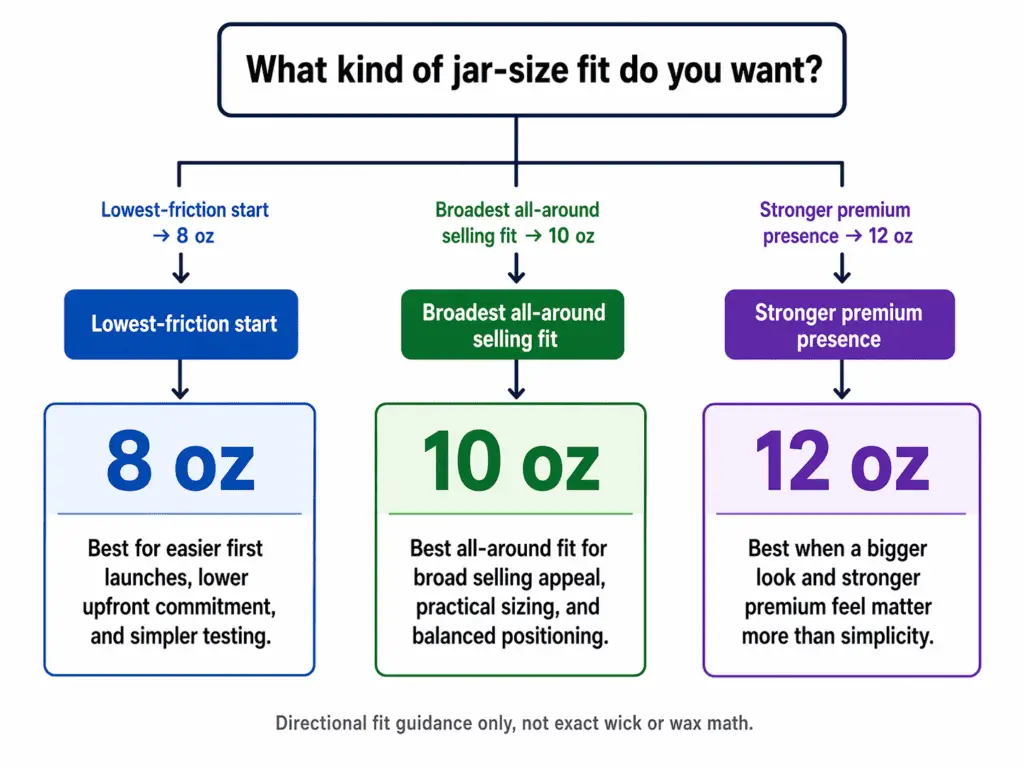
| If your main goal is… | Start with… | Why |
|---|---|---|
| Keep first pours simple | 8 oz | Lower commitment and easier first-round testing |
| Launch one size that feels broadly sellable | 10 oz | Best balance of ease, shelf presence, and price flexibility |
| Build a more premium-looking offer | 12 oz | Larger format can support a stronger premium read |
| Give gifts or lower-commitment candles | 8 oz | Smaller size often feels easier to buy and easier to place |
| Avoid extra testing early | 8 oz or 10 oz | Mid-size and smaller jars usually keep retesting lower |
| Split the difference between ease and presence | 10 oz | Strong middle ground without leaning too small or too large |
Best Candle Jar Size for Beginners: 8 oz vs 10 oz vs 12 oz
For most beginners, 8 oz starts easiest, 10 oz is the safer step up, and 12 oz makes sense only when you already accept more testing.
Here, beginner-fit means easier testing, lower commitment, and fewer early assumptions. In Candle Containers & Jars, the best beginner size is not the one that looks most premium or promises the longest burn. It is the size that gives you the clearest first win without forcing too many variables into the first batch. That is why 8 oz and 10 oz usually make the strongest opening choices.
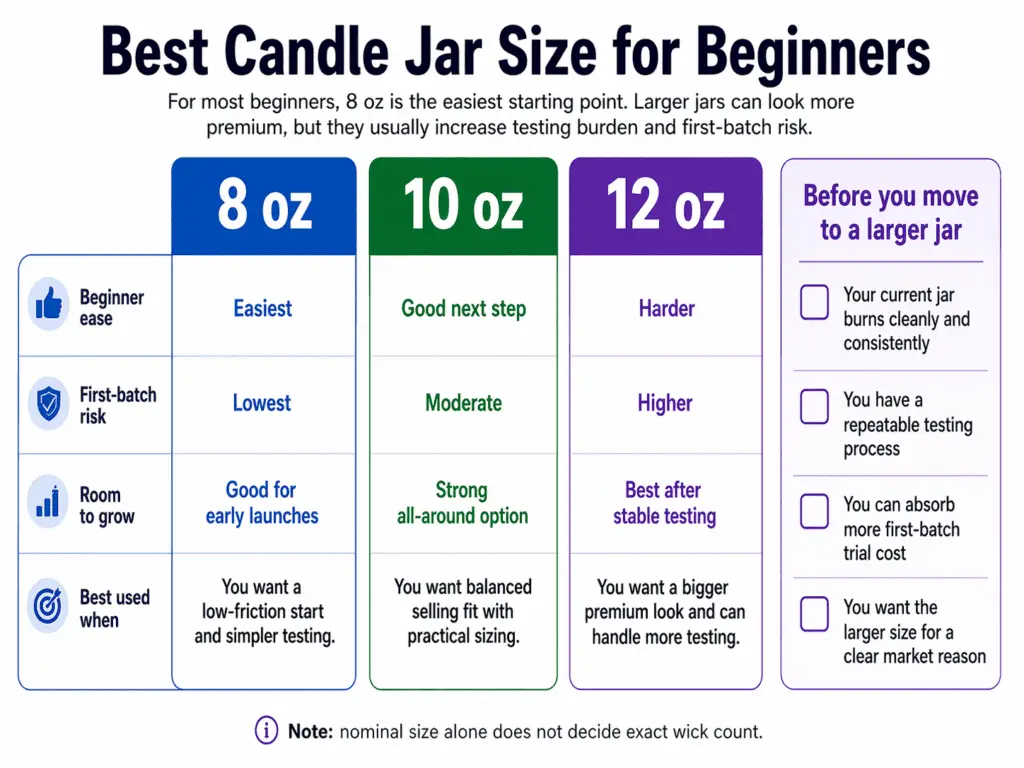
| Jar size | Beginner ease | First-batch risk | Room to grow | Best used when… |
|---|---|---|---|---|
| 8 oz | Highest | Lowest | Good | You want the simplest start |
| 10 oz | High | Low to medium | Highest | You want a more sellable first size |
| 12 oz | Medium to low | Highest | Good | You already want a larger-format offer |
These are the main beginner tradeoffs:
- 8 oz works best when you want the lowest-friction start and the least pressure to prove a bigger format right away.
- 10 oz works best when you want beginner ease without feeling locked into the smallest size.
- 12 oz works best when shelf presence matters enough to accept more retesting and a firmer price ask.
The reason smaller and mid-size jars often feel easier is simple. They usually keep the first round of decisions tighter, the cost of mistakes lower, and the launch pressure easier to handle. A larger jar can still work for a beginner, but it is better as a deliberate choice than as the default.
How to read this section: these comparisons are directional, not lab claims. They weigh first-batch simplicity, likely retest burden, and launch risk across nominal jar sizes. Exact results still depend on the finished candle system, which is why technical questions belong on separate wax-amount or wick-sizing pages.
Why Larger Jar Sizes Usually Mean More Wick Testing
Larger jars usually raise testing burden because more demanding burn behavior often needs more validation.
Wick complexity here means testing burden, not exact engineering. A larger jar does not automatically need two wicks, but it often gives you more chances to retest before the candle behaves the way you want. That is the hidden cost of moving up in size too early.
Use this short check before you move to a larger jar:
- Ask whether you want a bigger jar for a real selling reason or just because it looks better.
- Check whether you can afford extra trial pours and extra burn checks.
- Treat wider jars as more demanding until your testing proves otherwise.
- Keep wick questions separate from size choice until you know the jar is worth pursuing.
A caution matters here: nominal size alone does not decide exact wick count. If your real question is two-wick thresholds or series guidance, that belongs on wick-specific pages. If you need the measurement step first, use How to Measure Jar Inner Diameter for Wick Sizing.
Best Candle Jar Size for Selling at Entry, Mid, and Premium Price Points
For selling, 10 oz is usually the strongest middle-band choice, 8 oz fits leaner entry pricing, and 12 oz needs stronger premium framing.
This section is about commercial fit by size, not full pricing method. Here, best means the jar size that matches the planned price band, buyer expectation, and product-line simplicity. Size affects perceived value and offer structure, not just volume. That is why 10 oz often lands as the safest selling size for a new line: it usually balances price-band flexibility, shelf presence, and manageable testing burden better than the smaller or larger option.
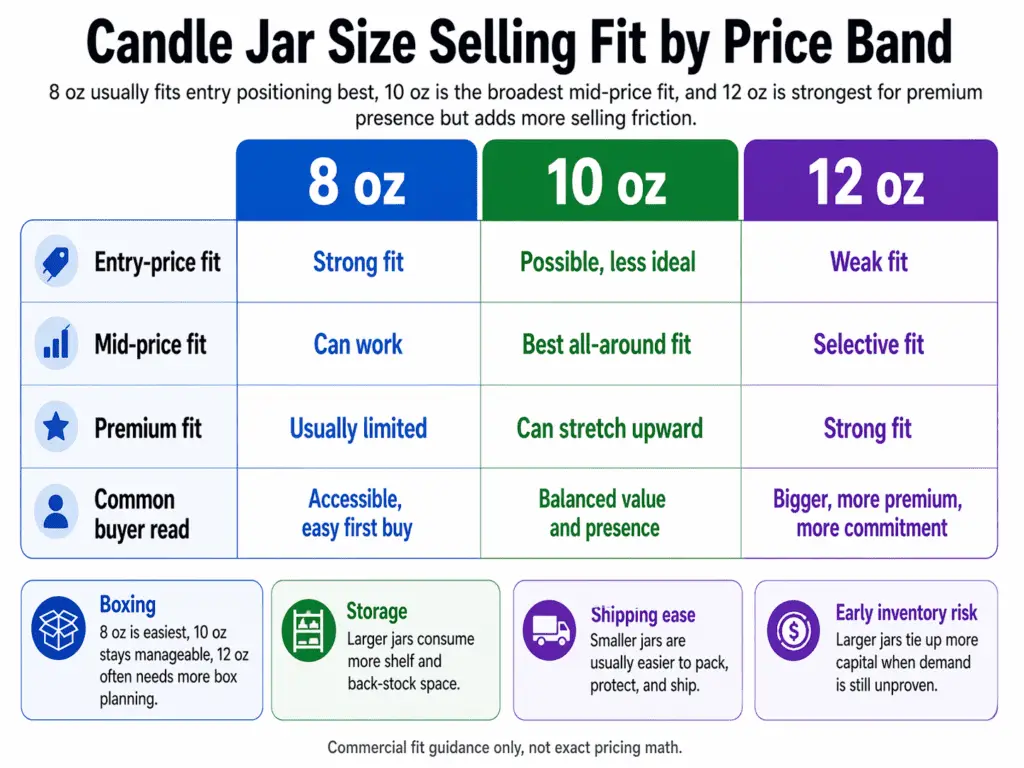
| Jar size | Entry-price fit | Mid-price fit | Premium fit | Common buyer read |
|---|---|---|---|---|
| 8 oz | Strong | Medium | Low to medium | Easy first buy, lower commitment |
| 10 oz | Medium | Strongest | Medium | Balanced, polished, clear value |
| 12 oz | Low to medium | Medium | Strongest | Larger, more premium, higher commitment |
These tradeoffs matter by price tier:
- 8 oz usually helps entry pricing because it feels approachable and does not ask the buyer for a big first commitment.
- 10 oz usually works best in the middle because it feels substantial without forcing a hard premium pitch.
- 12 oz can support premium pricing, but only when the brand, scent story, and presentation all support the larger ask.
A larger jar does not automatically justify a higher price. If the rest of the offer is weak, 12 oz can feel oversized instead of premium. That is why 10 oz often becomes the safer seller default in early product lines.
How to read this section: this is fit guidance, not a pricing calculator. It compares perceived value, band flexibility, and early selling ease across the three jar sizes. If your real question is exact pricing math, move to Candle Pricing Formula.
Which Size Is Easier to Box, Store, and Ship
For small-batch selling, 8 oz and 10 oz are usually easier to box, store, and ship than 12 oz.
This is operational-fit guidance, not a shipping calculator. In early fulfillment, 8 oz usually takes the least room, 10 oz usually balances shelf presence with simpler boxing and storage, and 12 oz usually adds more handling and packing burden. Exact shipping math belongs outside this page.
Which Size Creates Less Inventory Risk for a New Seller
For a new seller, 8 oz and 10 oz usually reduce early commitment risk, while 12 oz often needs stronger confidence and stronger framing.
Here, risk means capital exposure, shelf-space pressure, and the chance that a size sits longer than expected. In practical terms, 8 oz lowers first-batch exposure, 10 oz balances value perception with lower commitment than a larger-format launch, and 12 oz usually needs stronger confidence in demand and sell-through. Deeper stock planning belongs outside this comparison.
Burn Time Expectations by Candle Jar Size
Larger candle jars usually support longer burn-time expectations, but exact hours depend on the finished candle system, not jar size alone.
A larger jar does not automatically mean stronger scent throw or a predictably longer useful burn, because the finished candle system still controls the result.
This section stays with expectation bands, not exact hour math. Best does not mean the longest burn in every setup. It means the size that gives the clearest expectation for the use case and the buyer. That is why 10 oz often sits in the safest middle band, 8 oz is not automatically too short to sell, and 12 oz does not always burn longer in a useful or predictable way.
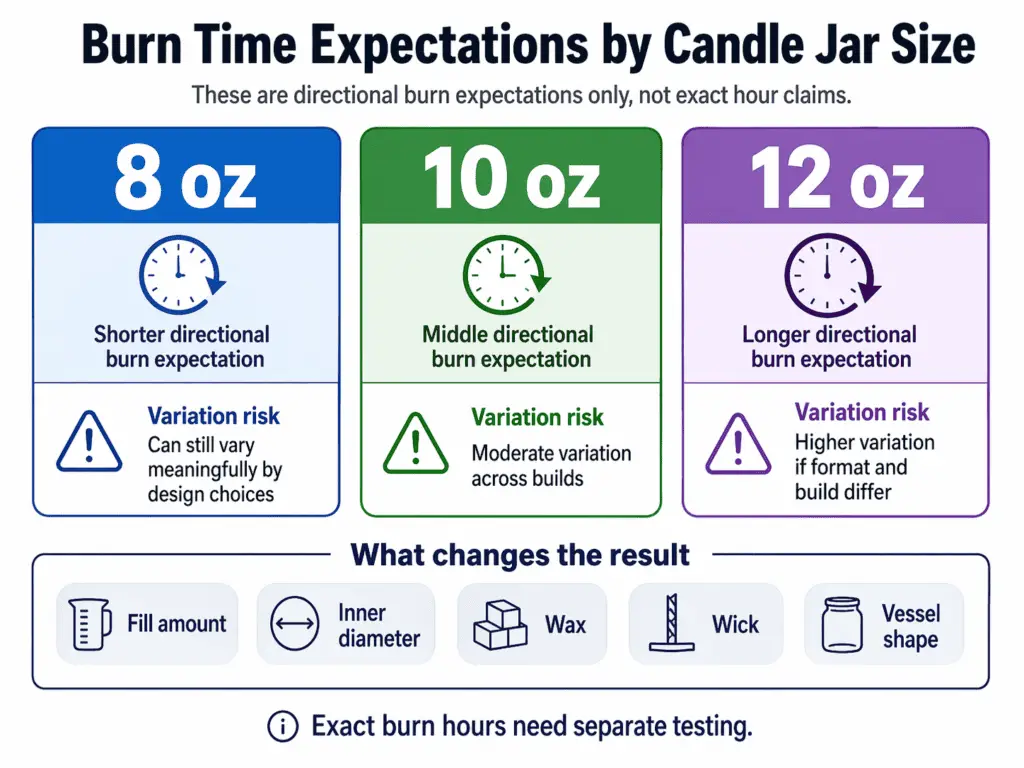
| Jar size | Burn expectation | Variation risk | Best used when… |
|---|---|---|---|
| 8 oz | Shorter directionally | Lower to medium | You want a lower-commitment candle |
| 10 oz | Middle directionally | Medium | You want the broadest all-around fit |
| 12 oz | Longer directionally | Medium to higher | You want a larger-use expectation |
A larger jar often supports a longer expectation because it often holds a larger finished candle, but that is still not a shortcut to exact hours. Fill amount, inner diameter, wax, wick, and vessel shape can all change the result. A well-matched 10 oz candle can feel more dependable than a 12 oz candle that still needs more dialing in.
How to read this section: these are expectation bands only. They are written to lower false assumptions, not to replace exact testing. If your real question is precise fill amount or wick fit, move to those separate pages.
Label Space and Branding Flexibility by Jar Size
10 oz often gives the most flexible branding balance, while 8 oz can feel clean and 12 oz can feel more premium only when the design earns the extra size.
Here, best means the size that fits the look you want the buyer to read at a glance. More blank surface does not automatically mean better branding. A larger jar can feel more premium, but it can just as easily feel empty or oversized when the label and overall design do not match the larger footprint.
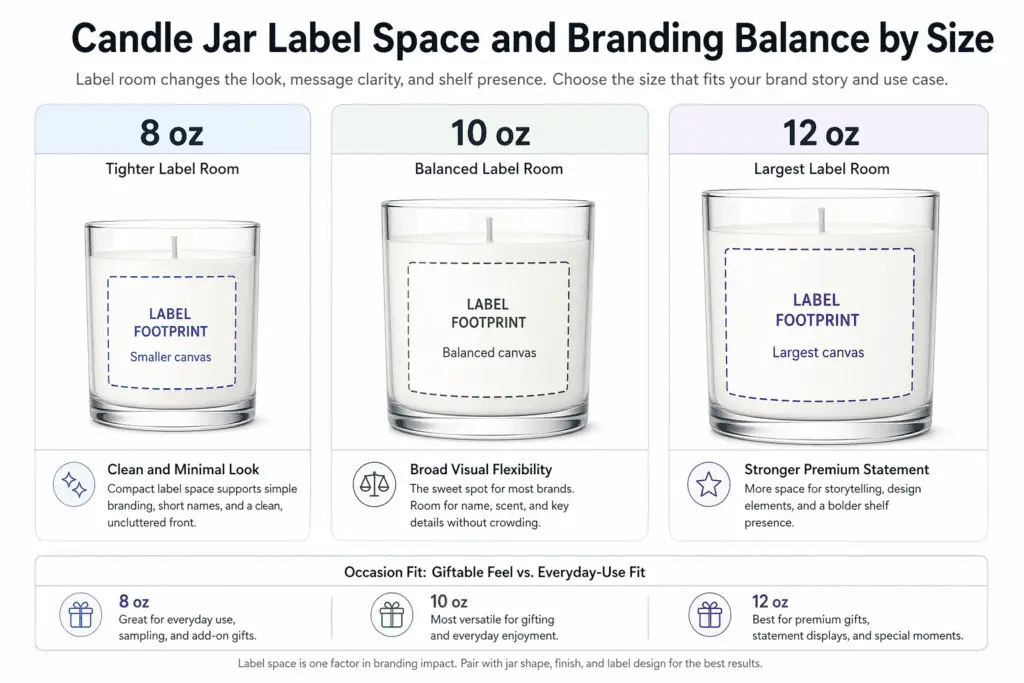
| Jar size | Label room | Visual balance | Best used when… |
|---|---|---|---|
| 8 oz | Tighter | Clean when the design stays simple | You want a neat, lower-commitment look |
| 10 oz | Balanced | Easiest to keep proportionate | You want one size with broad visual flexibility |
| 12 oz | Largest | Strong only when the design fills the space well | You want a stronger premium statement |
These branding patterns usually hold:
- 8 oz works well with short copy, simple labels, and a cleaner overall look.
- 10 oz gives enough room for clear branding without feeling cramped or oversized.
- 12 oz asks more from the label, scent story, and price position to look finished.
If the real decision is vessel material instead of size, that belongs on Glass vs Tin Candle Containers. If size is settled and you want vessel options, Best Candle Jars is the next step. If the broader choice is still unresolved, return to How to Choose the Best Candle Container.
Which Sizes Feel More Giftable vs Better for Everyday Use
8 oz usually feels more giftable, 10 oz usually feels stronger for everyday use, and 12 oz works best when the gift is meant to feel more substantial.
This is occasion-fit guidance only. A smaller jar often feels easier to give because it looks thoughtful without feeling heavy or demanding. A middle size often feels stronger for repeat home use because it balances presence with ease. A larger jar can still work as a gift, but it usually needs the brand and price position to match the bigger impression.
These occasion patterns help most:
- 8 oz often suits gifts, starter purchases, and lower-commitment use.
- 10 oz often suits repeat home use and all-purpose selling.
- 12 oz often suits premium gifting or buyers who want a bigger visual statement.
Which Size Is the Best Fit for Your Exact Use Case?
For exact use-case fit, 8 oz usually wins for lower-commitment starts, 10 oz usually wins as the best all-around compromise, and 12 oz usually wins only when larger presence clearly justifies extra testing and a harder sell.
At this point, the answer is not about one universal winner. It is about matching the jar size to the job. The right choice comes from the tradeoff between beginner ease, burn expectation, branding room, selling flexibility, and testing burden.
| Your main goal | Best-fit size | Why it usually wins | What to watch |
|---|---|---|---|
| Start with the lowest commitment | 8 oz | Lower commitment and simpler first testing | Can feel smaller on the shelf |
| Launch one broadly useful size | 10 oz | Best balance of ease, presence, and selling range | Still needs clear price and brand fit |
| Build a stronger premium read | 12 oz | Larger visual weight and bigger-use expectation | More testing, more price resistance, slower sales pace |
When 10 oz is the best compromise size
10 oz often wins when you want more sellability and presence than 8 oz without taking on the extra testing burden and stronger premium ask that often come with 12 oz.
It tends to fit best when you want one size that can cover both learning and early selling, want more label room and shelf presence than 8 oz, and do not want the added pressure that often comes with a larger-format launch.
If your next question becomes margin math, move to Candle Pricing Formula. If you want vessel options after size is settled, move to Best Candle Jars.
When 8 oz is the best starter size
8 oz often wins when lower commitment and easier first testing matter most.
This is the narrower case where the easiest entry matters more than a bigger shelf statement. It tends to fit best when you want to keep the first batch manageable, lower risk tied to one format, and make an easier launch before deciding whether a larger size is worth it.
If size is set and you want vessel options, Best Candle Jars is the next page.
When 12 oz is worth the extra size and friction
12 oz is worth it when stronger premium signal or larger-use expectation matters more than lean launch simplicity.
This is the narrow case where the largest size in this comparison earns its place. It tends to fit best when you want the candle to read as more substantial at first glance, the brand can support a stronger premium ask, and you can accept more testing and slower early sell-through.
If the next question becomes broader container choice, move to How to Choose the Best Candle Container. If the real issue is technical setup, move to How Jar Shape and Diameter Affect Wick Choice, Hot Throw, and Overheating.
Final Comparison Summary: 8 oz vs 10 oz vs 12 oz
In final terms, 8 oz is the easiest starter, 10 oz is the strongest middle-ground default, and 12 oz earns the nod only when stronger presence matters enough to accept added testing and sales resistance.
| Scenario | Best-fit size | Final takeaway |
|---|---|---|
| First pours, lower commitment, lean launch | 8 oz | Easiest place to start when simplicity matters most |
| One-size launch, broadest balance, steady selling range | 10 oz | Strongest all-around default for many beginners and sellers |
| Larger presence, stronger premium cue, bigger-use expectation | 12 oz | Worth it only when the added testing and price burden clearly support the offer |
| Unsure between ease and presence | 10 oz | Safest middle choice before moving smaller or larger |
When the question moves beyond size comparison, route it on purpose instead of forcing it into the wrong answer. For the wider parent topic, return to Candle Containers & Jars. For broader container choice, use How to Choose the Best Candle Container. For beginner container types beyond size, use Best Candle Containers for Beginners. For jar options after size is settled, use Best Candle Jars. For material choice, use Glass vs Tin Candle Containers. For wick behavior by jar geometry, use How Jar Shape and Diameter Affect Wick Choice, Hot Throw, and Overheating. For exact pricing math, use Candle Pricing Formula.