
Candle additives are optional, goal-specific materials that beginners can usually skip until one clear test goal makes an additive worth trying.
Candle additives are optional materials added to wax to change one defined result, such as hardness, opacity, or surface look, and they are not the same as wax, wick choice, fragrance planning, or decoration. This page is about what beginners should test first, what they can ignore at the start, and when an additive belongs in the formula at all. For the main guide, see candle making.
What candle additives are and when beginners need them
Candle additives are optional materials added to wax for one named result, not wax, wick choice, fragrance strategy, or decorative inclusions.
For beginners, the most common named examples behind these categories are stearic acid for hardness or opacity support, Vybar for selected performance goals, and UV inhibitors for light-related color protection. That does not mean a beginner should use all of them. It means these are the most common entry points into the broader candle additives.
A candle additive belongs on this page only when its job is to change a wax-related result. That result might be a firmer candle, a more opaque look, a smoother surface, or another defined change in the finished candle. It is not the same thing as choosing wax, sizing a wick, or building a full candle ingredients overview is the right place to sort the main material groups. When the question is really about colorants, a candle dye guide is the better route because dye and additive decisions can overlap in beginner searches even when they are not doing the same job.
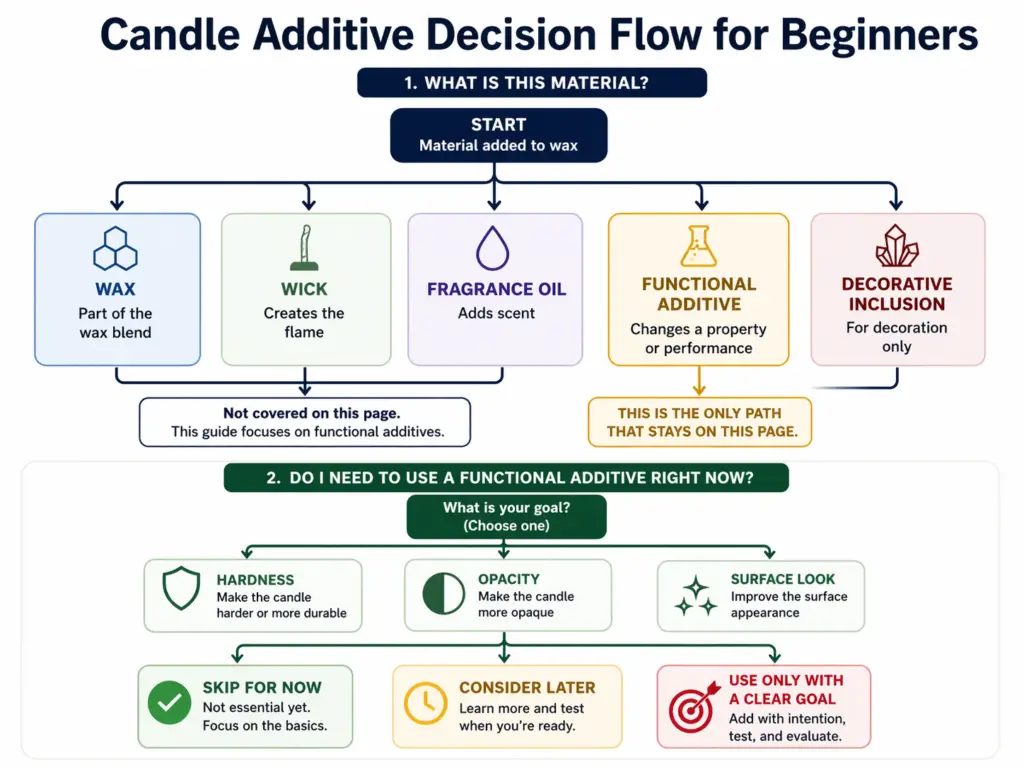
| Material type | Why it gets confused | Does it count here | Where it belongs instead |
| Wax | It changes how the whole candle behaves | No | Wax choice |
| Wick | It affects melt pool and burn behavior | No | Wick choice |
| Fragrance oil | It is added to wax during making | No | Scent planning |
| Functional additive | It is added for one defined wax outcome | Yes | This page |
| Decorative inclusion | It goes into or onto the candle for looks | No | decorative candle embeds guide |
Another point that causes confusion is built-in performance help in some wax systems. If a wax already contains performance boosters, you are still getting additive support, but you are not making a separate additive choice. That matters because beginners often do better when they lower the number of variables at the start. In many cases, the simpler route is a beginner wax-system guide or a pre-blended candle wax guide rather than buying separate materials before you know what problem you are trying to solve.
No, most beginners do not need additives for their first learning batches.
If you start with a pre-blended wax, test that wax plain before adding separate materials, because built-in support and extra additives are different decisions.
Optional does not mean useless. It means additives are outcome-specific tools, not required starter supplies. A beginner can make workable candles without them and learn more from a plain setup because the variable list stays smaller. That is why many first test batches work better as candles without additives. If your question turns into exact amounts or wax-by-wax rules, that belongs in candle additive dosage by wax type, because those answers depend on the wax and the material being tested.
| Decision | What it means |
| Skip for now | You are still learning the base wax, wick, vessel, and fragrance setup |
| Consider later | You want one clearer result, but the current candle is still teaching you useful basics |
| Use only with a clear goal | You can name the result you want and test one change at a time |
Starting without extra materials usually lowers cost, lowers confusion, and makes first-batch results easier to interpret.
Decorative inclusions are not the same as functional additives
Functional additives are chosen to change a defined wax result, while decorative inclusions are chosen for how the candle looks.
That difference matters because beginners often treat any material added to wax as part of the same decision. It is not. Glitter, botanicals, crystals, and other visual add-ins belong on a different path because the goal is decoration, not a controlled change in how the wax performs. That is why visual questions belong with the decorative candle embeds guide, while additive questions stay tied to one named wax outcome. A simple rule helps here: if the material is mainly there to look pretty, it is not part of the functional additive shortlist on this page.
Beginner-friendly candle additive types worth considering first
The most beginner-friendly candle additive types are optional categories that match one clear goal, are easy to test in small batches, and do not create multi-variable confusion.
Here, beginner-friendly means easy to source, easy to test, and low in stacking pressure. On this page, the safest shortlist means the lowest-confusion set for beginner testing, not toxicology, fire safety, or legal compliance. It does not mean strongest, highest-performing, or best in every wax system. The safest shortlist is not the longest one. It is the one that lets a beginner connect one material to one visible result without guessing.
| Additive type | Primary beginner goal | Why it may be worth testing | When not to start with it |
| Hardness or opacity additive | Firmer look or less-translucent wax | The goal is easy to name and easy to compare | Skip if you do not care about firmness or opacity |
| Surface-finish additive | Smoother tops or a cleaner surface look | The result is visible and simple to judge | Skip if you are still learning how your base wax cools on its own |
| Structure-support additive for a specific style | More support for a style that needs it | It can help when the outcome is clearly defined | Skip if you are making ordinary first-batch container candles |
In practice, named examples often sit behind these categories. Stearic acid is a common bridge example when the goal is more hardness or opacity, while Vybar appears when the question shifts toward selected performance goals in certain wax systems. If your next question is what one named material does, move to the matching material page instead of turning this article into a chemical catalog.
For many beginners, the easier answer is still no separate additive at all. A pre-blended wax guide can be the better starting point because it reduces extra choices before you know which outcome matters most to you. That does not make separate additives bad. It only means a simpler wax system often teaches more in the early stage.
A good first choice is usually the additive family tied to opacity, hardness, or surface appearance, because those goals are easier to see and easier to compare than vague promises about “better performance.” If you later need material-level detail, pages such as Vybar guide or stearic acid guide make more sense than turning this page into a chemical catalog. If your real goal is color, keep that question separate and use the candle dye guide instead of treating every color-related material as an additive decision.
Match the additive to the goal, not the trend
The best beginner additive is the one that matches one named goal.
That sounds obvious, but it stops many bad purchases. If your goal is a firmer candle, choose a material category tied to firmness. If your goal is more opacity, choose a category tied to opacity. If your goal is a smoother-looking top, choose a material only when your base wax and pouring process are already understood well enough to judge the change. Trend-driven buying causes problems because “popular” does not tell you what the material is supposed to fix.
A helpful beginner question is not “What additive should I buy?” but “What exact result do I want to change?” Once that answer is clear, the shortlist becomes smaller and easier to test. When the question stays broad, beginners usually overbuy and undertest.
Test one additive variable at a time
Change one additive variable at a time so you can tell what changed and why.
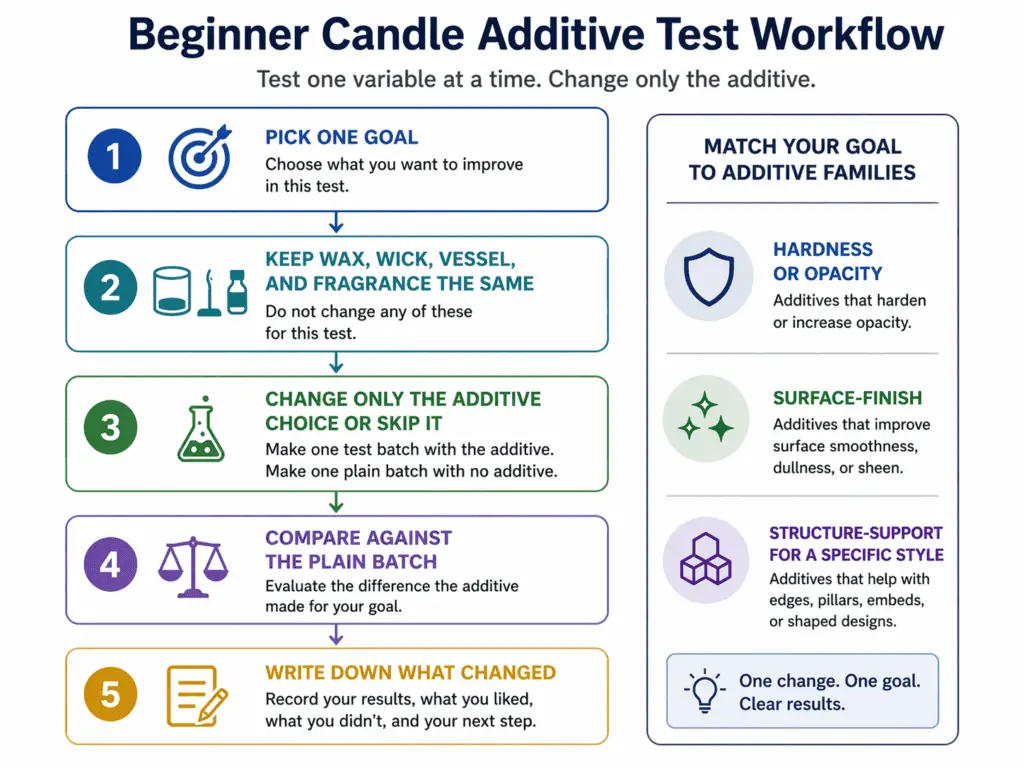
Single-variable testing protects beginners from false lessons. If you change wax, wick, fragrance load, and additive choice together, the next result becomes hard to read. You might think the additive helped when the real cause was a wick change, or blame the additive when the real issue was a cooling or pouring difference. Small, readable changes work better than dramatic batch-to-batch jumps.
A safe beginner rhythm looks like this:
- Pick one goal before you pour.
- Keep the same wax, wick, vessel, and fragrance setup.
- Change only the additive choice or the decision to skip it.
- Compare the result to the plain batch.
- Write down what changed before you test again.
That keeps the learning clean. When the real need becomes exact ratios, compatibility, or wax-conditional decisions, that belongs in additive dosage by wax type, not in a beginner decision page.
Additives beginners should avoid in early batches
Beginners should avoid additive choices that add confusion, hide root causes, or act like shortcut fixes in early batches.
Avoid here means defer for now because the choice raises failure risk or makes first-batch results harder to interpret. It does not mean a permanent ban, a legal ban, or proof that a material is always wrong in every candle setup. The point is narrower than that: if a material adds noise before you understand your base setup, it belongs later, not first. Early-batch choices should make results easier to read, not harder.
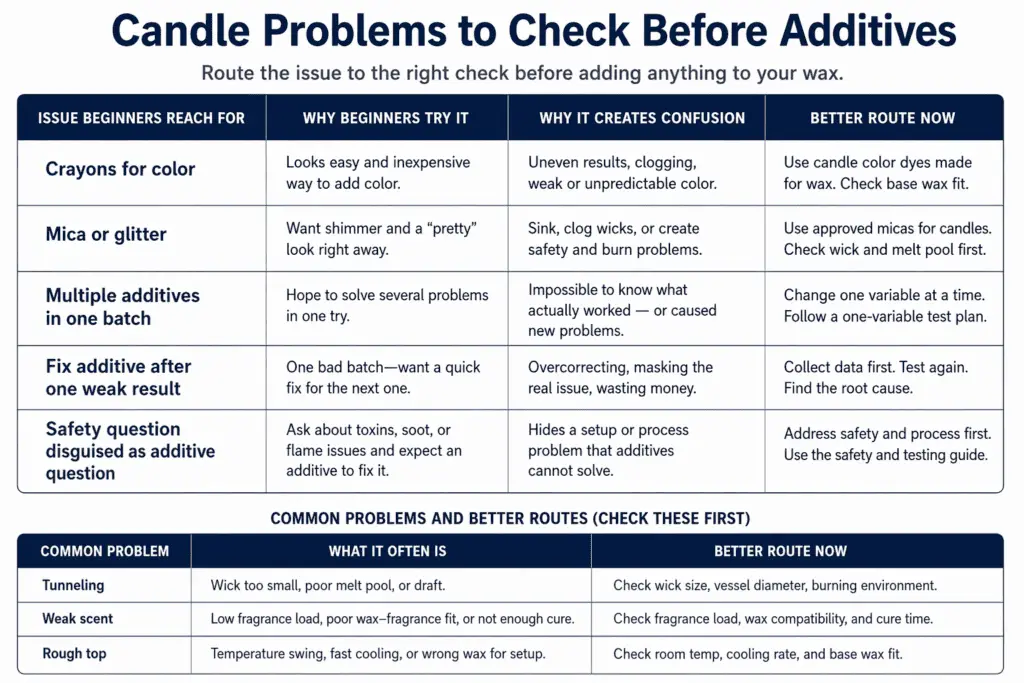
| Looks useful | Why beginners try it | Why it creates confusion early | Better action now |
| Crayons for color | They seem cheap and familiar | They blur the difference between purpose-made colorants and random substitutes | Use the candle dye guide when your real goal is candle color |
| Mica, glitter, or other sparkle-first add-ins | Photos make them look simple | They push the decision into visual materials, not functional additive choice | Treat that as a decor question and use the decorative candle embeds guide |
| Multiple additives in one first batch | It feels faster than slow testing | You cannot tell which change caused which result | Keep one change per batch |
| “Fix” additives bought after one weak result | They promise a fast answer | They can hide a wick, wax, vessel, or process issue | Check the base setup first |
| Safety questions disguised as additive questions | Beginners want one clear yes or no | The real question is safe material use, not additive choice | Route those concerns to candle safety basics |
A better beginner move in most of these cases is to change less, not buy more. If the material is mostly about sparkle, texture, or visual styling, it belongs outside the additive lane. If the problem looks like color, handle it as a color question. If the problem looks like burn behavior or scent strength, handle it as a wick, wax, fragrance, or process question first.
Shortcut materials are often bad for beginners because they blur causality. A beginner does not just need a prettier candle. A beginner needs to know why a result changed. Any material that makes that answer less clear is usually a poor early choice, even if it might make sense later in a narrower use case.
Additives do not fix every candle problem
Additives do not fix every candle problem because many first-batch defects come from wick choice, wax system, vessel setup, cure behavior, or process mistakes instead.
This boundary matters because beginners often buy extra materials when the real cause sits somewhere else. That habit turns a simple learning problem into a messy one. A rough top does not always mean you need a wax additive. Weak throw does not always mean you need a helper material. Tunneling does not automatically mean the wax needs changing. Many early problems sit upstream from additives.
| Problem assumption | Why this page does not own it | Better route |
| “My candle tunnels, so I need an additive” | Tunneling usually starts as a wick, vessel, or burn-fit question before it becomes an additive question. | Start with candle troubleshooting and then the wick sizing guide |
| “My scent is weak, so I need more additive” | Weak throw often points to fragrance load, cure, wick, or base wax fit before extra materials. | Check the candle wax comparison guide |
| “One rough top means my wax needs extras” | One rough surface does not justify stacking new materials into a first-batch test. | Log one variable at a time in the beginner candle testing guide |
That is why the safest beginner rule is simple: use an additive only when the change you want clearly belongs to the additive layer. If the issue is really about burning, sizing, scent load, cure, or base wax fit, start with the matching page instead of reaching for an additive as a general fix. For most first batches, plain wax plus a clear test goal beats a basket of extra materials.