
Candle additives are optional wax modifiers that help with a specific result, but many candles work without them when the wax, candle type, and goal do not call for extra support.
Candle additives are materials added to wax to change how a candle looks, releases fragrance, unmolds, or holds its shape. They are enhancers, not requirements, so they belong in the formula only when they serve a named goal. A plain wax formula can be the right starting point when the wax already fits the job and the result is modest. The main choice is simple: match the wax and goal first, then decide whether to stay additive-free, use one additive, or leave a pre-blended wax alone.
This page explains what candle additives are, when they are optional, and how to choose a direction, not exact rates, mixing steps, safety testing, or single-additive deep dives.
What candle additives are
Candle additives are optional wax modifiers used to change a named result, such as hardness, opacity, mold release, fragrance support, or surface stability.
On this page, a candle additive means an extra material that changes how the wax behaves or looks. It does not mean fragrance oil, dye, or decorative inclusions by default, and it does not mean a candle is better just because more ingredients were added. The broader idea behind candle additives and enhancers is simple: they are result-linked tools, not automatic requirements.
Common examples include stearic acid for structure-focused formulas, Vybar for fragrance or finish-focused formulas, and UV inhibitors for color or light-stability goals, but this page stays at the function level rather than deep product detail.
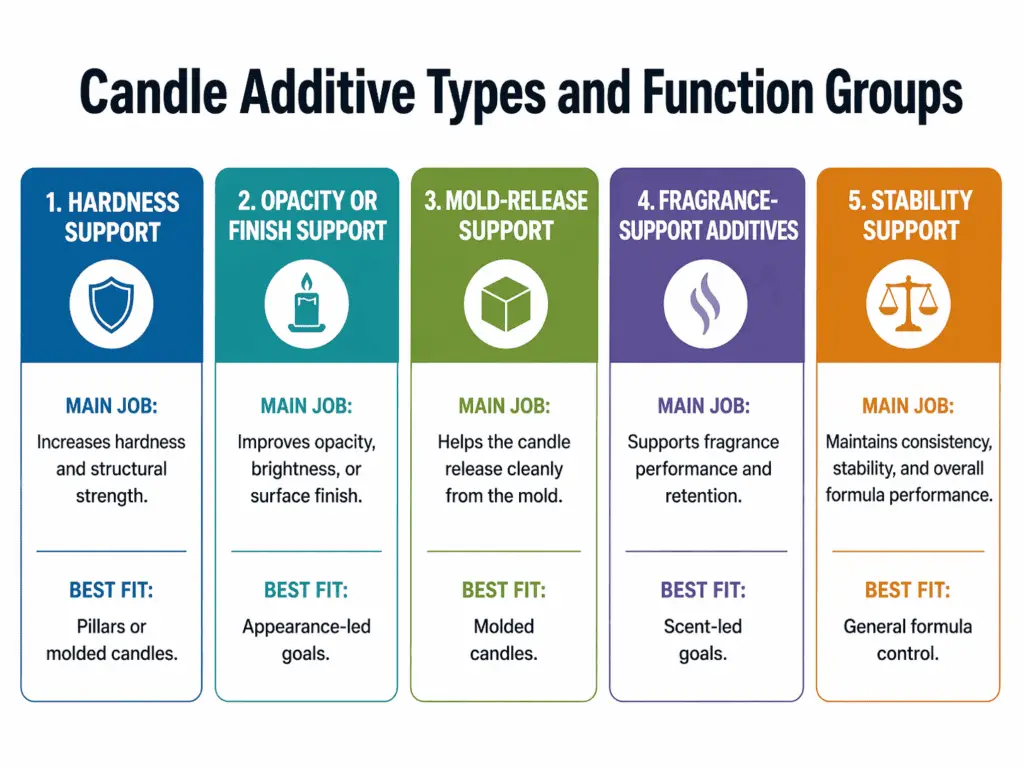
Why candle makers use additives
Candle makers use additives to reach a specific result, not to make every formula look more advanced.
A maker might use one additive to make a pillar candle firmer, another to improve mold release, and another to support fragrance retention or surface appearance. The key point is that each additive should answer one main goal. When wax choice, candle type, or blend status already covers that goal, adding more is not always the right move.
- Hardness or structure support matters most when the candle must hold shape on its own.
- Opacity or finish support matters when surface look is part of the target result.
- Mold-release support matters when the candle needs to leave the mold cleanly.
- Fragrance-support additives matter when the goal is better scent retention within the current wax setup.
- Stability support matters when the maker wants a cleaner, more controlled result from the same wax path.
Common additive categories at a glance
Common candle additives are easiest to understand as function groups, such as hardness support, opacity or finish support, mold-release support, fragrance-support additives, and stability support.
| Additive category | Main job | Best fit |
|---|---|---|
| Hardness support | Helps wax hold shape more firmly | Pillars, molded candles, firmer finish goals |
| Opacity or finish support | Changes how solid or smooth the wax looks | Appearance-led goals |
| Mold-release support | Helps candles release from molds more cleanly | Molded candles |
| Fragrance-support additives | Support scent retention in the wax system | Scent-led goals |
| Stability support | Helps control surface or handling behavior | General formula control |
Common examples at this level include stearic acid for structure-focused formulas, Vybar for fragrance or finish-focused formulas, and UV inhibitors for color or light-stability goals, while specific additive pages handle exact product behavior.
This function-first view keeps the category clear before narrower pages such as how much additive to use in candles come into play. It also keeps functional additives separate from fragrance oils, dyes, and decorative extras. When a plain wax path already fits the goal, candles without additives remains a real option rather than an afterthought.
Do candles need additives or are they optional?
Candles do not automatically need additives. An additive becomes optional, useful, or likely necessary only when the wax, candle type, and named goal call for it.
Here, necessary means likely required to reach a stated result with the chosen wax and candle type. It does not mean every candle needs additives, and it does not mean a beginner should buy several modifiers before making a first batch. A pre-blended wax for a modest goal may need nothing extra, while a raw wax aimed at a more demanding result may push the additive question much sooner.
| Need level | What it means | Typical reading |
|---|---|---|
| Optional | The candle can meet the goal as-is | Start without additives |
| Useful | The candle can work without the additive, but a named result may improve | Add only if that result matters |
| Likely necessary | The current wax path is less likely to reach the named result without extra support | Consider one additive tied to one goal |
This three-part view is more useful than a flat yes-or-no answer because it keeps the decision tied to wax, candle type, and result.
Skip additives when the wax already matches the candle type, the goal is modest, and no single result is clearly missing.
When additive-free candles work
Additive-free candles can work well when the wax, candle type, and goal do not ask for extra performance support.
That path is often strongest when the goal is modest, the wax already fits the job, or the maker is using a pre-blended wax designed for a clear use case. A fuller additive-free path makes sense when the candle already burns, releases, and looks acceptable for the intended result. It stops making sense when the goal becomes more demanding than the plain wax can reliably handle.
Goal-first no-additive starting path: start with plain wax when the target is modest, the candle type is simple, and the wax already matches the job. Move to additives only when the result you want is still missing after that first decision.
A quick no-additive check looks like this:
- The wax already matches the candle type.
- The goal is modest rather than demanding.
- The wax is sold as a pre-blended option for that use.
- No single result is clearly missing yet.
- You still need proof before buying more materials.
If the question shifts from a broad additive-free starting path to a narrower pre-blended-wax decision or exact-rate question, move to should you add additives to pre-blended candle wax or how much additive to use in candles instead of expanding this overview.
How to choose additives by candle goal
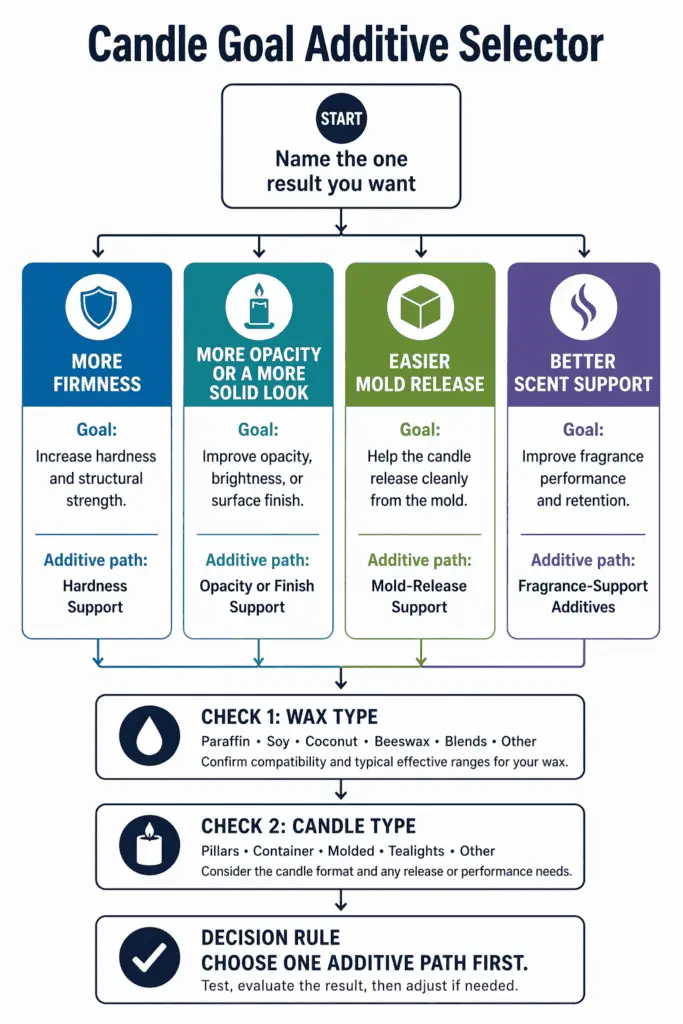
Start with the result you want, then match one additive family to that one result instead of shopping by product name or buying several modifiers at once.
The cleanest way to choose is to name the outcome before you name the ingredient. On this page, “best” means best for the named goal and the current wax and candle format, not best in every formula. A useful first pass is to choose candle additives by asking one question: what is the one result the wax is not giving you yet?
| Goal | What to look for | First decision |
|---|---|---|
| More firmness | An additive path that supports structure | Check whether the wax is too soft for the candle format |
| More opacity or a more solid look | An additive path that supports finish and appearance | Decide whether appearance is the main priority |
| Easier mold release | An additive path that supports clean release | Confirm that the candle is molded, not container-only |
| Better scent support | An additive path that supports fragrance retention | Check whether the scent goal is the main gap |
If the issue starts with the wrong wax rather than a missing modifier, change the wax path first and leave additives for later. That is one reason pages like best candle additives for hardness opacity mold release and best candle additives for scent belong as narrower next steps rather than being absorbed here.
How wax type changes additive need
Wax type changes additive need because soy, paraffin, beeswax, and blends do not bring the same strengths, limits, or starting priorities.
That does not mean each wax needs a long separate formula lesson here. It means the wax family changes which goal rises to the top first. A softer wax may push the decision toward structure or finish, while another wax may already handle that part well enough that the better move is to skip extra modifiers.
A fast wax-type check looks like this:
- Softer waxes may raise structure or finish questions earlier.
- Firmer waxes may not need help for the same result.
- Blends can reduce the need for extra support if the blend already targets the use case.
- Raw waxes leave more of the decision work to the maker.
Choose additives by candle type
Candle type changes additive choice because container, pillar, molded, and melt formats do not ask the wax to do the same job.
A container candle can follow a different decision path than a pillar or molded candle, because freestanding candles depend more on structure, release, and surface control. Wax melts shift the focus again because burn structure is not the same priority there.
| Candle type | Main selection question | Why it matters |
|---|---|---|
| Container candle | Does the wax already suit jar use? | Structure demands are lower than for freestanding candles |
| Pillar candle | Does the wax need more firmness? | The candle must hold shape on its own |
| Molded candle | Does the wax need release support? | Clean unmolding matters |
| Wax melts | Is scent or appearance the main goal? | Burn structure is less central |
Know the main tradeoffs before you choose
Every additive choice solves one problem by making one result easier to reach, but it can make another part of the formula less simple.
That is why beginners usually do better when they solve one goal first instead of chasing hardness, opacity, release, and fragrance support at the same time. When the real question is scent depth rather than general selection, route that choice to best candle additives for scent instead of turning a single-goal decision into a broad formula project.
Common tradeoffs at the selection stage include:
- A choice that helps firmness may not be the same choice that helps scent support.
- A cleaner molded result may come with a different priority than a container candle.
- A more controlled surface may matter more for appearance-led candles than for basic testing.
- More modifiers can make the reason behind the result harder to read.
Choose by function, not brand hype
Use this short check before buying:
- Name the result first.
- Confirm the wax type.
- Confirm the candle type.
- Ask whether the wax already does the job.
- Buy by function, not by product label alone.
Pre-blended wax vs raw wax: add more or not?
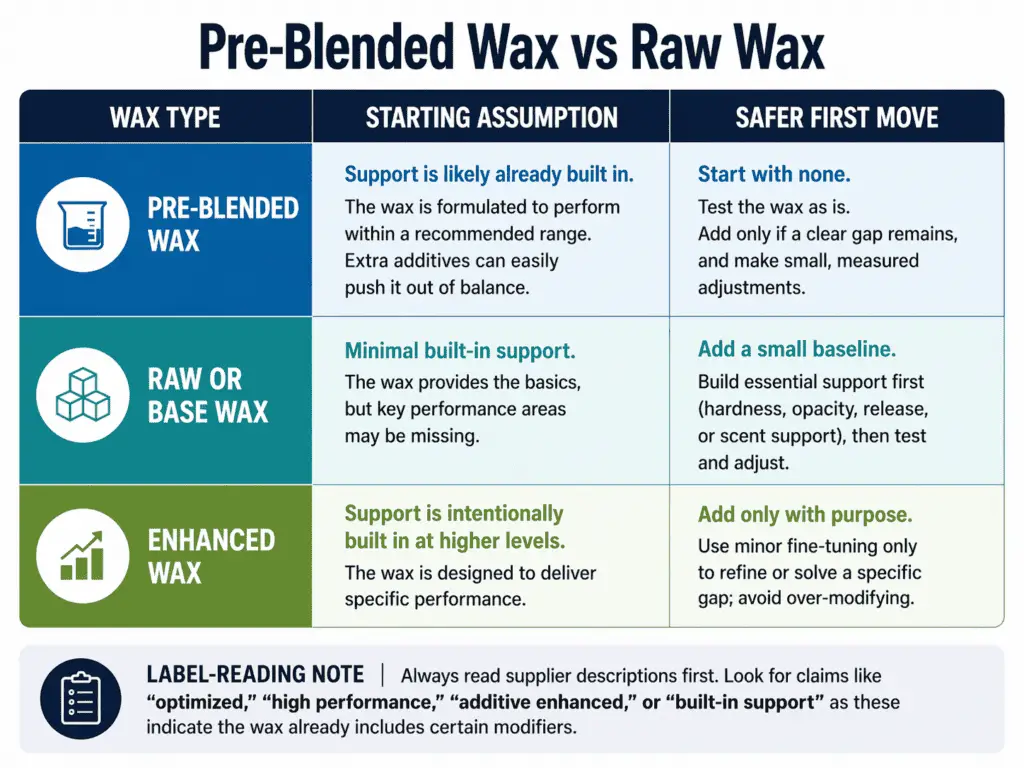
Pre-blended wax and raw wax do not create the same additive decision path, because a pre-blended wax already includes built-in support while a raw wax leaves more of the formula work to the maker.
Here, “need” means whether extra modifiers are justified after you account for the wax status and the named goal. It does not mean you should automatically improve a pre-blended wax with more ingredients. In many cases, the better first move is to leave the blend alone, test the result you actually get, and only then decide whether a change is justified.
| Wax type | Starting assumption | Safer first move |
|---|---|---|
| Pre-blended wax | Some support may already be built in | Leave it alone unless a clear result is missing |
| Raw or base wax | More formula choices remain open | Decide what result you need before adding anything |
| “Enhanced” wax | The supplier may already have tuned part of the job | Check what is already being supported |
A reader asking whether to add additives to pre-blended candle wax usually needs a narrower answer than a flat yes or no. The broad rule here is simple: do not add more by default. If the deeper question is how to judge a specific blend, move to should you add additives to pre-blended candle wax instead of expanding this overview.
Read supplier claims and wax specs first
Supplier descriptions often tell you whether extra additives are unnecessary, optional, or only worth testing later.
Read candle wax specs before you change the formula. Words such as pre-blended, enhanced, better release, improved tops, or stronger scent support can change the decision before any additive is purchased. Those words do not mean the wax is perfect for every goal, but they do show that the wax may already include support you do not want to duplicate.
Use this label-reading check before changing the formula:
- What candle use is the wax made for?
- Does the description suggest built-in support for release, tops, or scent behavior?
- Is the wax sold as a finished blend or as a base wax?
- Is your goal still missing after you account for that built-in support?
If the next question becomes exact rate or testing method, move to how much additive to use in candles or how to test candle additives in small batches before scaling up instead of expanding this overview.
A beginner-first minimal starter path
Beginners should start with the lowest-variable path that fits the goal: additive-free when that is enough, one additive when the goal clearly calls for it, or pre-blended wax when simplicity matters most.
Here, beginner means a low-complexity, low-variable starting path, not a low-quality result, not the highest-performance formula, not the most advanced setup, and not the most fully equipped setup. On this page, candle additives should enter the formula only when the wax and the goal justify them.
A simple starting path looks like this:
- Start with the wax and the one result you want, not with a shopping list.
- If plain wax already fits a modest goal, keep candles without additives as the first option.
- If one missing result is clear, add one modifier for that one result first.
- If you want fewer moving parts, choose a pre-blended wax instead of building a more complex formula.
- Buy only what the first batch actually needs.
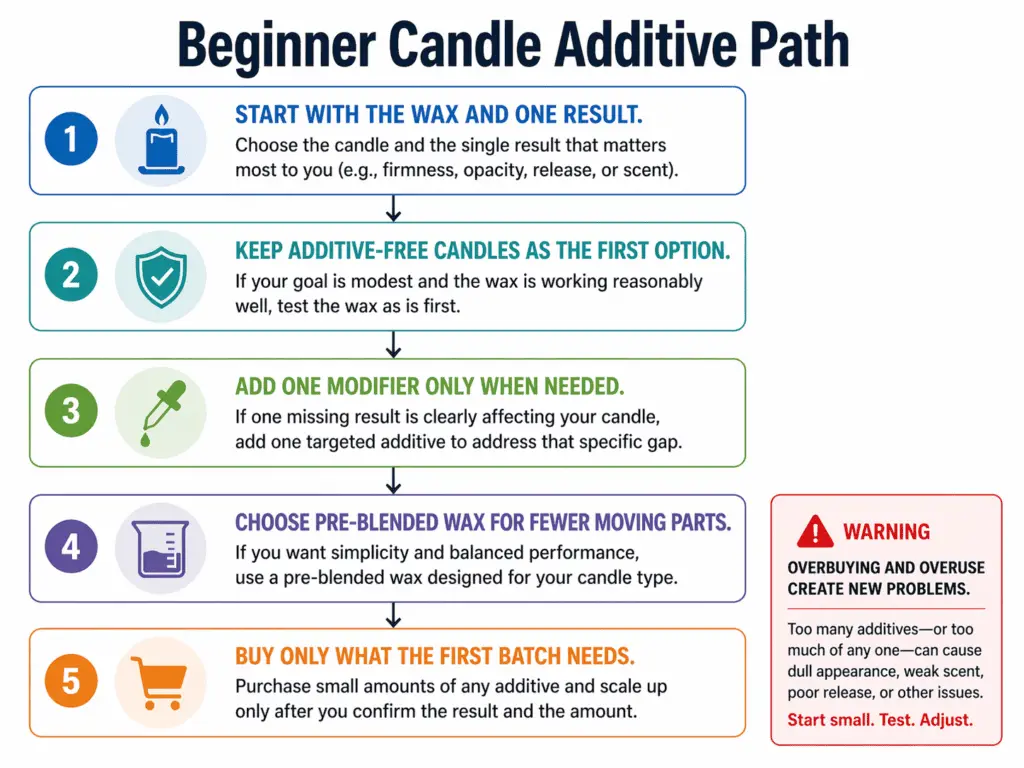
Beginner kits vs individual additive buying
Beginner kits and individual additive buying solve the same decision problem in different ways: convenience versus tighter goal fit.
A kit can make sense when the reader wants a faster first purchase and accepts less control over what is included. Individual buying makes more sense when the goal is narrow, the wax path is already clear, and buying extra items would only raise confusion. In this section, “best for beginners” means best for the reader’s goal count and complexity tolerance, not the most bundled option.
| Buying path | Best fit | Main risk |
|---|---|---|
| Beginner kit | You want fewer early decisions and a faster start | You may buy items you do not need |
| Individual additive buying | You already know the wax and the one result you want | It takes more decision work at the start |
Deeper shopping detail belongs on candle additives for beginners: what to use, what to avoid rather than this overview.
Avoid overbuying and overuse at the selection stage
Use this warning checklist before buying more:
- Do not treat owning more additives as proof that the formula needs them.
- Do not buy for several goals when only one result is missing.
- Do not buy a second or third modifier before testing the first path.
- Do not turn a modest beginner goal into a full formula project too early.
When the question shifts from first-path selection to testing or exact amount, move to how to test candle additives in small batches before scaling up or how much additive to use in candles instead of expanding this section.
Use one additive or stack multiple?
One clearly defined candle goal should usually lead to one additive path first, because stacking multiple modifiers raises variable count before the first useful test.
One additive is often enough for an early decision because it keeps the result easier to read. Here, better performance means a closer fit to one named goal, not an automatic gain from combining more materials in the same wax.
| Choice | Best fit | Why |
|---|---|---|
| One additive | One clear missing result | Easier to judge cause and effect |
| Multiple additives | More than one proven gap after testing | Adds complexity and raises uncertainty |
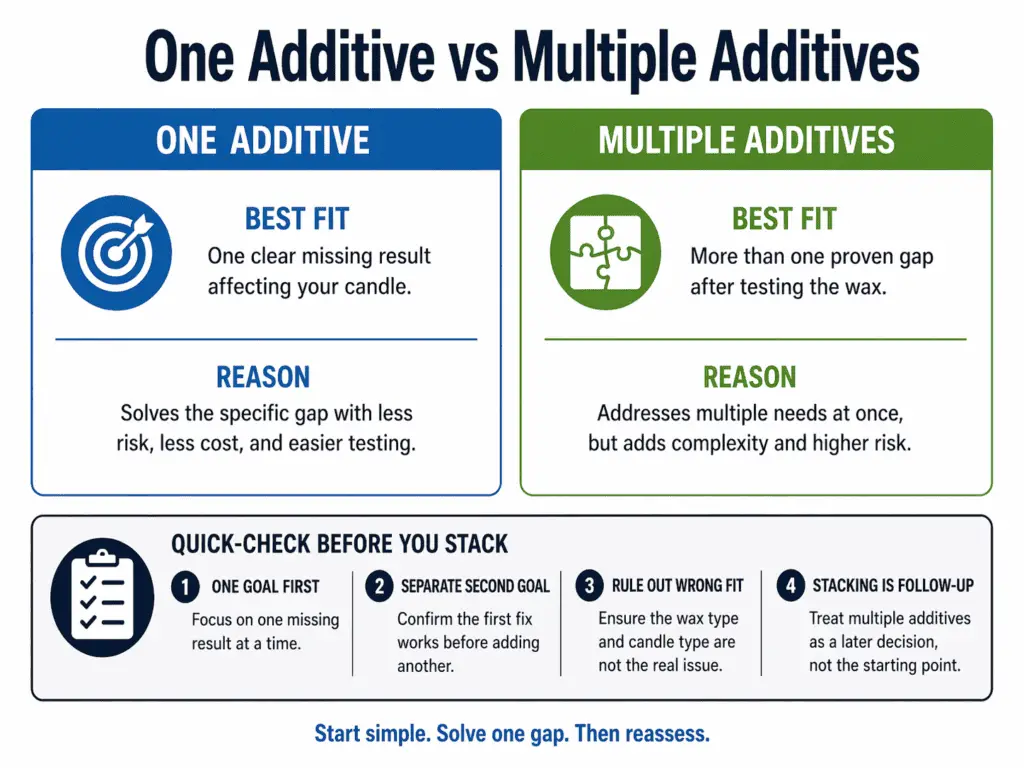
Use this quick check before you stack:
- Stay with one additive when one goal is still the main problem.
- Add a second modifier only when it solves a separate second goal, not a vague hope of making everything better.
- Rule out the wrong wax, the wrong candle type, or an already-supportive pre-blended wax before adding more variables.
- Treat stacking as a narrower follow-up decision, not the default first move.
A one-additive path is easier to judge because the change has a clearer cause. A stacked path makes it harder to tell whether the result came from the first modifier, the second one, or the way both interact inside that wax.
Use this rule only to set the first path. If the question becomes compatibility, testing, or exact rate, move to can you use stearic acid and Vybar together, how to test candle additives in small batches before scaling up, or how much additive to use in candles instead of expanding this overview.
Use this order: wax → goal → blend status → additive
The lowest-inference order for choosing candle additives is to identify the wax, name the goal, confirm blend status, and only then decide whether an additive is needed.
The best order here means the sequence that cuts bad guesses and unnecessary purchases fastest, not a rigid rule for every advanced edge case. It is the clearest way to choose candle additives because it forces each decision to narrow the next one instead of treating every factor as equal from the start. Product-first or additive-first browsing is the weaker path because it asks you to shop before the candle problem is even defined.
Additive Selection Matrix
This selection matrix shows the order for deciding whether to stay additive-free, change the wax path, or choose one additive direction.
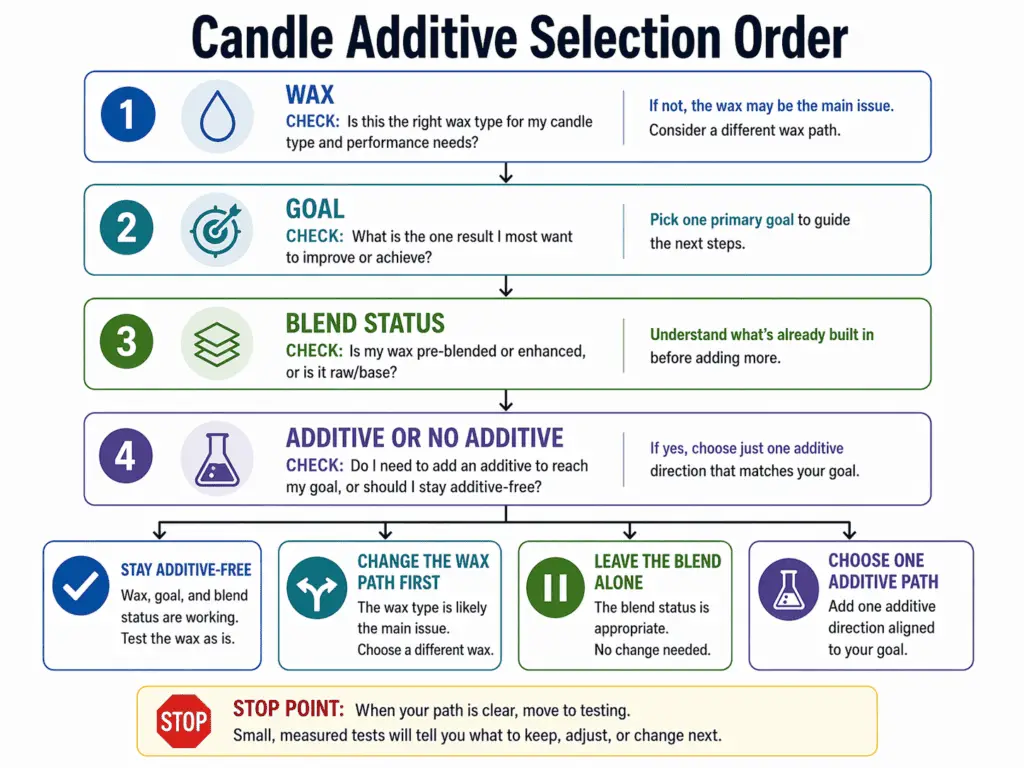
| Step | Decide this first | What you are checking | Next route |
|---|---|---|---|
| 1 | Wax | What wax family are you using? | Stay with the wax or change the wax path first |
| 2 | Goal | What one result do you want to improve? | Keep the goal modest or narrow it to one main result |
| 3 | Blend status | Is the wax raw, base, enhanced, or pre-blended? | Leave the blend alone or confirm that a real gap still exists |
| 4 | Additive or no additive | Does plain wax already fit the goal? | Choose additive-free, one additive, or a child page |
Wax comes first because the wax can remove or create the need for a modifier before any product choice is useful. Goal comes second because “better” has no meaning until you name what should improve, such as firmness, release, surface look, or fragrance support. Blend status comes third because a base wax and a finished blend do not ask the same question, which is why should you add additives to pre-blended candle wax belongs after wax and goal, not before them.
Use the sequence like this:
- Identify the wax you are working with.
- Name the one result you want from the candle.
- Confirm whether the wax is raw, base, enhanced, or pre-blended.
- Decide whether plain wax already fits the goal.
- If not, choose one additive path that matches the missing result.
When to stop choosing and start testing
Stop choosing when the wax, the goal, and the blend status already point to one likely path. At that point, more comparison usually adds noise instead of clarity, and the next useful move is to test candle additives in small batches rather than reopen broad selection questions.
A practical stop point looks like this:
- You know the wax family.
- You can name the main result you want.
- You know whether the wax is pre-blended or raw.
- You have narrowed the path to plain wax or one additive family.
- Your next question is proof, amount, or mixing rather than selection.
When the question shifts from selection to rate, mixing, or testing, move to how much additive to use in candles, how to mix candle additives, or how to test candle additives in small batches before scaling up instead of reopening selection here.