You can use essential oils in candles, but they work only when the wax, scent load, heat, cure time, and burn test produce stable wax and acceptable scent throw.
Essential oils are plant-derived aromatic materials evaluated here as candle fragrance inputs, not aromatherapy products. In this guide, “works” means the candle stays stable, smells acceptable before and during burning, and behaves well in a basic burn test.
That does not mean essential oils give therapeutic benefits, guarantee strong scent, or become safer because they are natural. The practical decision is whether your essential oil performs inside a wax-and-wick candle system or whether a candle fragrance oil is the better scenting choice.
This article covers candle fragrance performance only. It does not cover diffuser use, topical use, pet safety, pregnancy safety, medical advice, or aromatherapy claims.
Can You Use Essential Oils in Candles? The Practical Answer
Essential oils can scent candles when the specific oil, wax, load, temperature, and burn test produce stable wax and acceptable scent throw.
Essential oils are candle fragrance inputs here. They are not being judged as wellness, diffuser, topical, pet, pregnancy, or medical products. A candle “works” when it stays physically stable, has acceptable cold throw, has acceptable hot throw, and passes a basic burn test.
This page answers the essential-oil decision only. It does not cover the full candle scenting system, full recipe workflow, full safety documentation process, or full comparison of scenting materials.
| Essential oils work when | Essential oils do not work when |
|---|---|
| The scent goal is subtle or natural-style | The goal is strong, room-filling scent |
| Oil is measured by wax weight | Oil is added by drops or guesswork |
| The wax holds the oil without sweating | Oil separates, pools, or causes surface defects |
| Cold throw and hot throw pass testing | Bottle scent is strong but candle throw is weak |
| Supplier documentation supports candle use | No candle-use guidance or safety data is available |
Essential oils can suit a maker who wants a softer, plant-derived scent and is willing to test. They are less reliable when the goal is a bold scent that repeats from batch to batch.
Not every essential oil should be used in candles; the specific oil still needs supplier guidance, suitable handling information, and a passing finished-candle test.
Strong bottle scent does not prove the oil will bind well in wax, survive heat, cure cleanly, or release well during burning. The finished candle is the test, not the bottle.
Beginners can use essential oils, but they should treat the first candle as a test candle. The safer choice is to measure, record, cure, burn test, and inspect the result before making more. If the candle sweats, separates, smells harsh, or has weak hot throw, the essential oil did not pass the candle test.
Essential oils and candle fragrance oils are not the same fragrance input. This article uses only the comparison needed to decide whether an essential oil can work in a candle test.
Why Essential Oil Candles Succeed or Fail
Essential oil candles often smell weaker because a strong bottle scent does not guarantee strong cold throw or hot throw in wax.
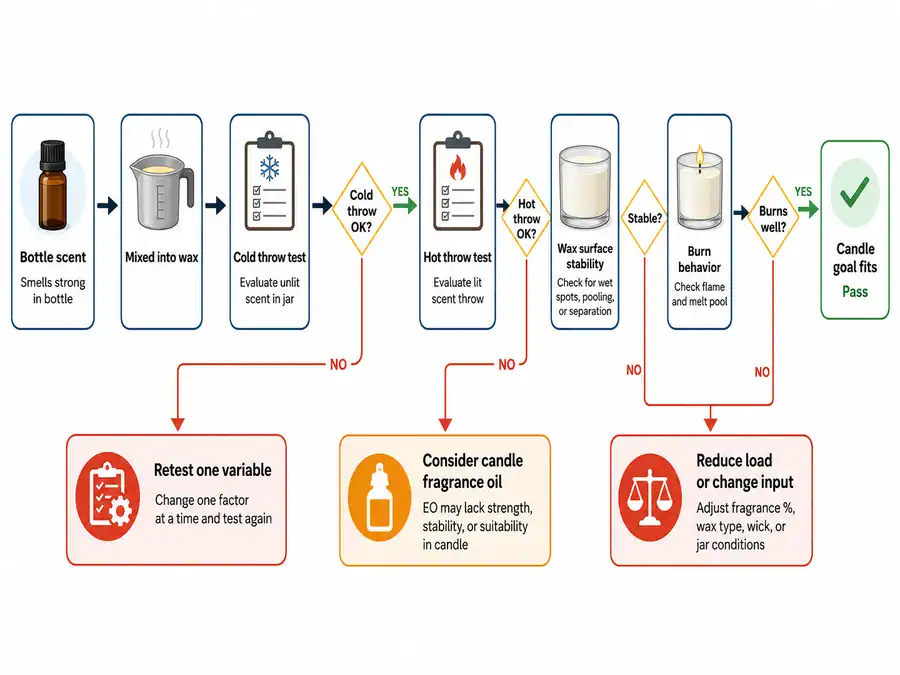
Cold throw is the scent a candle gives off before burning. Hot throw is the scent released while the candle burns. Both must be tested because an oil can smell good in one stage and fail in another.
Bottle scent, cold throw, and hot throw are three different test signals. Essential oils can smell strong in the bottle because they are concentrated and volatile. Once mixed into wax, the same oil may evaporate, change under heat, bind poorly, cure weakly, or fail to release during a burn test.
| Test signal | What it means | Decision |
|---|---|---|
| Strong bottle scent, weak cold throw | The oil may not carry well in wax | Retest wax, load, or oil choice |
| Good cold throw, weak hot throw | The burn system is not releasing scent well | Burn-test one variable at a time |
| Weak cold and hot throw | The oil may not fit this candle goal | Consider candle fragrance oil |
| Surface defect plus weak throw | The problem is stability, not just scent | Reduce load or change the input |
Adding more essential oil is not always the fix. More scent material can cause sweating, oil pockets, separation, wick stress, or a harsher burned smell.
A candle that smells weak may need a different wax, a different load, a different add temperature, longer curing, or a switch to candle fragrance oil. The goal is not to keep adding oil until the candle smells strong. The goal is to make a stable candle that releases scent acceptably.
The main test is not “Does the oil smell strong?” The better test is “Does this finished candle smell acceptable cold, smell acceptable hot, and stay stable?” Full scent-strength troubleshooting is outside this article; here, the question is whether the essential oil passes the finished-candle test.
A weak essential-oil candle can still teach you something useful. If cold throw is weak, the oil may not hold well in the wax. If cold throw is fine but hot throw is weak, the burn system may not release the scent well. If both fail, the essential oil may be a poor fit for that candle goal.
If the test keeps failing, decide whether the goal still fits essential oils. If the candle has sweating, separation, tunneling, wick problems, or harsh burn behavior, the issue has moved beyond the essential-oil yes-or-no decision and into candle troubleshooting.
How Much Essential Oil Can You Add to Candle Wax?
Measure essential oil for candles by wax weight, not by drops, and treat every amount as a test load rather than a universal recipe.
Fragrance load means the weight of scent material compared with the weight of wax. This measurement frame matters because the topic is candle fragrance behavior, not aromatherapy dilution.
Drops are unreliable because drop size changes by oil thickness, dropper style, temperature, and handling. Wax weight gives you a repeatable starting point.
| Wax test stage | Test load frame | What to record |
|---|---|---|
| Small test candle | Percent of wax weight | Oil weight, add temperature, cure days |
| First retest | Change one variable only | Throw, surface, and burn result |
| Failed stability | Reduce load or change input | Sweating, separation, burn behavior |
The amount depends on the wax, the oil, supplier guidance, and the finished candle test. A wax that holds one scent material cleanly may sweat, separate, or burn poorly with another.
Exact batch math is outside this article. This section only explains the measurement frame: measure by wax weight, treat the amount as a test load, and judge the finished candle before making more.
Adding more essential oil does not always make a candle smell stronger. Too much scent material can create oil pockets, surface sweating, weak burn behavior, wick issues, or a harsh scent. In that case, the candle has a stability problem, not just a scent-strength problem.
Use small test batches before scaling. Measure the oil, record the wax weight, note the add temperature, cure the candle the same way, then compare cold throw, hot throw, surface condition, and burn behavior.
Heat, Flash Point, and Volatility: What Actually Matters
Flash point is only one safety and handling clue; it does not prove that an essential oil will smell good, stay stable, or be safe in a finished candle.
Volatility means how easily aromatic compounds evaporate. Flash point is a flammability-related test value. Scent retention is the candle’s ability to keep a noticeable scent after mixing, curing, and burning.
Heat can affect essential oils before the candle is ever lit. During melting, mixing, pouring, curing, and burning, some aromatic compounds may evaporate, change, or fail to release well from the wax. That is why pour temperature, wax type, oil type, supplier documentation, and burn testing all matter together.
| Common claim | What it misses | What to check instead |
|---|---|---|
| “The flash point tells me if it works.” | Flash point is not the whole candle system. | Supplier documentation, wax behavior, burn test |
| “The scent burned off.” | This may mean evaporation, scent change, or poor throw. | Add temperature, cure time, cold throw, hot throw |
| “Low flash point means unsafe candle.” | Handling data and finished-candle behavior are different. | SDS, intended use, test results |
| “Natural oil is safer in hot wax.” | Natural origin does not prove candle suitability. | Candle-use guidance and burn behavior |
Makers often say an oil “burned off” when several different things may have happened. The scent may have evaporated during heating, changed under heat, failed to bind well in wax, cured weakly, or produced poor hot throw.
These are not the same problem, so they should not be fixed with one rule. Do not rely on flash point alone. Check supplier documentation, use the oil only within its intended handling guidance, and judge the finished candle by stability, cold throw, hot throw, and burn behavior.
Full safety-document interpretation is outside this article. The candle-specific point is that flash point, volatility, scent retention, supplier documentation, and burn testing all need to be understood separately.
Wax Compatibility: Why Some Tests Work Better Than Others
An essential oil only works in a candle if the wax can hold the oil, stay stable, and release scent during a burn test.
The same essential oil can behave differently in soy wax, coconut wax, beeswax, paraffin, or a wax blend. This does not mean there is one best wax for every essential oil.
“Best wax” means the best tested wax-and-oil pairing for your scent goal, surface stability, and hot throw. A wax may accept the oil cleanly but release scent poorly, or it may smell pleasant cold and fail during burning.
| Wax/oil behavior | Possible issue | Next test variable |
|---|---|---|
| Oil does not bind smoothly | Separation or surface oil | Add temperature, load percent, stir time |
| Candle smells cold but not hot | Poor wax release | Burn test, wax type, wick system |
| Surface sweating appears | Load or compatibility issue | Reduce load or retest wax |
| Scent changes after curing | Weak retention or oil mismatch | Cure time, oil type, wax blend |
Keep wax testing narrow. Change one variable at a time so you know whether the result came from the oil, the wax, the load, the temperature, or the burn system. If you change everything at once, the test may produce a better candle but still leave you guessing.
A full wax-selection process is outside this article. This page only needs the candle-specific point: essential oils are not judged in isolation; they are judged by how they behave inside the wax system.
Are Essential Oils Safe in Candles? Natural Does Not Mean Candle-Safe
Essential oils are not automatically candle-safe just because they are natural.
Candle safety means the oil is suitable for the candle system: supplier documentation supports the use, the load is measured, the wax stays stable, and the burn test behaves acceptably.
Natural origin only tells you where the scent material came from. It does not prove that the oil will bind well in wax, smell good under heat, or behave safely in a burning candle.
Full fragrance safety, SDS interpretation, medical safety, pet safety, pregnancy safety, and diffuser safety are outside this article. This section is only about candle-system suitability.
Use this safety-boundary checklist before scaling an essential-oil candle:
- Supplier documentation is available.
- The oil is intended or documented for fragrance or candle use.
- The load is measured by wax weight.
- The wax surface stays stable after curing.
- The candle passes a basic burn test.
- The scent does not become harsh, smoky, or unpleasant during burning.
- Medical, pet, pregnancy, diffuser, and therapeutic claims are avoided.
This page does not judge essential oils by topical safety, diffuser use, or wellness claims. A material can be plant-derived and still fail inside a candle because the wax sweats, the scent collapses, or the burn test behaves poorly.
If supplier documentation is missing, treat that as a stop sign for larger batches. You can still run a cautious personal test only when the oil is appropriate for the intended use, but you should not treat “natural” as a replacement for documentation, measurement, and burn testing.
For the practical fragrance choice, judge the finished candle by the same performance standard used throughout this article: wax stability, measured load, cold throw, hot throw, and burn behavior.
Essential Oils vs Fragrance Oils: When to Switch
Essential oils and candle fragrance oils can both scent candles, but they are not interchangeable.
Essential oils may fit subtle plant-derived scent goals, while candle fragrance oils are usually the better fit for strong, predictable, repeatable scent throw.
“Better” means better for the candle maker’s goal. It does not mean healthier, cleaner, safer, or more ethical by default.
| Goal | Better fit | Why |
|---|---|---|
| Subtle plant-derived scent | Essential oil, if it passes testing | Natural preference matters more than throw strength |
| Strong hot throw | Candle fragrance oil | More predictable in wax |
| Beginner repeatability | Candle fragrance oil | Easier performance expectations and documentation |
| Natural-positioned small batch | Essential oil test batch | Works only after stability and throw testing |
| Failed essential-oil test | Fragrance oil or one-variable retest | Switching may solve scent predictability |
Switch to candle fragrance oil when your essential-oil test keeps producing weak hot throw, sweating, separation, harsh burned scent, or unstable wax.
A switch does not mean the essential oil is “bad.” It means that oil did not meet the candle-performance goal.
Stay with essential oils when the scent goal is subtle, the supplier documentation fits the use, the wax stays stable, and both cold throw and hot throw are acceptable. That is a narrow but valid use case.
This article only covers the switch decision needed for essential-oil candle testing. Full product selection, brand comparison, and buying criteria are outside this page.
What It Looks Like When Essential Oils Don’t Work in Candles
An essential oil candle does not work when it fails a candle-specific test: weak throw, sweating, separation, discoloration, harsh burned scent, or poor burn behavior.
This does not mean all essential oils fail. It means the tested oil, wax, load, heat, cure, or burn system failed.
A common maker question is, “Why is my candle sweating after I added essential oil?” In this article, that is a test signal, not a full troubleshooting case.
| Failure sign | Likely cause | Next action |
|---|---|---|
| Weak cold throw | Poor scent retention or low load | Retest load or oil/wax pairing |
| Weak hot throw | Poor wax release or high volatility | Burn-test another variable |
| Surface sweating | Excess load or poor compatibility | Reduce load or change wax/input |
| Oil separation | Poor incorporation or wax-oil mismatch | Adjust temperature, stir time, or input |
| Discoloration | Oil chemistry, heat, or wax reaction | Retest at lower heat or with another oil |
| Harsh burned scent | Heat change or unsuitable oil profile | Stop scaling and retest or switch |
Do not treat personal scent dislike as a candle defect. A scent can be unpleasant to you but still stable. A real candle-performance failure shows up in the wax surface, throw test, burn behavior, or scent quality under heat.
Change only one variable in the next test. If you increase the load, change the wax, change the wick, and change the pour temperature at the same time, you may not know what fixed or worsened the candle.
If the candle smells weak but has no surface or burn defect, the issue may still be scent throw rather than essential-oil suitability. If the same essential oil fails after a controlled retest, decide whether the scent goal still fits essential oils before making more candles.
A Small-Batch Test Before You Make More Candles
The safest practical decision is to test one essential oil in a small candle before making more.
The test goal is simple: acceptable scent throw, stable wax surface, and normal burn behavior. Use one wax, one wick, and one essential oil for the first test.
Measure the oil by wax weight, record the add temperature, stir the same way each time, and cure the candle consistently. Then test cold throw before burning and hot throw during a controlled burn.
| Test field | Record |
|---|---|
| Wax type | |
| Essential oil | |
| Load % | |
| Add temperature | |
| Stir time | |
| Cure days | |
| Cold throw score | 1–5 |
| Hot throw score | 1–5 |
| Surface result | pass / fail |
| Burn result | pass / fail |
| Decision | pass / retest / switch |
A passing test means the candle smells acceptable cold and hot, the wax surface stays stable, and the candle burns without obvious scent or wax problems.
A retest means one variable is unclear, such as load, temperature, cure time, wax type, or oil choice. A switch means the essential oil no longer fits the candle goal, especially when strong or repeatable scent is the goal.
Do not scale a candle because the bottle smells good. Scale only after the finished candle passes the test. If the measurement is the weak point, fix the measurement frame before scaling. If the making process is the weak point, retest the process before blaming the essential oil. If the candle fails during testing, record the failure sign and change only one variable.
Final Recommendation
Essential oils can work in candles when the goal is a subtle, natural-style scent and the finished candle passes small-batch testing.
They are not the best choice when you need strong, predictable hot throw across repeated batches.
Use essential oils when supplier documentation, wax stability, measured load, cold throw, hot throw, and burn behavior all line up. Retest when one variable is unclear. Switch to candle fragrance oil when the candle keeps producing weak scent, sweating, separation, harsh burned notes, or inconsistent results.
The practical rule is simple: do not judge by natural origin, bottle scent, or flash point alone. Judge the finished candle by wax behavior, scent throw, and burn-test performance.
If the essential oil passes the candle test, it can work for that candle goal. If it fails after controlled retesting, switch the fragrance input or change the candle goal before making more.