
Vanilla extract is not recommended for candles because it is food flavoring, not a candle-tested fragrance material. It may smell like vanilla in the bottle, but candle use depends on wax compatibility, flame behavior, and scent performance while burning.
Here, not recommended means vanilla extract is not a reliable or verifiable candle additive for normal burning, not that every small test candle will have the same failure outcome.
Here, candle-safe means suitable for wax, wick, heat, and normal candle-burning conditions. It does not mean edible, natural, homemade, or pleasant-smelling before burning.
The better choice is a candle-safe vanilla fragrance oil or another vanilla scent material sold with candle-use guidance. Use vanilla extract for baking, not for candle wax.
Can You Put Vanilla Extract in Candles?
No, you should not put vanilla extract in candles. Vanilla extract is made for cooking, not for candle wax, wick behavior, or flame performance.
A few drops do not change the material category. Small amounts may reduce the problem, but they do not make vanilla extract a candle-tested fragrance material.
This answer is about candle use, not food use. Vanilla extract may be safe to eat when used as intended, but that does not make it safe or reliable to burn inside a candle.
| Common beginner mistake | Why it happens | Better candle-making choice |
|---|---|---|
| Adding vanilla extract because it smells strong | Bottle smell does not show burn performance | Use vanilla fragrance oil labeled for candles |
| Treating edible vanilla extract as candle-safe | Food use and candle use are different | Check supplier candle-use guidance |
| Using vanilla extract as a cheap fragrance oil substitute | The word “vanilla” hides different ingredient types | Choose a candle-specific vanilla scent material |
| Adding more extract when scent seems weak | More extract does not fix wax compatibility | Fix scent through the right fragrance and recipe |
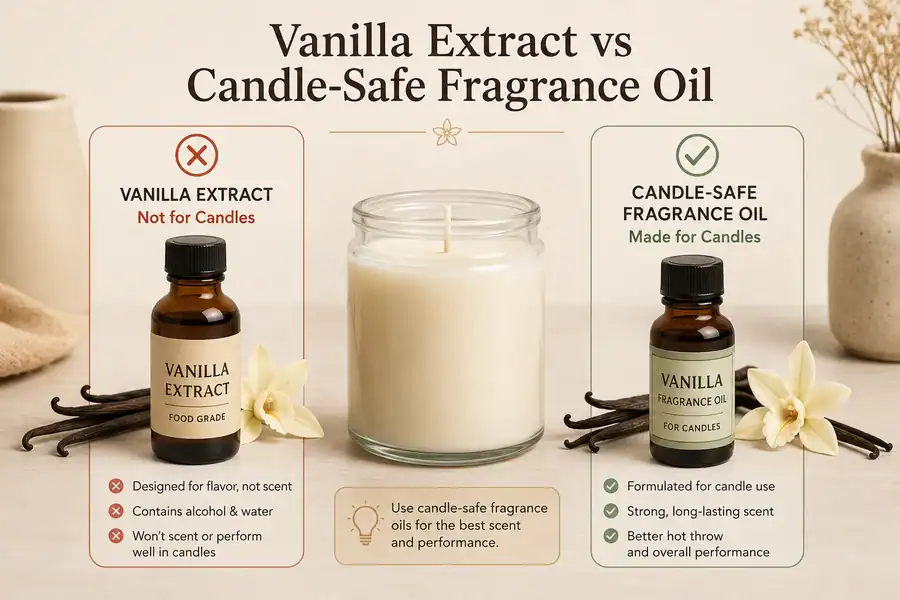
A candle-safe vanilla fragrance oil is the better starting point when you want a vanilla-scented candle. For a full making process, use a vanilla-scented candle recipe that covers wax type, fragrance load, wick size, cure time, and test burning.
Why Vanilla Extract Does Not Work Well in Candle Wax
Vanilla extract does not work well in candle wax because it is not built to mix, hold, or burn like candle fragrance. It can separate, smell weak, or disturb the candle’s burn.
In candle making, “works” means more than adding a nice smell to melted wax. The scent material needs to suit the wax, survive heat, and give a usable smell while the candle burns.
| Vanilla extract trait | Why it matters in candles | Likely candle problem | Better substitute |
|---|---|---|---|
| Food-use formula | It is designed for recipes, not wax | Poor compatibility | Candle fragrance oil |
| Alcohol or water-based carrier | Wax does not handle these like fragrance oil | Separation or uneven mixing | Candle-safe vanilla scent |
| Food aroma profile | Cold smell does not prove burn scent | Weak hot throw | Tested vanilla fragrance oil |
| Possible food solids or sugars | Food ingredients are not chosen for wick combustion | Odor or uneven burn concerns | Supplier-guided candle fragrance |
| No candle-use guidance | The maker cannot confirm wax and flame limits | Guesswork | Candle material with documentation |
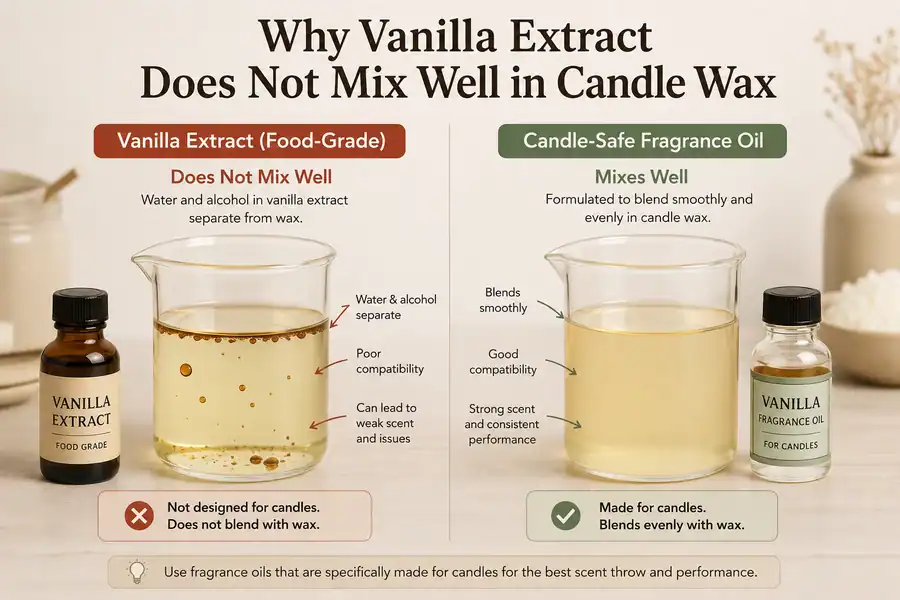
The main issue is intended use. Vanilla extract belongs in food, where flavor and aroma matter. Candle fragrance materials are chosen for wax, heat, scent throw, and burn behavior.
This is why “natural” does not solve the problem. A natural food ingredient can still be wrong for wax and flame conditions.
Is Vanilla Extract Dangerous to Burn in a Candle?
Vanilla extract can make a candle unreliable to burn, so do not treat it as a candle-safe additive. The risk is uncertain burn behavior, not one guaranteed outcome.
Here, dangerous means the candle has uncertain burn behavior, not that every candle with vanilla extract will fail in the same way.
A candle is a wax-and-wick system. Once a food extract is added, the maker cannot confirm that the wax, wick, flame, and added liquid will behave like a tested candle.
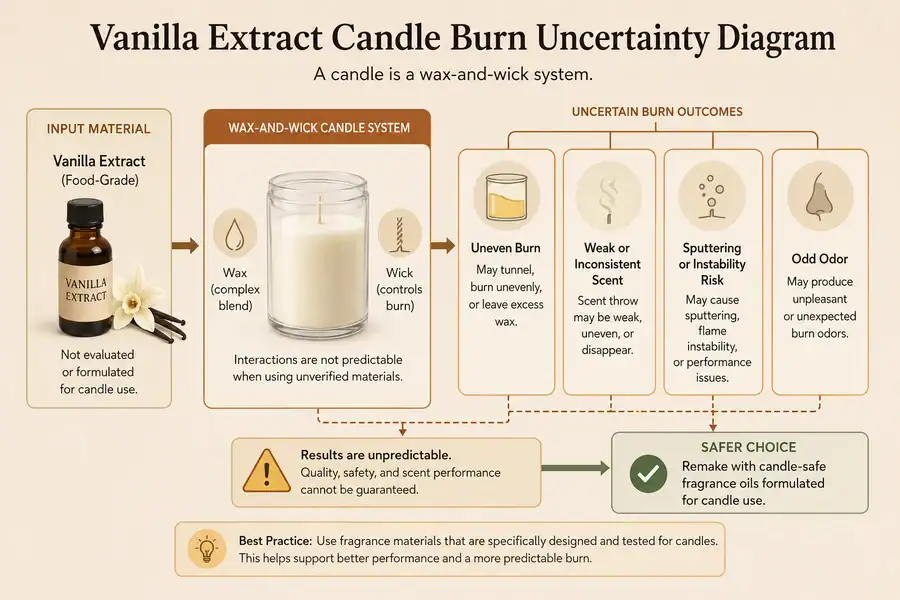
| Possible issue | Why it can happen | Safer answer |
|---|---|---|
| Sputtering | Non-candle liquids may not mix cleanly in wax | Do not use vanilla extract as fragrance |
| Smoke or odd odor | Food ingredients are not chosen for candle burning | Use candle fragrance materials instead |
| Uneven burn | The wax-and-wick balance may be disturbed | Follow a tested candle formula |
| Weak or unpleasant scent | Food aroma does not equal hot throw | Use vanilla fragrance oil made for candles |
| Unclear safety outcome | Amount, mixing, wax type, and wick size are unknown | Do not rely on a test burn for proof |
| False reassurance | “It lit once” does not prove stable performance | Remake with candle-safe materials |
The careful answer is not that every candle with vanilla extract will behave the same way. The practical answer is that vanilla extract is the wrong material for a burning candle.
A safer candle starts with ingredients made for candle making. For vanilla scent, that usually means a candle-safe vanilla fragrance oil with supplier guidance.
If You Already Added Vanilla Extract, Should You Burn the Candle?
If you already added vanilla extract to candle wax, do not assume the candle is safe to burn. Treat the batch as unreliable and avoid using it as a normal finished candle.
This applies to wax that already contains food-grade vanilla extract. It does not apply to a properly made candle that uses candle-safe vanilla fragrance oil.
| Already-added scenario | What not to assume | Safer next step |
|---|---|---|
| You added only a few drops | A small amount does not prove burn safety | Do not treat the candle as tested |
| You added it to melted wax | Mixing in hot wax does not prove compatibility | Avoid burning it as a finished candle |
| The candle smells fine cold | Cold smell does not prove flame behavior | Use candle-safe fragrance next time |
| The candle hardened normally | A solid surface does not prove safe mixing | Remake with the right scent material |
| You want to remelt and fix it | More fragrance does not remove the extract | Use wrong candle additive troubleshooting guidance |
The safest answer is conservative because the batch details are unknown. The amount added, how evenly it mixed, the wax type, and the wick size all affect the final candle.
A full salvage decision belongs in a wrong candle additive troubleshooting guide. This page’s answer is narrower: do not treat a candle with vanilla extract as reliable to burn.
Will Vanilla Extract Make a Candle Smell Like Vanilla?
Vanilla extract may smell like vanilla before lighting, but it is not a reliable way to make a candle smell like vanilla while burning. Candle scent depends on hot throw.
Hot throw means the scent a candle releases while it burns. Vanilla extract is made for food aroma and flavor, so a strong kitchen smell does not prove candle scent performance.
| Vanilla scent source | Cold smell | Hot throw expectation | Candle suitability | Recommendation |
|---|---|---|---|---|
| Vanilla extract | Familiar vanilla smell in the bottle | Weak, uneven, or unpleasant | Poor | Do not use |
| Candle-safe vanilla fragrance oil | Depends on the supplier blend | More reliable when used correctly | Stronger fit | Best beginner choice |
| Vanilla absolute | Rich vanilla aroma | Depends on formulation and supplier guidance | Possible, but more advanced | Use only with candle-use guidance |
| Vanilla essential oil claims | Often confusing in vanilla searches | Unclear without product details | Product-specific | Check documentation |
| Vanilla candle recipe | Depends on wax, wick, and fragrance load | Testable when made correctly | Best handled separately | Follow a full recipe |
The main mistake is judging candle performance from the smell before burning. A candle can smell pleasant in melted wax and still have poor scent throw after curing or during burning.
Use vanilla extract for baking. Use candle-safe vanilla fragrance material for candle making.
Food-Safe vs Candle-Safe: Why Edible Does Not Mean Burn-Safe
Food-safe vanilla extract is not the same as candle-safe fragrance. Food safety describes use in recipes; candle safety depends on wax behavior, heat, flame, smoke, and scent performance.
This distinction is the main reason vanilla extract causes confusion. A familiar kitchen ingredient can feel safer than fragrance oil, but the candle use case is different.
| Label or assumption | What it proves | What it does not prove | Candle guidance |
|---|---|---|---|
| Food-safe | Suitable for its intended culinary use | Suitable for wax, wick, and flame | Do not transfer the claim to candles |
| Natural | The ingredient may come from a natural source | Better burn behavior | Natural does not mean candle-compatible |
| Homemade | The maker controls the recipe | The candle is safe to burn | Use tested candle materials |
| Smells pleasant | The aroma is appealing before burning | It will have strong hot throw | Judge scent through candle performance |
| Vanilla | The scent family is vanilla-like | The product is made for candles | Check candle-use labeling and supplier guidance |
A candle-safe scent material should be selected for candle use, not borrowed from food use. Supplier guidance, safety documents, and candle-use labeling matter more than whether the ingredient is common in a kitchen.
The practical rule is simple: do not treat edible ingredients as burn-safe candle additives unless the material is made for that use.
What To Use Instead of Vanilla Extract for Vanilla-Scented Candles
Use a vanilla scent material made for candle making instead of vanilla extract. The best beginner choice is usually a candle-safe vanilla fragrance oil with supplier guidance.
Here, best beginner choice means the scent material comes with candle-use guidance, mixes predictably with wax, and can be test-burned as part of a normal candle recipe.
The replacement should solve the real problem: you want vanilla scent in wax, not a food flavoring in a candle. Choose by candle suitability first and vanilla aroma second.
| Alternative | Candle suitability | What to check | Best use case |
|---|---|---|---|
| Vanilla fragrance oil labeled for candles | Best fit for most beginners | Supplier candle-use guidance, wax fit, safety sheet | Reliable vanilla scent in homemade candles |
| Vanilla absolute | Possible, but more advanced | Supplier notes for candle use and blend limits | Makers who understand formulation and testing |
| Vanilla essential oil claims | Product-specific and often confusing | Whether the product is truly suited for candles | Only when documentation supports candle use |
| Pre-blended vanilla candle fragrance | Strong beginner option | Wax recommendations and usage notes | Simple vanilla candle projects |
| Vanilla candle-making kit | Good learning route | Included wax, wick, and fragrance instructions | First-time vanilla candle makers |
| Full vanilla candle recipe | Best for step-by-step making | Wax type, fragrance amount, wick, cure time, test burn | When you are ready to make the candle |
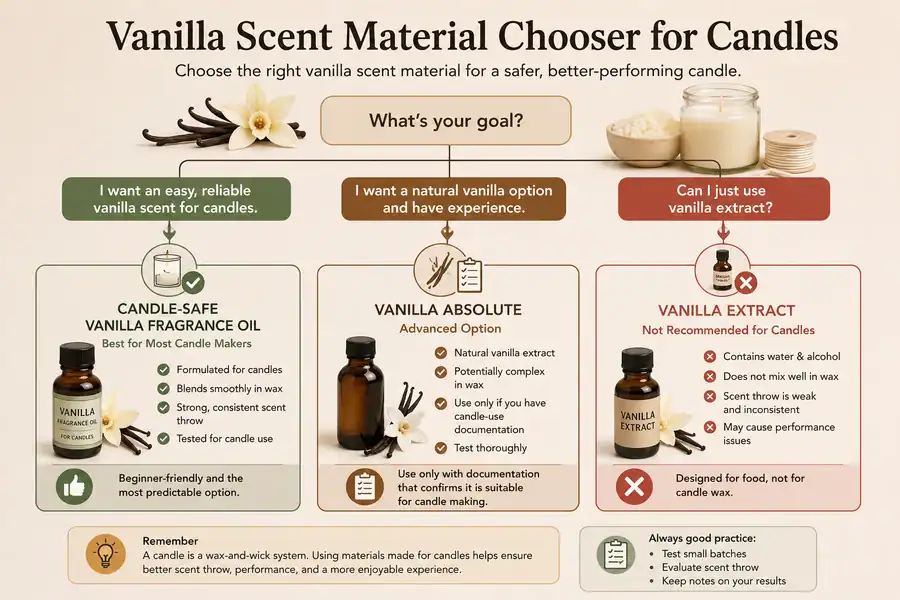
Do not choose a scent material only because the word “vanilla” appears on the label. Vanilla extract, vanilla fragrance oil, vanilla absolute, and vanilla-scented blends can have different purposes and different candle-use requirements.
A good replacement should be sold for candle making or backed by clear supplier guidance. That gives you a better path for scent throw, wax mixing, and burn testing than a pantry ingredient can provide.
Vanilla Extract vs Fragrance Oil vs Vanilla Absolute
Vanilla extract, vanilla fragrance oil, and vanilla absolute are not the same candle ingredient. Vanilla extract is the poor choice; candle-safe vanilla fragrance oil is usually the practical candle option.
The shared word “vanilla” can hide the use case. In candle making, the material’s purpose matters more than its scent name.
| Material | What it is | Candle-use fit | Best page answer |
|---|---|---|---|
| Vanilla extract | Food flavoring made for cooking | Not recommended | Do not put it in candles |
| Vanilla fragrance oil | Scent material often made for candles, soaps, or home fragrance | Usually the best fit when labeled for candles | Use supplier candle guidance |
| Vanilla absolute | Concentrated aromatic material from vanilla | Possible, but not beginner-proof | Use only with candle-use documentation |
| Vanilla essential oil | Commonly misunderstood label in vanilla scent searches | Product-specific | Verify the product before use |
| Vanilla candle blend | Pre-made fragrance blend for candle making | Often beginner-friendly | Use as directed by the supplier |
The simplest decision is this: vanilla extract belongs in food, while candle-safe vanilla fragrance oil belongs in candle wax. Vanilla absolute may have a place for advanced makers, but it should not be treated as an automatic substitute without documentation.
A full ingredient comparison belongs in a vanilla fragrance oil versus vanilla absolute guide. This section only prevents the main mix-up behind the vanilla extract question.
What Is the Safer Way to Make a Vanilla-Scented Candle?
To make a vanilla-scented candle safely, start with candle wax, the right wick, and a vanilla fragrance material meant for candles. Do not build the recipe around vanilla extract.
A full vanilla candle recipe needs details that do not belong inside this narrow safety answer. The recipe should cover wax type, fragrance load, melting temperature, pour temperature, wick size, cure time, and test burning.
| Recipe decision | Why it matters | Where it belongs |
|---|---|---|
| Wax type | Soy, paraffin, coconut, and blends hold scent differently | Full vanilla candle recipe |
| Wick size | Wick choice affects flame size, melt pool, and burn quality | Wick guide or recipe page |
| Fragrance load | Candle fragrance has wax-specific limits | Fragrance-load guide |
| Cure time | Some waxes need rest time before scent testing | Recipe page |
| Test burn | A finished candle should be checked for burn quality | Candle testing guide |
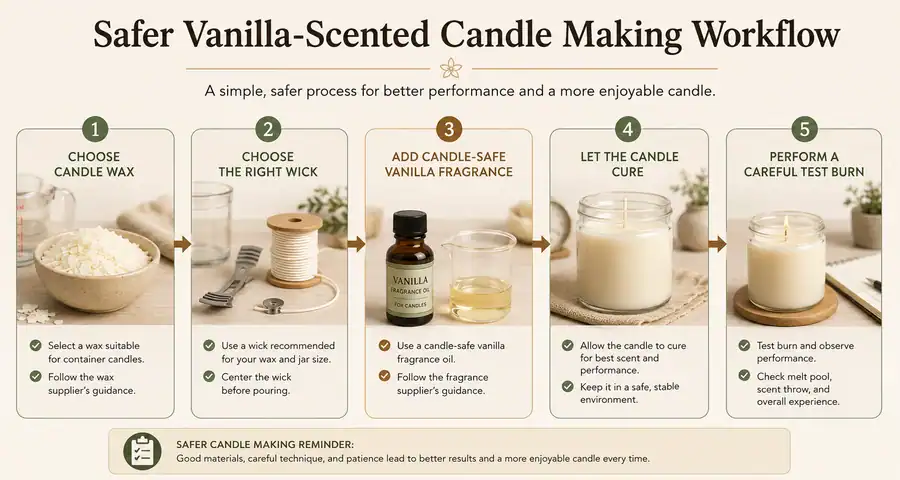
This is why vanilla extract should not be treated as a shortcut. It skips the material-selection step that a candle recipe depends on.
The safer path is to choose a candle-safe vanilla fragrance first, then follow a recipe built around that fragrance, the wax, and the wick.
How Does Vanilla Extract Fit Into Broader Candle Additive Safety?
Candle-safe ingredients are materials chosen for wax, wick, heat, and normal burning conditions. Food extracts, drink flavorings, dried pantry ingredients, and random scented liquids should not be treated as candle additives.
This article answers one narrow question about vanilla extract. A broader candle additive safety guide should cover herbs, spices, flowers, glitter, colorants, fragrance oils, essential oils, and decorative materials.
| Ingredient type | Candle-use answer | Better next step |
|---|---|---|
| Candle fragrance oil | Often suitable when labeled for candles | Follow supplier guidance |
| Candle dye | Suitable when made for candle wax | Use candle dye, not food coloring |
| Vanilla extract | Not recommended | Replace with candle-safe vanilla fragrance |
| Food flavoring | Not recommended | Do not use as candle fragrance |
| Dried herbs or spices | Usually poor burn choice inside wax | Review a candle additive safety guide |
| Decorative embeds | Product-specific | Check whether they are made for candle heat |
The practical rule is simple: a material should be selected for candle making before it goes into wax. A product that is safe for food, skin, crafts, or room scent does not automatically become safe for a burning candle.
For vanilla scent, the answer stays the same: skip vanilla extract and choose a candle-safe vanilla fragrance material instead.