
The best wick for soy candles here means the best first-test family—CD, ECO, or LX—for your jar width, formula, and burn goals, not the final wick size.
Wick families for pure soy container candles are the focus here, with CD, ECO, and LX compared as first-test options rather than final wick numbers. On this page, best means the family most likely to suit your jar width, formula, and burn pattern at the start of testing. Start-point means a provisional family choice that still needs exact sizing and burn confirmation later. Pure soy only is covered here, because soy blends and non-soy wax can shift which family behaves better.
What “best” and “start-point” mean for soy candle wick selection
Best here means the most suitable first-test wick family for a pure soy container candle, and start-point means a provisional choice.
On this page, best does not mean one family wins for every wax, jar, formula, or finished candle. It means the family most worth testing first under stated soy conditions, while broader wick guidance covers wider wick options and this page stays on pure soy container candles only. If you already want an exact wick number, that belongs with exact soy wick sizing and burn testing, not the comparison here.
Start-point matters because wick choice happens in stages. First, choose the family that best fits the jar, formula, and burn goal; next, confirm the exact size inside that family; then burn test the candle to see whether the result is stable. That order keeps family selection separate from final sizing, which is the main boundary this page is meant to hold.
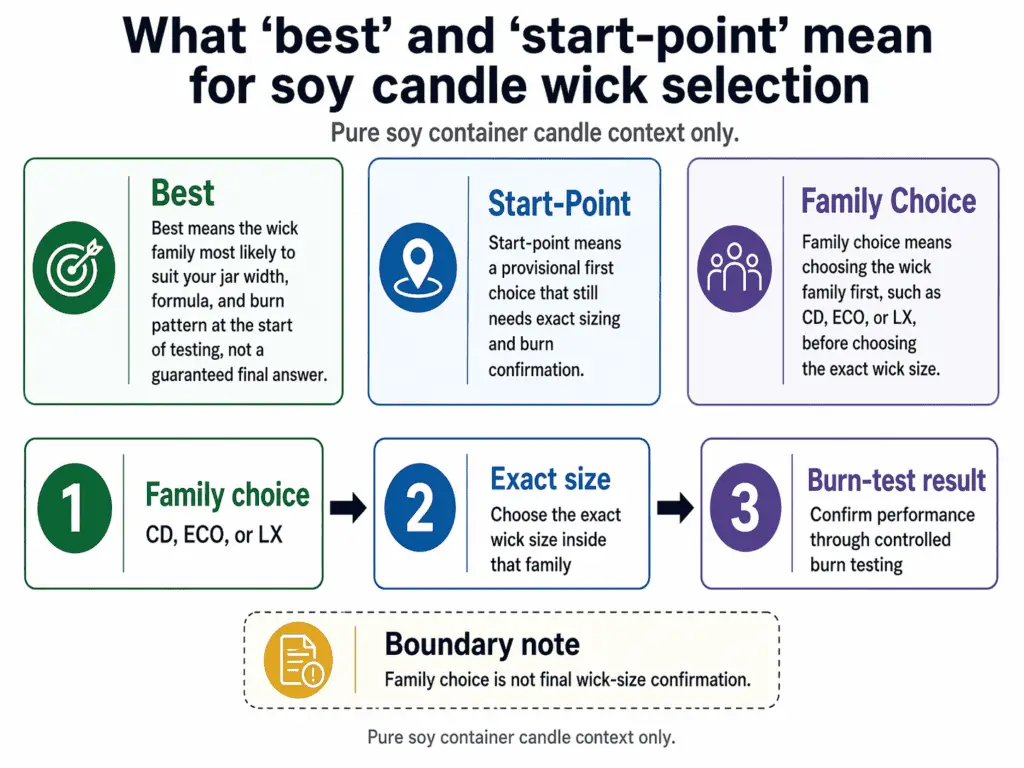
| Term | Means here | Does not mean here |
|---|---|---|
| best | The first family most worth testing for a pure soy container candle under stated conditions | A universal winner for every candle |
| start-point | A provisional family choice before size confirmation and burn testing | The final approved wick size |
| family choice | Choosing CD, ECO, or LX as the first branch to test | Choosing a supplier number or finished setup |
Family choice is not final wick-size confirmation
Choosing CD, ECO, or LX is only the family decision.
A wick family tells you where to begin, not where to stop. After you pick a family, you still need size confirmation and burn testing, which is why readers looking for a jar-specific answer should move to exact wick sizing for that vessel, then return to burn testing for confirmation. That is also why this page does not paste in supplier ladders or full charts.
| Stage | What you decide | What you do not decide yet |
|---|---|---|
| 1 | Family choice: CD, ECO, or LX | Exact wick number |
| 2 | Exact size inside that family | Final approval without testing |
| 3 | Burn-test result | That one family is always best |
The next decision is not size yet, but which family usually gives the strongest first-test fit in pure soy: CD, ECO, or LX.
CD vs ECO vs LX: how soy compatibility changes the best wick-family start-point
CD, ECO, and LX can all work in pure soy containers; the better first-test family depends on jar width, formula load, and the burn signal.
Here, soy compatibility means which family is most worth testing first for a given pure soy jar, formula, and burn goal. On this page, burn goal means the family-level behavior you want to test first, such as a stronger start or a calmer one. It does not mean final approval, safety, or a full troubleshooting standard.
Use this comparison to choose the first family to test. Use a narrower two-family comparison only when the choice is already down to two lines, and move to exact soy wick sizing only after the family choice is made.
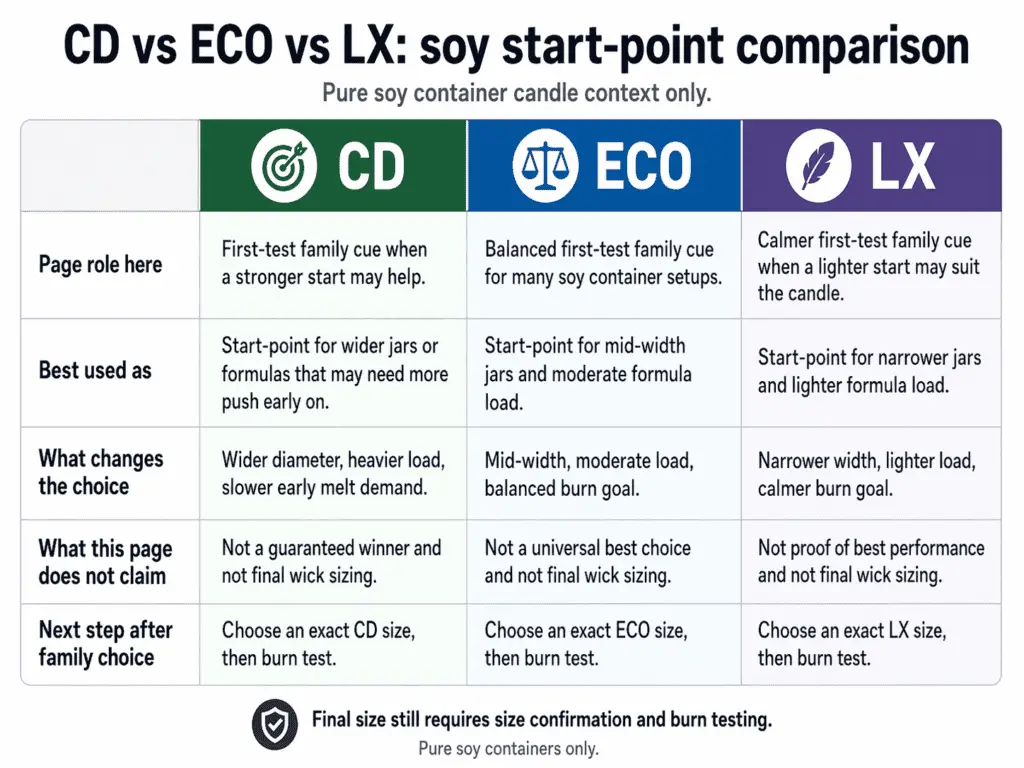
| Comparison point | CD | ECO | LX |
|---|---|---|---|
| Page role here | A possible first-test branch | A possible first-test branch | A possible first-test branch |
| Best used as | A stronger first-test branch when the setup asks for more melt demand | A middle first-test branch when the setup does not clearly point narrower or stronger | A narrower first-test branch when the setup points to a calmer start |
| What changes the choice | Wider diameter, heavier load, slower early melt demand | Mid-width jars, moderate load, balanced burn goal | Narrower width, lighter load, calmer burn goal |
| What this page does not claim | CD always wins | ECO is the default for all soy | LX is irrelevant for soy |
| Next step after family choice | Size confirmation and burn test | Size confirmation and burn test | Size confirmation and burn test |
When CD is the better soy start-point
CD is the better first-test family when a pure soy jar needs a stronger opening branch because width, formula load, or slow early melt demand points that way.
CD is less likely to be the first family when the jar is narrower, the formula is lighter, or the burn goal points to a calmer start. If the choice is already down to two families, narrow it there, then move to exact soy wick sizing for the final size check.
When ECO is the better soy start-point
ECO is the better first-test family when the soy setup sits in the middle and does not clearly point toward a narrower LX start or a stronger CD start.
ECO is less likely to be the first family when a narrow jar points to LX first or a wider, heavier, or slower-melting setup points to CD first. Keep ECO as a conditional branch, not a soy default.
When LX is the better soy start-point
LX is the better first-test family when a narrower pure soy jar or a calmer burn goal makes a narrower first branch worth checking before moving up.
LX is less likely to be the first family when jar width, heavier load, or slow melt demand points to a stronger opening branch. If you need more LX-only detail later, move to LX-specific guidance rather than expanding this comparison.
Jar width is the next filter, because the same family choice becomes clearer once vessel diameter starts ruling out weaker or stronger first tests.
Jar diameter and width start-points for soy containers
Jar width changes the first wick family to test for soy containers, but it does not choose the final wick number.
For pure soy container candles, start-point still means a provisional family choice. Width helps narrow the first family to test, while exact soy wick sizing and later burn checks confirm the exact size only after that first choice is made.
A usable first pass looks like this. The point is not that one family always wins in each band, but that width changes melt demand enough to change which family deserves the first test.
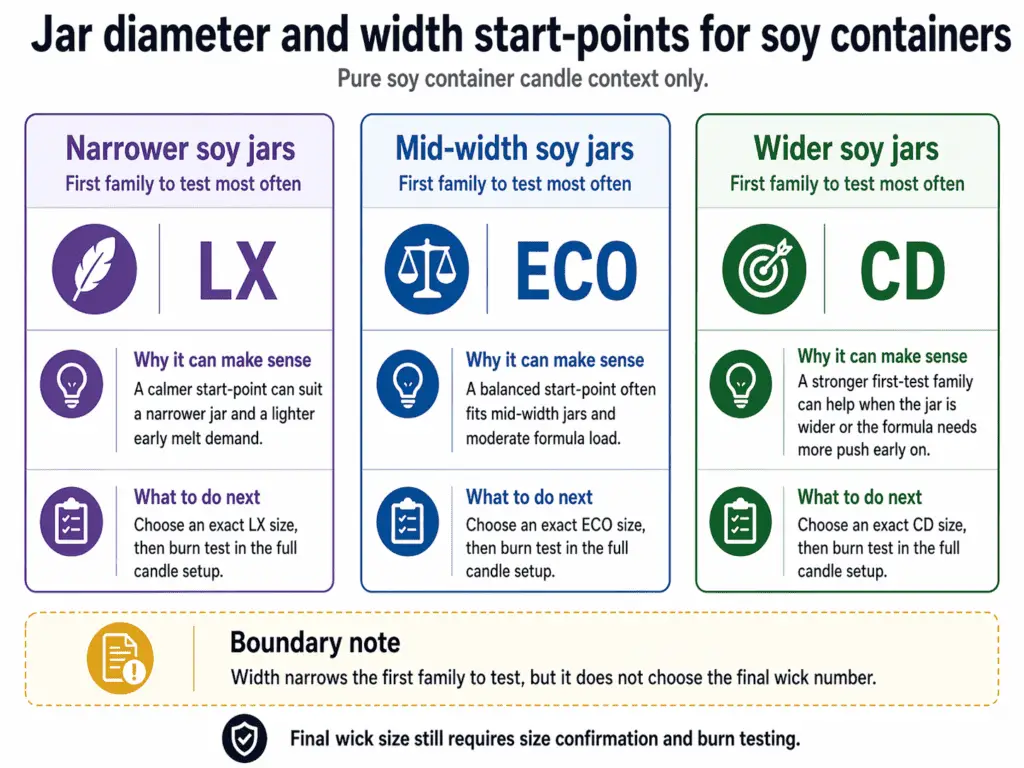
| Jar width band | First family to test first most often | Why it can make sense | What to do next |
|---|---|---|---|
| Narrower soy jars | LX first more often, with ECO as the next check | Narrower containers can justify a narrower first branch before a stronger push | Confirm with exact soy wick sizing once the family is chosen |
| Mid-width soy jars | ECO or CD more often | Middle widths often need the formula and burn goal to break the tie between a balanced start and a stronger start | Move to burn testing after choosing the family |
| Wider soy jars | CD first more often, with ECO still worth checking in some formulas | Wider containers can need a stronger first branch to meet higher melt demand | Compare the result with exact sizing after the family choice |
The same soy wax does not lock in the same first family across all jars. A narrow jar and a wide jar can point to different first tests before fragrance load changes.
Treat width as the first filter, not the last answer. After width narrows the family, formula load and burn behavior still have to confirm that choice.
Why fragrance load and additives can shift the right wick family
Formula changes can shift the better first-test family for a soy candle before any final size change is confirmed.
Here, the right wick family means the family most worth retesting first after the formula changes, not the final approved wick size. The same jar can need a different first-family test after fragrance load rises or additives change how the soy formula burns.
That is why family choice should be checked again before you assume the fix is to size up. Use full troubleshooting for diagnosis, and use wick sizing and burn testing only after the family branch is retested.
A practical way to read formula shifts is below. These are family-level start moves, not chemistry rules and not final wick-number advice.
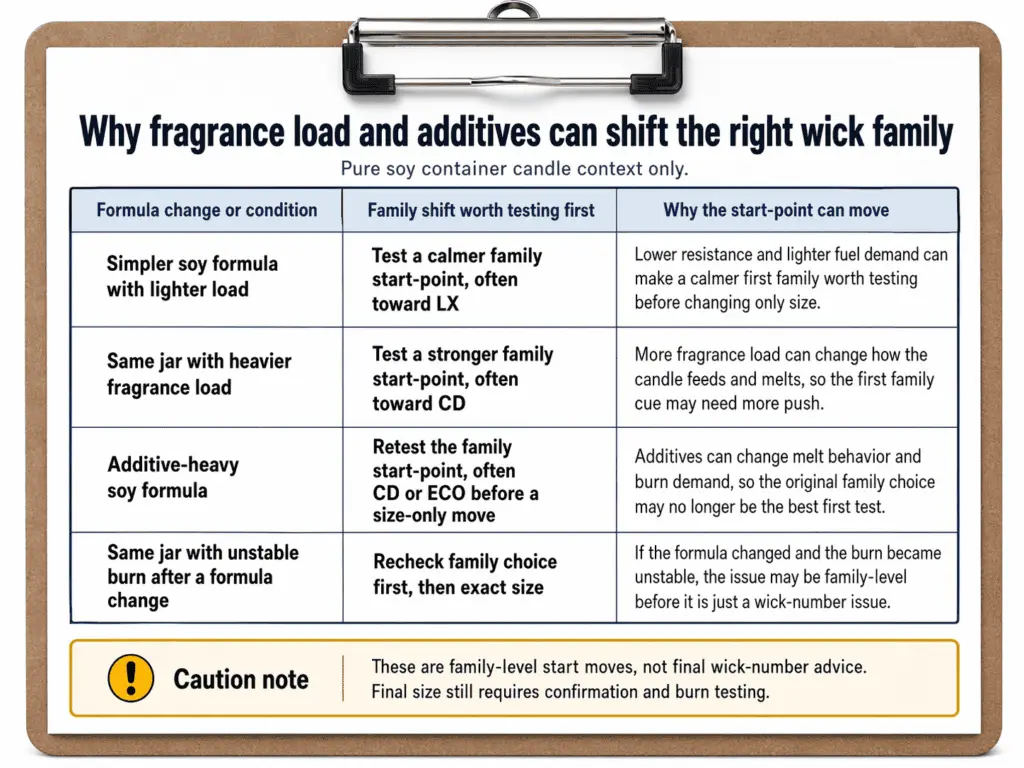
| Formula condition | Family shift worth testing first | Why the start-point can move |
|---|---|---|
| Simpler soy formula with lighter load | LX or ECO may stay first more often | Lower formula resistance can keep the first test on a narrower or middle branch |
| Same jar, heavier fragrance load | Recheck CD earlier than before | More load can push the first test toward a stronger family branch |
| Additive-heavy soy formula | Recheck CD, ECO, and LX at family level, with CD checked earlier if the candle now burns slower | Additives can change family fit before they change size |
| Same jar, unstable burn after a formula change | Reconsider family before a simple size increase or decrease | A formula shift can change family fit, not just wick size |
The main mistake here is treating a formula change as a sizing-only problem. When a jar that used to behave well changes after a fragrance or additive change, retest family fit first, narrow the choice if needed, and only then confirm size.
This page stops at the family decision on purpose. Fragrance safety, additive chemistry, and full fix paths sit on sibling pages because the job here is to show why the same soy jar can change families before it changes sizes.
After width and formula narrow the field, burn behavior becomes the clearest signal for which family to test first.
Burn-behavior trade-offs that change the first family to test
Burn behavior should guide the first wick family to test, but it does not replace full troubleshooting.
In pure soy container candles, burn signals are useful here only as family-selection clues. They help you decide whether CD, ECO, or LX deserves the next first test, but they do not prove a universal winner and they do not replace jar-width or formula checks.
Use the table below as a signal-reading tool, not as a full fix sequence. The point is to read what the candle is asking for at family level before you jump to a bigger or smaller wick number.
| Burn signal in pure soy | What it can mean at family level | Family branch worth testing first next | When the signal should leave this page |
|---|---|---|---|
| Melt pool is too slow to form | The current family may be too weak a start for this jar or formula | Recheck CD first more often | Use tunneling troubleshooting when you need a full fix path |
| Flame looks steady but the candle still feels underpowered | The current family may still be too soft for this setup | Recheck CD or ECO, depending on width and load | Move to wick sizing and burn testing if the family looks right but the number still does not |
| Flame feels more active than needed for the burn goal | The current family may be stronger than this setup needs | Recheck ECO or LX first, depending on width and formula | Leave for exact sizing only after the family question is settled |
| Repeated cap buildup or soot starts showing | The current family may be pushing harder than the burn goal allows, but one symptom is not a final verdict | Recheck ECO or LX before ruling out CD everywhere | Use mushrooming or soot troubleshooting when the issue needs full diagnosis |
| One symptom appears after a formula change | The same jar may now prefer a different family start | Recheck family before changing size again | Route to wick sizing and burn testing only after the family branch is retested |
A few wrong turns show up often when makers read burn signals. The first is treating one symptom as proof that a whole family is wrong. The second is using symptom pages as family-comparison pages, even though those pages are meant to solve the fault itself rather than decide the first family to test.
Read the signals in order: width first, formula second, burn behavior third. When burn behavior disagrees with the family you expected, use that mismatch as a reason to recheck the family choice before exact sizing.
How to read the signals: compare the same jar and formula across first tests, not across different candles. Watch for melt-pool speed, flame steadiness, and cap buildup as pattern signals rather than one-burn verdicts. If the family now looks right but the result is still off, the next stop is wick sizing and burn testing rather than a broader family comparison.
This page compares first-test wick families for pure soy container candles; soy blends can shift the decision logic and belong on a separate blend-focused page.