
Hot weather changes wax choice faster than many beginners expect. A wax that works in a warm apartment can still be a poor fit for outdoor display, gift presentation, or summer delivery. The safest shortlist depends on heat exposure, candle format, scent goals, and how much appearance matters after cooling. Start with the wax families that stay firmer in heat, then narrow the choice by shipping risk and actual use case.
Best candle wax types for hot climates and summer shipping
Beeswax, paraffin, and firmer blends usually handle hot climates and summer shipping better than softer container-first waxes, but the best fit still depends on format.
Start with Candle Wax Types as a shortlist, not as a hunt for one perfect wax. In hot weather, the best answer changes with jar versus pillar use, scent goals, and whether the candle stays indoors or faces delivery heat. Soy Wax vs Beeswax vs Paraffin: Which Is Best? becomes a summer question about shape retention, sweating risk, and transit survival rather than a simple natural-versus-performance debate.
| Wax family | Heat handling | Best fit in summer | Main caution |
|---|---|---|---|
| Beeswax | Usually firmer in heat | Pillars, decorative shapes, hotter rooms, harder-to-control shipping | May not be the first choice when jar appearance or other formula goals lead the decision |
| Firmer paraffin | Usually holds shape well | Outdoor display, pillars, shipment-exposed candles | Still needs format and scent-load screening |
| Firmer blends | Balanced middle lane | Jars and some shipping scenarios where appearance and stability both matter | Performance still changes with the blend and the exposure pattern |
| Softer container soy | More conditional in heat | Protected indoor jars with lower heat exposure | Weaker first pick for porch delay, outdoor selling, or unsupported shapes |
A practical shortlist looks like this:
- Beeswax usually suits hotter rooms, firmer shapes, and stronger heat tolerance.
- Paraffin, especially firmer styles, usually keeps shape better than softer container waxes.
- Firmer blends often give the most balanced middle ground when appearance and shipping both matter.
- Soft container soy waxes can still work for protected indoor jars, but they are a weaker first pick for porch delay or outdoor selling.
Use How to Choose the Right Wax for Your Candles after that first shortlist, because wax family alone does not decide the winner. Then Best Wax for Pillar Candles vs Container Candles becomes the format check that stops a jar-friendly wax from being treated like a pillar or display wax.
Use melt point and softening range as the first heat filter
Use melt point, the temperature where wax fully liquefies, and softening range, the earlier band where shape starts to give, as the first summer screen.
Published melt-point bands often place softer container waxes lower than firmer soy, paraffin, or beeswax options. That difference helps reject weak summer fits before deeper testing. A wax can slump, dent, or lean before it reaches full melt, so early softening matters as much as the headline number.
A fast first-pass screen works like this:
- Lower-melt container waxes are more likely to soften first in hot rooms, sunny stalls, and delayed deliveries.
- Higher-melt or firmer waxes usually stay in the running longer when the candle faces porch delay or outdoor display.
- Jar candles can tolerate more softness than pillars, wax melts, and decorative shapes.
- A published melt point is a start, not a guarantee, because candle shape and exposure pattern still change the outcome.
This screening logic follows supplier melt-point bands, supplier application notes, and common format guidance rather than one brand’s marketing label. It is a sorting rule for shortlisting, not a promise that any wax will survive every summer condition.
Match wax firmness to shape retention needs
Firmer waxes usually keep shape better in heat, especially when the candle is not protected by a jar.
That matters most for pillars, melts, sculpted candles, and market display pieces. A soft wax can still look fine on a bench at home and then show dents, leaning, tackiness, or soft tops once the room warms up.
Visible shape-retention tradeoffs usually look like this:
- Jars hide some softness because the container supports the wax.
- Pillars need more firmness because the wax supports itself.
- Wax melts and decorative shapes show edge rounding and surface damage sooner.
- Display candles need firmer wax than private indoor-use candles because appearance matters the moment they warm.
Container adhesion is how well wax stays visually settled against the glass as temperatures rise and fall. That is why jar readers should treat heat tolerance first and appearance second.
Container adhesion is a tie-breaker for hot-weather jars. Once two jar waxes both clear the heat screen, the better choice is often the one that still looks cleaner after cooling.
For jar candles, the tie-break usually looks like this:
- One wax survives heat but shows stronger wet spots or pull-away after transit.
- Another survives the same trip and settles back with a cleaner glass line.
- That difference matters more for giftable candles than for personal use jars.
Warm transit can make cosmetic flaws show up faster, especially in clear glass. It does not always mean the wax is wrong, but it can decide which jar wax is easier to sell, photograph, or gift.
Choose the best wax for summer shipping and porch-delay risk
For summer shipping, choose waxes that resist softening, shape loss, and oil migration during transit and porch-delay exposure.
Shipping changes the answer because the candle may face a hot vehicle, a warm warehouse, and then still sit outside at delivery. Start from Candle Wax Types, but narrow the choice harder than you would for indoor-only use. How to Choose the Right Wax for Your Candles matters more here because transit stress punishes soft wax choices quickly.
A simple shipping sequence works best:
- Estimate the real exposure window, including transit heat and likely porch delay.
- Remove the softest waxes first if the candle is not staying in a protected indoor space.
- Match the remaining wax family to the candle format.
- Lower the scent ambition if the wax only stays stable when it is not pushed close to its limit.
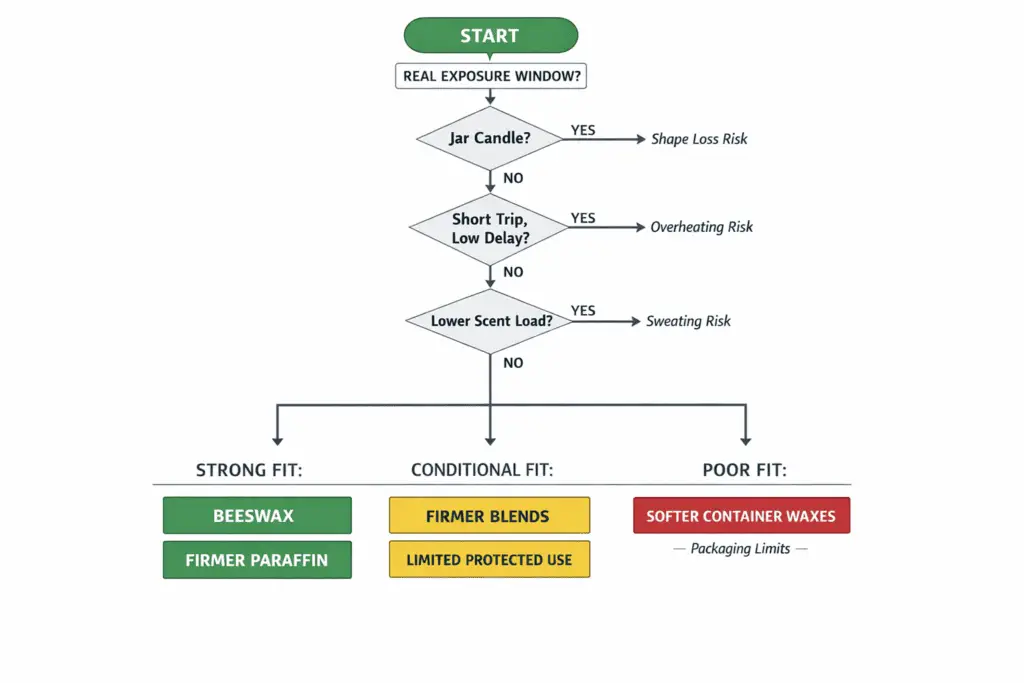
These shipping controls reduce avoidable heat stress:
- Ship early in the week when possible so weekend hold time does not add heat exposure.
- Use the fastest practical transit option when porch delay is likely.
- Add insulation or cold packs when the route regularly runs hot and the product can justify it.
- Use tracking and delivery timing to cut down porch delay where possible.
That is why How to Blend Different Candle Waxes becomes useful in summer. A firmer blend can solve a shipping problem that a soft single-family wax struggles to handle.
A common failure pattern looks like this:
- Soft container soy is chosen because it pours well and smells strong indoors.
- The candle survives the box trip but softens during final porch delay.
- The seller blames packaging alone.
- The real miss was a weak match between wax choice and heat exposure.
In maker forums, sellers often describe that exact pattern during heat spikes. Those reports help explain real-world stress points, but they are still seller reports rather than controlled lab testing.
Keep the shipping decision tight:
- Softer container waxes are a conditional fit for short, protected trips.
- Firmer blends are often the safer middle lane for summer orders.
- Beeswax and firmer paraffin styles usually give more shape security when heat exposure is hard to control.
- Packaging can reduce damage, but it does not turn a low-heat-tolerance wax into a high-heat-tolerance wax.
Use Best Wax for Strong Scent Throw as a secondary decision, not the first one, because a strong-smelling candle that deforms in delivery is still a poor shipping wax.
Balance fragrance load against sweating risk
Hot weather makes high fragrance loads less stable, so the best summer wax balances scent strength against sweating risk.
Fragrance load is the percentage of fragrance oil mixed into the wax. In warm storage or transit, a wax that smells stronger on paper can show oil migration sooner if the formula is pushed too hard.
The tradeoff is usually simple:
- Softer waxes pushed near their advertised fragrance limit are more likely to show surface sweat in heat.
- Firmer waxes and steadier blends usually give more room for summer stability, even if the scent feels less aggressive.
- A candle that looks clean after cooling may still have been too close to its limit for shipping use.
That is why Best Wax for Strong Scent Throw should stay a supporting decision. Strong throw is useful, but summer orders often need a cleaner balance between scent ambition and heat stability.
When sweating shows up, read it in context before treating it as total failure:
- Light surface sweat after a hot trip can be cosmetic.
- Repeated oil pooling, softness, and distorted tops suggest the formula is too ambitious for the scenario.
- A lower fragrance target is often a safer fix than forcing the same wax through hotter delivery conditions.
This tradeoff follows supplier application notes and fragrance-safety guidance in broad terms, not one universal fragrance cap for every wax family. Summer fit depends on the wax, the load, and the heat pattern together.
Separate cosmetic heat changes from real failure. A candle can look messy without being ruined, and it can also look almost normal while still being a poor choice for future summer orders.
A quick triage rule helps:
- Bloom or light surface change can stay cosmetic.
- Minor sweating can stay cosmetic if the candle cools cleanly and keeps shape.
- Soft tops, dents, leaning, and repeated oil movement point to a weaker summer fit.
- True deformation means the wax choice no longer matches the exposure pattern.
Match the wax to your summer use case
No single wax is best for every hot-weather scenario; indoor use, outdoor display, and summer shipping need different tradeoffs.
A wax that works in a warm apartment can still be the wrong pick for a market stall or a gift order left on a porch. The final choice should follow exposure pattern, candle format, and how important appearance stays after the candle cools.
Use this quick router:
- Hot apartment, jar candle, no shipping: a softer container wax can still work if appearance stays acceptable.
- Outdoor market, pillars or decorative shapes: move toward firmer waxes that hold shape better.
- Gift presentation in clear jars: favor waxes that stay cleaner against glass after warming and cooling.
- Summer shipping with porch delay: choose the firmer side of your shortlist first.
That is where How to Choose the Right Wax for Your Candles and How to Blend Different Candle Waxes overlap. One helps narrow the use case, and the other helps solve the gap between scent goals and summer durability.
When readers still land between two options, the best next move is to narrow the scenario instead of arguing over one “best” wax family. Scenario fit is not the same as universal superiority.
Summer Heat & Shipping Wax Fit Checker
Use this checker to match heat exposure, candle format, and shipping risk to a strong fit, conditional fit, or poor fit wax family.
This selector turns the advice from Best candle wax types for hot climates and summer shipping and Choose the best wax for summer shipping and porch-delay risk into one fast decision step. It works as a planning aid, not a promise, and it narrows the shortlist before you go back to Candle Wax Types or reread Match the wax to your summer use case for edge cases.
| Scenario | Format and heat pattern | Strong fit | Conditional fit | Poor fit |
|---|---|---|---|---|
| Warm apartment, personal-use jar | Jar candle, indoor heat, no shipping | Firmer blends or other jar-safe waxes that stay stable in warmth | Softer container-first waxes if appearance stays acceptable | Unsupported shape-first wax choices used only to chase firmness |
| Gift jar with appearance priority | Clear jar, warm transit, cooling and re-set matter | Firmer blends or cleaner-settling jar waxes | Medium-firm container waxes with lower presentation risk | Very soft container waxes that show pull-away, sweating, or messy glass lines after heat |
| Outdoor market pillar | Pillar, direct warmth, shape must hold | Beeswax or firmer paraffin styles | Firmer blends that still hold shape well | Softer container-first waxes |
| Decorative candle or wax melt display | Unsupported or detail-heavy shape in warm conditions | Beeswax, firmer paraffin, or firmer blends | Medium-firm blends with limited heat exposure | Softer container-first waxes used for edge detail or unsupported shapes |
| Short summer shipping | Jar candle, shorter route, lower porch-delay risk | Firmer blends or firmer paraffin styles | Some container waxes in protected jars | Softer container-first waxes shipped without much margin for heat |
| Long transit plus porch delay | Repeated summer exposure, delivery delay likely | Beeswax, firmer paraffin, or firmer blends | Medium-firm blends only when scent ambition and packaging risk stay controlled | Softer container-first waxes used as if porch delay does not matter |
Use this short verification sequence before you commit:
- Pick the row that matches the real candle format and the hottest likely exposure pattern.
- Test the shortlist in the final candle format instead of judging the wax only in a sample pour.
- Let the finished candle sit through a warm-room cycle or shipment-like condition before treating it as approved.
- Check for sweating, shape loss, leaning, soft tops, and messy glass appearance after the candle cools.
- If the candle only works when the scent load stays high and the heat stays low, move one lane firmer or lower the scent ambition.
Use one final rule before you commit: scenario fit is not the same as universal superiority. A wax that performs well in a warm apartment can still be the wrong choice for a gift candle, a market table, or a delivery route with repeated summer exposure. When the real problem is mostly packaging or fulfillment, return to the shipping logic first rather than changing wax blindly.