

A candle wick usually leans because placement, tab adhesion, cooling wax, drafts, or burn heat moved it off-center; fix a burning candle only after extinguishing it.
A candle wick is the strand that carries melted wax to the flame, and a leaning wick means that strand is tilted, bent, or sitting away from the candle’s intended centerline. The problem can start before the pour, appear after cooling, or show up only once the candle burns. It is different from mushrooming, tunneling, soot, flame flicker, wick drowning, or normal tip curl unless those issues move the wick body. The right fix depends on when the wick moved and whether the wax is soft, hardened, or already burning.
What a Leaning Candle Wick Means
A leaning candle wick is a wick whose body tilts, bends, or sits off-center instead of staying upright along the candle’s intended centerline.
The problem is about the wick’s physical position, not every flame or wax defect. If the wick body stays centered but the flame bends in moving air, the flame is leaning, not the wick.
A wick counts as leaning when the top angles to one side, the base is visibly off-center, the wick body curves toward the container wall, or the wick shifts after pouring, cooling, or burning. A small cosmetic lean is not always dangerous, but a wick or flame near glass deserves closer attention because heat can concentrate on one side of the container.
If the wick has a carbon ball at the tip, that is wick mushrooming, not a leaning-wick problem. If wax melts mostly down the center and leaves a wall of unmelted wax, that is candle tunneling. If only the flame bends while the wick body stays upright, that is usually flame flicker or airflow. If the real question is which wick diameter, braid, or thickness to use, that belongs under wick sizing rather than leaning-wick troubleshooting.
Leaning Wick vs Off-Center Wick vs Curled Wick
A leaning wick is angled, an off-center wick is misplaced from the container’s centerline, a curled wick bends at the burning tip, and flame lean is flame movement without wick-body movement.
| What you see | What it usually means | What to check first |
| Wick body tilts to one side | Leaning wick | Whether the base, top, or burn heat moved the wick |
| Wick stands upright but is not centered | Off-center wick | Whether the tab was placed away from the centerline |
| Wick tip curls during burning | Curled wick | Whether only the tip curled or the whole wick body shifted |
| Flame leans but wick stays upright | Flame lean | Drafts, air movement, or uneven melt-pool pull |
| Wick or flame moves close to glass | Higher-risk lean | Stop, extinguish, and assess before further burning |
Normal wick-tip curl can be harmless when the wick body stays centered and the flame remains stable. The concern rises when the whole wick body bends, the flame sits close to the container wall, or one side of the candle heats more than the other.
Diagnose the Cause by When the Wick Started Leaning
The timing of the wick lean is the fastest clue: before pouring, after cooling, and after the first burn point to different causes.
If it started before or during the pour, suspect placement, tab adhesion, top support, or pour disturbance. If it appeared after cooling, suspect wick movement while the wax firmed. If it started while the candle burns, suspect heat, wick curl, airflow, melt-pool pull, or an earlier placement error.
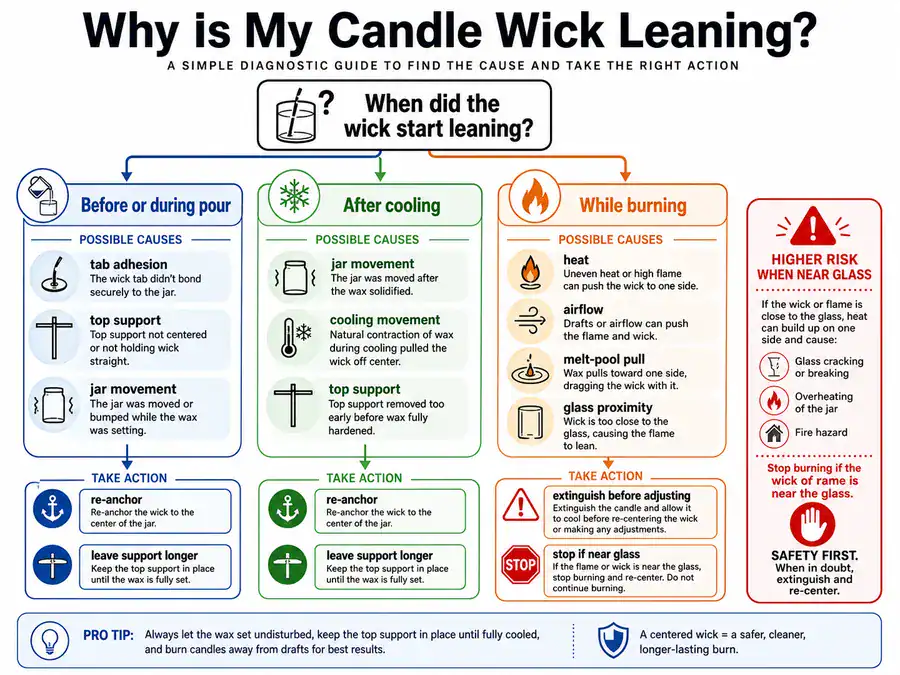
| When the wick started leaning | Likely cause | What to check | Next action |
| Before or during the pour | Off-center tab, weak sticker, loose support, tight holder, pour stream movement | Look at the tab position and whether the top holder pulled the wick sideways | Re-anchor, re-center, reduce top tension, and pour gently |
| Centered after pouring but leaning after cooling | Support removed too early, jar moved, wax shifted, tab adhesion weakened | Compare the wick position right after pouring with the position after the wax firmed | Keep the jar still and leave support in place longer |
| After the first burn | Wick curl, heat softening, airflow, melt-pool pull, earlier off-center placement | Check whether the wick body moved or only the flame bent | Extinguish before adjusting and watch glass proximity |
| Wick or flame close to glass | Severe off-center placement or burn-stage movement | Feel for uneven container heating only after safe cooling | Stop burning if heat concentrates near one side |
Use a simple timing note when the problem repeats in a batch: record whether the wick was centered before wax, centered after pour, centered after firming, and centered after the first burn. The same visible lean can come from different stages, so the final position alone does not prove the cause.
If the Wick Leaned Before or During the Pour
A wick often leans before or during the pour because the base was not anchored firmly or the top was not held straight.
The wick tab may have been placed slightly off-center, the wick sticker or glue dot may have lifted, or the holder may have pulled the wick toward one side. A wick can also drift if the pour stream hits it directly or the container moves during filling. Check the base first, then the top angle, then the tension from the holder.
A holder should keep the wick upright without dragging it off the centerline. Too much tension can pull the tab loose, while too little tension lets the wick float or bow as wax fills the jar. If the concern turns into “which wick should I use,” that is wick sizing, not the main cause of a wick that was physically pulled or placed off-center. If a wood wick rocks in its metal base, check wood wick clip size rather than changing every part of the candle.
If the Wick Was Centered First but Leaned After Cooling
A centered wick can lean after cooling when it moves before firm wax locks the base and upper wick in place.
Cooling here means the period when wax changes from fluid to firm enough to hold the wick, not the full cure period. The wick holder may have been removed too early, the jar may have been bumped or rotated, or warm wax may have softened weak tab adhesion. Wax movement can expose a loose wick path, but do not blame wax type unless the wick visibly moved while the candle set.
The easiest check is a two-point comparison: note the wick position immediately after pouring, then check it again once the surface is firm. If it was straight at first and crooked later, focus on jar stability, support timing, and tab adhesion rather than unrelated wax defects.
If the Wick Starts Leaning While the Candle Burns
A burn-stage lean means the wick body changes angle after lighting, not just that the flame bends in moving air.
Heat can soften the wick, the tip can curl, the melt pool can expose one side unevenly, or a draft can make the flame pull in one direction. Extinguish the candle before touching or straightening the wick. Do not push, pull, or re-center a wick while the candle is lit.
If only the flame moves and the wick body stays upright, treat the symptom as flame flicker or airflow. If the wick body leans toward glass, the burn looks unstable, or one side of the container heats more than the other, stop burning and let the candle cool before deciding whether it can be corrected. For sale or gift candles, a visual correction is not the same as candle testing; the candle still needs to burn safely and predictably.
Move to fix a leaning wick safely only after you know whether the lean came from placement, cooling movement, or burn-stage behavior.
How to Fix a Leaning Candle Wick Safely
Fix a leaning candle wick based on its state: soft wax, hardened wax, actively burning, or too close to the glass.
If the candle is lit, extinguish it first and let the wax and container cool before touching the wick. “Safe” means extinguish-first, heat-aware, and glass-proximity-aware, not simply pushing the wick back into place.
| Candle state | Visible risk | Safe next action | When to stop, remake, or reject |
| Unlit, wax still soft | Wick is slightly tilted or off-center | Gently re-center with a clean tool and hold it upright until the wax firms | remake a candle if the tab has detached or the wick will not stay centered |
| Unlit, wax hardened | Wick is only slightly off-center | Trim the wick correctly and monitor the next burn | Remake or repurpose if the wick is severely off-center |
| Actively burning | Wick body is leaning | Extinguish first, let wax cool, then assess | Stop burning if the wick or flame is close to glass |
| Wick near glass | Heat gathers near one container wall | Stop burning and do not leave it unattended | Reject or remake if burn behavior is unstable |
| Seller or gift candle | Visual lean or uncertain burn result | Treat it as a candle quality control issue | Do not sell or gift based only on visual re-centering |
Use the table as a practical decision aid, not as proof that a candle is safe for sale. It separates low-risk correction from situations that need testing, rejection, or a remake.
Follow these steps in order:
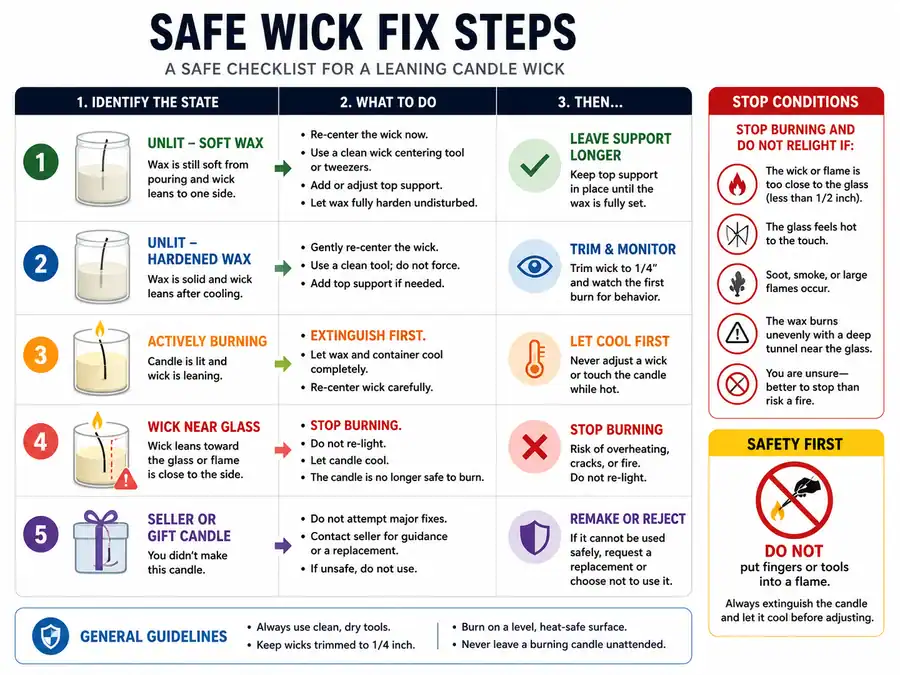
- Identify whether the candle is unlit, soft, hardened, or burning.
- Extinguish the candle first if it is lit.
- Check whether the wick body is leaning or only the flame is moving.
- Check whether the wick or flame is close to the glass.
- If wax is soft, re-center gently with a clean tool.
- If wax is hardened, trim and monitor only when the lean is minor.
- If the wick is close to glass or the burn looks unstable, stop burning.
- If the candle is for selling or gifting, use candle testing before deciding it is acceptable.
Do not put fingers or tools into a flame. Do not pull a hot wick through melted wax while the candle is burning. Do not treat a visually straightened wick as proof that the candle will burn evenly.
When to Stop Burning, Remake, or Reject the Candle
A leaning wick becomes a real problem when it moves flame or heat toward the container wall, causes uneven burning, or fails maker quality checks.
A small cosmetic lean can be acceptable when the wick stays away from glass, the flame is stable, and the melt pool does not pull hard to one side. Stop burning when the wick or flame sits close to glass, one side of the container heats more than the rest, or the flame becomes unstable because of wick position.
| Decision | Use this when | What it means |
| Continue with caution | The lean is small, the wick is away from glass, and the flame is stable | Watch the next burn and keep the wick trimmed |
| Fix before use | The candle is unlit, the wax is still soft, and the wick can be re-centered | Re-center and support the wick before lighting |
| Stop burning | The wick or flame nears glass, heat gathers on one side, or the burn becomes unstable | Let the candle cool and reassess before reuse |
| Remake or reject | The wick is severely off-center, the tab is loose, or seller testing has not passed | Treat it as a failed placement or QC issue |
For personal use, candle safety comes before saving the candle. For seller or gift candles, visual repair is not enough because a straight-looking wick can still burn unevenly if the base is misplaced or the candle has not been checked under real burn conditions. If the issue is only excess carbon at the wick tip, diagnose wick mushrooming separately instead of remaking the candle for the wrong reason.
Prevention starts with holding the wick straight before the wax has a chance to lock the lean in place.
How to Prevent Wick Leaning Next Time
Prevent wick leaning by anchoring the tab firmly, supporting the wick top without over-tensioning, and leaving support in place until the wax firms.
The goal is not to buy the “best” tool; the goal is to match the support function to the failure point. A tab problem needs base adhesion, a top lean needs a holder, and cooling movement needs a stable container setup.
| Failure point | Tool or function | Setup caution | What not to overdo |
| Wick tab slides | wick sticker, glue dot, or tab adhesive | Press onto a clean, dry jar base | Do not rely on weak adhesion in dusty or oily containers |
| Wick top leans | wick bar, bow-tie clip, clothespin, or skewer | Keep the wick centered across the opening | Do not pull so tightly that the tab lifts |
| Wick bows during pouring | Top holder plus gentle pour control | Pour steadily without hitting the wick directly | Do not force the wick against one side of the holder |
| Wick moves while cooling | Stable tray, level surface, and undisturbed jar | Leave the support in place until wax is firm | Do not move jars before the wick is locked in place |
| Wood wick shifts | Clip support and straight seating | Make sure the wick sits fully in the metal clip | Do not turn this into a full wood wick clip support comparison |
This table ranks functions, not products. It is based on the failure point the maker can see: base slip, top lean, pour movement, cooling disturbance, or wood-wick seating.
Before pouring, check the wick from above and from the side. From above, the tab should sit near the center of the container base. From the side, the wick should stand upright without being pulled tight enough to lift the tab.
After pouring, keep the container still and leave the holder in place while the wax firms. Removing support too early can let a centered wick drift after the surface looks calm. If the problem repeats across a batch, note whether the lean appears at the tab, the upper wick, or only after cooling.
Does Wick Type Make Leaning More Likely?
Wick type can affect leaning when material, braid, core, memory, or clip support changes how straight the wick stays.
A cotton wick may curl at the burning tip without the whole wick becoming off-center. A cored wick may hold position better, but a “strong” wick here means positional stability, not a stronger flame. A wood wick can lean if it is not seated firmly in its clip, even when the wick itself is not the wrong size.
Do not treat every leaning wick as a wick sizing problem. Size matters when the wick is wrong for the candle diameter or wax blend, but leaning usually starts with placement, support, cooling movement, burn heat, or clip seating. If the real question is which wick type belongs in a container, use Wick Types and Sizing instead of expanding the leaning-wick fix into a full selection chart.
Use a prevention note for each batch: base centered, top supported, jar undisturbed, first burn watched, and wick type checked only if the same lean repeats after placement and cooling are controlled.